The Current War, an epic detailing the battle for electrical power in the 19th century, was supposed hit theaters in the fall of 2017. But its distributor was the Harvey Weinstein Company and its release date was delayed by more important matters.
The film depicts the technological and financial war between Thomas Edison (played by Benedict Cumberbatch) and George Westinghouse (Michael Shannon) to power the United States with electricity — Edison championing direct current (DC) while Westinghouse promoted alternating current (AC).
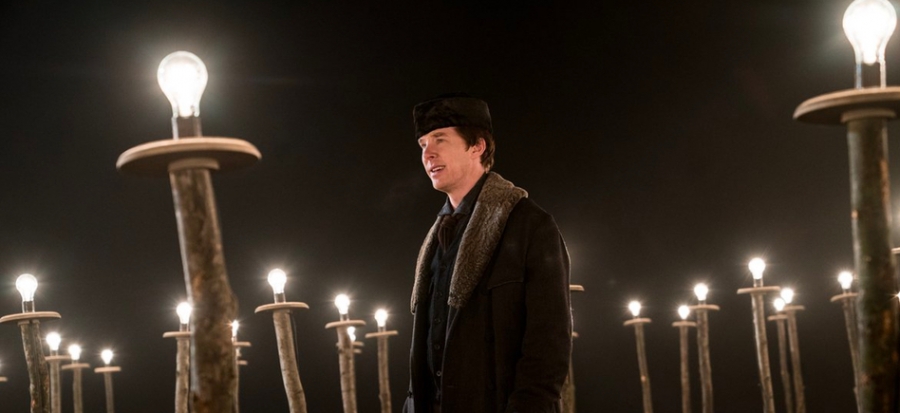
Edison (Benedict Cumberbatch) lights up Menlo Park / Lantern Entertaiment
The film is a bonanza for history lovers — and a bit of a bust for regular film goes and probably an offense to fans of real science on the screen. Gomez-Rejon presents a series of sumptuous, even breathtaking historical recreations — from Menlo Park to Niagara Falls — with a sharp visual style.
Many scenes reminded me of Steven Soderbergh’s The Knick; at its most ambitious, it was Eduard Muybridge by-way-of Brian DePalma.
The Current War gives us images we’ve rarely seen in cinema before — the lighting of lower Manhattan via the Pearl Street Station, the hauntingly lit grounds of Menlo Park, the triumph of the Chicago World’s Fair. (Obviously, at the Ferris Wheel, I gasped aloud.)
Westinghouse (Michael Shannon) in the corridors of Pittsburgh high society / Lantern Entertaiment
The film is so busy checking off the boxes of actual history that it sometimes forgets to make its principal characters interesting. To be fair, there’s so much going on. But Cumberbatch’s Edison hangs from bullet points about Edison’s life that never feel like they add up to the actual man. Shannon provides Westinghouse with more contemplation and carriage.
Tom Holland‘s hanging around too as Edison’s young assistant Samuel Insull. Comic book movie fans, if you’re keeping track — that’s Spider-Man, Dr. Strange, the Beast and General Zod in one movie.
The film’s fatal flaw is its failure to adequately visualize the core conflict — the battle of direct current vs alternating current. You know, the war of The Current War.
If you didn’t know what distinguished these two forms of electrical delivery before the film, it’s doubtful you’ll understand them afterwards. Scientific concepts can be difficult to translate onto film — finance shares the same problem — but the movie doesn’t really try.
Okay, but after all that — history buffs, please seek out this film! The worlds it creates are ravishing, often thrilling. The sense of gaslit rooms, the wonder of Victorian decor drenched in electric light. THE FERRIS WHEEL.
We have spoken about this subject many times on our podcasts. In fact, you can stitch the film’s screenplay together from listening to these past episodes of the Bowery Boys and The First:
PODCAST Welcome to the unlucky 13th Annual Bowery Boys ghost stories podcast, where history combines with folklore for a bone-chilling listening experience.
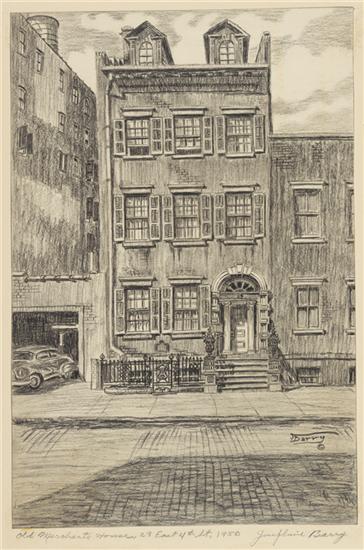
In this year’s Halloween-themed special, Greg and Tom take you into some truly haunted private residences from throughout New York City history. These rowhouses, brownstones and mansion all have one thing in common — stories of restless spirits who refuse to leave.
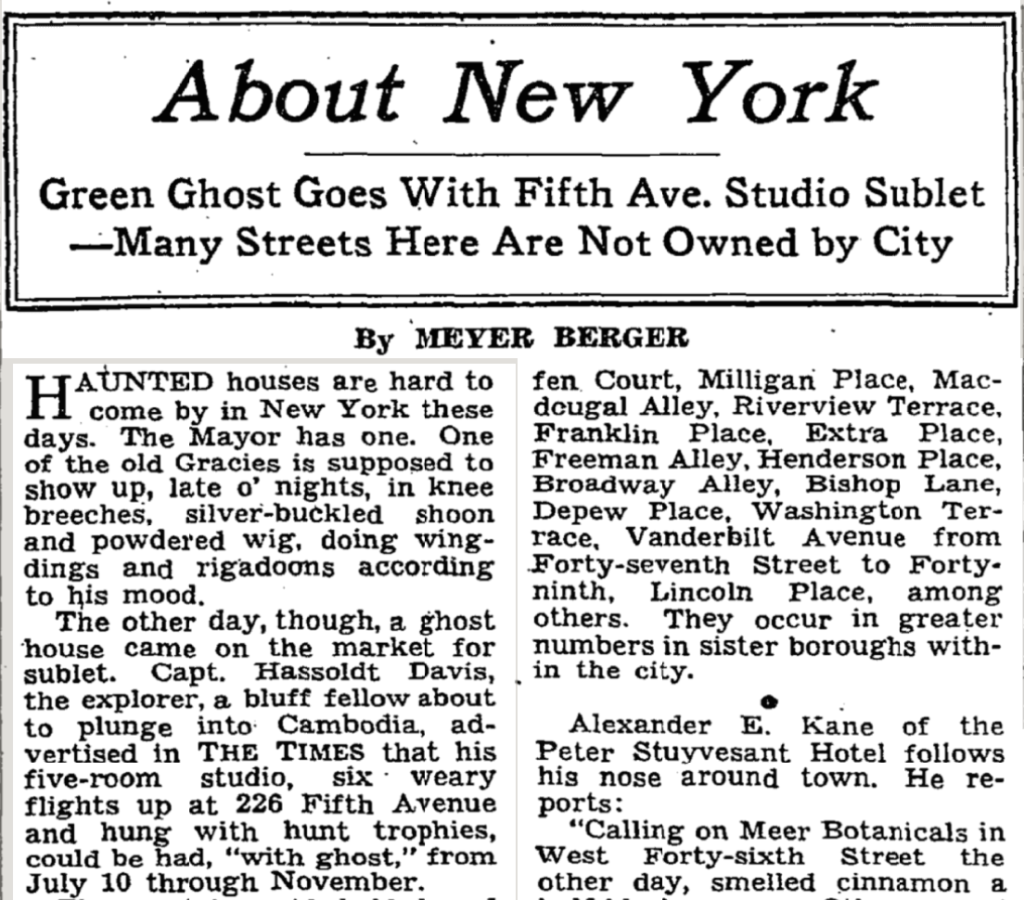
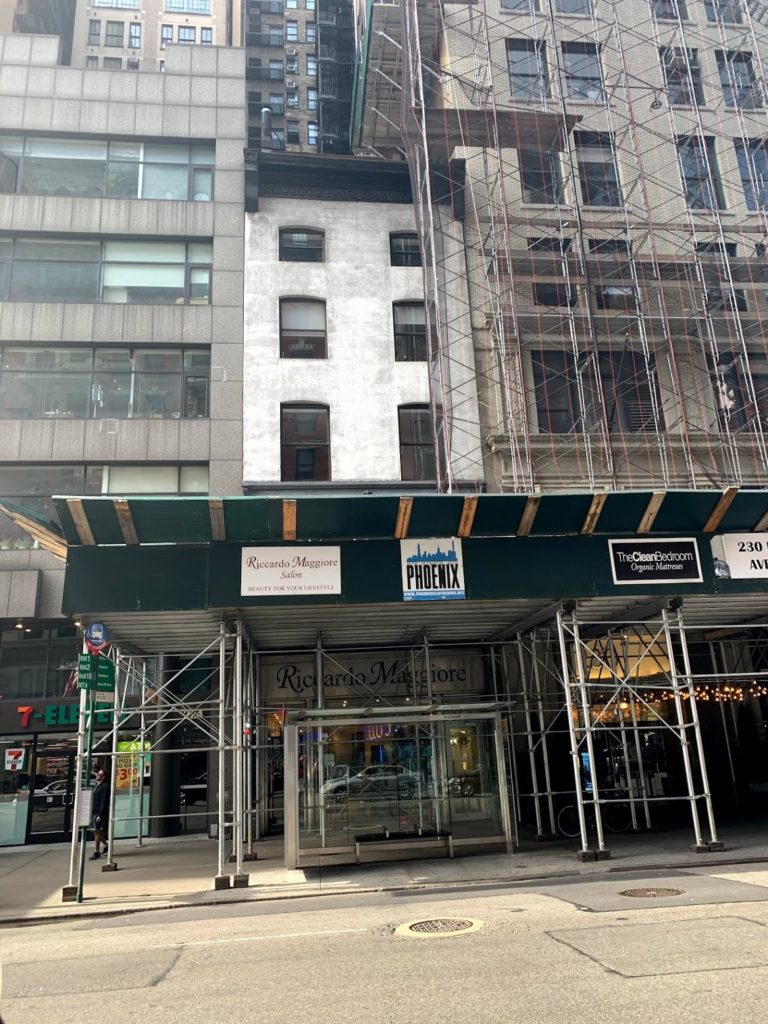
— Near Madison Square Park, an eccentric writer posts a classified ad, hoping to rent out an attic room to a prospective subletter. Unfortunately the room already an occupant — a greenish ghost with a troubling Civil War history.
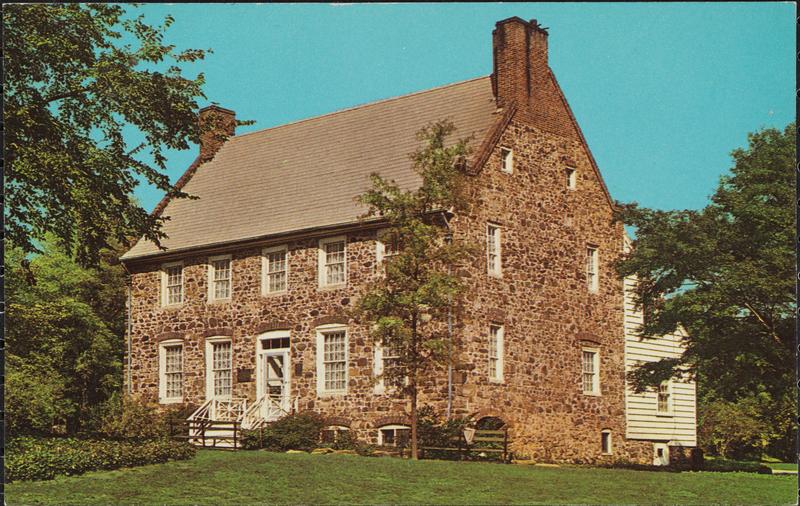
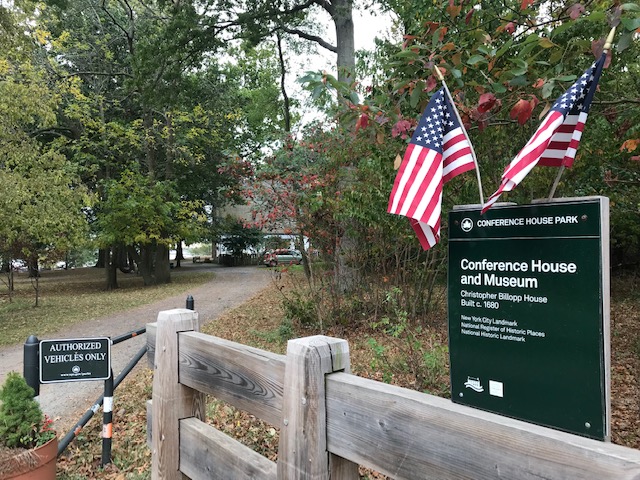
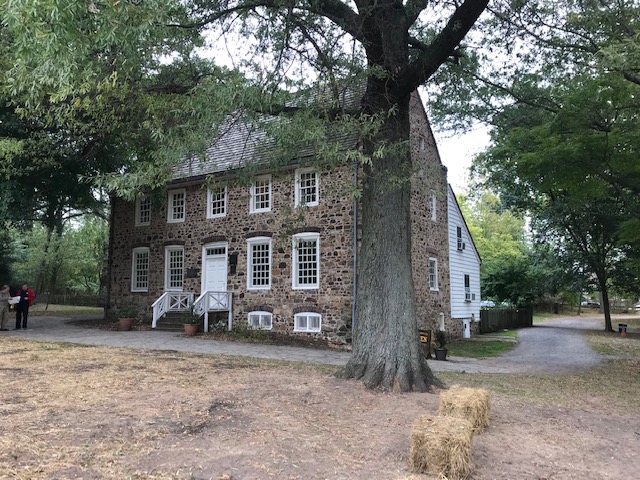
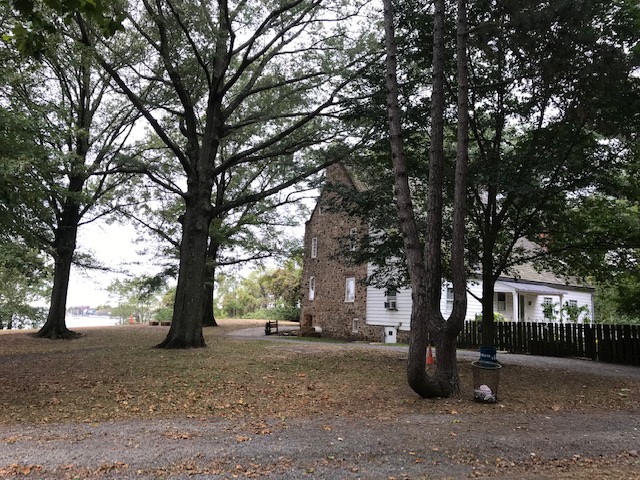
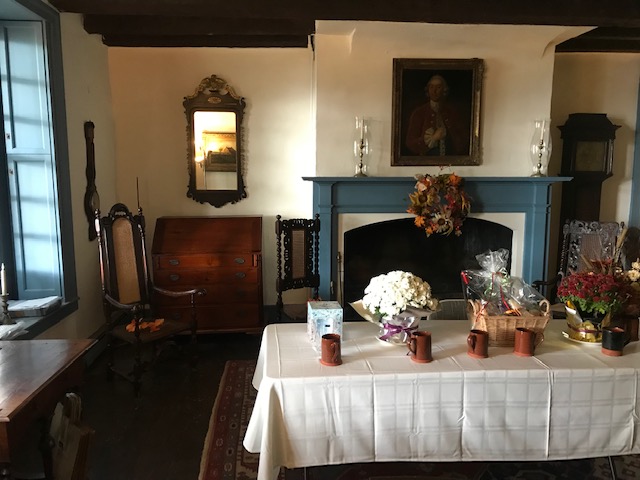
— The Conference House in Staten Island played an interesting role in the Revolutionary War, and some residents from that period may still wander its ancient hallways.
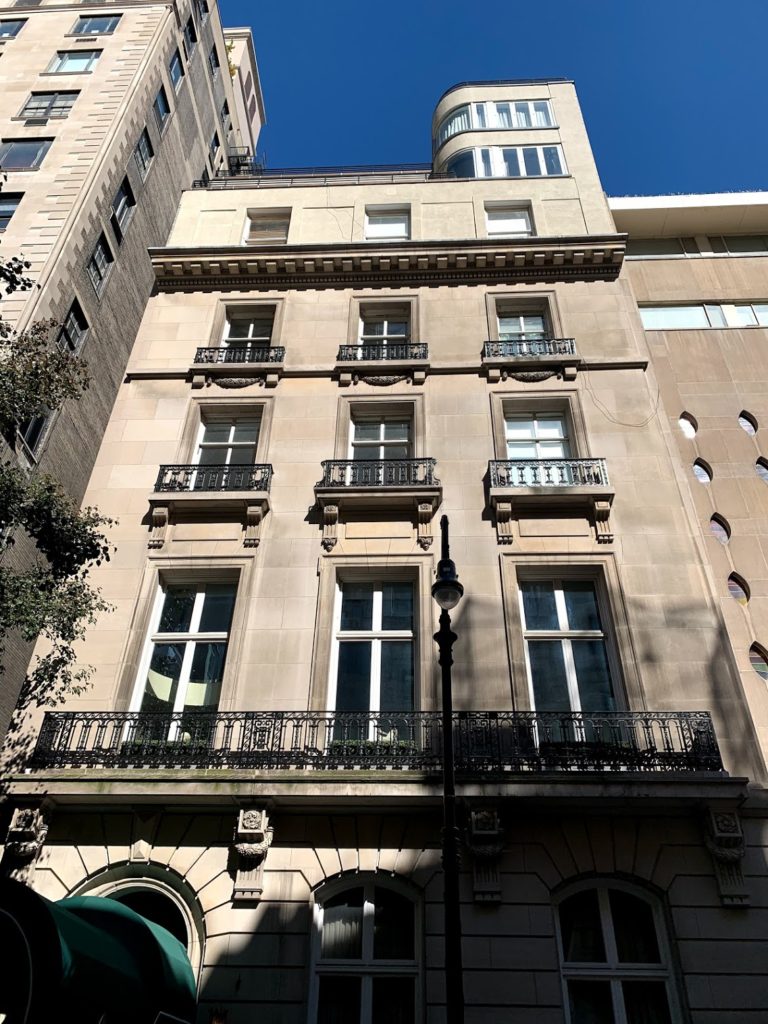
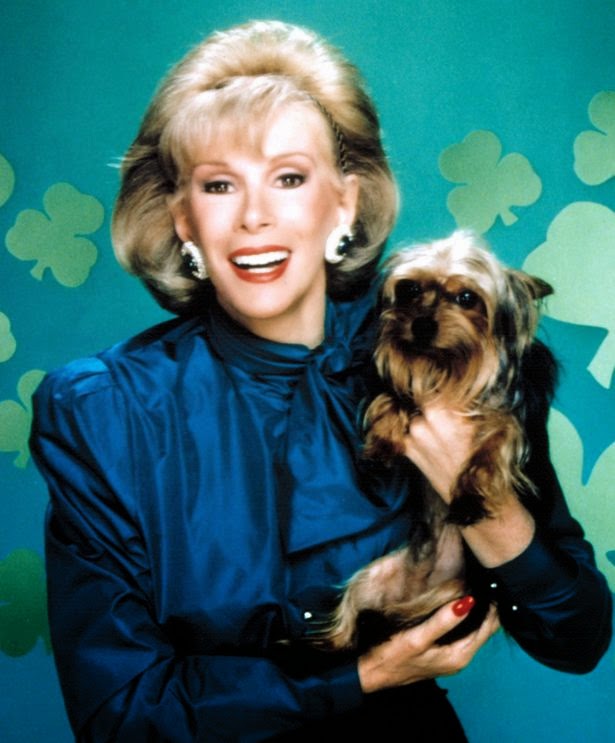
— On the Upper East Side, a lavish penthouse ballroom may be permanently vexed with the ghost of a testy spirit named Mrs. Spencer. Can a legendary funny lady and a Vodou priestess manage to keep the ghoul under control?
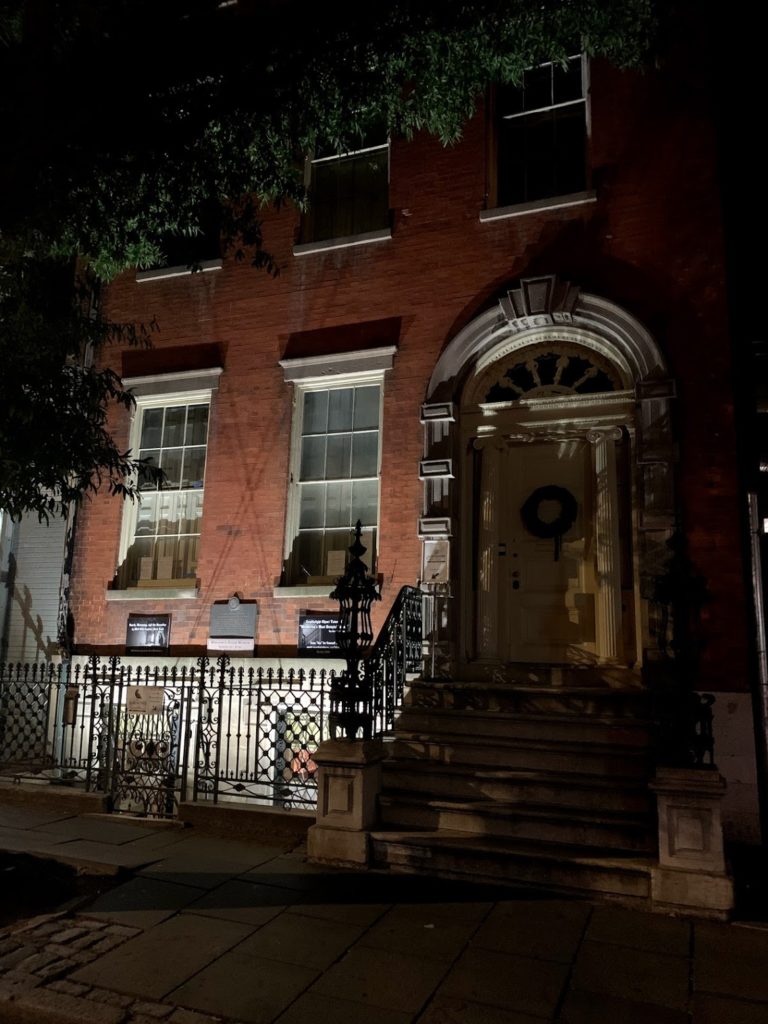
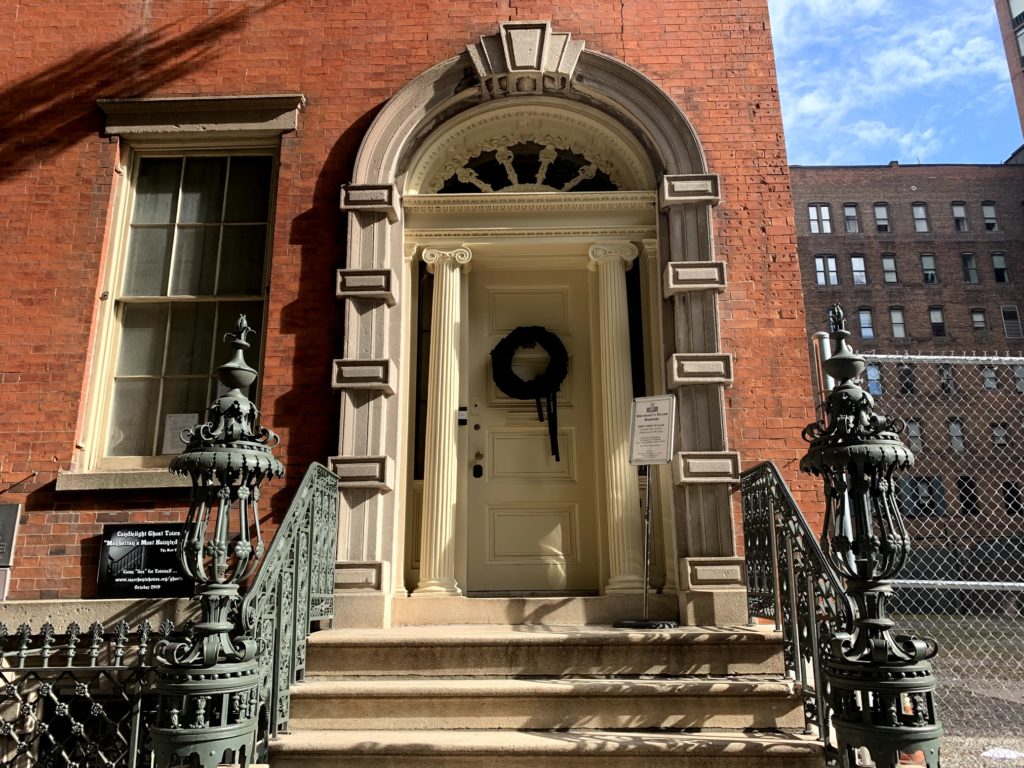
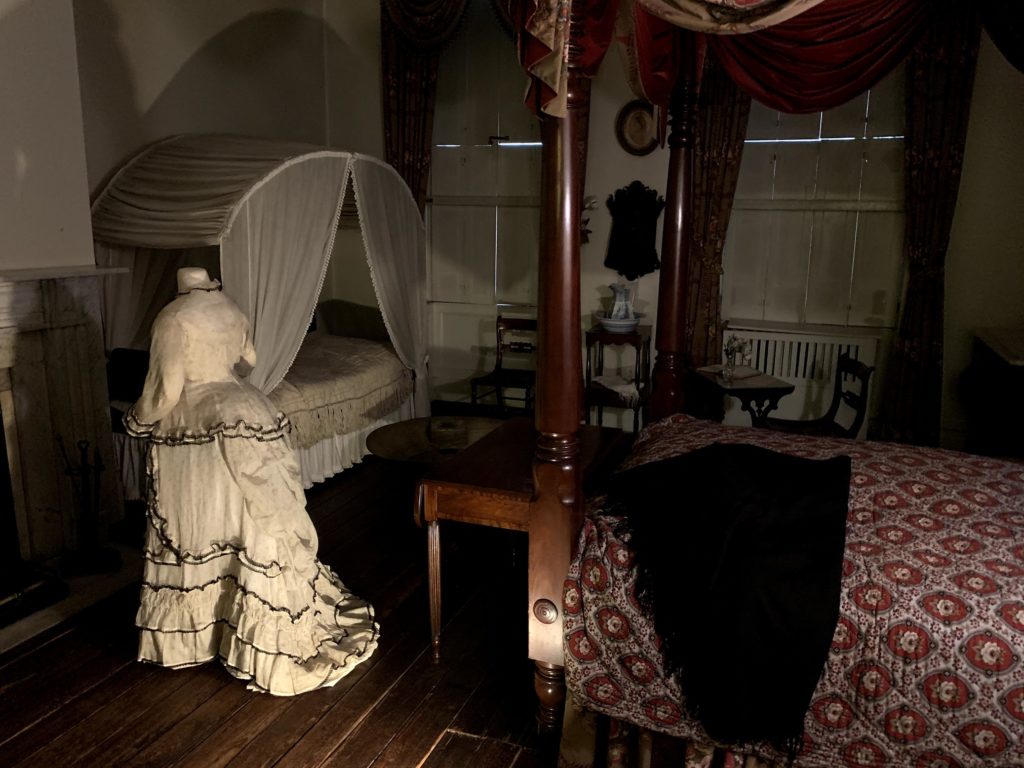
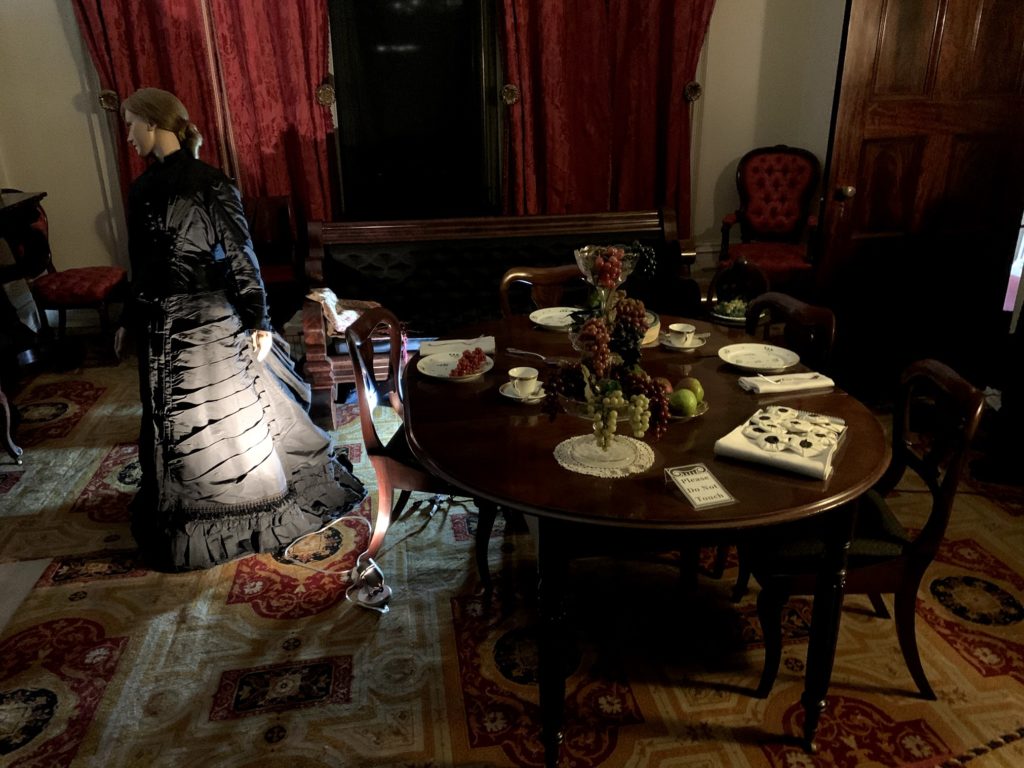
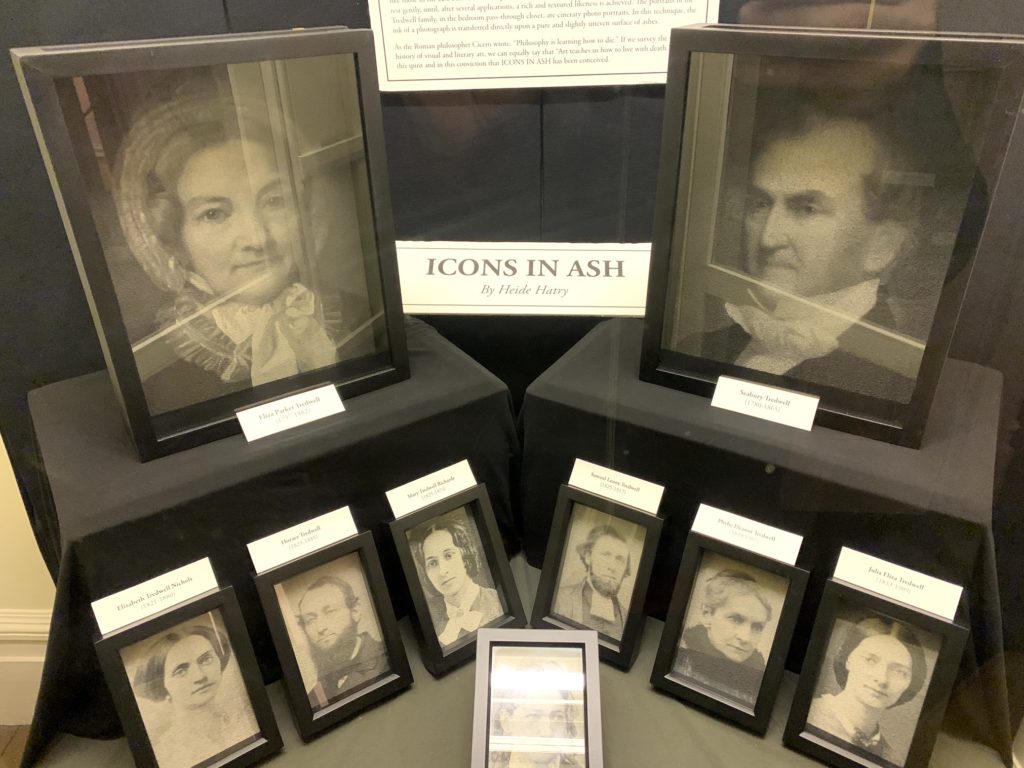
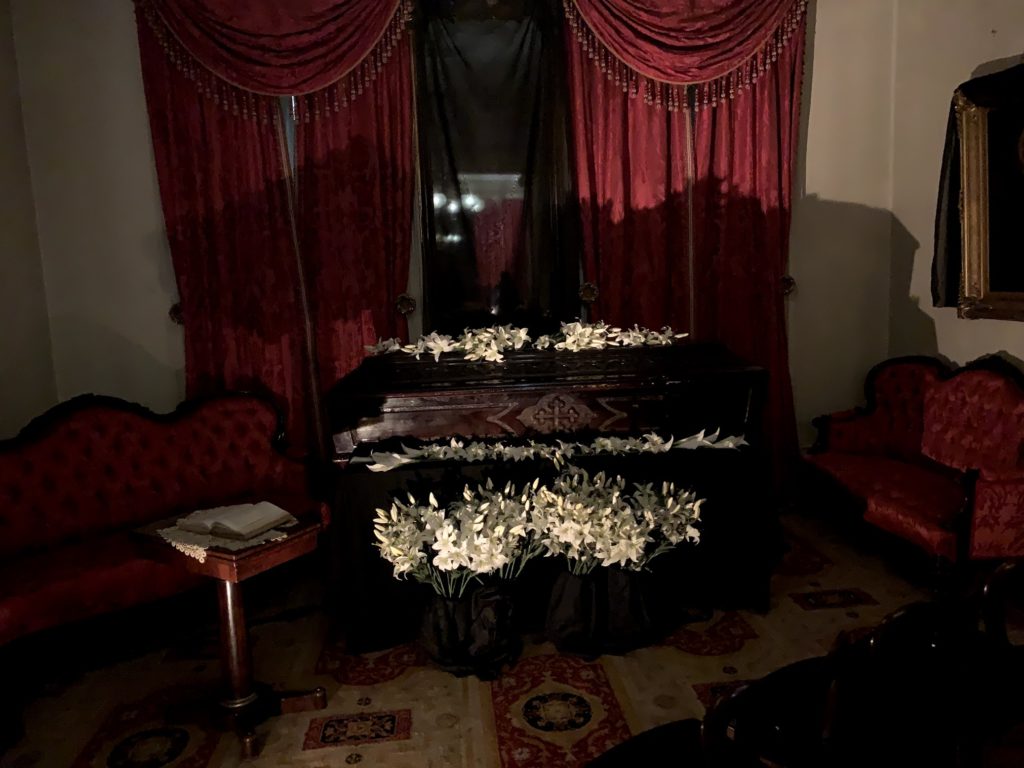
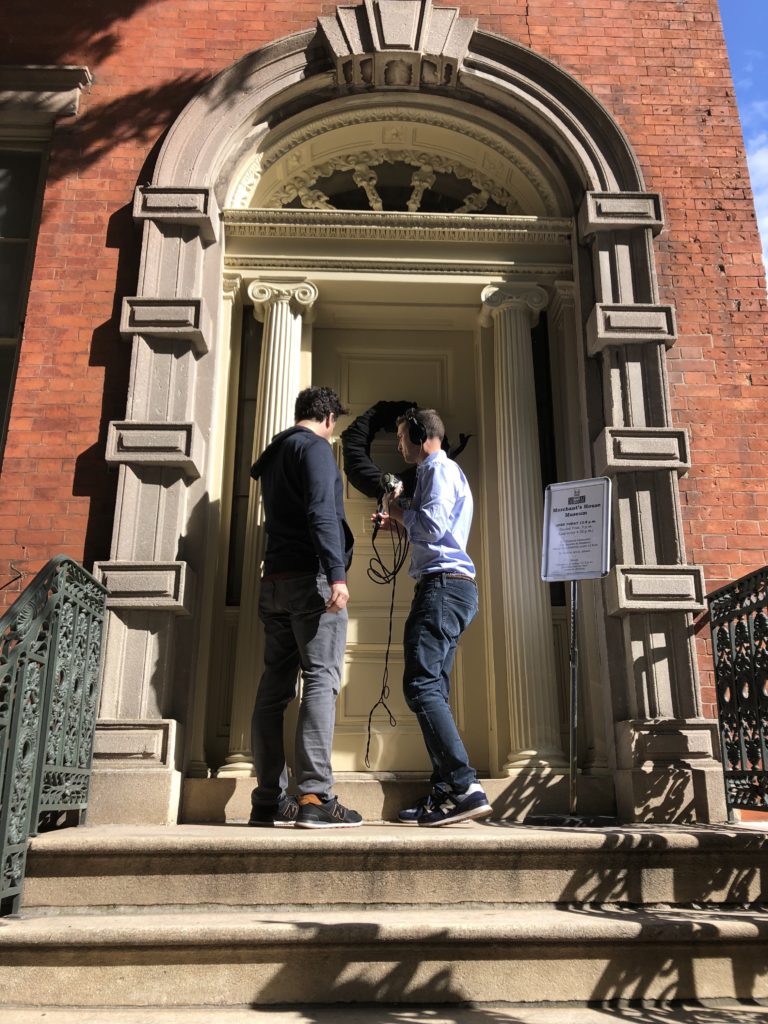
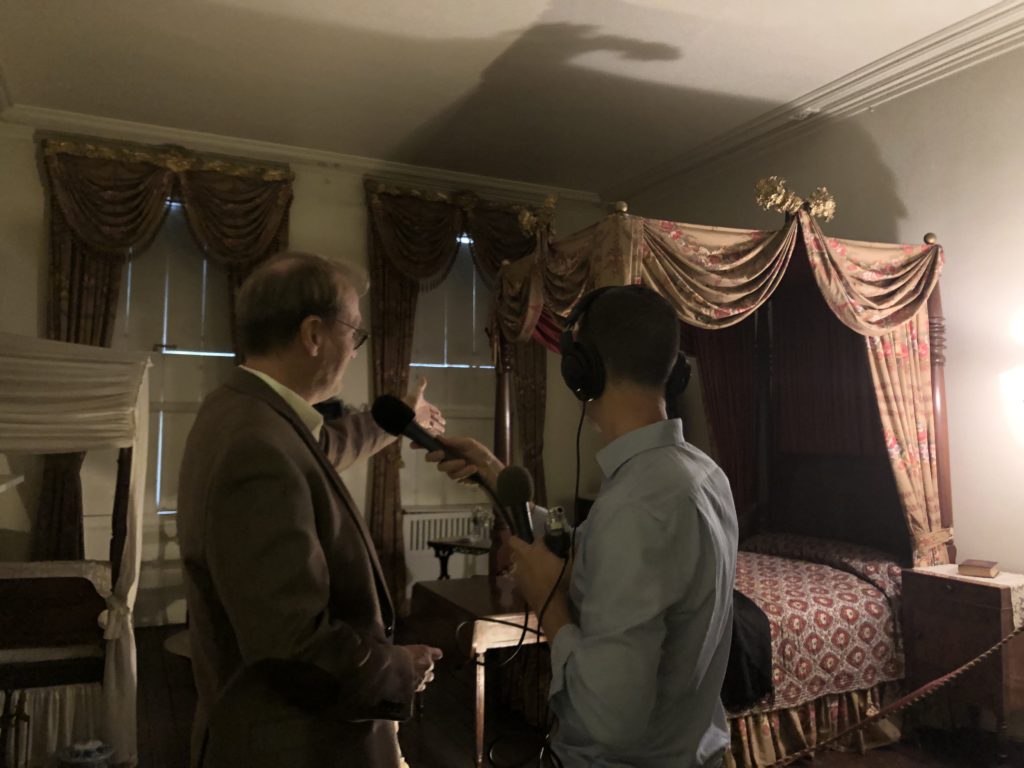
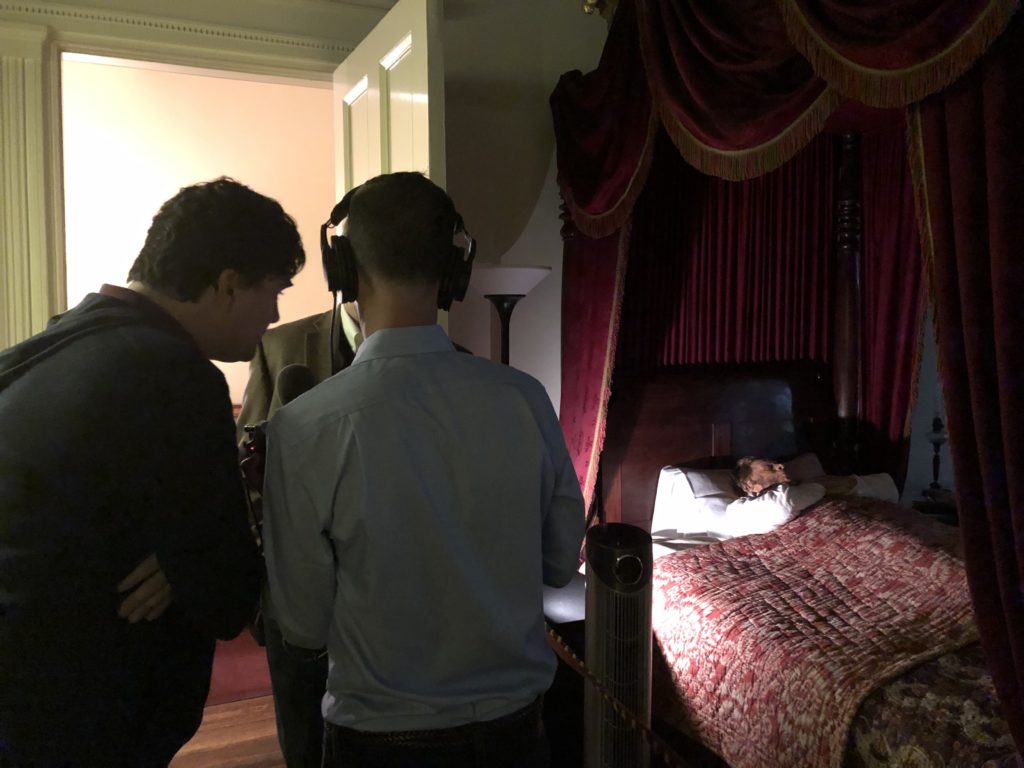
And for the first time in Bowery Boys ghost-stories history, Greg and Tom record a segment of the show — from within an actual haunted house. Merchant’s House docent Carl Raymond joins them for a close look at the life of Gertrude Tredwell and the rooms where she lived and died — and may, to this very day, haunt.
LISTEN NOW — HAUNTED HOUSES OF OLD NEW YORK
A very special thanks to Carl Raymond, docent at the Merchant’s House Museum, for guiding us through the museum as they prepare for their October programming. You can find out more about the Merchant’s House by visiting their website. Book a candlelight ghost tour and check out their exhibition “Death, Mourning, and the Hereafter in Mid-19th Century New York.”
Thursday, October 17 – Saturday, October 19
Wednesday, October 23 – Saturday, October 26
Monday, October 28 – Wednesday, October 30
60-minute tours begin on the half hour, 6:30 to 9:30 p.m.
The Bowery Boys: New York City History podcast is brought to you …. by you!
We are now producing a new Bowery Boys podcast every other week. We’re also looking to improve and expand the show in other ways — publishing, social media, live events and other forms of media. But we can only do this with your help!
We are now a member of Patreon, a patronage platform where you can support your favorite content creators.
Please visit our page on Patreon and watch a short video of us recording the show and talking about our expansion plans. If you’d like to help out, there are six different pledge levels. Check them out and consider being a sponsor.
And join us for the next episode of the Bowery Boys Movie Club, an exclusive podcast provided to our supporters on Patreon. This month’s film — Moonstruck starring Cher and Nicholas Cage.
We greatly appreciate our listeners and readers and thank you for joining us on this journey so far.
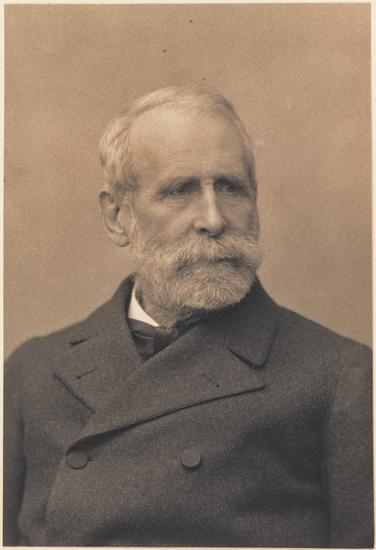
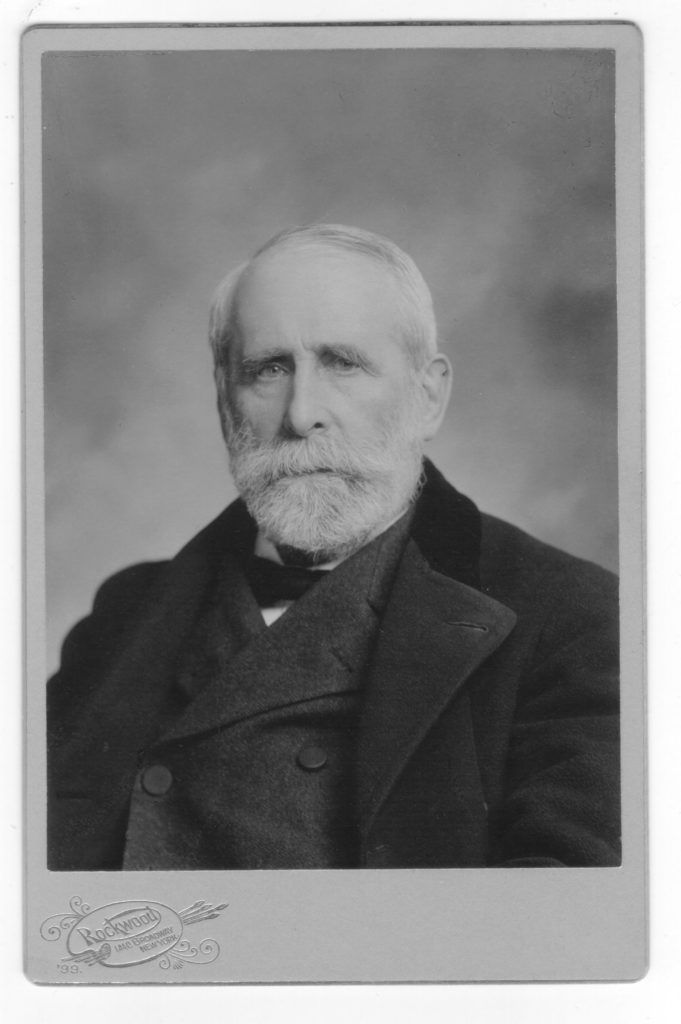
This smart, frugal and unassuming bachelor, an attorney and financial whiz, was critical in taking down William Tweedand the Tweed Ring during the early 1870s, helping to bail out a financially strapped government.
Kenneth T. Jackson, editor of the Encyclopedia of
New York, called Green “arguably the most important leader in Gotham’s
long history, more important than Peter Stuyvesant, Alexander Hamilton, Frederick Law Olmsted, Robert Moses and Fiorello La Guardia.”
So why is he virtually forgotten today?
“Today not one New York in 10,000 has heard of Andrew Haswell Green,” wrote the New York Daily News in 2003.
In our 300th episode, we’re delighted to bring you the story of Mr.
Green, a public servant who worked to improve the city for over five
decades. And we’ll be joined by an ardent Green advocate — former
Manhattan Borough Historian Michael Miscione.
LISTEN NOW — THE FORGOTTEN FATHER OF NEW YORK CITY
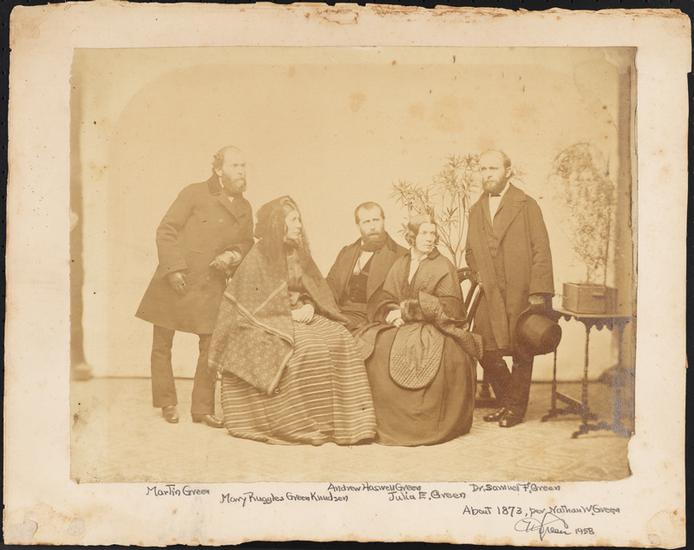
Andrew H. Green sits for a family photo, 1873. He would remain a bachelor his entire life.
Martin
Green, Mary Ruggles Green Knudsen, Andrew Haswell Green, Julia E.
Green, Dr. Samuel F. Green — courtesy Museum of the City of New York
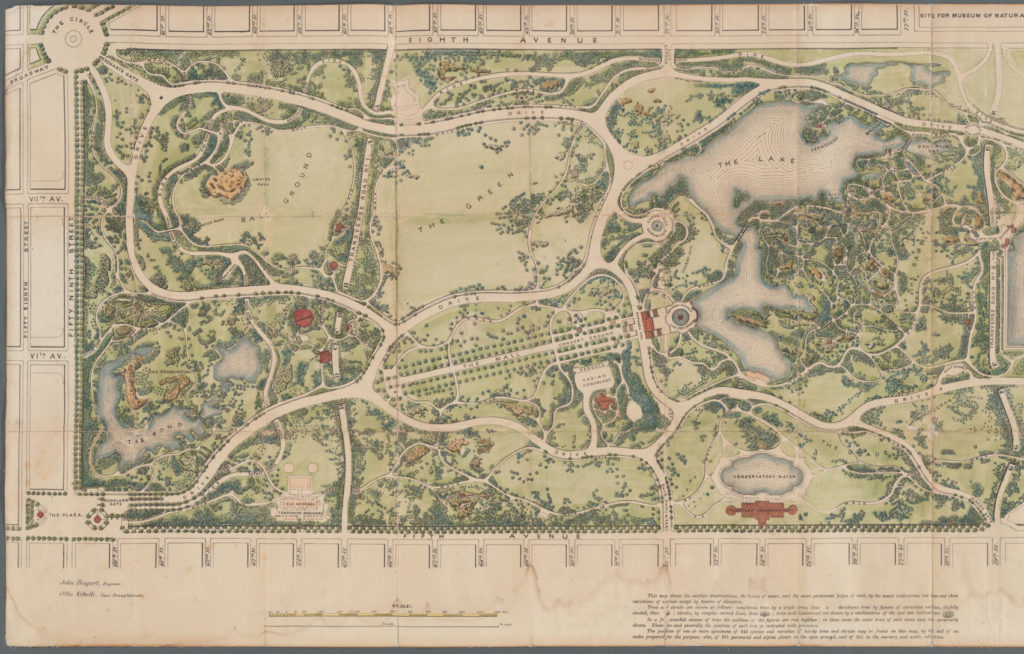
The Greensward plan, by Frederick Law Olmsted and Calvert Vaux, was
chosen as the winning design for the new ‘central park’ in 1857
New York Public Library
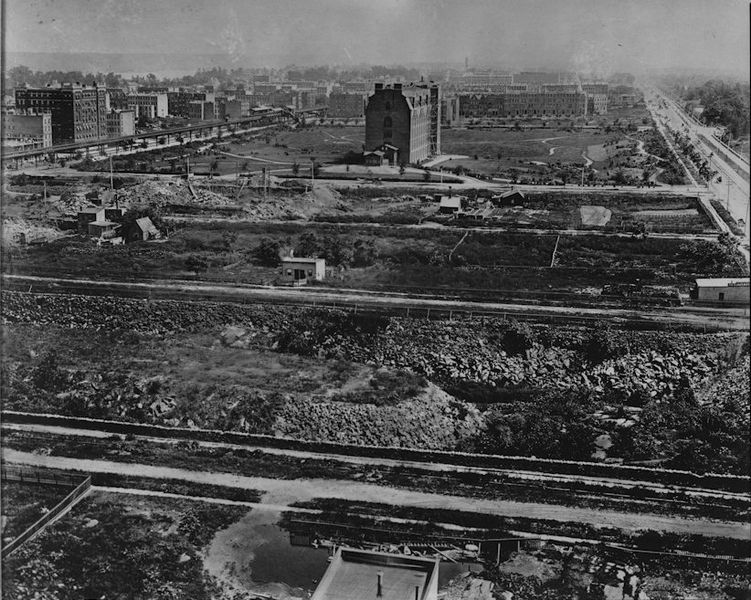
From the late 1870s, the solitary American Museum of Natural History building sits on the spot of Manhattan Square (land just to the west of Central Park granted to Green and the Central Park Commission).
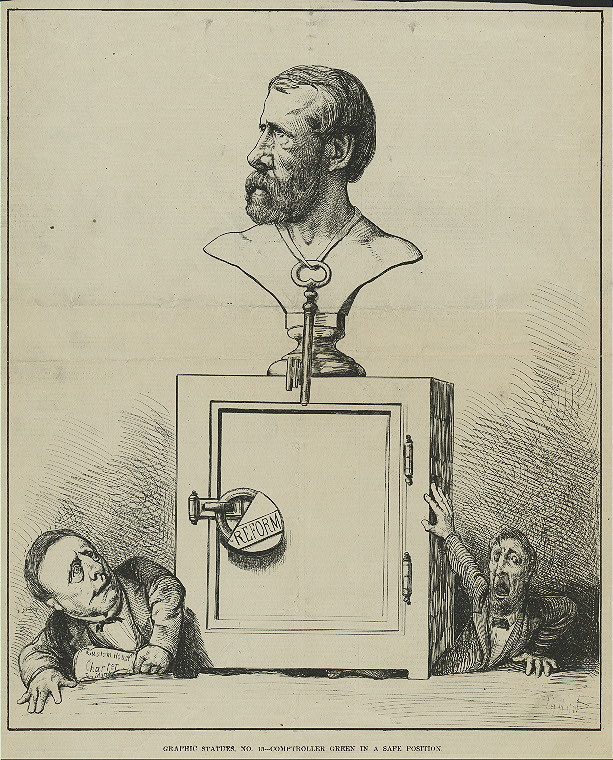
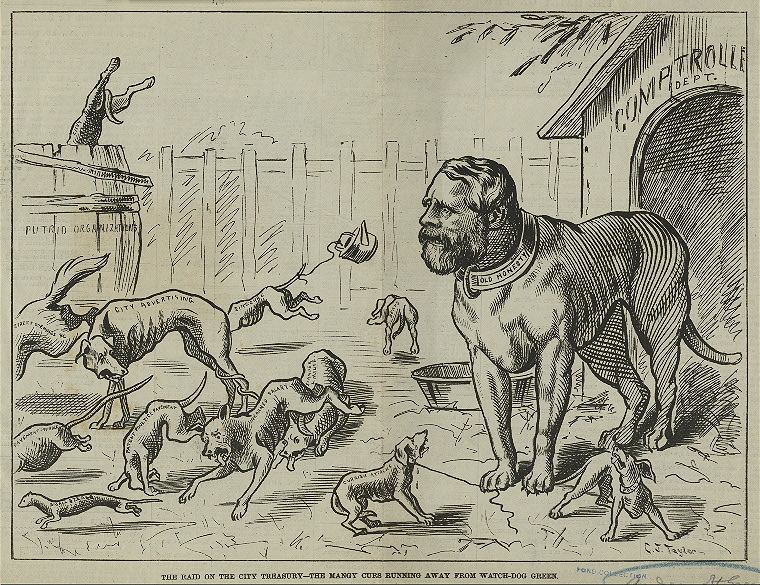
Green in a couple 1870s political cartoon, lampooning his honesty and
austerity — in comparison to Boss Tweed and his Tammany Hall cronies.
New York Public Library
“Not a dollar, not a cent, is got from under his paw that is not wet
with his blood and sweat.” — Olmstead on Green’s legendary
money-managing reputation.
New York Public Library
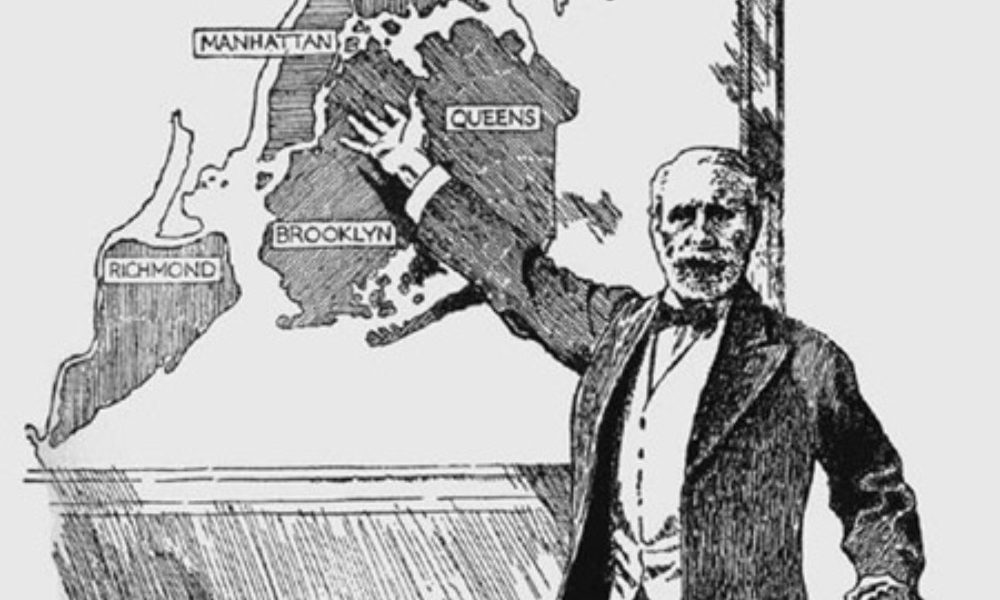
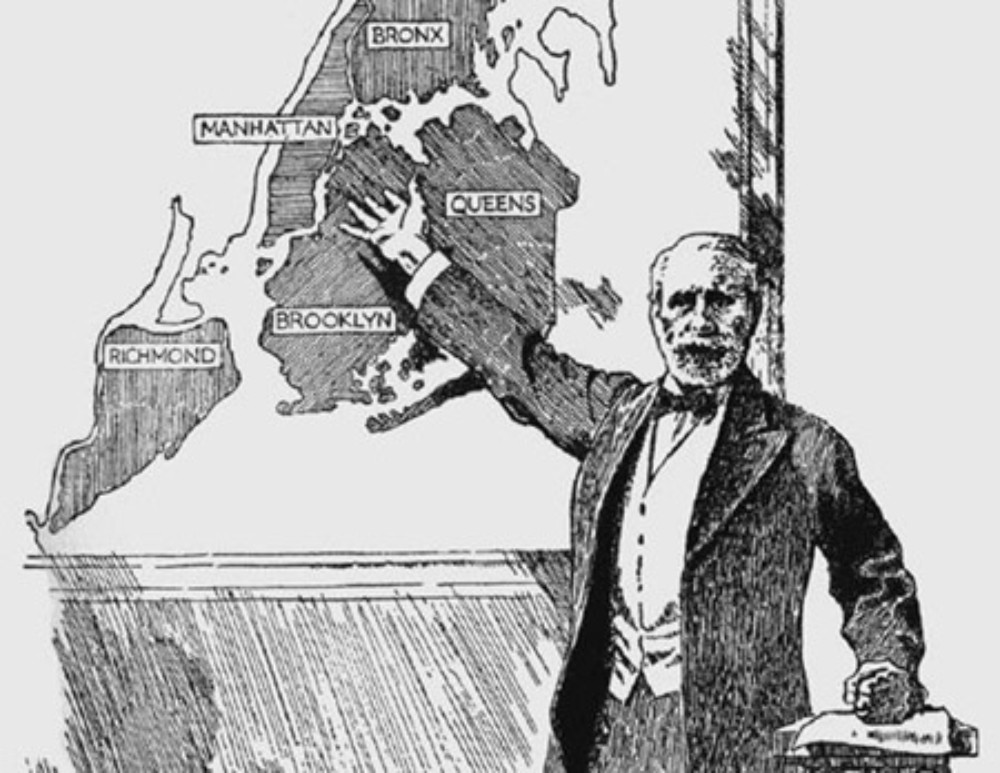
Green, the ardent salesman of a consolidated metropolis.
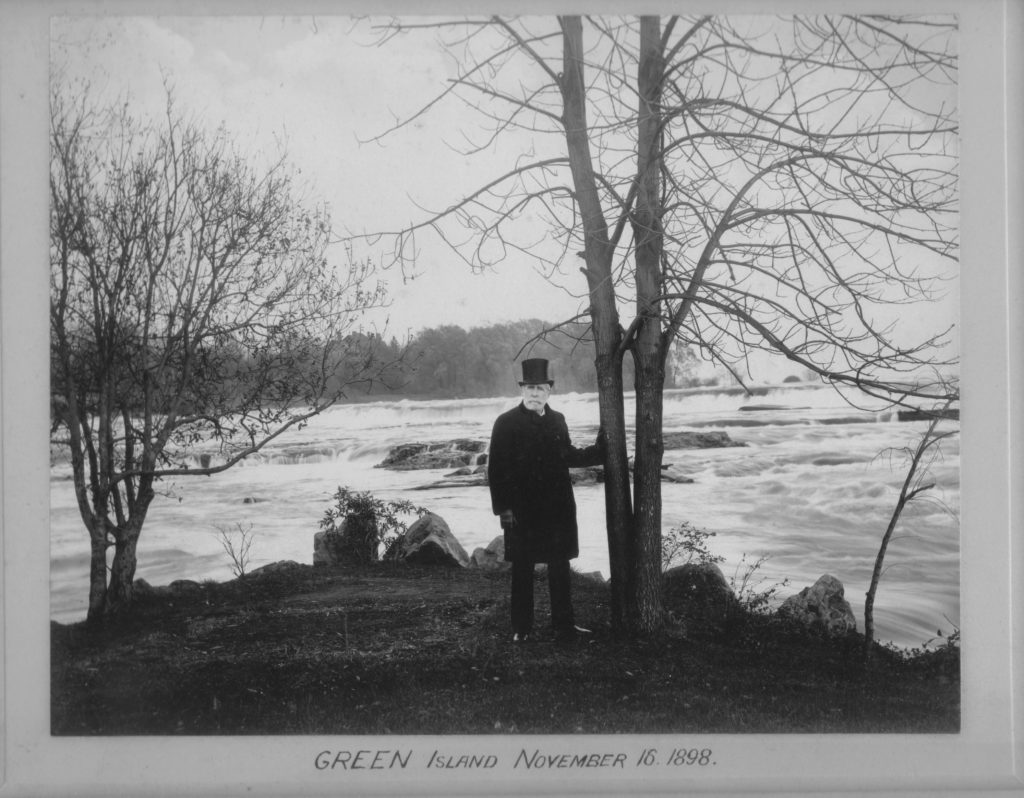
Green on the island that was named for him near Niagara Falls in
1898. He chaired the Niagara Falls State Reservation Commission for
decades, helping to create the park and preserve the falls.
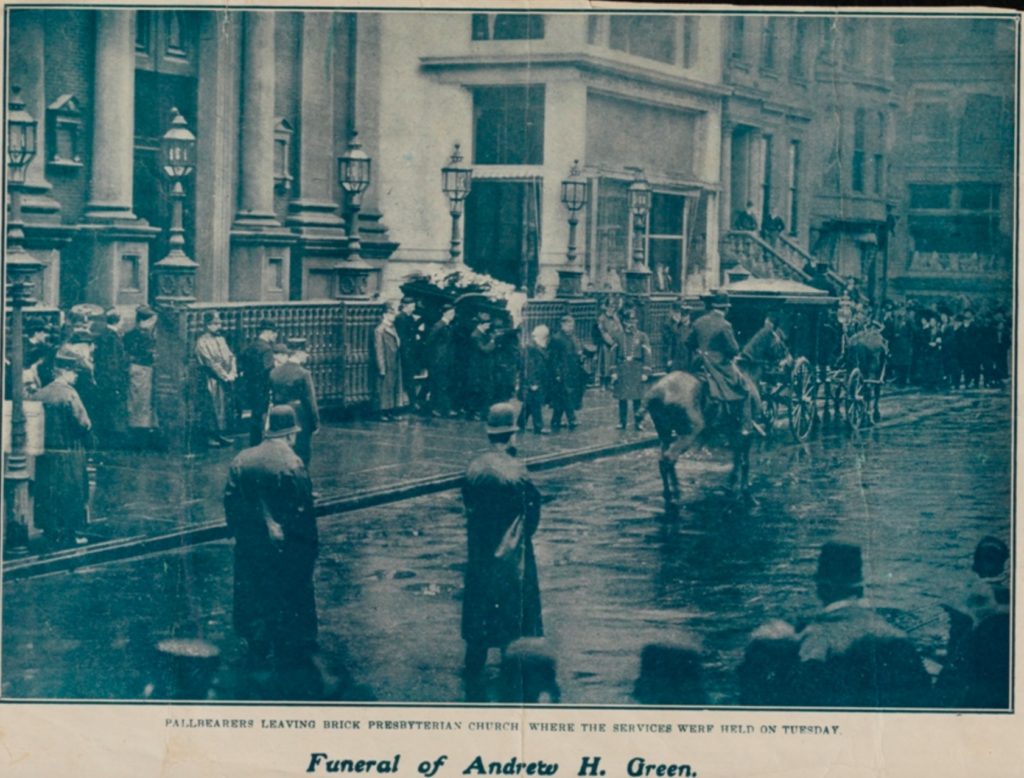
Andrew Haswell Green’s funeral procession leaving Brick Presbyterian Church, 1903
Museum of the City of New York
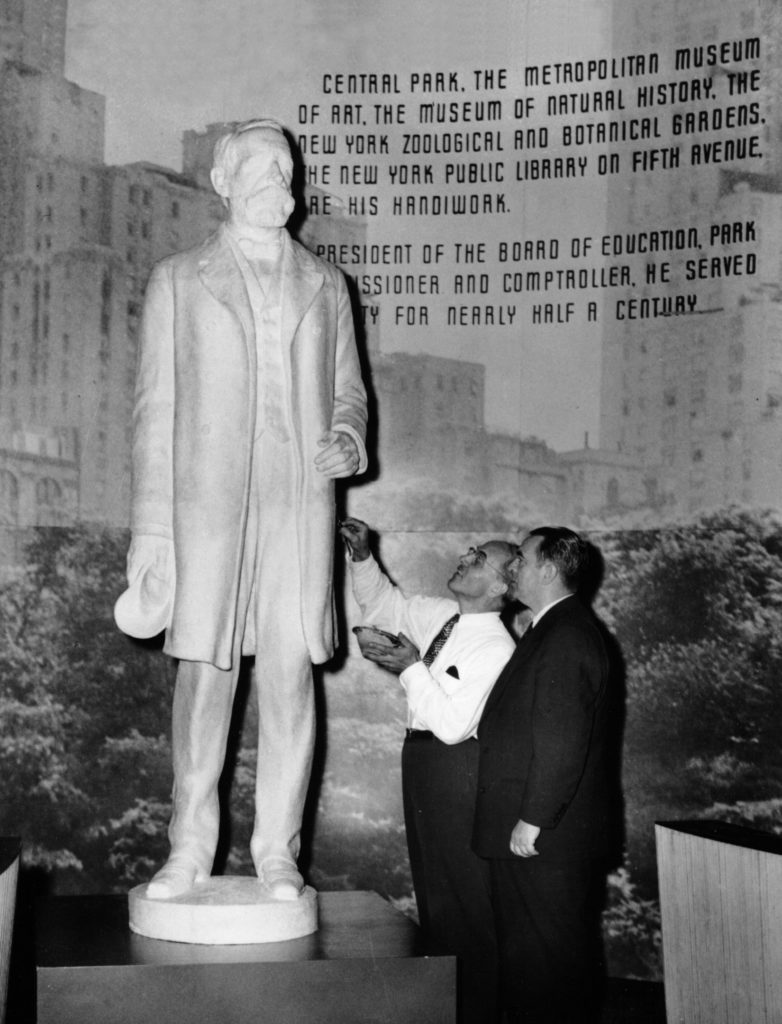
Temporary statue of Green created for the city’s Golden Jubilee
celebration in 1948, marking the 50-year anniversary of the consolidated
city. The men are sculptor Karl Gruppe and NYC Mayor William O’Dwyer.
Michael Miscione
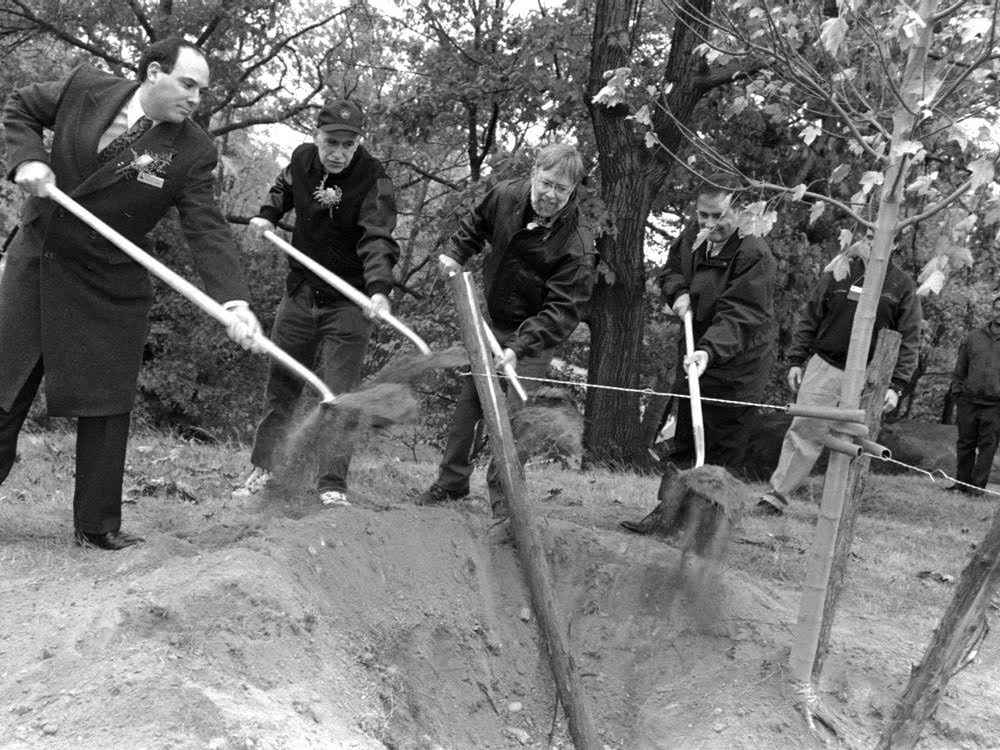
Michael Miscione, Parks Commissioner Henry Stern, Pulitzer
Prize-winning historian Mike Wallace, and MCNY President Robert
Macdonald (left to right) planting five new symbolic trees —
representing the boroughs — at the AHG Memorial Bench in Central park in
1998 to replace the original ones that had died decades years earlier.
Michael Miscione
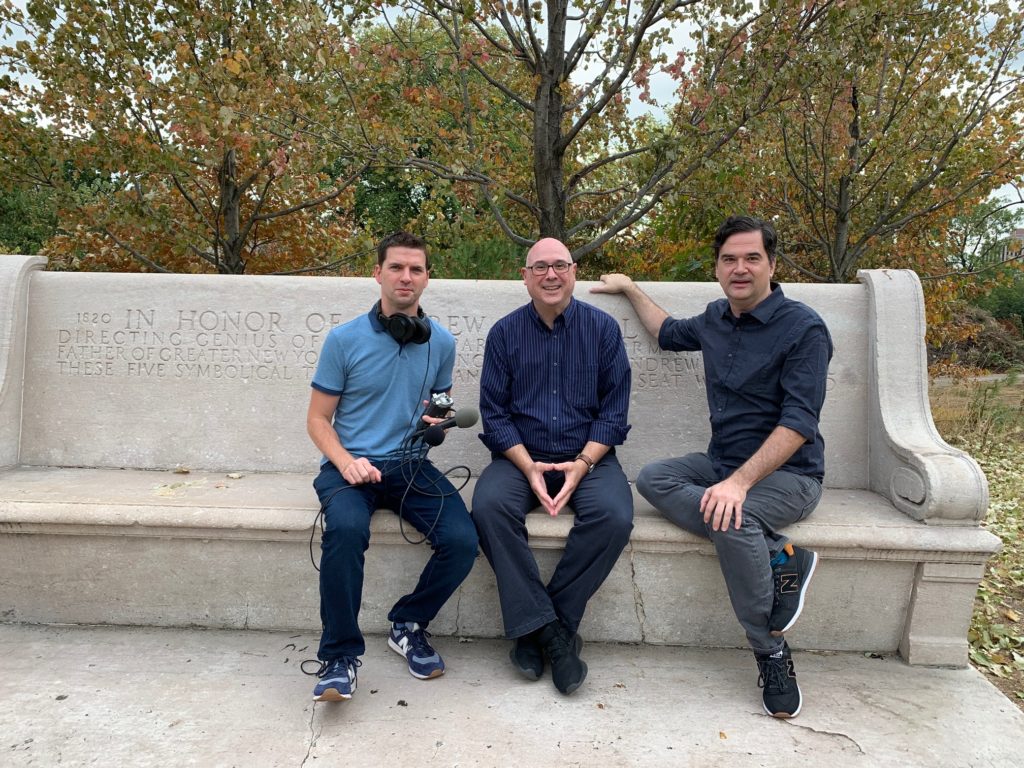
Tom and Greg with Michael Miscione at the Andrew Haswell Green Bench.
Courtesy Michael Miscione
FURTHER LISTENING:
So many of our past 299 shows touch upon landmarks and institutions mentioned in the show, but start with these five:
Andrew Haswell Green and Dorothy Catherine Draper courted for just a
few months and both would remain unmarried for their entire lives. Yet
both are critical figures in American history:
The Consolidation of Greater New York was Green’s grand vision, conceived of during his years on the Central Park Commission.
From way, way back in our back catalog, a two part show on the history of Central Park:
The Bronx Is Born: The magnificent idea of
consolidation was conceived from Green’s ideas of expansion into
Westchester County, into districts that would become known as the
Annexed District
FURTHER READING:
The American Museum of Natural History and How It Got That Way by Colin Davey
The Life and Public Services of Andrew Haswell Green by John Foord
The Greater New York Charter by Andrew Haswell Green
Capital City: New York City and the Men Behind America’s Rise to Economic Dominance, 1860-1900 by Thomas Kessner
The Once and Future New York: Historic Preservation and the Modern City by Randall Mason
Two Centuries of American Planning by Daniel Schaffer
The Father of Greater New York: Official Report of the
Presentation to Andrew Haswell Green of a Gold Medal Commemorating the
Creation of the Greater City of New York: with a Brief Biographical
Sketch
The Bowery Boys: New York City History podcast is brought to you …. by you!
We are now producing a new Bowery Boys podcast every other
week. We’re also looking to improve and expand the show in other ways —
publishing, social media, live events and other forms of media. But we
can only do this with your help!
We are now a member of Patreon, a patronage platform where you can support your favorite content creators.
Please visit our page on Patreon
and watch a short video of us recording the show and talking about our
expansion plans. If you’d like to help out, there are six different
pledge levels. Check them out and consider being a sponsor.
And join us for the next episode of the Bowery Boys Movie Club, an exclusive podcast provided to our supporters on Patreon.
We greatly appreciate our listeners and readers and thank you for joining us on this journey so far.
PODCAST (Episode 299): Part Two of our series on the history of Brooklyn Heights, one of New York City’s oldest neighborhoods.
By the 1880s, Brooklyn Heights had evolved from America’s first suburb into the City of Brooklyn’s most exclusive neighborhood, a tree-lined destination of fine architecture and glorious institutions.
The Heights would go on a roller-coaster ride with the opening of the Brooklyn Bridge and the transformation of Brooklyn into a borough of Greater New York. The old-money wealthy classes would leave, and the stately homes would be carved into multi-family dwellings and boarding houses.
The new subway would bring the bohemians of Greenwich Village into Brooklyn Heights, transforming it into an artist enclave for most of the century. But even with addition of trendy hotels and the Brooklyn Dodgers (whose front office was located here), the Heights faced an uncertain future.
When Robert Moses began planning his Brooklyn Queens Expressway in the 1940s, he planned a route that would sever Brooklyn Heights and obliterate many of its most spectacular homes. It would take a devoted community and some very clever ideas to re-route that highway and cover it with something extraordinary — a Promenade, allowing all New Yorkers to enjoy the exceptional views of New York Harbor.
This drama only served to highlight the value and unique nature of Brooklyn Heights and its extraordinary architecture, leading New York to designate the former tranquil suburb on a plateau into the city’s first historic district.
FEATURING: Truman Capote, Jackie Robinson, Gypsy Rose Lee, St. Ann’s Warehouse, Matt Damon and the Jehovah’s Witnesses!
LISTEN NOW — THE STORY OF THE BROOKLYN HEIGHTS PROMENADE AND NEW YORK’S FIRST HISTORIC DISTRICT
PODCAST: A history of all things trash in New York City.
Picture New York City under mountains of filth,
heaving from clogged gutters and overflowing from trash cans. Imagine
the unbearable smell rotting food and animal corpses left on the curb.
And what about snow, piled up and untouched, leaving roads entirely
impassable?
This was New York City in the mid 19th century, a place growing
faster than city officials could control. It seems impossible to keep
clean.
In this episode, we chart the course to a safer, healthier city
thanks to the men and women of the New York City Department of
Sanitation, which was formed in the 1880s to combat this challenging
humanitarian crisis.
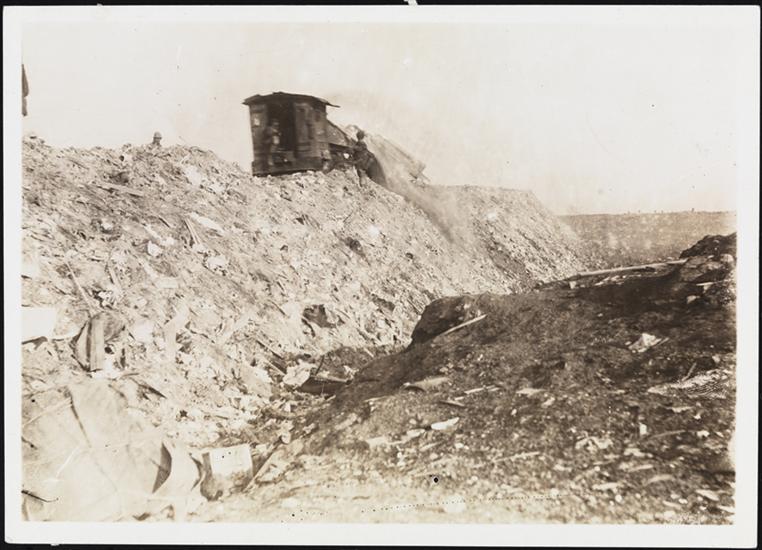
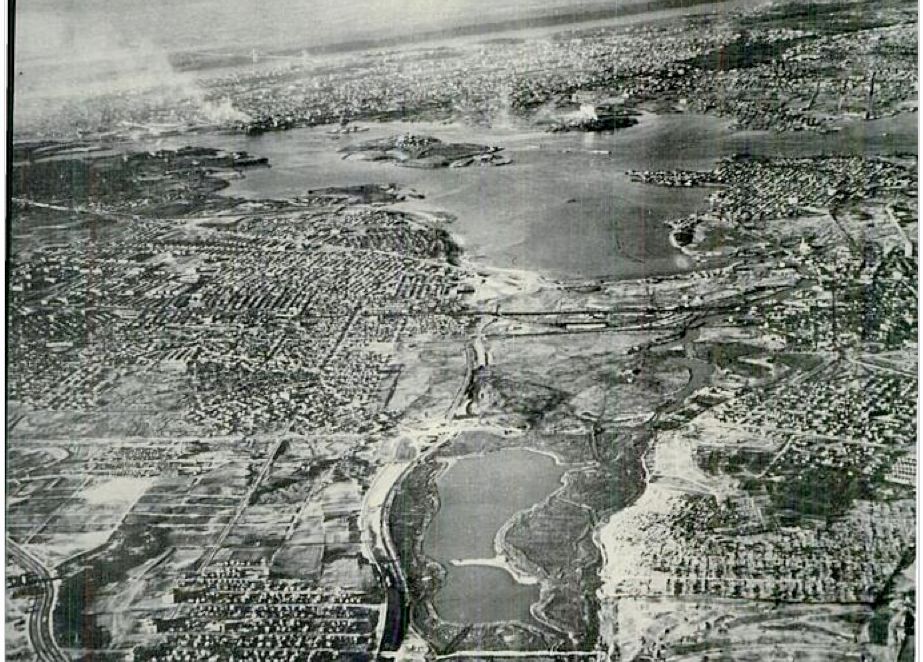
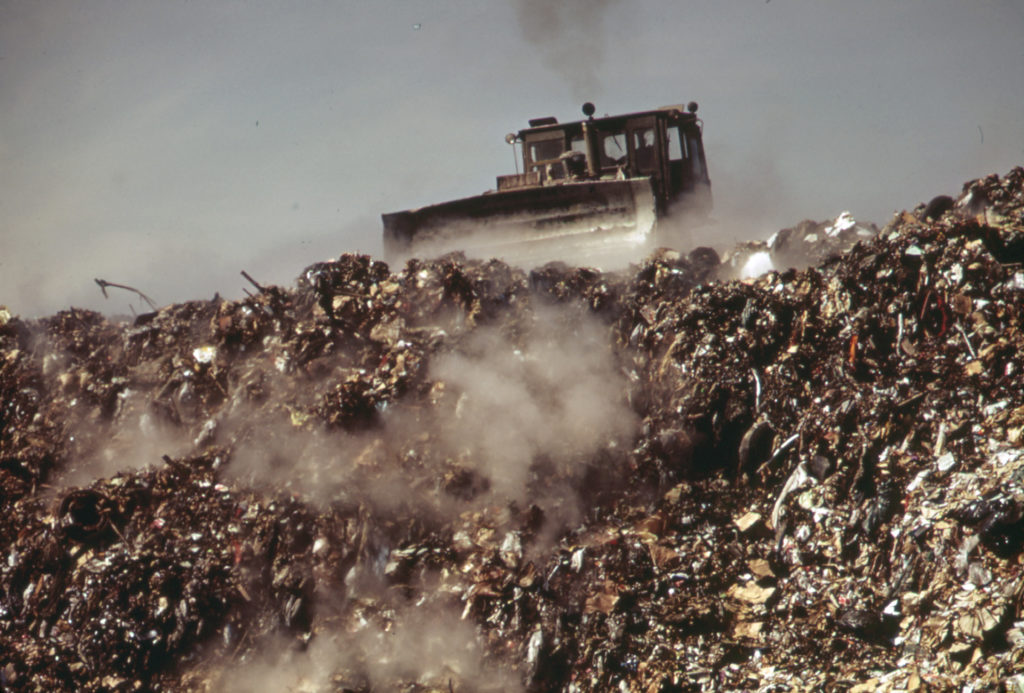
And along the way, we’ll stop at some of the more, um, pungent landmarks of New York City history — the trash heaps of Rikers Island, the mountainous Corona Ash Dump, and the massive Fresh Kills Landfill.
PLUS: We’ll be joined by two special guests to help us understand the
issues surrounding New York City sanitation in the 21st century:
Robin Nagle is a Clinical Professor at NYU and the
Anthropologist in Residence for New York City’s Department of
Sanitation, and the author of Picking Up – On the Streets and Behind the Trucks with the Sanitation Workers of New York City.
Maggie Lee is the records management officer in the
Sanitation Department, and also serves as the deputy director for Museum
Planning for the Foundation for New York’s Strongest.
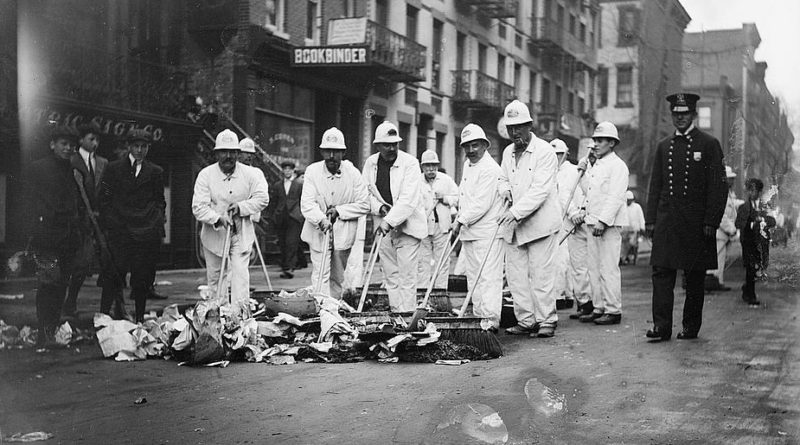
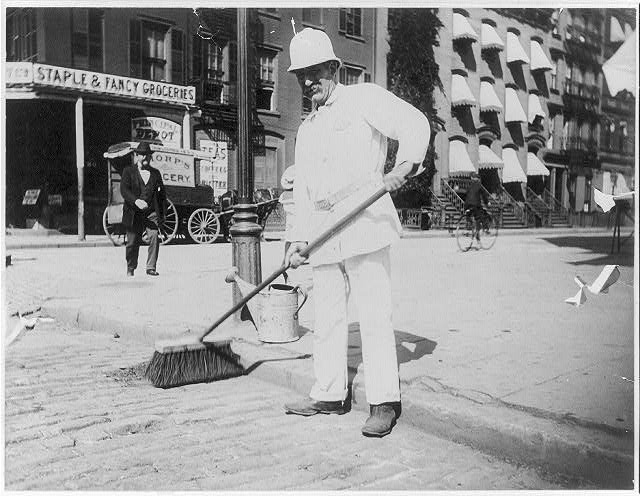
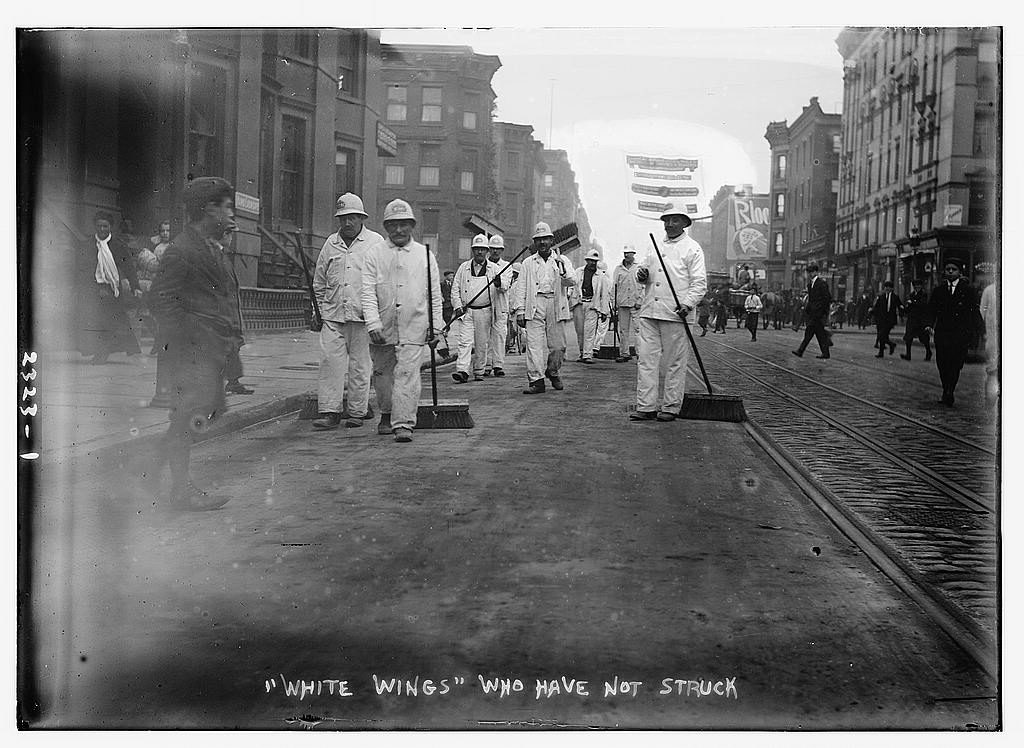
New York Public Library1896 street cleaner and member of Waring’s ‘white wings’, photograph by Alice AustenColonel
George E. Waring Jr., who changed the course of New York City life with
the development of a rigorous new sanitation process in the city.The ‘White Wings’ on parade, 1903, filmed for the Edison Company.Photo
shows men in white uniforms and hats with brooms in the street to sweep
trash during the New York City garbage strike, Nov. 8-11, 1911.
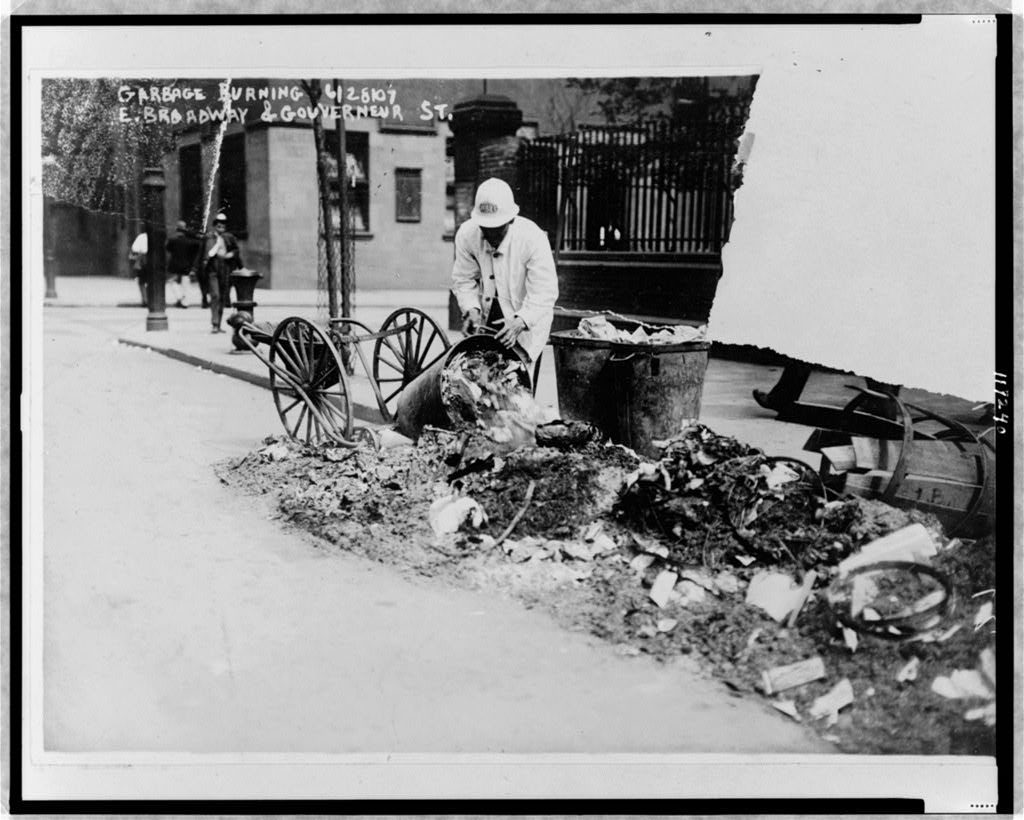
(Source: Flickr Commons project.)[Garbage burning at East Broadway and Gouverneur Street, New York City]
Created / Published
1907 June 28. Courtesy Library of CongressIn
the distance you see the incinerator located on Governor’s Island,
operating at full capacity. Circa 1900. Photographer Robert Bracklow,
image courtesy Museum of the City of New York.A
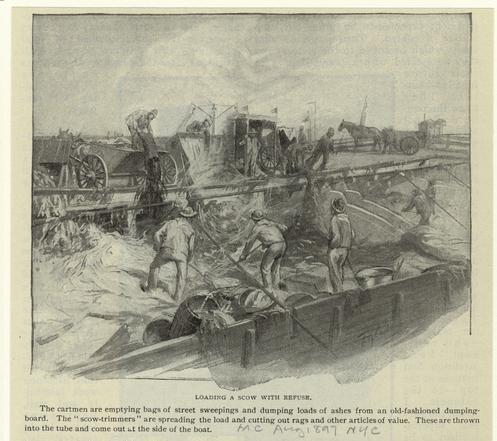
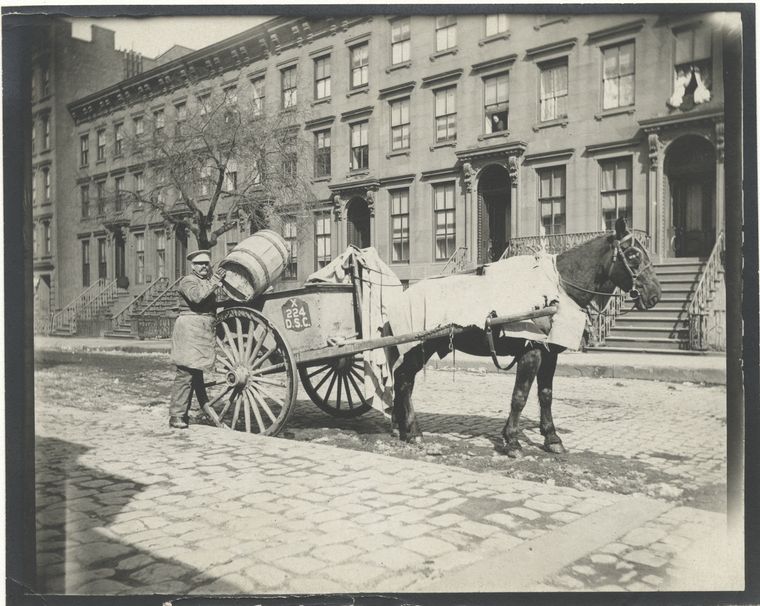
sanitation worker carting carting away a full barrel of ash. The open
cart would be filled, taken to barges, then sent to far-away dumps. In
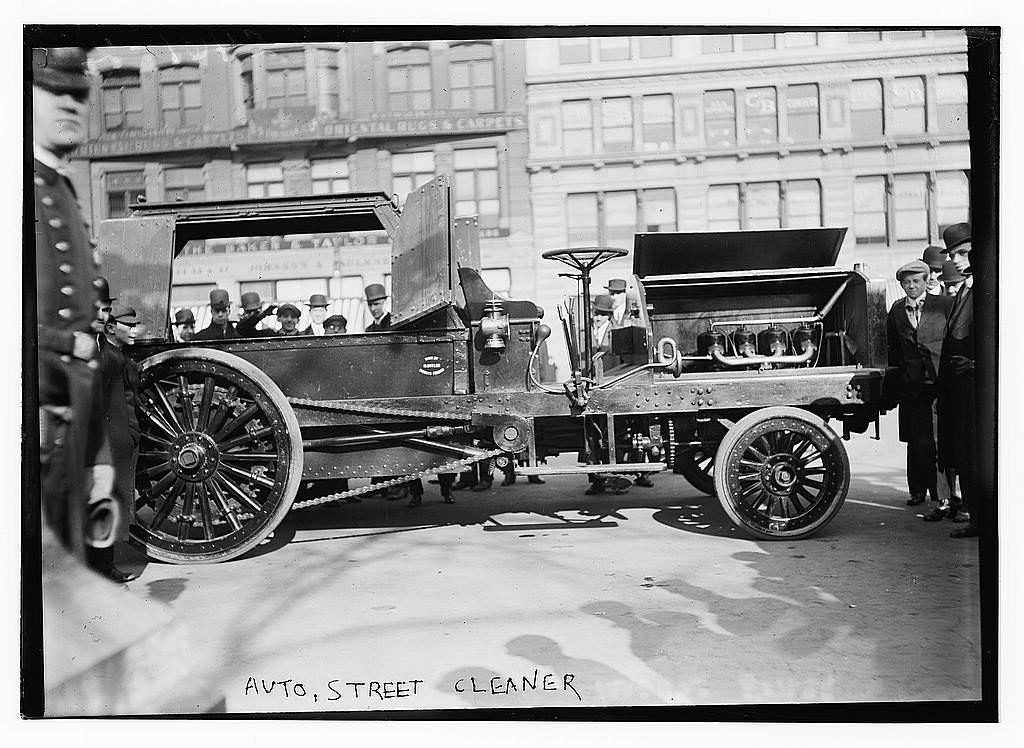
the 1910s, Brooklyn ash went to Corona. Rikers Island, 1915, a post-apocalyptic sea of trash. (Image courtesy the Museum of the City of New York)A fancy auto street cleaner, 1920. Photo courtesy Library of CongressThe
Corona Ash Dump as seen from overhead. Rikers, also a destination for
the city’s waste, can be seen in the bay. Courtesy CUNYView
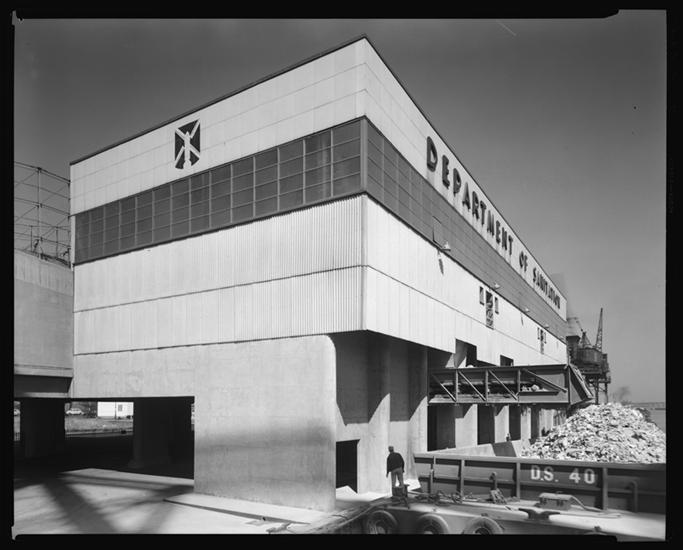
of garbage disposal plant at the foot of 60th Street and the East
River, 1946. Photo by the Wurts Brothers, courtesy the Museum of the
City of New YorkFreshkills Landfill, 1973. Gary Miller photographerOur guest Robin Nagle giving a fascinating TED Talk on the subject!
The Bowery Boys: New York City History podcast is brought to you …. by you!
We are now producing a new Bowery Boys podcast every other
week. We’re also looking to improve and expand the show in other ways —
publishing, social media, live events and other forms of media. But we
can only do this with your help!
We are now a member of Patreon, a patronage platform where you can support your favorite content creators.
Please visit our page on Patreon
and watch a short video of us recording the show and talking about our
expansion plans. If you’d like to help out, there are six different
pledge levels. Check them out and consider being a sponsor.
And join us for the next episode of the Bowery Boys Movie Club, an exclusive podcast provided to our supporters on Patreon.
We greatly appreciate our listeners and readers and thank you for joining us on this journey so far.
The allure surrounding the building at 190 Bowery has captivated me from the first moment I laid eye upon it, a century-old bank sealed off from the trendy streets surrounding it. Very few people ever saw the interior. Nobody could have imagined the strange treasures which collected on every floor, in every room, of the building.
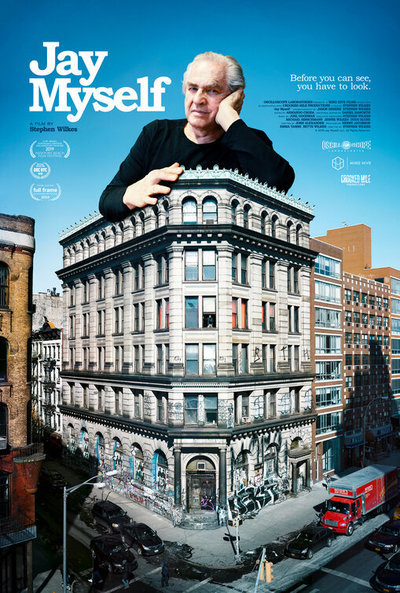
Jay Myself Directed by Stephen Wilkes Oscilloscope Laboratories Currently playing at the Film Forum
In the terrific documentary Jay Myself, the public is finally allowed in, at the very moment when its special charms are forced to vacate the building.
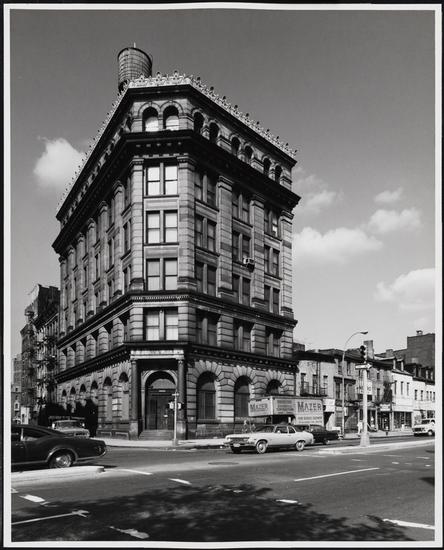
190 Bowery has been the home of renowned photographer Jay Maisel since 1966. During the period when artists began seeking unfinished lofts in the cast-iron districts that became SoHo and Tribeca, Maisel was instead made a most unusual offer — an empty six-story bank along a street famously known as ‘Skid Row’.
The Germania Bank Building in 1975. Courtesy Museum of the City of New York
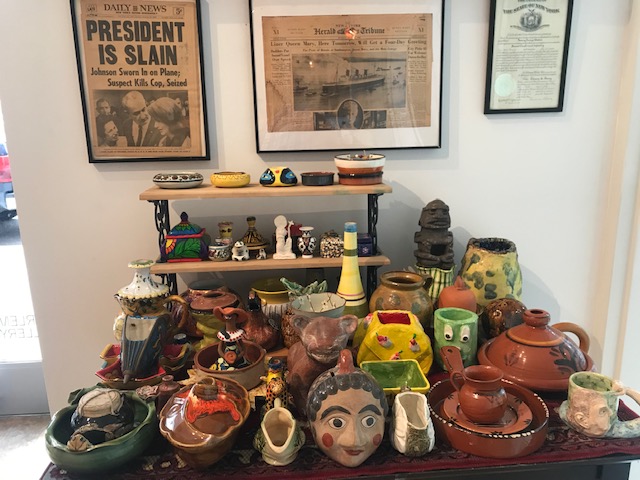
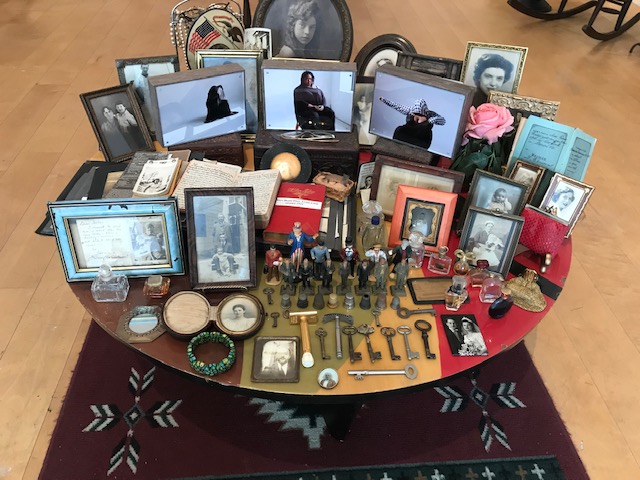
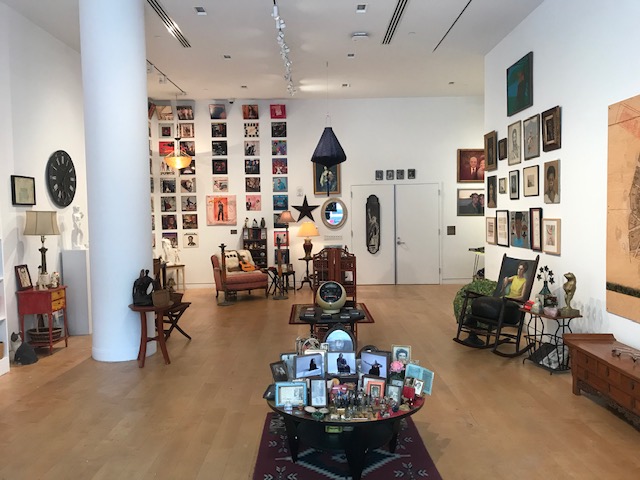
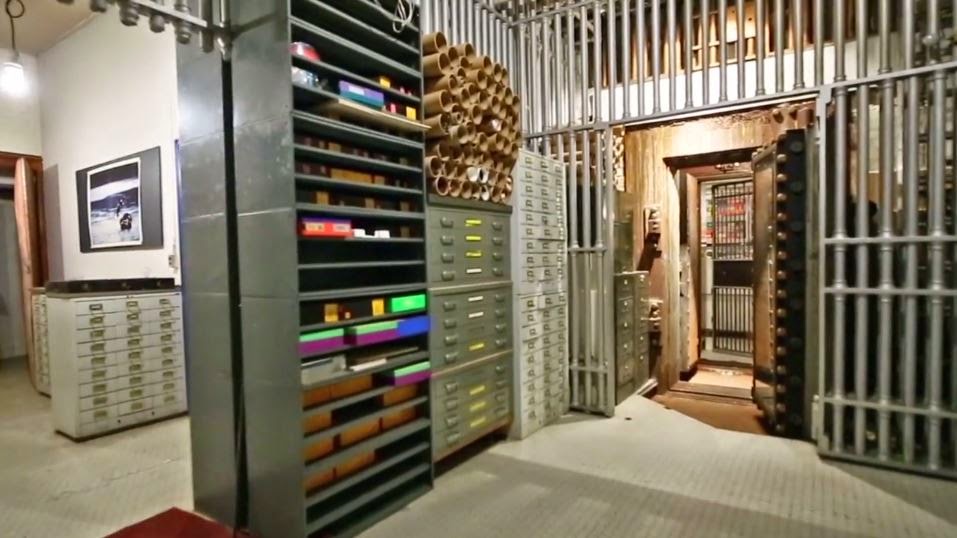
For decades, Maisel filled each rooms with items he might use in his lush, colorful photographs. It wasn’t quite hoarding; rooms were meticulously arranged, lined with beautiful bottles, dye transfer prints and even a collection of porcelain hands from a rubber glove factory.
Few were allowed in to Maisel’s strange castle. Maisel’s former associate Stephen Wilkes, an acclaimed photographer in his own right and the director of Jay Myself, finally convinced Maisel to let him film the interiors of the home — but at a bittersweet moment.
An artist’s wonderland inside a former bank. Courtesy ISO1200
In 2015, Maisel sold the building due to mounting maintenance costs. (In 1966 he purchased the bank for $102,000; he sold it $55 million!) Jay Myself documents Maisel in the process of disentangling himself from an artist’s paradise.
If this were merely a film about mourning the past, it would work better as a photo essay. But almost immediately the film becomes a celebration of Maisel himself, both his incredible body of work — drenched in fascinating experiments in color — and his irascible personality.
Imagine the luxury of expanding yourself physically into a space, filling every corner with whims and potential visions. Then imagine dismantling it all, an era of imagination — if not quite over – at least reduced. (Even Maisel might admit that a healthy back account does offset the disappointment.)
It’s no surprise that he keeps working even as the final boxes were being removed. You’ll not want to leave either.
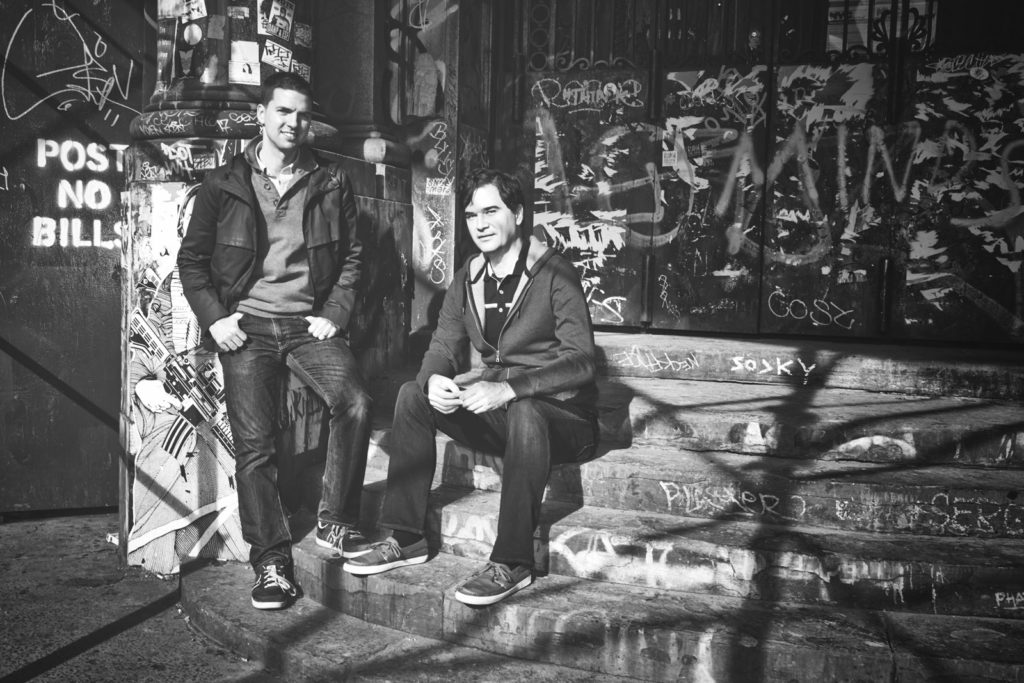
When Maisel still lived there, we took one of our old publicity photos on the steps of 190 Bowery!
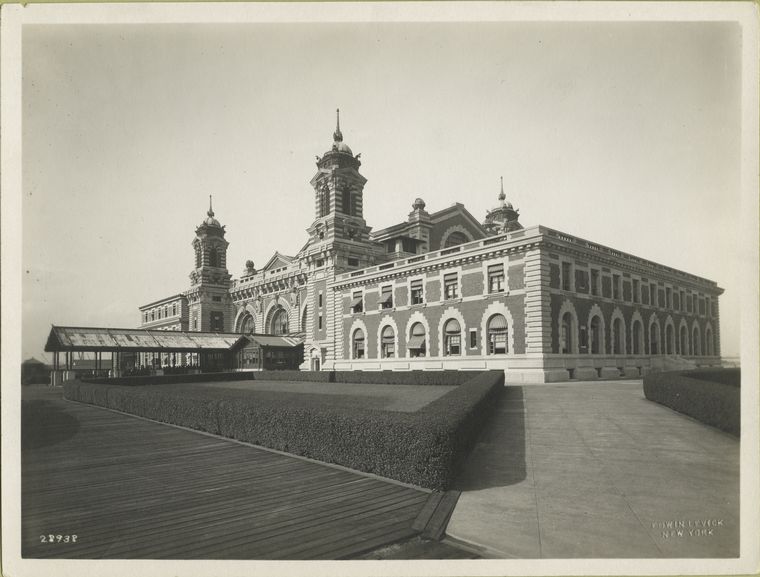
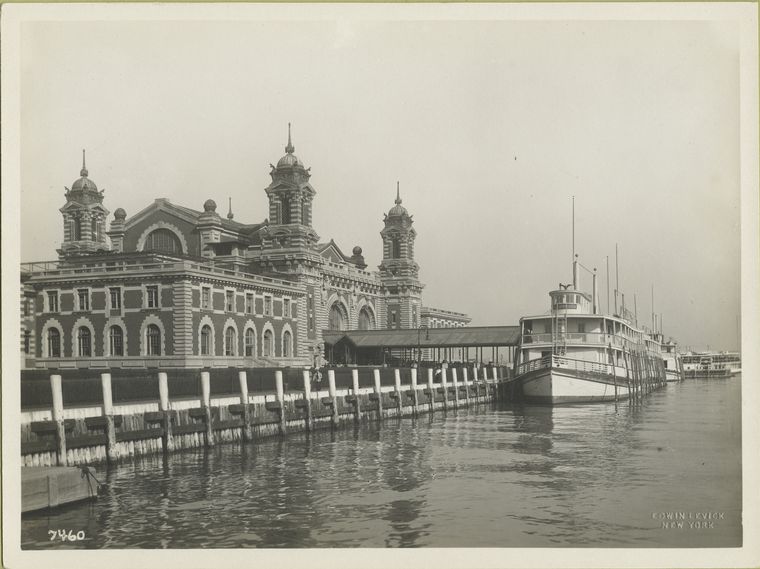
PODCAST The epic tale of Ellis Island and the process by which millions of new immigrants entered the United States.
For millions of Americans, Ellis Island is the symbol of introduction, the immigrant depot that processed their ancestors and offered an opening into a new American life.
But for some, it would truly be an ‘Island of Tears’, a place where they would be excluded from that life.
How did an island with such humble beginnings — ‘Little Oyster Island’, barely a sliver of land in the New York harbor — become so crucial? Who is the ‘Ellis’ of Ellis Island? And how did it survive decades of neglect to become one of New York’s most famous tourist attractions?
FEATURING our special guest Tanya Bielski-Braham (currently of the Holocaust Center of Pittsburgh) who walks us through her own family’s immigration experience over a century ago — from Eastern Europe to America.
THIS SHOW WAS ORIGINALLY RELEASED TEN YEARS AGO THIS MONTH ON JULY 31, 2009!
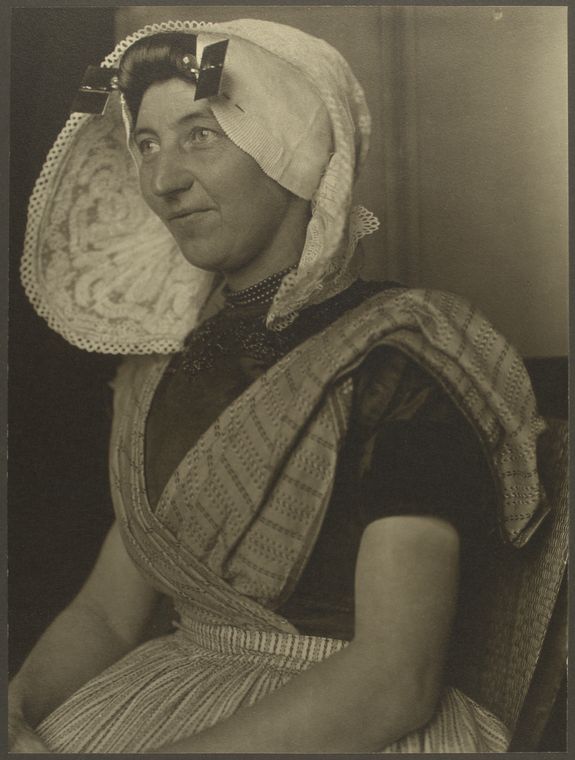
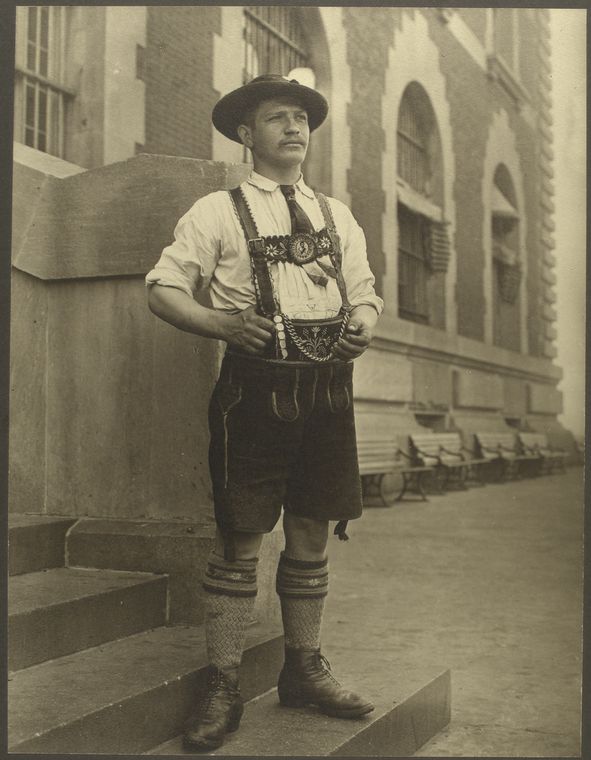
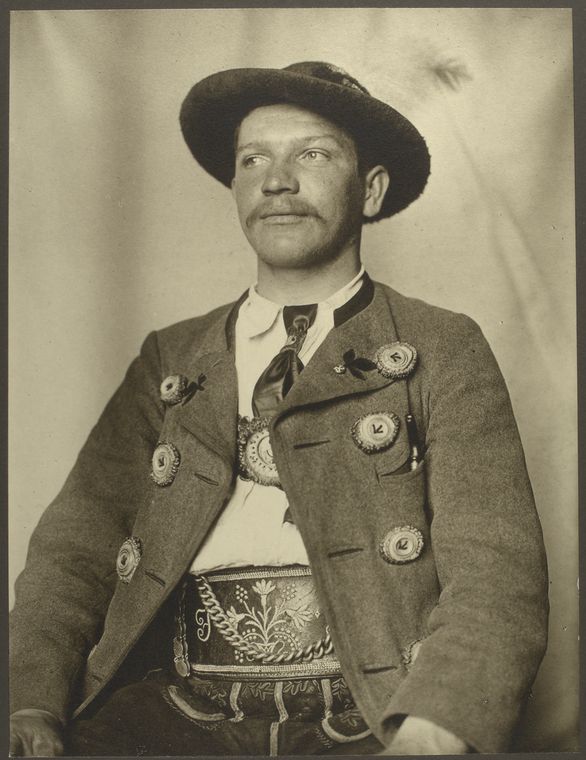
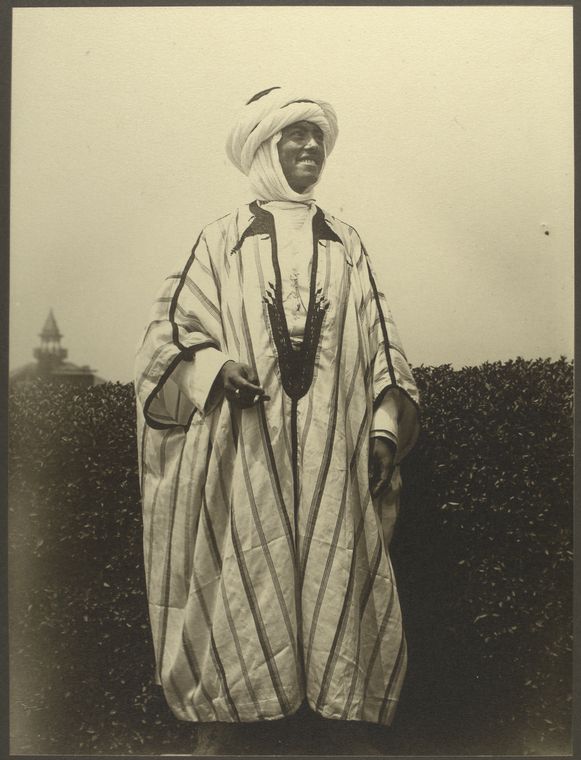
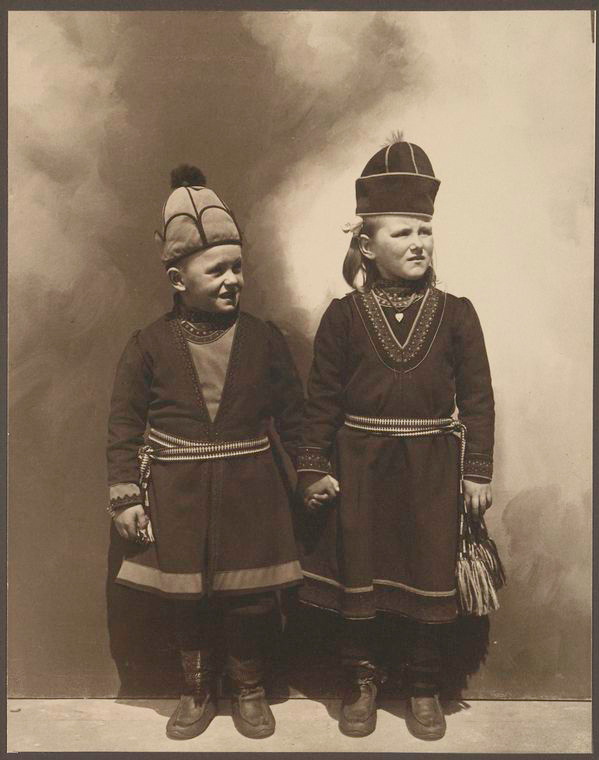
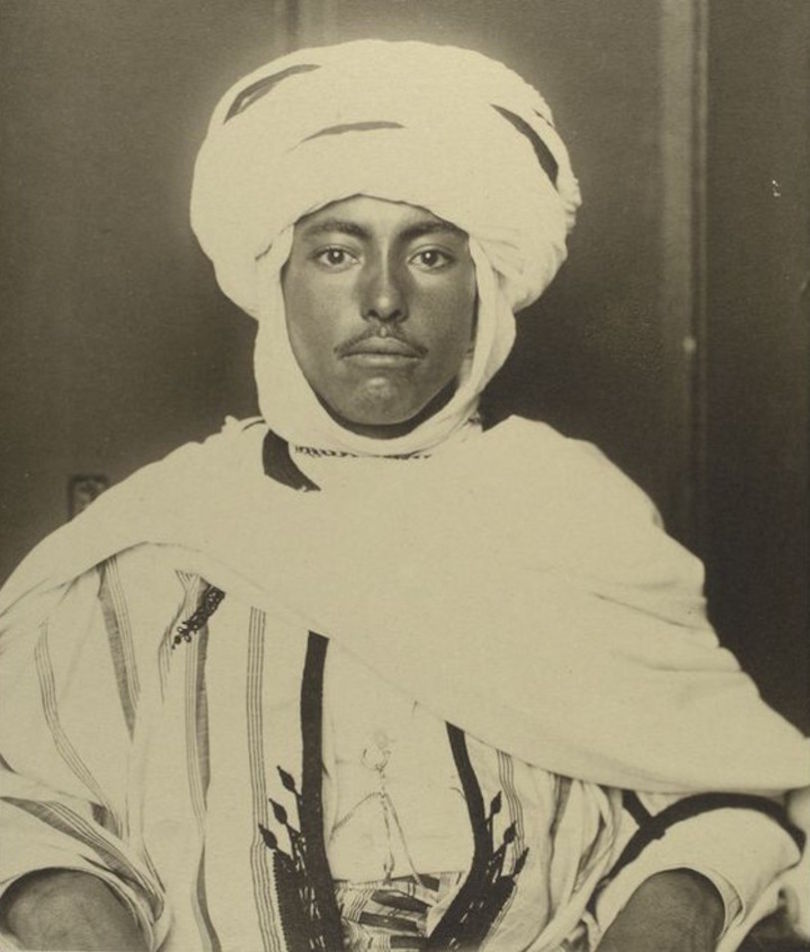
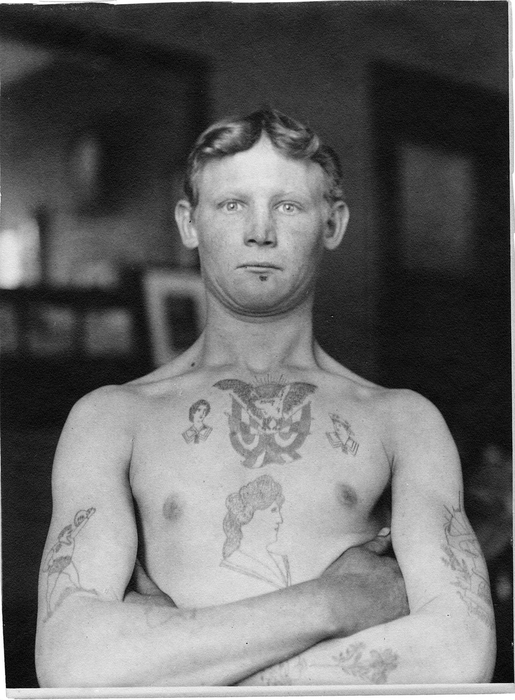
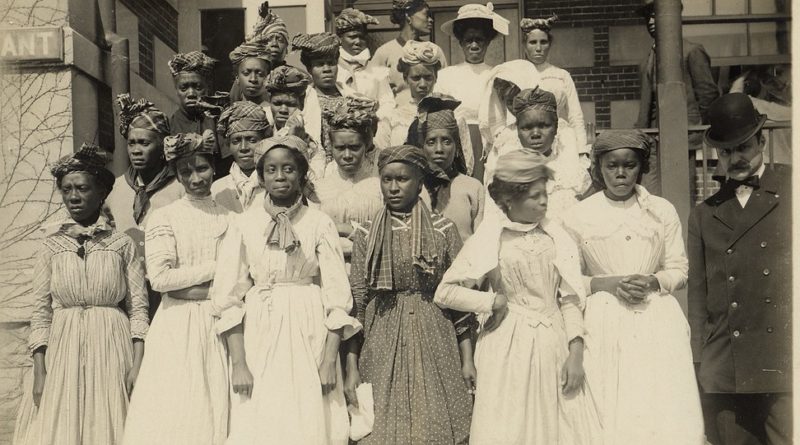
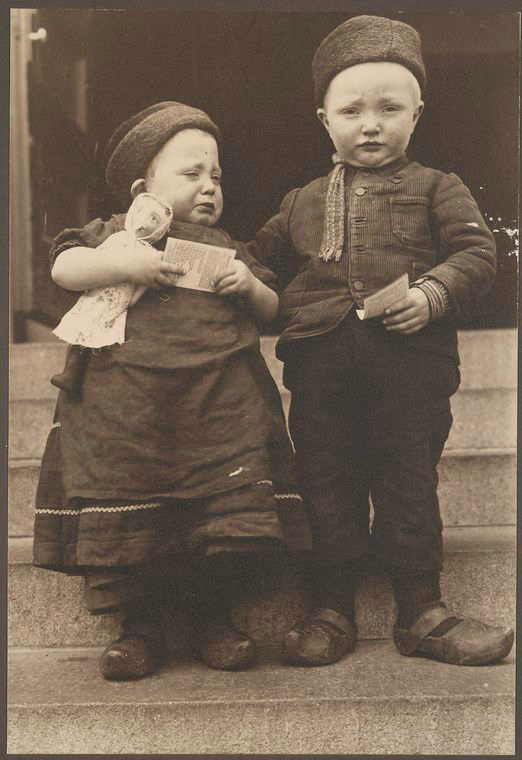
Here’s a look at many of the faces of newly arriving immigrants from between the years 1904 and 1924, photos byAugustus Frederick Sherman, a clerk on Ellis Island.
Interestingly these are not ‘official’ photographs. Sherman himself was particularly interested in national costume and mostly chose subjects who happened to be wearing the most flamboyant apparel from their respective countries. You can see more pictures from this series at the National Park Service website on Ellis Island. The particular images below are courtesy New York Public Library
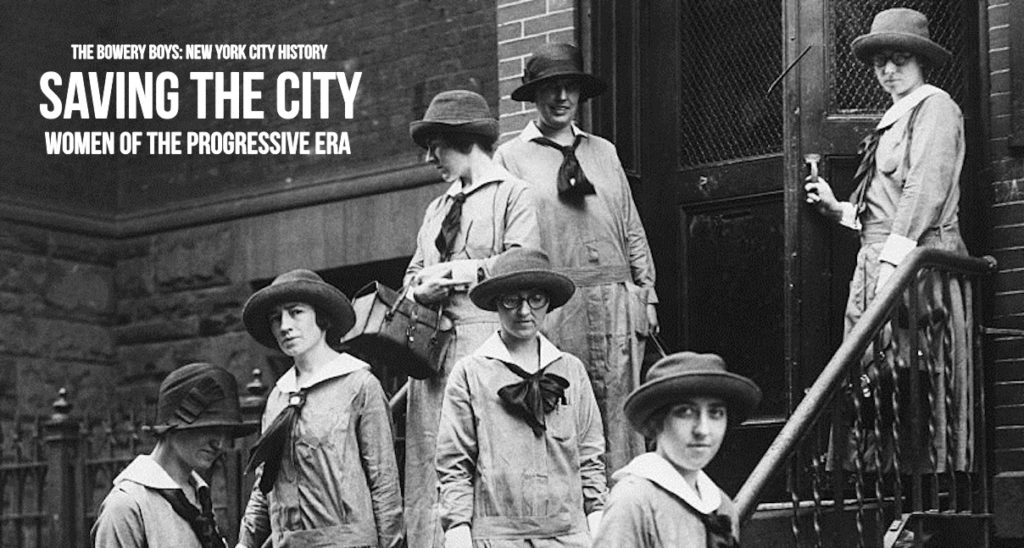
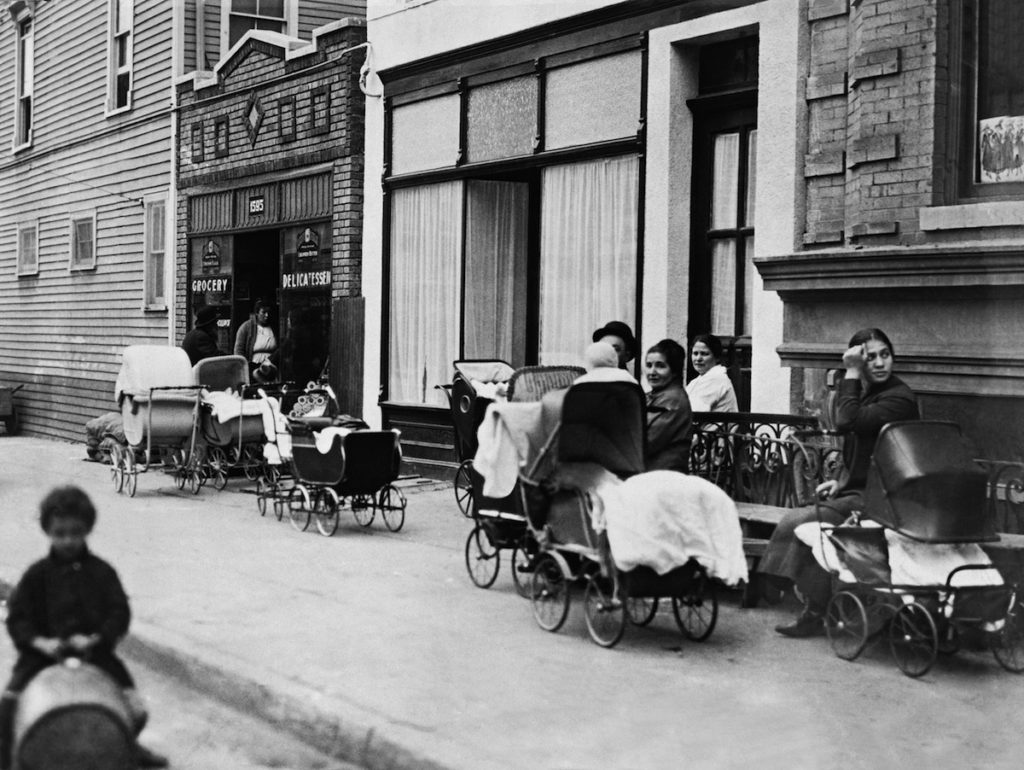
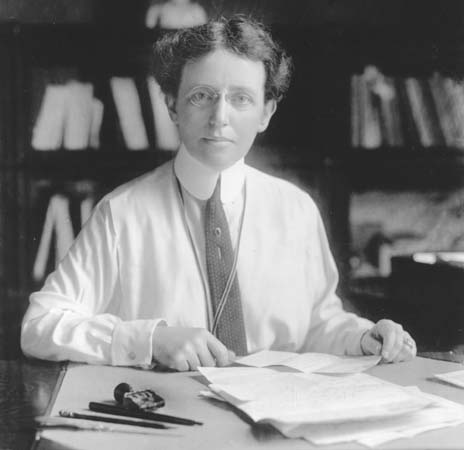
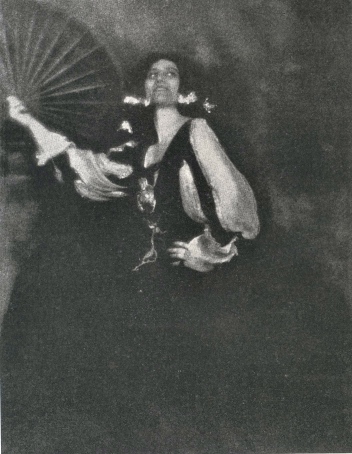
This is a podcast about kindness and care. About the bold Progressive Era pioneers who saved the lives of thousands of people in need — from the Lower East Side to Washington Heights, from Hell’s Kitchen to Fort Greene.
The Visiting Nurses of the Henry Street Settlement
Within just a few decades – between the 1880s and the 1920s – so much social change occurred within American life, upending so many cultural norms and advancing so many important social issues, that these years became known as the Progressive Era. And at the forefront of many of these changes were women.
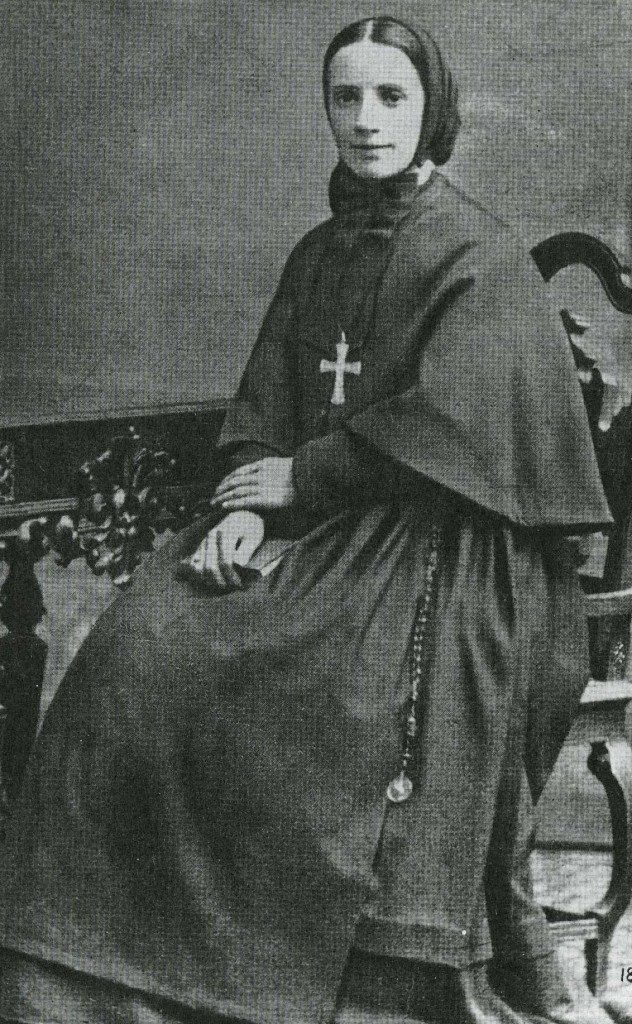
In this show, Greg visits two important New York City social landmarks of this era —Henry Street Settlement, founded by Lillian Wald in the Lower East Side, and the Cabrini Shrine, where Mother Frances X. Cabrini continued her work with New York’s Italian American population.
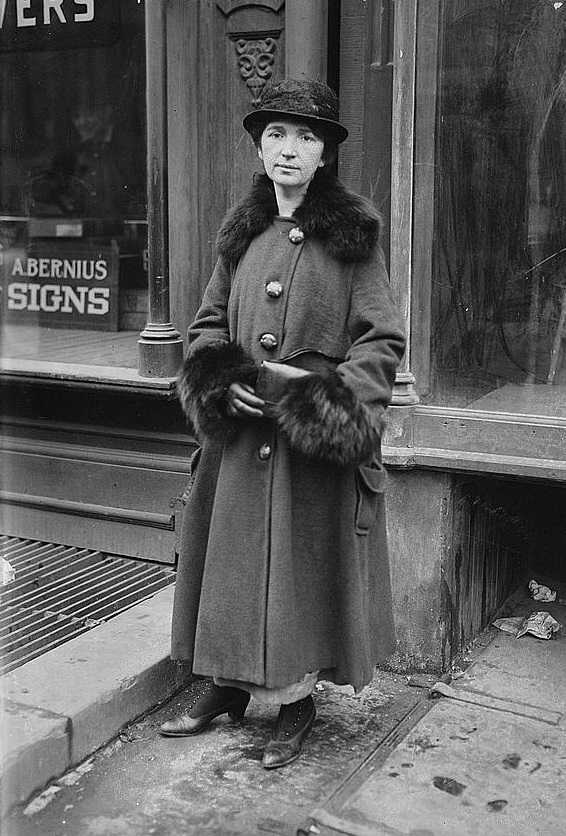
Margaret Sanger’s birth control clinic in Brownsville. (Photo by Underwood Archives/Getty Images)
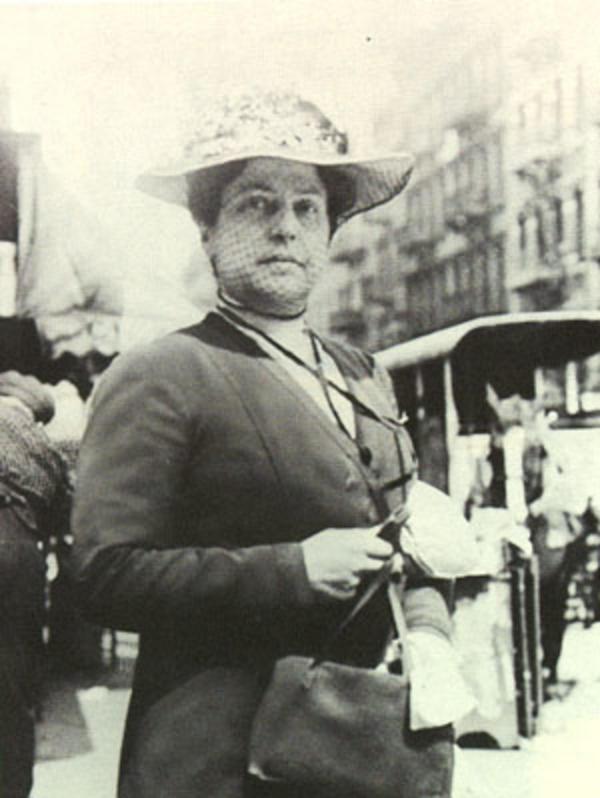
If you have ancestors who came through New York City during 1880s through the 1920s, most likely they came into contact with the efforts of some of the women featured in this show. From the White Rose Mission, providing help for young black women, to the life-saving investigations of ‘Dr. Joe’, leading the city’s fight for improvements to public health.
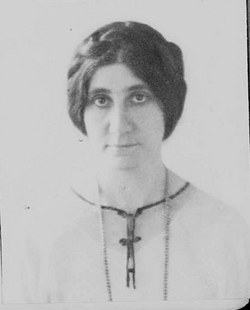
This episode features the stories of the following ten women — not to mention other guest appearances by other important women like Jane Addams, Ida B. Wells, and Eleanor Roosevelt.
Lillian Wald Nursing pioneer and founder of the Henry Street Settlement
The History Chicks Podcast (Beckett Graham and Susan Vollenweider) recorded two shows on the life of Jane Addams for more information on the settlement house movement:
In addition, listen to these shows in our back catalog for more information on subjects mentioned in this show —
For further insights into life in the Lower East Side in the late 19th century:
For more on the neighborhood of San Juan Hill (demolished to construct Lincoln Center):
For a look at what medical institutions were like during this period:
And to get a sense of what the area around Henry Street was like before the settlement house, give a listen to this show on Corlear’s Hook:
Dr. Joe was instrumental in the capture of Typhoid Mary. Revisit our episode on this intense episode of New York City history!
SPECIAL THANKS TO TANYA BIELSKI-BRAHAM, now of the Holocaust Center of Pittsburgh. She joined Greg on the Bowery Boys podcast ten years ago (!) with the story of Ellis Island.
Tanya’s latest project — “The Holocaust Center of Pittsburgh is very excited to share that The Chutz-Pow Project is now available for purchase on Amazon! Be sure to get copies for yourself and those that you care about–you’re supporting the Center and spreading education through art and the true stories of real-world superheroes: Survivors of the Holocaust, Resistance Fighters, and Righteous Gentiles who stood up to horrors of the final solution!”
The Bowery Boys: New York City History podcast is brought to you …. by you!
We are now producing a new Bowery Boys podcast every other week. We’re also looking to improve and expand the show in other ways — publishing, social media, live events and other forms of media. But we can only do this with your help!
We are now a member of Patreon, a patronage platform where you can support your favorite content creators.
Please visit our page on Patreon and watch a short video of us recording the show and talking about our expansion plans. If you’d like to help out, there are six different pledge levels. Check them out and consider being a sponsor.
And join us for the next episode of the Bowery Boys Movie Club, an exclusive podcast provided to our supporters on Patreon.
We greatly appreciate our listeners and readers and thank you for joining us on this journey so far.
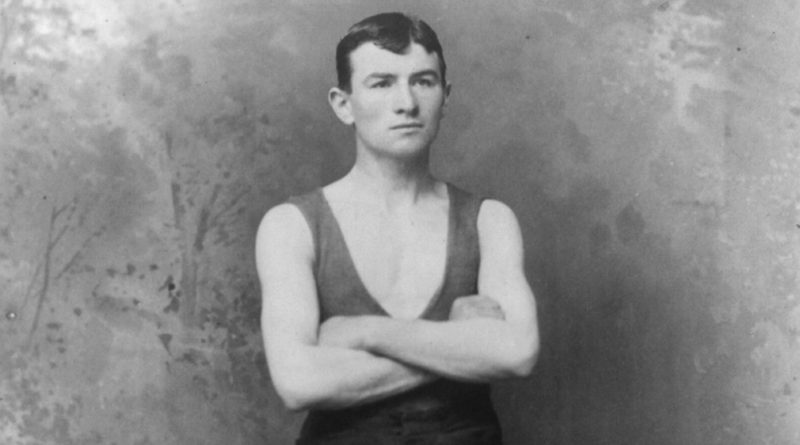
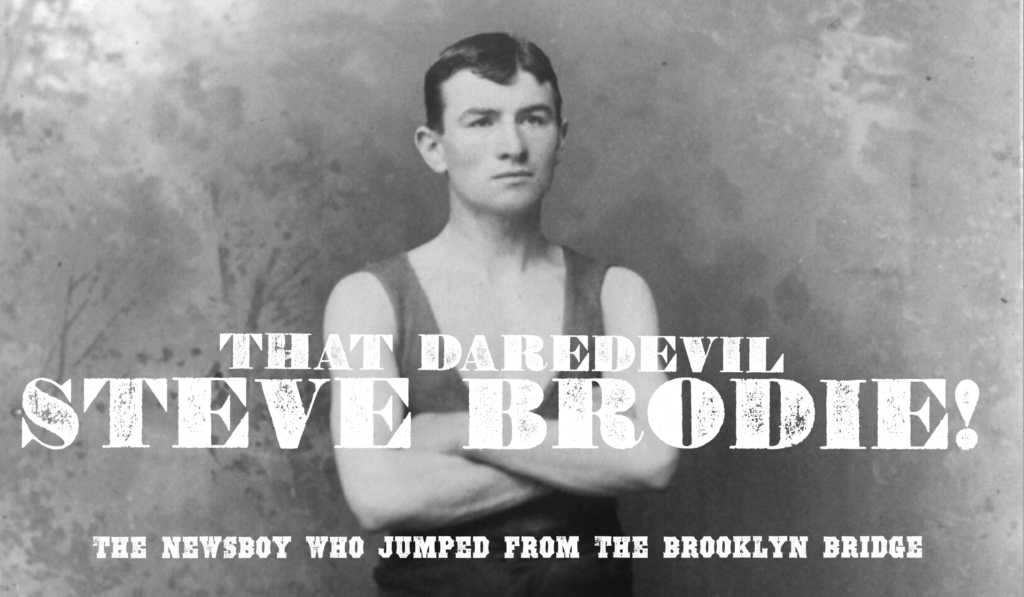
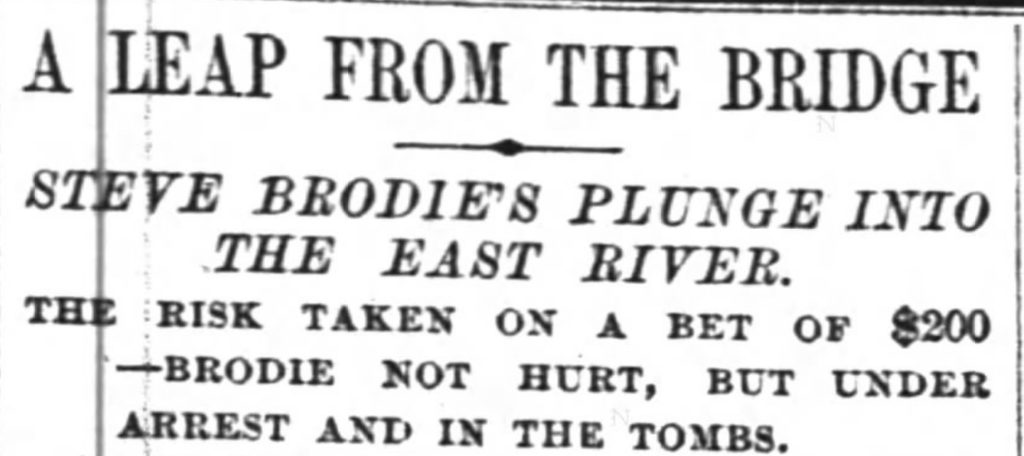
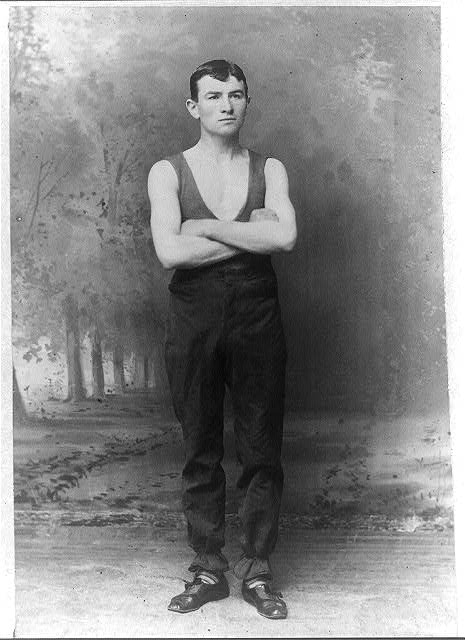
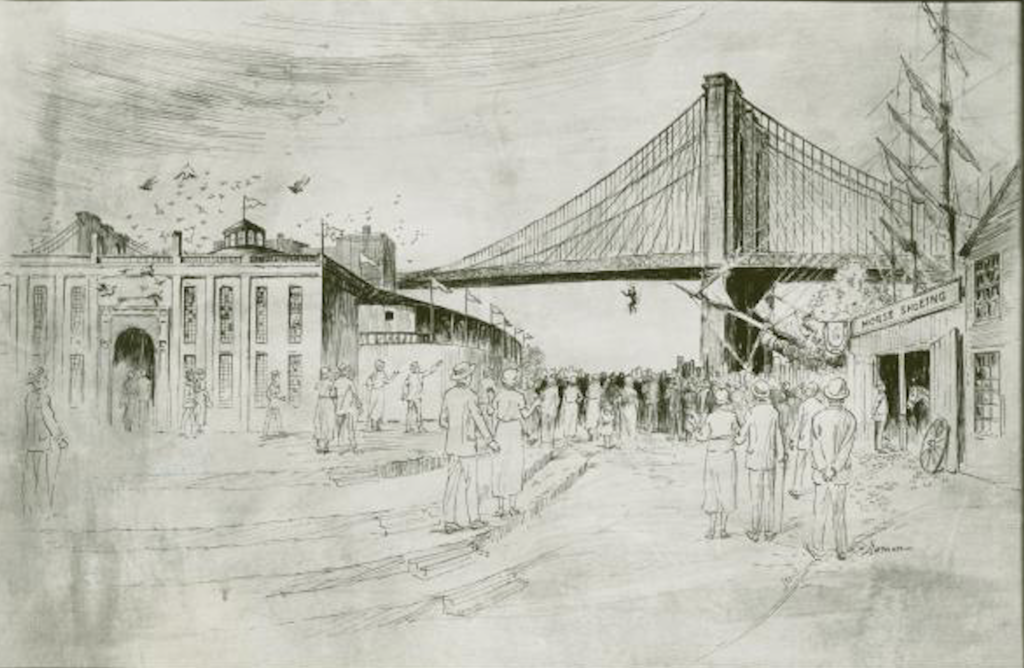
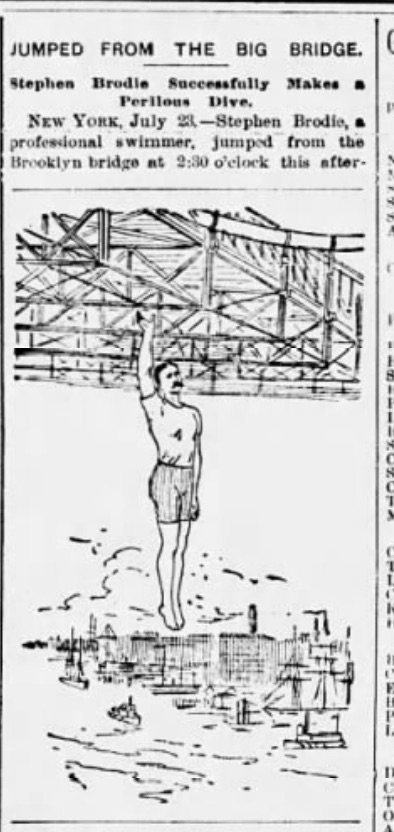
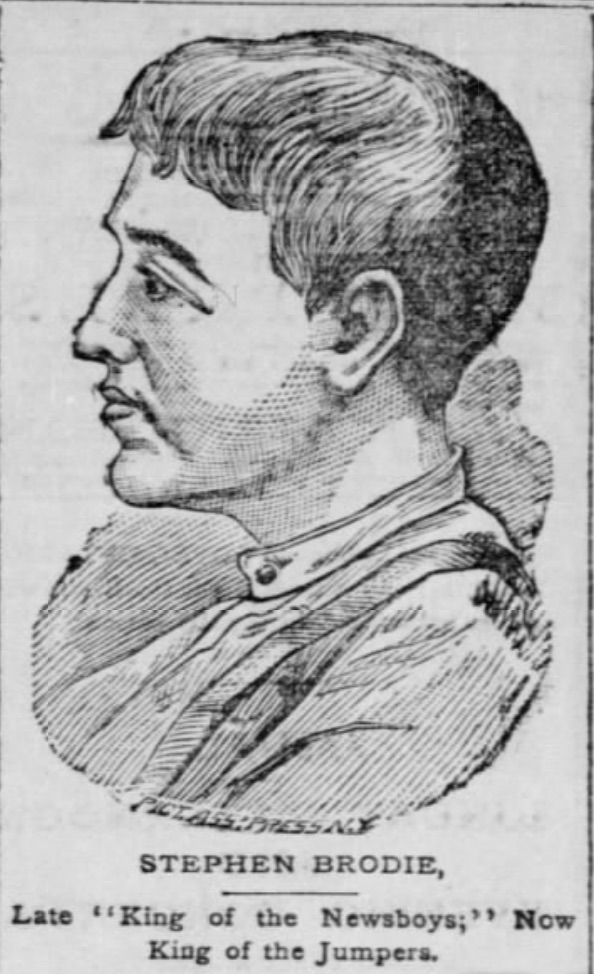
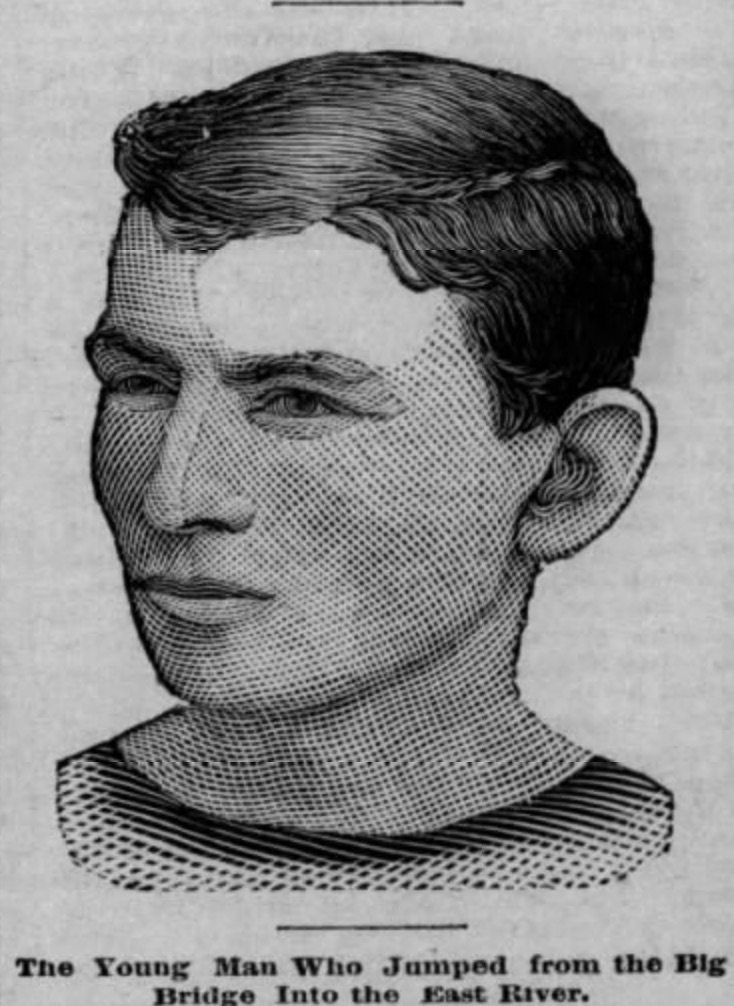
PODCAST A tale of the ‘sporting life’ of the Bowery from the 1870s and 80s. A former newsboy named Steve Brodie grabs the country’s attention by leaping off the Brooklyn Bridge on July 23, 1886. Or did he?
The story of Steve Brodie has all the ingredients of a Horatio Alger story. He worked the streets as a newsboy when he was very young, fighting the bullies (often his own brothers) to become one of the most respected newsies in Manhattan.
He experienced his first taste of adulation and respect as a minor sports celebrity, participating in pedestrian competitions across the country. Back in New York, Brodie started a family and promptly lost most of his money at the race track. He yearned to do something athletic and attention grabbing again.
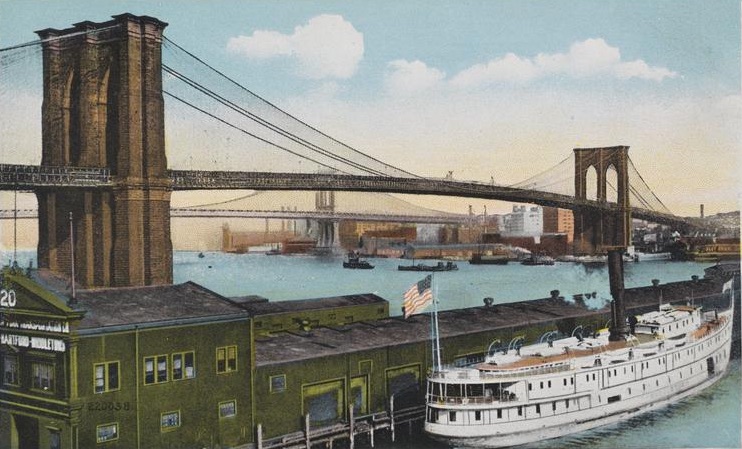
TheBrooklyn Bridge, completed in 1883, was a crowning architectural jewel linking two major cities; Brodie witnessed much of its construction during afternoons diving from East River docks. He now proposed an outrageous stunt that would garner him instant fame and fortune.
He would jump off the Brooklyn Bridge!
Was Steve Brodie a hero or a fool? A daredevil or a con artist? His story provides a window into the ‘sporting men’ life of the Bowery and a look into what may possibly be the greatest hoax of the Gilded Age.
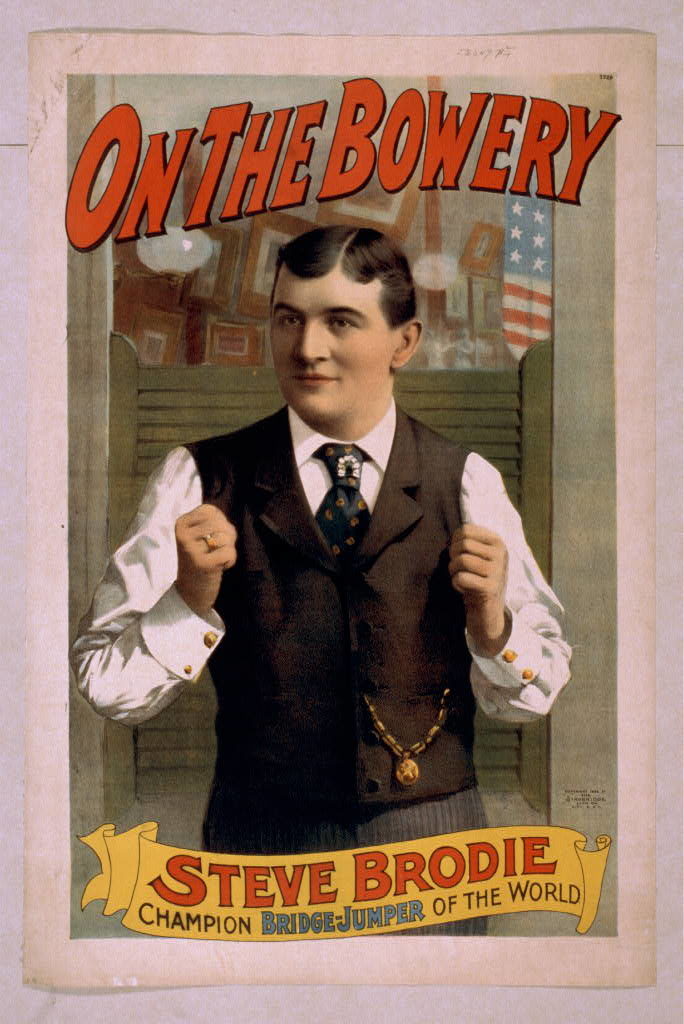
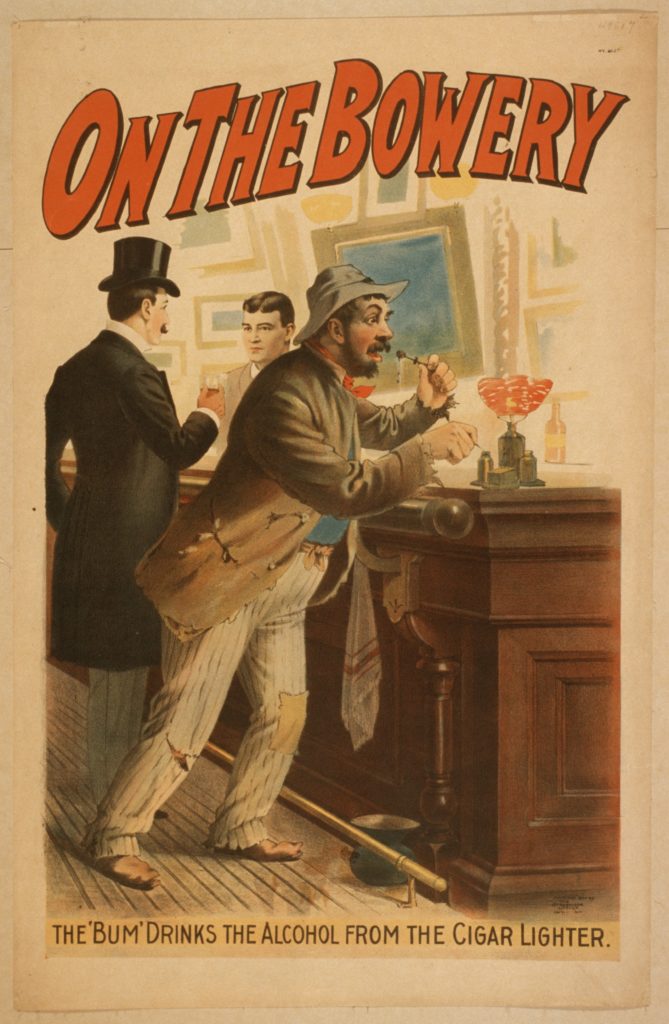
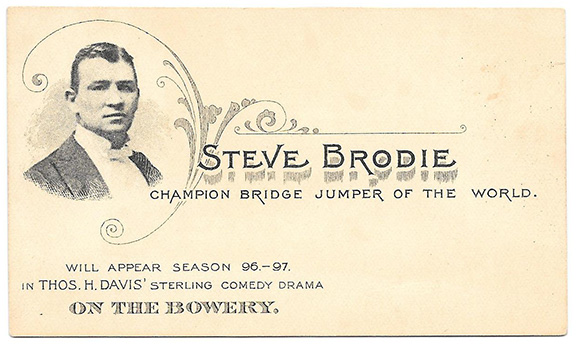
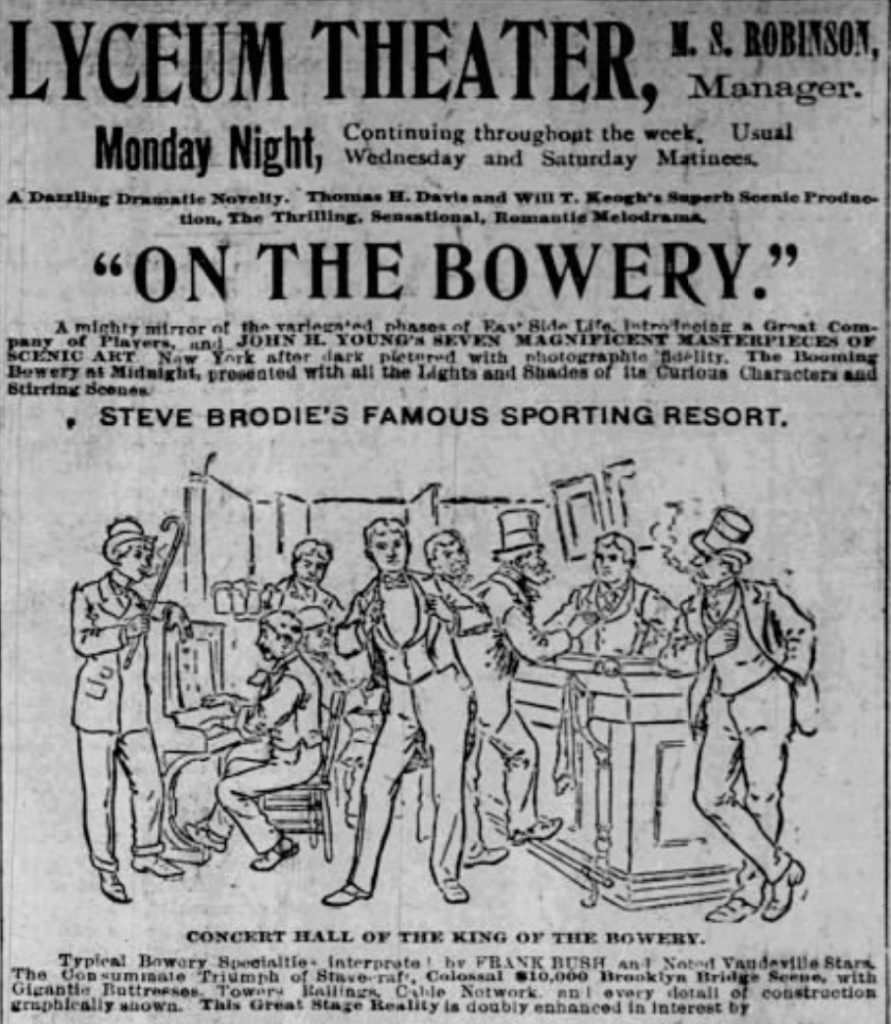
A photograph of Steve Brodie, taken on July 31, 1886, a week after his ‘jump’.Advertisements for the show On The BoweryImages courtesy Library of CongressAn illustration of Brodie’s jump made for the Old New York exhibition at the 1939 New York World’s Fair.
A few of the creative illustrations of Steve Brodie in the days and weeks following his stunt.
Here’s the Bugs Bunny cartoon Bowery Bugs (from 1949), courtesy the Internet Archive.
You can watch the 1933 film The Bowery on streaming services and even get the entire thing — in pieces — on YouTube. Here’s the section of the film featuring Brodie’s ‘brilliant idea’ (at around the 5:30 mark). By the way, this film is riddled with offensive stereotypes so be warned!
The actor Steve Brodie, who made his name in Western films and televisions shows, took his screen name from the Bowery’s Steve Brodie. You can also see Brodie in The Beast from 20,000 Fathoms!
My thanks to Grant Barrett for allowing me to use a clip from A Way With Words. Hopefully you’re all listeners of his excellent show with Martha Barnette about the history of language. Barrett and Barnette have been producing the show since 2007.
And here’s an article I wrote back in 2007 (!) about two saloons on the Bowery — including Brodie’s. This was written for our FRIDAY NIGHT FEVER series about the history of New York City nightlife. Past entries can be found here .
We’re going way, way, way back to New York’s seediest, filthiest and most notorious place — the Bowery in the late 19th century.
The nightlife of the old Bowery could have an entire blog in itself. It has been witness to some of the rowdiest, most shameless and debauched New Yorkers who have ever lived. They filled up dives and flophouses, brothels and saloons, and catered to the poorest of immigrants and the richest of the upper class ‘slumming it’ for a real idea of fun unimagined in the drawing rooms of the elite.
The two saloons from the late 19th century featured here weren’t extraordinary places as we would consider today — they would both fit comfortably in the 20th century sin-den the Limelight — but they were run by extraordinary people, ‘heroes’ of the Bowery brawler set.
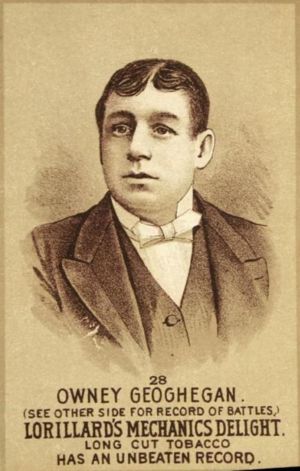
Geoghegan’s at 105 Bowery has been described as “a rendezvous for professional mendicants.” Often called the Bastille of the Bowery, it didn’t just spawn a few fisticuffs; it catered to them. Because this two-floor boiserie featured two boxing rings, and one of the men in the ring was often the bar’s owner.
Owney’s boxing card.
Owney Geoghegan held the boxing distinction of Lightweight Champion of America from 1861 to 1964 when he retired to open his tavern/fight palace in the Bowery. His reputation naturally drew the crowds, and Geoghegan encouraged his patrons on to a little pugilism with the help of ample ales and whiskey. In 1891 the ‘Bastille’ even hosted a few rather fierce bouts of women’s wrestling, with the competitors required to cut their hair (to prevent pulling) and costume themselves wearing only tights.
Such a swarthy establishment was bound to attract the lowest elements and the most sinful gangs of New York. One journalist at the time describes it: “The faces around us are worse than those seen in a bench show of pugnacious dogs, and instinct teaches us to have a care for our nickels, for our pockets are in imminent danger.”
But perhaps the person the clientele should have feared the most was Geoghegan himself. A short but powerful Irish man, Geoghegan was known for his impressive, compact strength. And his penchant to cheat when needed.
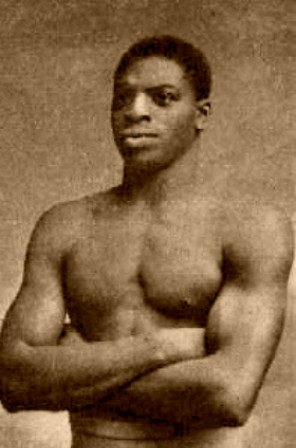
Viro Small, one of the Bowery’s most popular boxers.
Geoghegan was in the ring one night against Viro Small, a very popular black wrestler. Geoghegan was still in his prime but it was clear he was being bested in the ring by Small. The drunken crowd kept catcalling him, and he knew he couldn’t lose in his own establishment. So he had one of his henchmen hold a gun to the referee’s head and call the match for Geoghegan!
(Small didn’t hold a grudge. He later wrestled there again, with a man named Billy McCallum who afterward tried to murder him.)
As Geoghegan flexed his strength to his barflies, another Bowery saloon owner was busy displaying his gifts of agility. In 1886 Steve Brodie, on a bet, jumped off the Brooklyn Bridge, the bridge being only about three years old at the time. What was amazing was not the amount of stupidity that took, but the fact that he survived and claimed his $100 bet money.
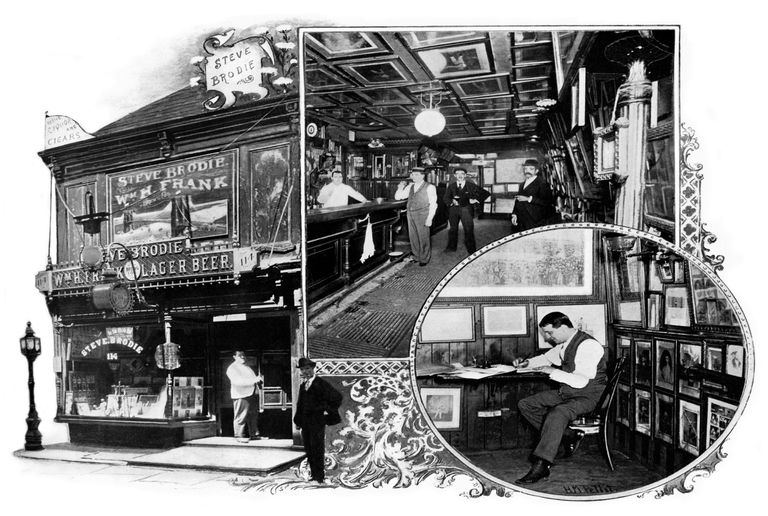
His feat was celebrated at the time and from the fame of this simple act, he was able to open Steve Brodie’s Saloon, 114 Bowery, at Bowery and Grand Street (a couple of doors down from Geoghegan’s place).
Brodie’s saloon. Note the Brooklyn Bridge mural above the bar entrance.
If Geoghegan’s dive was a celebration of his profession, Brodie’s was a celebration of his own personality. Behind the bar was an elaborate oil painting depicting Brodie bravely hurling off the bridge, along with a signed affidavit from the boat captain who fished him out of the water. The floor of the bar was inlaid with silver dollars to give it that wealthy feeling that money had been hurled to the floor.
For the cost of a drink, Brodie would gladly recount his tale. As silly as it seems today, he was able to pack in patrons, perhaps many from Geoghegan’s place, still drunk on booze and bloodletting.
Somehow he managed to turn his feat into a touring autobiographical performance entitled On The Bowery. Eventually, he tried to top his feat with a plunge down Niagara Falls in 1889. (It could never be proven that he actually went ahead with it!) He settled in Buffalo and opened another saloon there, but the enigma of his fame apparently didn’t carry that far. He moved to San Antonio and died at age 39.
Geoghegan had a similar short-lived fate. He lapsed into a severe depression at the death of his father and, traveling to Hot Springs, Ark., to try cure himself of his pain, actually died there, age 45.
As his obituary in the New York Times said: “There is mourning in the Bowery, sorrow on Houston and Bleecker streets, and desolation in the dance halls of the slums….. His career as a prizefighter, ward heeler and dive keeper was that of the typical New York rough, and is only interesting as it illustrates a phase of life little known to respectable people.”
The Bowery Boys: New York City History podcast is brought to you …. by you!
We are now producing a new Bowery Boys podcast every other week. We’re also looking to improve and expand the show in other ways — publishing, social media, live events and other forms of media. But we can only do this with your help!
We are now a member of Patreon, a patronage platform where you can support your favorite content creators.
Please visit our page on Patreon and watch a short video of us recording the show and talking about our expansion plans. If you’d like to help out, there are six different pledge levels. Check them out and consider being a sponsor.
And join us for the next episode of the Bowery Boys Movie Club, an exclusive podcast provided to our supporters on Patreon.
We greatly appreciate our listeners and readers and thank you for joining us on this journey so far.
Our first-ever Bowery Boys book, “Adventures in Old New York” is now out in bookstores! A time-traveling journey into a past that lives simultaneously besides the modern city.
Bowery Boys Walking Tours
Are you ready to walk through time? We’re excited to announce Bowery Boys Walks, our new walking tours developed around our podcast. Join us in the streets — beginning in October 2018!
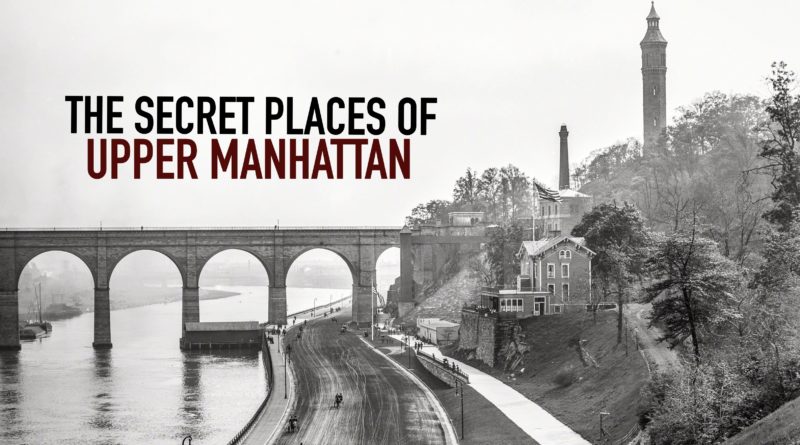
PODCAST A tour of historic sites in Washington Heights and Inwood, an unusual set of landmarks and curious destinations that comprise almost 400 years of Upper Manhattan history.
In Washington Heights and Inwood, the two Manhattan neighborhoods above West 155th Street, the New York grid plan begins to become irrelevant, with avenues and streets preferring to conform to northern Manhattan’s more rugged terrain. As a result, one can find aspects of nearly 400 years of New York City history here — along a secluded waterfront or tucked high upon a shaded hill.
In this episode, we look at four specific historic landmarks of Upper Manhattan, places that have survived into present day, even as their surroundings have become greatly altered.
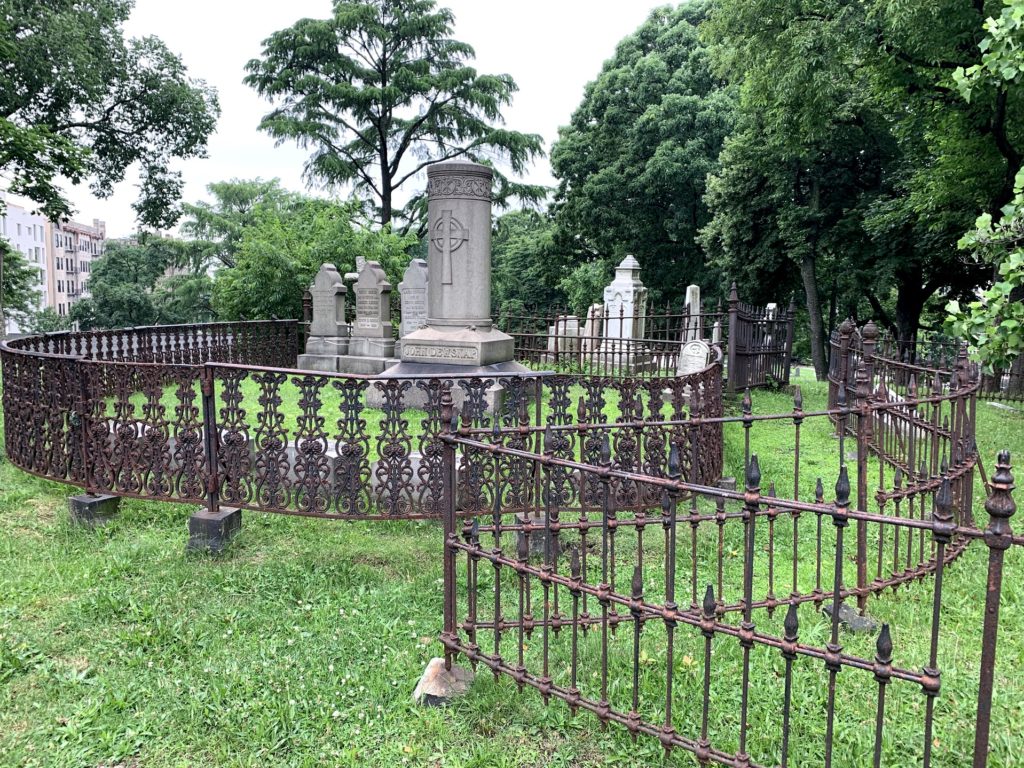
— A picturesque cemetery — the final resting place for mayors, writers and scandal makers — split in two;
— An aging farmhouse once linked to New York’s only surviving natural forest with a Revolutionary secret in its backyard;
And that’s just the beginning! Upper Manhattan holds a host of fascinating, awe-inspiring sites of historical and cultural interest. For those who live and work in Washington Heights and Inwood, these historic landmarks will be familiar to you. For everybody else, prepare for a new list of mysterious landmarks and fascinating places to explore this summer.
Twenty remarkable places of historic interest in Washington Heights and Inwood
After you listen to our podcast episode, check out all twenty sites listed below — by foot, by bike or by subway. Under the article, you’ll find a Google Map that you can use to help you navigate the uptown city streets.
1 TRINITY CHURCH CEMETERY AND MAUSOLEUM
In 1842, with the city rapidly growing and new burials banned from lower Manhattan, Trinity Church constructed a second cemetery, way, way out of town upon property owned by naturalist John James Audubon (1785–1851). It was a spot for quiet contemplation—until they plowed Broadway through it in 1871, splitting Trinity’s peaceful cemetery in two (and disinterring dozens of bodies in the process). Eliza Jumel, John Jacob Astor, Ed Kochand Clement Clarke Moore (the author of ‘A Visit from St. Nicholas‘) are buried here. (770 Riverside Drive)
2 AUDUBON TERRACE
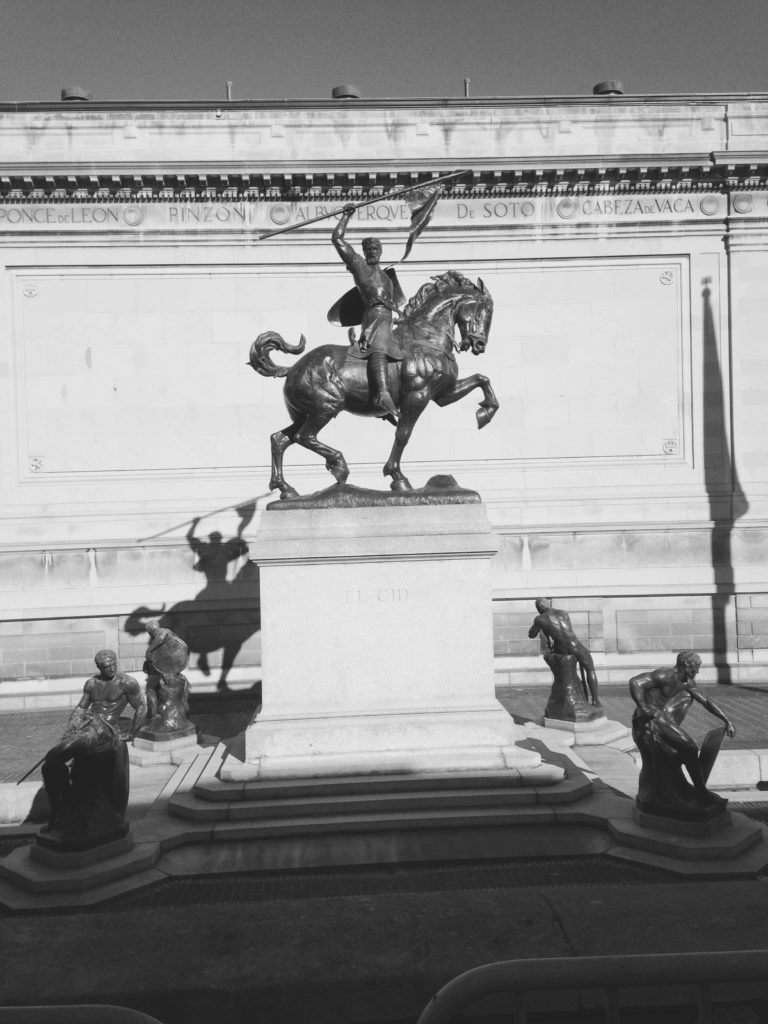
This pocket of majestic Beaux-Arts palaces surrounds a sculpture garden that would look at home in the Metropolitan Museum of Art or the Frick Collection. The Audubon Terrace’s remoteness is a big part of its charm. Audubon owned twenty acres of rolling hills, ideal for his naturalistic obsessions, and when he died in 1851, the land was parceled off into a shaded neighborhood named Audubon Park.
Philanthropist Archer Milton Huntington developed several institutions here including the Hispanic Society of America and the originalMuseum of the American Indian (which later moved downtown to even loftier digs). Boriqua College also makes its home here today. (Broadway and West 155th Street)
3 POLO GROUNDS STAIRCASE
Polo Grounds Towers, a housing project on West 155th Street, marks the former spot of the Polo Grounds (1890–1964), the legendary stadium that was home to three major baseball teams (Yankees, Mets, and Giants) and the first home to football’s New York Jets.
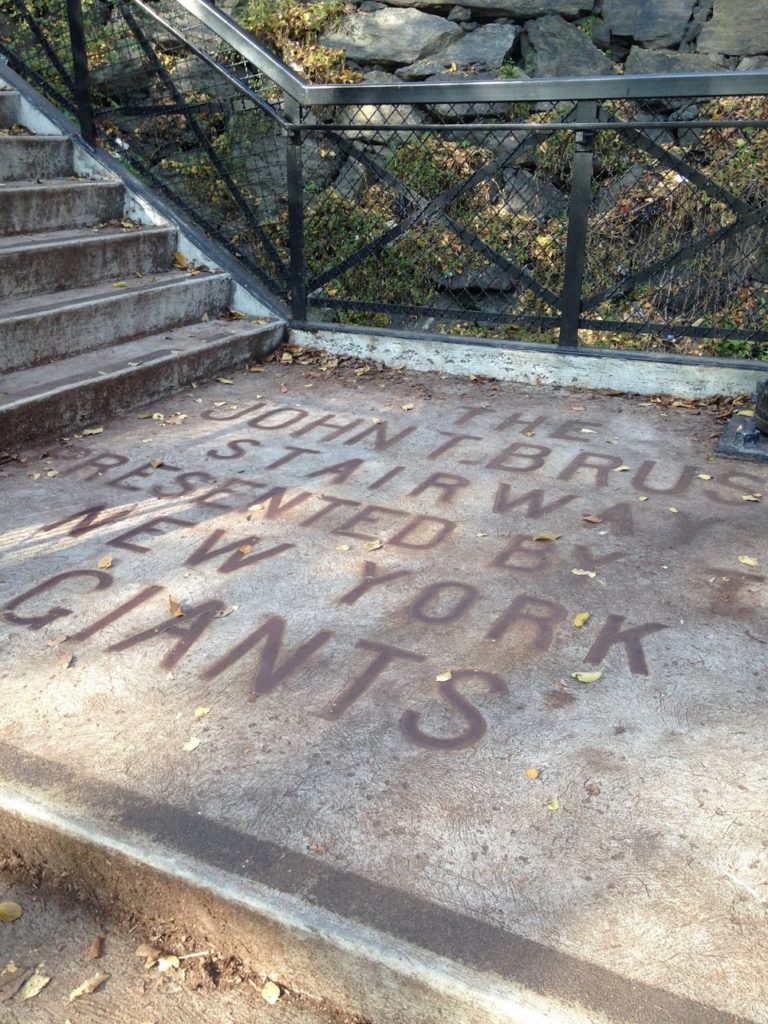
A surprising vestige remains today: a staircase, linking the low-lying east side to the high promontory called Coogan’s Bluff. The stairs were installed in 1913, linking public transit on the bluff to the stadium. An even more romantic image to ponder: fans with empty pockets often watched games from these stairs, which are named for John T. Brush, the owner of the Giants from 1890 until he died in 1912. (Edgecombe Avenue and West 158th Street)
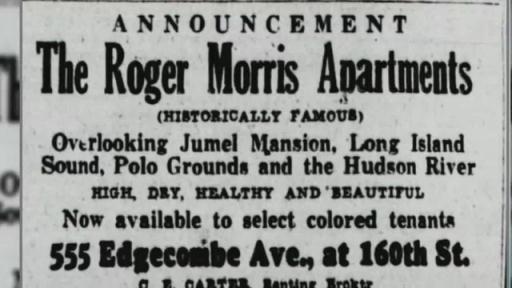
The residences of Edgecombe Avenue enjoy gorgeous views of the Harlem River, and the mid-1910s apartment tower at 555 even enjoys close proximity to the Morris-Jumel Mansion. (The building was even named for Roger Morris when it first opened).
But it’s the stellar line-up of African-Americans notables who lived here starting in the 1930s that gives the building its reputation — including Joe Louis, Count Basie and Paul Robeson. It is because of Robeson, film star and civil rights icon, that the building is also a National Historic Landmark. (555 Edgecombe Avenue)
5 MORRIS-JUMEL MANSION
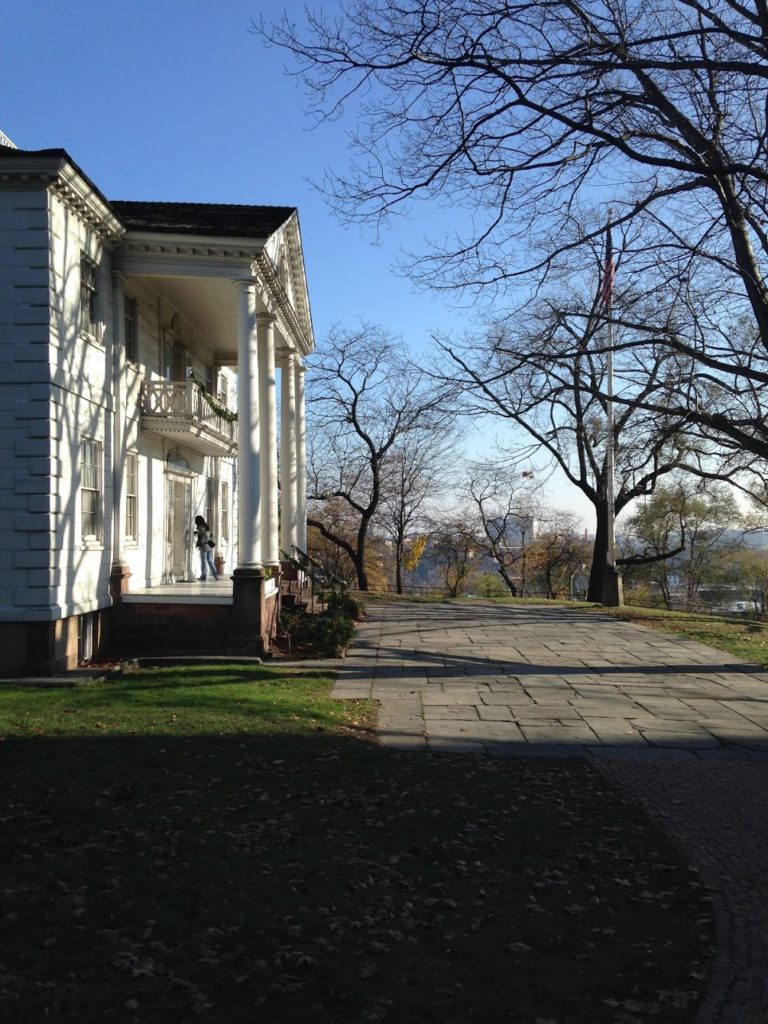
Built in 1765, the Morris-Jumel Mansion is the oldest surviving house in New York, and was the home of British sympathizer Roger Morris, who wisely decided to bid New York adieu during the war.
But it’s the tales of Eliza Jumel that give its Colonial hallways a jolt of scandal. She married former vice president Aaron Burr, but his squandering of her estate led to a quick divorce. When she died in 1865, she was regarded as one of the most notorious women in the city’s history. Some say her ghost still inhabits the house (now a fascinating museum, well worth a visit). If you see her, say hello from us. (65 Jumel Terrace at West 160th Street)
6 SYLVAN TERRACE
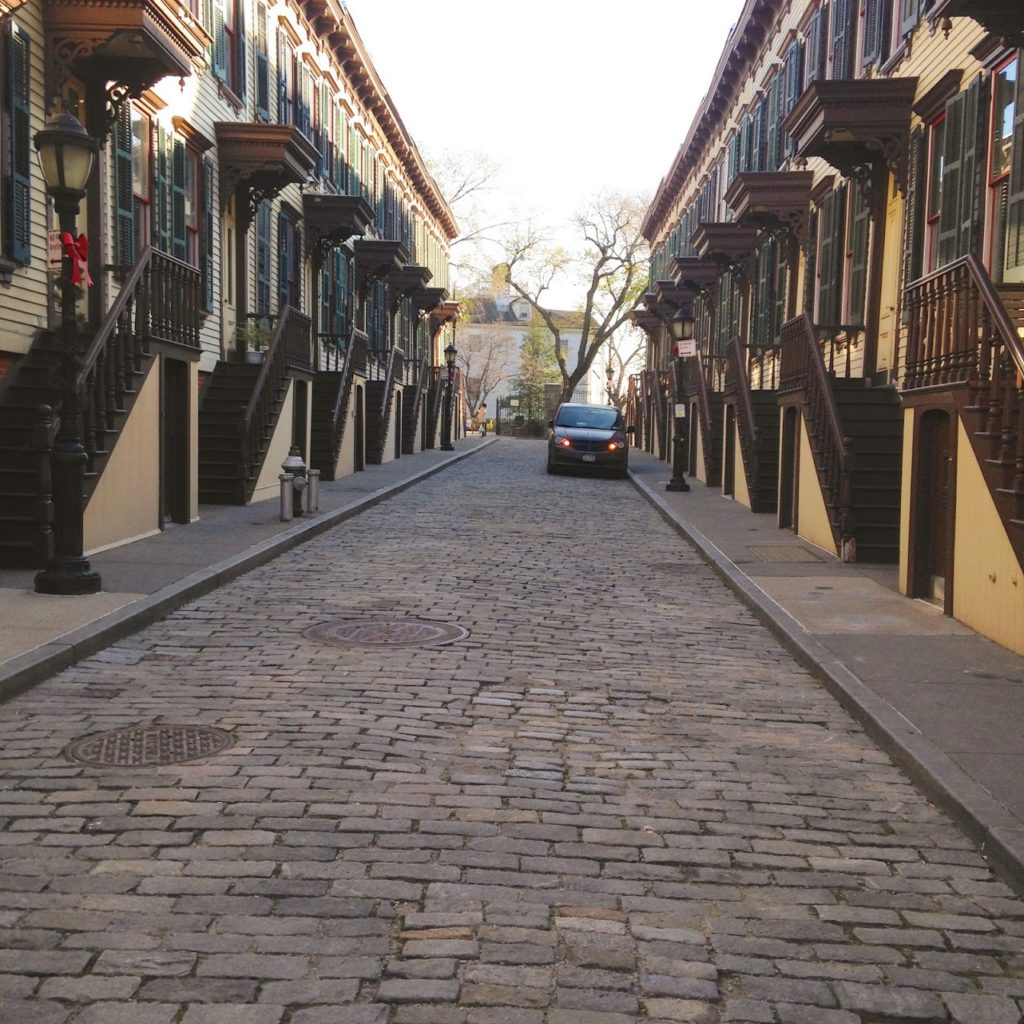
This slightly surreal, Belgian block street presents a row of curious wooden houses, lined up like Victorian-era dollhouses. They were constructed in 1882 along the former carriage trail leading to the Jumel Mansion. Their staircases rising high off the street like lifted petticoats but, despite their haughty airs, these jewels were built for working class families. (St. Nicholas Avenue, between West 160th and 161st Streets)
7 AUDUBON BALLROOM
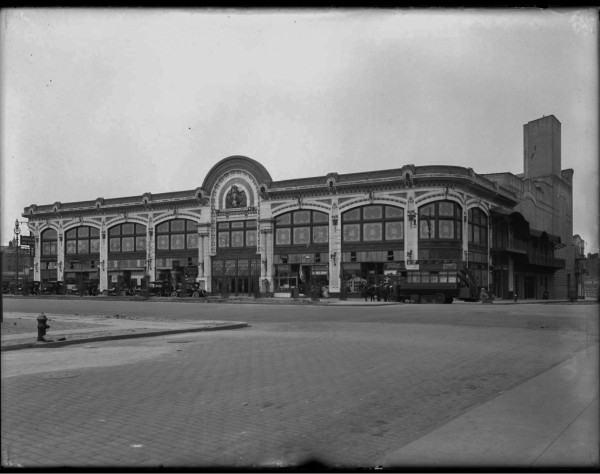
Few buildings have gone through as much adaptation as this former 1912 Thomas Lamb-designed movie palace, a colorful slice of terra-cotta birthday cake decorated with foxes — in honor of Lamb’s client William Fox. By the 1930s, its basement housed a synagogue while impassioned labor gatherings took place upstairs.
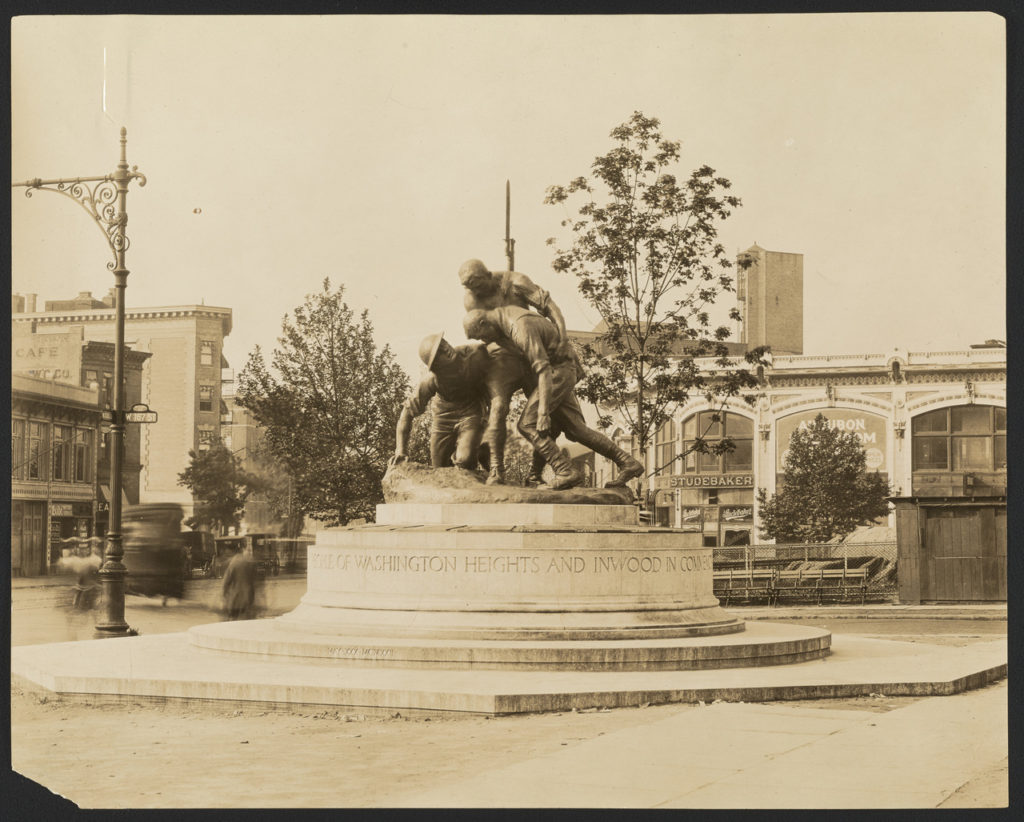
Situated in the middle of a collection of medical buildings (most associated with NewYork-Presbyterian), this triangular wedge park is named for one of our favorite mayors — John Purroy Mitchel aka ‘The Boy Mayor’.
After Mitchel left office, he entered the service to fight in World War I but tragically died in training exercise in Louisiana on July 6, 1918. This park was named in his honor a month later.It would acquire an interesting war memorial in 1923, sculpted by Gertrude Vanderbilt Whitney. Several years later, Whitney would found her own museum, comprised almost entirely of work she collected — the formation of the Whitney Museum. (3975 Broadway)
Beyond My Ken/Wikimedia
9 FORT WASHINGTON AVENUE ARMORY
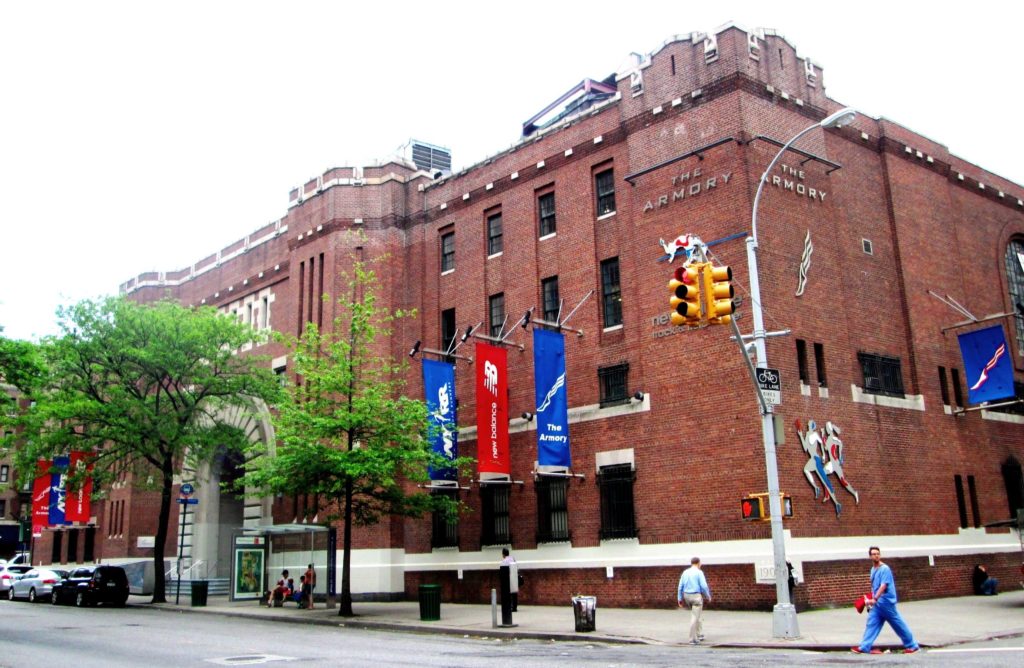
Manhattan once had over twenty armories, built to store military ammunition and sometimes house troops. This armory, named for the old Revolutionary War fort, was built in 1911 and became home to a regiment of the Army Corp of Engineers.
Today it’s more associated with another sort of endurance — track and field. The Armory Track is one of the most important sites in America for the sport, and the National Track and Field Hall of Fame shares space here with dozens of yearly track events. (216 Fort Washington Avenue)
Sam Costanza for New York Daily News
10 COOGAN’S
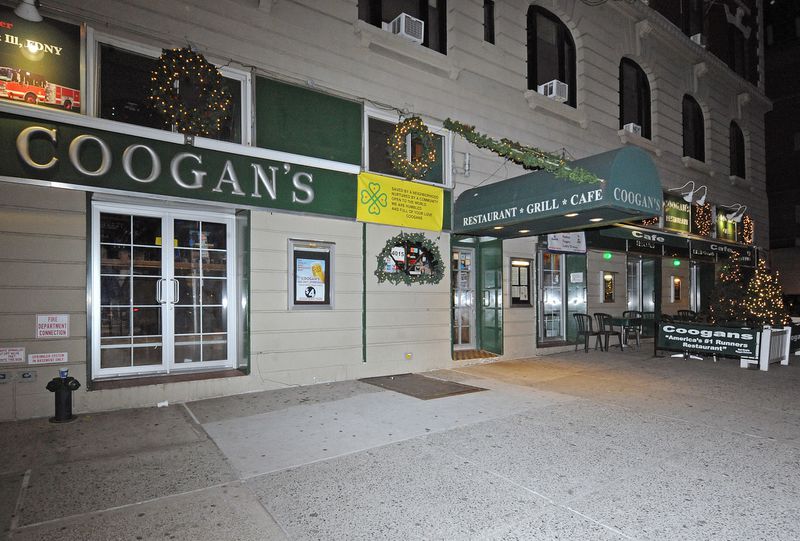
Coogan’s is the Cheers of Washington Heights, although they prefer, according to their website, “the Washington Heights equivalent of Rick’s Place in Casablanca.” Since 1985, the flamboyantly decorated pub has welcomed visiting dignitaries and countless celebrities. In 2018, when Coogan’s announced they would be closing, regular patron Lin-Manuel Miranda swept in to help save the place! (4015 Broadway)
Courtesy Greg Young
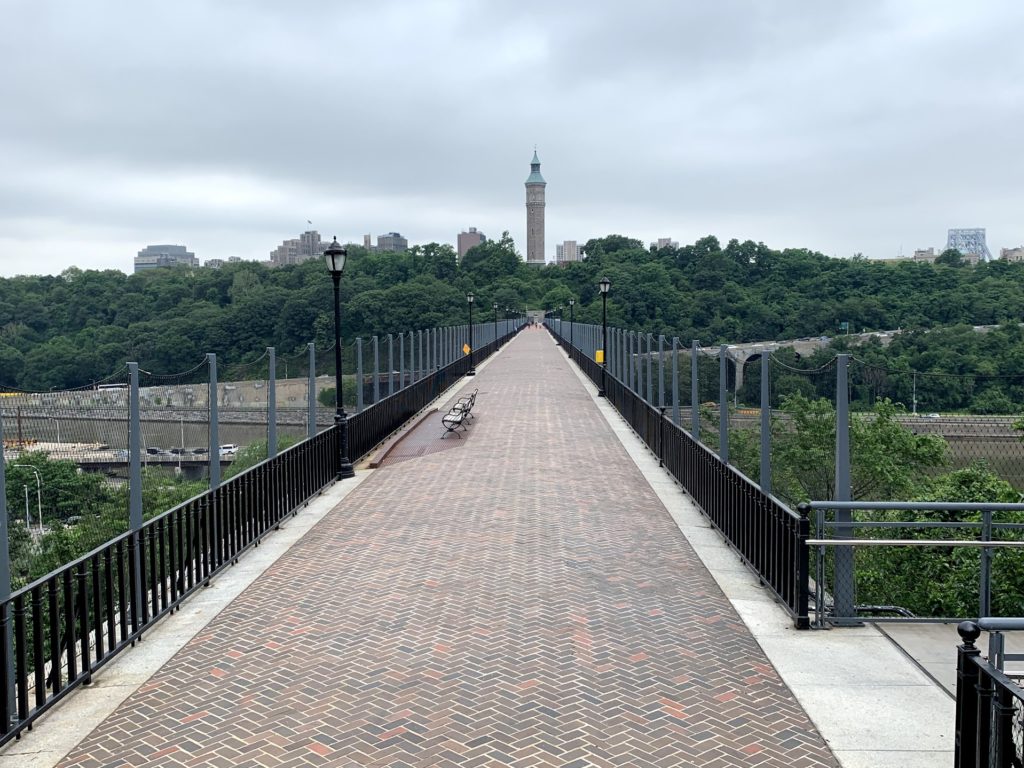
11 THE HIGH BRIDGE
No monument to freshwater dominates quite like the High Bridge, the Romanesque wonder linking Manhattan to the Bronx over the Harlem River. For many decades this majestic artifact, seemingly plucked from the hills of ancient Gaul, was a vital link in that great engineering triumph: the Croton Aqueduct.
Completed in 1848, it not only brought the Croton water into the city, but it also made one heck of a statement noticed around the world. In 1872, as masses of new arrivals from far-off lands crammed into tenements, an attractive water tower was constructed near the High Bridge to help increase the water pressure into the city.
The water has long been turned off, but the bridge still beckons pedestrians onto its expanse over the Harlem. (Highbridge Park)
12 UNITED PALACE / EL MALECÓN
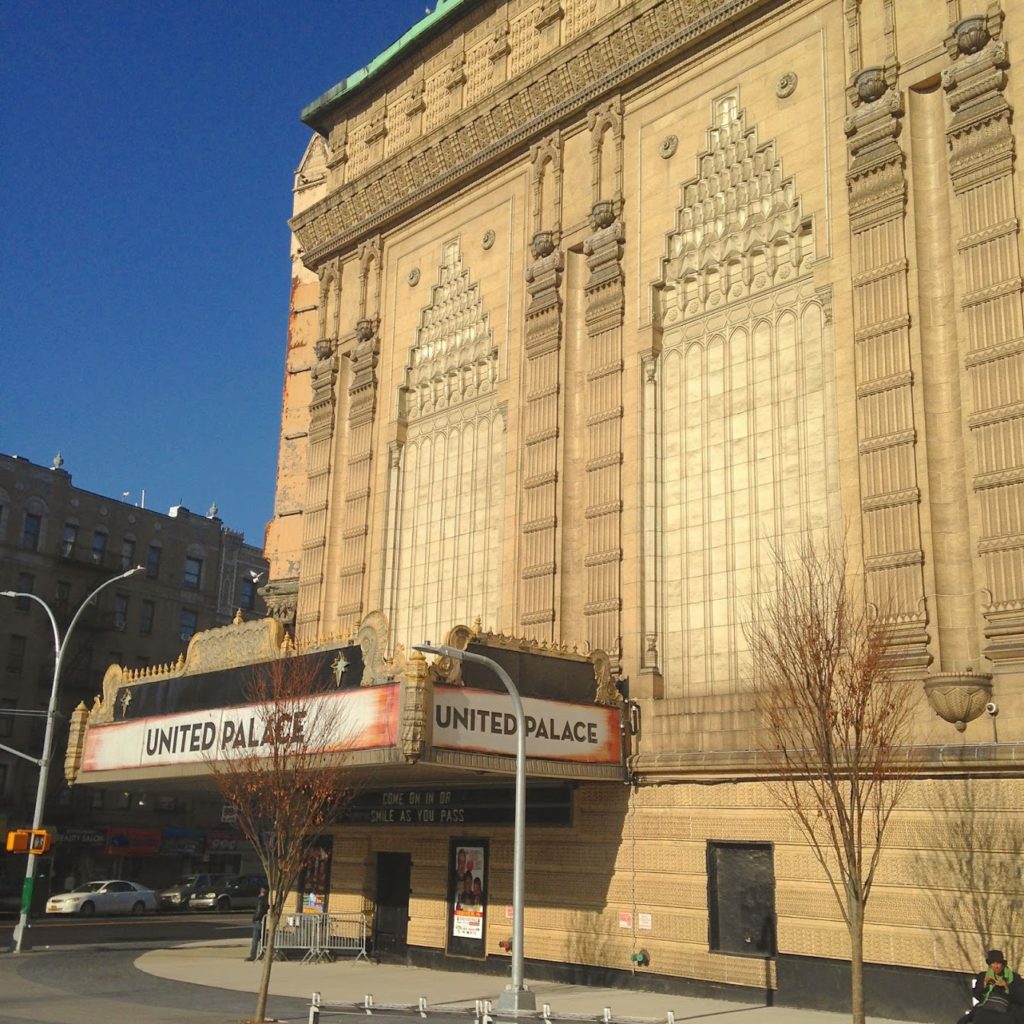
Just up the street from the Audubon Ballroom sits another Thomas Lamb movie palace — the equally dazzling Loew’s 175th Street Theatre, one of New York City’s original ‘Wonder Theatres’ that took movie going to a new level of luxury.
It took a decidedly Evangelical direction in 1969 when the television preacher Reverend Ike transformed it into the Palace Cathedral. While it still retains religious ties, the venue is frequently opened to concerts and film revivals — and frequently hosts tours of the site. (Check out the entire schedule here.) (4140 Broadway)
By the way, across the street is one of the best restaurants in the neighborhood EL MALECÓN, serving some of New York’s best Dominican cuisine for over thirty years. (4141 Broadway)
13 THE LITTLE RED LIGHTHOUSE
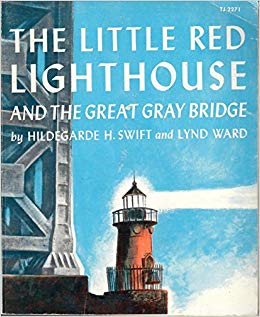
Dwarfed by the might of the George Washington Bridge, tiny as a peg as you drive past it into Manhattan, is the quiet red Jeffrey’s Hook Light far below. Manhattan’s only operational lighthouse when it was placed here in 1921, it was quickly made obsolete by the very bright new bridge that opened high above it in 1931— the new structure cast plenty of light down to help guide vessels along the Hudson.
Fortunately for the lighthouse, it became the subject of a popular 1942 children’s book, The Little Red Lighthouse and the Great Gray Bridge by Hildegarde Swift. Demolishing it would have been like killing off Pinocchio, and so it remains to this day. (178th Street and the Hudson River)
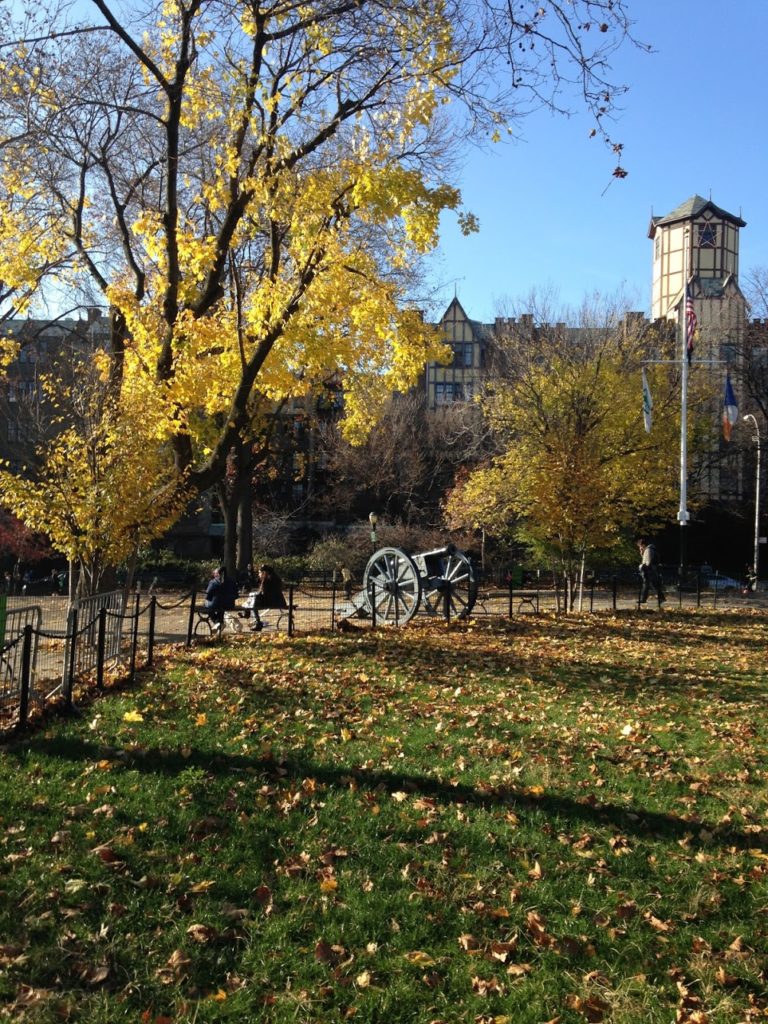
Bennett Park on a nice fall day last year. Courtesy Greg Young
14 BENNETT PARK
The highest point on Manhattan Island was, unsurprisingly, also the site of Fort Washington, a Revolutionary War fort. Nothing remains of it; the spot, now surrounded by apartment buildings, instead holds Bennett Park today, named for news paper publisher James Gordon Bennett, Sr. because he happened to own this land when he died in 1872.
A decorative cannon still adorning the park is a stern reminder of the day, November 16, 1776, when the fort fell into British hands. And nearby, to commemorate the bicentennial of Washington’s birth in 1732, grows an American elm, planted in 1932. (Fort Washington Avenue, West 183rd Street, Pinehurst Avenue)
Courtesy Mother Cabrini
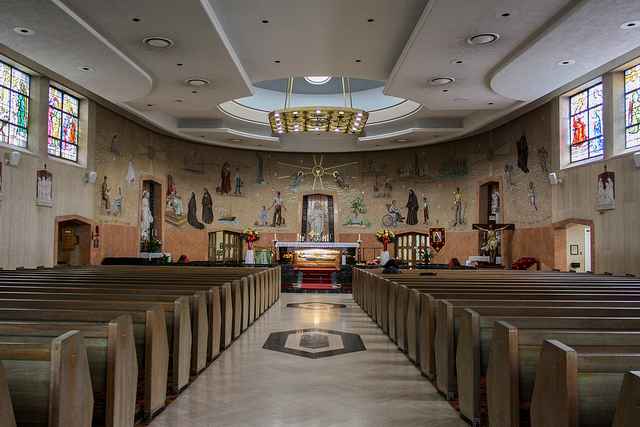
15 ST. FRANCES XAVIAR CABRINI SHRINE
The Cloisters isn’t the only place to find a bit of religious reliquary in Upper Manhattan. In 1899 Mother Frances Cabrini, who founded hospitals and orphanages throughout the United States, bought a remote piece of property on Fort Washington Avenue and founded a high school here. When she died in 1917, her remains were kept in the high school chapel.
But her canonization in 1946 required a larger quarters for visitors and she was moved to this newly constructed shrine in 1959. You can visit Cabrini to this day; she’s contained in a glass coffin beneath the altar. (July 13, her birthday, would be a special time to visit.)
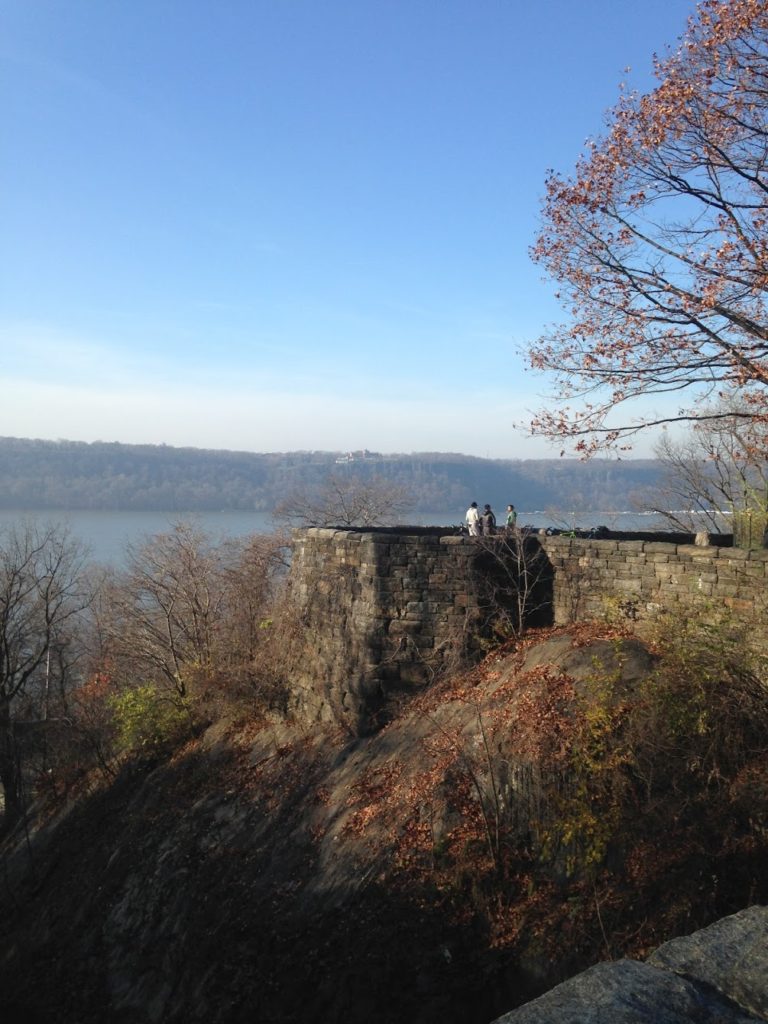
Fort Tryon Park last fall. Photo by Greg Young
16 FORT TRYON PARK
This captivating public park not only hosts the renowned Cloisters museum, but it’s also one of the lushest and most romantic spots in Manhattan, with dramatic outlooks over the Hudson River and sweeping views of the Palisades. Curiously, the name refers to Sir William Tryon (1729–1788), one of the last governors of the Province of New York, who led British forces to burn and plunder civilian outposts throughout New England during the Revolutionary War. He was a debonair monster. And yet the name has, by tradition, stuck.
Wander the meandering paths and you’ll come across several other mementos of long-ago times, including a bronze plaque to the memory of Margaret Corbin (1751–1800), considered the first woman to see active battle in the Revolutionary War and the first to receive a military pension after the war. (190th Street and Fort Washington Avenue)
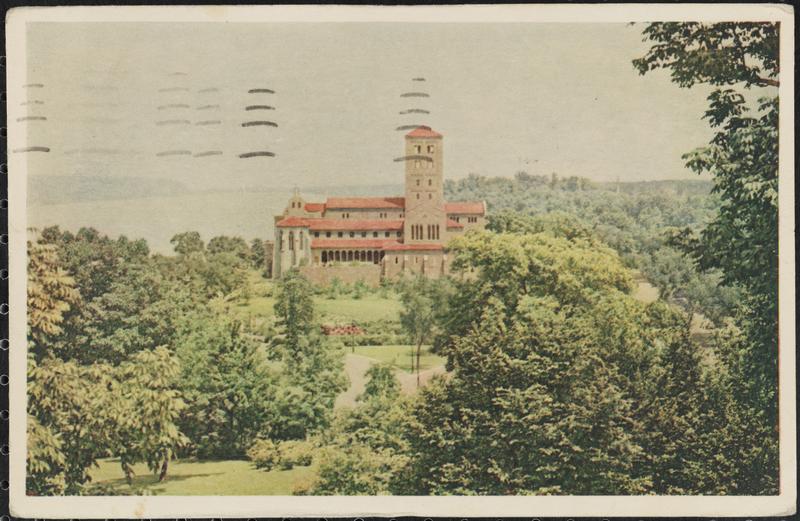
The Cloisters in a postcard image, 1950. Courtesy the Museum of the City of New York.
17 THE MET CLOISTERS
The Cloisters is an offshoot of the Metropolitan Museum of Art, specializes in medieval European treasures and is filled with spectacular examples of Middle Ages paintings, reliquaries, tapestries, and tombs.
But nearly as amazing as its collection is the actual museum structure itself, its walls, corridors, and apses cobbled together from five European holy sites and cloisters.
Parts of the Cloisters are among the oldest structures standing in the United States—although of course, they weren’t made here. They were brought over, stone by stone, in an ambitious scavenger hunt that could only have been the pet project of one of the richest New Yorkers who ever lived: John D. Rockefeller, Jr.
The Hessian Hut on a sunny day at Dyckman Farmhouse. Pic courtesy Greg Young
18 DYCKMAN FARMHOUSE MUSEUM AND HESSIAN HUT
Not all of the surviving Colonial-era homes in New York are elegant mansions. The Dyckman Farmhouse, built in 1784, wouldn’t look out of place on the Midwestern prairie. However, it could not be farther from an actual farm today, as it is boxed in by apartment buildings and locked into place by the traffic of Broadway. Two additional features set it apart from the urban reality that surrounds it: 1) It has a backyard, blooming with flowers, and 2) that backyard also has rugged Hessian barracks. The excavated hut—thrillingly rebuilt in 1916, when the home became a museum—predates the house. (4881 Broadway)
NOW SHOWING AT THE DYCKMAN FARMHOUSE: An interesting new exhibition by Peter Hoffmeister commemorating the Inwood Slave Burial Ground. As the year unfolds, Hoffmeister will be creating additional works placed throughout the house, creating a dialogue between his studio practice and research in our archives.
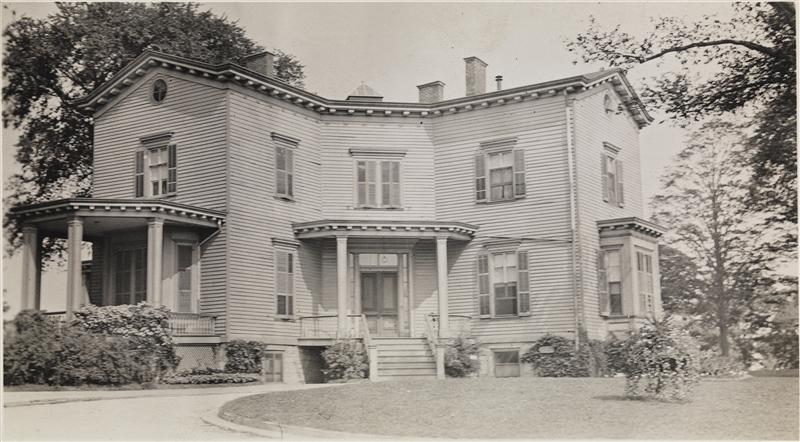
The former Isham Mansion, pictured here in 1930 — before Robert Moses pulled it down! Courtesy Museum of the City of New York
19 ISHAM PARK
This extraordinarily peaceful spot also has deep Revolutionary roots but it also has a unique connection to another aspect of Inwood history. Until the early 20th century, mansions of elite New Yorkers dotted this rugged landscape, and it was on this exact spot that banker William Bradley Isham built a summer home. Believe it or not, the home and many surrounding structures were actually a part of the park when it opened in the 1910s. Parks commissioner Robert Moses had these structures ripped down in the 1940s. (Isham Street and Seaman Avenue)
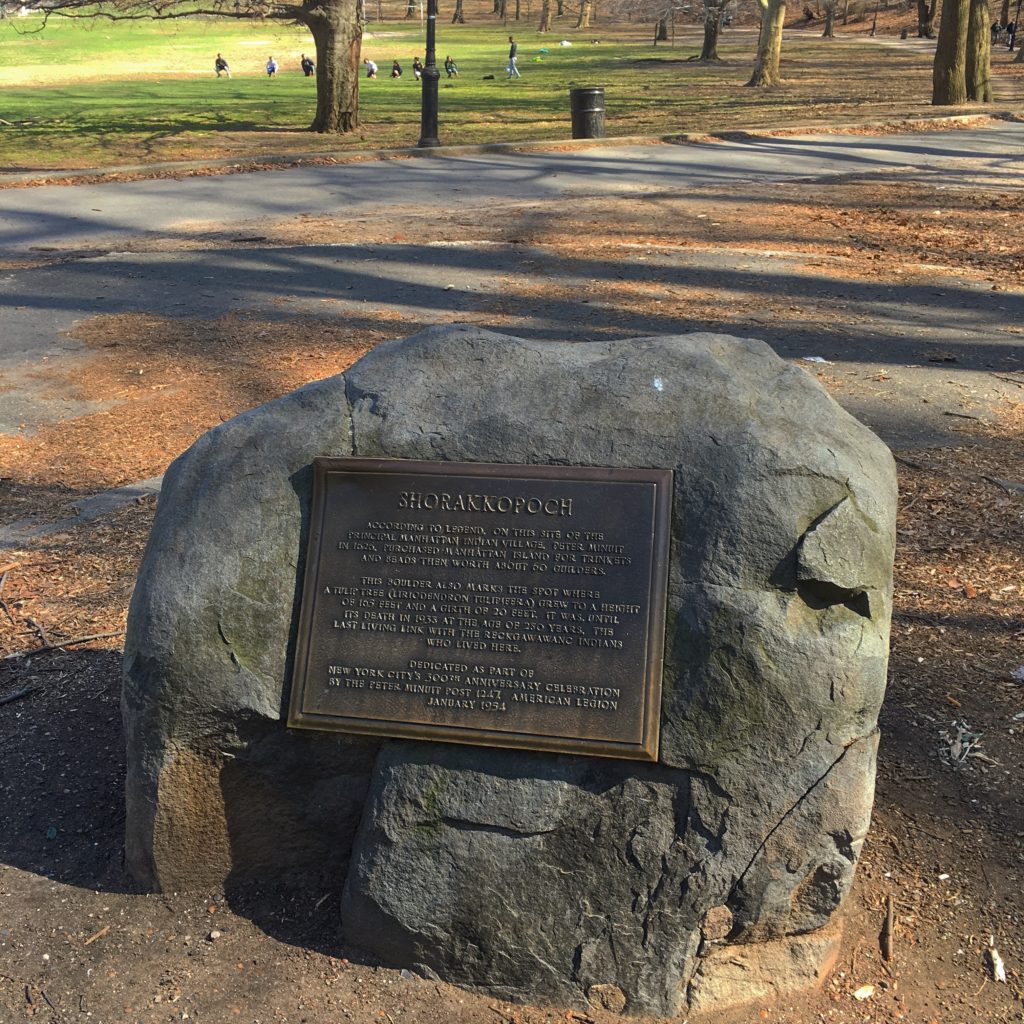
20 INWOOD HILL PARK / SHORAKKOPOCH ROCK
This majestic park is quite possibly New York City’s most under-appreciated treasure, a series of breathtaking postcards come to life, where earth, foliage, and water return Manhattan to “Mannahatta.” Made a park in 1916, its woods are naturally wild and rugged, as if no European had ever crossed this forested landscape. Who knows what ancient secrets lurk along the banks of the Spuyten Duyvil?
Nearly 400 years ago, in 1626, next to a tulip tree here, Peter Minuit, the director-general of New Amsterdam, reportedly purchased the island from the Lenape for a grand total of 60 guilders. Today you can find the location of the old tulip tree near a boulder named Shorakkopoch Rock. (Payson Avenue and Seaman Avenue)
You can use the map below to help you out on your journey or click on this link.
FURTHER READING: For years, we’ve been big fans of the MyInwood blog, a gorgeous tribute to the history of Inwood. You can also visit Indian Road Cafe once a month for a LOST INWOOD presentation of historic images.
The Bowery Boys: New York City History podcast is brought to you …. by you!
We are now producing a new Bowery Boys podcast every other week. We’re also looking to improve and expand the show in other ways — publishing, social media, live events and other forms of media. But we can only do this with your help!
We are now a member of Patreon, a patronage platform where you can support your favorite content creators.
Please visit our page on Patreon and watch a short video of us recording the show and talking about our expansion plans. If you’d like to help out, there are six different pledge levels. Check them out and consider being a sponsor.
And join us for the next episode of the Bowery Boys Movie Club, an exclusive podcast provided to our supporters on Patreon.
We greatly appreciate our listeners and readers and thank you for joining us on this journey so far.
Oh what a glamorous party! Those ‘midnight sailing parties’ along the Hudson River piers, partygoers boarding luxury ocean liners as the sun set, drinking and dining with passengers before the ship set sail for destinations abroad.
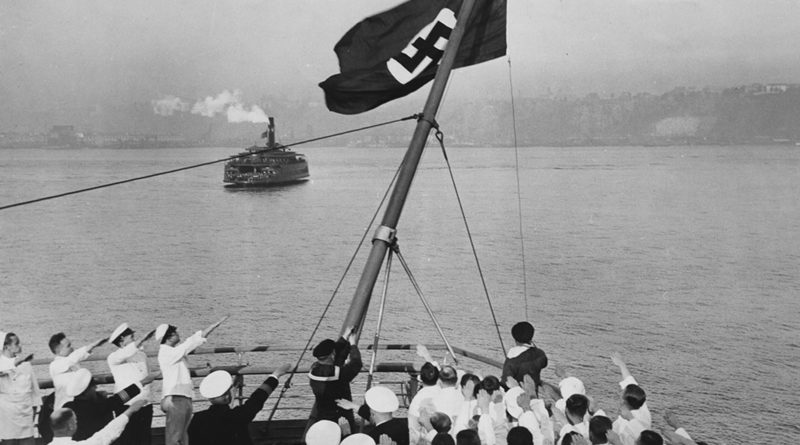
One hot summer evening of 1935, the crew of the SS Bremen welcomed almost 5,000 non-passengers aboard the jewel of the German ocean fleet, “a technical and aesthetic marvel regarded by the world as the water-borne embodiment of German nationhood.”
At the nose of the ship, a bright arc lamp illuminated a gigantic flag rising high over the piers, seen from the shoreline below. Its unmistakable insignia — the swastika of the Nazi Party.
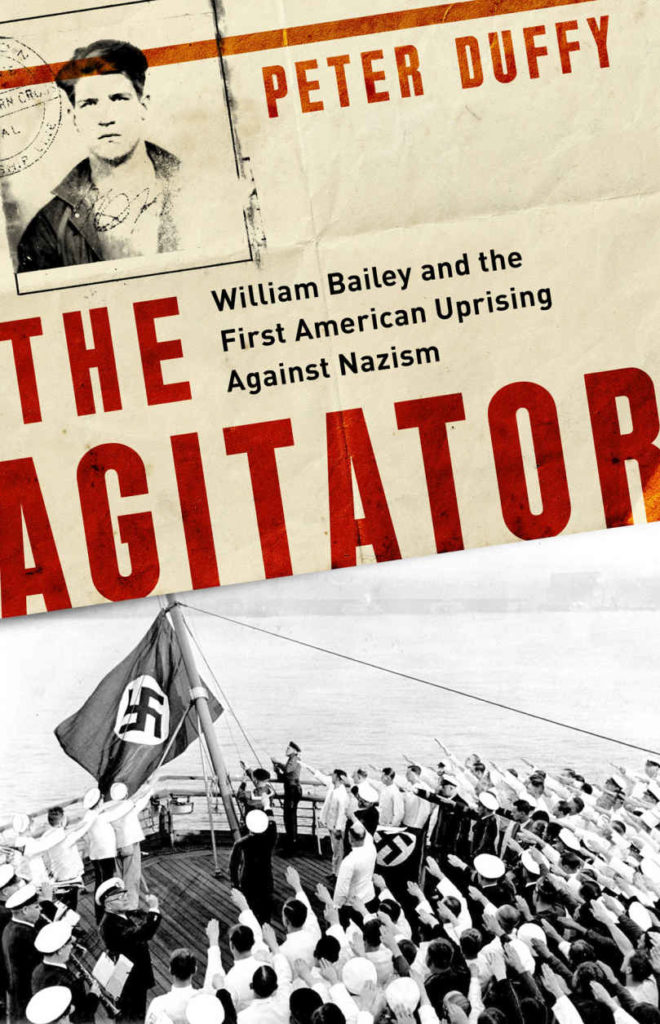
The Agitator: William Bailey and the First American Uprising Against Nazism by Peter Duffy Public Affairs Books
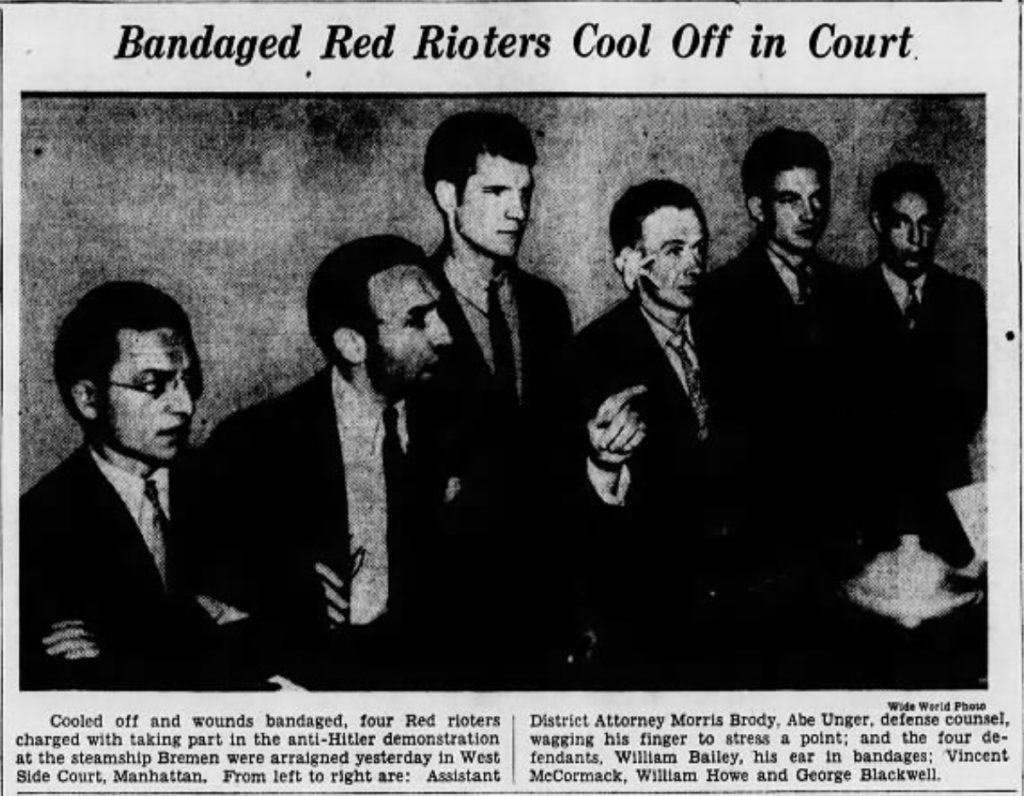
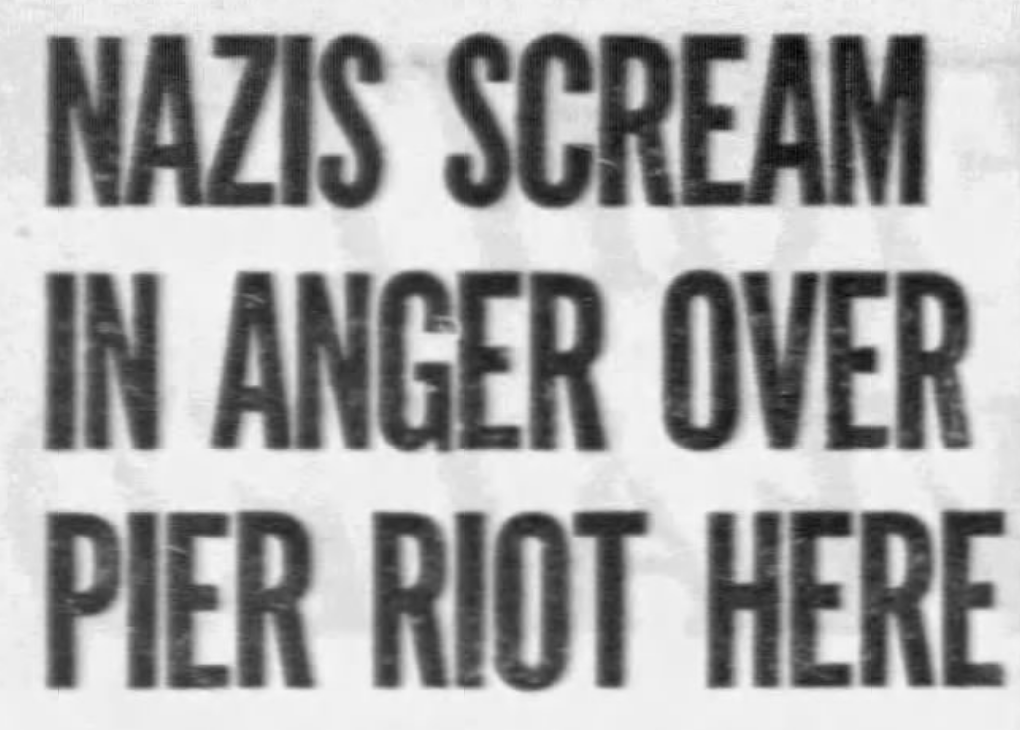
On July 26, 1935, William Bailey, the subject of Peter Duffy’s The Agitator, a firecracker of a book, led a scrappy, ragtag group of anti-Nazi protestors aboard the ship and — in a chaotic and riotous surge — succeeded in tearing down that Nazi flag.
The Bremen, as it were, was on Bailey’s turf. Born in Jersey City and raised in Hell’s Kitchen, Bailey became a merchant seaman and eventually a union activist, rugged and enthusiastic, who happened to come of age when the movement needed him most.
From the Brooklyn Daily Eagle, July 28, 1935
Duffy’s book also works as a history of early resistance efforts and protests in New York City, disparate groups (Jews, Catholics, union organizers, Communists) taking a stand against Nazi Germany at a time when most Americans were simply not paying attention.
At first the groups opposing Nazi appearances at the piers were “socialist student groups and anti-Fascist refugee committees and Communist peace leagues,” fringe groups that visiting German leaders managed to ignore. (“About those little things, those demonstrations,” said Hitler confidante Ernst Hanfstaengl. “I think they’re just trying to have a bit of fun with me.”)
But as Hitler escalated his reign of terror, New Yorkers were forced to take a look. By 1934, major department stores like Macy’s and Bloomingdale’s were boycotting German products and even MayorFiorello La Guardiawas making minor gestures of protest. Still, the growing threat, the unimaginable horror to come, seemed of minor interest to most Americans.
New York Daily News headline, July 28, 1935
Which makes the brazen and symbolic stunt by Bailey and his cohorts all the more remarkable. “In a proper world,” writes Duffy, “the name Bill Bailey would call to mind an indelible figure in the confrontation against international fascism …. He was a slum kid from a destitute Irish family, a reformed juvenile delinquent with a Hell’s Kitchen twang, who developed a political conscience by working in the decrepit freighters of the Depression-era seafaring trade.”
When he died in 1995, Bailey, who also fought in the Spanish Civil War had become defined by the Bremen incident. He spent his final years telling the story to whomever wanted to hear it. And now Duffy shares it with the world.
Below: A breezy little film clip — taken from the 1936 German film Spiel an Bord — documenting the SS Bremen. Nazi swastikas have conveniently been omitted! (But whoever edited this video has managed to insert an image into the footage.) The liner’s final journey to New York — no surprise — was in 1939. The ship was dismantled in 1942.
PODCAST Many stories of 19th century New York City seem to lead to the Tombs, a stark prison complex with menacing architecture and a fearful reputation.
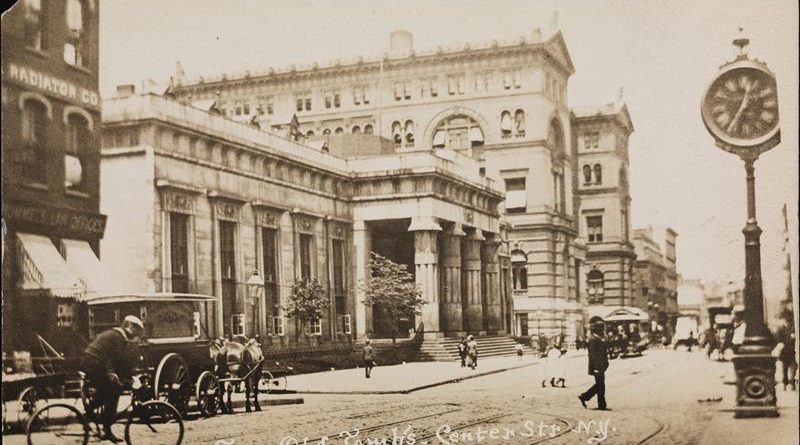
Some might find it strange that the Manhattan Detention Complex — one of New York City’s municipal jails — should be located next to the bustling neighborhoods of Chinatown and Little Italy. Stranger still is its ominous nickname — The Tombs.
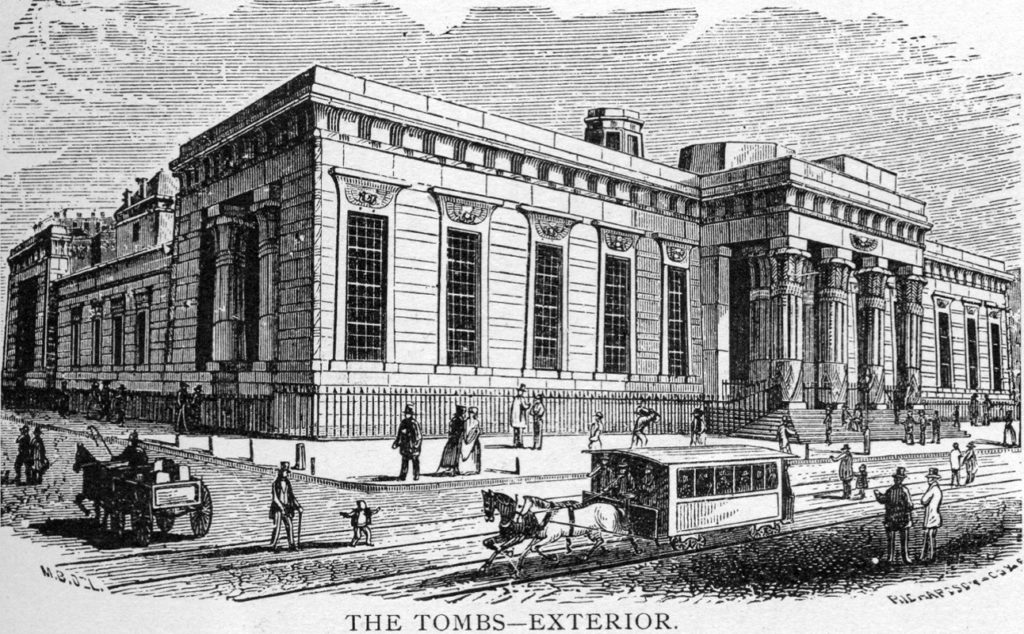
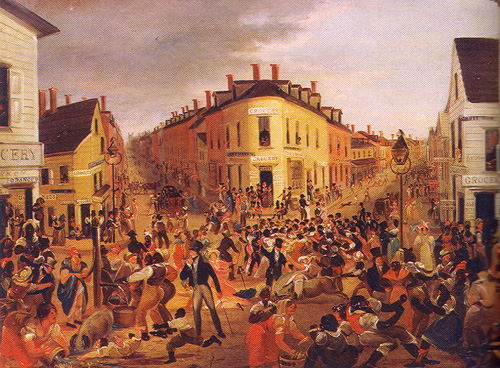
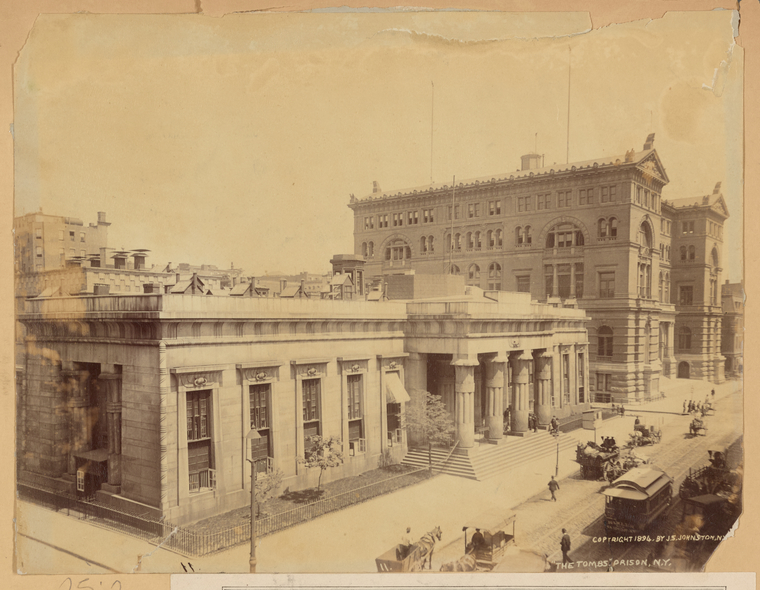
Near this very spot — over 180 years ago — stood another imposing structure, a massive jail in the style of an Egyptian mausoleum, casting its dark shadow over a district that would become known as Five Points, the most notorious 19th century neighborhood in New York City.
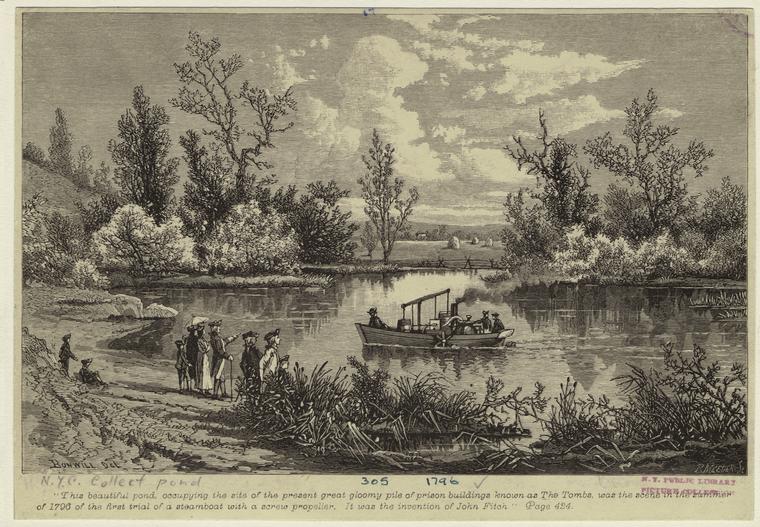
From the Foundations of Collect Pond
Both Five Points and the original Tombs (officially New York City Halls of Justice and House of Detention) was built upon the spot of old Collect Pond, an old fresh-water pond that was never quite erased from the city’s map when it was drained via a canal — along today’s Canal Street.
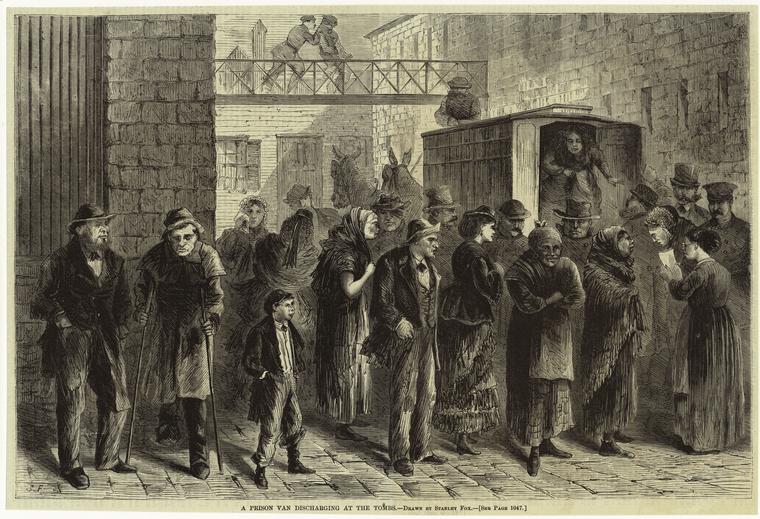
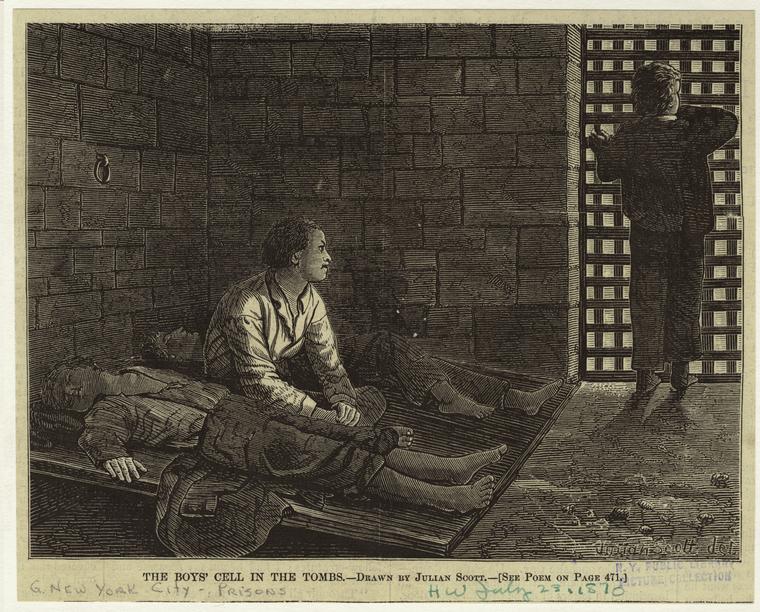
But the foreboding reputation of the Tombs comes from more than sinking foundations and cracked walls. For over six decades, thousands of people were kept here — murderers, pickpockets, vagrants and many more who had committed no crimes at all.
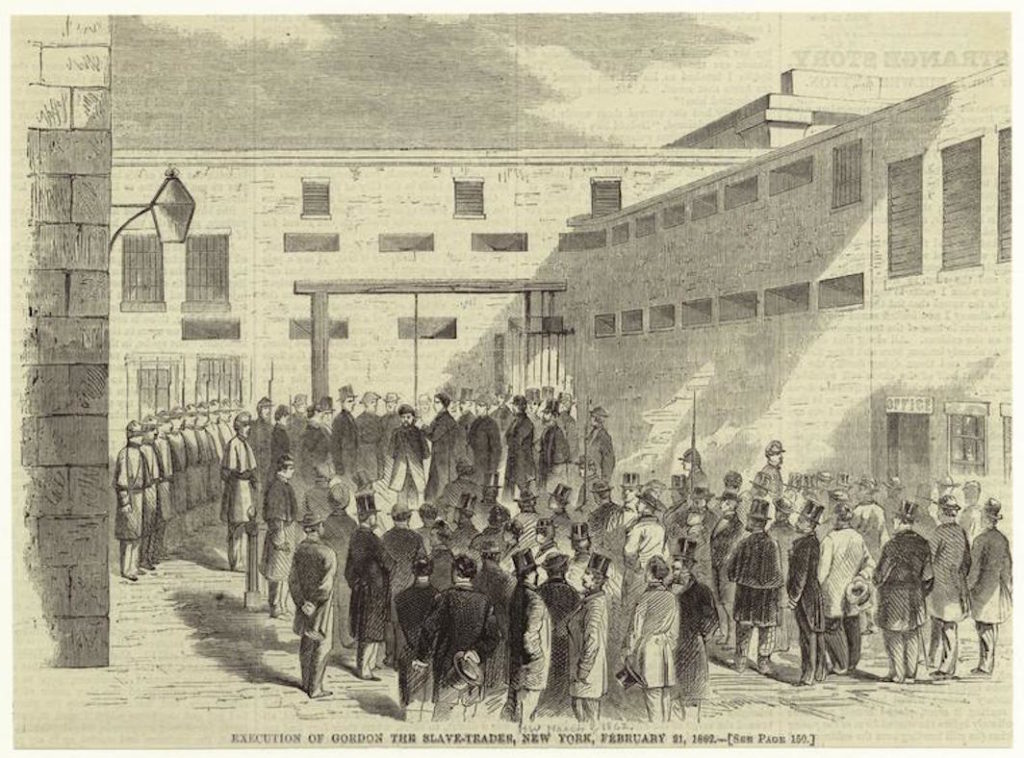
And there would be a few unfortunates who would never leave the confines of this place. For the Tombs contained a gallows, where some of the worst criminals in the United States were executed.
Other jails would replace this building in the 20th century, but none would shake off the grim nickname.
Listen Now — The Tombs: Five Points’ House of Detention
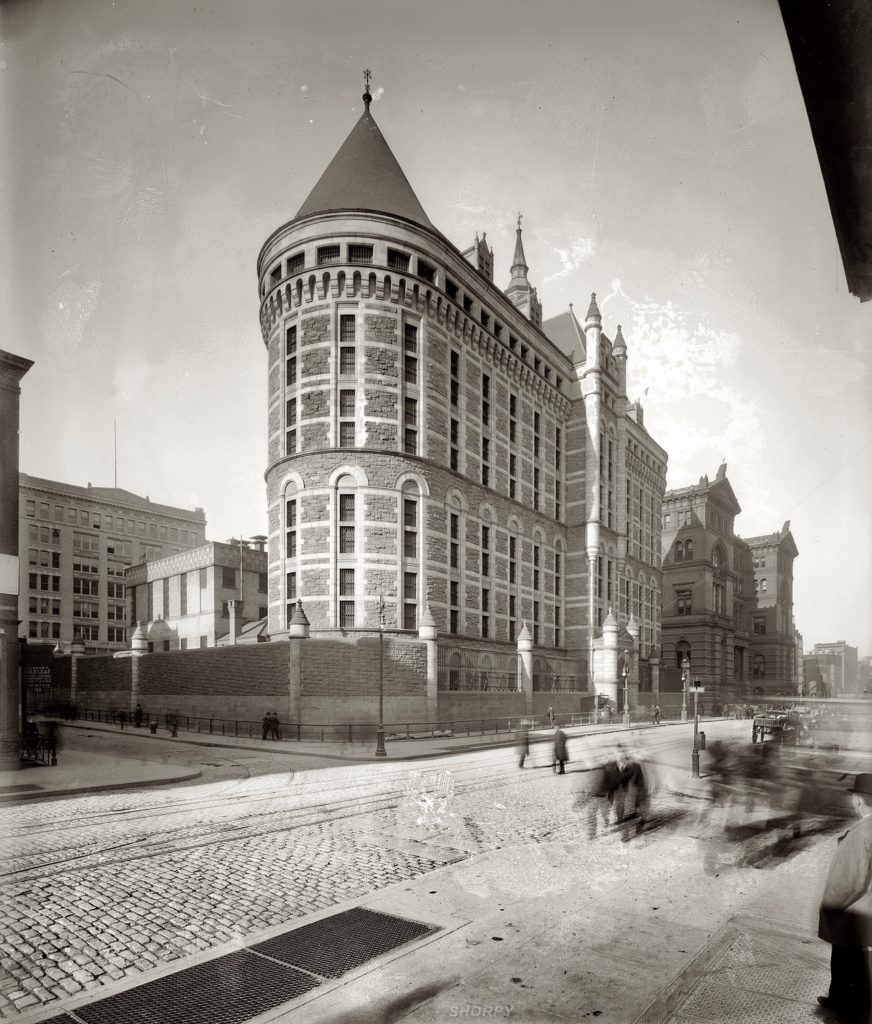
Collect Pond, in an illustration from 1880 — New York Public LibraryGeorge Catlin painting of Five PointsThe Tombs 1894 — New York Public LibraryA Prison Van Discharging At The Tombs 1871 — New York Public LibraryThe Boy’S Cell In The Tombs 1870 — New York Public LibraryThe Execution of Nathaniel Gordon in Five Points. For more information, read this article from our website on Gordon’s execution.The second Tombs, pictured here in 1907 — G. G. Bain Collection/Shorpy
FURTHER READING
The Old World and the New by William Ballantine A Pickpocket’s Tale: The Underworld of 19th Century New York by Timothy J. Gilfoyle New York by Sunlight and Gaslight: A Work Descriptive of the Great American Metropolis by James Dabney McCabe The New York Tombs, Inside and Out!: A Story Stranger Than Fiction, with an Historic Account of America’s Most Famous Prison by John Josiah Munro
FURTHER LISTENING After listening to our show on the history of the Tombs, check out these shows from our back catalog:
The Bowery Boys: New York City History podcast is brought to you …. by you!
We are now producing a new Bowery Boys podcast every other week. We’re also looking to improve the show in other ways and expand in other ways as well — through publishing, social media, live events and other forms of media. But we can only do this with your help!
We are now a member of Patreon, a patronage platform where you can support your favorite content creators.
Please visit our page on Patreon and watch a short video of us recording the show and talking about our expansion plans. If you’d like to help out, there are six different pledge levels (New Amsterdam, Five Points, Gilded Age, Jazz Age, Empire State and Greater New York). Check them out and consider being a sponsor.
And join us for the next episode of the Bowery Boys Movie Club, an exclusive podcast provided to our supporters on Patreon. This month’s movie — Midnight Cowboy!
We greatly appreciate our listeners and readers and thank you for joining us on this journey so far.
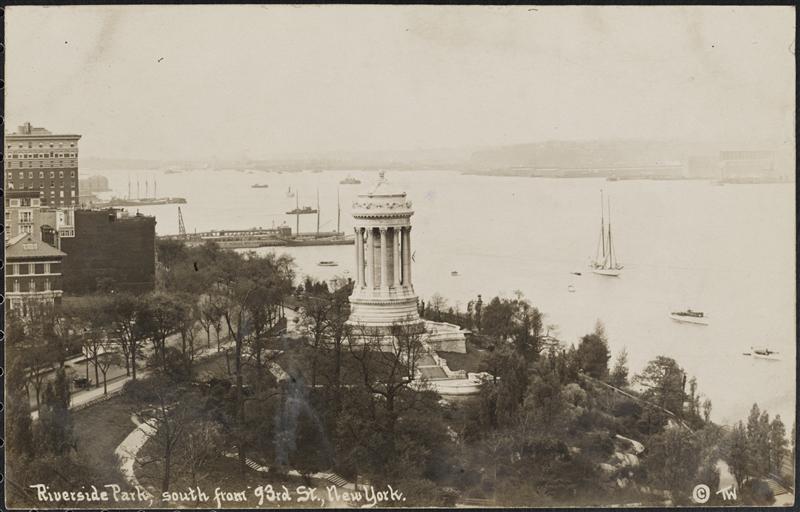
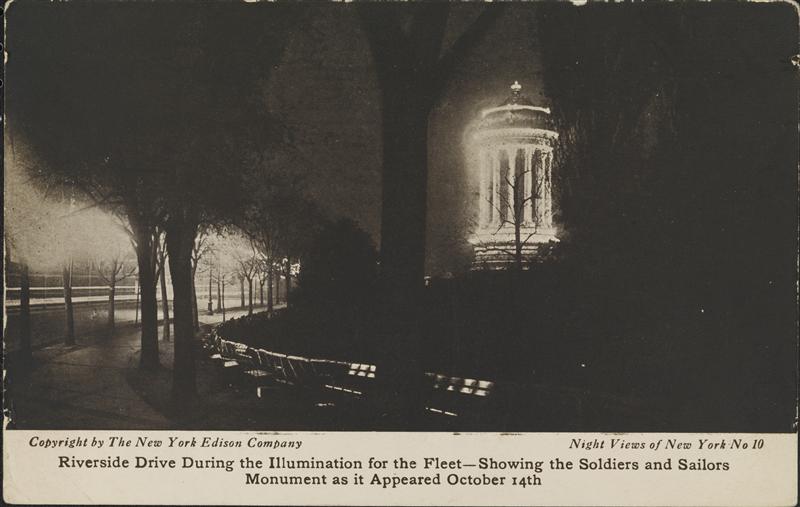
This Monday (May 27, 2019), a Memorial Day observance will be held from 10 a.m to noon at the Soldiers and Sailors Monument in Riverside Park. In honor of the holiday, we’re rerunning this 2015 article on this oft-forgotten monument.
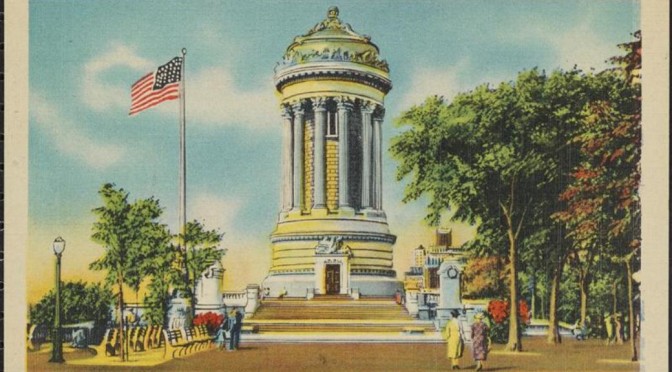
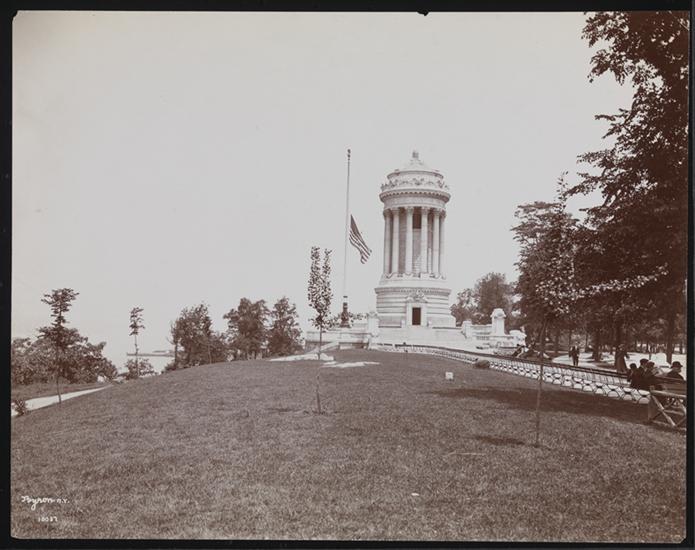
The Soldiers’ and Sailors’ Monument on the Upper West Side has been the centerpiece for Memorial Day commemoration for decades. Unless you actually live by it, you probably have not been there in years, if at all. It’s a vastly under-appreciated landmark, occasionally vandalized and certainly in need of work. [For more on the history of Riverside Park, listen to our podcast episode: Heaven on the Hudson.]
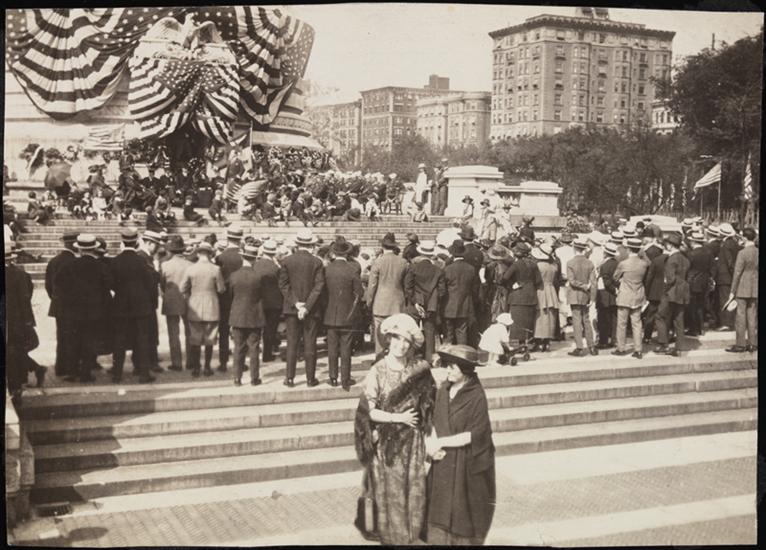
Courtesy the Museum of the City of New York
It owes its form to the great Gilded Age fervor for classical beauty and the aesthetic appeal of Beaux-Arts architecture. Grand war memorials were sprouting up all over New York during this period, most notably he Soldiers’ and Sailors’ Arch in Brooklyn’s Grand Army Plaza (1892) and Prison Ship Martyrs Monument in Fort Greene (1908). Then there’s Grant’s Tomb (1897), which owes its existence more to the General’s military career and not so much his scandal-filled presidency.
And similar monuments of such colossal proportion were erected in other cities including Hartford(1886), New Haven (1887), Allentown (1899) Indianapolis(1902), Baltimore(1909) Syracuse (1910), Pittsburgh(1910), among many others.
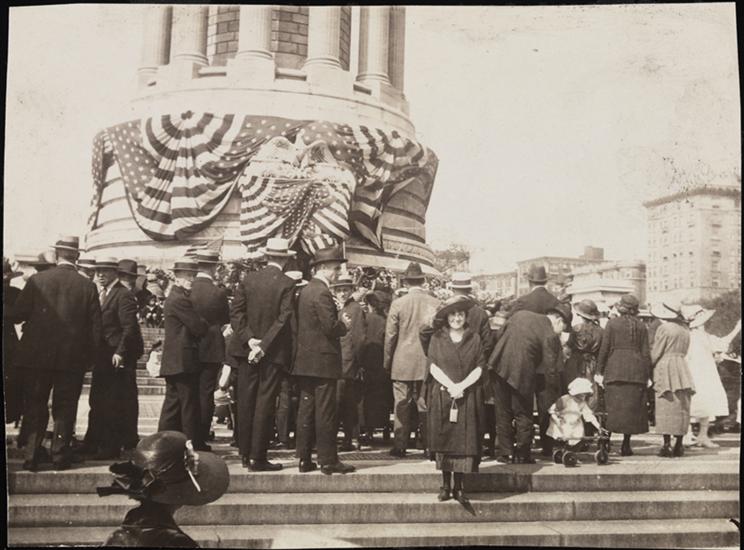
Courtesy the Museum of the City of New York
Monuments are dandy indicators of civic pride but many were inspired by practical necessity. Most Union veterans were in their ’50s and ’60s by this time many of these memorials were planned. Those that grew up after the war– the sons and daughters of war heroes — wanted to recognize the achievements of a previous generation. Many of these men (Grant being the notable example) were now prominent citizens in New York.
Its also not a coincidence patriotic feelings were swelling during this period due to conflicts like the Spanish-American War which would later demand their own memorials like the powerful Maine Monument, unveiled in 1913.
1915, courtesy the Museum of the City of New York
Riverside Drive might seem a curious place to put a Civil War monument. In fact, its location inspired a bit of a civic war itself from the moment it was first planned in 1893. “THE MONUMENT FIGHT AGAIN” proclaimed the New York Times in 1895, reporting on a rivalry between members of the Upper East Side Association and the Upper West Side Association.
I mean, in 1895, didn’t it make sense to place it on Fifth Avenue, the most prominent and wealthy street in the world? Proponents chose Fifth Avenue and 59th Street, the entrance to Central Park, as the ideal spot. “It is rather amusing to hear …. grounds for opposition in view of what was said in front of the Commissioners when the west side men wanted to locate the monument on the Riverside Drive and Seventy-Second Street…..[T]hey charged that the Plaza was not suitable because the monument would be surrounded by buildings that would dwarf it.”
Supports of the Riverside site claimed that the foundations would not be sturdy enough near the park, an amusing remark given the skyscraper boom which would take over Midtown Manhattan in the 20th century. In particular, naval officers bristled at the Fifth Avenue site which was almost as far from the site of water that one could get in Manhattan.
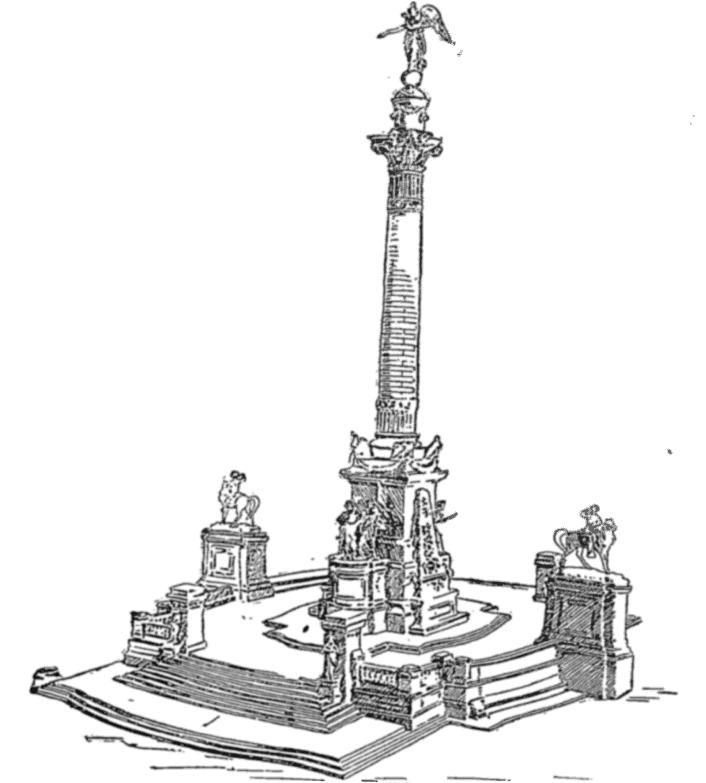
Had the eastsiders won, we would have gotten a Soldier’s and Sailors Monument that looked like this on the spot of today’s Grand Army Plaza:
By 1899, years after the project was conceived, proponents of the west side finally won out. The monument was planned for a spot in the newly developed Riverside Park known as Mount Tom, a “very beautiful little knoll of natural rock,” believed to have been a spot of quiet contemplation for one Edgar Allen Poe (who lived nearby in 1844). That was at Riverside Drive and 83rd Street. Eventually that too was deemed inadequate, and the preparations were then moved to the present location at 89th Street.
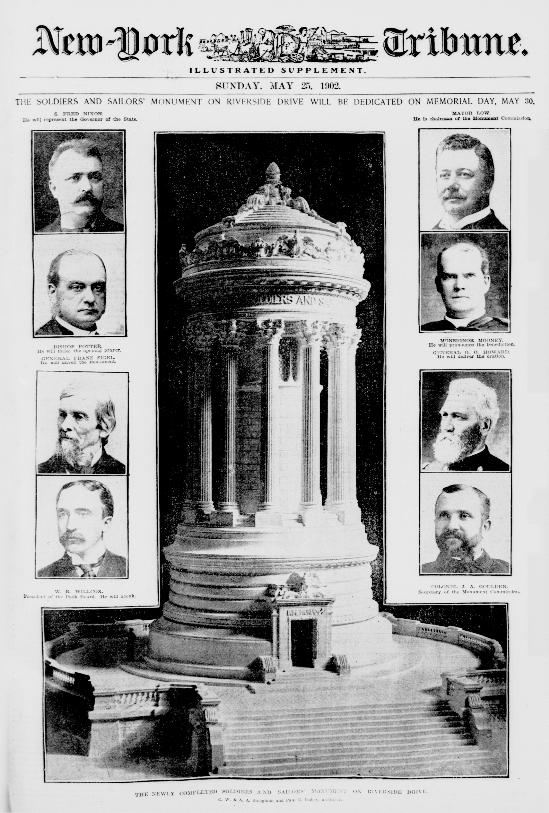
Given the new location, the monument was redesigned by the firm of Straughton and Straughton as a circular temple adorned with Corinthian columns. The Soldiers and Sailors Monument was officially dedicated on Memorial Day 1902:
Here are a couple views of its dedication ceremony in 1902:
Courtesy the Museum of the City of New YorkCourtesy the Museum of the City of New York
The final monument is absolutely beautiful, of noble design, but was not well constructed. Repairs were necessary less than five years later, and the structure has gone through several alterations. This New York Times article gives you a look inside the monument and reviews some current efforts to rescue the building from further deterioration.
The weather’s supposed to be spectacular this holiday weekend, so make that a good excuse to visit this unusual and charming little memorial.
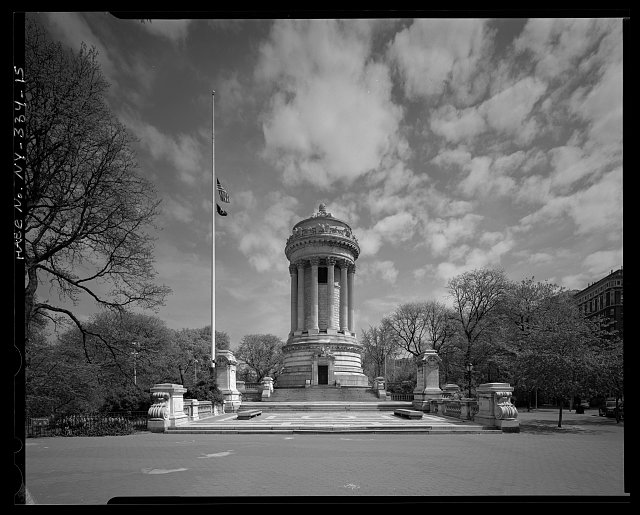
Photo by Renee Bieretz, courtesy the Library of Congress
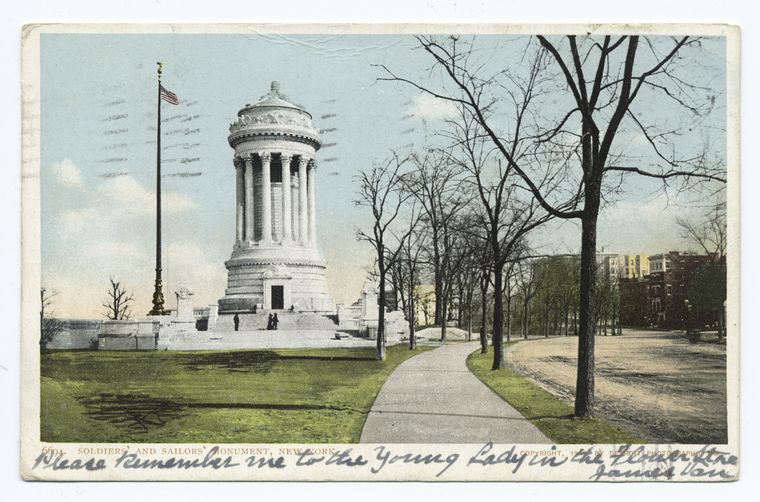
And finally, a mysterious post card from the New York Public Library collection. Note the caption:
PODCAST Some delicious bagel history! How did the bagel go from the basement bakeries of the Lower East Side to the supermarkets and breakfast tables of the entire country?
The most iconic New York City foods — bagels, pizza, hot dogs — are portable, adaptable and closely associated with the city’s history through its immigrant communities. Bagel history, no surprise, traces back to the heart of Jewish New York.
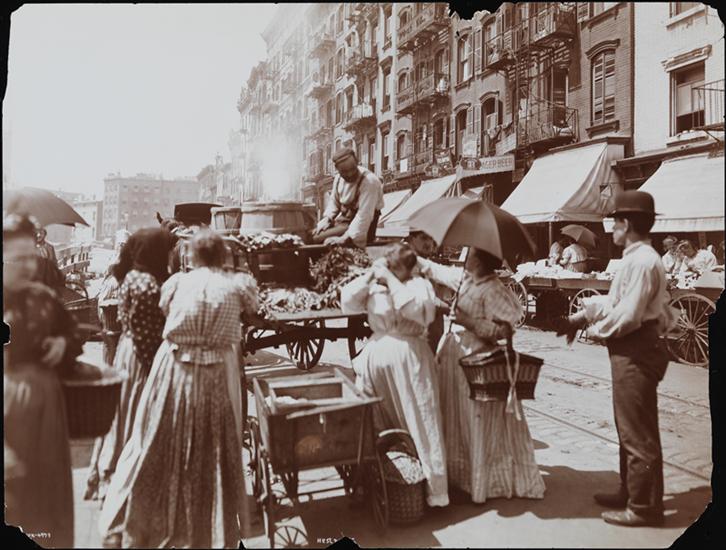
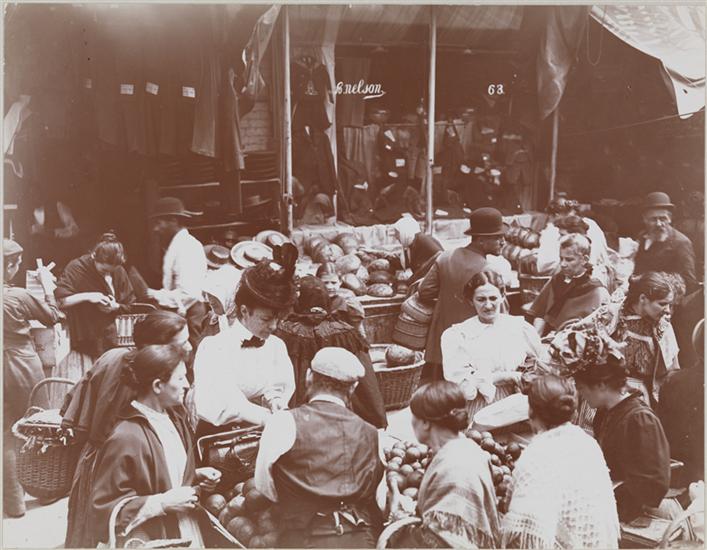
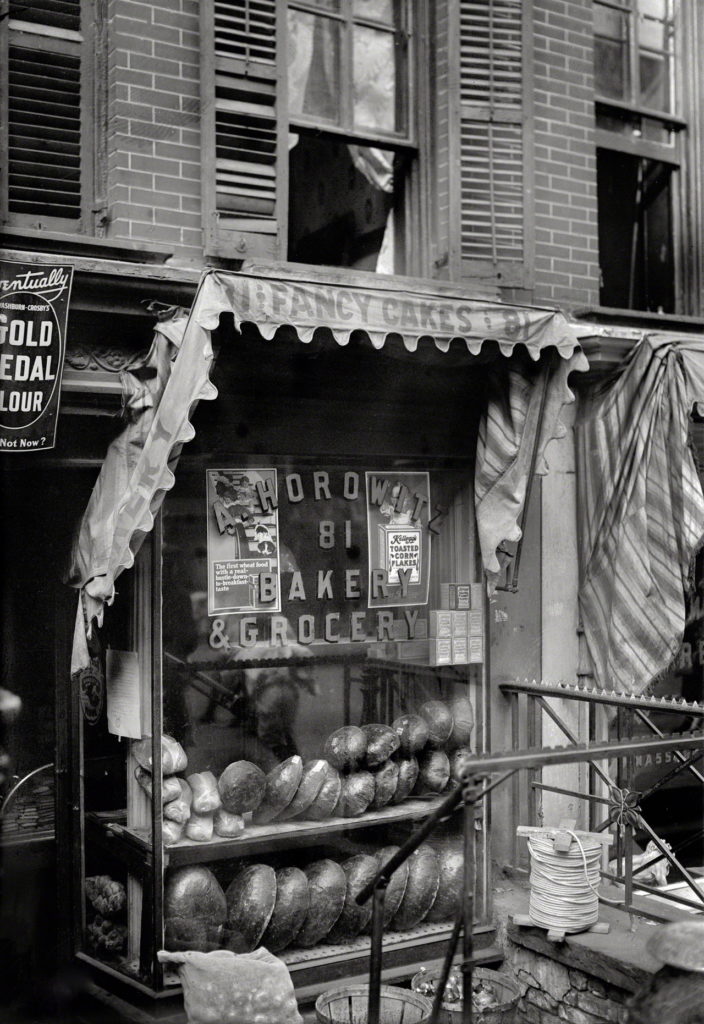
In the case of the bagel, that story introduces us to the Polish immigrants who brought their religion, language and eating customs to the Lower East Side starting in the 1870s. During the late 19th century, millions of bagels were created in tiny bake shops along Hester and Rivington Streets, specifically for the neighborhood’s Jewish community.
We start there and end up in the modern day with frozen supermarket bagels, pizza bagels, bagel breakfast sandwiches, bagel bites. BAGELS SLICED ST. LOUIS STYLE?! How did this simple food from 17th century Poland become a beloved American breakfast staples?
Bagel History is Labor History
It starts with a bagel revolution! Poor conditions in the bakeries inspired a worker’s movement and the formation of a union that standardized the ways in which bagels were made. By the mid 20th century, modern technology allowed for bagels to be made cheaply and shipped all over the world.
But the ‘real’ way to make a bagel is to hand roll it. In this episode, we speak to Melanie Frost of Ess-a-Bagel for some insight into the pleasures of the true New York City bagel.
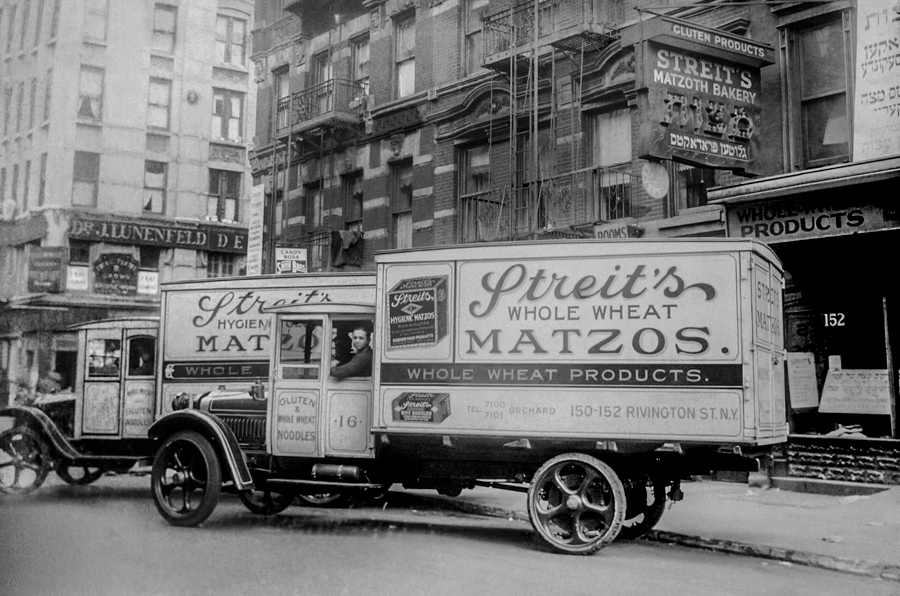
Streits Matzos manufacturing was once located at 150 Rivington Street. Although they no longer make Rivington Street their home, they are still in business.
Streits Matzos
Tom and Greg interviewing Melanie Frost at Ess-a-Bagel:
FURTHER LISTENING After sinking your teeth into this week’s episode on the history of the bagel, try out these past shows about either cuisine and/or Jewish life in New York City
<
FURTHER READING The Bagel: The Surprising History of a Modest Bread by Maria Balinska Eight Flavors: The Untold Story of American Cuisine by Sarah Lohman Encyclopedia of Jewish Food by Gil Marks Gastropolis: Food and New York City by Annie Hauck-Lawson and Jonathan Deutsch A History of Polish Americans by John J. Bukoczyk Savoring Gotham: A Food Lover’s Companion to New York City / Oxford University Press
The Bowery Boys: New York City History podcast is brought to you …. by you!
We are now producing a new Bowery Boys podcast every other week. We’re also looking to improve the show in other ways and expand in other ways as well — through publishing, social media, live events and other forms of media. But we can only do this with your help!
We are now a member of Patreon, a patronage platform where you can support your favorite content creators.
Please visit our page on Patreon and watch a short video of us recording the show and talking about our expansion plans. If you’d like to help out, there are six different pledge levels (New Amsterdam, Five Points, Gilded Age, Jazz Age, Empire State and Greater New York). Check them out and consider being a sponsor.
And join us for the next episode of the Bowery Boys Movie Club, an exclusive podcast provided to our supporters on Patreon. This month’s movie — Midnight Cowboy!
We greatly appreciate our listeners and readers and thank you for joining us on this journey so far.
“By the pricking of my thumbs / something wicked this way comes” — Macbeth
PODCAST In old New York, one hundred and seventy years ago, a theatrical rivalry between two leading actors of the day sparked a terrible night of violence — one of the most horrible moments in New York City history.
England’s great thespian William Macready mounted the stage of the Astor Place Opera House on May 10, 1849, to perform Shakespeare’s Macbeth, just as he had done hundreds of times before. But this performance would become infamous in later years as the trigger for one of New York City’s most violent events — the Astor Place Riot.
The theater, being America’s prime form of public entertainment in the early 19th century, was often home to great disturbances and riots. It was still seen as a British import and often suffered anti-British sentiments that often vexed early New Yorkers.
Macready, known as one of the world’s greatest Shakespearean stars, was soon rivaled by American actor Edwin Forrest, whose brawny, ragged style of performance endeared the audiences of the Bowery. To many, these two actors embodied many of America’s deepest divides — rich vs. poor, British vs. American, Whig vs. Democrat.
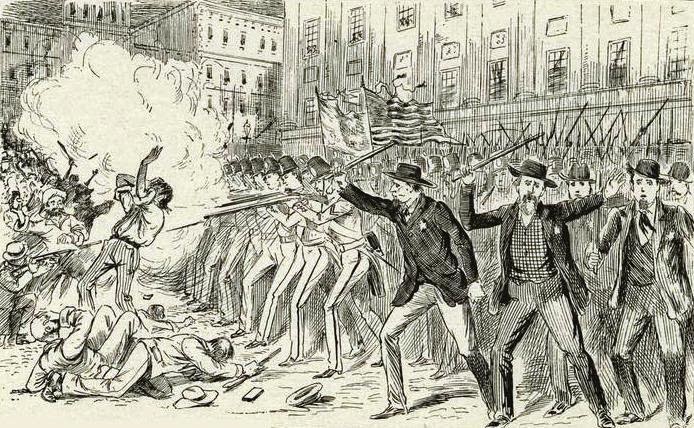
On May 10th, these emotions overflowed into an evening of stark, horrifying violence as armed militia shot indiscriminately into an angry mob gathering outside theater at Astor Place. By the end of this story, over two dozen New Yorkers would be murdered, dozens more wounded, and the culture of the city irrevocably changed.
RIOT OR RIOTS? You may have noticed in our podcast that we go from calling it the Astor Place Riot and the Astor Place Riots. We both saw primary references to both the singular and the plural. Though it was just one riot which occurred on May 10, the incidents on May 7 and May 11 constitute smaller riots or disturbances that lead up or were the result of the May 10 event. The word ‘riot’ is not perfect either as it starts as a riot and ends as a massacre.
CORRECTION: In the podcast, I mention that John Jacob Astor lived in the line of stately buildings today known as Colonnade Row. Although he built them, he never lived here. However he moved his family into them, including his grandson John Jacob Astor III. Cornelius Vanderbilt and Washington Irving also lived here. __________________________________________________________
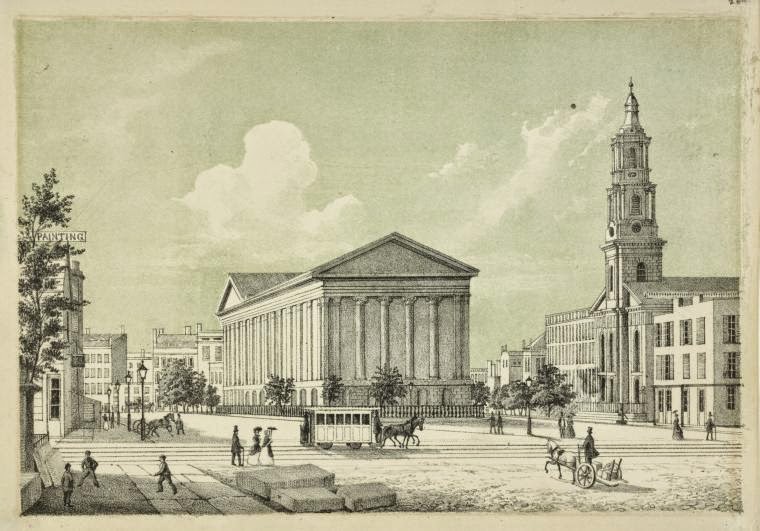
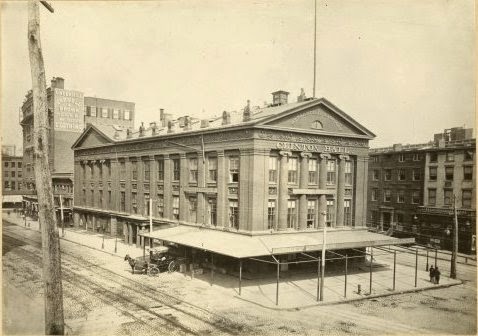
The Astor Place Opera House in 1850:
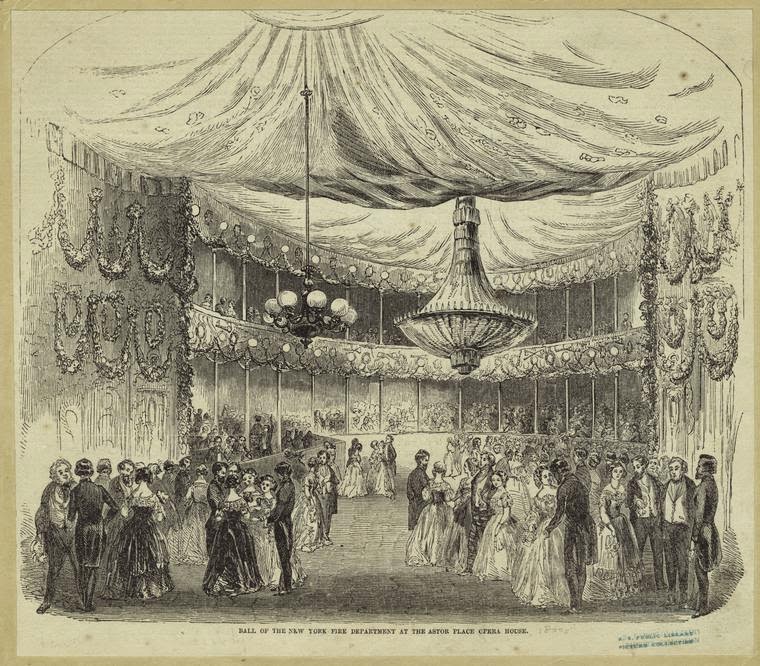
Inside the Astor Opera House, one of the most lavish spaces in all of New York in the 1840s. Curiously, this illustration depicts a ball for the New York Fire Department. Many members of the volunteer fire departments actually set upon the opera house as part of the angry mob.
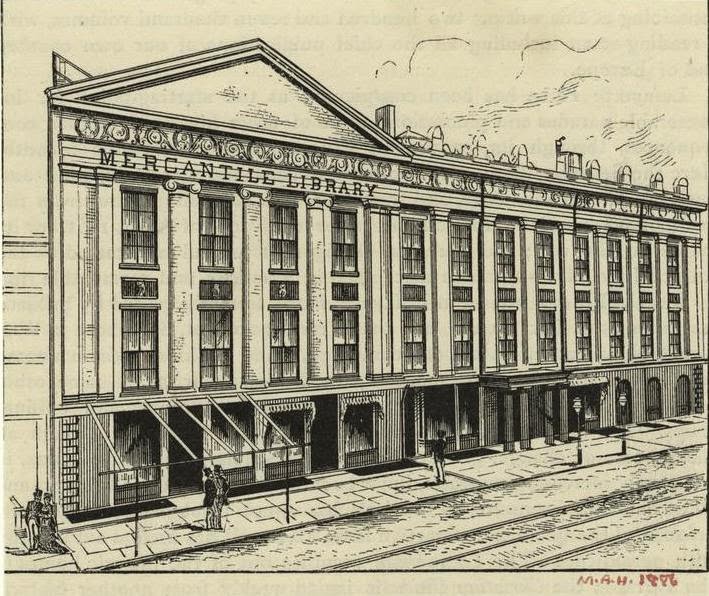
After the riots, the opera house quickly lost its cache. High society moved uptown to the Academy of Music (not so far away actually, on 14th Street, near Union Square). The interior of the theater was eventually demolished and sold to the New York Mercantile Library and renamed Clinton Hall.
This was torn down in 1890 and replaced with the 11-story structure that stands there today.
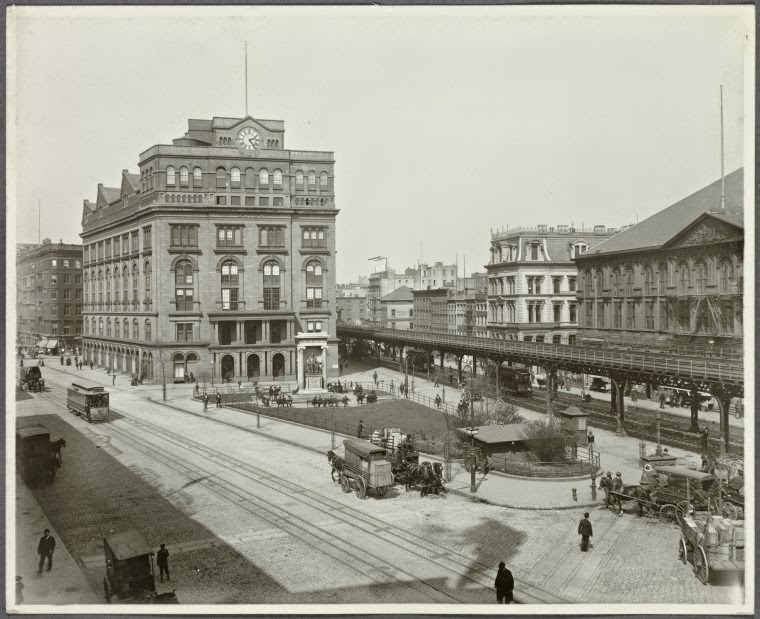
Many considered the demons of Astor Place purged when Cooper Union was finally constructed in 1859, a decade after the riots. In this image, we’re looking up Third Avenue and the final remnant of the Bowery. The Third Avenue Elevated has already been built here:
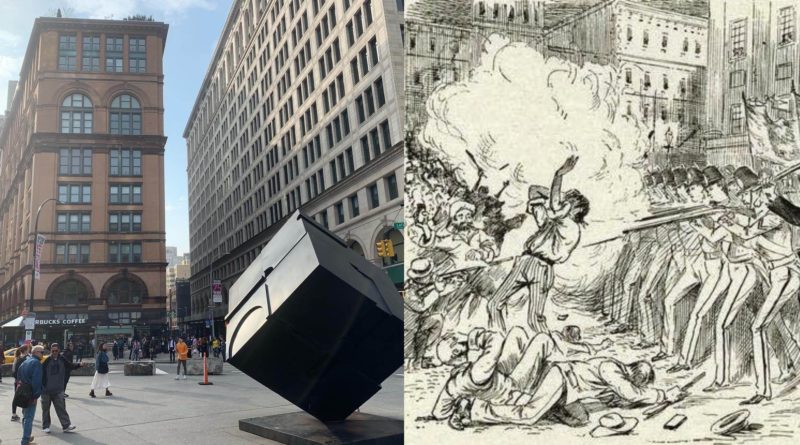
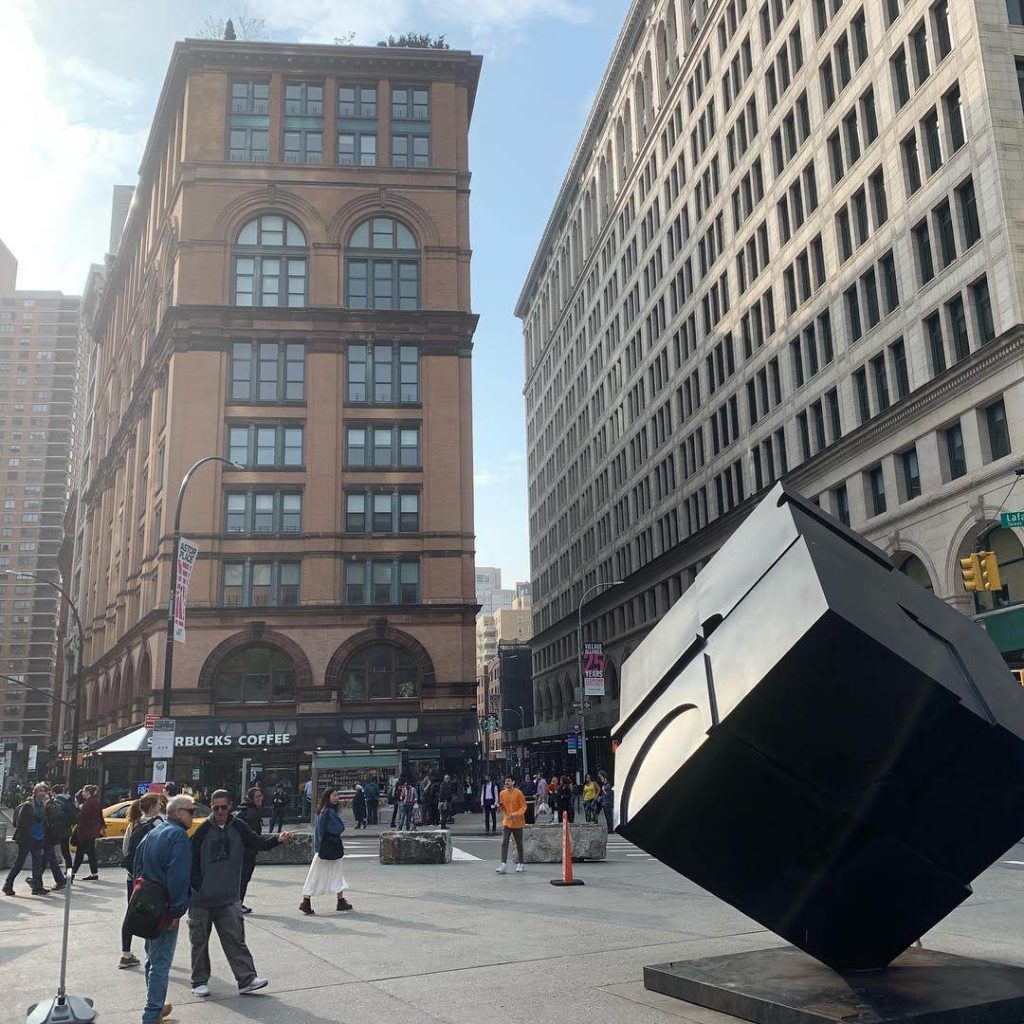
Astor Place in 2019:
William Macready:
From the New York Evening Post, May 1, 1849, advertising his May 7th show (which was interrupted by protesters).
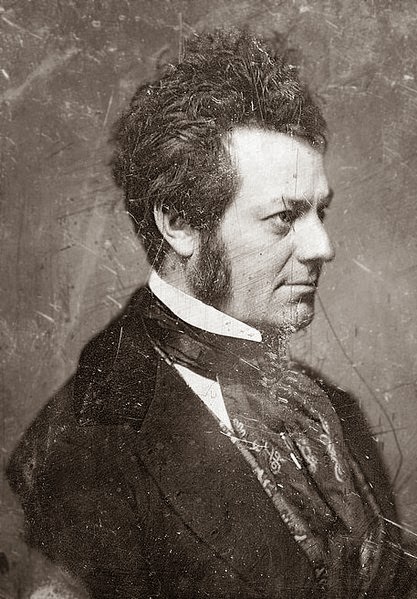
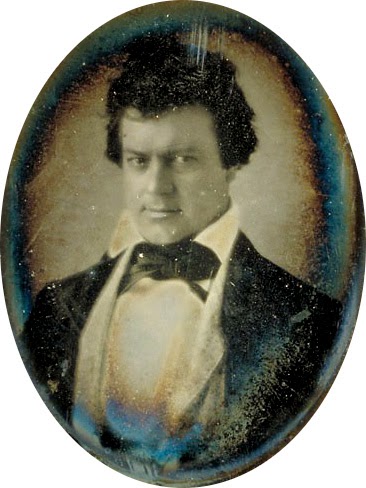
Edwin Forrest: In portrait and in daguerreotype
Images above courtesy the New York Public Library (except where otherwise noted).
FURTHER LISTENING:
We’ve been doing this for so long that we have MANY podcasts about historical landmarks in and around Astor Place. After you listen to this show, check out these older shows from our catalog:



![Sherman, Augustus F. (Augustus Francis) -- Photographer. [1911]](https://www.boweryboyshistory.com/wp-content/uploads/2016/10/3095766125_40d61a3130_o.jpg)
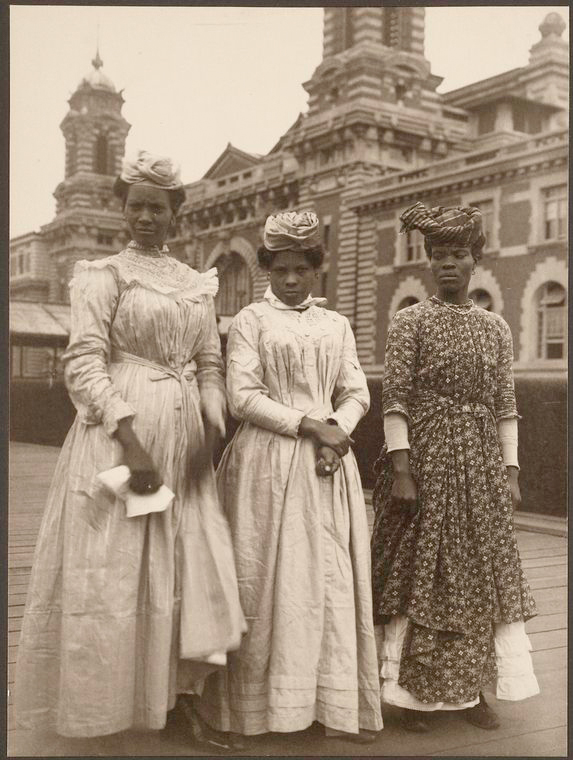
![NYPL, Sherman, Augustus F. (Augustus Francis) -- Photographer. [ca. 1906]](https://www.boweryboyshistory.com/wp-content/uploads/2016/10/3110164652_4ac26f22a0_o.jpg)
![Sherman, Augustus F. (Augustus Francis) -- Photographer. [ca. 1906]](https://www.boweryboyshistory.com/wp-content/uploads/2016/10/3110163346_d342440914_o.jpg)
![Courtesy NYPL. Augustus F. Sherman [ca. 1906-1914]](https://www.boweryboyshistory.com/wp-content/uploads/2016/10/3110164858_d11ce4843f_o.jpg)
![Courtesy NYPL, Sherman, Augustus F. -- Photographer. [ca. 1906]](https://www.boweryboyshistory.com/wp-content/uploads/2016/10/3109330325_550cd50284_o.jpg)
![Sherman, Augustus F. -- Photographer. [ca. 1906]](https://www.boweryboyshistory.com/wp-content/uploads/2016/10/3110162400_ec91ca2fda_o.jpg)

![NYPL, Sherman, Augustus F. (Augustus Francis) -- Photographer. [ca. 1906]](https://www.boweryboyshistory.com/wp-content/uploads/2016/10/3109331119_1de4d7edb5_o.jpg)
![NYPL Sherman, Augustus F. (Augustus Francis) -- Photographer. [ca. 1906-1914]](https://www.boweryboyshistory.com/wp-content/uploads/2016/10/3110163692_f8c66c0f5a_o.jpg)
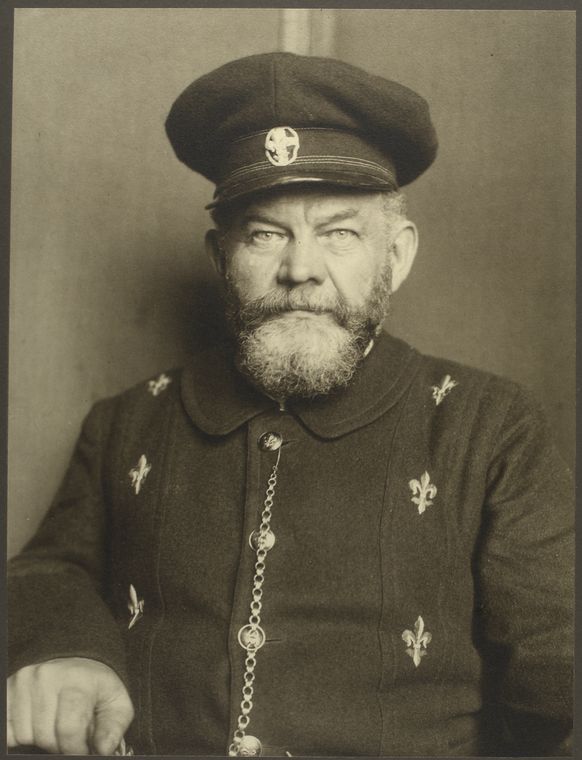
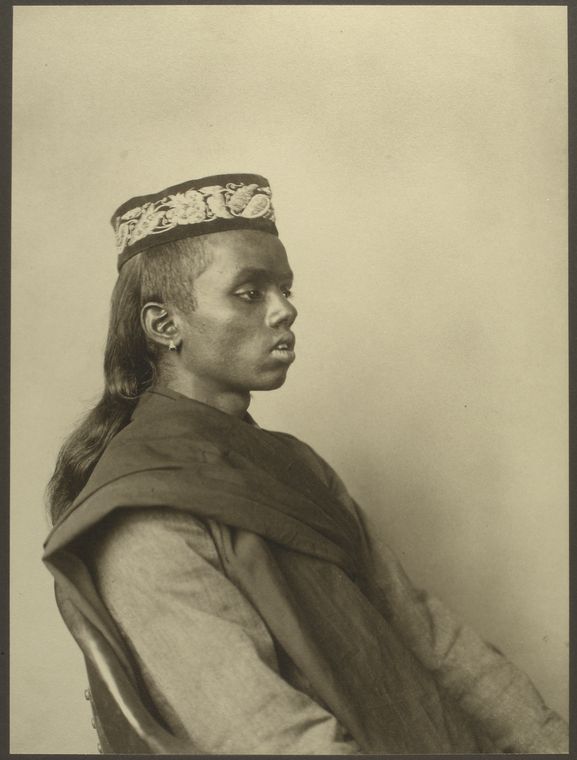
![Sherman, Augustus F. (Augustus Francis) -- Photographer. [ca. 1906]](https://www.boweryboyshistory.com/wp-content/uploads/2016/10/3109329865_acba999d7b_o.jpg)
![Sherman, Augustus F. (Augustus Francis) -- Photographer. [ca. 1906]](https://www.boweryboyshistory.com/wp-content/uploads/2016/10/3110163440_f861bca66d_o.jpg)