Categories
Mysterious Stories Podcasts

Whatever Happened to Dorothy Arnold? A tale of New York’s most famous missing person

PODCAST The mysterious disappearance of a young woman becomes one of the most talked-about events over one hundred years ago.

The young socialite Dorothy Arnold seemingly led a charmed and privileged life.

The niece of a Supreme Court justice, Dorothy was the belle of 1900s New York, an attractive and vibrant young woman living on the Upper East Side with her family. She hoped to become a published magazine writer and perhaps someday live by herself in Greenwich Village.

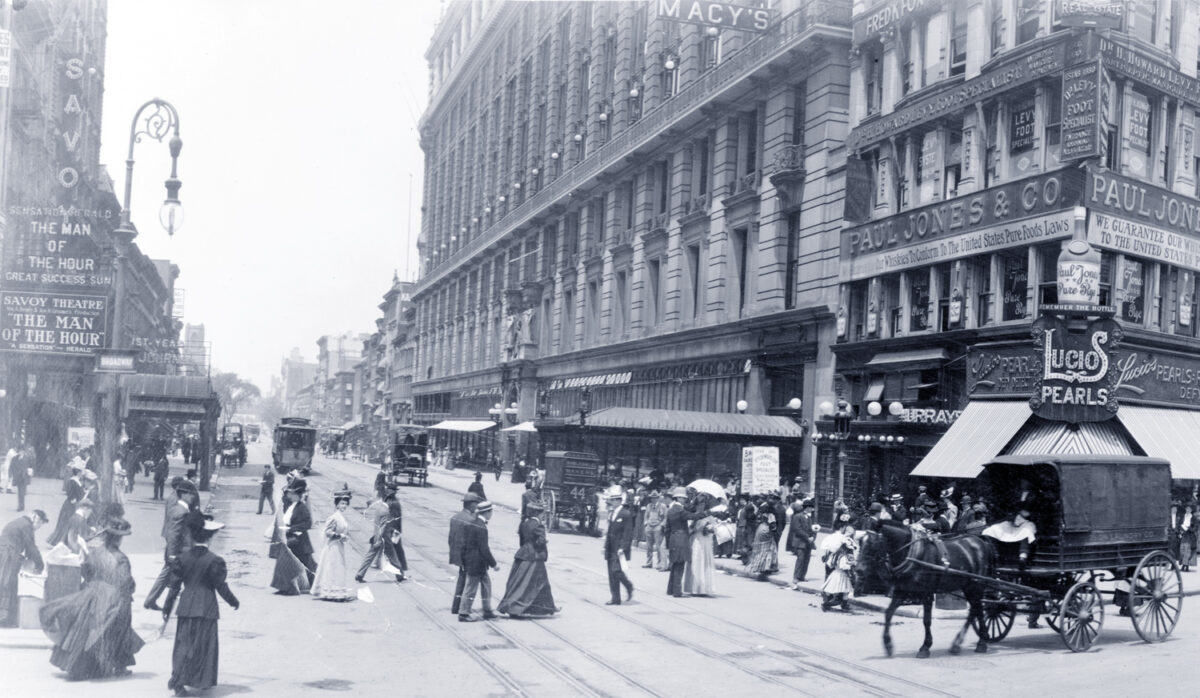
But on December 12, 1910, while running errands in the neighborhood of Madison Square Park, Dorothy Arnold — simply vanished.

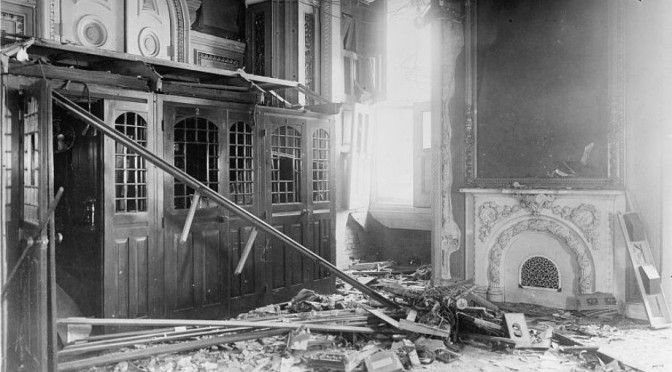
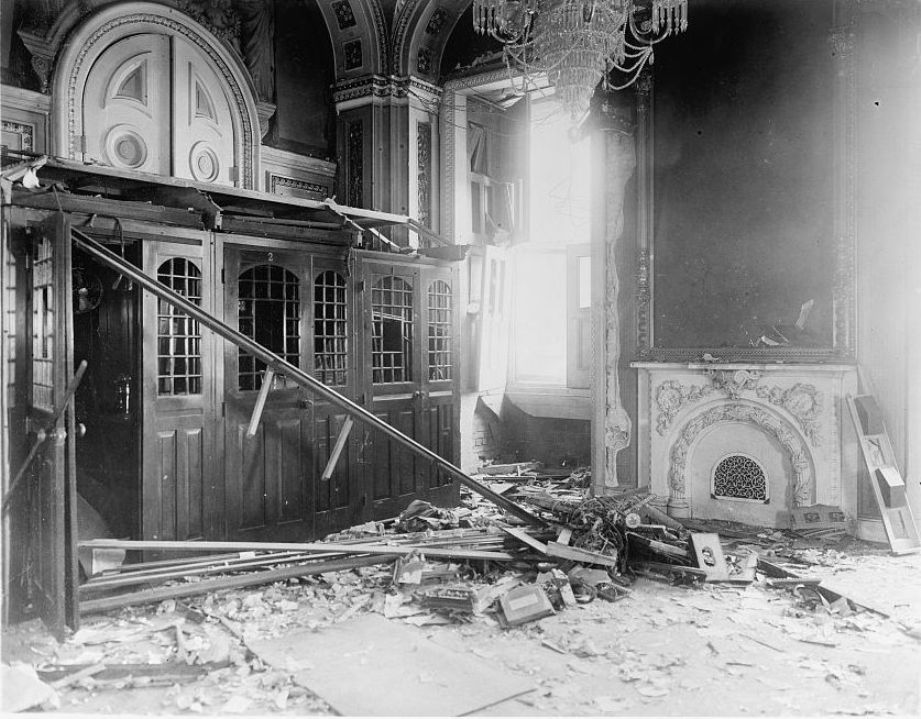
In this investigative new podcast, we look at the circumstances surrounding her disappearance, from the mysterious clues left in her fireplace to the suspicious behavior exhibited by her family.

This mystery captivated New Yorkers for decades as revelations and twists to the story continued to emerge. As one newspaper described it: “There is general agreement among police officials that the case is in a class by itself.”

ALSO: What secrets lurk in the infamous Pennsylvania ‘House of Mystery’? And could a sacred object found in Texas hold the key to solving the crime?

This episode is a newly re-edited and re-mastered version of a show we recorded in 2016.


The Bowery Boys: New York City History podcast is brought to you …. by you!

Please visit our page on Patreon and watch a short video of us recording the show and talking about our expansion plans. If you’d like to help out, there are five different pledge levels (and with clever names too — Mannahatta, New Amsterdam, Five Points, Gilded Age, Jazz Age and Empire State). Check them out and consider being a sponsor.

We greatly appreciate our listeners and readers and thank you for joining us on this journey so far. And the best is yet to come!


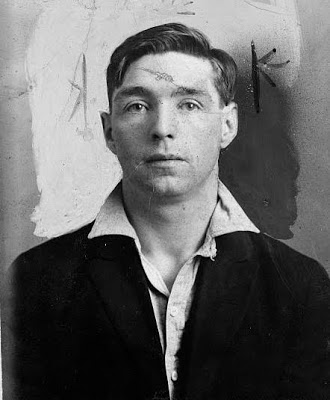
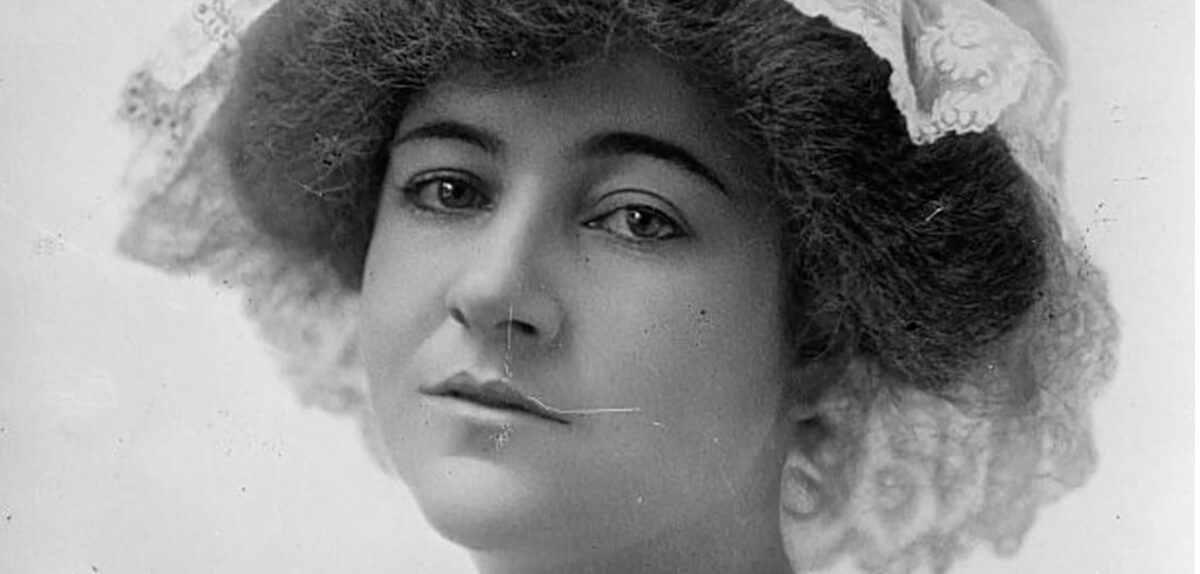
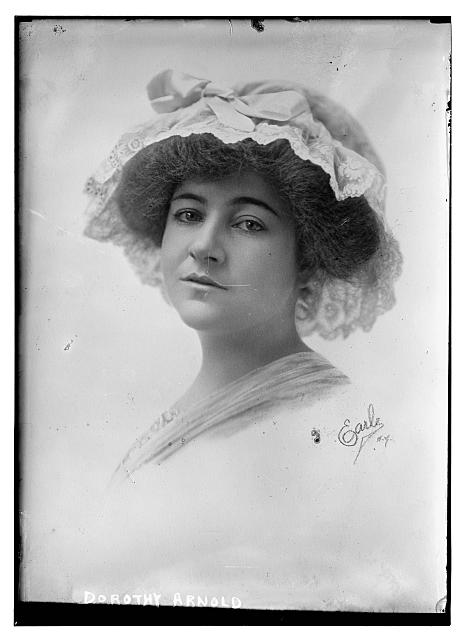
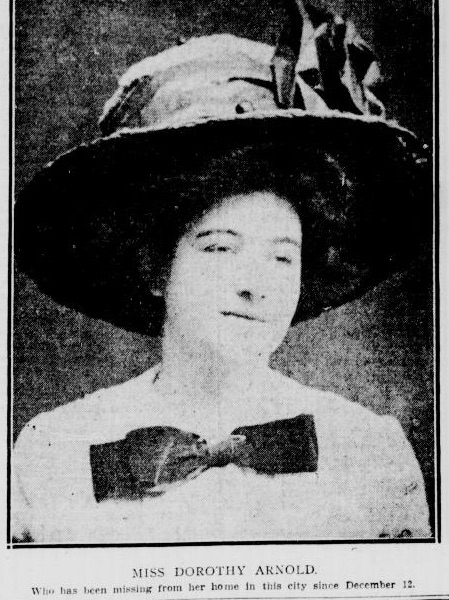
The photograph of Dorothy Arnold that was much reproduced in the press after her disappearance on December 12, 1910.

Library of Congress
Library of Congress

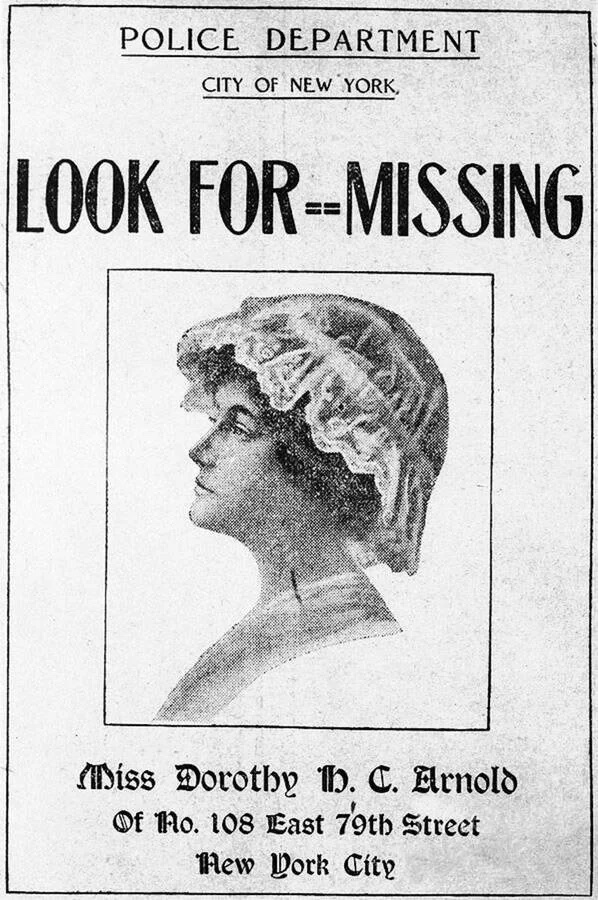
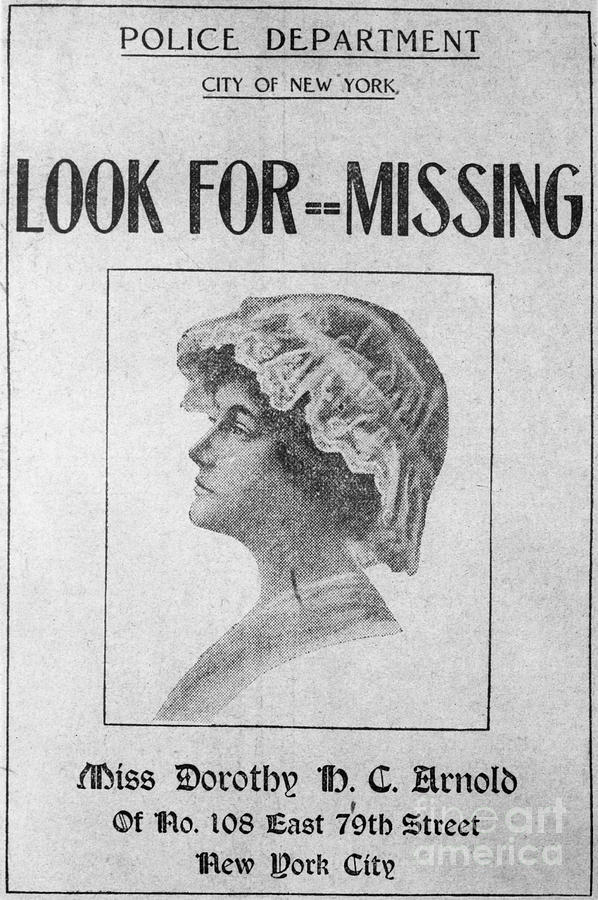
An example of a missing persons notice that was (eventually) distributed to police departments around the city.

missing-person-1911-granger

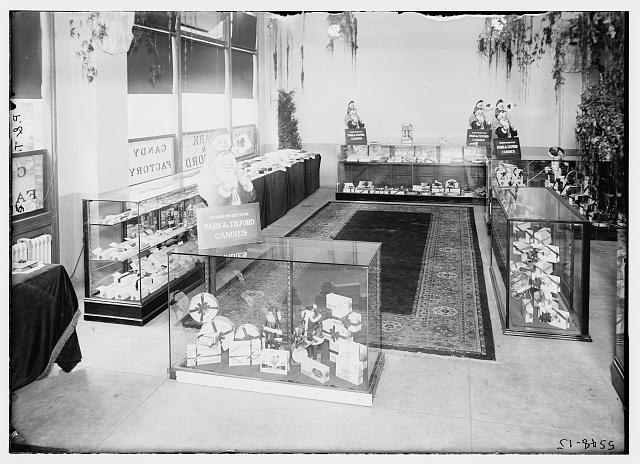
On the day of her disappearance, Arnold bought chocolates at the Park & Tilford candy shop.

Library of Congress
Library of Congress

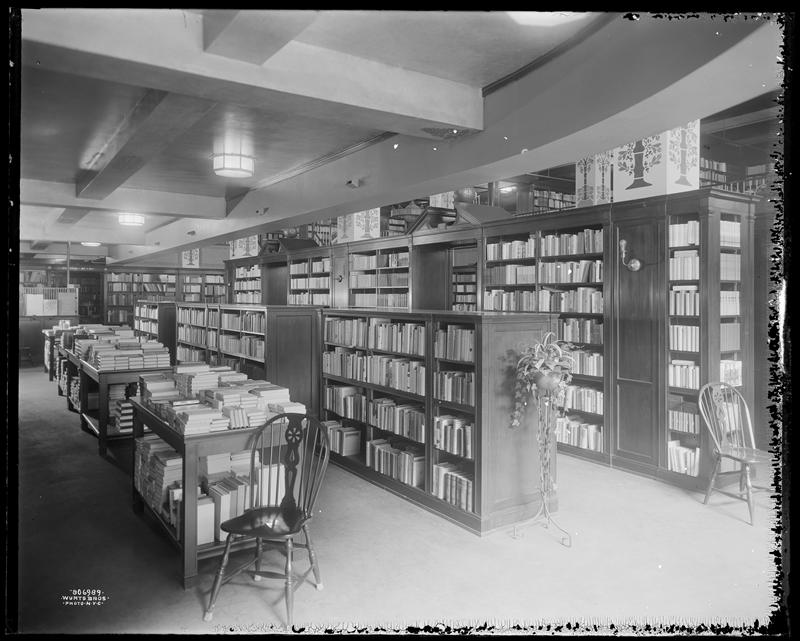
She was last spotted at a Brentano’s Book Store on 27th Street and Fifth Avenue. Here’s the interior of a New York Brentano’s store in 1925:

Museum of the City of New York

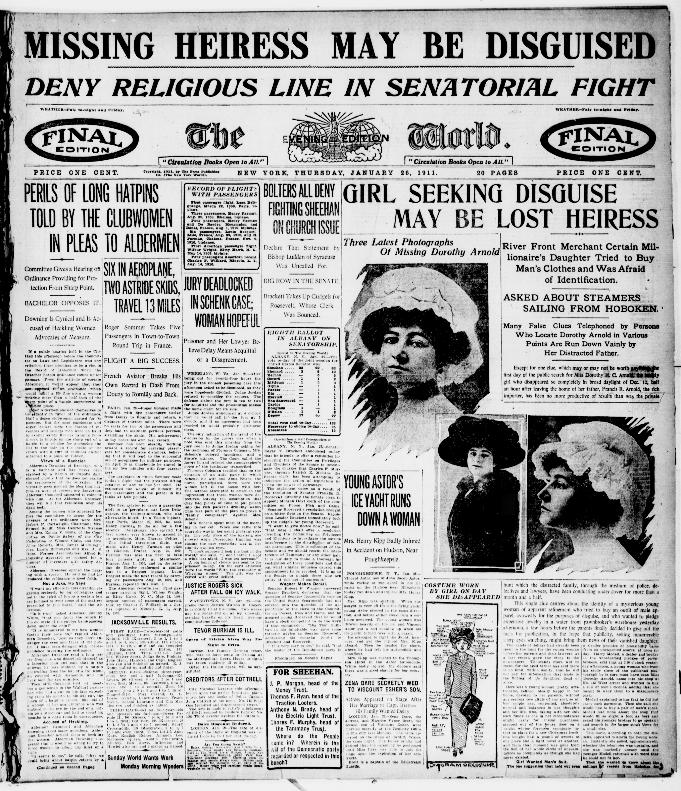
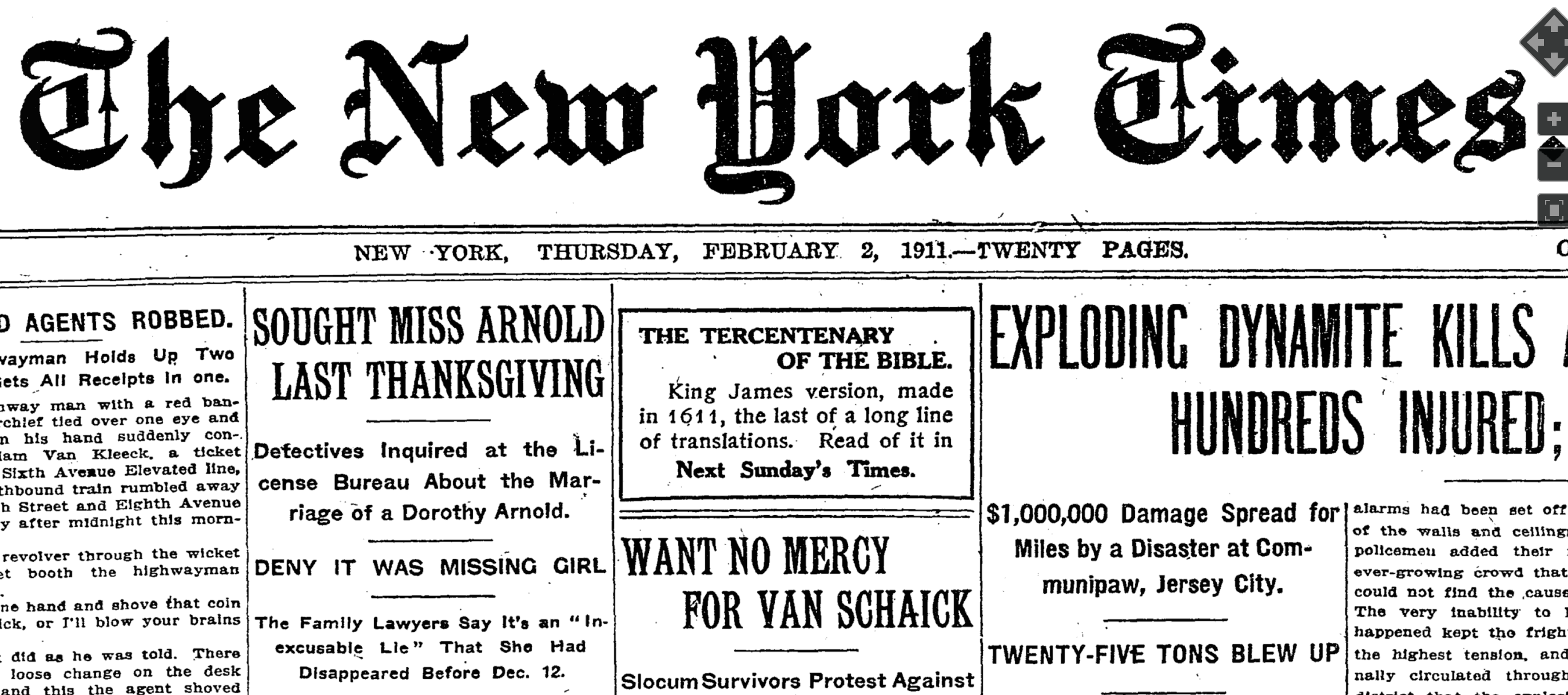
An extraordinary front page from the January 26, 1911, edition of the New York Evening World. Please note the other unusual headlines on the page:

Courtesy the Evening World

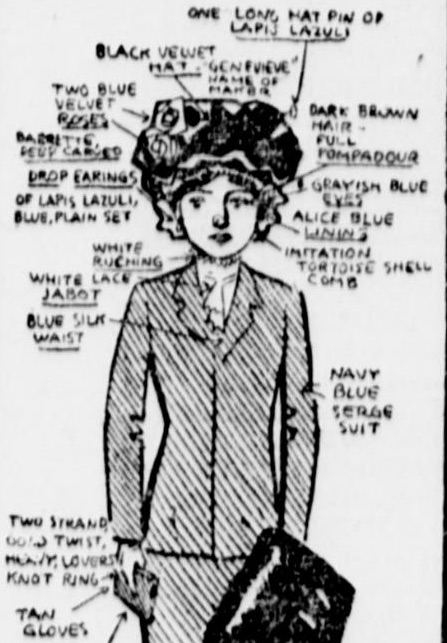
A close-up of the insanely detailed illustration of her wardrobe:

1

From the Jan. 26, 1911, New York Tribune: “Miss Dorothy Arnold who has been missing from her home in this city since December 12.”

Courtesy the New York Tribune

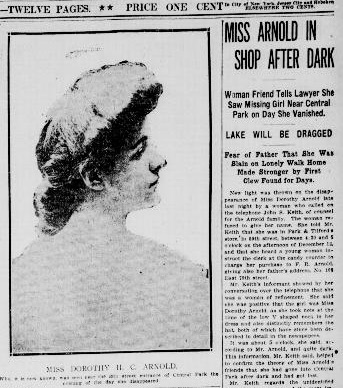
The New York Tribune, Jan 30, 1911:  “Miss Dorothy H.C. Arnold who, it is now known, was seen near the 59th Street entrance of Central Park the evening of the day she disappeared.”

Courtesy New York Tribune

A Dorothy Arnold related headline, sitting next to a headline involving the captain of the ill-fated General Slocum steamship, which sank in 1904.

Screen Shot 2016-05-26 at 10.54.56 PM

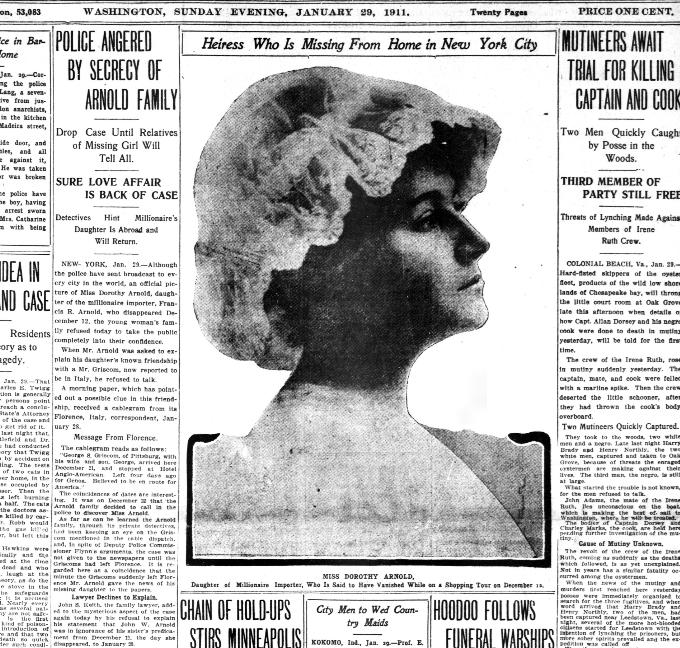
The event soon made newspapers across the country. This is from the front page of the Washington (D.C.) Times, January 29, 1911

Washington Times
Washington Times

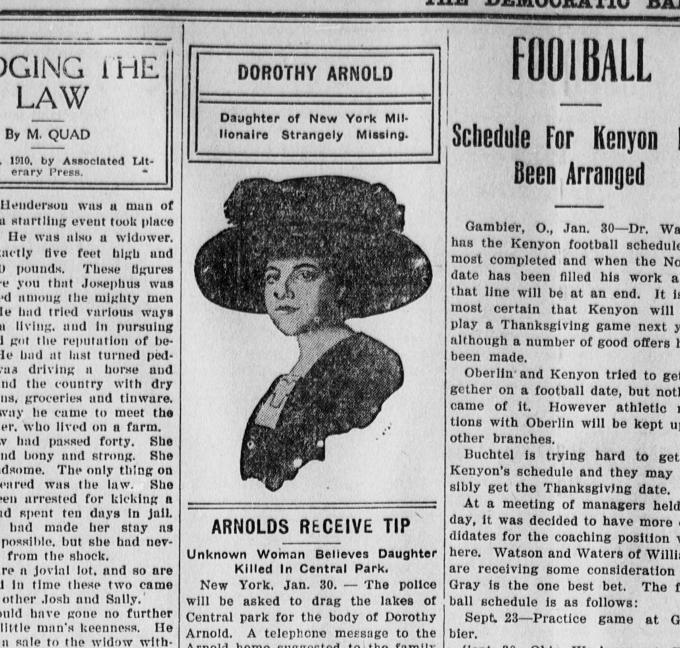
From the Mt. Vernon Ohio newspaper, January 31, 1911

image_681x648_from_1269,326_to_2984,1960
image_681x648_from_1026,415_to_4616,3834

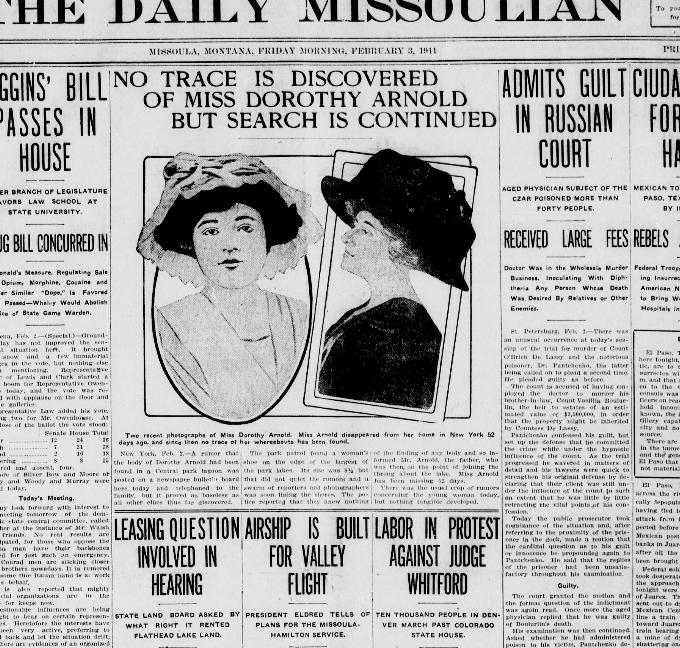
It even made the February 3, 1911, front page of the Missoula, Montana, newspaper!

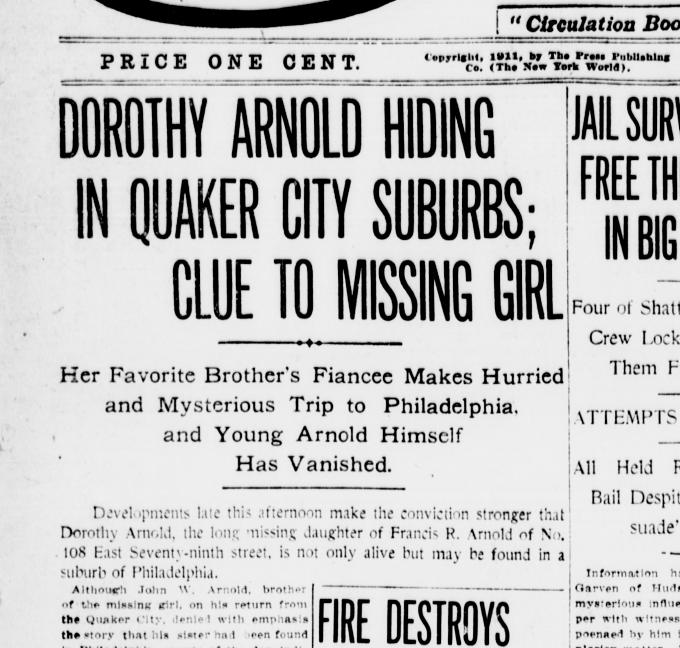
A clue that went nowhere, in the February 4, 1911, edition of the Evening World:

Courtesy New York Evening World

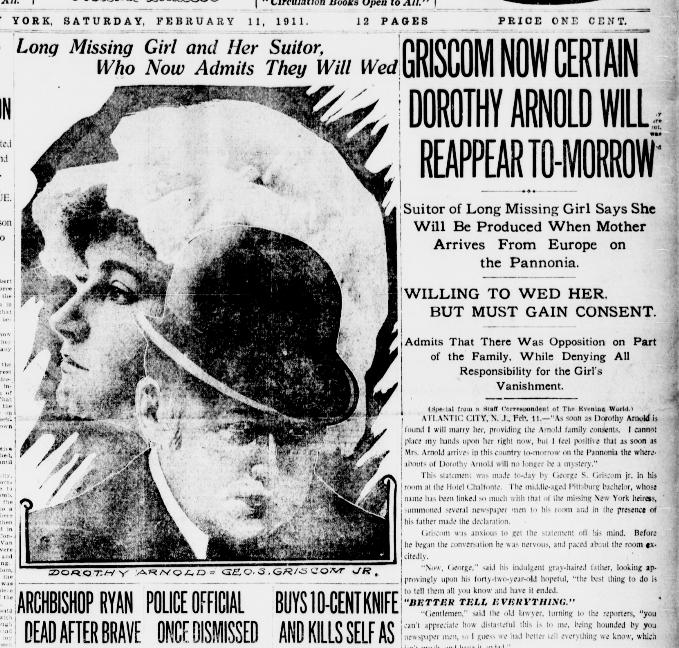
A photo illustration of Dorothy Arnold and George Griscom — accompanied by yet another speculative headline — in the February 11, 1911, edition of the New York Evening World:

Courtesy the Evening World

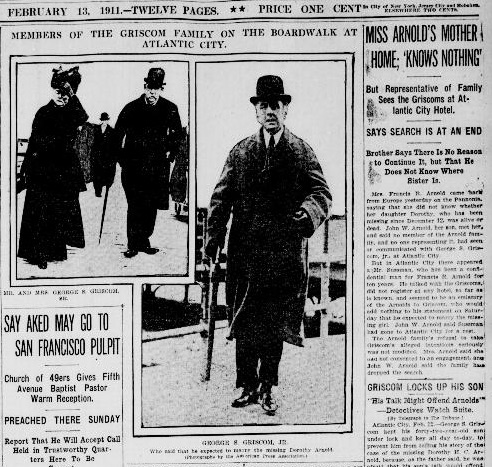
Even Griscom’s family was harassed by eager reporters. Here are his parents, captured on the Atlantic City boardwalk (February 13, 1911)

Courtesy New York Tribune

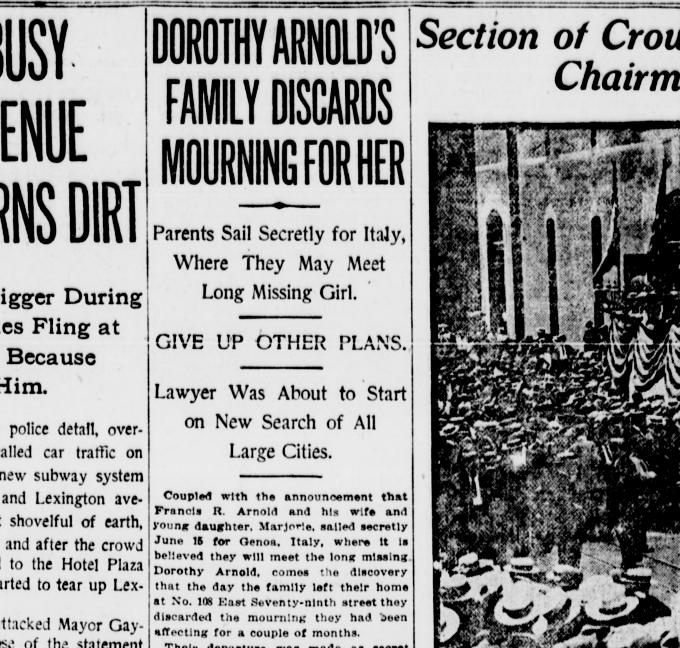
A headline from July 31, 1911, seems to question the motivation of Dorothy’s parents:

image_681x648_from_1066,1275_to_2699,2830

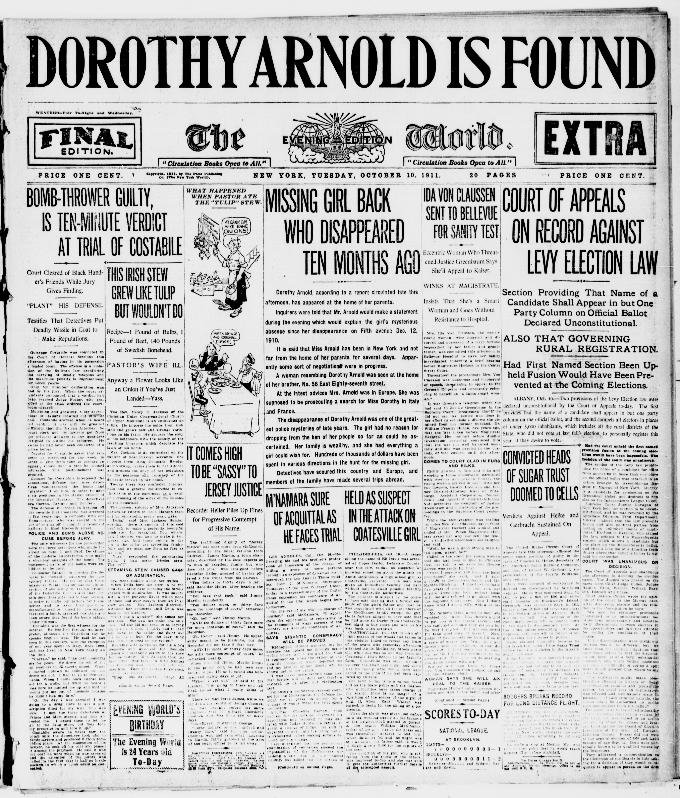
At other times, they went all in with unsubstantiated facts to sell newspaper such as this whopper from October 10, 1911.

Courtesy Evening World

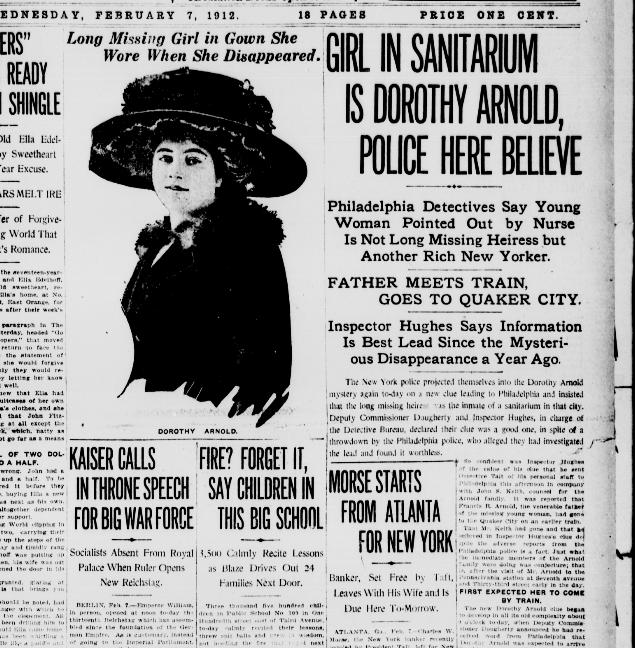
Another false report of Dorothy found in a sanitarium, from February 7, 1912:

Courtesy New York Evening World

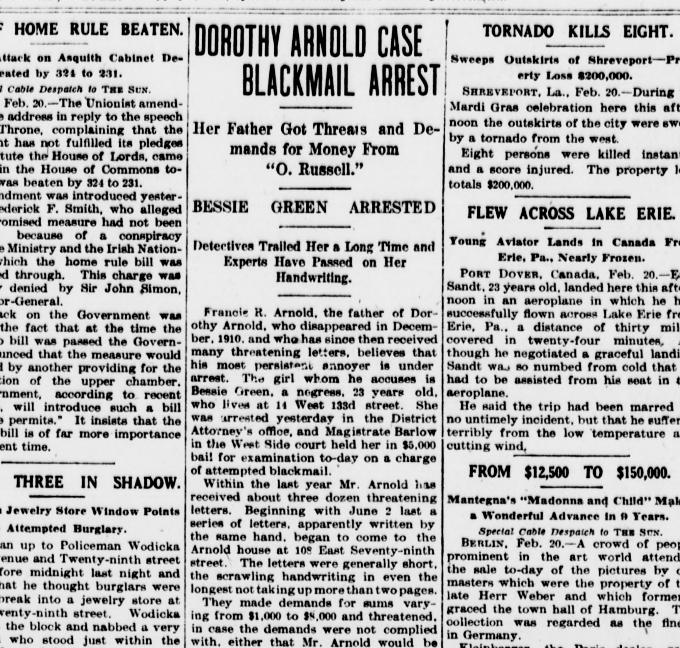
News of a blackmail from February 21, 1912, but in this case, the woman, Bessie Green, was later acquitted.

Courtesy New York Sun

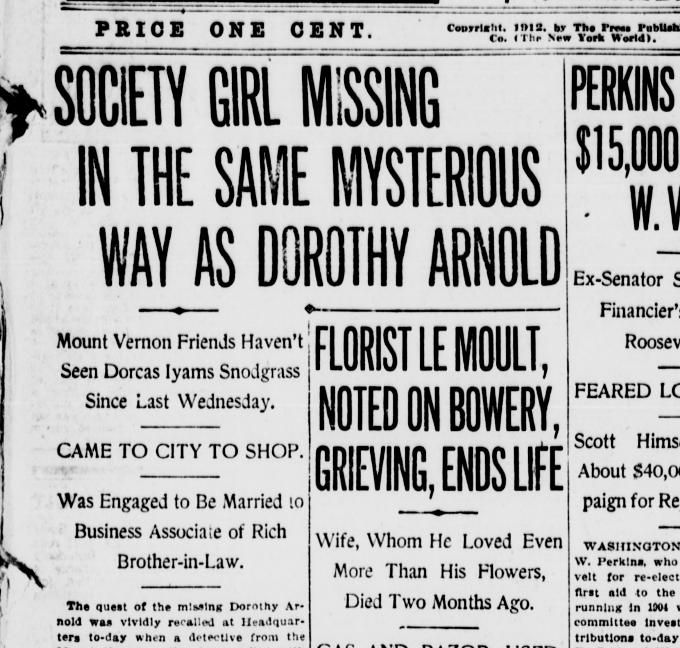
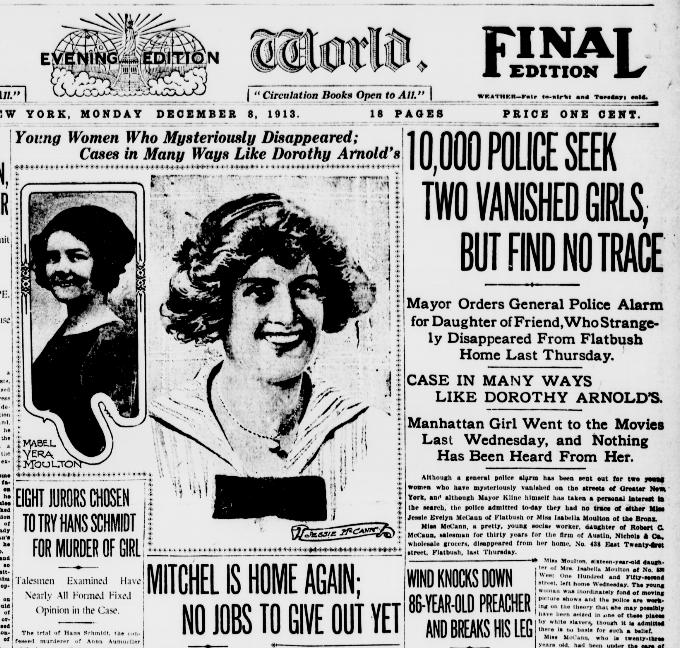
Dorothy Arnold was frequently brought up anytime a person went missing, as in this case in July 22, 1912 and another from December 8, 1913.

Courtesy Evening World
image_681x648_from_2022,735_to_5311,3867

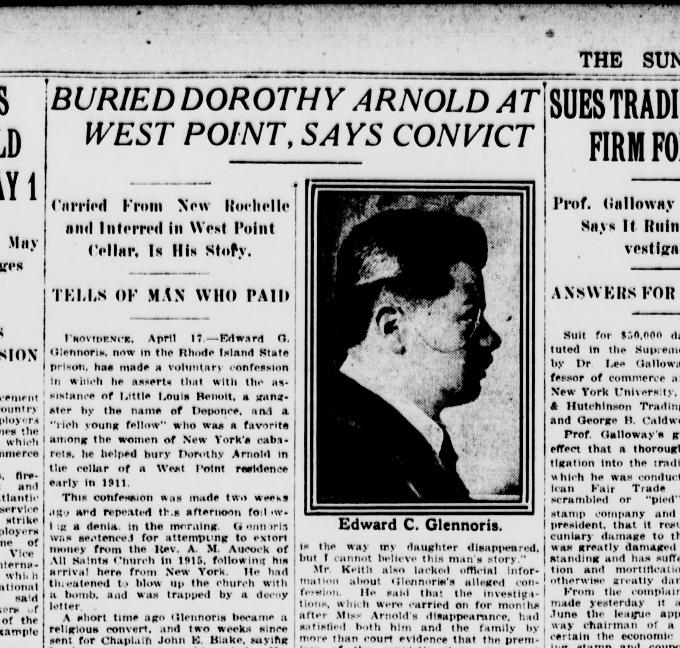
Over five year after her disappearance, her name is brought up again in a possible unfortunate event described by the Rhode Island convict Edward Glennoris.

Courtesy New York Sun

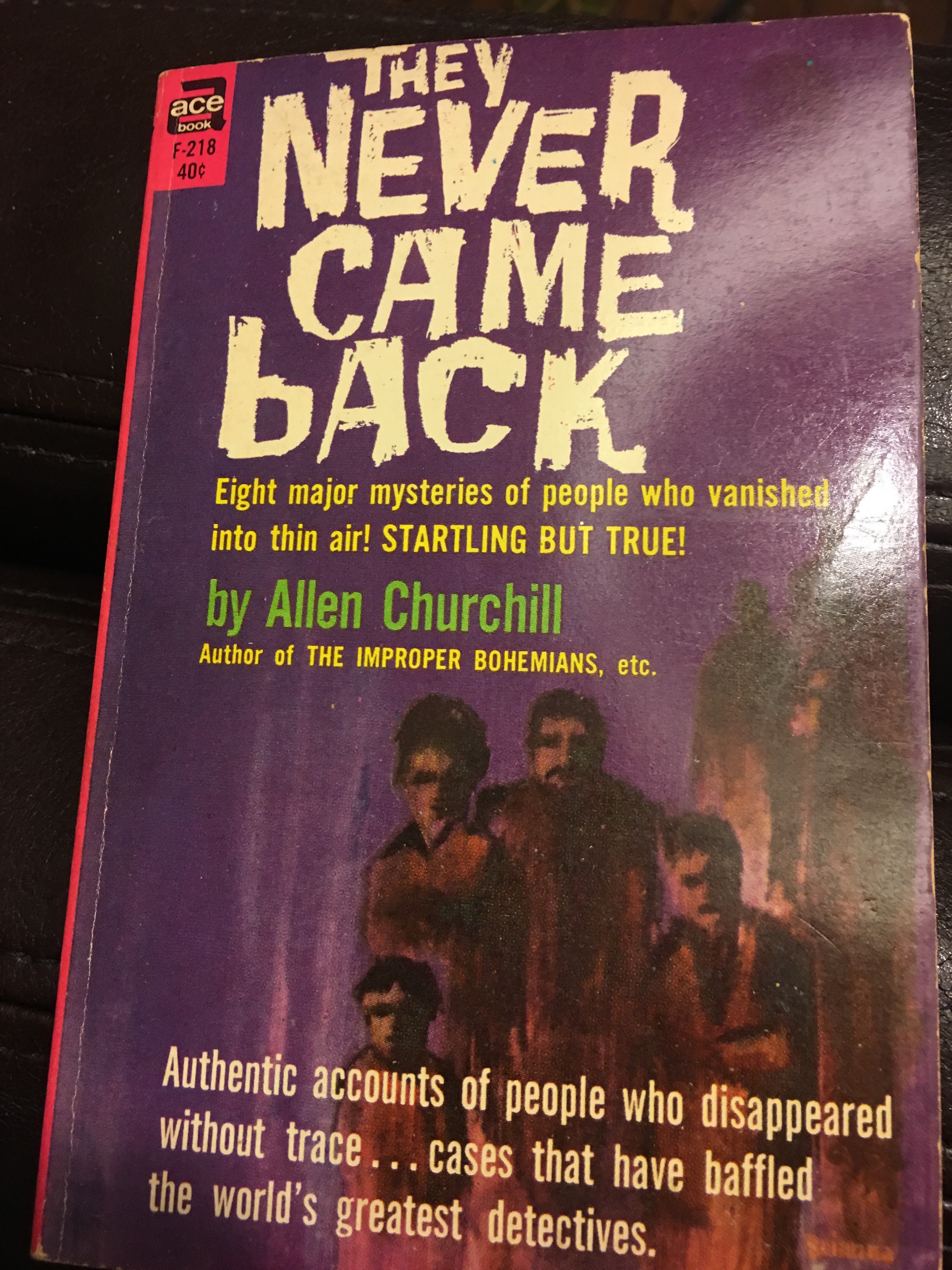
This podcast is inspired by an old paperback I found a long time ago called They Never Came Back by Allen Churchill which features the story of Dorothy Arnold:

IMG_9339 (1)
Categories
Gilded Age New York Mysterious Stories Neighborhoods Podcasts

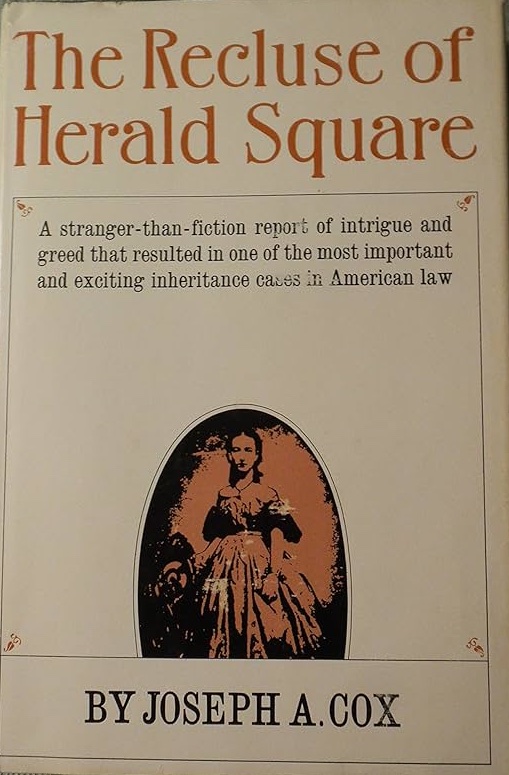
The Recluse of Herald Square: The Mystery of Ida Wood

Ida Wood had a secret. Born Ida Mayfield in New Orleans, Ida moved to New York in the 1850s and through her marriage to Benjamin Wood, publisher of the New York Daily News, she entered society. 

By the 1870s and 80s, Ida’s name was found in the social columns of the city’s newspapers.

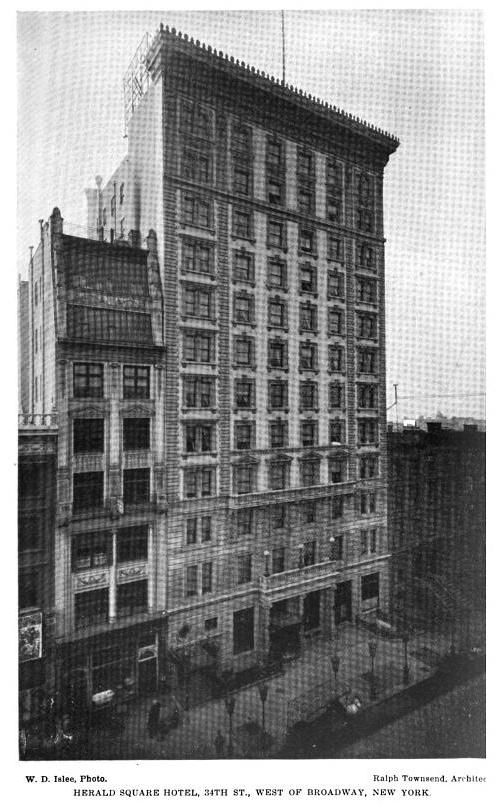
So why, in 1907, did Ida Wood cash in – withdrawing her fortune from the bank and then, along with her sister and daughter, retreat into a suite at the Herald Square Hotel… for decades?

This is the story of a Gilded Age belle turned recluse, who chose to withdraw from society while still living in the heart of it. It’s also the story of the fortune hunters who circled around her in her final years. 

And most incredibly – it’s the story of what happened next.

LISTEN NOW: THE RECLUSE OF HERALD SQUARE

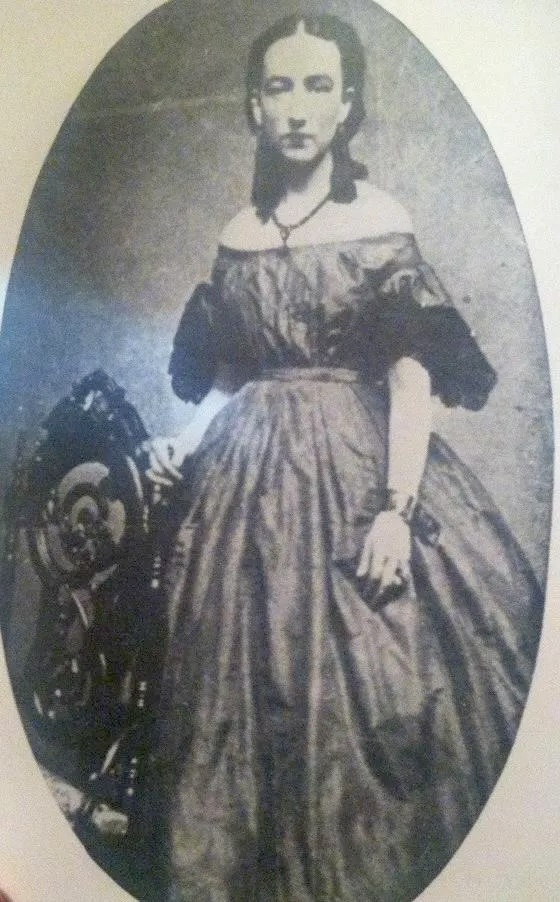
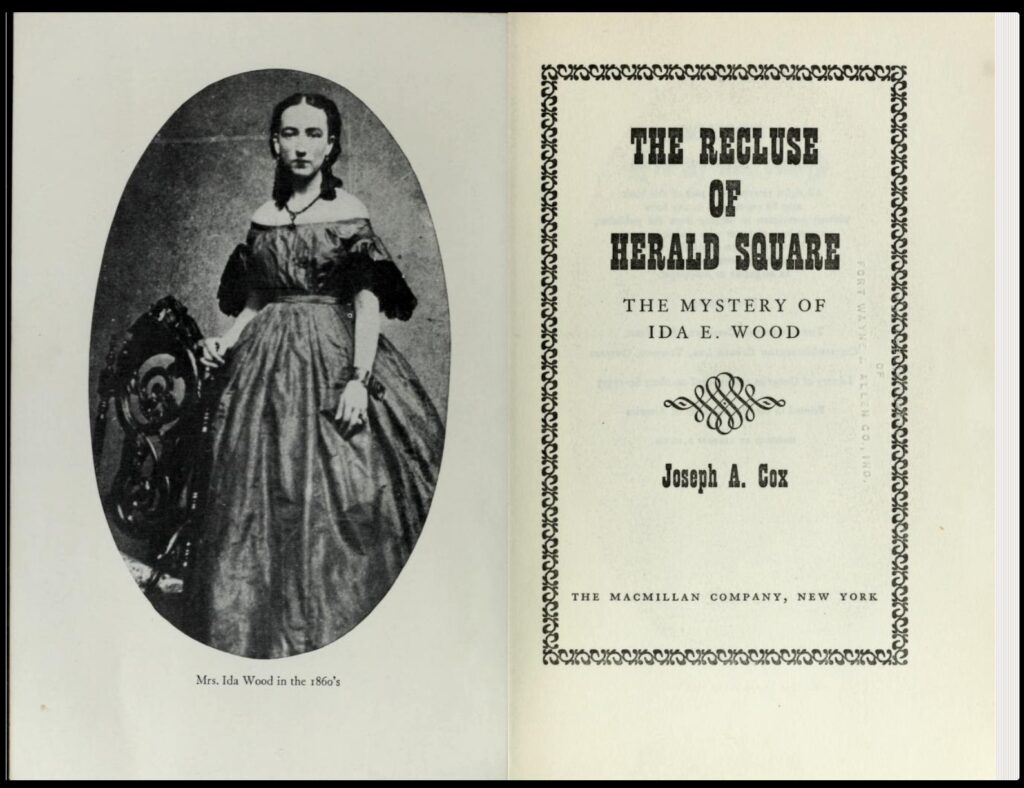
One of the only remaining images we have of Ida Wood.

“Ida Mayfield”, moved to New York in the 1850s and married publisher and politician Benjamin Wood in 1867. By the 1870s, her name appeared regularly in the society columns.

Ida’s husband, Benjamin Wood, publisher of the New York Daily News from 1861 until his death in 1900. He was also the brother of the notorious Civil War-era Mayor of New York, Fernando Wood. Upon his death, Ida took over editorial responsibilities for the Daily News.

The Herald Square Hotel around 1900. (Source: Beyond The Gilded Age) The hotel opened in the late 1890s. Ida, her sister Mary and daughter Emma, moved into a suite in on the hotel’s fifth floor in 1907. Ida would remain in the hotel until her death in 1932.

In 1964, The Recluse of Herald Square: The Mystery of Ida E. Wood by Joseph A. Cox was published by The Macmillan Company.

In the 1930s, Cox served as counsel for the Surrogate Court of New York County and charged with determining the legal identity of Ida E. Wood so that her estate could be distributed.

The book is out of print today, although you can read it for free here on Archive.org, and you may be lucky and find it in your library.

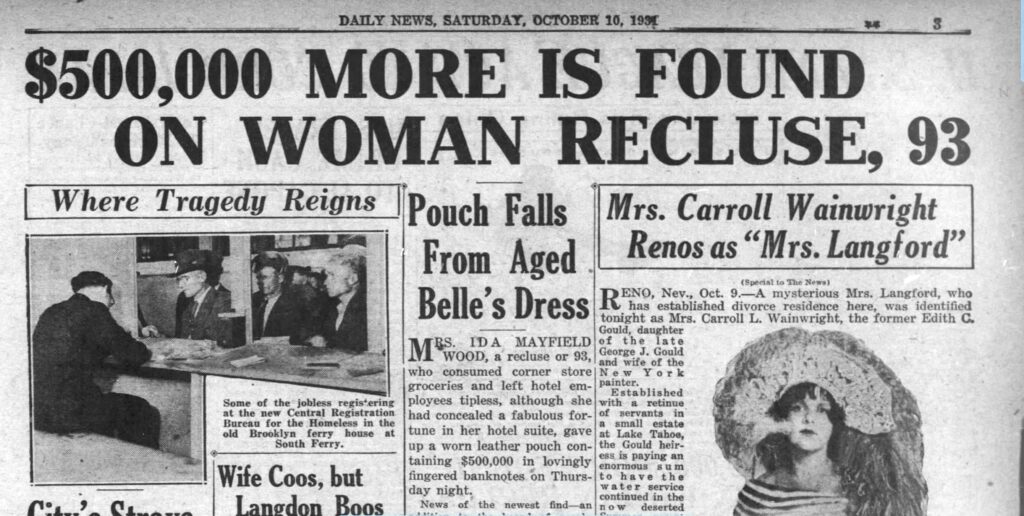
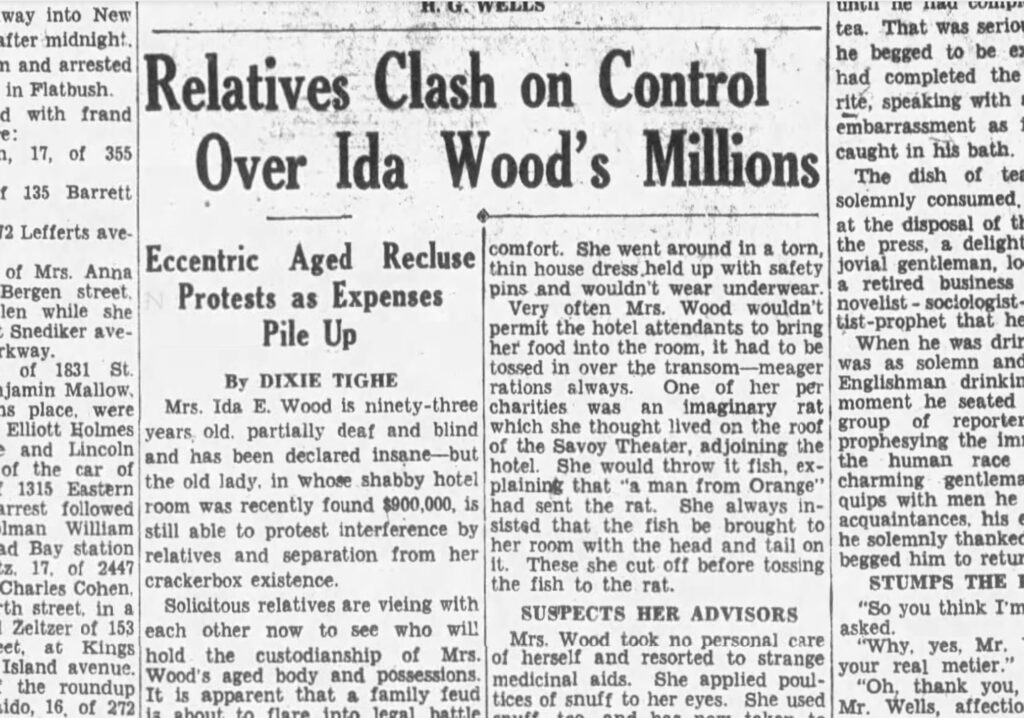
New York Daily News, Oct. 10, 1931. Not mentioned: The pouch had been sliced out of her dress while she slept by her nurse.

Brooklyn Times-Union, October 14, 1931. Ida was still very much alive.

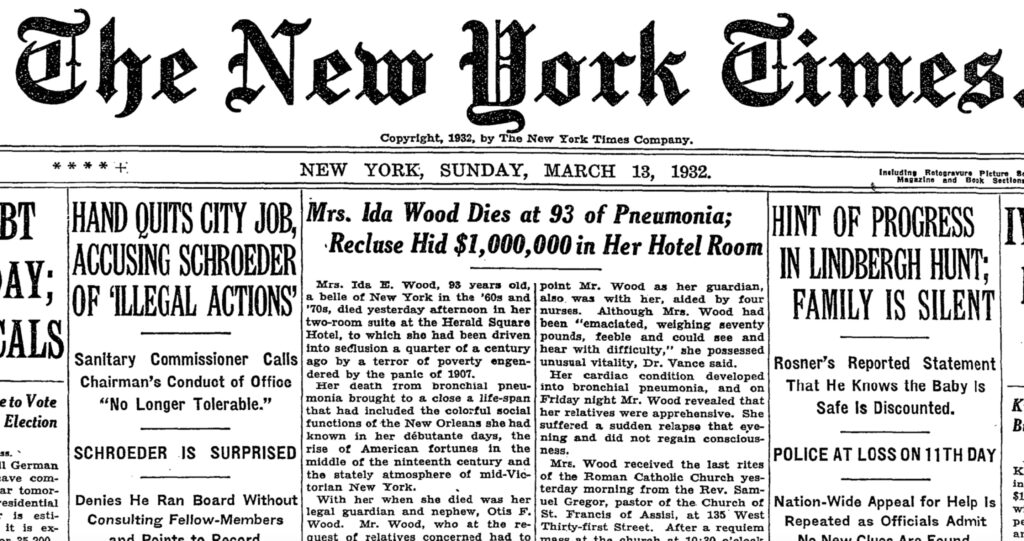
The New York Times, March 13, 1932. Ida’s obituary ran at the top of Page One.

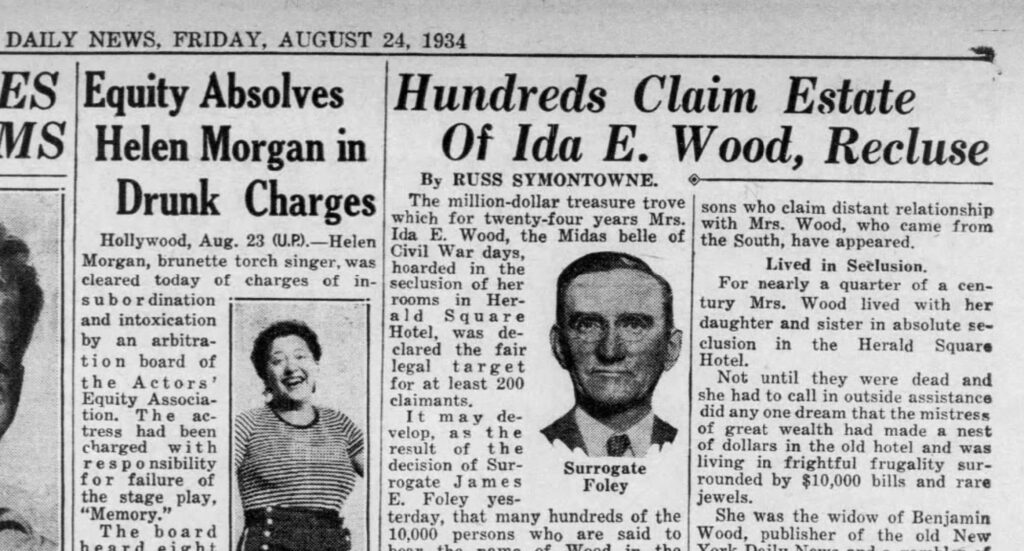
New York Daily News, August 24, 1934. By 1934, hundreds of Mayfields and Woods families were filing claims on Ida’s estate. More than 600 claimants would appear in court.

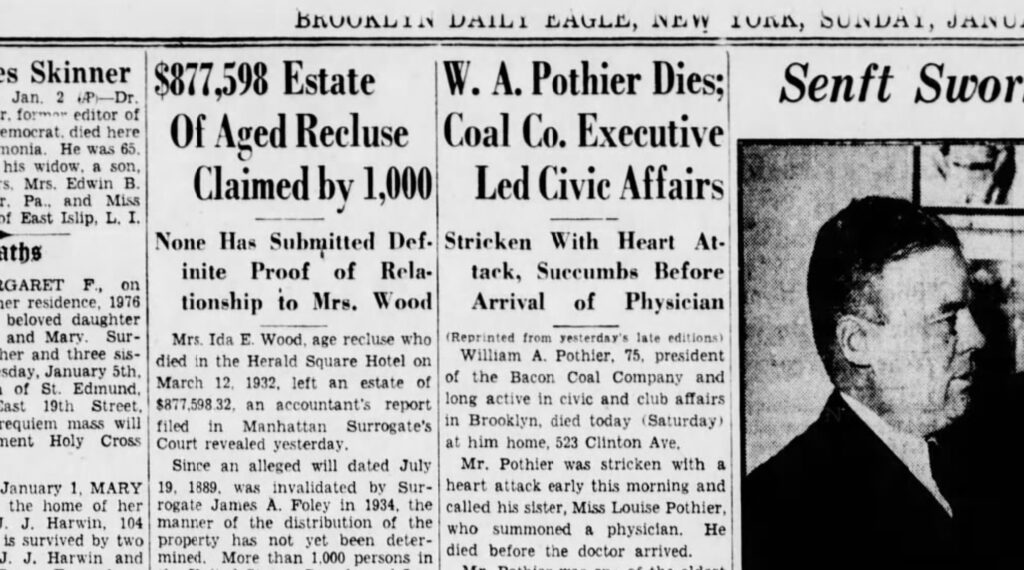
Brooklyn Daily Eagle, January 3, 1937 More than 1,000 claimed a familial connection to Ida — mostly through the Mayfield side. Joseph Cox, working for the Surrogate’s Court, was assigned to find out who, exactly, Ida really was.

FURTHER LISTENING

After listening to this episode, dive into these past shows with similar themes and locations


FURTHER READING


Spoiler alert! Spoiler alert!

Stop reading here if you haven’t yet listened to the show. 

At the end of the show, Tom mentioned another possible ending that was proposed by investigator Joseph Cox, author of “The Recluse of Herald Square: The Mystery of Ida E. Wood.” 

Cox proposed in his final chapter that Ida, before leaving Massachusetts for New York, likely worked as a domestic helper. He theorizes that she could have become involved with a young man of the house, and could have found herself pregnant.

She could have returned to live with her family, secretly given birth to Emma, and then, through her own clever manipulation, had her parents’ names entered on Emma’s birth certificate. 

In this scenario, however, Ida (or rather, Ellen) was very much the mother of Emma. Ellen then moved to New York with the child, whom she told Ben Wood was her much younger sister. 

This, Cox believes, simply makes more sense. For why else would Ellen/Ida have taken on the young child? Why wouldn’t Emma have stayed with her mother in Massachusetts?   

It’s pure speculation, but logical. However, the facts – and all the documents – secured by Cox showed Ida’s parents listed as Emma’s parents. And Ben’s letter to the priest also makes clear his position. So all the evidence points to Emma being Ida’s sister.

Was it all a cover up? We’ll never know.

Categories
Mysterious Stories Podcasts

The Ghosty Men: The Story of the Collyer Brothers

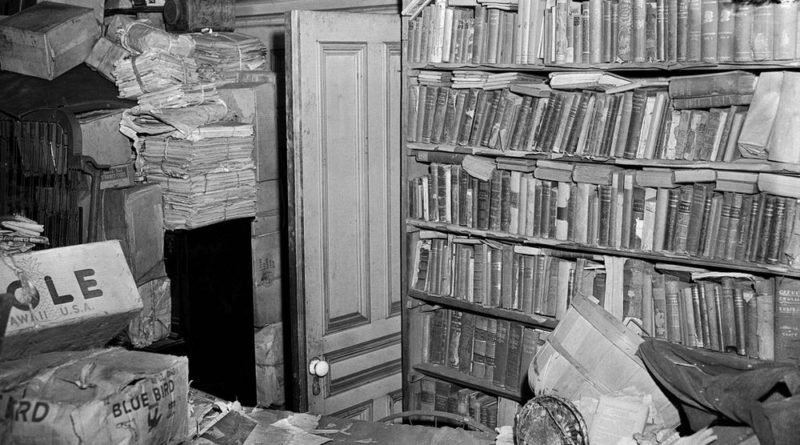
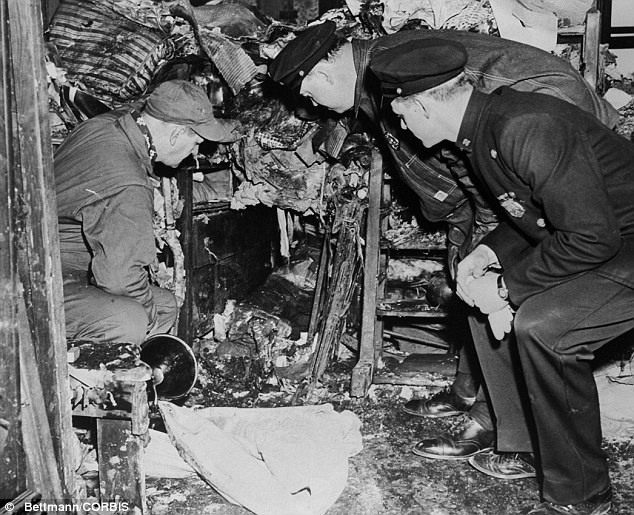
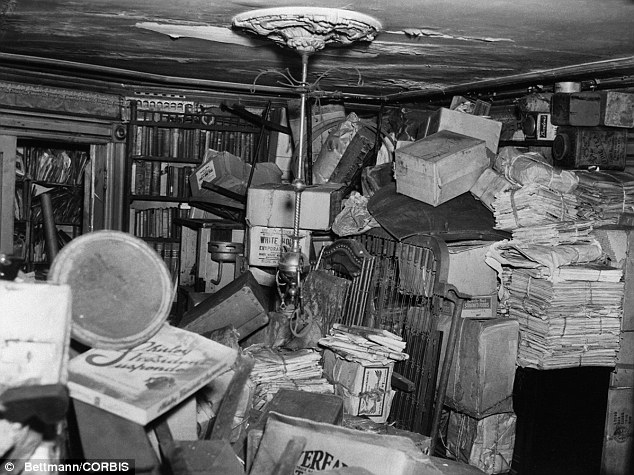
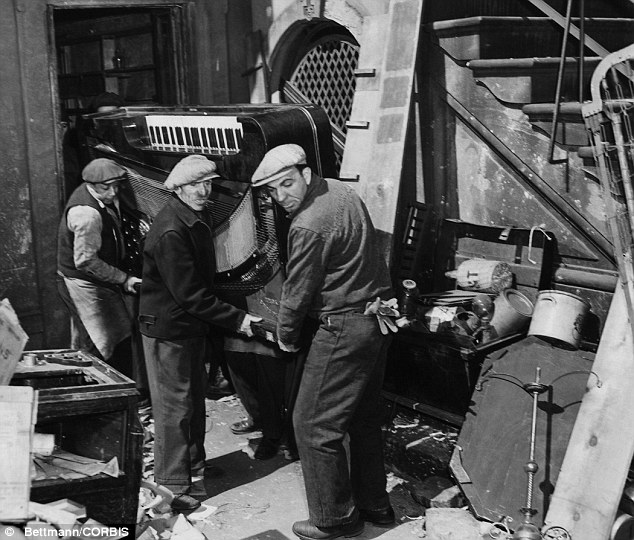
You better clean your room or you’ll end up like the Collyer Brothers.

New York City, a city crammed of 8.6 million people. It’s filled with stories of people who just want to be left alone – recluses, hermits, cloistering themselves from the public eye, closing themselves off from scrutiny.

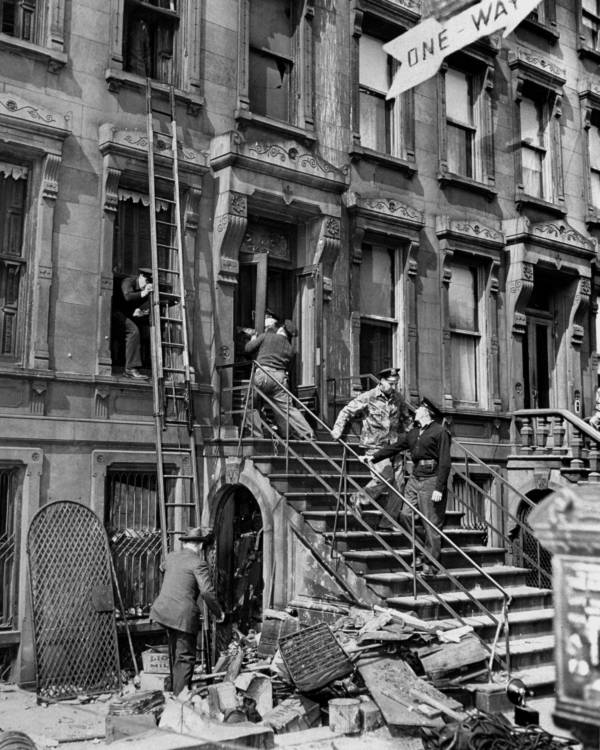
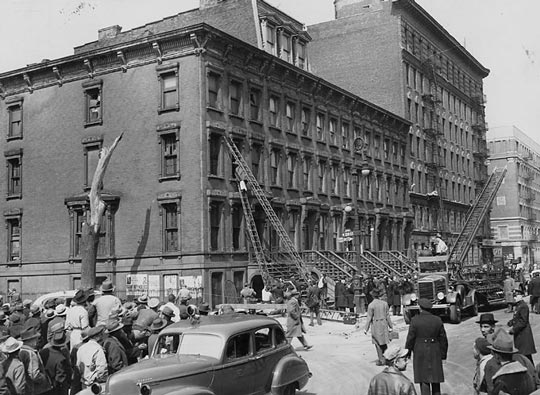
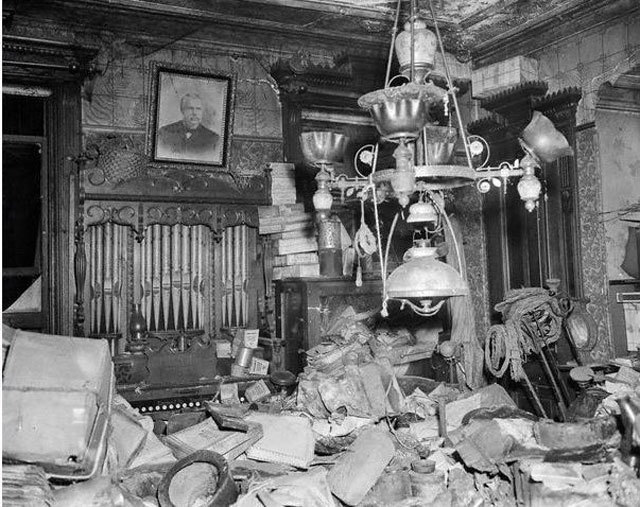
But none attempted to seal themselves off so completely in the way that Homer and Langley Collyer attempted in the 1930s and 1940s. Their story is infamous. In going several steps further to be left alone, they in effect drew attention to themselves and to their crumbling Fifth Avenue mansion – dubbed by the press ‘the Harlem house of mystery’.

They were the children of the Gilded Age, clinging to blue-blooded lineage and drawing-room social customs, in a neighborhood that was about to become the heart of African-American culture. But their unusual retreat inward — off the grid, hidden from view — suggested something more troubling than fear and isolation. And in the end, their house consumed them.

Listen Now: Collyer Brothers Podcast

__________________________________________________________

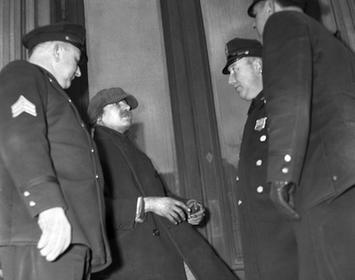
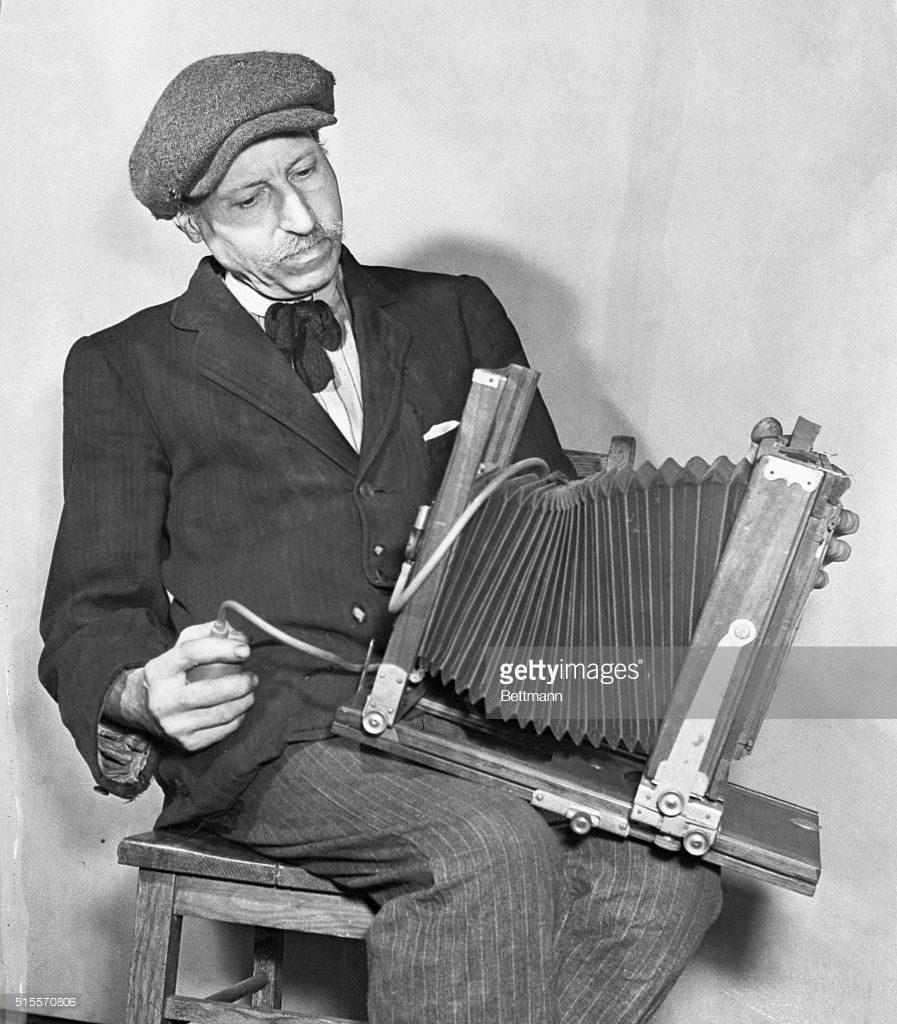
Homer Collyer, 1939

Langley Collyer, 1942, at his New York Herald Tribune photo shoot

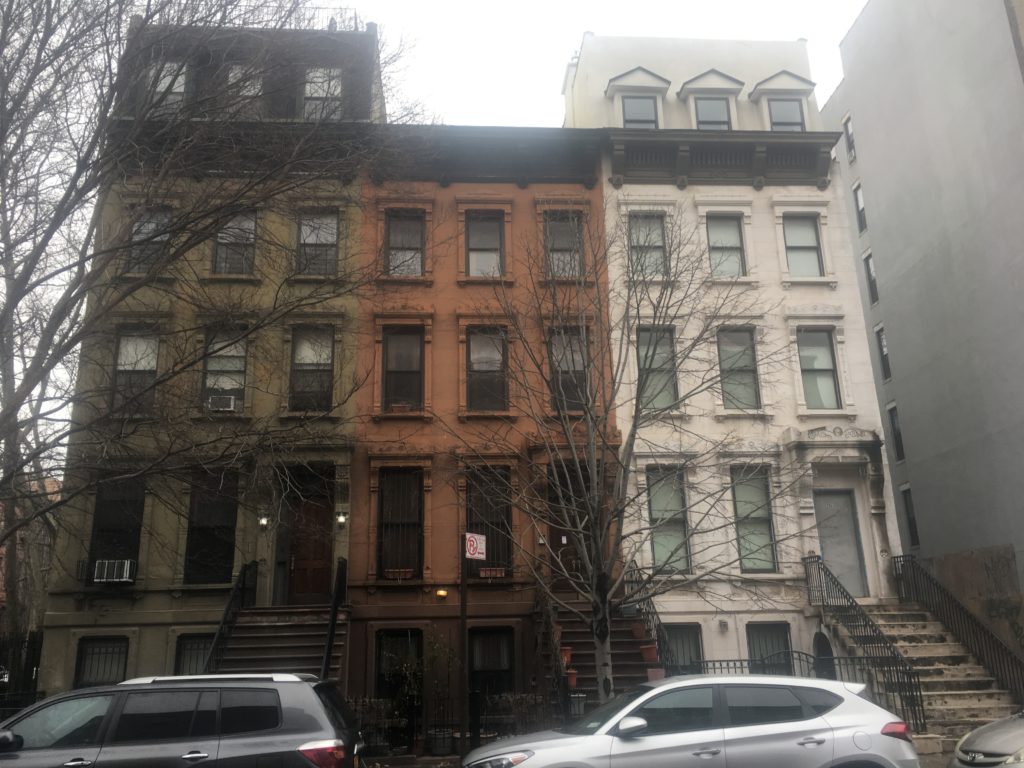
The three remaining rowhouses developed by George J. Hamilton. The middle house gives you some idea of what the Collyer mansion looked like.

Charles Hoff / NY Daily News

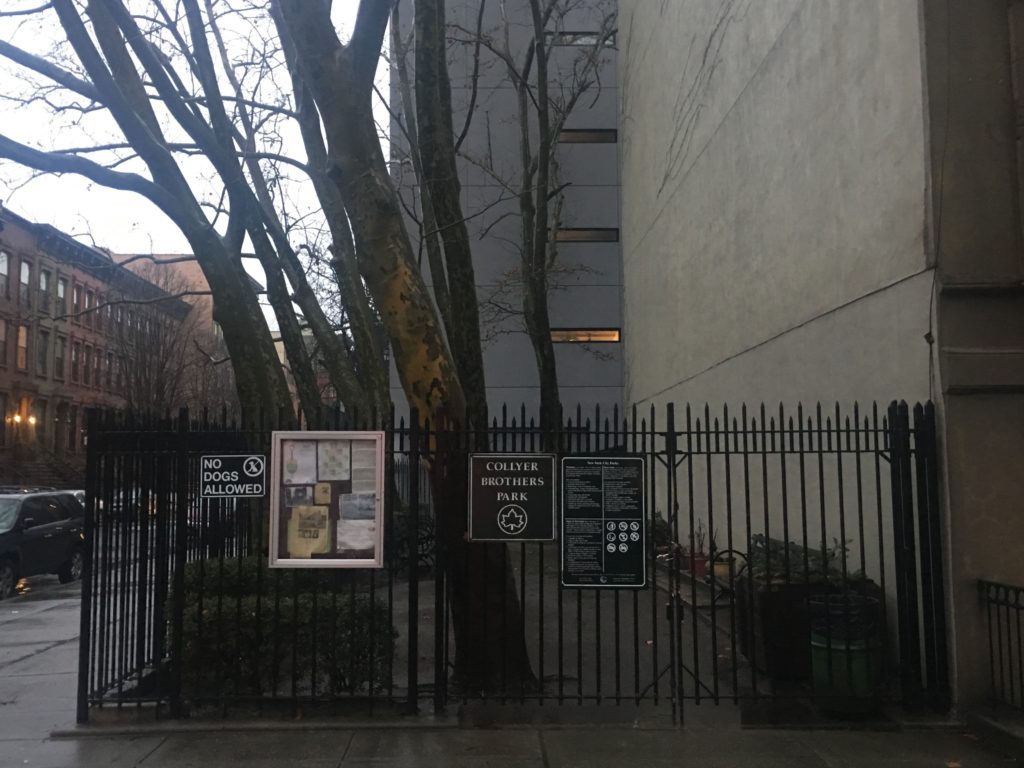
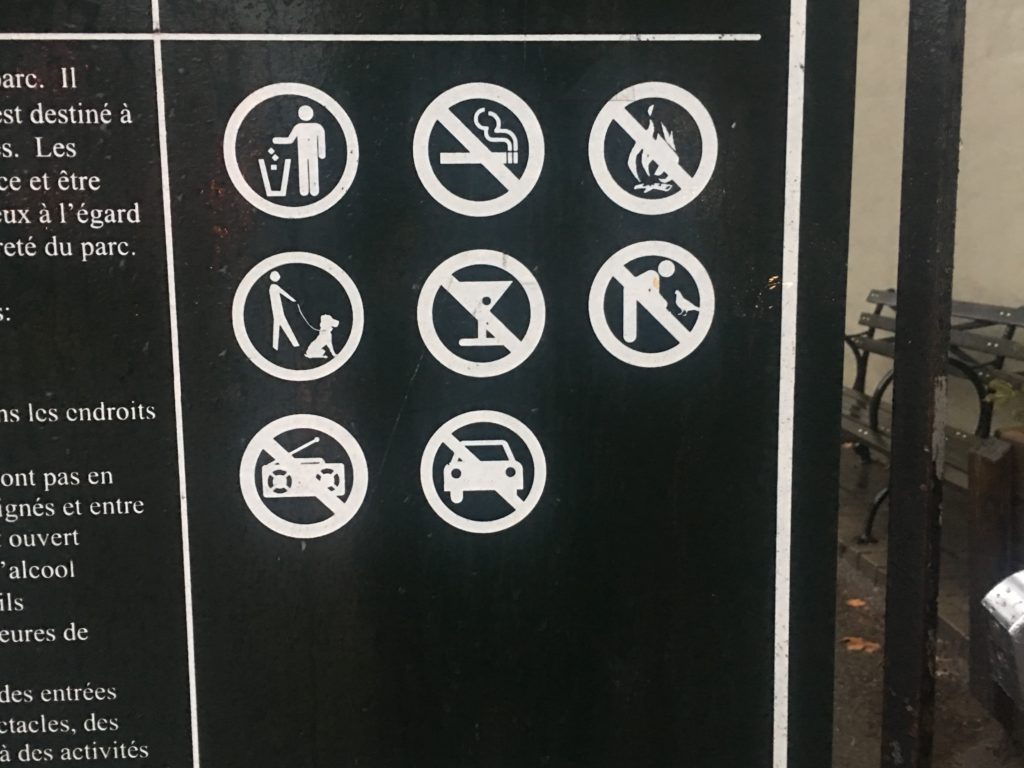
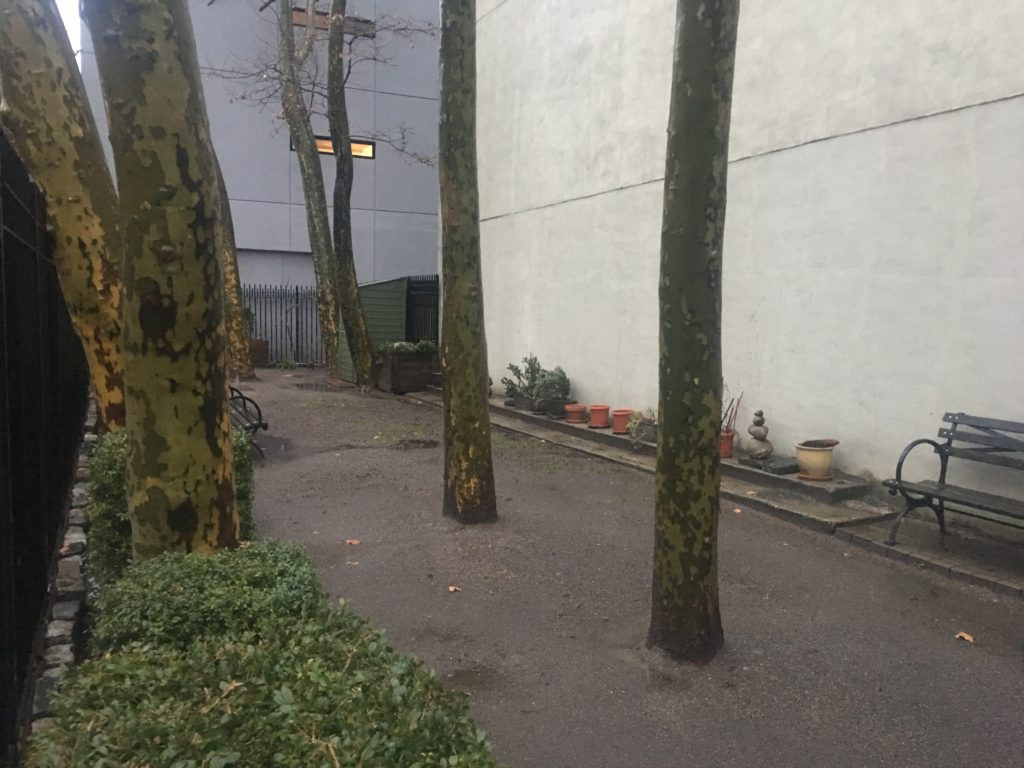
No littering in Collyer Brothers Park!

Silent footage taken outside the Collyer house, 1947

FURTHER READING

Homer and Langley by E.L. Doctorow
Out of this World by Helen Worden Erskine
Stuff: Compulsive Hoarding and the Meaning of Things by Randy O. Frost and Grail Steketee
Ghosty Men by Franz Lidz

FURTHER LISTENING

We’ve visited the back story of famous recluses in past shows with the story of Big Edie and Little Edie Bouvier (Grey Gardens) and the legendary film actress Greta Garbo:

And the story of changing Harlem is profiled in the biography episode of the great Madam C. J. Walker

<
Categories
Podcasts Revolutionary History

Aaron Burr vs. Alexander Hamilton: The terrible consequences of an ugly insult

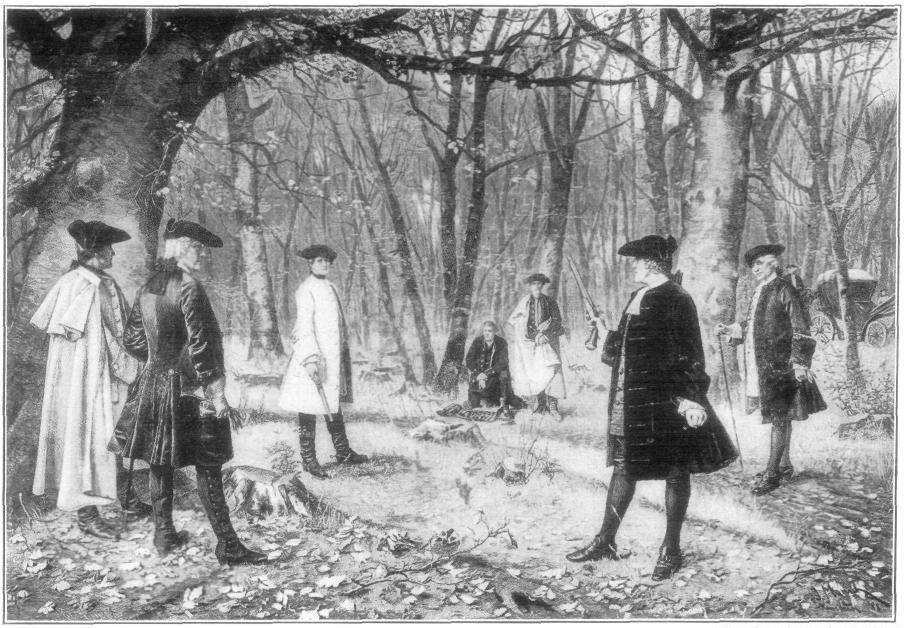
Alexander Hamilton and Aaron Burr met at a clearing in Weehawken, NJ, in the early morning on July 11, 1804, to mount the most famous duel in American history. But why did they do it?

This is the story of two New York lawyers — two Founding Fathers — that so detested each other that their vitriolic words (well, mostly Hamilton’s) led to these two grown men shooting each other out of honor and dignity, while robbing America of their brilliance, leadership and talent.

You may know the story of this duel from history class, but this podcast focuses on its proximity to New York City, to their homes Richmond Hill and Hamilton Grange and to the places they conducted their legal practices and political machinations.

Which side are you on?

ALSO: Find out the fates of sites that are associated with the duel, including the place Hamilton died and the rather disrespectful journey of the dueling grounds in Weehawken.

CORRECTION: Alexander Hamilton had his fateful dinner as the house of Judge James Kent, not John Kent, as I state here.

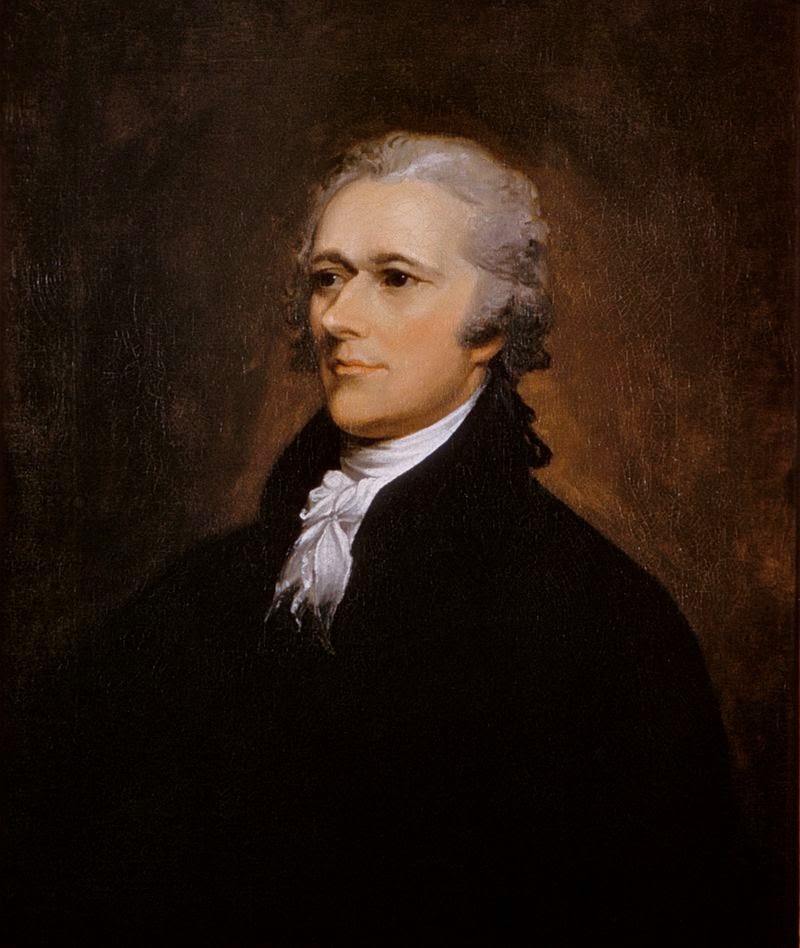
Alexander Hamilton, leader of the Federalists was a played out, stressed out, heavily in debt politician by June 1804. This is John Trumbull’s painting of Hamilton, completed almost over a year after the duel.

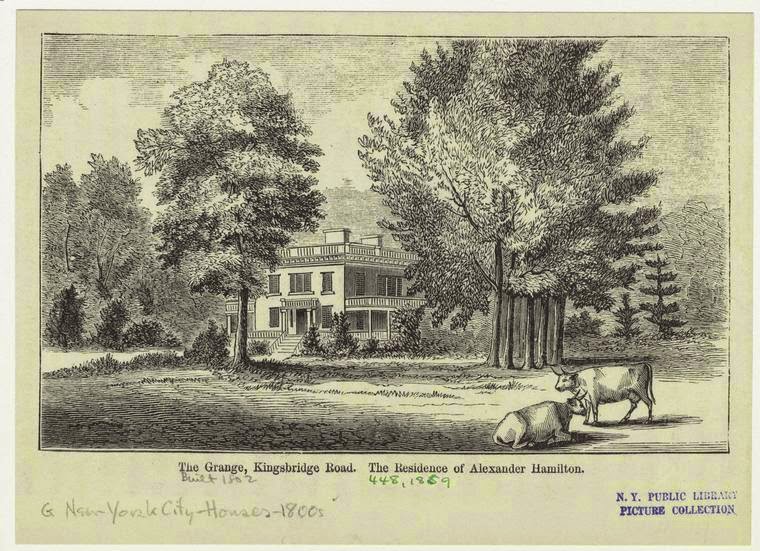
The Hamilton Grange, a beautiful home on the Hudson that Alexander only lived in for a couple years. (NYPL)

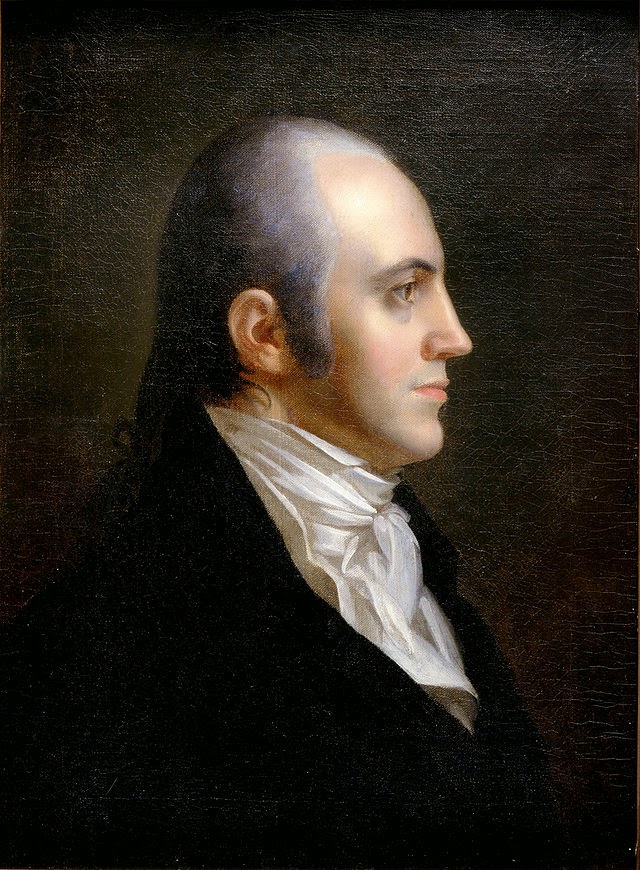
Aaron Burr, Vice President of the United States, was a played out, stressed out, heavily in debt politician by June 1804. This is John Vanderlyn’s portrait of Burr from 1802.

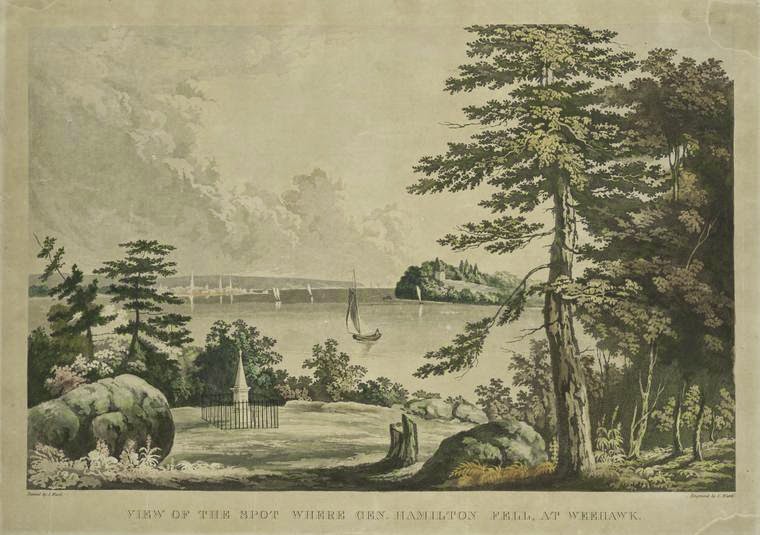
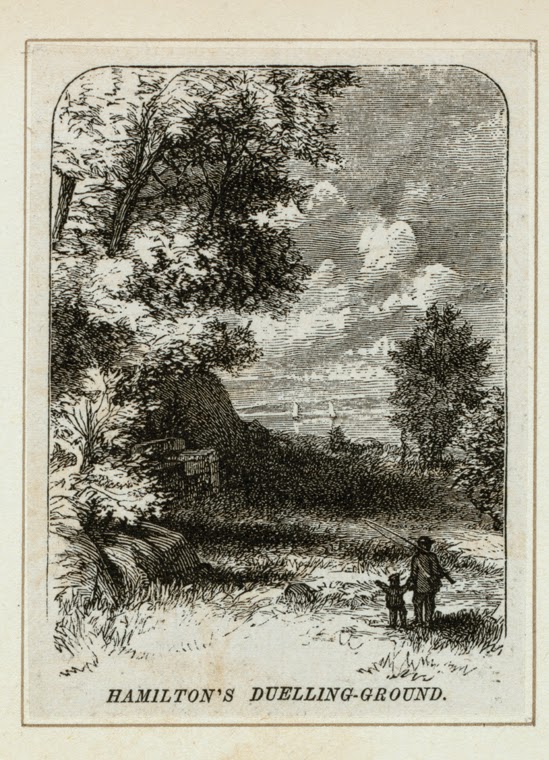
View of the Weekhawken dueling grounds in 1830s.  This area most likely still saw some duels at this period.  Note the small monument/obelisk marking the spot allegedly where Hamilton fell. (NYPL)

Thomas Addis Emmet’s quaint depiction of the dueling grounds was created in 1881, long after the actual grounds were destroyed by railroad construction. (NYPL)

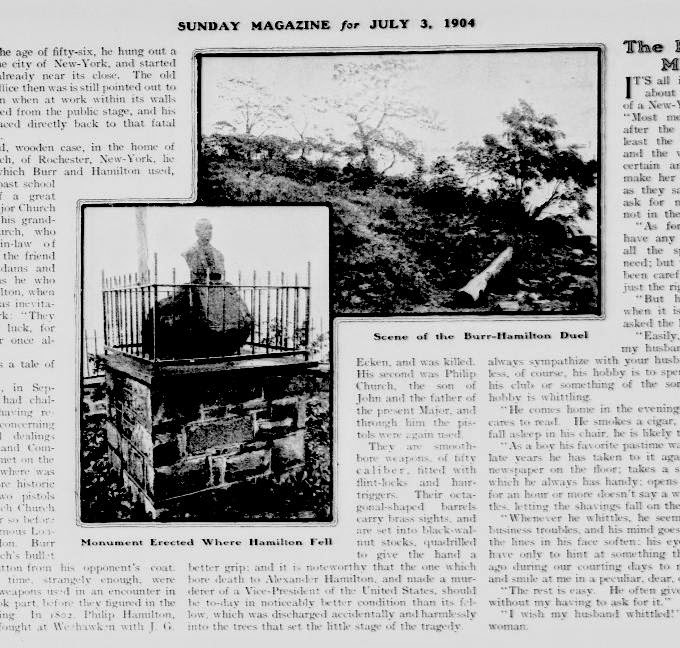
From the New York Tribune, July 1904, a look at the Hamilton bust that once sat in Weehawken.  Several years later, vandals took the bust and hurled it off the cliff.

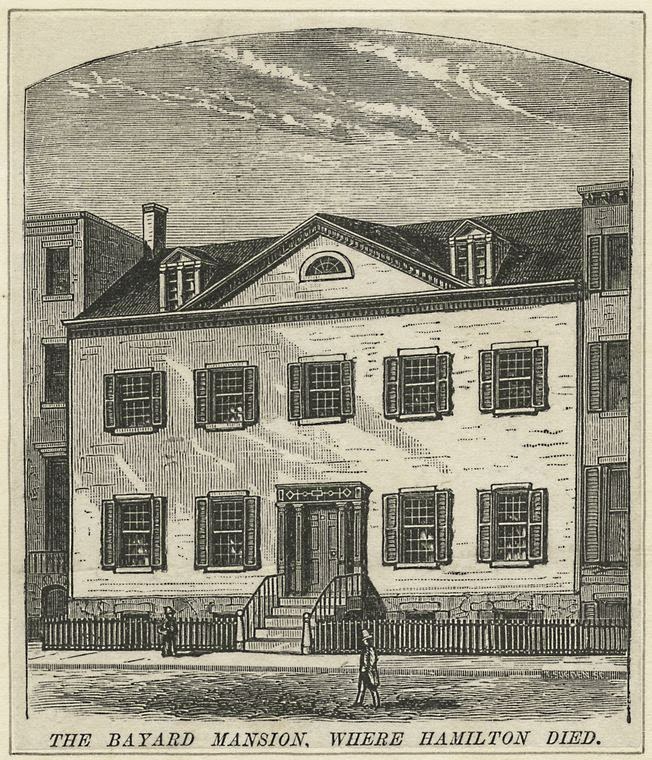
The William Bayard house in later years, with the lots surrounding it obviously sold and built up around it. (NYPL)

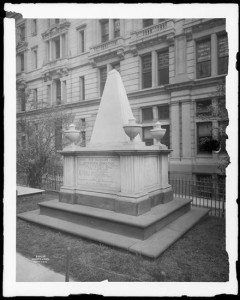
The Hamilton tomb at Trinity Church, picture taken in 1908, although it looks pretty much the same today! (Wurts Brothers, Courtesy MCNY)

Broadway and Wall Street. Tomb of Alexander Hamilton, Trinity churchyard.
Categories
Those Were The Days

Madison Square Snow Show: The first-ever film of a New York City blizzard

Missing a good old-fashioned New York City snowfall? Well, then, take in this unusual view from 1902:

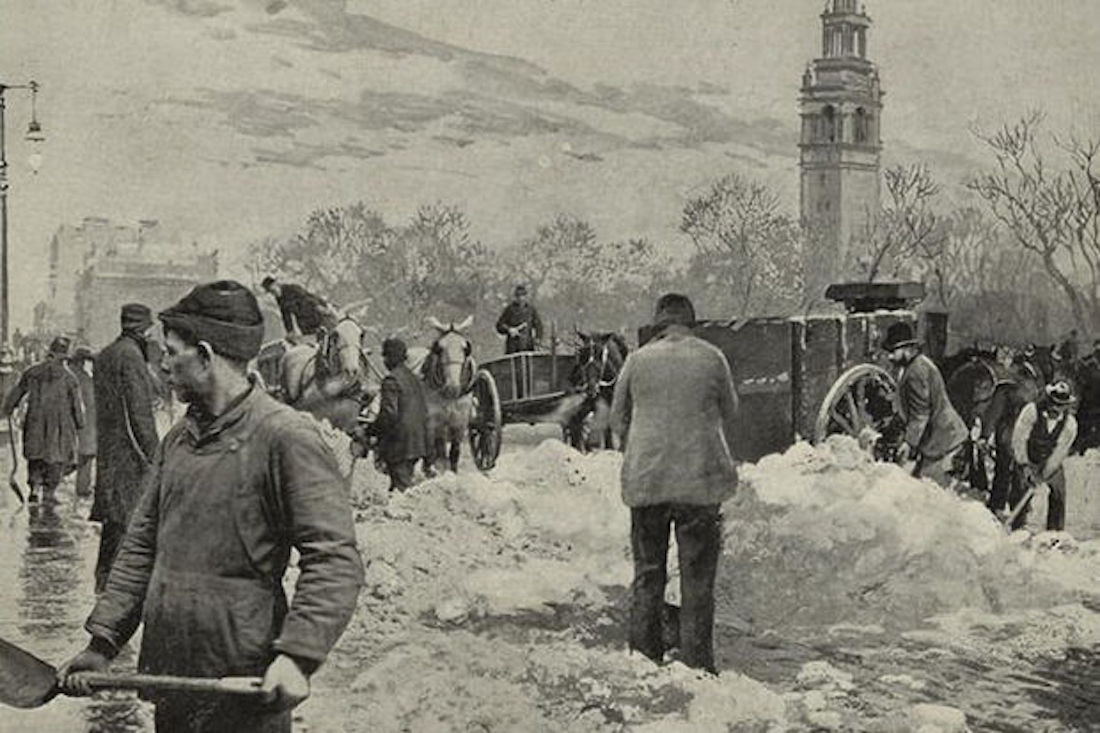
What storm is this? The horrific blizzard that hit New York on February 17, 1902.  It would be considered the worst snowstorm to hit the metropolitan area since the Great Blizzard of 1888. (Read all about it here.)  I assume we’re actually in the aftermath of the blizzard here, as the snow shovels are out, and the kids are playing.

What area is being filmed?  Madison Square Park (near 23rd Street), with the Worth Memorial in the background of some angles

Who made this?  Edison Manufacturing Company. Their Manhattan studio was nearby, at 41 East 21st Street.

Who’s the director? The head of Edison’s film division Edwin S. Porter, considered by most to be the first real movie director, inventing basic techniques used by subsequent filmmakers.

What are we seeing?  Trolleys, cabs, carriages and other unusual vehicles, braving the icy conditions and dodging pedestrians at the intersection of Broadway, Fifth Avenue and 23rd Street.  At one point, you almost see a team of horses slide off the road!

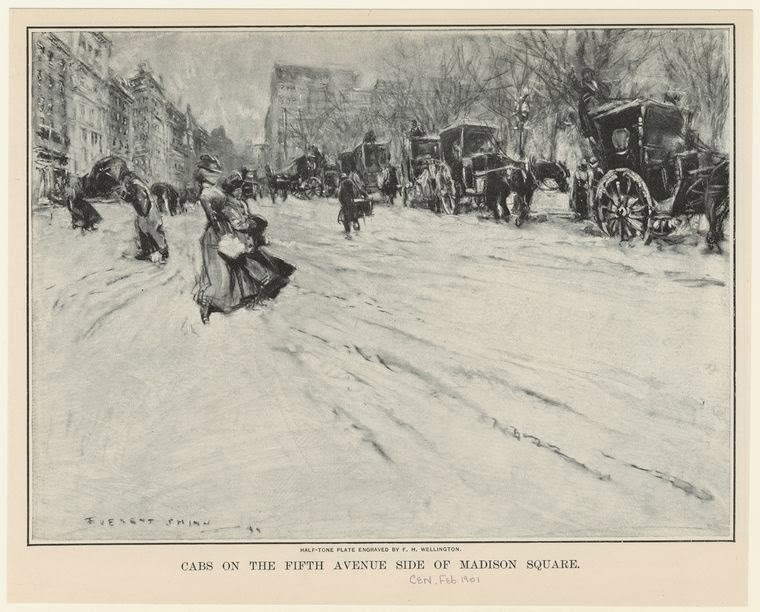
Below: An illustration from 1899, showing cabs parked along Madison Square (courtesy NYPL)

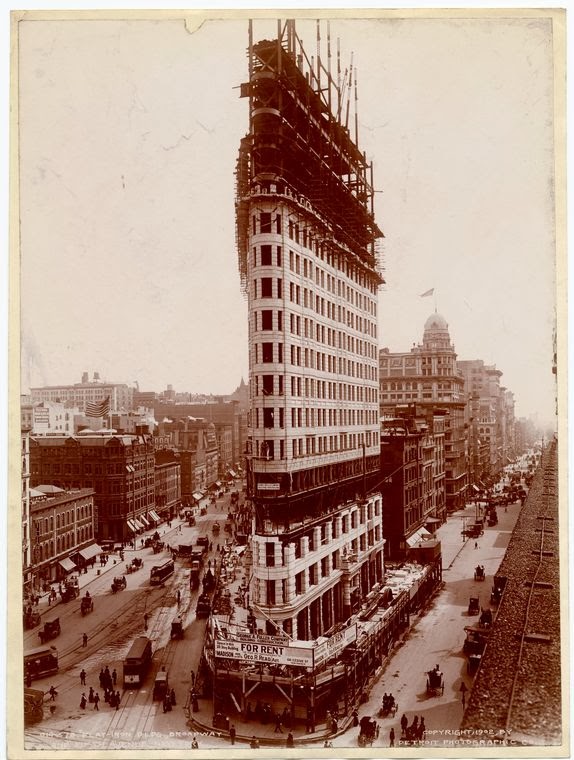
Why aren’t they showing the Flatiron Building?  It’s not completed yet!  The Daniel Burnham-designed office building would be opened by the summer, to great fanfare.  But as an open construction site, it would have been dangerous to linger anywhere around it.  I believe the slanted beams you see at the very end are part of the construction site.

It would have looked something like this (picture courtesy the New York Public Library):

This is the first film of a New York blizzard?  This is probably the first film of any American blizzard. Primitive film technology had only recently allowed for outdoor filming.  Porter and his crew would have been brave indeed dragging Edison’s equipment even two blocks through these conditions.

What’s that statue at the 1:15 mark?  The seated, snow-covered figure of William Seward.  The statue has sat at that corner since 1876. (More about that here.)

What’s that big building at the end?  The Fifth Avenue Hotel, once considered the greatest accommodation in New York City and a headquarters for backroom politics in the 1870s and 1880s.  Its glory days are long passed by the time of the blizzard.  Six years later, it would be torn down and replaced with the building that stands at that corner today — the International Toy Center.

As the camera pans around, you can see the Fifth Avenue Hotel street clock, a replica of which still sits in that very spot.

Is this the first movie ever filmed in Madison Square?  No.  That distinction goes to a boxing match filmed seven years earlier at the top of Madison Square Garden between ‘Battling’ Charles Barnett and Young Griffo.

Categories
Amusements and Thrills Podcasts Writers and Artists

Truman Capote’s Black and White Ball: The Absurd Story of a Marvelous Party

PODCAST Your ticket to Truman Capote’s celebrity-filled party at the Plaza.

This month FX is debuting a new series created by Ryan Murphy — called Feud: Capote and the Swans — regarding writer Truman Capote‘s relationship with several famed New York society women.

And it’s such a New York story that listeners have asked if we’re going to record a tie-in show to that series. Well, here it is! Tom and Greg recorded this show back in November of 2016 but, likely, most of you haven’t heard this one.

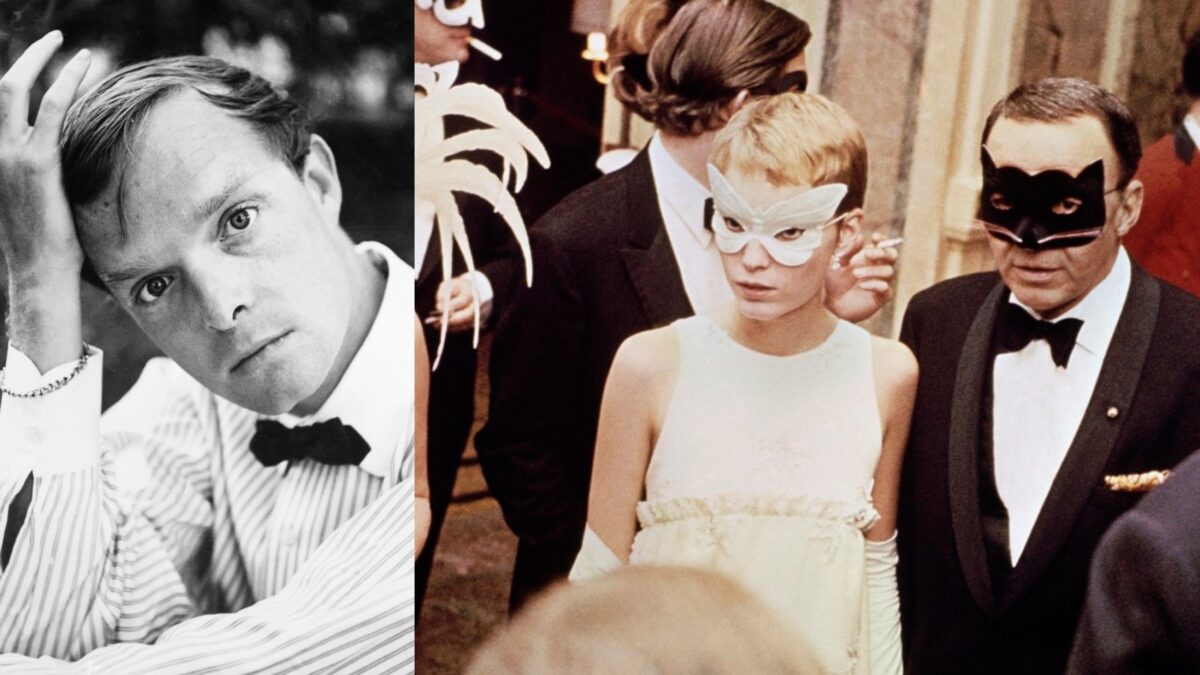
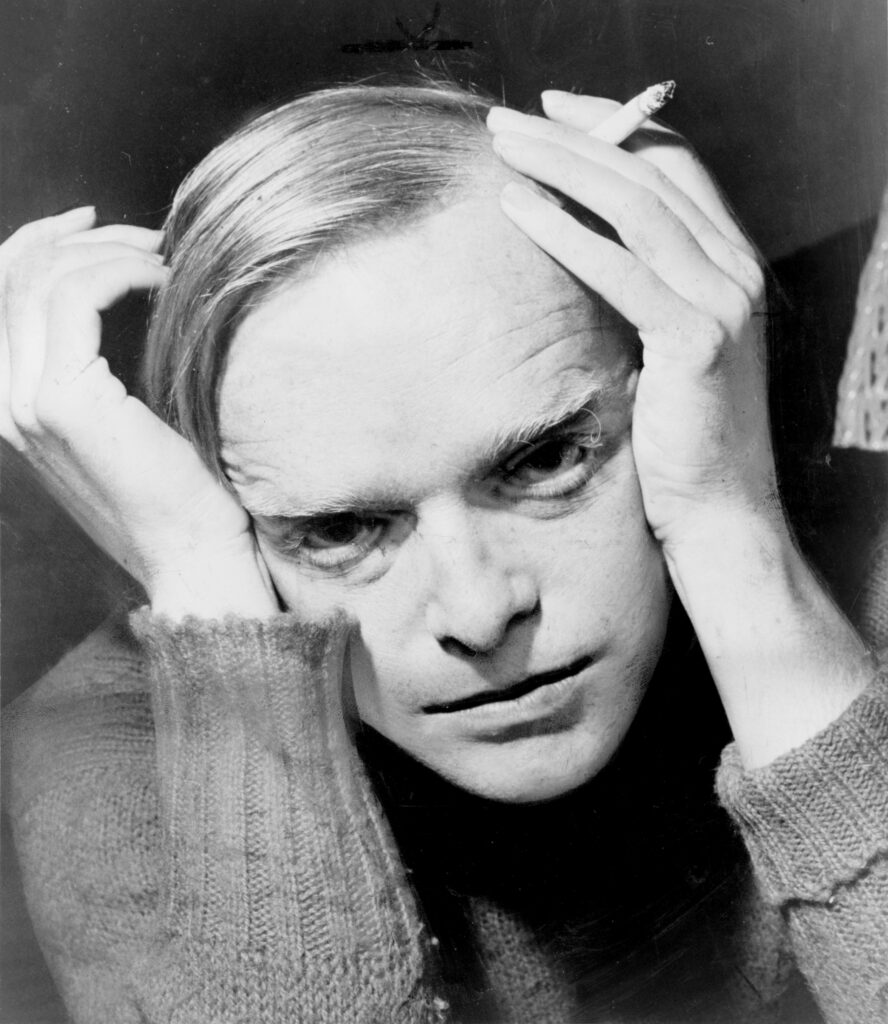
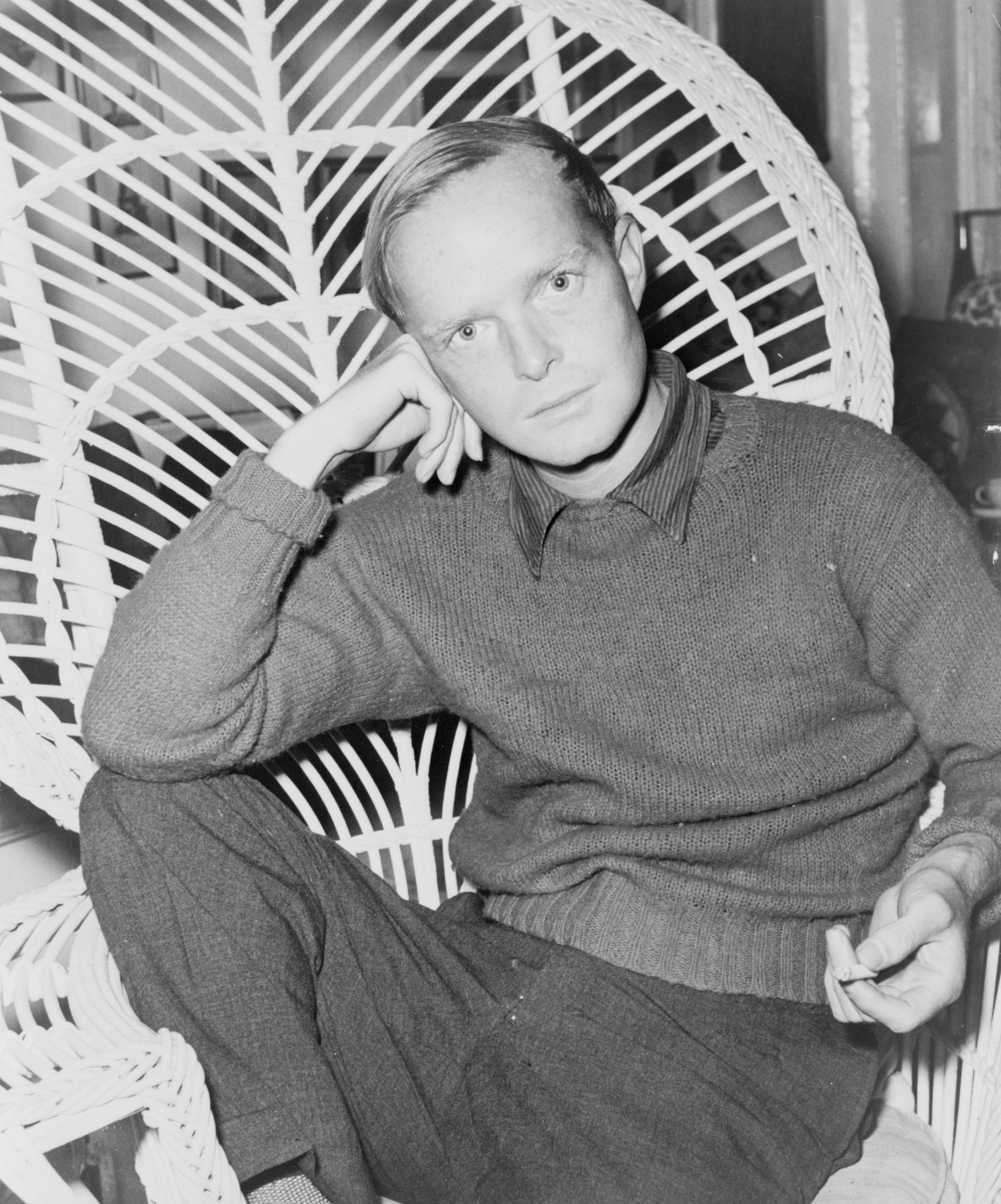
Capote in 1959 / Library of Congress Prints and Photographs Division. New York World-Telegram and the Sun Newspaper Photograph Collection.

Capote is a true New York character, a Southern boy who wielded his immense writing talents to secure a place within Manhattan high society. Elegant, witty, compact, gay — Capote was a fixture of swanky nightclubs and arm candy to wealthy, well-connected women.

One project would entirely change his life — the completion of the classic In Cold Blood, a ‘non-fiction novel’ about a horrible murder in Kansas. Retreating from his many years of research, Truman decided to throw a party.

But this wasn’t ANY party. This soiree — a masquerade ball at the Plaza Hotel — would have the greatest assemblage of famous folks ever gathered for something so entirely frivolous. An invite to the ball was the true golden ticket, coveted by every celebrity and social climber in America.

Come with us as we give you a tour of the planning of the Black and White Ball and a few glamorous details from that strange, glorious evening.

FEATURING: Harper Lee, Lauren Bacall, Frank Sinatra, Robert Frost, Lillian Hellman, Halston, Katharine Graham and a cast of thousands (well, or just 540)


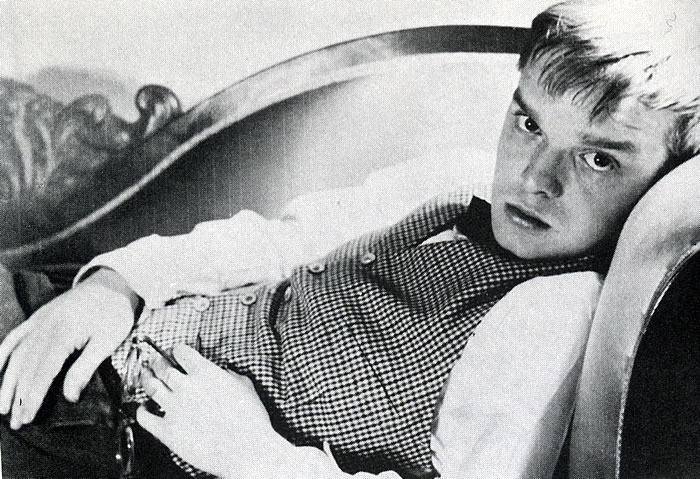
Truman Capote in 1945

capote-truman-1945

From the unusual book jacket of Other Voices, Other Rooms, 1948

1477405059645

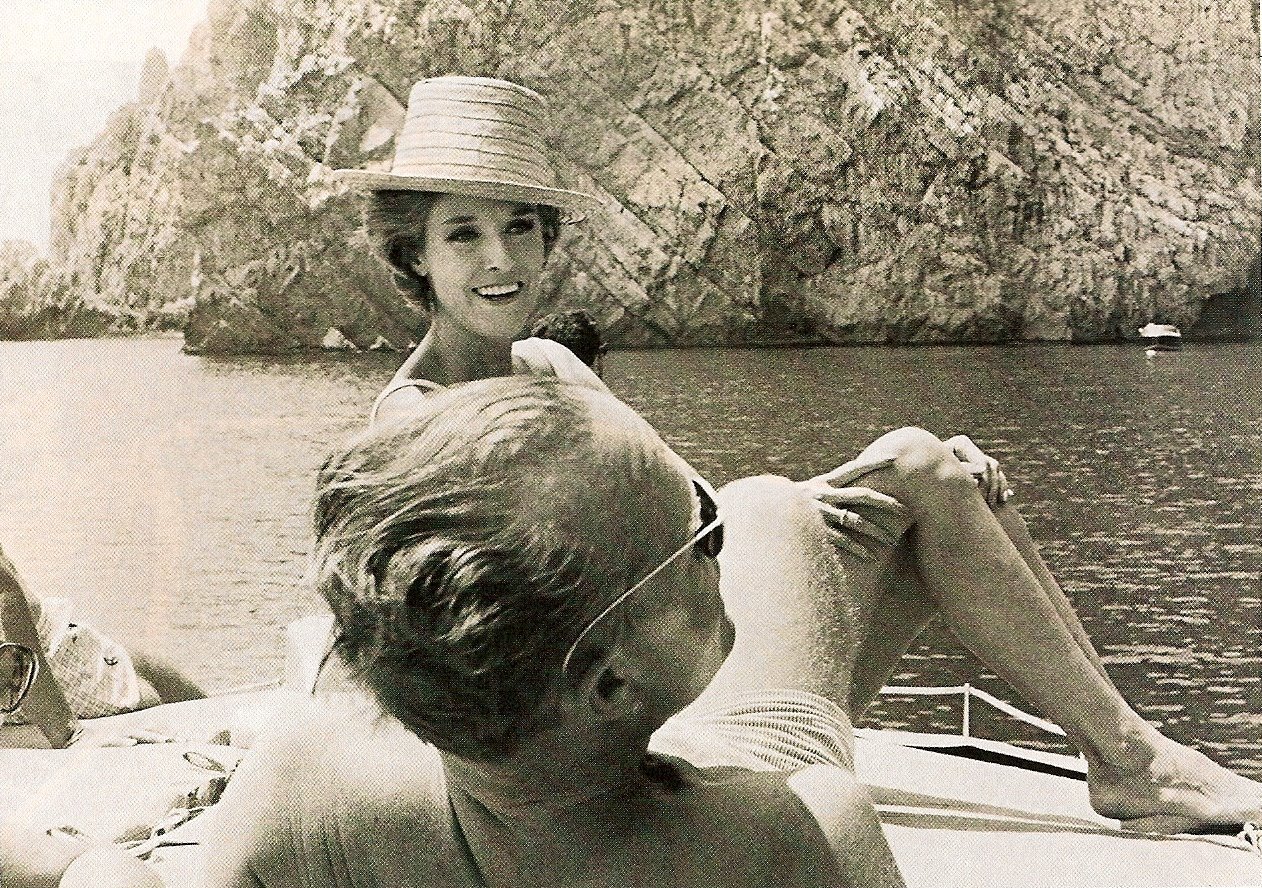
Babe Paley with Truman Capote in Capri, early 1960s

Courtesy the Red List

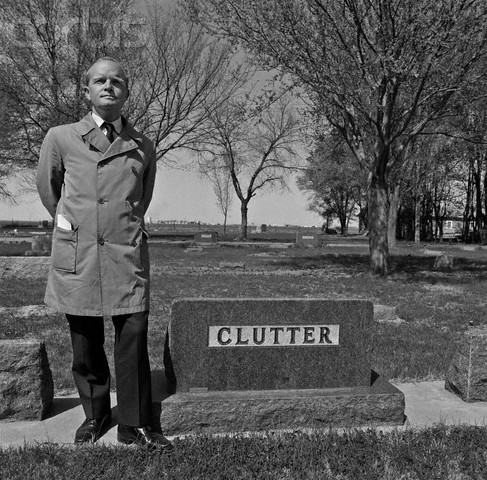
Capote in Kansas, at the grave of the Clutter family, their murder being the inspiration for his book In Cold Blood.

1967, Holcomb, Kansas, USA --- Author Truman Capote poses at the grave of the murdered Clutter family, made famous in his novel and in the film . --- Image by © Bob Adelman/Corbis
1967, Holcomb, Kansas, USA — Author Truman Capote poses at the grave of the murdered Clutter family, made famous in his novel and in the film.  — Image by © Bob Adelman/Corbis

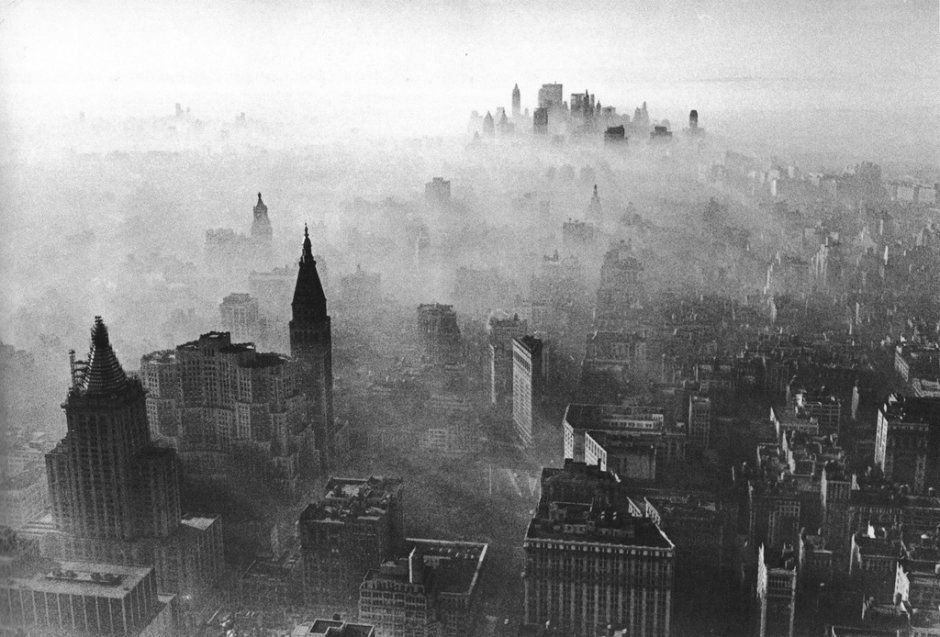
Just a few days before the party, this is what New York City looked like — draped in a toxic smog.

manhattan-smog

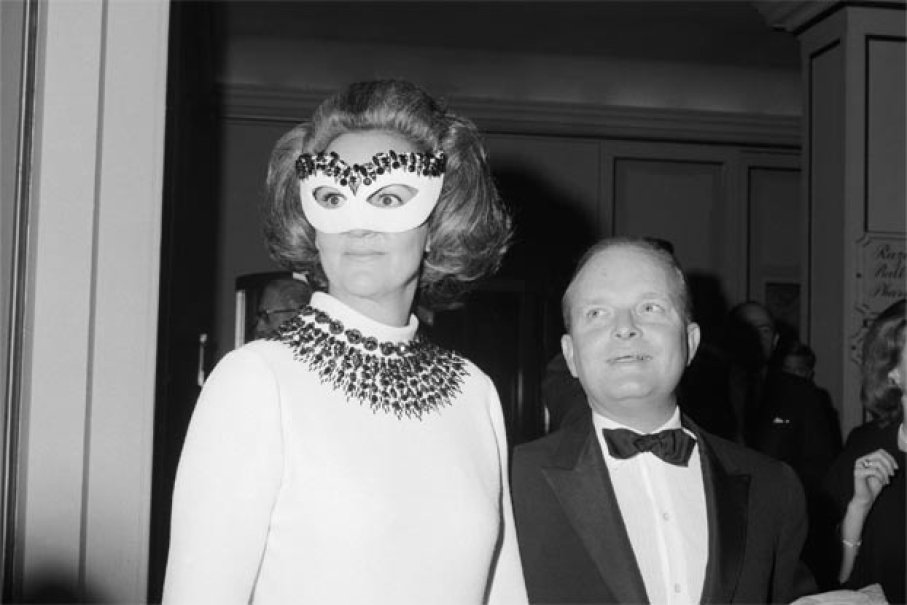
Truman Capote with his guest of honor — Katharine Graham

 BETTMANN/CORBIS
BETTMANN/CORBIS

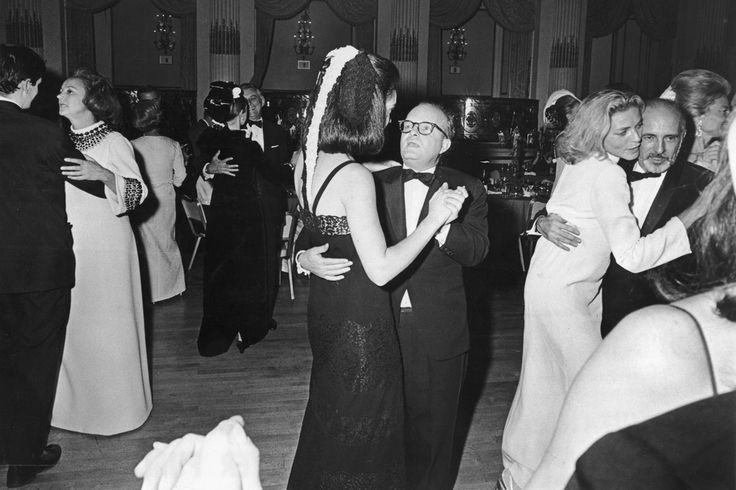
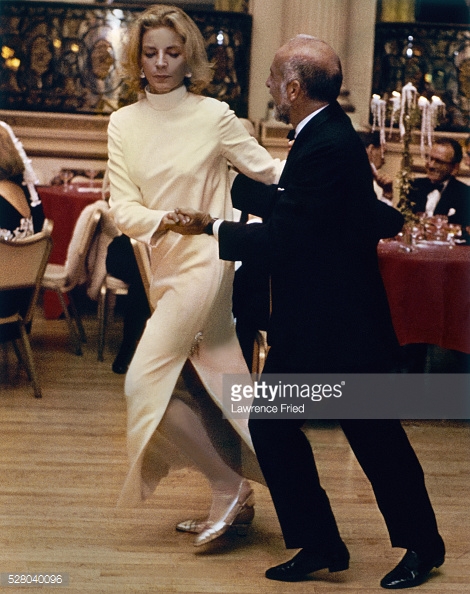
Graham is on the left and Capote is front and center, but the real action is Lauren Bacall and Jerome Robbins at right.

b4c4827ad282c89b6bf712cb6be26a5a
Mrs. Jason Robards Jr. dancing with Jerome Robbins at Truman Capote's party *** Local Caption *** Lauren Bacall;Jerome Robbins;

©Lawrence Fried or photo by Lawrence Fried. 

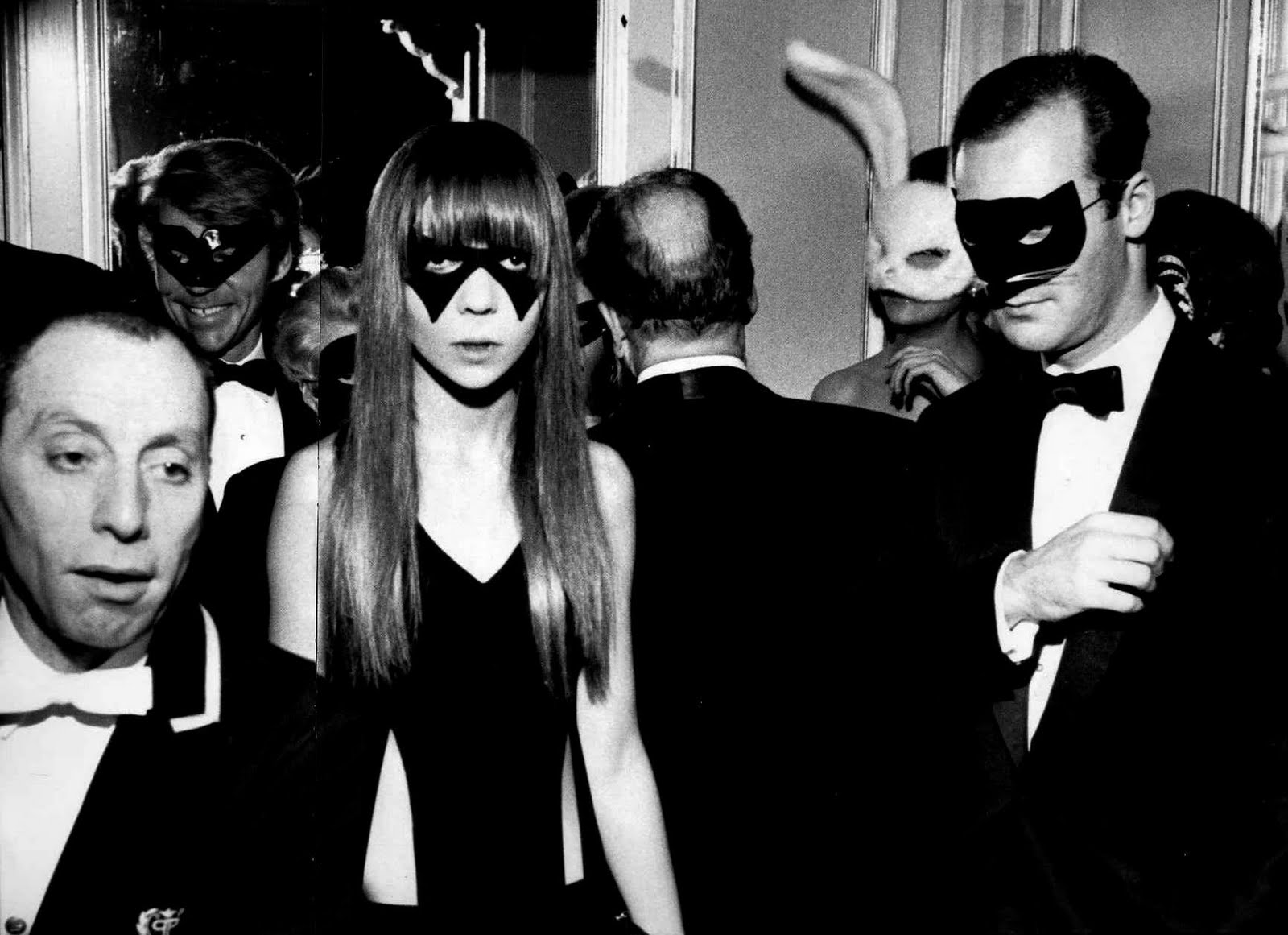
Supermodel Penelope Tree looks a little bit like Batgirl here.

024_penelope_tree_theredlist

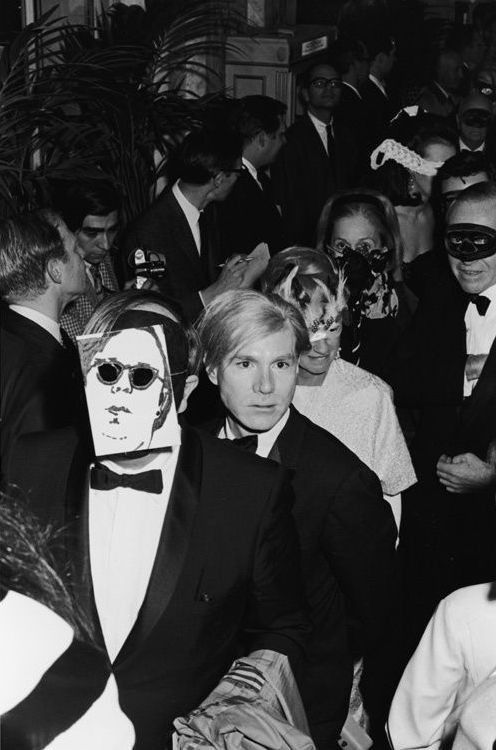
Andy Warhol came to the party without a mask.

661156045889f5e9c50f92a012952ebc

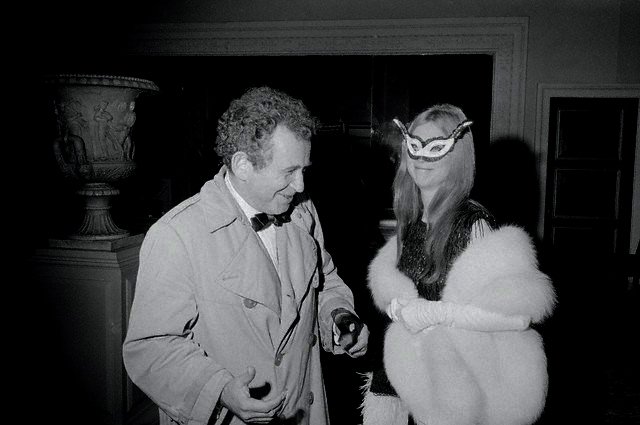
Norman Mailer and an unidentified guest.

norman-mailer-and-guest-in-costume

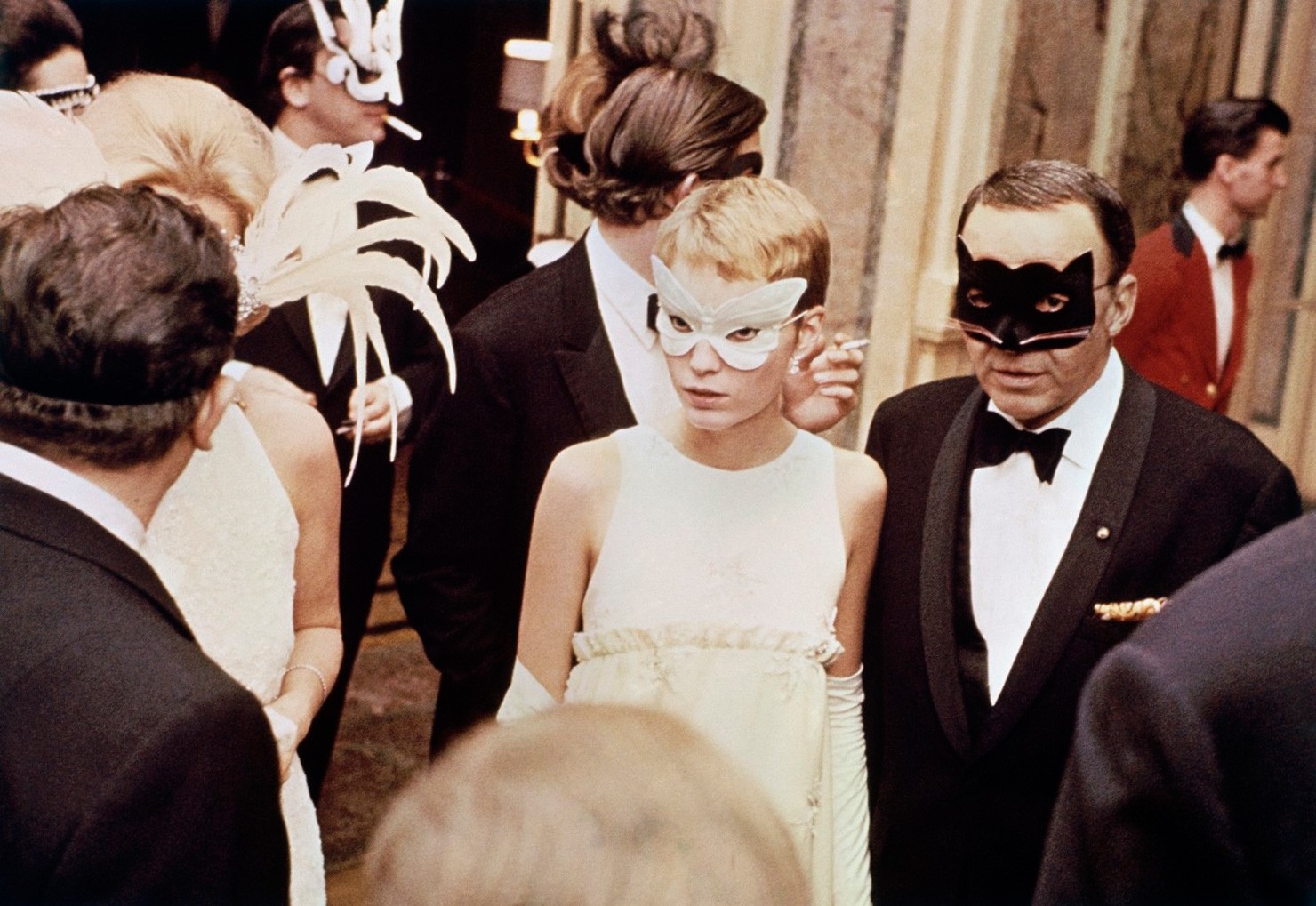
One of the most talked about couples of the evening — Frank Sinatra and his new bride (with a new haircut) Mia Farrow.

Conde Nast Archive / Corbis / East News.
Photo courtesy ©Lawrence Fried

FURTHER LISTENING

Two other New York cultural icon — who happened to be invited to Capote’s dance:

Some context on the New York ball/society scene, courtesy The Gilded Gentleman

FURTHER READING

Truman Capote / Breakfast at Tiffany’s
Truman Capote / In Cold Blood
Truman Capote / Other Voices, Other Rooms
Truman Capote / “La Côte Basque 1965” and Answered Prayers
Deborah Davis / Party of the Century: The Fabulous Story of Truman Capote and His Black and White Ball
George Plimpton / “Was Truman Capote’s Black-and-White Ball the Greatest Party Ever?” Esquire 1991
Guy Trebay / “50 Years Ago, Truman Capote Hosted the Best Party Ever,” New York Times, 2016
Ralph Voss / Truman Capote and the Legacy of “In Cold Blood”

Categories
Mysterious Stories Podcasts

The Bowery Boys Halloween Special: Ghosts of the Gilded Age

This newly edited edition of this episode of the Bowery Boys is now running on the The Gilded Gentleman podcast. Listen today:


PODCAST Four strange and spooky tales taken from New York City newspaper articles published during the Gilded Age

For this year’s 10th annual Bowery Boys Halloween special, we’re highlighting haunted tales from the period just after the Civil War when New York City became one of the richest cities in the world — rich in wealth and in ghosts!

We go to four boroughs in this one (sorry Brooklyn!):

— In the Bronx we highlight a bizarre house that once stood in the area of Hunts Point, a mansion of malevolent and disturbing mysteries

— Then we turn to Manhattan to a rambunctious poltergeist on fashionable East 27th Street

— Over in Queens, a lonely farmhouse in the area of today’s Calvary Cemetery is witness to not one, but two unsettling and confounding deaths

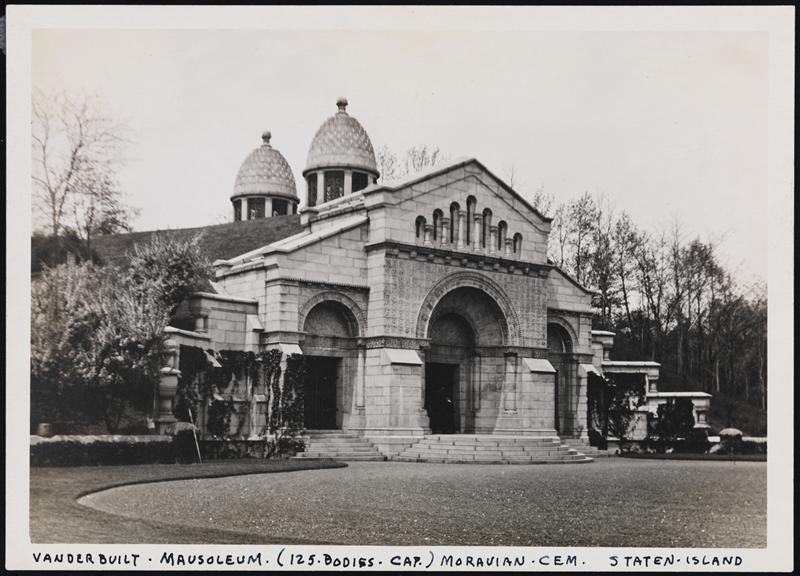
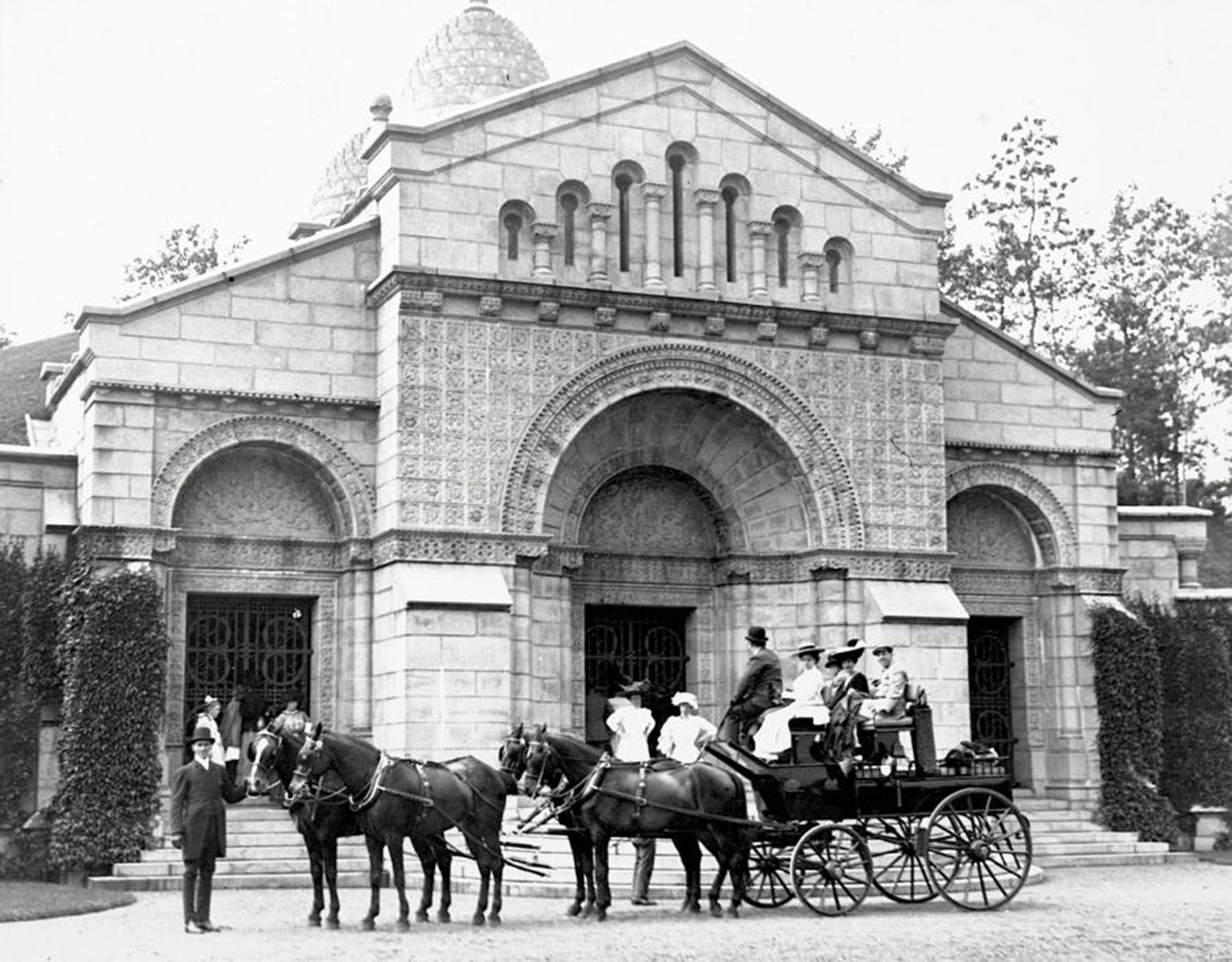
— Finally, in Staten Island, we take a visit to the glorious Vanderbilt Mausoleum, a historic landmark and a location with a few strange secrets of its own


The Bowery Boys: New York City History podcast is brought to you …. by you!

We are now producing a new Bowery Boys podcast every two weeks. We’re also looking to improve the show in other ways and expand in other ways as well — through publishing, social media, live events and other forms of media. But we can only do this with your help!

We are now a member of Patreon, a patronage platform where you can support your favorite content creators for as little as a $1 a month.

Please visit our page on Patreon and watch a short video of us recording the show and talking about our expansion plans. If you’d like to help out, there are five different pledge levels (and with clever names too — Mannahatta, New Amsterdam, Five Points, Gilded Age, Jazz Age and Empire State). Check them out and consider being a sponsor.

We greatly appreciate our listeners and readers and thank you for joining us on this journey so far. And the best is yet to come!


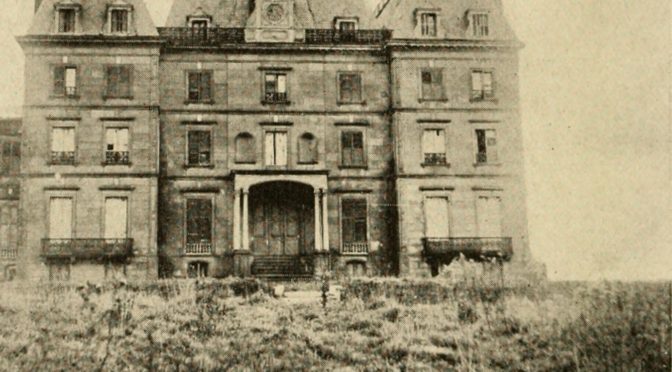
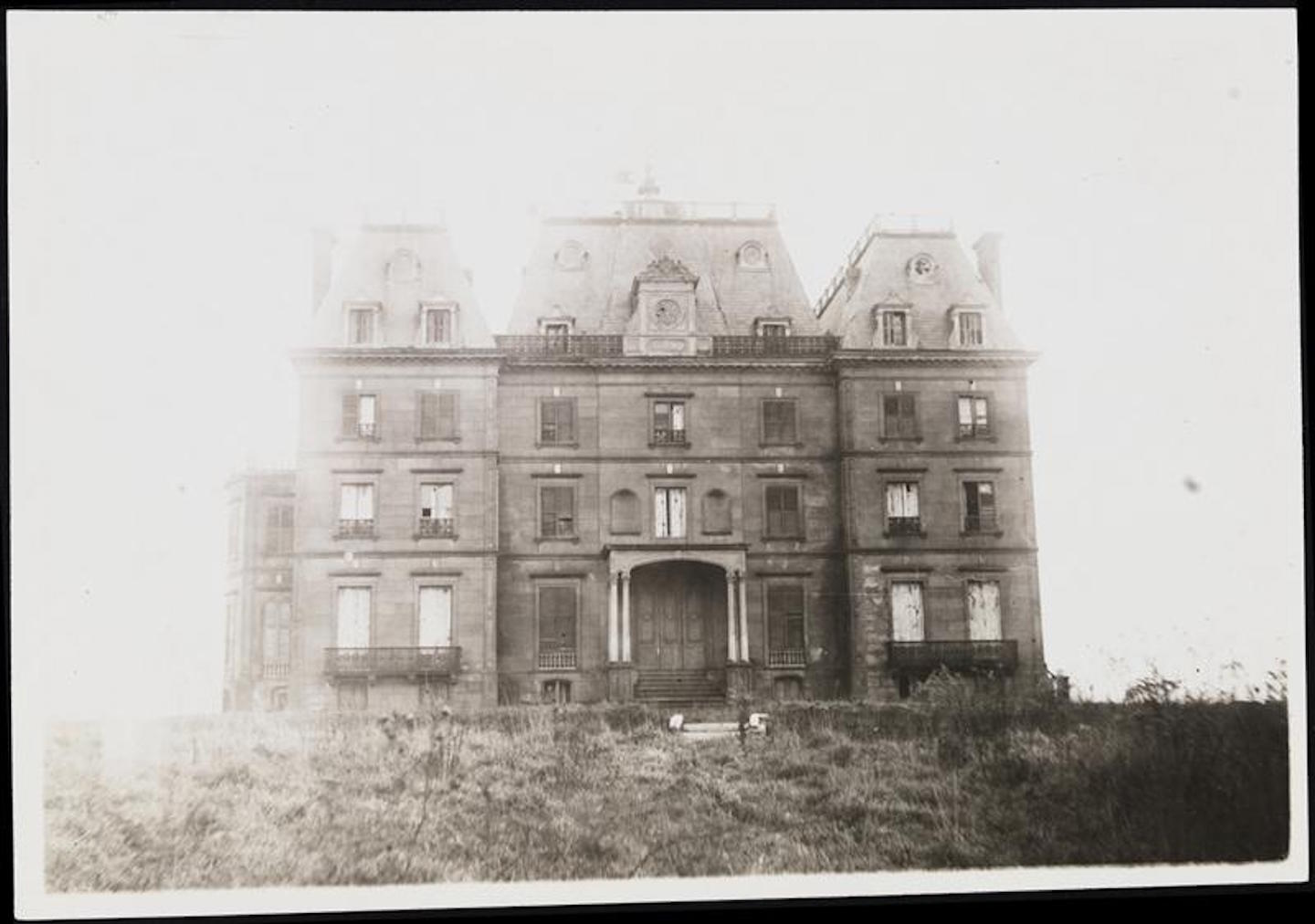
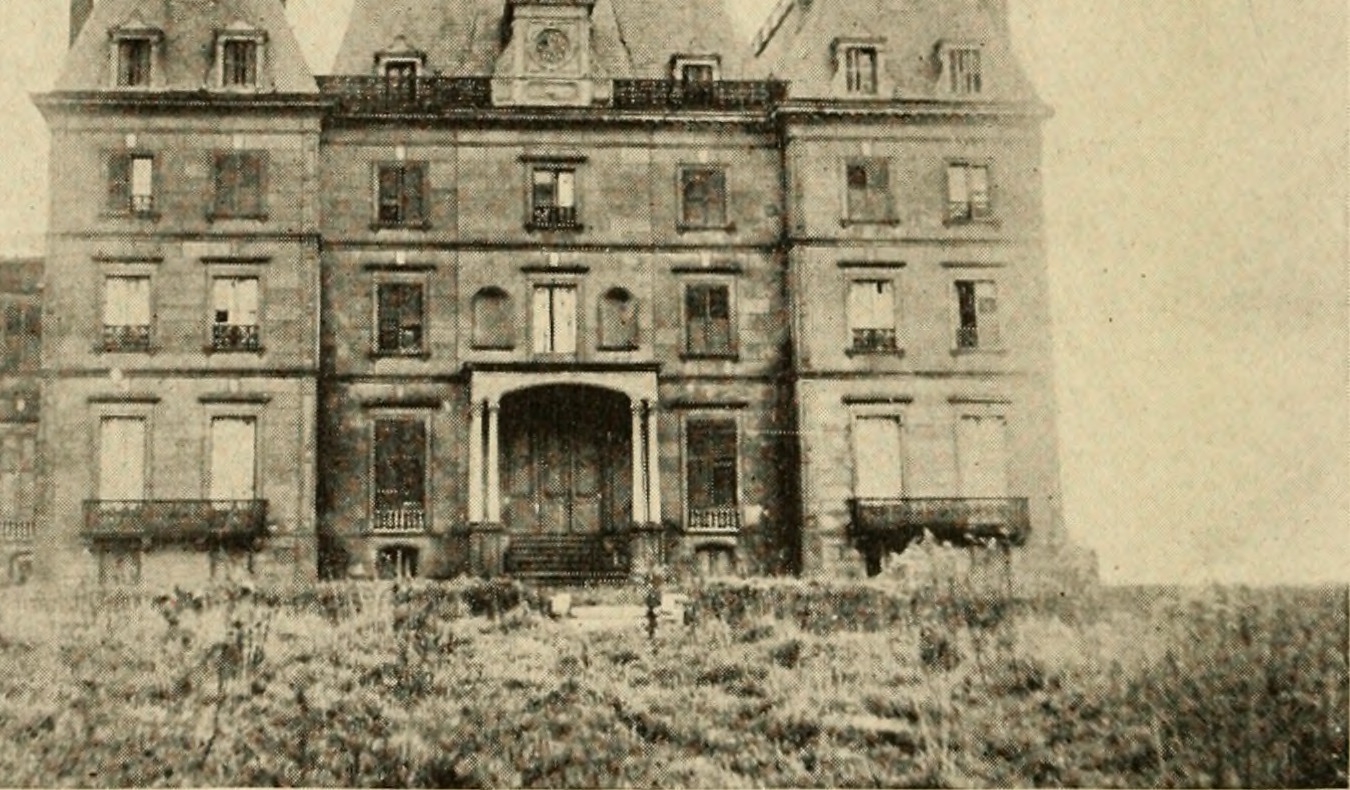
This is the Casanova Mansion aka “the house of many mysteries”

mny221052
Courtesy Museum of the City of New York

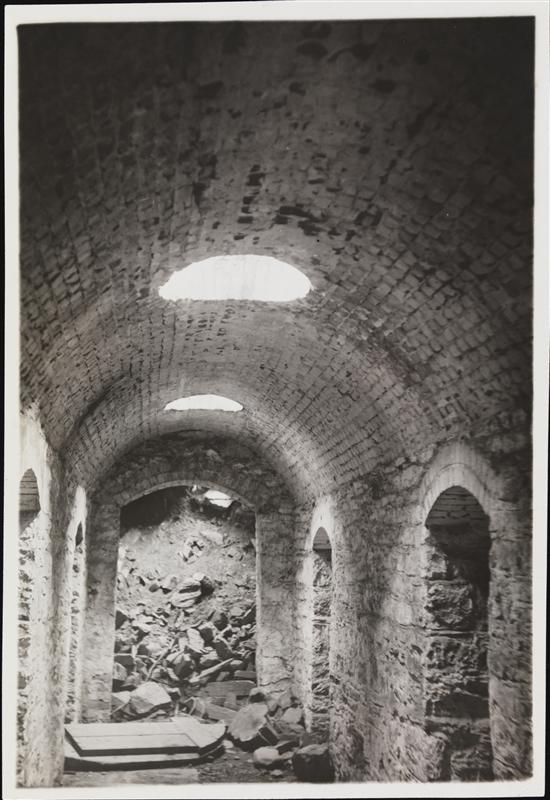
The subterranean tunnels under the Casanova mansion, as they appeared in 1910. Prison cells were discovered along the walls of the tunnels. What could they have been used for?

Courtesy MCNY
Courtesy MCNY

From the book “The borough of the Bronx, 1639-1913; its marvelous development and historical surroundings” (1913): “Casanova Mansion were stored with powder and rifles which eventually found their way into the hands of the patriots in Havana and other Cuban cities. An underground passage had been made, running from the house to the Sound, and under cover of darkness boats, which were undoubtedly filibusters, were occasionally seen to steal into the little cove that the mansion overlooked; and, after being freighted with ammunition and other implements of war, to creep out again as mysteriously as they had entered.”

20391932902_78d73ca50f_o

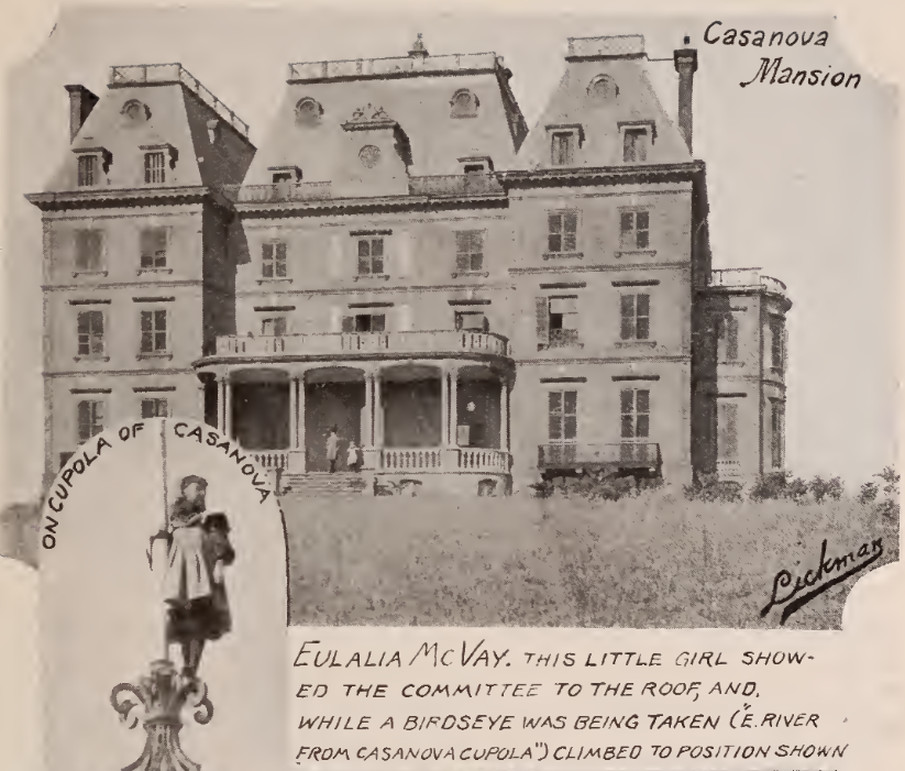
In 1902 a young girl made the news when she by climbing the the very top of the old mansion. Note that the porch is different than the picture above. This is probably the side of the house that faced the East River.

casanova-mansion-aka-whitlocks-folly-west-farms-bronx-1897
Courtesy Stuff Nobody Cares About

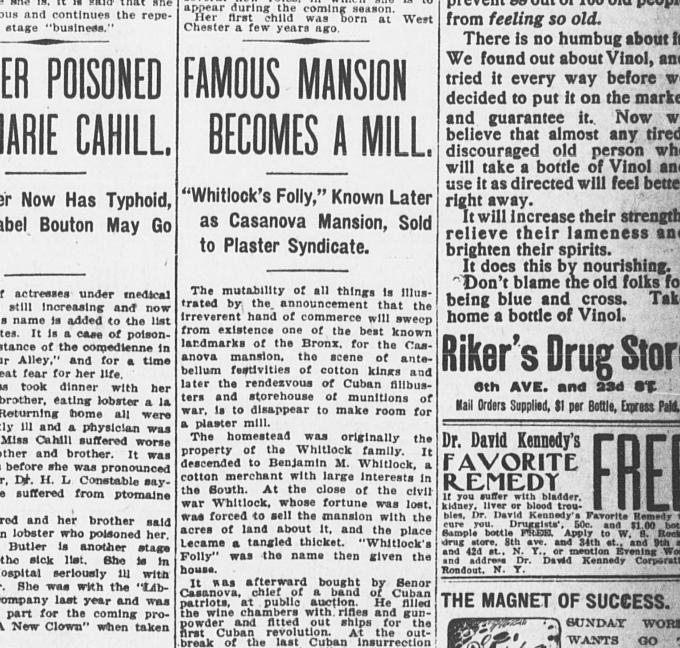
The Casanova Mansion makes one of its final appearances in the newspapers. This article is from 1902 although it appears that the mansion was not completely demolished until much later (the pictures above are from a later date)

From the New York World, November 18, 1902

For more information on the Casanova Mansion, check out this exhaustive research from Paul DeRienzo.

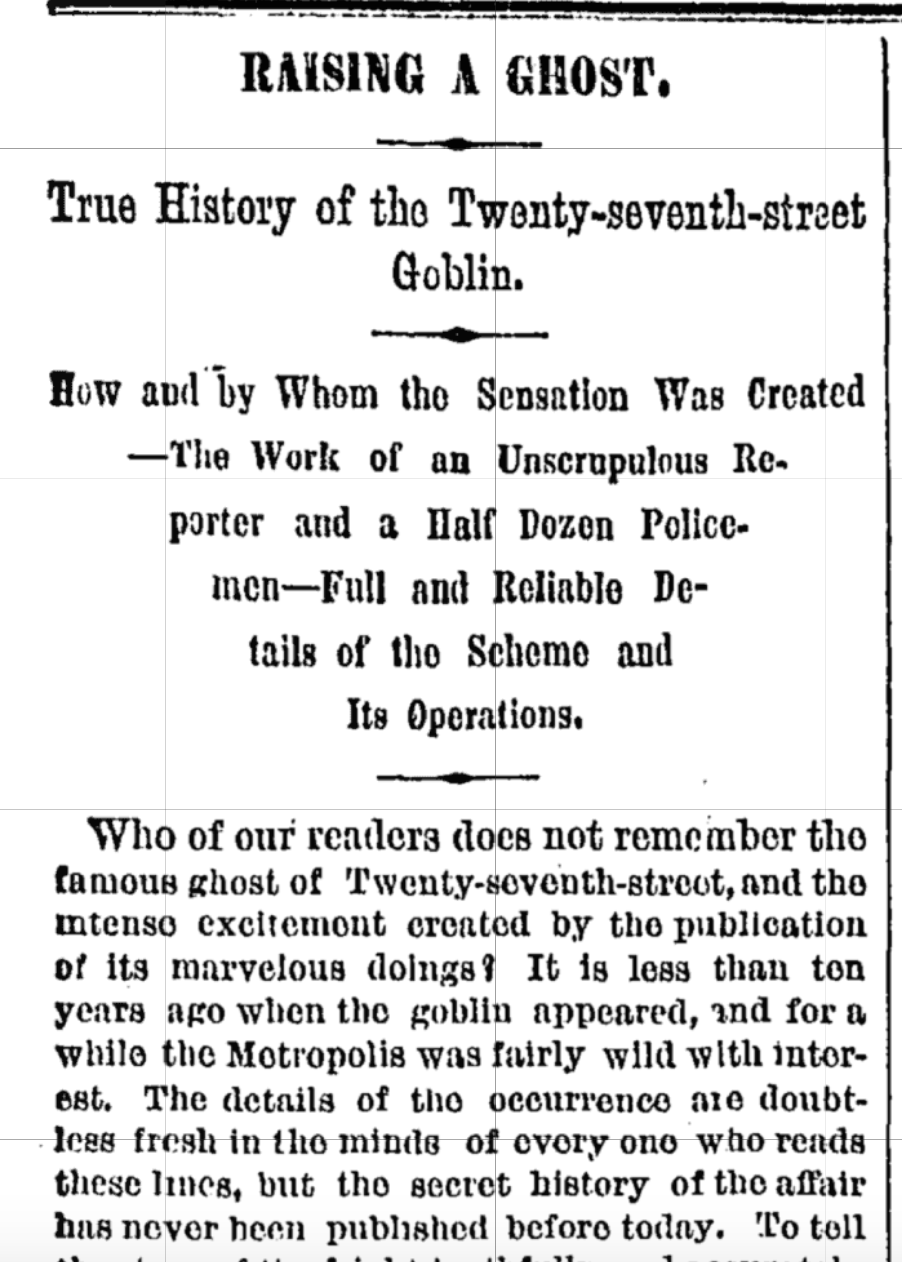
From the New York Times, September 18, 1870, a thorough recounting of the strange story of possible ghosts on East 27th Street, with a thorough description of the police’s creative use of lighting and photography.

screen-shot-2016-10-14-at-10-38-23-am

A selection of houses along East 27th Street, photographs by Charles Von Urban, courtesy the Museum of the City of New York

mny80444

mny80448

mny80445

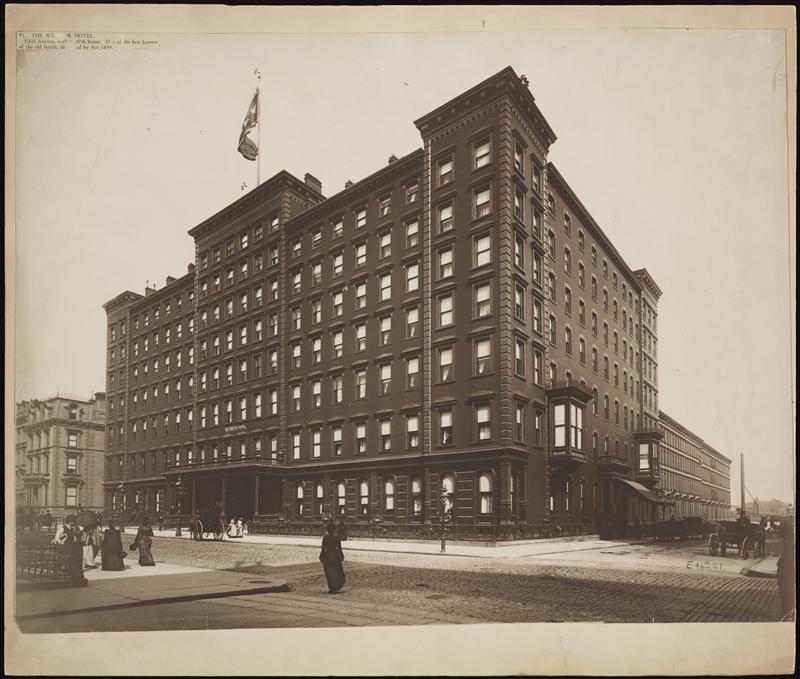
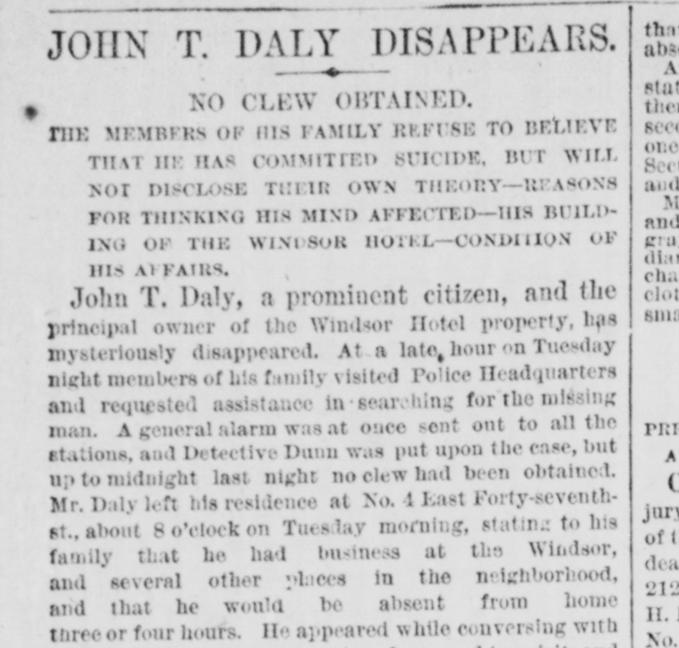
The spectacular Windsor Hotel on Fifth Avenue and 46th Street, pictured here in 1890, many years after the death of its proprietor John T. Daly. For more information on this forgotten hallmark of upper-class glamour, check out this article from Daytonian In Manhattan.

Museum of the City of New York

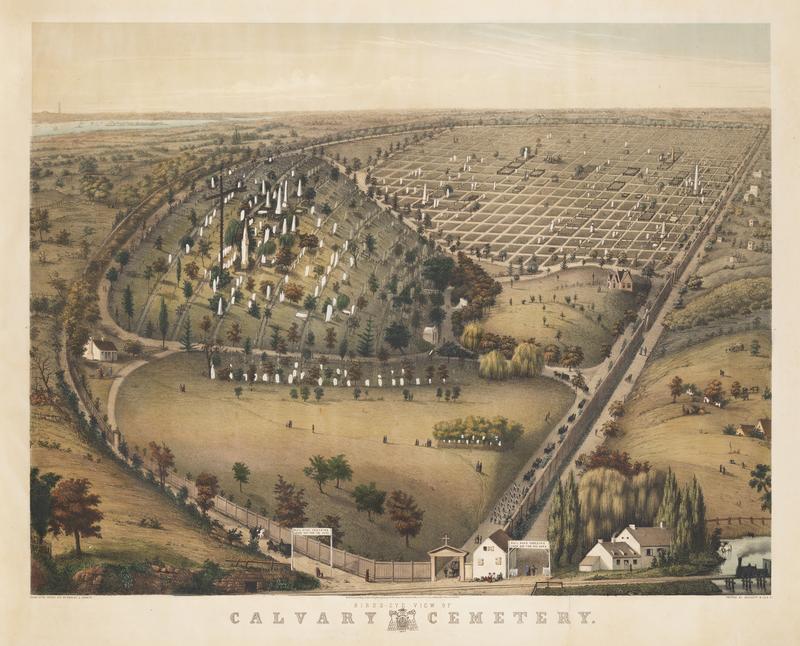
A ‘bird’s eye’ view of Calvary Cemetery in 1855, well before its expansion. Taking from clues from various newspaper, my guess is that the ‘cursed farmhouse’ lay somewhere to the far right of this image.

MCNY
MCNY

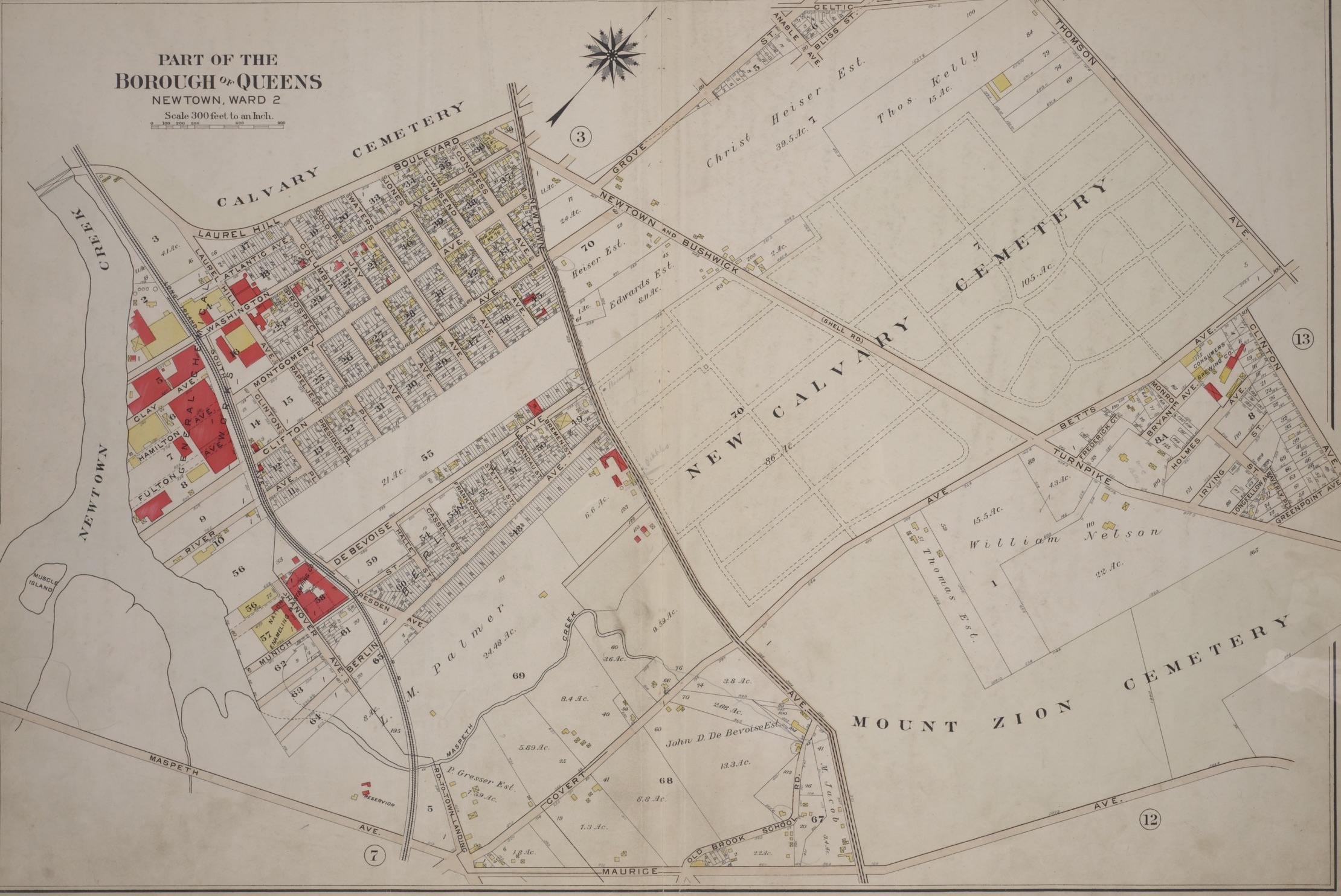
A map from 1909 detailing the expansion of Calvary Cemetery.

Courtesy NYPL
Courtesy NYPL

From the New York Tribune, May 3, 1877

image_681x648_from_83236_to_12321331

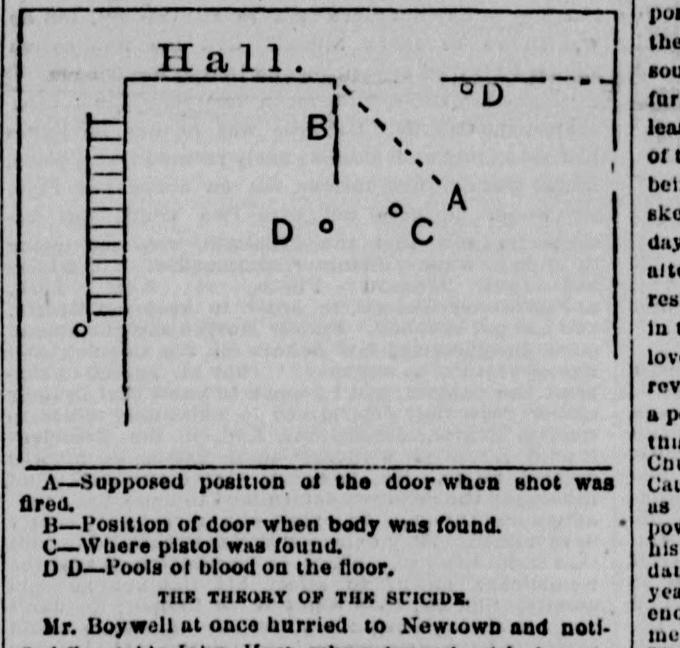
A macabre diagram of the Daly crime scene at the farmhouse, published in the New York Herald, May 7, 1877.

image_681x648_from_20504517_to_30945511

The Vanderbilt Mausoleum, pictured here in 1910

Museum of the City of New York

new-york-vanderbilt-mausoleum-2-1892-unknown

We hope you stuck around until the end of the show — to hear the official trailer for the new Bowery Boys podcast series called The First. Listen to it here:

Categories
Friday Night Fever

Recollections of the Electric Circus: “If you remembered much of what happened, you weren’t really there.”

The interior of the Electric Circus on St. Mark’s Place. Pic courtesy Christian Montone/flickr

WARNING The article contains a couple light spoilers about last night’s ‘Mad Men’ on AMC.  If you’re a fan of the show, come back once you’re watched the episode.  But these posts are about a specific element of New York history from the 1960s and can be read even by those who don’t watch the show at all.  You can find other articles in this series here

Almost predictably, a couple characters from ‘Mad Men‘ finally interact with a psychedelic temple of Andy Warhol, in this case the nightclub Electric Circus at 19-25 St. Mark’s Place, today the site of a Chipotle and a Supercuts.

As I wrote back in an article from 2007: “It became the East Village fuse box for Warhol’s talents and those of his entourage, in particular the Velvet Underground and Nico.  The dazzling synthesis of psychedelica and glamour, of the Velvet’s strange atmospheric music and Warhol’s performance displays of lights and costumes, immediately attracted the scenesters to this odd little street — according to the New York Times, “everyone from hippies to Tom Wolfe and George Plimpton” — way before St. Marks would make its reputation in the 1970s with the punk scene.”

An original ad from the Electic Circus, summer of 1967 (courtesy butdoesitfloat)

Since I wrote that article, many people have chimed in within the comments section to relive their memories of Electric Circus.  Here are a few of my favorite comments from those who were actually there:

“What memories.  I started working at the E.C. as a ticket taker.  I say working, but in reality we didn’t get paid, we got let in for our work.  Like Woodstock, if you remembered much of what happened at the E.C. you weren’t really there.” – Being the Best

Below: Headline from the Village Voice, July 6, 1967

“I worked at the Electric Circus, 67-68-ish.  I was the fire-eater, and mime/clown, working with another mime named Michael Grando.  Larry Pizoni was the director of the circus show.  We had a trapeze artist named Sandy [Alexander], and security was a biker club called the Aliens (which worked, unlike Altamont).

Everytime I’m in New York, in the East Village, I stop on St Mark’s and bow my head.  I wanted to have someone put up a plaque, but nobody in the stores knew who to call.” – Richard Bluejay

“I was one of 5 or 6 people who worked at Limbo* for number of years across from the Electric Circus.  I was there at the opening night, and then on for a long time I remember we use to give discounts to the Circus employees so we get in free. Can not tell you how many times I was in there but it was a lot!!!!  It was great time back then.  Fillmore East was around the corner and Max’s Kansas City was not far away.  East Village was where it was at back then ” – Anonymous

A freakout-indusing video from Electric Circus, scored to the music of Frank Zappa: 

“I remember two things about the electric circus from my one visit in 1969. One was the fact that the walls were not at a right angle to the floor, which combined with the strobe lights and swirling crowd, made for a delightfully disorienting experience. The other was a dark room off to the side where couples — or even strangers I suppose — could sit and smooch. In addition to all kinds of nooks and crannies for this purpose there was a rotating upholstered carousel in the middle of the room, divided into sections, one per couple.” — Anonymous

Below: A typical crowd on the stairs outside the Electric Circus (pic courtesy Old New York)

“I’m so excited, after all these decades to hear from people who got to experience the the most amazing Electric Circus, as I did.  By far dancing myself into a dazed, psychedelic trance, while absorbing the magical energy of the Chambers Brothers sing ‘Time’, was right up there in my top ten of life altering experiences.  I was a runaway, living with new friends in the Village.

I used to panhandle on St. Marks Place, and spend all my money on clothes at the Limbo, pizza, and tickets to hear my fav bands, except for the times I used to get in for free.” — Sonny

Below: Sonny’s jam from the floor of the Electric Circus:

“I can’t remember exactly how I arrived at St. Marks Place that first night.  I had never been to St Marks Place and I certainly didn’t know about Electic Circus.  I was just following a friend of mine who was interested enough in the new culture to find out where to go and what to do.

There must have been some kind of happening that night because the streets were full of people.  People were hanging all over the stairs leading up to the Circus.  And, you didn’t have to pay.  We just walked in. I still remember it emotionally.

The big room was completely decorated with fabric amorphously draped on walls and spanning corners and cornices.  Projectors behind the fabric ran continuous short loops of films. Of course it was dimly lit so as not to wash out the films.  People were everywhere and moved mysteriously in the smoky dim light.  I was born in Brooklyn and had already lived a few years in Manhattan, but I never saw anything like this before.  The next time I saw EC the decor had changed. I never paid to get in because I was a member of the PABLO Light** show.” — Anonymous

* Limbo was a famed ‘hippie clothing’ boutique where today’s Trash & Vaudeville sits today.

** That would be Lights By Pablo, a leading ‘liquid light show’ exhibitor of the late 1960s, frequently here and at Fillmore East.

Categories
Parks and Recreation Podcasts

The rebellious history of Tompkins Square Park

This episode on the history of Tompkins Square Park ties right into an all-new two-part episode coming in September, the first part coming at you next week. 

Central Park has frequently been called ‘the people’s park,” but we think Tompkins Square Park may have a better claim to that title.  From its inception, this East Village recreational spot — named for Vice President Daniel D Tompkins — has catered to those who might not have felt welcome in other New York parks.

Carved from the marshy area of Peter Stuyvesant‘s old farm, Tompkins Square immediately reflected the personality of German immigrants who moved here, calling it Der Weisse Garten.  With large immigrants groups came rallies and demands for improved working conditions, leading to more than a number of altercations with the police in the 19th century.

Progressives introduced playgrounds here, and Robert Moses changed the very shape of Tompkins Square.  But the most radical transformation here took place starting in the late 1950s, with the introduction of beatnik and ‘hippie’ culture and infusion of youth and music.

By the 1980s, the park became known not only for embodying the spirit of the East Village through punk music and drag shows (above: Lady Bunny), but also as a haven for the homeless.  Clashes with police echoed the clashes that happened here one century before.  The park still maintains a curfew left over from the strife of the late 1980s.

FEATURING:  Lillian Wald, the Grateful Dead, Charlie Parker, Samuel S. Cox, Lady Bunny … and Chevy Chase?

LISTEN NOW: TOMPKINS SQUARE PARK

A version of this show was originally released in 2014 (episode #160)


Images from the park this week (August 2023)


It’s doubtful that the image below is accurately depicted by the caption which accompanied it in Frank Leslie’s Illustrated Newspaper in 1874: “The red flag in New York – riotous Communist workingmen driven from Tompkins Square by the mounted police, Tuesday, January 13th.” [Courtesy LOC]

Another illustration of the 1874 protests, notably featuring a German establishment in the background. (More information on the Tenement Museum blog.)

People enjoying (most likely) German music and entertainment in Tompkins Square Park, 1891. An image from Harper’s Weekly by Thure de Thulstrup. (NYPL)

Women and children enjoying themselves in Tompkins Square Park, Arbor Day, 1904, on the brand new playground for girls. (Photos courtesy Museum of the City of New York)

Thompson Sq., Play Ground.
Arbor Day, Thompson Sq.
German Play Ground.

The Tompkins Square Milk House, which provided clean, healthy milk to families in the 1910s.

The statue of Samuel Cox, funded by New York postal workers. (1900, pic courtesy Museum of the City of New York

[Samuel Sullivan Cox statue.]

Children waiting in line to use the children’s reading room at the Tompkins Square branch library. (NYPL)

An advertisement from 1920, urging residents of the Lower East Side to take English courses at the Tompkins Square branch library. There are several of these posters in different languages here. (NYPL)

 Lady Bunny and friends, performing at Wigstock 1988 (Picture courtesy aquaman6 on Flickr)

The Tompkins Square Police Riot from 1988 (courtesy Quilas)

Police retake Avenue A during a riot outside Tompkins Square Park that erupted after police allegedly beat a homeless man. The late 1980’s and early 1990’s was a period of rapid gentrification in the East Village, and many homeless residents, activists, and squatters, battled the process, frequently clashing with the police around Tompkins Square Park.

The Tompkins Square Park bandshell, which was torn down by the city in 1991.  (Photo courtesy Flickr/Mike Evans)

A performance by the hardcore band Breakdown at the bandshell in 1988

A Ghostbusters-themed entrant in the Halloween Dog Parade in 2013 (Courtesy USA Today)

Categories
Podcasts Politics and Protest Wartime New York

The Deadly Draft Riots of 1863: New York City and the American Civil War

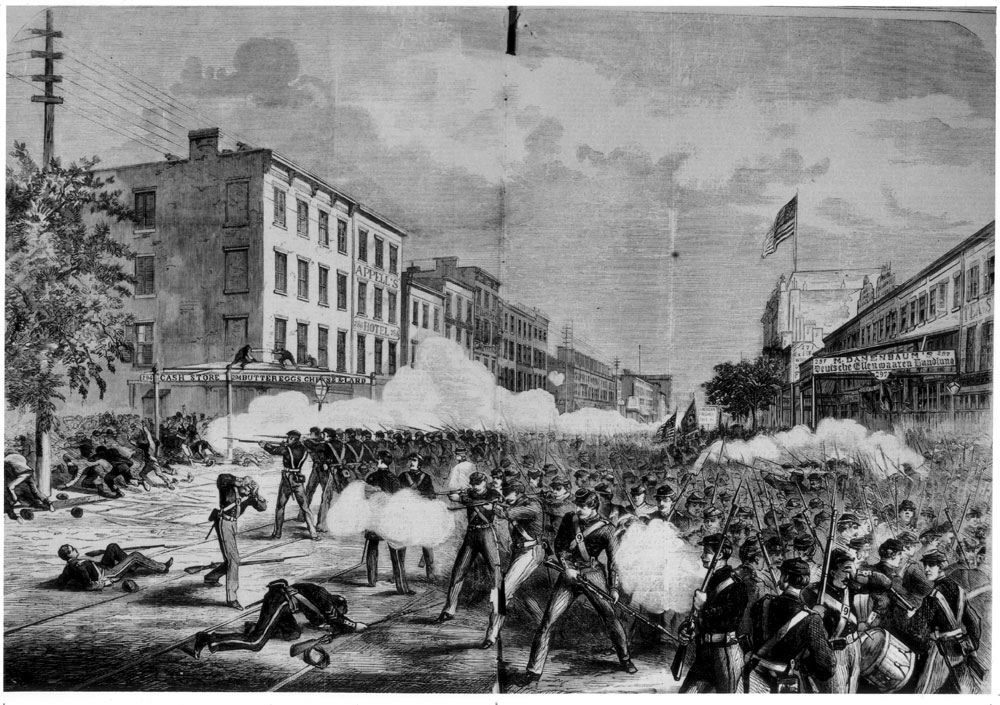
This month we are marking the 160th anniversary of one of the most dramatic moments in New York City history – the Civil War Draft Riots which stormed through the city from July 13 to July 16, 1863.

Thousands of people took to the streets of Manhattan in violent protest, fueled initially by anger over conscription to the Union Army which sent New Yorkers to the front lines of the Civil War. (Or, most specifically, those who couldn’t afford to pay the $300 commutation fee were sent to war.)

Looting at Brooks Brothers. Harpers Weekly, August 1, 1863

In many ways, our own city often seems to have forgotten these significant events.

There are very few memorials or plaques in existence at all to the Draft Riots, a very odd situation given the numerous markers to other tragic and unsettling moments in New York City history. 

In particular, given the number of African-Americans who were murdered in the streets during these riots, and the numbers of Black families who fled New York in terror, we think this is a very significant oversight.

Harper’s Weekly, August 1, 1863

The riots place New York City not outside the significance of the Civil War battlefield, but squarely within it. The Union was not united, but an assortment of different viewpoints.  

In this episode, a remastered, re-edited edition of our 2011 show, we take you through those hellish days of deplorable violence and appalling attacks on abolitionists, Republicans, wealthy citizens, and anybody standing in the way of blind anger. Mobs filled the streets, destroying businesses (from corner stores to Brooks Brothers) and threatening to throw the city into permanent chaos.

That Abraham Lincoln and the Union Army succeeded is even more remarkable when you realize the dissension from within, dissension which we discuss in this show (a remastered, reedited version of a show we originally recorded in 2011).

LISTEN NOW: THE DEADLY DRAFT RIOTS

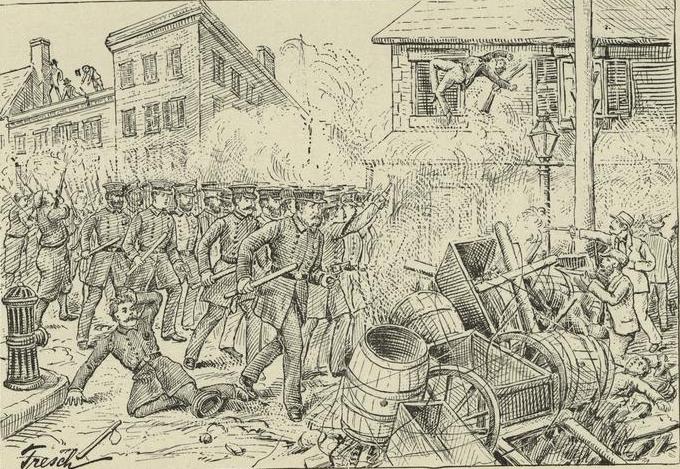
The burning of the Colored Orphan Asylum on Fifth Avenue: In a day of vile crimes that Monday, July 13th, this certainly stands out as one of the worst.
The mob burned the draft office at 3rd Avenue and 46th Street first thing on Monday morning. The destruction was but only a taste of the violence that was to come. By Friday, New York would be smoldering with dozens of structures in ashes — from factories and homes to armories and even bridges.

John A. Kennedy, the superintendent of police, who was savagely beaten and barely escaped with his life on the first day of rioting.

By Tuesday, rioters had cordoned off barricades along a couple key streets, including a mile-long makeshift fortification along Ninth Avenue, through today’s Chelsea and Hell’s Kitchen neighborhoods.

Illustrations courtesy New York Public Library digital image collection

The Illustrated London news

The other draft riots: Given the New York-centric nature of our program, I should note that draft riots occurred throughout the North that week, and even earlier. Yet none were of the intensity as those that occurred in Manhattan. In Boston, for instance, mobs stormed the famous Faneuil Marketplace and an armory on Cooper Street. But troops quelled the violence early, and only eight people died. [Read more about this even in the Boston Phoenix.]

And events were sparked in the future boroughs of Brooklyn, the Bronx, Queens and Staten Island as well. You can read more about them in this blog post.


Why are there no permanent memorials or remembrances of any significant kind in New York City to the Civil War Draft Riots? It was the most grave, the most tumultuous event in New York City history between the Revolutionary War and September 11, 2001. Doesn’t it merit some mention? Read Greg’s opinion piece which ran on the 150th anniversary — which more or less still applies today.


FURTHER READING

For more information on the Draft Riots, you can turn to several sources, based on your level of interest. My favorite is Barnet Schecter’s ‘The Devil’s Own Work’which gives a gripping chronological retelling of events. He really manages to tame a chaotic tale in a way that neither confuses nor oversimplifies. I used Schecter’s ‘Mrs. Hilton’ anecdote from this book, and his book is chockful of other individual tales like that one.

If you prefer something a bit more analytical, there’s Iver Bernstein’s ‘The New York City Draft Riots’ which tries to parse who exactly the rioters were. Of course ‘Gotham’ by Edwin G Burrows and Mike Wallace have a nice, compact recount with plenty of context. The City University of New York’s ‘Virtual New York’ web resource has a timeline with maps.

The Gangs of New York: Perhaps the most famous depiction of the riots occurs in Herbert Asbury’s classic ‘The Gangs of New York’. The film version, directed by Martin Scorsese, takes quite a few liberties with the facts of course. The placing of candles in windowsills and the fire at Barnum’s American Museum, for instance, did not happen during the riots. But those are based on true events that happened in New York a year later.

FURTHER LISTENING

There’s also the Broadway musical Paradise Square, set during the Draft Riots. Joaquina Kalukango won a Tony Award for Best Actress for her work in the musical: 

When this show was originally released in 2011, it was part of a three part mini-series on New York City and the Civil War. You might like to check out the other two parts — especially part three Hoaxes and Conspiracies of 1864

In this episode, Greg pays a visit to Weeksville, the Brooklyn community which became a haven for Black New Yorkers fleeing the city during the riots.

If there is a ‘prequel’ to the Draft Riots, it’s certainly the Astor Place Riot of May 10, 1849.

Categories
American History Politics and Protest The Immigrant Experience

The Making and Remaking of the Pledge of Allegiance


The Pledge of Allegiance feels like an American tradition that traces itself back to the Founding Fathers, but, in fact, it was only written in 1892.

And the version you may be familiar with from elementary school — featuring the most recent phrase “under God” — is less than 70 years old.

This is the story of the invention of the Pledge, a set of words that have come to embody the core values of American citizenship. And yet it began as part of a for-profit magazine promotion, written by a Christian socialist minister.

Listen to the pledge wording evolve throughout the years and discover the shocking salute that once accompanied it.

Featuring: Tom Meyers as the voice of Francis Bellamy, the inventor of the pledge. This is a reedited, remastered version of an episode of Greg’s spin-off show The First, originally released in 2017

LISTEN NOW: THE MAKING OF THE PLEDGE OF ALLIEGANCE

Francis Bellamy, known as the author of the Pledge of Allegiance:

What the Bellamy salute used to look like

Other forms of the salute had students lift their hands palms up, not down.

San Francisco, California, 1942: Flag of allegiance pledge at Raphael Weill Public School (Geary and Buchanan Streets). The original caption to this photo read: “Children in families of Japanese ancestry were evacuated with their parents and will be housed for the duration in War Relocation Authority centers where facilities will be provided for them to continue their education.”

Department of the Interior. War Relocation Authority. Courtesy US National Archives

Young scouts on a hike. Photo by Roy Perry, 1940. Most people were saluting the flag in other methods than the ‘Bellamy salute’ which remained in the Flag Code until the 1940s.

Courtesy Museum of the City of New York

Second graders pledge allegiance in an elementary school in Rockport, Massachusetts,  February 1973

Deborah Parks, photographer. Courtesy US National Archives

From the Youth’s Companion in September 1892, outlining the day’s ceremonies and the first use of the pledge.

A copy of the Youth’s Companion from 1899:

My beautiful picture

And yet WHY does an almost identical version of the pledge appear in the Ellis County News Republican on May 21, 1892? Did Francis Bellamy simply misremember when he wrote the pledge? Or did he really actually steal it from a 13-year-old boy — who happened to be named Frank Bellamy? Mystery!

The child Frank E. Bellamy graduated from high school and fought in the Spanish-American War. He died in 1915 from bone tuberculosis he contracted while fighting.

What is the real story between Francis Bellamy and Frank E. Bellamy?

Categories
Bridges Brooklyn History Landmarks

Deadly Rumor: The Brooklyn Bridge Collapse That Didn’t Happen

On May 30, 1883 — one week after it officially opened — 12 people were killed in a horrifying trample caused by the collapse of the Brooklyn Bridge.

Except of course, the Bridge didn’t actually collapse.

Photo_957

The prior week, the Brooklyn Bridge opened to terrific fanfare, with almost 14,000 people invited to cross this architectural behemoth which had sat in their harbor under construction for years.

The experience of crossing for the first time — to experience the sprawling city from a vantage in the harbor and at equal height of the tallest buildings of the time — must have been immense. And rather frightening.

One week later, on May 30th (Memorial Day that year), the path was still clogged with curiosity seekers.

Suddenly a woman fell on the stairs walking up on the Manhattan side, and her friend screamed.

Just this unnerving act alone created a rumor that the new bridge was about to collapse, that it couldn’t take the weight of all these people.

Panic ensued and people stampeded in every means possible to escape off the bridge. I feel the editorial from the Brooklyn Daily Eagle says it best:

“Two men tried to raise the prostrate woman and were instantly trampled and paid forfeit with their lives. In a few seconds human beings were piled four deep at the foot of the steps, and the crowd was hurried over them.”

Top story of the New York Times, May 31, 1883

From the report of a police officer on the bridge:

I was just above the stairs, at the side of the promenade. There was a crowd going in each direction and I was trying to keep them moving. A woman stumbled on the stairway below the landing and fell. Another woman at the head of the stairway saw her fall, and she screamed. The whole thing was caused by that woman screaming.”

“Then came the rush and the panic. I succeeded in getting up the woman who had fallen, but my hands were stepped on and my head kicked. I tried to drive back the crowd but could do nothing. It seemed as though the people didn’t see the stairs till they were pushed headlong down them by the rushing crowd behind.

1

Under a grim heading ‘The Pile of Dead’ in the New York Sun sits some frightful descriptions by survivors:

I felt the pulse of a number of those who were taken out. The first was a woman, who lay on her back just below the steps, with one arm twisted under her and the other hand clenching the reman of a child’s shawl. She had gray hair. Her forehead had been cut by the fall and her face was stained with blood. I believe she died before they got her off the bridge.”

New York Tribune

In the bloody tussle, 12 people died and over 36 were seriously injured. The victims ranged in age from 15 to 60, according to the Tribune.

Brooklyn Daily Eagle, May 31, 1883

The bridge, of course, wasn’t in any danger of collapsing. But few who walked upon it had ever stepped upon such a thing and it must have been a disorienting experience for the uninitiated.

And newspapers were periodically filled with the news of collapsing bridges. Only a few years before, on December 28, 1879, seventy-five people were killed when Scotland’s Tay Bridge collapsed during a storm.

Closer to home, a railway accident upon a bridge in Little Silver, New Jersey, killed three and injured dozens. (One of the survivors was former president Ulysses S. Grant.)

Following this unfortunate disaster upon the bridge, Brooklyn beefed up the police presence upon the bridge. “The order had evidently gone forth to keep everything moving for officers were stationed on the broad platforms circling the middle pier of each tower — favorite resorts hitherto for loungers and for others who want a shady spot in which to rest.” [source]

A variation of this article originally ran in 2007.

Categories
Bridges

The story of ‘Painters On The Brooklyn Bridge’

The photograph above (officially called “Brooklyn Bridge showing painters on suspenders”) is perhaps the best-known image taken by Eugene de Salignac, a city employee who took municipal photography of most major New York structures during the early 20th century.

His work had never appeared in a gallery until 2007, almost 65 years after his death.

His exquisite eye rendered otherwise ordinary shots with a captivating grandeur; this was certainly beyond the call of duty of his responsibilities for the Department of Bridges (later named the Department of Plant and Structures) for which he worked from 1906 to 1934.  

In all, it’s estimated the city owns about 20,000 glass-plate negatives taken by de Salignac.

Another striking view of the Brooklyn Bridge, taken by de Salignac on May 6, 1918. / Municipal Archives of the City of New York

On September 22, 1914, de Salignac headed to the Brooklyn Bridge to observe workers painting the bridge’s steel-wire suspension. Perhaps a bit inspired by modern artistic photography of the day, the normally workaday photographer returned to the bridge a couple weeks later, on October 7.

To quote Aperture: “The image was obviously planned, as evidenced by the relaxed nature of these fearless men who appear without their equipment and are joined, uncustomarily, by their supervisor.”

It was, generally speaking, an unspectacular day for the 31-year-old bridge.

It’s believed that the original color of the Brooklyn Bridge was ‘Rawlins Red’ although by this time, the vibrant color might have been replaced with the less dramatic ‘Brooklyn Bridge Tan.’  

Can you imagine what this image would have looked like in color?

I would like to think de Salignac took some inspiration from photographers like Paul Strand who were beginning to see New York City as a set of geometric abstracts.  

The spirit of this photograph echoes into the work of Berenice Abbott and especially Charles C Ebbets. In 1932, while de Salignac was still employed by the city, Ebbets was hired by Rockefeller Center to document the construction of the RCA Building.

In one photo, workers were posed in a way that eventually became quite iconic:

Most likely, none of those other photographers saw de Salignac’s Brooklyn Bridge picture.  It was essentially lost among the thousands of archives pictures until the 1980s.  

For his first film for PBS, Ken Burns used the photograph  in his Brooklyn Bridge documentary which went on to snag an Academy Award nomination.  In 2007, de Salignac was belatedly honored with an exhibition at the Museum of the City of New York.

 De Salignac returned to the bridge to several times to catch more workers in the act of maintaining the bridge. Such as this photograph the following year:

Want to get lost for an hour or so? Check on the New York Municipal Archives vast trove of Eugene de Salignac photographs directly.

**This famous picture Lunch atop a Skyscraper was attributed first to Lewis Hine, then to Charles C Ebbets. Thank you to Michael Lorenzini for pointing this out!

Top photo courtesy New York Municipal Archives. Hine photo courtesy the George Eastman House

Categories
It's Showtime Podcasts

The Broadway Musical: A trip through American theater history


The Broadway Musical is one of New York City’s greatest inventions, over 150 years in the making! It’s one of the truly American art forms, fueling one of the city’s most vibrant entertainment businesses and defining its most popular tourist attraction — Times Square.
 But why Broadway, exactly? Why not the Bowery or Fifth Avenue? And how did our fair city go from simple vaudeville and minstrel shows to Shuffle Along, Irene and Show Boat, surely the most influential musical of the Jazz Age?

This podcast is an epic, a wild musical adventure in itself, full of musical interludes, zipping through the evolution of musical entertainment in New York City, as it races up the ‘main seam’ of Manhattan — the avenue of Broadway.

We are proud to present a tour up New York City’s most famous street, past some of the greatest theaters and shows that have ever won acclaim here, from the wacky (and highly copied) imports of Gilbert & Sullivan to the dancing girls and singing sensations of the Ziegfeld revue tradition.

CO-STARRING: Well, some of the biggest names in songwriting, composing and singing. And even a dog who talks in German!  At right: Billie Burke from a latter-year Follies. (NYPL)
This show, originally recorded in 2013, has been re-edited, remastered and even includes extra material which was cut from the original episode.

LISTEN NOW: THE BIRTH OF THE BROADWAY MUSICAL


A few images from Greg’s trip to the Museum of Broadway at 145 West 45th Street.

The Black Crook
Ziegfeld Follies
Showboat
Rent
The Phantom of the Opera

The original grid plan from 1811. As you can see, Broadway was not meant to extend further than the Parade Ground, the largest planned plaza from the Commissioner’s Plan. Years later, the Parade Ground was reduced (becoming Madison Square) and Broadway was allowed to break the grid, creating plazas conducive for transportation and public gathering. (NYPL)

New York Public Library

One of dozens of knock-off productions of HMS Pinafore, this one featuring children:

The facade of the Fifth Avenue Theater, once located at 1185 Broadway. Why was it called the Fifth Avenue Theater then? Possibly to just make the society ladies feel at home here!  This was home to three Gilbert & Sullivan original productions, including the premiere of The Pirates of Penzance.
The Florodora girls, from the hugely successful 1900 musical comedy which debuted at the Casino Theater. (NYPL)

The Casino Theatre at West 39th Street and Broadway.

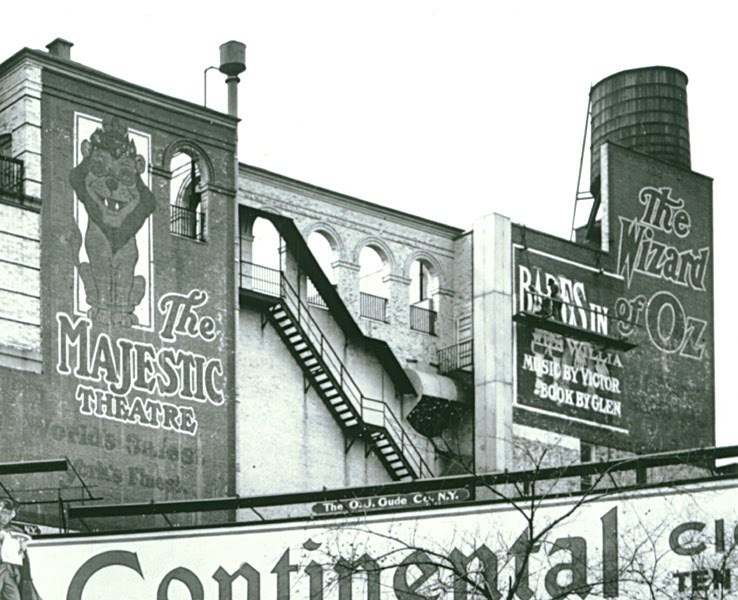
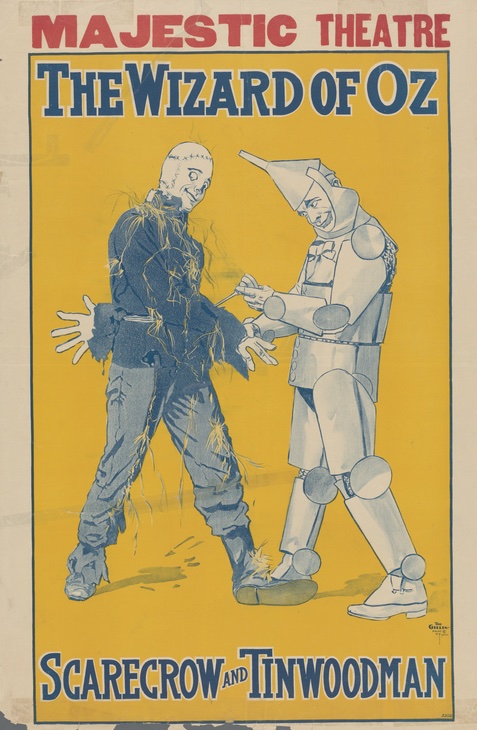
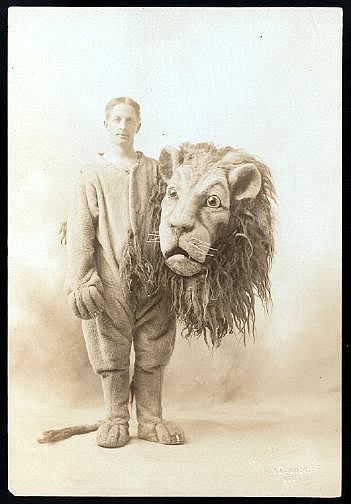
One of the more fantastic creatures from Victor Herbert’s Babes In Toyland, which made its debut in Columbus Circle’s Majectic Theater. You can read my article here on the musical which inspired Herbert’s show, the musical version of The Wizard of Oz. (NYPL)

New York Public Library

George M Cohan singing “Over There”

Video of a Ziegfeld Follies from 1929, a bit past their heyday, actually. They would only last until 1931:

Sheet music from 1921 of one of the most famous songs from Shuffle Along (NYPL):

Dancing girls during the Actors Strike of 1919, which galvanized the industry and gave regular New Yorkers a window into the tough conditions faced by many background performers. (NYPL)

So the number ‘After The Ball’ — a huge hit song that made its stage debut in A Trip To Chinatown — made a return appearance to Broadway in 1927’s Show Boat!

Musical cues from this week’s show:
Give My Regards To Broadway and After the Ball performed by Billy Murray
A version of Make Believe recorded by Bing Crosby, and Ol Man River, performed by Paul Robeson, from a 1932 cast recording, featuring Victor Young and His Orchestra
Love Will Find A Way, from a 1921 recording by Eubie Blake
Selection from HMS Pinafore, from a 1914 recording by the Victory Light Opera Chorus

 And finally, a clip from the film version of ‘Show Boat’, featuring an iconic performance by Paul Robeson.
 

Categories
Landmarks

The Woolworth Building at 110: How they partied in 1913, with the “highest dinner ever held in New York”

This is how they turn on the lights at the tallest building in the world in 1913:

At some time after 7 pm, on April 24th, according the New York Sun the following day, “President [Woodrow] Wilson pushed a button in Washington last night, a bell tinkled in the engineer’s quarters far below the street level in the Woolworth Building and thousands of lights [80,000, by contemporary accounts] flashed out … to signal that New York’s newest heaven kissing tower was opened formally for service.”

As normal New Yorkers stared up in wonder at this glowing candle near City Hall, an electric vision that lorded over the dark hulk of the unloved Post Office across the street, a collection of wealthy men were gathered up on the 27th floor for a lavish banquet in honor of the building’s architect, Cass Gilbert (at right).

The Tribune called it “the highest dinner ever held in New York.” (The building is 57 floors; dinner could have been much higher but for tenants who had already moved in.)

Holding court this evening was, of course, Frank W. Woolworth, the man whose retail empire inspired the building’s construction.

Also presiding over the gala was Francis Hopkinson Smith, a close friend of Gilbert’s who, several years earlier, just happened to built the foundation for the Statue of Liberty.

People toasted a true American entrepreneur. They toasted his visionary architect and his world-class achievement. Many toasted the fact that both men, after years of arduous work, were still talking to each other.

1

The Woolworth Building at night in 1913. This extraordinary photo is courtesy of Shorpy, my favorite website of all time. Click here to see the whole spectacular version and to search their their archive of cleaned-up vintage photos. (You can find the original picture at Library of Congress.)

It was a celebration of the filthy rich, possibly one of the most indulgent dinners of the Gilded Age.

In attendance were governors, dozens of congressmen and military men, judges, the police commissioner and at least seven of Woolworth’s early business partners. A letter from William Howard Taft, a month into his post-presidency, elicited enthusiastic applause.

But nothing like the reaction when Gilbert stood up to honor his benefactor, who paid for the entire building from his lucrative retail profits. “I asked his bankers about it and they told me that the Woolworth Building is a structure unique in New York, since it stands without mortgage and without a dollar of indebtedness.”

At this, the 37th floor erupted into “the big noise of the celebration.” Gilbert was then presented with a bronze foot-high cup — a literal trophy earned for building one for Frank Woolworth.

Following the dinner, Boy Scouts — patient ones, apparently — then raced downstairs ten floors to the Marconi wireless station, where an honored greeting was sent back to President Wilson.

Below: The Woolworth and lower Manhattan in 1919, lit from a building in Brooklyn.  Specifically this was the Sperry Spotlight. You can read my article on ‘the world’s most powerful searchlight’ here. (Picture courtesy Library of Congress)

1
 

The Woolworth Building was an achievement of American capitalism and a fabulous symbol of limitless New York real estate. Its technical achievements, impossible to imagine a decade prior, only reinforced the themes of the day — money could defy gravity.

On the day of the official opening, the following ad ran in the Evening World (While April 24th was the ceremonial first day, May 1st was the beginning of the building’s leases.):

Nobody would “forget about you” — provided you took out a lease at the Woolworth — but most importantly they certainly wouldn’t forget the name affixed to this building. The Woolworth continued the trend of business owners who created skyscrapers as a show of business dominance.

Newspapermen popularized the trend — for instance, The World Building, offices for Joseph Pulitzer‘s New York World, was also a world’s-tallest at one point — and insurance companies and retailers would perfect it.

In fact, three decades later, the crown for world’s tallest building would be taken by a structure in midtown Manhattan named for a car company — The Chrysler Building.

The Woolworth was considered a vertical super-city, in an era before anybody ever dreamt of Rockefeller Center.

“You can deposit and draw money at the bank on the first floor; in the basement there are barber shops and a swimming pool, one of the largest in New York …. There is an arcade lined with attractive shops whose fronts are entirely of plate glass. Then there is a luncheon club, library and gymnasium on the 28th floor and an observatory station on the roof.”

Woolworth’s own businesses took up only two floors. The rest were filled with such premiere tenants as Fordham University (its law school and dean’s offices were here), Irving National Bank and even Columbia Records.

Below: A study for Woolworth’s private office in the Woolworth Building. Frank Woolworth was obsessed with the life of Napoleon Bonaparte, and his office was fashioned on a room from Napoleon’s castle in Compaigne, France.  (Pic courtesy LOC)

Today, we might consider the Woolworth Building to be a rather elusive monument. You can’t regularly tour it, and its style, before New York’s zoning laws, makes it a unique stranger within New York’s skyscraper population. You can’t interact with it like Grand Central, and it doesn’t have the personality of the art-deco Chrysler or the Flatiron.

But even if its nightly mystical posture on the skyline somehow fails to ensnare you, the Woolworth Building stands alone as an influence to almost every skyscraper that has come afterwards, from the Empire State Building to the Woolworth’s old neighbor the World Trade Center.

Of the many grand visions born in New York before the 1910s — the Erie Canal, Central Park, the Croton Aqueduct, the Brooklyn Bridge — the Woolworth Building is easily the most effortless in execution. And arguably the most duplicated.

Or as the Sun prophesied a week after the building opened: “The Woolworth Building is unique, it was explained. Its style of architecture is original in office buildings and there were no precedents or rules upon which to go. The proportions have now been ascertained and will be available for the guidance of architects in the future.”

Photo by Alan Miles/Flickr

————-
A couple other Woolworth Building themed posts in the past week: Cass Gilbert’s three stunning prequels to the Woolworth Building and Before Woolworth: The early towers of lower Broadway at the birth of the skyscraper boom.

Interested in learning about the history of the Woolworth Building? It’s our Episode 76. You can download it from here, find it on iTunes, or just play it below!

__________________

And finally, I found this in a July 1919 copy of the New York Evening World — the Woolworth Building as a possible air dock for dirigibles! (This never happened of course.)

This article originally ran on the Woolworth Building’s 100th anniversary.