“Horrors” of Roosevelt Island: Grampa Al


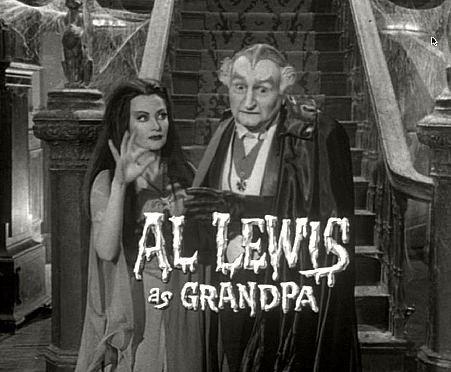
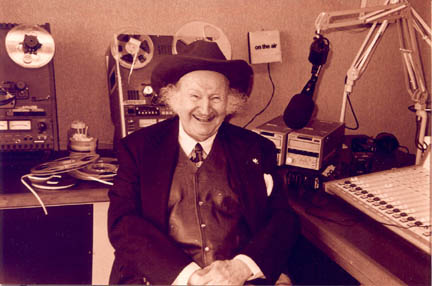
Before going any further, I would be remiss if I didn’t mention its most famous monster man, the godfather of Roosevelt Island and one of the most original New Yorkers who ever lived – Al ‘Grampa Munster’ Lewis.

Perhaps these days it’s difficult to understand a man like Al. He’s a crusty mix of old school vaudevillian and opinionated local celebrity who ingratiated himself with cantankerous and uncommon familiarity. Everybody seems to have an Al Lewis story. I met Grampa Munster only once in the 90s, years after his Greenwich Village restaurant — naturally called Grampa’s Bella Gente, (at 252 Bleecker Street) — had opened in April 1987. He was sitting in a rocking chair, cackling the night away. But how I wished I had taken my friend’s offer a few years later; he was having a drink with Al at Roosevelt Island’s only bar (I believe it was Julie’s Back Page).

Bigger celebrities have certainly lived on Roosevelt Island — Sarah Jessica Parker started her acting career living there — but none as beloved or as representitive of a certain type of true-blue New Yorker.

Lewis was either born here in Brooklyn, or out in Wolcott, NY; in the year 1910 or (more likely) 1923; with the birth name of Alexander or Albert. Depending on who Al was talking to, and when, the details of his life would tranform with the same dexterity that his TV persona Grampa Munster used to change into a cheap rubber bat. He purported to have a doctorate in child psychology at Columbia University, although his occupations were also purported to include a hotdog vendor at Ebbets Field, a store detective a former circus performer, and a Marine in World War II.

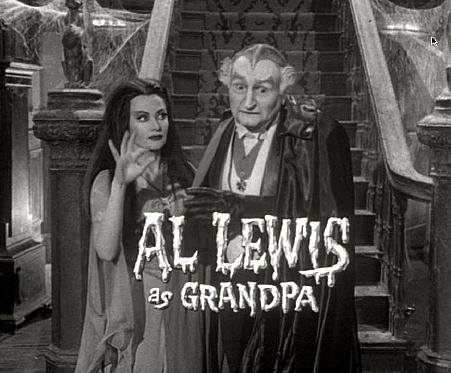
His big television break came with two seasons, Car 54, Where Are You?, playing a wacky Bronx police officer, cracking kooky cases with his partner, played by Fred Gwynne. Two years later he would join Gwynne in another series in the role that would define him. Literally. Like another vampirical player Bela Lugosi, Lewis would wear the cloak and mantel of Grampa Munster throughout the rest of his life, to nearly everything. For three campy seasons, “The Munsters” gave us Lewis amidst bubbling beakers and electrified gadgets in the basement of 1313 Mockingbird Lane, hocking sarcastic barbs at his Franken-son-in-law Herman.
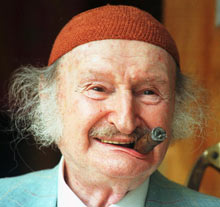
Lewis would keep working in television and film but his political leanings would coax him into activism of an often surprising sort. (Mitchel Cohen remembers first meeting him in 1971 at a Black Panthers demonstration!) With his wife Karen, whom he married in 1979, Lewis became closely associated with the Green Party. In 1998 actually ran for New York governor against George Pataki, a rather ambitious challenge for a man well in his 70s. He tried to run as ‘Grampa Al Lewis’ but was rejected by the Board of Elections. He did receive 52,000 votes, of which I believe I was one of them.

He settled with his family in Roosevelt Island and slowly became involved in radio broadcasting. He had a show for many years on WBAI which Karen took over once became ill. One story claims he ‘pestered’ himself into the job by constantly calling with “comments, [to] correct mistakes or complain about what was on the air.” He well known to New Yorkers of the early 90s for being a frequent guest on the Howard Stern, once memorably haranguing the FCC with a flurry of bleepable expletives.

According to a recollection by Cohen, “I remember when Al was already sick, a Reclaim the Streets party/demo had ended up on Roosevelt Island. We marched past Al and Karen’s apartment, and I started the chant: “We love you
Grandpa, we miss you, get better!” and pretty soon the hundreds of us took up the chant, lights came on in the apartments, people looked out the windows, and everyone waved, knowing whom we were chanting about as we snaked by.”

He died at his Roosevelt Island home on February 3, 2006. At his funeral, one friend said,
“Who was Al Lewis? A raconteur. The de facto mayor of Roosevelt Island. The best-dressed man on Roosevelt Island. He held court in front of 546 Main Street, the senior citizens center…” It should be noted that Grampa Munster’s signature ride, the ‘dragula’ gold coffin on wheels, rolled up to the door of the church.
“Horrors” of Roosevelt Island: Renwick Ruins

With apologies to the people who reside there, I must admit that Roosevelt Island has always freaked me out. Which is why I like it actually. Over the next few days, I’ll highlight some of my favorite Roosevelt Island places and people, some familiar to New Yorkers who have never ventured there.

The “little Apple”, i.e. the mini-Manhattan island floating below the Queensboro Bridge in the East River, Roosevelt Island is an anomaly. Although just across the water from lucrative real estate and everchanging Manhattan and Queens landscapes, it seems completely frozen in time.

Over the years, its been called Hogs Island, Blackwell Island, and Welfare Island, none exactly a draw to trendsetters or developers. (Although, I guess if Hell’s Kitchen can become a ‘hot neighborhood, anything can.) It was given its current name in 1973 to welcome a spectacular new memorial to Franklin Delano Roosevelt, designed by the renowned Louis Kahn. If you’re wondering why you’ve never heard of it, its because it was never built. So even its name harbors a certain incompleteness. (However believe it or not, there are still plans to build it!)

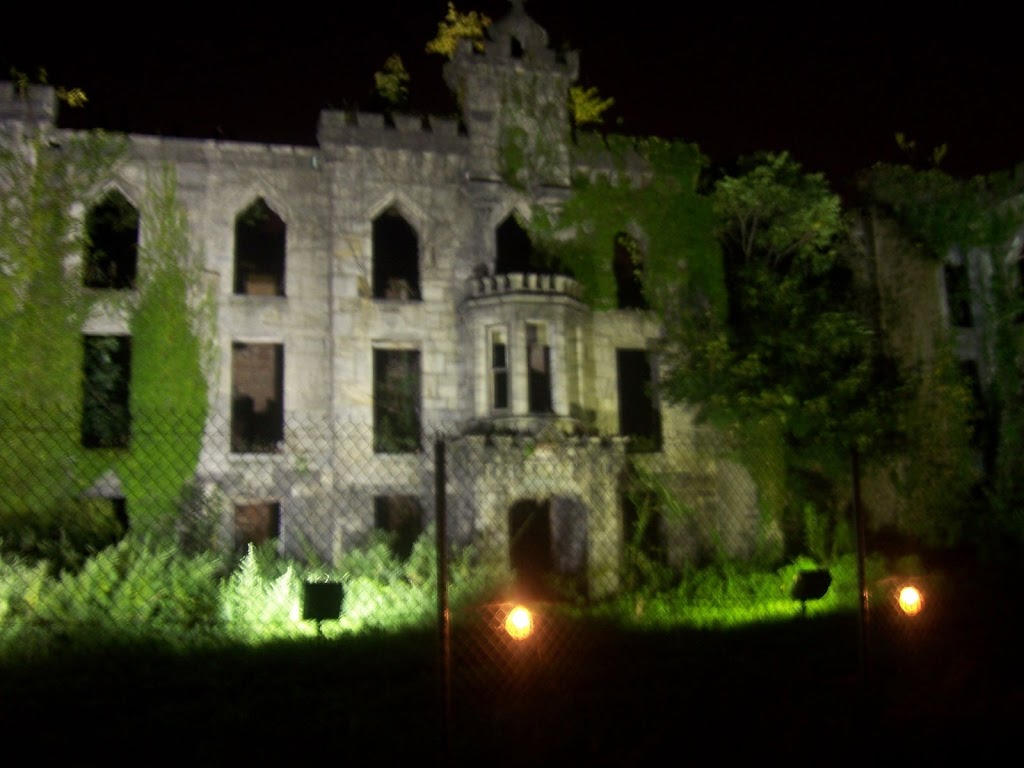
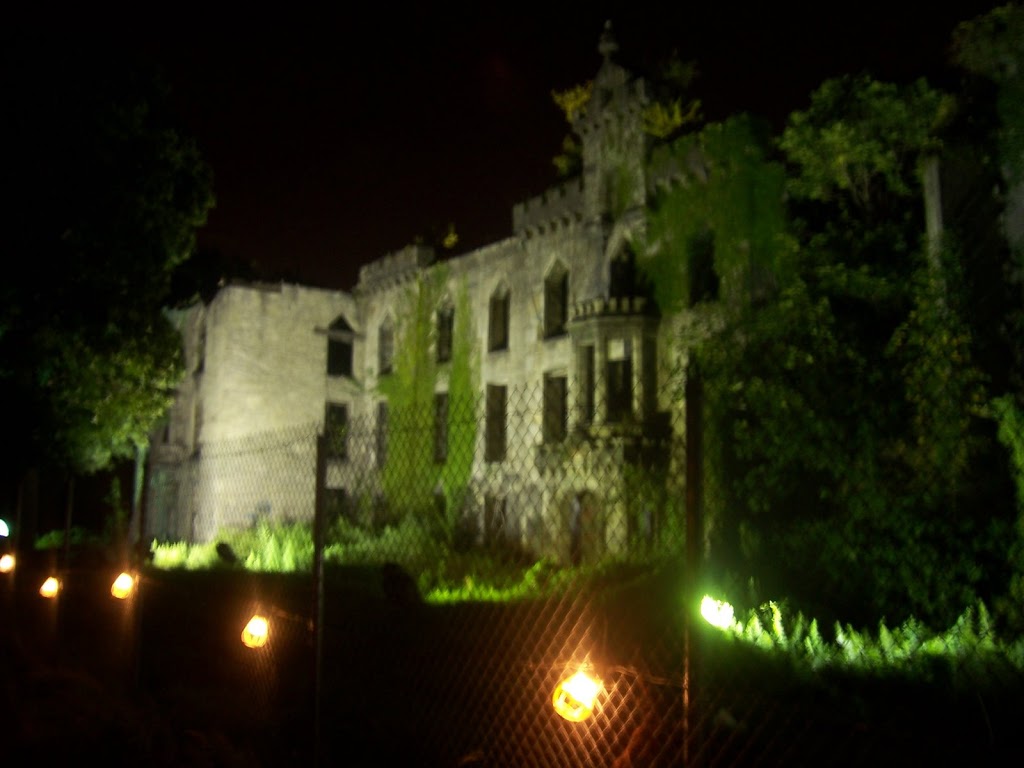
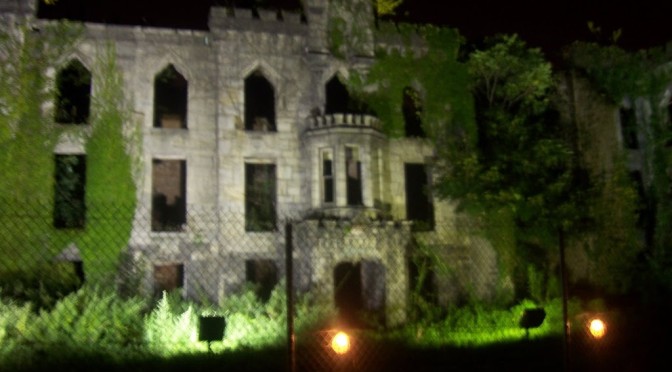
Our first stop along the Roosevelt Island is probably its most recognizable feature, at least to most Queens or Manhattan residents — the Renwick Ruins, on the southernmost point of the island. Delightfully lit year round, it rises out of the East River like a haunted castle, with stark turrets and dark windows peering back at the city. More impressive than its Halloween-like trappings is the fact that such a large ruin has managed to survive near Manhattan at all without being torn down and turned into a glass condominium. For that reason, Renwick Ruins should creep you out and impress you in equal parts.

I went over a couple weeks ago and took some snaps close up. (Not the best pics you’ll ever see of it, but you get the idea. Some better daytime shots can be found on Flickr.)

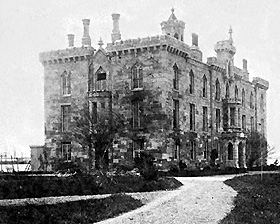
The almost fairytale Gothic structure was designed by James Renwick — most notable for St Patrick’s Cathedral, Grace Church, and the Smithsonian Institute in D.C. — as the location of a hospital for smallpox patients. It was built in 1856 using labor from the neighboring lunatic asylum and in fact supplanted a fort built by one of its more passionate inmates. (More on that later.)

Roosevelt’s relative isolation made it an ideal spot for a smallpox hospital, and the rooms were soon filled with hundreds of patients, many of them poor immigrants too distrusting of our country’s immunization practices, or Union soldiers shipped here to recover from the illness. Within twenty years, the New York Board of Health took over the building and made into a nurses residences and school maintained by City Hospital. That too was then abandoned when City Hospital was transferred off of Roosevelt to Queens.

Luckily the deteriorating structure was saved by the Landmarks Preservation Commission in the 60s and has only been preserved to the extent that its structure is maintained. It remains beautifully spooky to this day and a testament to the notion that not every inch of New York real estate need be functional.

The Roosevelt Island Historical Society has a more detailed history as well as a fine description of its architectural details. The site is closed to the public, but its home in Southpoint Park is occasionally opened for special events.

NOTE: As per the time of year, I’m only highlighting Roosevelt’s spookier elements. It’s obviously a normal and healthy place to live, mostly free of ghosts and insane lunatics. I promise. There are two good blogs that deal specifically with Roosevelt Island — Roosevelt Island360 and Roosevelt Islander.

FRIDAY NIGHT FEVER: McGurk’s Suicide Hall

To get you in the mood for the weekend, every Friday we’ll be celebrating ‘FRIDAY NIGHT FEVER’, featuring an old New York nightlife haunt, from the dance halls of 19th Century Bowery, to the massive warehouse spaces of the mid-90s. Past entries can be found here .

To stick with our morbid spooky theme this week, I thought I’d turn the spotlight briefly on literally the deadliest venue in New York nightlife history — McGurk’s Suicide Hall, formerly at 295 Bowery.

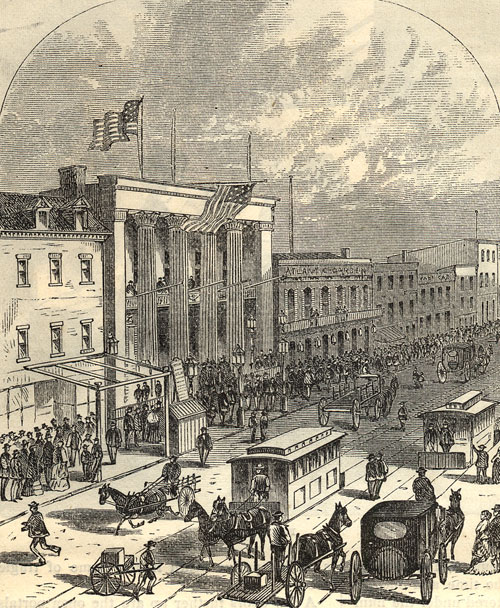
Prostitution was the Bowery’s oldest profession, drawing thousands of women and girls with often the only form of making money they could find. It was so prevalent that even the theaters there on certain nights of performances permitted prostitution in the uppermost tier of seats. “‘Public prostitution [in the theater] is not noticed by law,’ admitted one observer.” (Below is a picture of the old Bowery Theater, where such seamy occurances would happen in the top balcony.)

One had to have fallen pretty low to even enter John McGurk’s tawdry establishment, opened in 1895, in a space once used as a hotel for returning Civil War veterans. And even lower — much, much lower — to attempt to sell your body at McGurk’s. It was considered the worst and most squalid dive bar in the Bowery. “McGurk’s was nearly the lowest rung for prostitutes” according to Luc Sante’s book Low Life. It would not be surprising then to find that those that found themselves draped within the doorways of such a wretched place would be prime candidates for depression and suicide.

The bar became the destination of a great number of suicides, either from carbolic acid or a leap from its fifth story. According to Forgotton NY, six girls killed themselves in 1899. Most were teenagers who believed they had few options in life; I can painfully imagine a few experiencing something particularly rancorous at McGurk’s and taking a improvised leap in grief and horror.

McGurk, turning lemons into a morbid lemonade, actually renamed his place ‘Suicide Hall’ as a marketing ploy. And the reputation of the dive did draw its share of curiousity seekers, often from the upper class after a night at the theatre, looking for a bit of macabre excitement.

McGurk eventually closed the Suicide Hall and moved to California. The building saw nothing but flophouses and ruin for the most part of the 20th century until an artist couple took over and turned into a workspace. They were in turn forced out by the power of gentrification; it has now been transformed into the sleek glass condominium Avalon Bowery Place. 

The resident of the building at the time of demolition, sculptor Kate Millet, sums it up nicely: “If McGurk’s is turned to dust and supplanted with blank high rise market housing, official power will have buried its past in order to expunge it. Then it will be as if it never happened. No one will ever have to notice these deaths, mysterious folk reason that this building has stubbornly remained notorious for a hundred years, a landmark of gossip and legend repeated in every nook about the city of New York, an eerie and appalling specter never dealt with, formally and publicly never acknowledged.”

Well, they certainly tried to warn the Avalon people. If people start seeing the ghosts of women plummeting to their deaths, don’t blame us.

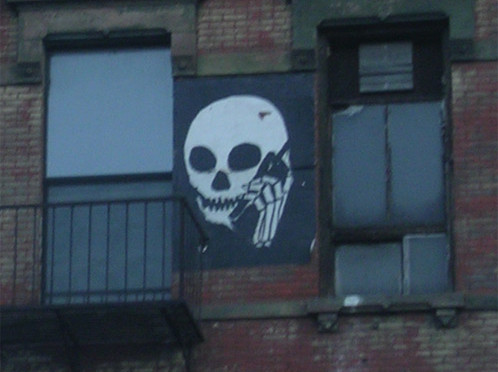
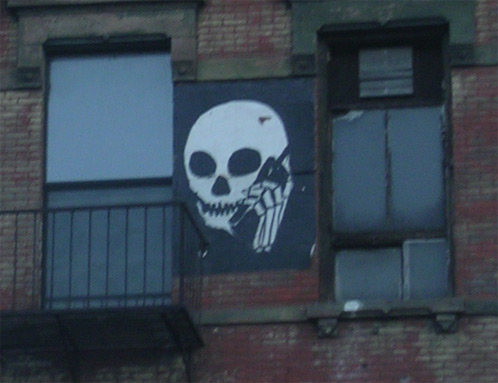
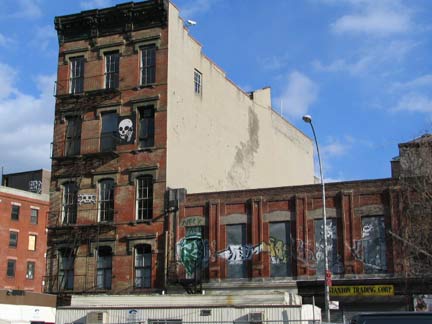
Below: what the building looked like in its final days (the skull is a nice touch).

Site photographs courtesy of Global Graphica.

Categories
Mysterious Stories Podcasts

PODCAST: Ghost Stories of New York

From the podcast: David Belasco and some his feminine daliances. Belasco is still believed to haunt his theater on 44th St.

A city this size certainly has its share of ghosts, and the Bowery Boys spend the spooky season with some of the most famous — a suicide showgirl, a grumpy landowner, a womanizing theater owner and a rich spinster.

Listen to it for free on iTunes or other podcasting services. Or you can download or listen to it HERE

In today’s podcast, we highlight some of New York City’s most popular ghost stories. There was one more story that we left out that I wanted to put here. It isn’t a ghost story; it’s an actual historical event that just happens to be really creepy. I dont have many pictures of this event — being from the 1840s — so interspersed are some shots of ‘haunted’ places from this week’s podcast.

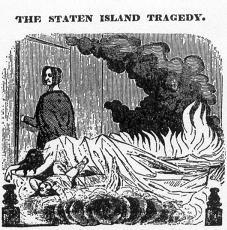
Christmas 1843 — On the western side of Staten Island lay a small town called Graniteville, some townspeople awoke to see a fire in the house of sailor George Housman. Although he was frequently at sea, his wife and his daughter still lived there, and George’s sister Polly was staying with her.

The people stormed into the burning house to find a scene of grisly horror — George’s wife Emeline had been attacked with an axe, her arms broken, her throat cut. The daughter lay next to her dead with her skull crushed. Polly had disappered. She did not live there but was staying because Emeline was frightened while her husband was away. For they had $1,000 in the house.

Nobody had actually remembered seeing Emeline come out of her house for the past couple days. But they did remember Polly. She was seen in town pawning silverware with the initials EH on it. And later that day, in Manhattan, she was seen spending the money, buying a green hooded cape and veils. So naturally suspicion naturally pointed to Polly. Townspeople began search parties, while women and children were locked in their homes.

Polly was considered a ‘wanton woman’ with a spurious reputation. Her son worked as an apprentice at a drug store on Canal Street in Manhattan, and his employer was also Polly’s lover.

Polly would make her way to the landing of the Tompkinsville ferry, a precursor to the Staten Island Ferry. She was camped in a corner, getting drunk on gin, and witnesses recognized her “by her long, hooked nose.” By strange providence, George Housman returned to New York that very day, and found Polly on the street with George’s cousin Freeman Smith. They must have had quite a lot to talk about.

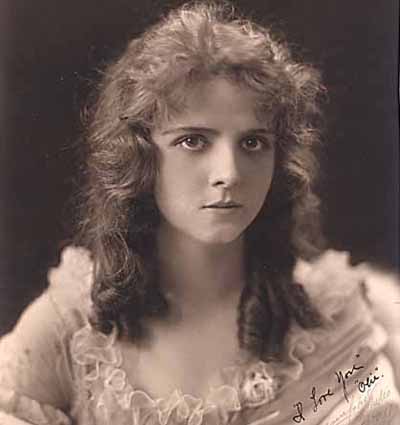
Above: from the podcast, Olive Thomas, the young starlet who haunts the New Amsterdam Theatre

She was eventually arrested and sent to county jail. The day after she was arrested, Polly gave birth to a stillborn child.

Polly eventually went on trial in June of 1844 but by then, news of the alledged lascivious murderess — one baby dead from an axe, another from her womb! — spread to Manhattan and beyond.

Special ferries were installed to bring people over to the courthouse. Reporters were sent from neighboring states, including one from Pennsylvania, by the name of Edgar Allen Poe who is heavily critical of how the trial was being handled:

“The trial of Polly Bodine will take place in Richmond and will no doubt excite much interest. This woman may possibly escape, for they manage these matters wretchedly in New York…..I have good reason to believe that it will do public mischief in the coming trial of Polly Bodine.”

Curiously enough, Poe would write up his article the same year his story of the publication of The Tell Tale Heart.

Not everybody was as sure as Poe however. Edward Van Emery in his 1945 ‘Sins of New York‘ states that “there has never been much doubt as to her having been the guilty party.”

There was so much public flurry and gossip that a fair trial was virtually impossible. According to Henry Lauren Clinton’s 1896 ‘Extraordinary Cases’ Polly’s life was spared by a single ‘incorrigable’ juror, and it was declared a hung jury.

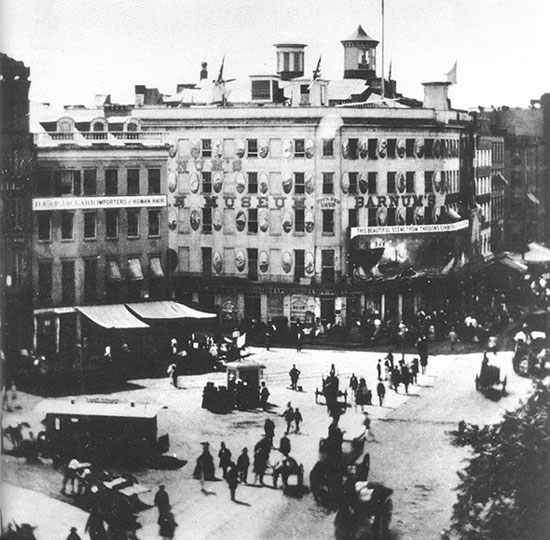
So a second trial was held in Manhattan to even greater fanfare. She was so notorious that PT Barnum, in his downtown museum on Broadway and Fulton Street (blocks from where the trial was taking place), erected a wax homage of her. In the tableaux, he called her “the witch of Staten Island”, representing the woman by hacking Emiline and her daughter with an axe.

Here’s a picture of how the Barnum museum looked in the 1850s:

Like the great ‘trials of the century’ today, Polly has superstar representation (Clinton DeWitt) and the attentions of every tabloid on the Eastern seaboard. During this trial, witnesses changed their stories and truth readily bled into rumors. Due to this was soon declared a mistrial.

The final trial had to be moved out of Manhattan to Orange Country because of a lack of unbiased jurists. Finally Polly was found … innocent.

Her reputation ruined, Polly returned to her home, rarely to leave her home, for almost 50 years. She would die on 1892.

Yet like OJ, the “real” murderer was never found. And much conjecture from modern investigators suggest that Polly really was the murder, who hacked her sister-in-law and niece to death. Just down the street from the Housman home (near Forest Avenue and US 440, according to the NY Public Library) you can find the grave of Emiline and her daughter, and at night they say that a ghost of she and her daughter roam the cemetary looking vainly for justice.


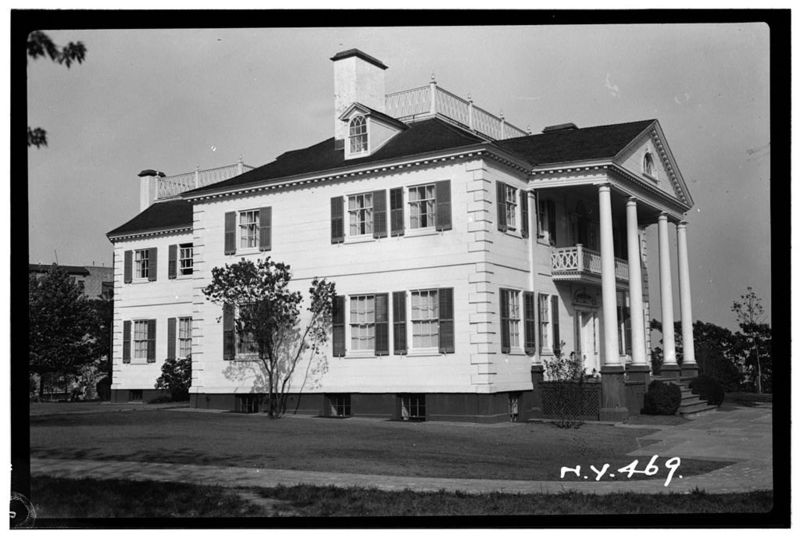
Above: the Morris-Jumel Mansion in Washington Heights, and home of the possible ghost of Eliza Jumel. Information on visiting the mansion can be found on the Morris-Jumel website..

FRIDAY NIGHT FEVER: Paradise Garage


To get you in the mood for the weekend, every Friday we’ll be celebrating ‘FRIDAY NIGHT FEVER’, featuring an old New York nightlife haunt, from the dance halls of 19th Century Bowery, to the massive warehouse spaces of the mid-90s. Past entries can be found here .

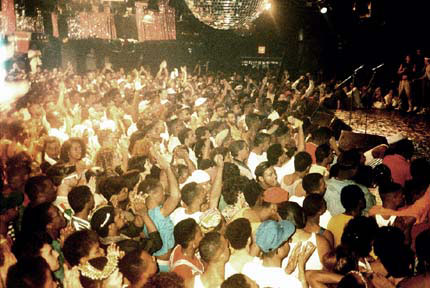
There are few nightclubs in the modern history of New York City that have as much good will attached to them than the Paradise Garage. While other clubs burn out or die, the “Garage” as it came to be referred is spoken about in reverent terms, almost as if it’s still open. The reason is simple — for better or for worse, it’s the birth of the modern nightclub.

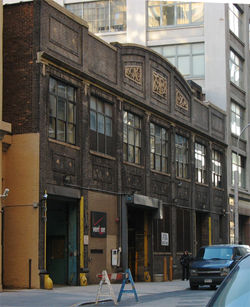
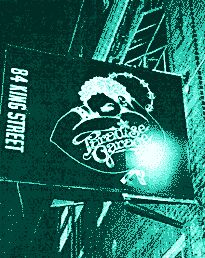
Born from a parking garage on 84 King Street, south of SoHo, in an area still festooned with warehouses, the Garage formed out of the early attempts of a disco called the Chameleon. Owner Michael Brody spent months retooling it as a vast heavenly warehouse and would often host ‘construction parties’ to generate buzz. By the opening on February 17, 1978, he was ready to greet the city.

Unfortunately, so was a devastating blizzard. The sound system was in boxes stranded at the airport while hundreds of partiers were outside, stranded in the snow. It could have been over before it began.

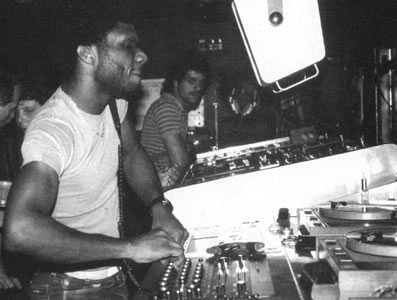
If not for the master of ceremonies — Larry Levan. The Garage was front and center about the music, and Levan, who has since become the patron saint of deejays, was the one who put it there. His music style would smoothly transport disco into the ’80s, and in the process helping popularize a new style of dance music called house — electronic infusions into soul, funk and disco. In fact, ‘garage music’ is a specific type of house, giving what would become house a raw, ‘big room’ urban quality. And named, of course, after the Paradise Garage.

The seeds of the Paradise Garage philosophy were planted in the mid 70s with roving parties under the banner called The Loft. Before then, New York nightclubs still had a primary focus, held over from the ’50s and ’60s, of being social gathering places, where people — often famous people — met other people, lubricated by booze. The music itself was often wallpaper.

The Garage essentially refocused the nightclub experience from meeting places to houses of music worship. The club served no liquor and, mostly notably, was a dancefloor for regular people in an era where locales were eagerly trying to attract celebrities and press. It was also ‘members only’, which served not to create an elitist exclusivity, but rather to ensure that every there was ‘all about the music’.

It’s no surprise that the Garage had a superb sound system, reputedly the best in New York, created by Levan and Richard Long to make the new sounds of house literally rumble underfoot, not to mention those murals on the walls by Keith Haring. Not to be outdone, the dazzling strobe and effects were courtesy of almost 730 lighting features, grown from just a dozen or so from the first days of the club.

According to A Garage Tribute, a heartfelt recollection site : “thunderous audio would burst through your heart like a bolt of lighting. . . the warm base vibration would lift you from the floor suspending you weightless, your heart would race and senses would tingle.” Its design has literally influenced every major dance club in the world, from New York to Europe and beyond.

Notably, the Garage clientele was black and Latino, mostly gay, in stark contrast to uptown’s whiter, straighter crowd. But as the club’s reputation grew, so did the makeup of the revelers. That was reflected in the talent that would occasionally arrive on stage — Madonna, Loleatta Holloway, New Order, Phyllis Hyman and Taana Gardner (whose song ‘Heartbeat’ might be considered the ultimate Paradise Garage tune).

Levan would lord over the proceedings in a deejay tower high above, a sort of musical wizard. According to Disco Disco, Steve Rubell of Studio 54 even attempted to lure Levan away from Garage. Larry’s response: “They’re not ready for me yet.”

A familiar enemy ended the Garage September 1987 — high rent and gentrification. Levan himself died in 1992, having literally partied himself out, according to In Da Mix Worldwide. A beautiful look into the Garage years can be found on CD — “Journey into Paradise: The Larry Levan Story“, a highly infectious time-capsule of some of the Garage’s greatest hits.

Categories
Podcasts

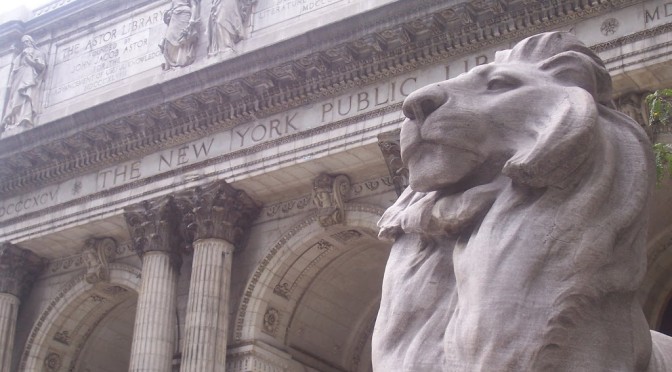
PODCAST: New York Public Library

The New York Public Library may be one of the most revered libraries in America, but it took a farflung combination of bookworms, millionaires and do-gooders to make it into the institution it is today. Also: find out why the architectural style of the Beaux Arts sometimes reminds us of an old French prostitute.

Listen to it for free on iTunes or other podcasting services. Or you can download or listen to it HERE

Before the lions of the New York Public Library — now less imposingly called the Humanities and Social Sciences Library — parked themselves at 40th and 6th Ave, the Croton Reservoir stood imposingly there, holding the city’s water supply. As you can tell from this picture, it looked a bit like an Egyptian pyramid, or perhaps a alien spaceship.

This was a distribution reservoir, which received water from a larger ‘receiving reservoir’ in what is now Central Park, but what was then on the outskirts of town.

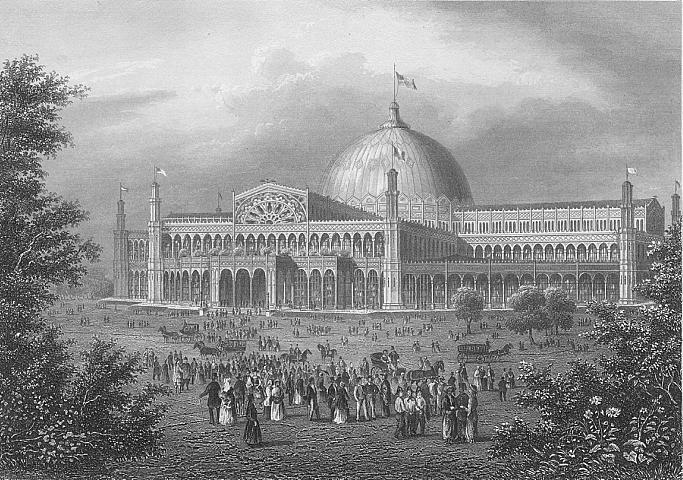
Meanwhile, the space now considered Bryant Park was, in the 1850s, the location of the New York Crystal Palace, home of America’s technological and engineering marvels. Here’s a look at the Crystal Palace in all its glory:

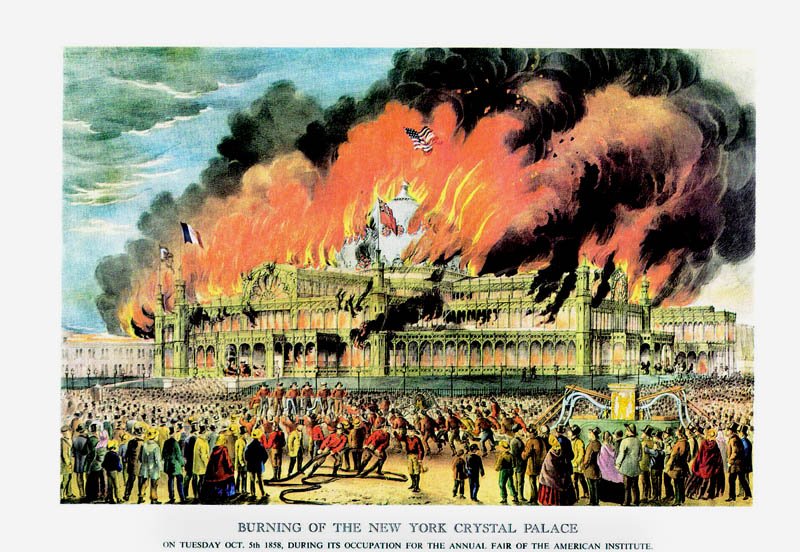
And a dramatic illustration of its final moments, felled in a quick burning fire.

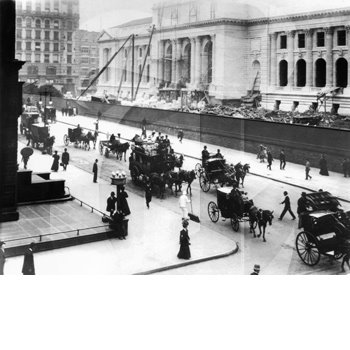
The construction of the library took nine years — sixteen if you consider the time from original design to dedication. The most ambitious marble building of its time, it was covered in Vermont marble so carefully chosen that two-thirds of the shipped stone was rejected for not being refined enough. The marble is at a thickness of almost a foot all around. The net effect even now gives the structure an immovability that makes the modern skyscrapers around it seem light and temporary.

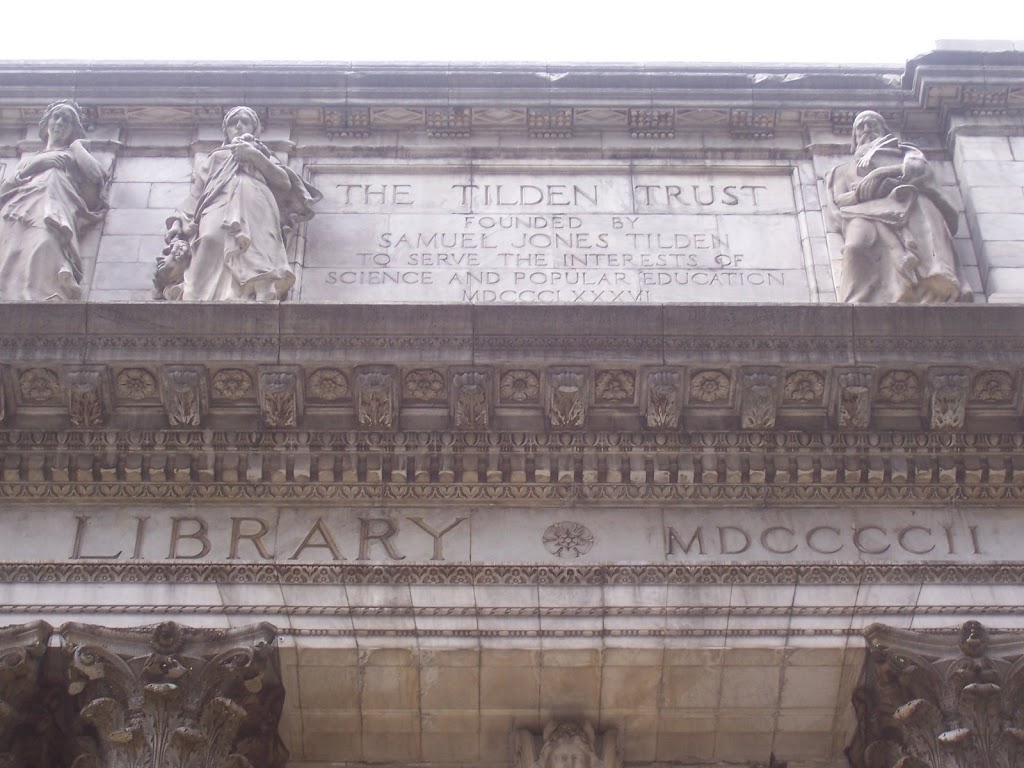
On the frontispiece above the entrance to the library is a tribute to its three creators — millionaire John Jacob Astor, collector James Lenox and former governor Samuel Tilden:

However, the area of 41st street that runs between 5th and 6th Avenue is now called ‘John Bigelow Plaza’, after the man who brought the Astor and Lenox collections together with the Tilden Trust.

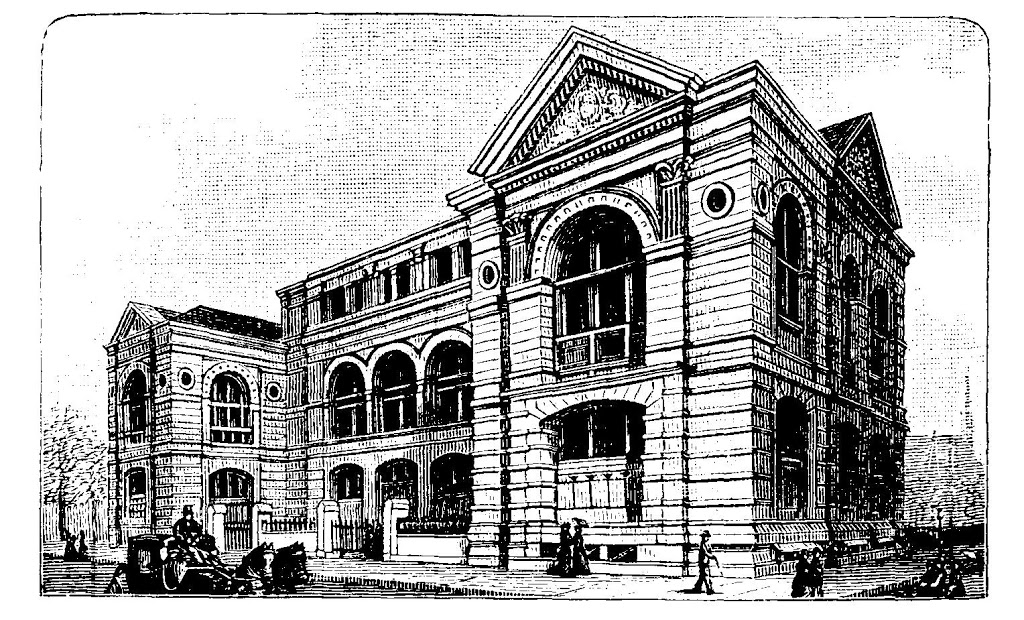
James Lenox has originally kept his collection in his own library on 5th and 70th street. This scratch illustration displays Lenox’s ‘indestructible’ limestone library, which housed most of the items held at the Public Library today, including Lenox’s personal copy of the Gutenberg Bible.

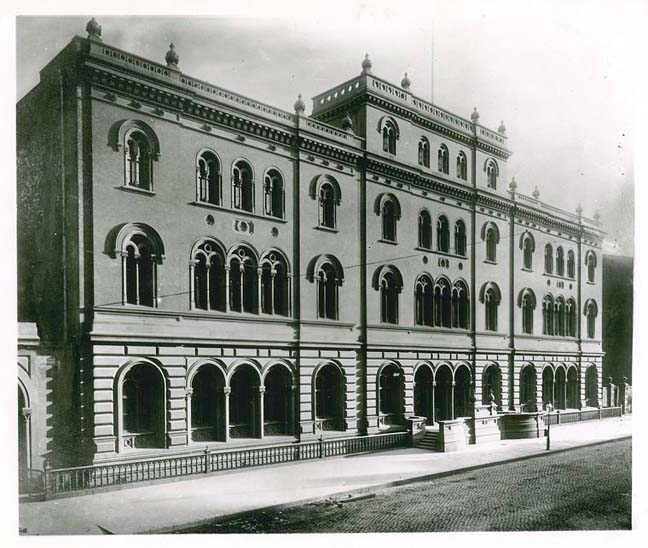
Meanwhile, the rest of the collection came from the Astor Library, constructed with money bequeathed by the millionaire. Thankfully the building remains pretty much intact, thanks to its present occupants, the Public Theatre, whose decades of success on Broadway, off-Broadway, dance, performance art and especially Shakespeare in the Park would have confused but satisfied the building’s original benefactor.

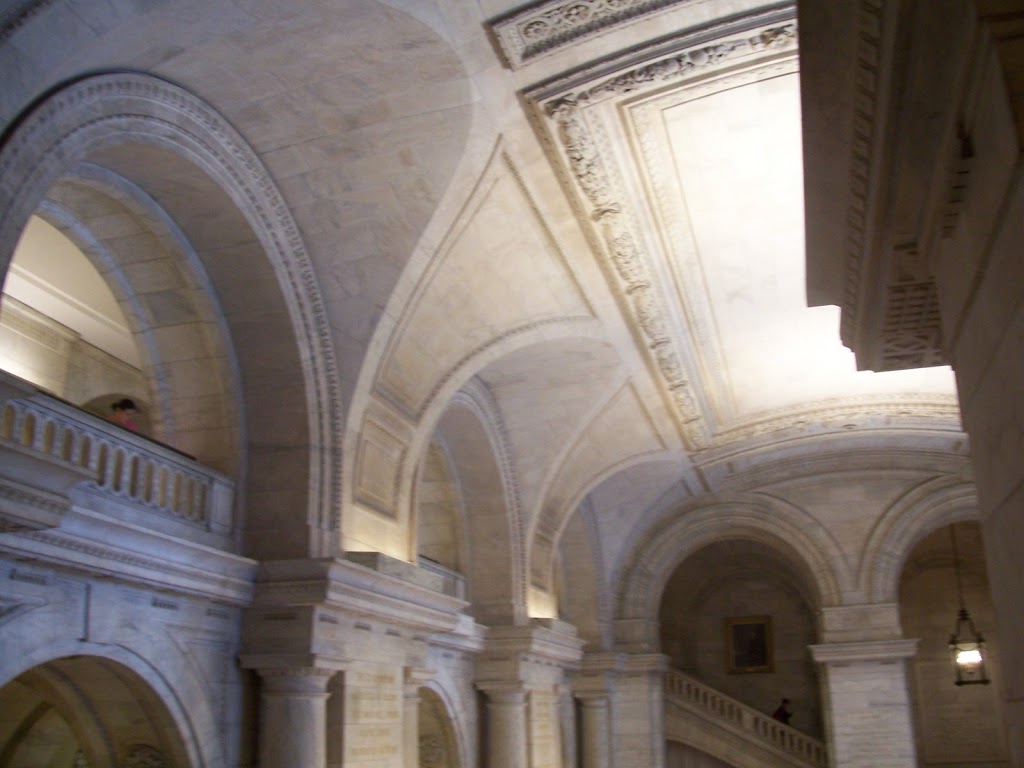
Some pictures from inside the New York Public Library building illustrate some of its more Beaux-Art-ish features. The broad vaulted arches:

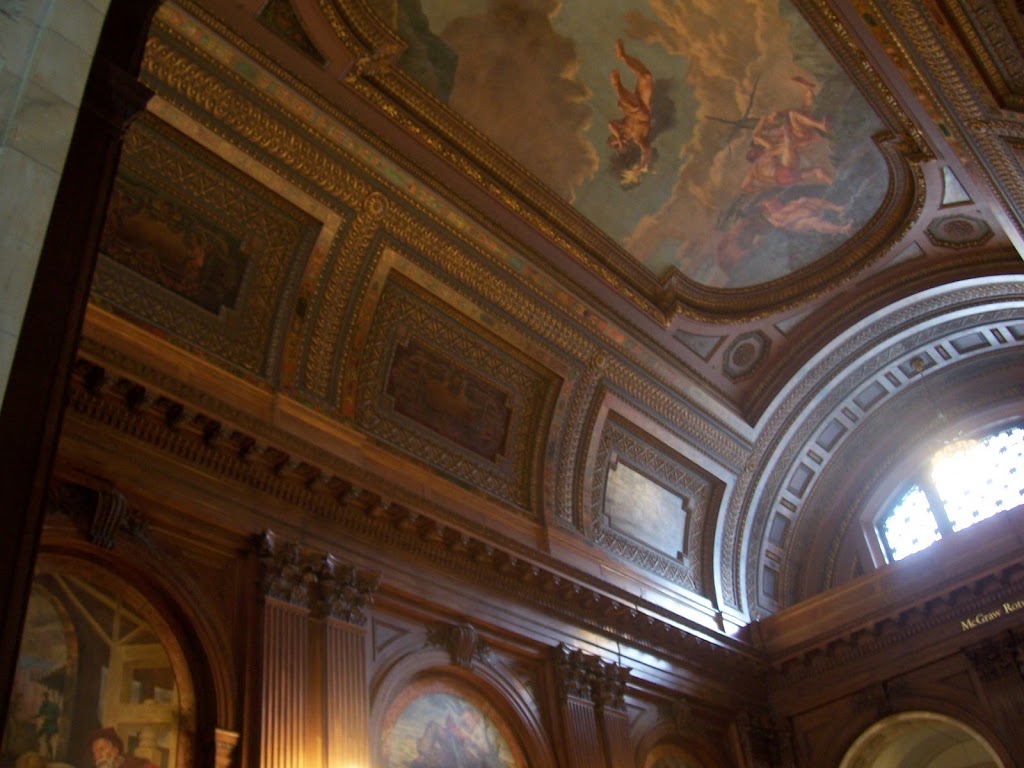
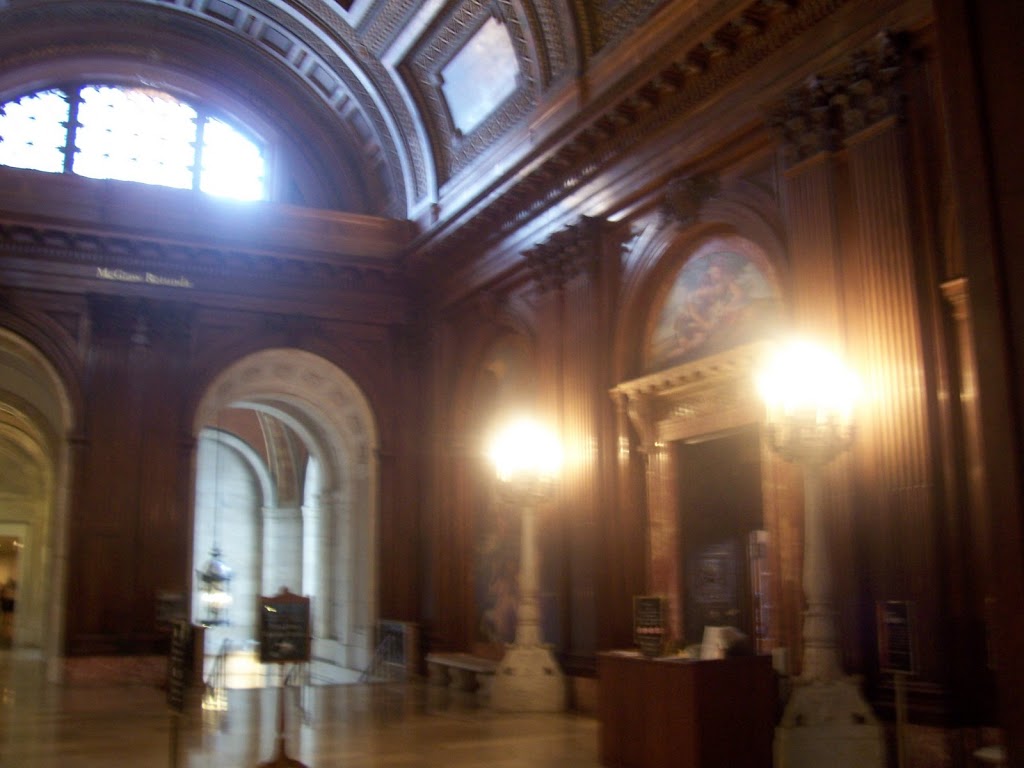
And ornate muralled ceilings in the McGraw Rotunda. The effect is a bit like the Vatican apartments mixed with an old bank:

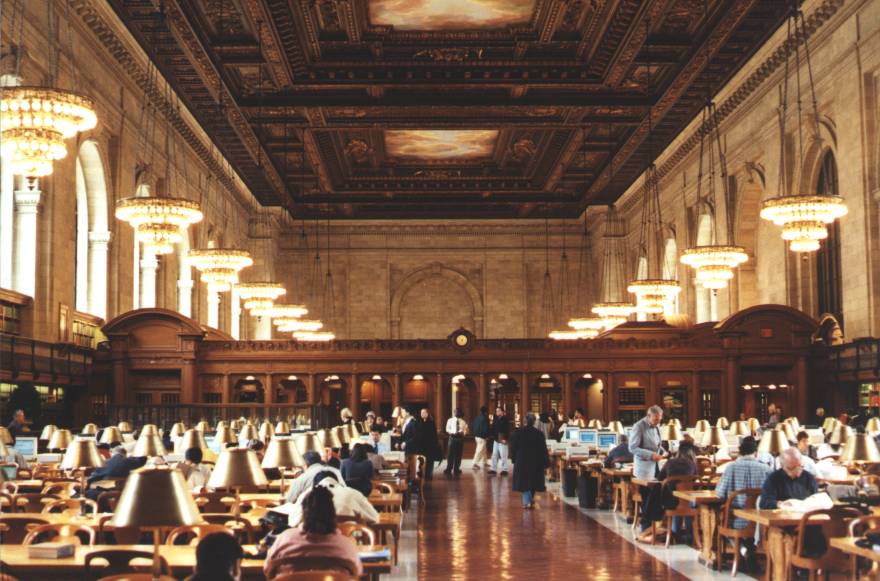
Its all dwarfed, however by the massive Rose Reading Room, whose basic organization came not from the architects but from the library’s first director, Dr. John Shaw Billings, from a sketch he made on a postcard!

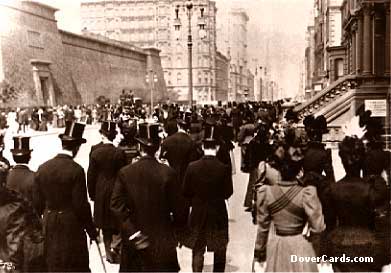
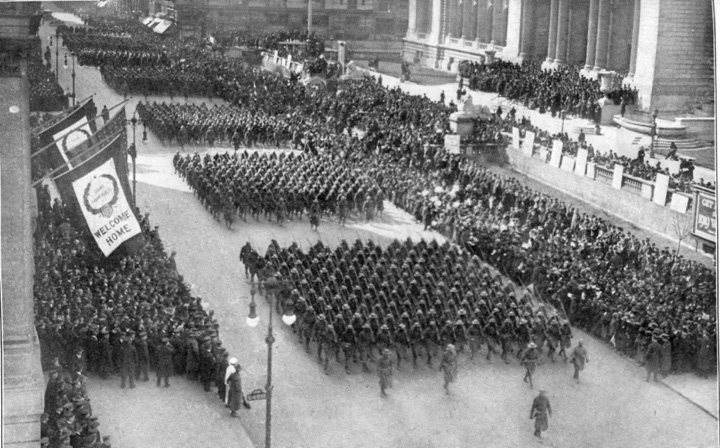
And finally, a beautiful picture I found on a World War I website, showing the fairly new library in all its glory, as New York’s 369th Regiment passes by.

Thanks to the New York Public Library official website for providing us with some of our trivia. And there’s lots more there to intrugue you. Click here for visiting hours and facts about some of the branch libraries.

Categories
Uncategorized

Young Griffo: New York’s first film, location shoot


The streets are getting particularly clogged these days with film crews in New York. According to the Mayor’s office, expect to see the following on your block: Gossip Girl, 30 Rock, What Happened In Vegas (Cameron Diaz and Ashton Kutcher), Death In Love (Adam Brody and Josh Lucas), Burn After Reading (Brad Pitt and George Clooney, as directed by the Coen Brothers), the Incredible Hulk (Edward Norton and Liv Tyler) and of course, Sex and the City: The Movie. And that’s just a sampling of the better known films and TV shows. The list of lesser knowns is three times as long!

But ever wonder what the very first movie ever shot in New York City was? It also happens to be the first film ever shown to a paying movie audience at all.

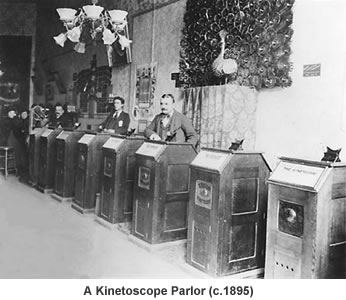
A newfangled invention by Thomas Edison, the Kinetoscope, had been tested in New York, a result of Edison’s studios being in West Orange, New Jersey. In fact, New Jersey very nearly became our modern day Hollywood, as many silent films were being filmed there well into the 20s. But it wasn’t until May that New York saw both its first on-location film shoot AND its first film premiere.

Otway and Gray Latham had invented the Eidoloscope projector (also called the Pantoptikon), running very crudely like a film projector today. However its image size was very small, about the size of a small TV set. The Latham brothers debuts test images to the press. But their real test of this device was to film something live and then display it a short time later.

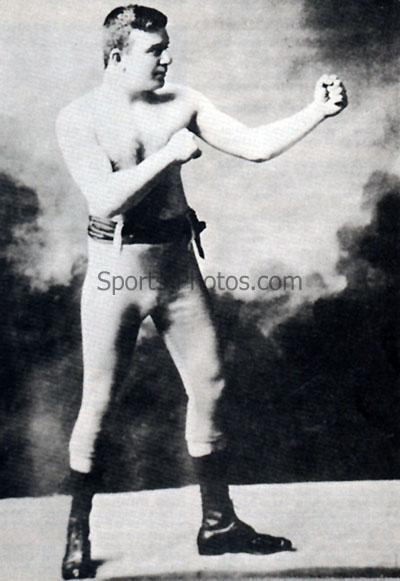
So on May 4, the brothers filmed a boxing match on the rooftop of Madison Square Garden, then on 26rd Street and Madison Ave. The competitors were ‘Battling’ Charles Barnett in the ring with Young Griffo (pictured above), a legendary Australian boxer who was also a raging alcoholic and later ended up in an insane asylum. Boxing was actually a popular topic of Edison’s Kinetoscope machines and was a natural choice for the Lathams.

Sixteen days later, that four-minute film, Young Griffo versus Battling Charles Barnett, was displayed to a paying audience, at a makeshift theater in a storefront at 153 Broadway (a couple blocks up from Wall Street). By doing so, Young Griffo christened New York as a film capital, paving the way for the Scorseses and Woody Allens of the world.

Of course, even then, the critics were torn. “There is considerable room for improvement and many drawbacks have yet to be overcome,” said the Photographic Times. “Even in the present state the results obtained are most interesting and even startling. Quite a crowd of people visit the store … making their exit wondering “How it’s done”

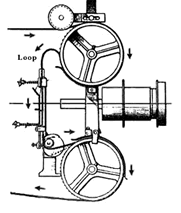
Sadly, the Lathams’ achievement was quickly overshadowed. As some of you cinephiles may know from film class, the Lumiere Brothers delivered the birth of film in Paris later that year with a series of short films projected by Cinématographe . And sadly, no extant copy of Young Griffo has been found. However Latham’s design did influence the design of later projectors, namely in the ‘Latham loop’ (pictured at right), a method of allowing the film that fed into a projector to slacken on either side, lessening the stress to the celluloid.

Categories
Uncategorized

FRIDAY NIGHT FEVER: Bond International Casino


To get you in the mood for the weekend, every Friday we’ll be celebrating ‘FRIDAY NIGHT FEVER’, featuring an old New York nightlife haunt, from the dance halls of 19th Century Bowery, to the massive warehouse spaces of the mid-90s. Past entries can be found here .

Bond International Casino — save for fifteen days back in 1981 — should not really be considered a “legendary” New York nightclub, by any means. But the space it occupies has a fascinating lineage, and as for those fifteen days, well…can any other nightclub in New York claim to have started what is called the ‘Times Square Riot of 1981‘?

The room was christened in the 1930s as the International Casino (the Bond would come in a bit), not a casino at all, but a swanky dinner club and cabaret that could cater up to 1,500 socialites, sipping on champagne while watching exotic shows featuring “novelties from five continents and the beauties of ten countries” on a motorized stage. Ads in 1936 proclaimed: `a Hollywood dream in theatre restaurants.’ Elaborate musical revue at 7.30 and 11.30 P.M. Minimum charge $2.50 — Saturdays $3.50.”

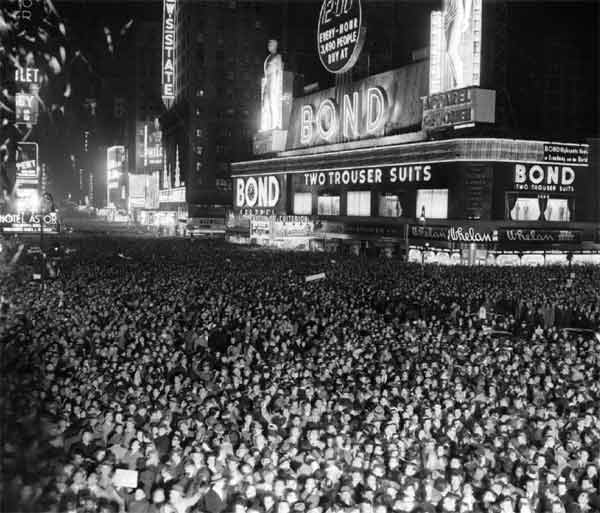
Such luxuriance was not to last, but the dazzle remained, from a most unlikely vector — men’s clothing. Bond Clothes took over the location as a men’s clothing emporium, and chose a flashy facade to match the rooms of garments inside. A huge neon sign held a clock in the O of BOND, alongside a 50-foot man and woman, an electronic waterfall and a news roll zipped along the front — all drenched in electric lights! It all looked especially dazzling at night, as the New York’s Eve ball drop pictures proves below:

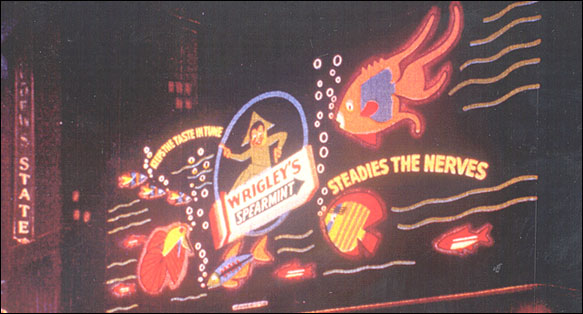
The elaborate sign gave way to a sponsor with bigger trouser pockets — Pepsi — placing gigantic soda bottles where the people once stood. Later the space was given over to a garish yet strangely hypnotic advertisement by Wrigley’s Gum:

The clothing store itself lasted until 1977. Sitting vacant for a couple years — at the true nadir of Times Square, the grit and garishness of 42nd street spilling over — it was finally reopened under a new name, incorporating both its prior incarnations. The ‘International Casino’ returned, the ‘Bond’ sign stayed, and Times Square had its own rock club.

This new incarnation Bond International Casino had interiors, at 9,000 square feet, as theatrical as those in the past. The staircase from the entry level to the dance floor glowed as you stepped on them and played musical notes, not unlike, I suppose, the gigantic piano in the movie Big. The dancefloor, one of the city’s biggest (much bigger than even Studio 54), was overseen by sumptuous on-stage water fountains and inflatable people who hovered above and would fill and deflate to the music.

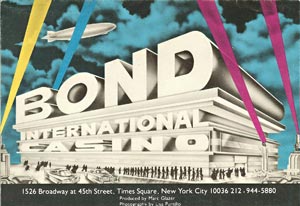
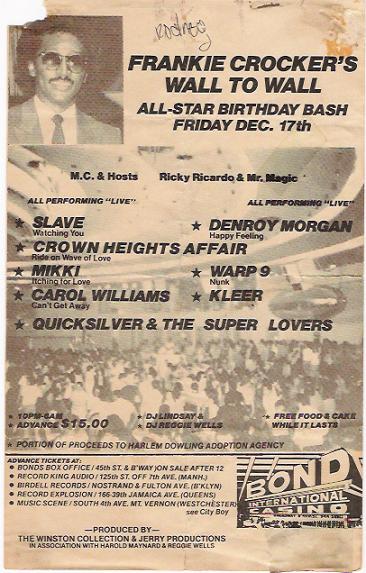
Cream Magazine called it “a shopping mall with bars and a dance floor… and telephone in the men’s room.” Here’s one of their flyers:


In this ad, you can get a sense of what the dance floor must have been like inside:

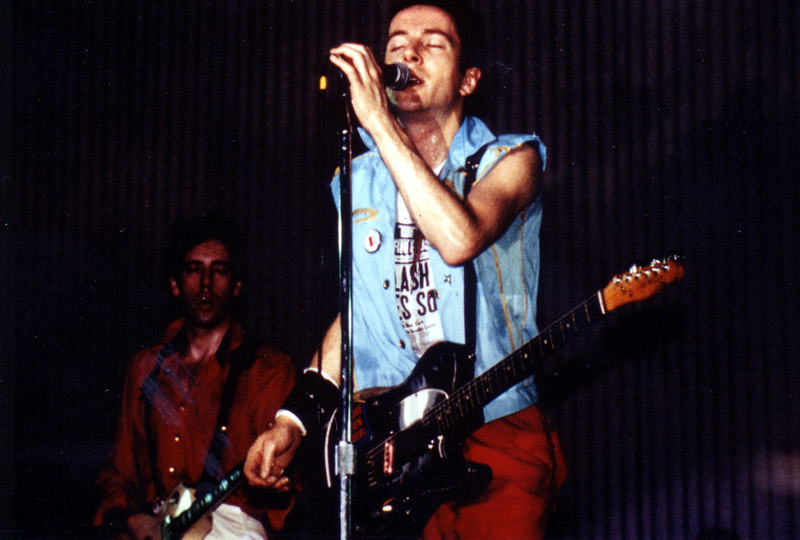
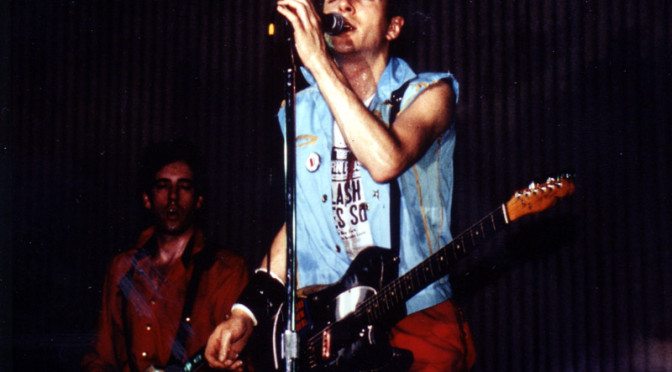
Over the course of its brief foray as a rock venue, Bond would see the likes of Blue Oyster Cult, the Plasmatics, the Dead Kennedys and Blondie. Always a slave to disco on regular nights, however, it would eventually give way to full-time usage as an early ’80s dance floor. But not before it saw The Clash.

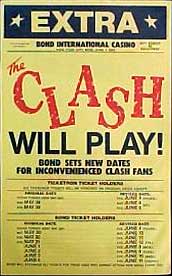
The hot punk group, who had just released one of rock music’s most important records (London Calling) in January 1980, were back in New York to do a series of shows at Bond in May of 1981. Originally they were supposed to play eight nights. The promoters however dangerously oversold the show — 3,500 tickets each night for a venue that could only hold about half that! 


Angry ticket holders rioted outside, filling the streets of Times Square, stopping traffic and drawing dozens of police officers to quell the rage. One website (with lots more information and more history on Bond and ‘the Clash riot’) claims Times Square “hadn’t seen that much commotion since … V-J Day.” The story made international news the next day.

Cream says, “There’s confusion over the numbers game, and inside it’s a sardine sauna. Fire marshalls count 3600 heads leaving the club in what has been a testy evening. Support acts suffered, being booed and hissed by the diehard fans impatient for the arrival of their heroes.”

To assuage the angry ticket holders, The Clash took the unprecedented step of extending their stay at Bond to seventeen shows over fifteen days, to cater to all those ticket holders who were not able to get in. Perhaps stress and the threat of violence and fire brought out the best in the group; the performances are supposedly their best ever, and a bootleg of one of the shows “Live at Bond’s Casino” is considered the finest ‘unofficial’ release in the band’s history. (All seventeen performances are available as bootlegs.)

For those polite enough and lucky (or unlucky? I can’t imagine how unpleasant and scary that club must have been) to have paid attention to the first show, they would have also caught opening act Grandmaster Flash and the Furious Five, the godfathers of rap music. Somebody actually booed them?

Ironically, Bond couldn’t fill the club on any of their other nights, being a discotheque trying to survive in the Reagan ‘disco is dead’ era. In the ’90s, the space was taken over by the Roundabout Theatre Company, who for several years brought some excellent shows into the space. 

It had two stages of different sizes, one classified a Broadway stage, the other off-Broadway. I saw a lot of great shows here back in the day, including Martin Short in ‘Little Me’ and an excellent revival of ‘1776’, starring Star Trek: Next Generation star Brent Spiner as John Adams. After several years, the Roundabout moved their stages to another former disco — Studio 54 — and another location on 42nd Street, the American Airlines Theatre.

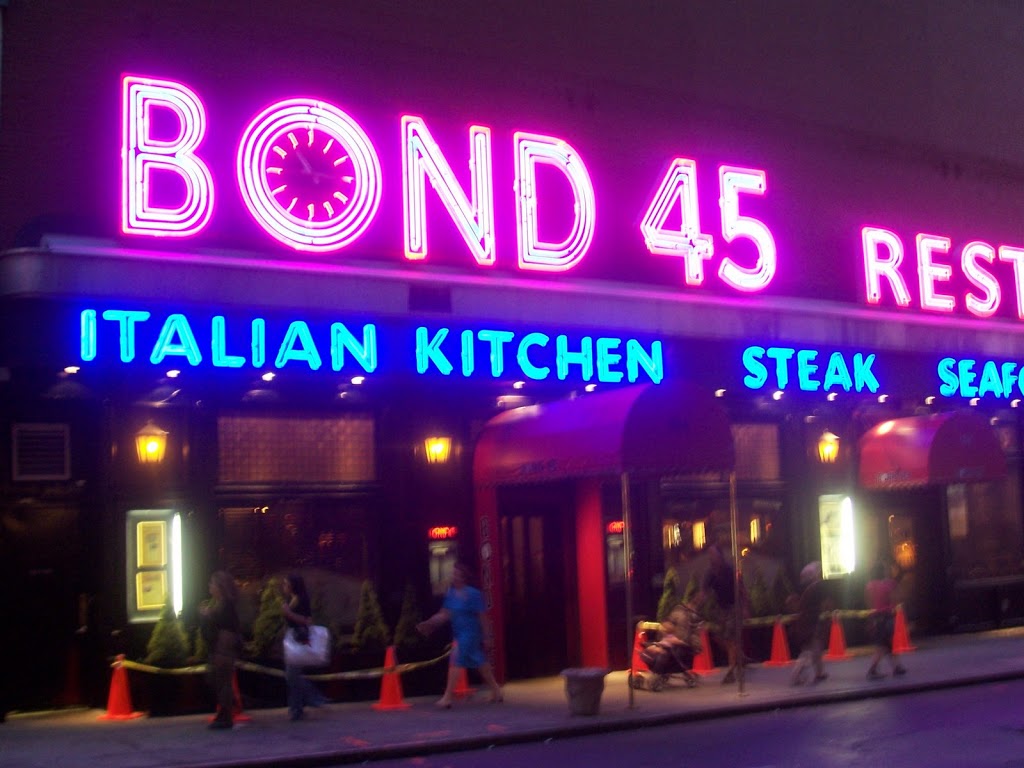
Bond has a happy ending however. The space has reopened as Bond 45 restaurant and lounge, recreating the classic sign with some adjustments, and pomping up the front to resemble its ’30s glamour days. Of course, it sits between a Starbucks and a Swatch store, but you can run to the Virgin Megastore literally across the street and pick up some Clash CDs and memorabilia and start your own riot today. (45th Street, between 6th and 7th avenues)

 
Categories
Uncategorized

Big, big buildings and little, little kids


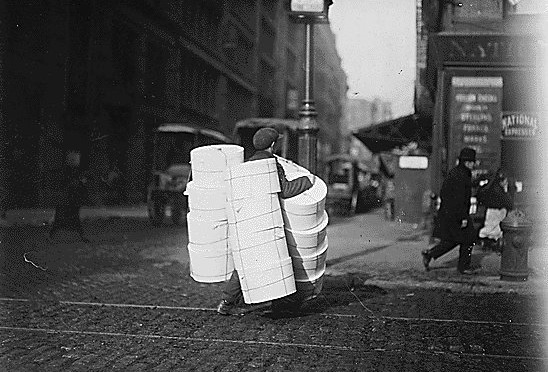
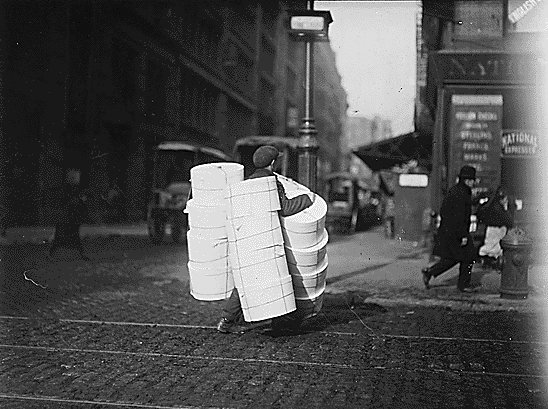
(Above: a boy delivers some very heavy looking hats through the city, circa 1910)

Most photographers document history, but few actually change it. Lewis W. Hine entered the brand new field of photojournalism during the first decade of the new century but quickly found a use for it in social reform, particularly in documenting (and cracking down) the practice of child labor.

Originally from Wisconsin, Hine went to New York University and later got a teaching post here in the city. He took photos with his class on field trips to places such as Ellis Island and soon realized it was his calling.

It was a wide-open field to enter in 1906. George Eastman had literally just invented film in the 1880s. You cant underestimate the impact that photography by and of the masses had on its perceptions; suddenly, imperfections and injustices could be seen, not just read about. And you know what they say about a picture being worth a thousand words.

Hines would become known as a photographer of the working man, setting up complicated and often dangerous shots of workers at Pittsburgh steel mills to illustrate their plight. His photographs for the Red Cross and of the Great Depression in the South are well known.

But he started his career working with the newly formed National Child Labor Committee, which today still works to represent the underage in work abuse situations. The NCLC each year grants the Lewis Hine Award to individuals who work to improve the lives of children in America.

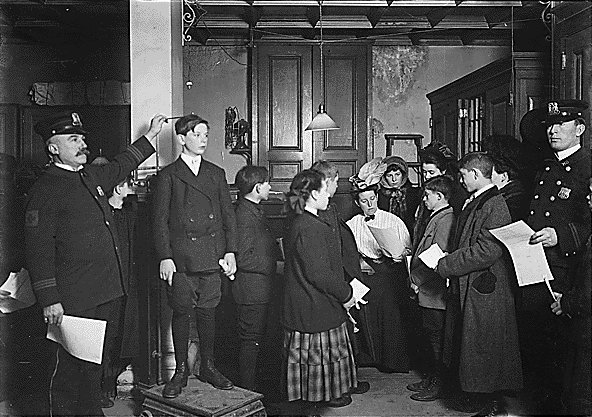
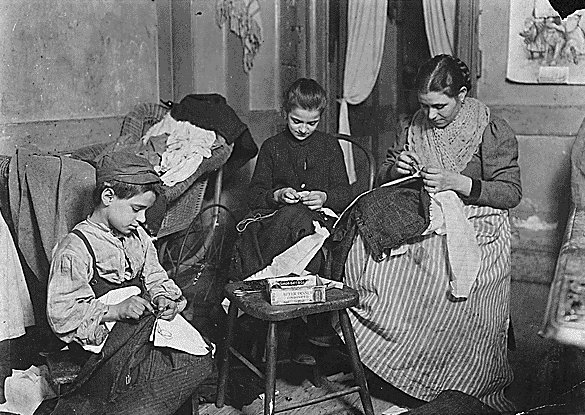
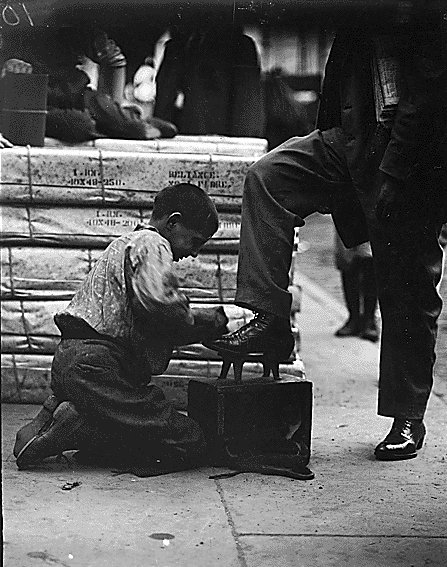
Hines took these pictures of young children laborers in New York City, taken from between 1908 and 1912. The History Place has an extraordinary trove of Hine photographs of children labor abuses from around the country. You’ll be able to quickly tell why his work made such an immediate impact:

Getting sized up for working papers:

Mom and kids at a Lower East Side garment shop:

A young bootblack, making his living on the Bowery:

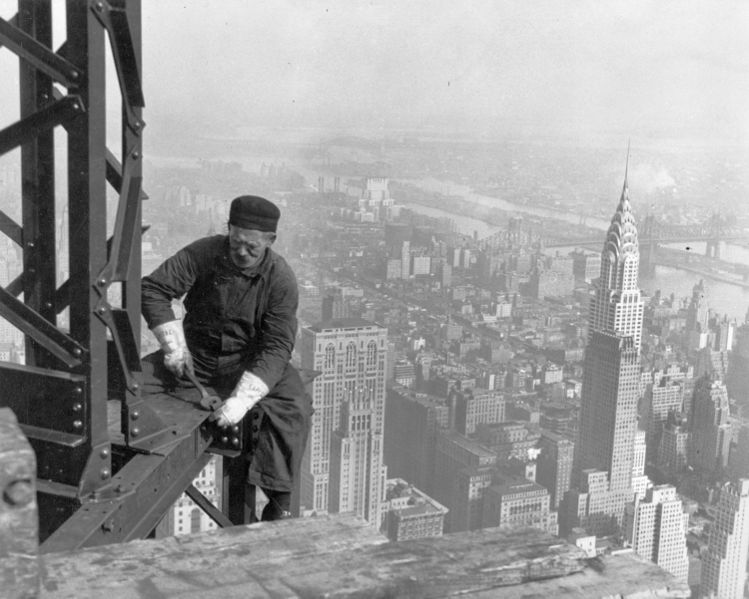
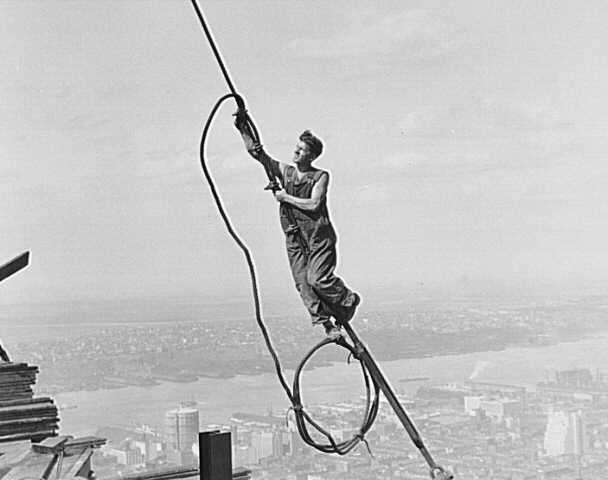
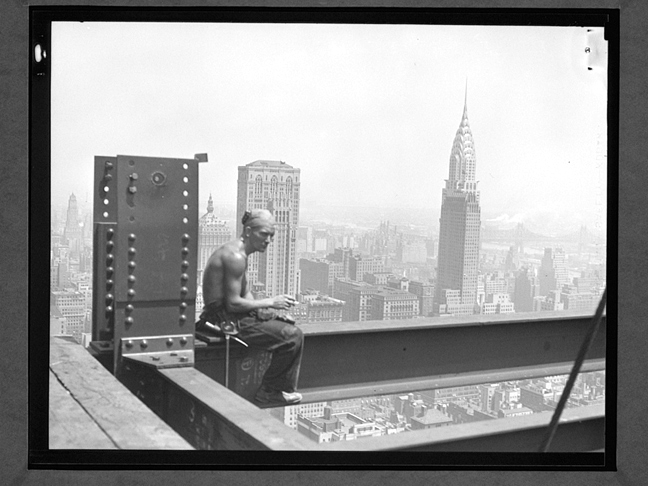
Incidentally, Hine’s most famous photographs weren’t of children but of something far, far loftier — the construction of the Empire State Building. How he actually got some of these photographs is beyond me. Keep in mind, he wasn’t exactly working with a point-and-shoot here….

Categories
Podcasts

PODCAST: The Statue of Liberty

Her torch may shine bright, but what story is she hiding under that copper-toned skin? The Bowery Boys bring you the story of the dinner party that created an American icon.


Her official name is the Statue of Liberty Enlightening The World. You can find a full survey of her measures here. Two facts of interest to me: her copper plating is only the width of a couple pennies. Incredible that something so relatively thin has been able to weather 121 years.
Especially considering fact no. 2: during 50 mph winds, the Statue of Liberty moves approximately three inches. Bartholdi and Eiffel managed to create a structure that could conform to sea winds and temperature changes without causing serious damage to the overall structure.

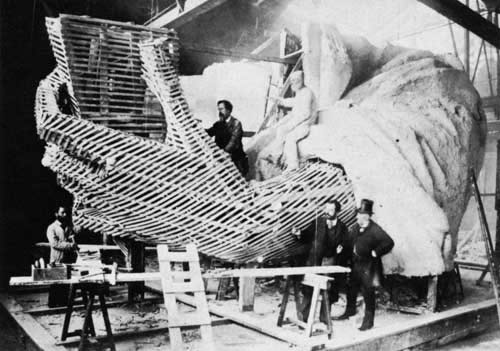
Seen here, one hand, clutching a book with the date July 4, 1776 written upon it, awaits its copper skin at the foundry of Gaget, Gauthier et Companie.

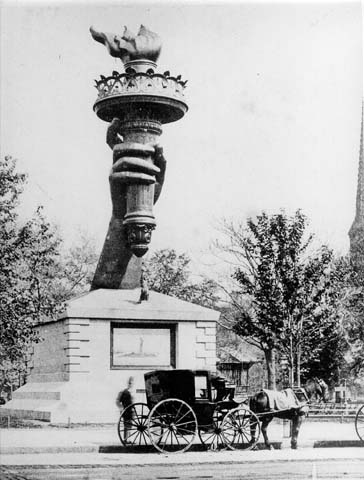
Her other hand meanwhile was busy taking a tour of America. The completed right arm and torch stopped first at the Philadelphia Centennial Exposition in 1876, the 100th year of America’s birth (and technically the date the gift of Liberty was celebrating). It then travelled back to New York, where it became a comfortable fixture of Madison Square Park in 1884.

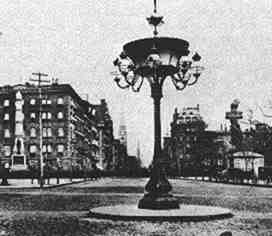
My blog entry from Monday was about the gravesite of Gen. William Worth, which seems peculiarly placed in middle of a traffic island. To get a better sense of how it was situated, here’s a picture (which I got from Forgotten NY) with Worth on the left, Fifth Avenue cutting through, and the arm of Ms. Liberty to the right.

And to think today, just a few feet to the right, out of frame, now stands the Shake Shack.

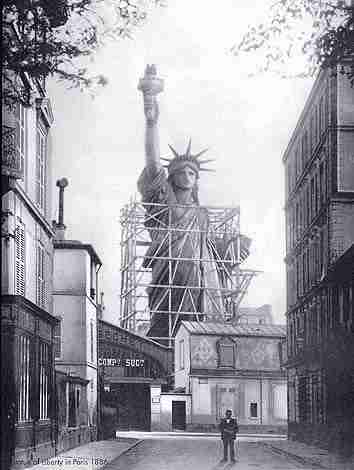
Eventually the arm and torch was returned to France, where the entire structure was put back together in the foundry, to the delight of 300,000 visitors, including one Victor Hugo, who said, “To the sculptor form is everything and is nothing. It is nothing without the spirit – with the idea it is everything.”

The designer of the pedestal was Richard Morris Hunt, best known for designing the Metropolitan Museum of Art as well as the sumptuous mansions for the Vanderbilt family. (CNN’s Anderson Cooper probably ran around in one when he was little.) Hunt trained at the Paris’ École des Beaux-Arts which would later see William Van Alen, the architect of the Chrysler Building.

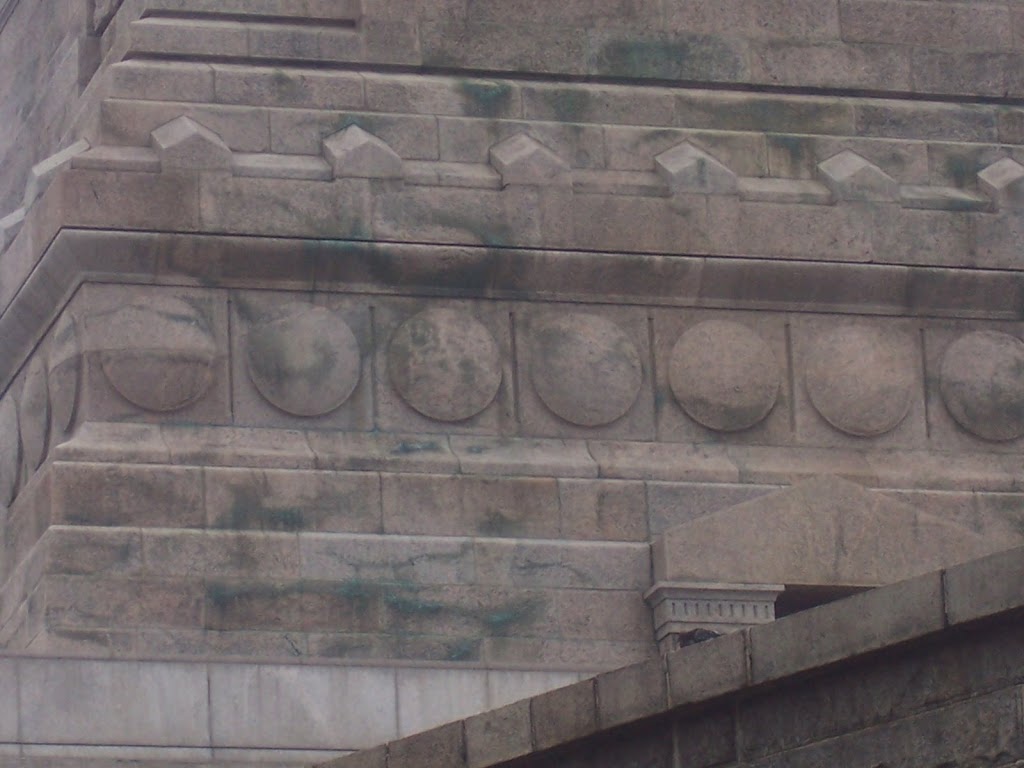
My harangue against my fellow Americans in their rather feeble attempts at fund-raising to build the pedestal obscured my general admiration for the design of the pedestal itself, which had to be understated but reflect some of the statues general themes. For instance, the shield pattern that runs along the side — click to see the detailing more closely — creates a dialogue with Liberty’s classical features and underscoring of strength and protection.

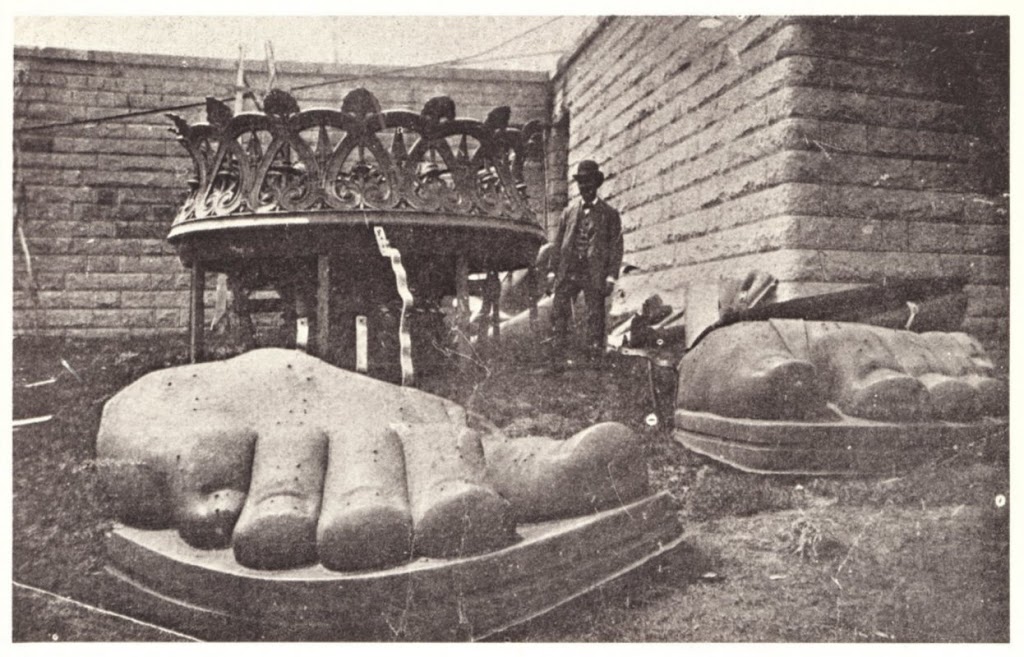
Even as the pedestal was still being constructed, the Statue arrived in New York harbor. Here, some workers unpack her feet at the base of the foundation, what was once a star-like fort:

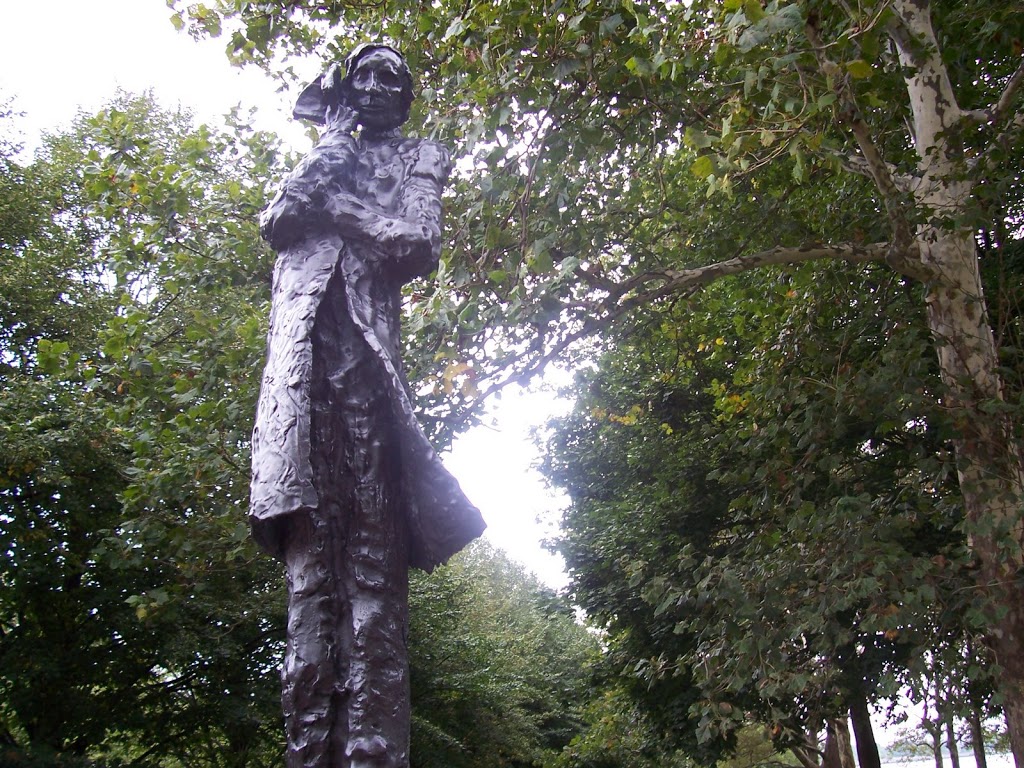
A stroll around the base of Lady Liberty grants you a terrific view of Manhattan, Brooklyn and parts of New Jersey. Along the path are some contemporary sculptures of five pivotal figures of Liberty’s legacy (all detailed in our podcast) — Bartholdi, Gustave Eiffel, Édouard René Lefèvre de Laboulaye (pictured below), Joseph Pulitzer and Emma Lazarus.

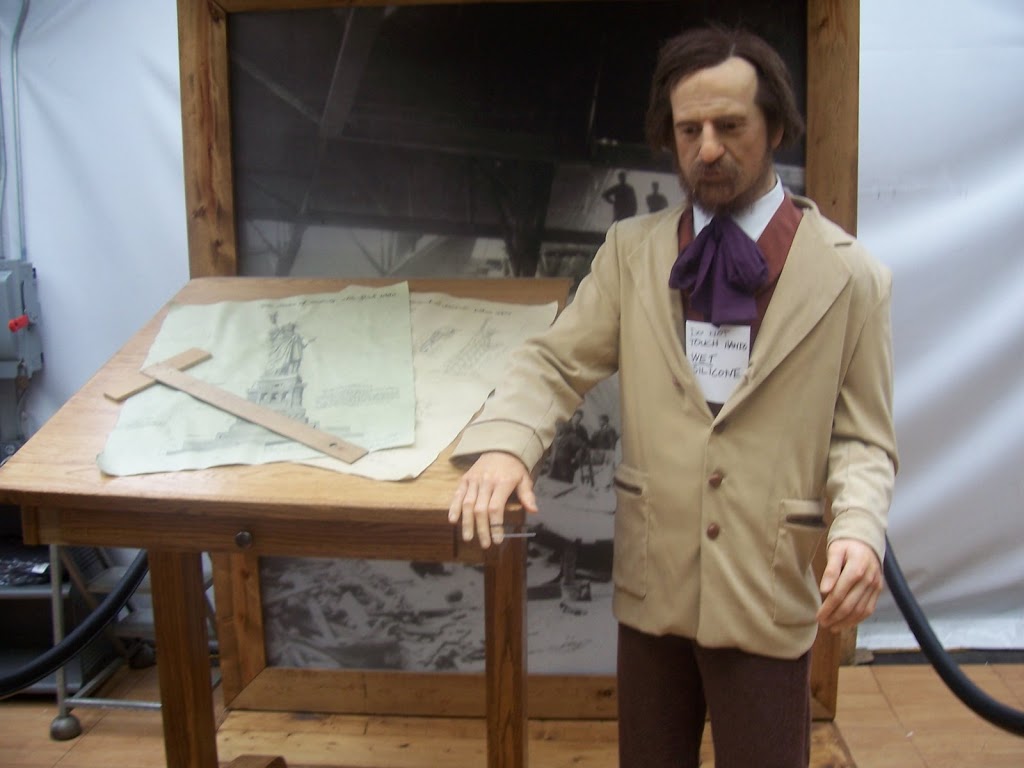
This strangely creepy depiction of Bertholdi also greets visitors. (Click the pic to see what the curious sign says tucked in his jacket.)

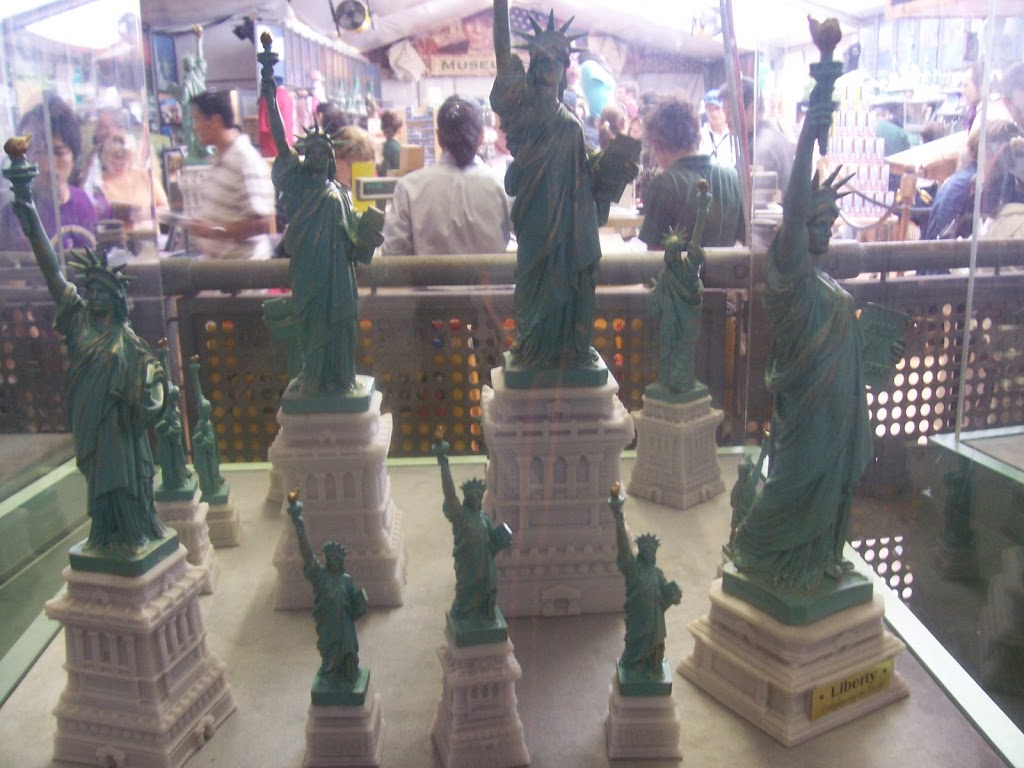
In a prescient bit of fund-raising, Bartholdi sold miniature versions of Lady Liberty before it was even constructed. That honored tradition of capitalism still holds strong throughout every tourist zone in New York City, Liberty Island itself certainly no exception.

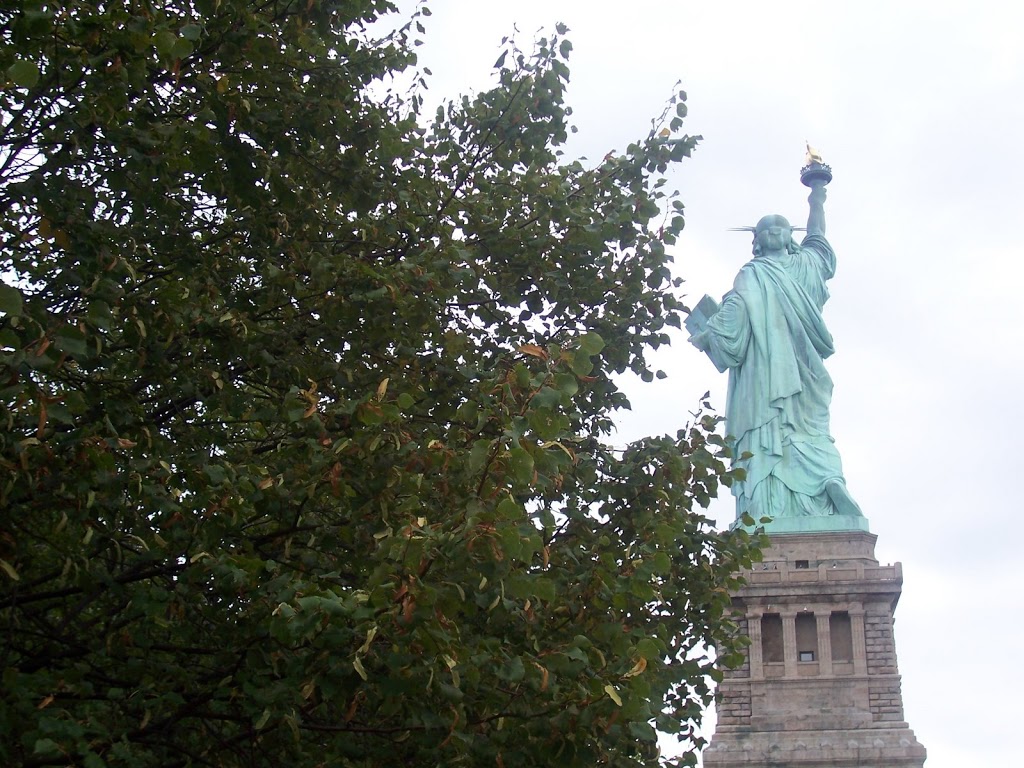
By the way, the Statue of Liberty, for many years was actually a deep brown color. When copper oxidizes, however, it turns that rich green color, which prevents it from eroding through rust. The copper used in the construction was so durable that during the extensive 1986 renovation and clean-up of the statue, none of it needed to be replaced. Although Eiffel’s contributions overshadowed those of the original architect Eugène Viollet-le-Duc (who died before the statue was completed), Eugene chose the copper, mined from copper ore obtained in Karmøy, Norway.

Click here to see our history of the Statue of Liberty … as she appears on album covers.

Worth Square: Madison Square’s cemetery for one

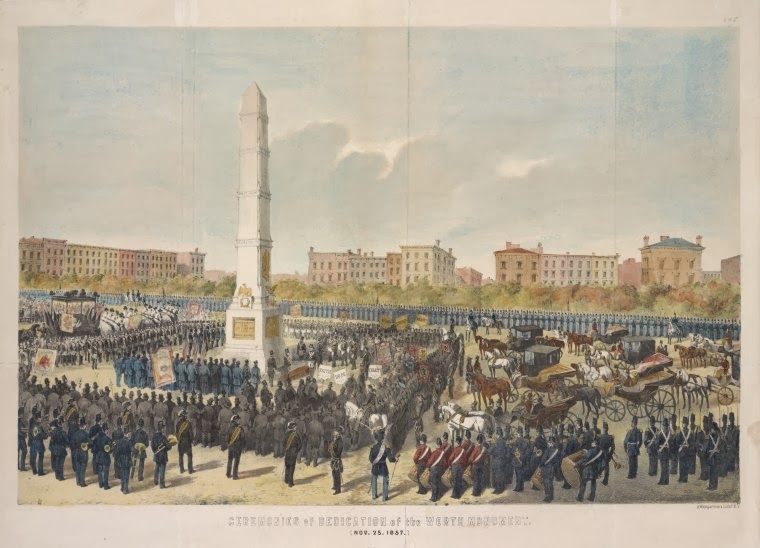
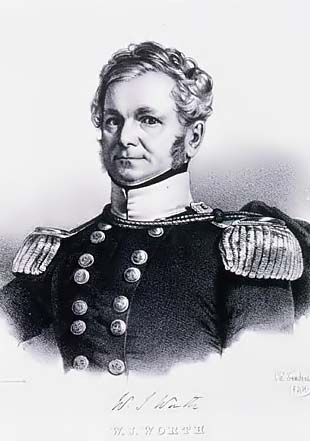
As you can tell from this lithograph of the Worth Monument dedication in 1857, it predates most of the development that surrounds it today. (NYPL)

 Few Americans have been so honored by their country that their remains have been buried in the middle of the most famous street in America in their own personal cemetery.

William Jenkins Worth can say that. According to Roadside America, Worth’s is one of only three private graves in all of New York City.  Although exactly why he’s been singled out with this particular honor is a bit obscure.

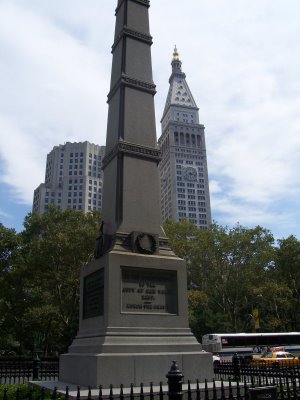
Worth Square, next to Madison Square and just feet from the Flatiron Building, is one of those odd traffic islands that’s hardly a place of peace and repose.  Broadway and Fifth Avenue rush by on either side and the traffic of 23rd street hurls by on its south side.  But it’s here that a monument stands in honor of Worth, a general in the oft-forgotten Mexican-American War, which won for the United States the state of Texas and, eventually, President George W. Bush.

Worth served admirably in many battles of the conflict, becoming the first general in American military history to engage off the shores of Veracruz in ‘amphibious warfare’ — namely, the strategic usage of approaches from the water to engage in combat on land.  In 1847 he also personally hoisted the American flag above the palace in Mexico City after the US’s victorious conquest there.

Within two years he would be dead of cholera, transported to Brooklyn and buried in Greenwood Cemetery, the hotspot for dead celebrities in the 19th century.  A few years later, he was dug up, brought to Manhattan, and buried at this unusual spot underneath an impressive obelisk designed by James Batterson (later to be the go-to guy for Civil War monuments).  Forgotten NY says that the iron rod gate surrounding this solemn monument is a revered example of iron craftsmanship.

Worth’s remains were placed here in a solemn ceremony on November 25, 1857, involving almost 6,500 soldiers in march. Etched upon the monument is a listing of all the many battle Worth fought in.
Worth was born in Hudson, NY, and briefly moved to Albany, but he has no meaningful connection to New York City.  Although I have found no definite conclusion as to why he’s buried here, a couple points to consider don’t make it seem so odd:

— Worth served under then-general Zachary Taylor at the start of the Mexican-American War.  By the time Worth died, Taylor was the President of the United States.  Certainly some political favoritism was at play.

— The monument’s location was considered peaceful at one time. Adjacent Madison Square opened two years prior and the building boom that would give us Flatiron, the Met Life Tower and the other beautiful buildings surrounding the park wouldn’t occur for decades.  The obelisk would have towered over everything.  It would have truly been a sincere honor to be placed here.

The respect New Yorkers had Worth extended downtown to Worth Street, which was, incidentally, one of the five streets intersecting to create the notorious Five Points district.  Another of the Five Points intersection streets — Baxter Street — is named after Charles Baxter, who died in the Mexican-American War. Another example of a well-meaning gesture of honor distorted by the realities of urban growth.
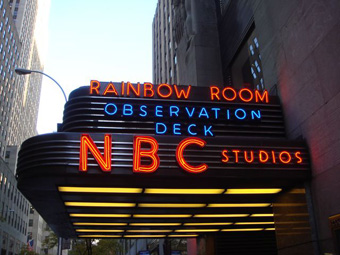
FRIDAY NIGHT FEVER: The Rainbow Room


To get you in the mood for the weekend, every Friday we’ll be celebrating ‘FRIDAY NIGHT FEVER’, featuring an old New York nightlife haunt, from the dance halls of 19th Century Bowery, to the massive warehouse spaces of the mid-90s. Past entries can be found here .
For a change, I thought I’d feature a place that is actually, you know, still open. Although it’s pricey enough that most of us won’t see it much in our lifetimes.

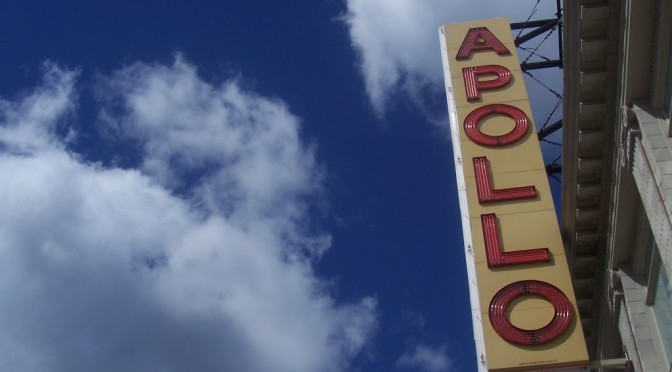
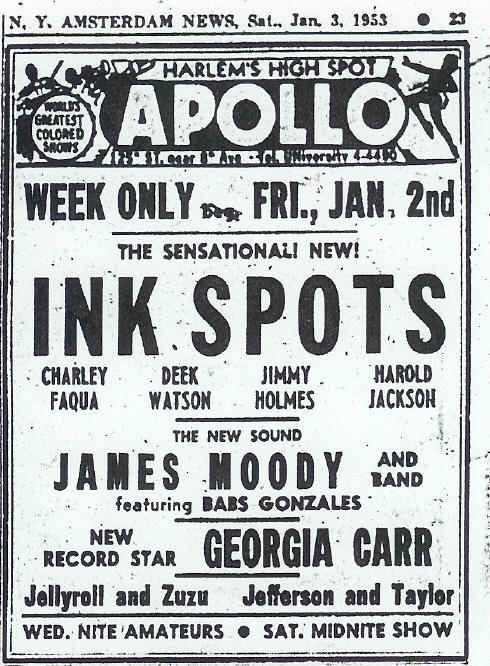
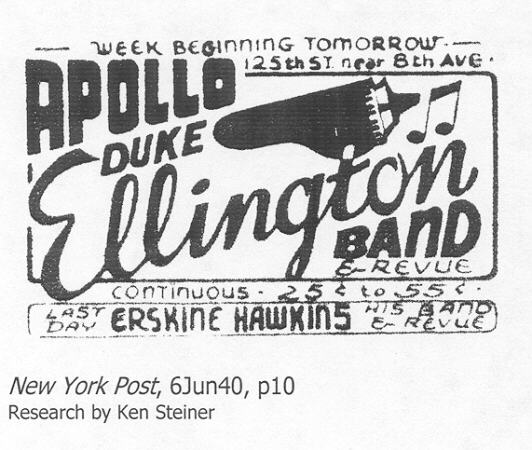
The Rainbow Room offers quite a stark contrast to the Apollo Theater. The Room opened in the same year (1934) as the Apollo opened its doors to black audiences for the first time. Both elicit images of heavenly bodies. Its similarities naturally end there.

Where the Apollo rose from the site of a sleazy burlesque joint, the Rainbow Room was literally the crown on J.D. Rockefeller Jr.’s newly built palace to commercial welfare, Rockefeller Center. Rockefeller, a clean, moral gentleman who preferred warm milk to champagne, was virtually forced to open the place due to social pressures. Rooftop nightclubs were sprouting up all over the city — and in all the society pages — and Rockefeller simply had to have best of everything. 

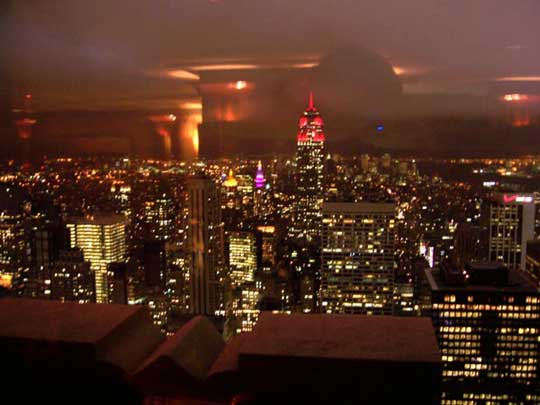
And thus the man who supported Prohibition opened in Oct 3, 1934 what would become the acme of champagne New York life. And all of it, sixty-five floors above the city, atop what was then the RCA Building.

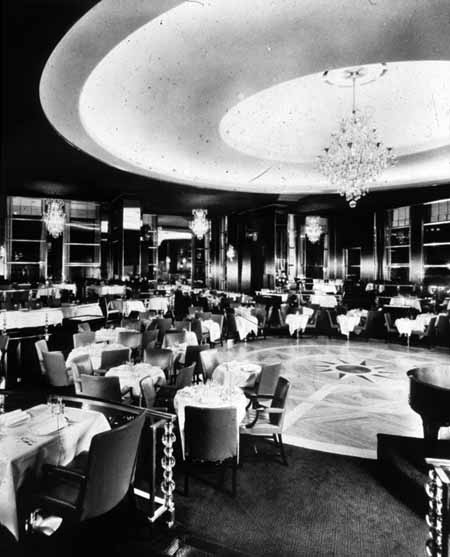
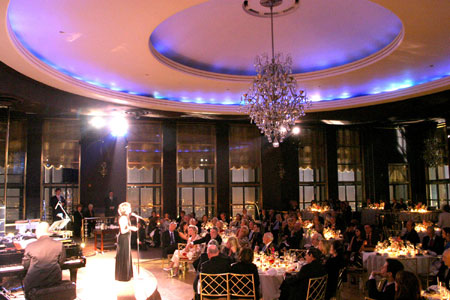
Its design by Elena Bachman Schmidt, with her assistant Vincent Minnelli (yes, Liza’s dad), encapsulated Art Deco luxury while never overshadowing either the clientele or those two-story windows. In fact, faceted mirrors near the bar created an illusion that that gorgeous skyline outside was literally seeping into the room. Perhaps it was, striking a waltz on that impressive dance floor that would have made John Travolta salivate — a slowly rotating plate glowing with dazzling colors that changed moodily to the music.

However it was the well-coiffed and tuxedoed birds atop the floor that gave the Room its polish. The Rainbow Room was strictly high society; for a time, it was ‘white tie’ only, until that was relaxed to ‘merely’ regular tuxedo styles. Its opening night was, as one journalist proclaimed, filled with “five or six hundred of New York’s Four Hundred.” It was considered the ‘upper crust’ of nightclubs, and eventually the well-dressed society families were joined by America’s unofficial royals — Broadway and movie stars. Jean Harlow, Cole Porter, Douglas Fairbanks Jr, Noel Coward, Bette Davis, Laurence Olivier. The hoity-toity club was no match for Marlene Dietrich, who wanted the band to stop playing waltzes and give her a tango. And they obliged.
(It should be noted, just to keep the Apollo in the back of your mind, that at least for a few years, it was not only ‘white tie’, it was strictly, entirely white. Blacks were neither admitted nor even allowed to perform. Contrast this to last week’s Friday Night Fever feature, Cafe Society, which was in a basement, sure, but whose integrated politics ensured truly world class entertainment.)

The Rainbow Grill soon opened down the hall. A more ‘informal’ place — still out of the price range of most New Yorkers — the Grill was considered a junior edition and attracted the college-age trust-funders.

When they weren’t dancing, patrons of the The Rainbow Room dined to the entertainments of a variety of acts, from the hi-lites of the big band era, to a mixture of almost carnival like acts — trained horses, ping pong champions, magicians, palm readers. In fact, Edgar Bergen and his wooden puppet Charlie McCarthy became national celebrities stemming from just a few performances there.

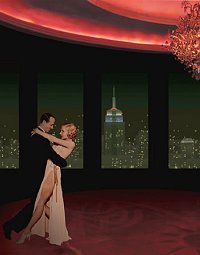
The Room has seen a couple renovations and a downgrade to ‘mere’ suit and tie. And the era of high-society nightclubbing itself has transformed into a more Paris Hilton-like debauchery. But it still holds its charms — as long as you’re dressed correctly — primarily because of that gorgeous view. Have a couple glasses of champagne, gaze out at New York’s perfect skyline, and you can’t help but feel romantic.

I should add here that down the hall there used to be a fantastic cabaret room called ‘Rainbow and Stars’ where out of sheer luck (and a regular columnist position as a theater writer, back when I could only afford mac-and-cheese for dinner) I had the privilege to go to write reviews. Imagine that beautiful New York backdrop, in a more intimate setting, with only the world’s best cabaret performers plopped in front, singing their hearts out.

 I wore the same (the only) suit jacket each time, I had to scrape up coins just to buy a martini or two. But for a couple hours, like the time I got to watch Rosemary Clooney, I could pretend to understand what it was like to be fabulous and Rockerfellian.

(I gleaned a few facts for this article from the excellent, excellent book Great Fortune by Daniel Okrent, about the building of Rockefeller Center. I love this book so much that I’m actually posting its link at Amazon.)

Categories
Podcasts

PODCAST: The Apollo Theater

Harlem’s jewel, the Apollo Theater, has more than lived up to its promise as a place “where stars are born and legends are made.” It’s been the cultural centerpiece of New York for more than seven decades, not bad for a former burlesque theater. And find out which icon made his name — and held his funeral — on the same stage.

Listen to it for free on iTunes or other podcasting services. Or you can download or listen to it HERE

First, a clarification from our podcast: the building of the Lenox Avenue line did greatly increase development in the Harlem area, and a great many of Harlem’s most beautiful blocks were developed at or near this time. But this boom did not benefit the increasing African-American members of the neighborhood. In a twist of absurd racism that just seems not only ridiculous but economically short-sighted, owners would let buildings sit vacant, waiting for white tenants, rather than rent them out to black ones.

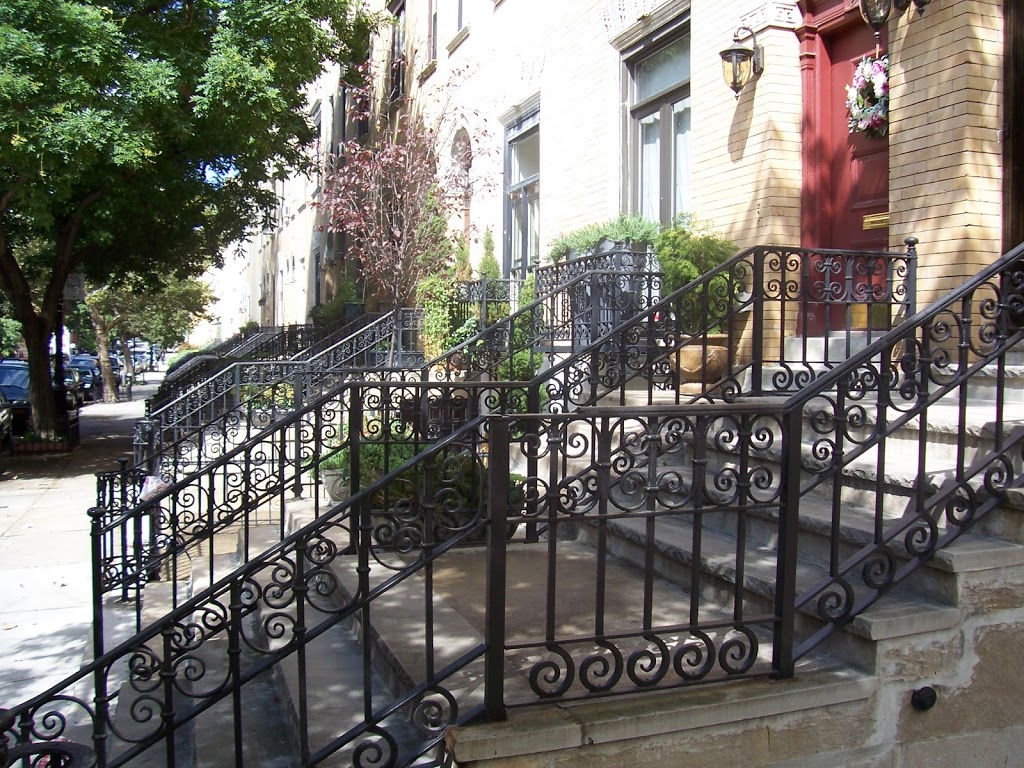
Luckily, areas like Strivers Row (pictured below, located about ten blocks north of the Apollo) soon dissolved that color barrier, and it was in neighborhoods like these that the community flourished.

The Apollo would see dozens of major names in R&B, jazz and pop hit its stage in just a few months, as acts would be stacked on top of each other, giving audiences an opportunity to sample lists of artists topping the charts, all at once.

However, what would often set the Apollo apart from other venues was not its talent, but its audiences. I love this quote from Ozzie Davis, about a play that he and his wife Ruby Dee performed on the stage of the Apollo: “The play lasted 15 to 20 minutes longer at the Apollo because the people laughed at everything and their laughter would stop the show. It was like having a show and a prayer meeting at the same time. It was wonderful.”

Near the height of her fame, Aretha Franklin returned to Apollo, a place that had seen many of her early performances. She performed a string of performances in 1971, all of them sold out, to a marquee outside that pronounced ‘She’s Home’. In the 60s, comedians like Bill Cosby, Redd Foxx and Richard Pryor built their stand-up followings at the Apollo. Before them, however it was Moms Mabley, one of the first female comedians to grace the Apollo stage, taking up a virtual residence there that lasted from the late 30s to the 60s. She would perform at the Apollo more than any other performer in its history, making up to $10,000 a week in her heyday. (That’s an awful lot of dough in 1950s money.)

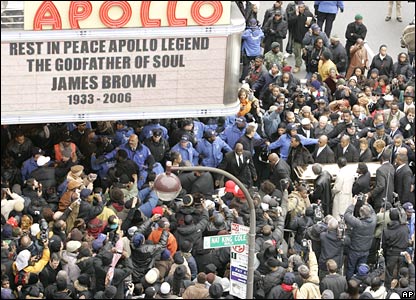
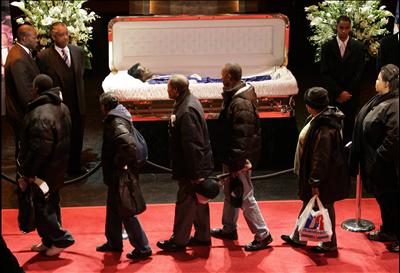
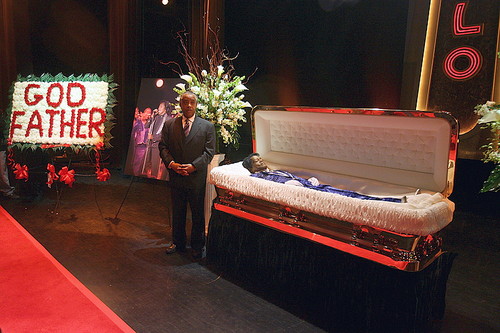
When James Brown died, the Apollo lost its leading light, the man that typified the world-class entertainment it had come to be known for. His funeral was attended by thousands of fans, who traipsed up to the stage to see the King of Soul a final time.


I can’t help but find this picture of Al Sharpton and the body of James Brown on the stage of the Apollo a little strange, however.

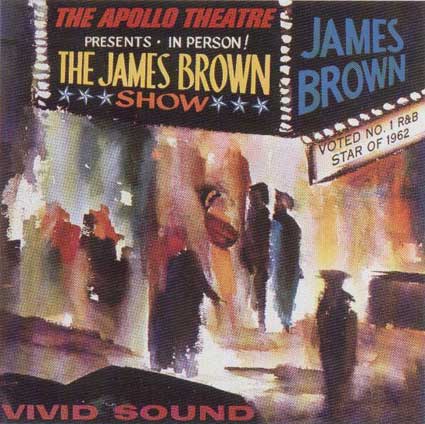
Al Sharpton, a close friend of Brown’s, was quoted as saying, “I don’t think any of us could think James Brown could die. It didn’t seem possible.” James is very much living and breathing on his pivotal recording ‘Live At The Apollo’, which Rolling Stone called the most important live album ever recorded. Listening to this, he does seem to have an air of immortality and boundless talent and energy.

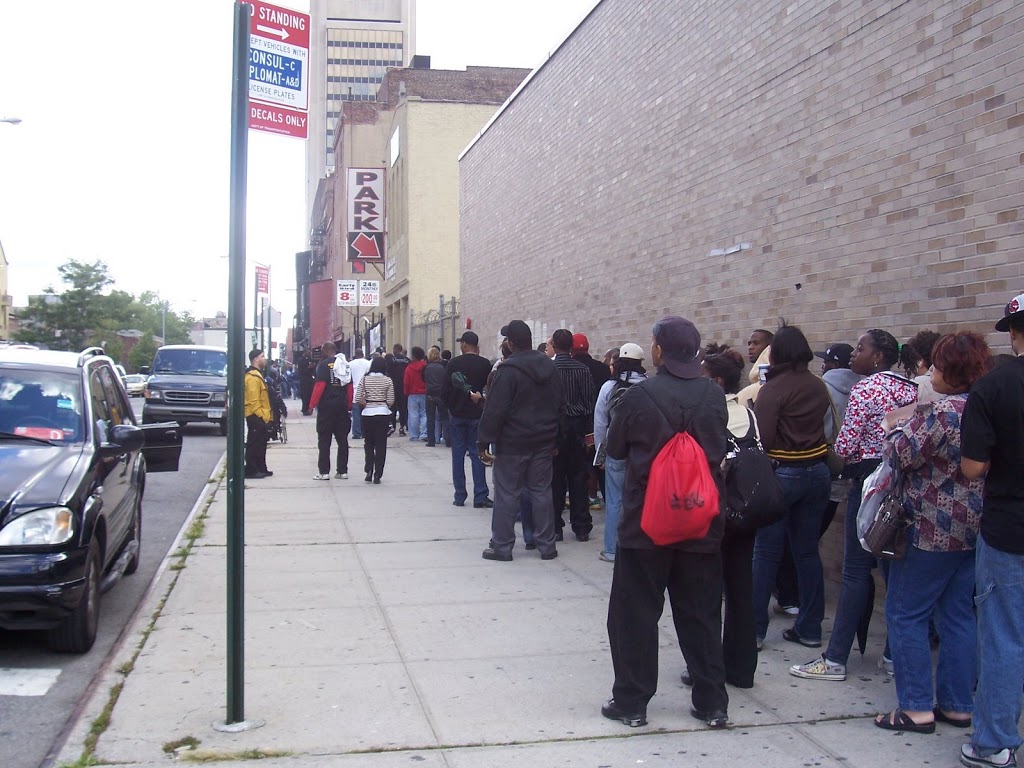
This past Saturday, I happened to be sauntering by the Apollo and caught this line of auditioners for Amateur Night filing into the back of the building to try out. Behold, for the chances are very good that what you are looking at is surely the backside of a major future star!

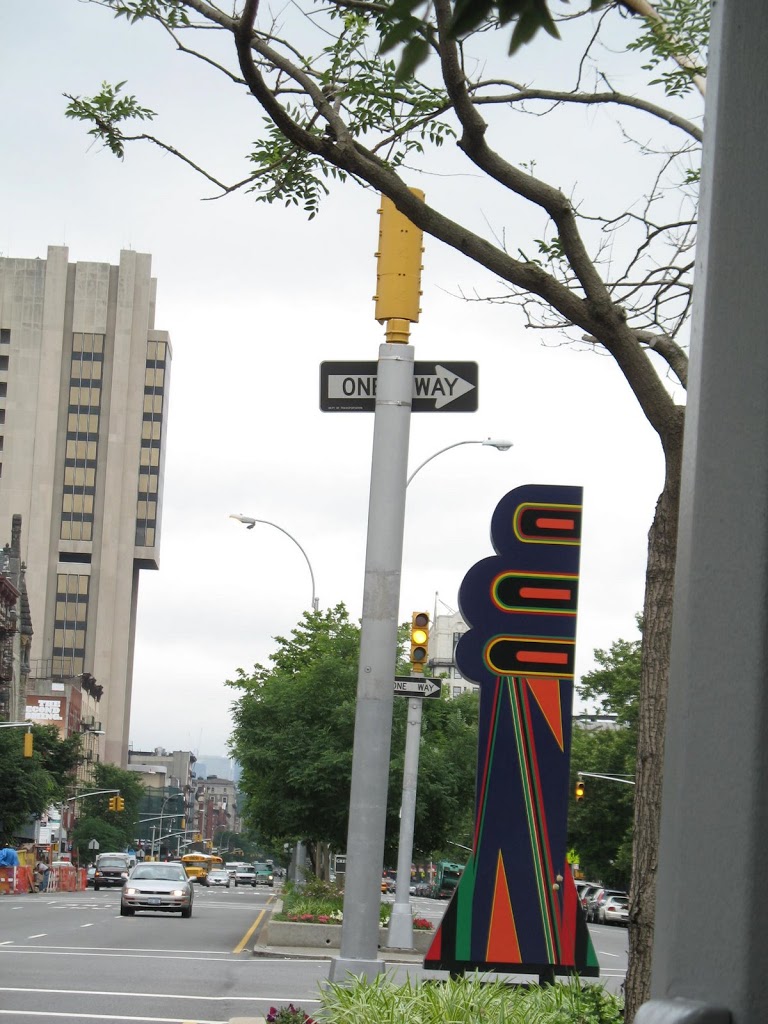
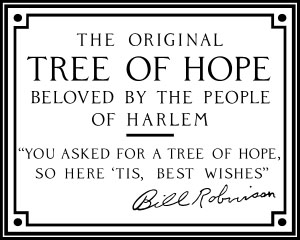
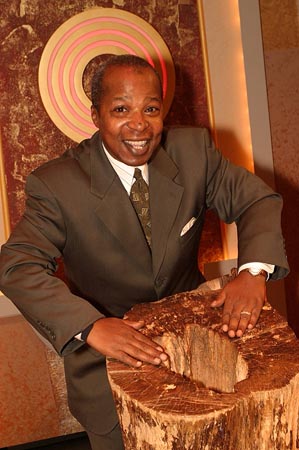
Those who gave a little rub to the sliver of the Tree of Hope have given better performances, at least according to legend. And given the Apollo’s track record, who can balk? Down the street at 131st and Adam Clayton Blvd,, near the original location of the Tree of Hope, you can find a sculpture by Al Miller commemorating the original tree, as well plaque laid in 1941 in a ceremony by mayor Fiorello LaGuardia and entertainer Bill ‘Bojangles’ Robinson. Robinson, naturally, was a frequenter of the stage of the Apollo. Like many performers of his era, he would sometimes perform up to 3 to 5 times a day to soldout shows.

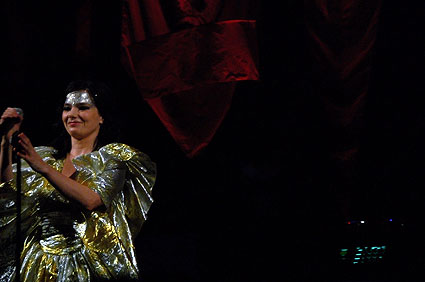
The Apollo is considered one of the most prestigious venues in the city and is host to musicians covering a wide swath of genres — gospel, hip hop, alternative. Below, it’s Bjork that takes the stage:

The Apollo Theater currently has tours for groups, led by longtime Apollo employee and ultimate historian Billy Mitchell. You can go to their official website for information, and you can go here for info on getting tickets to Showtime At The Apollo. (Billy and the Apollo’s slice of the Tree of Hope is at right.)

Please go here for some information on another Harlem music icon The Cotton Club, and here for all entries in our Friday Night Fever series.

Categories
Uncategorized

San Gennaro Festival (Part 2) : Most Precious Blood


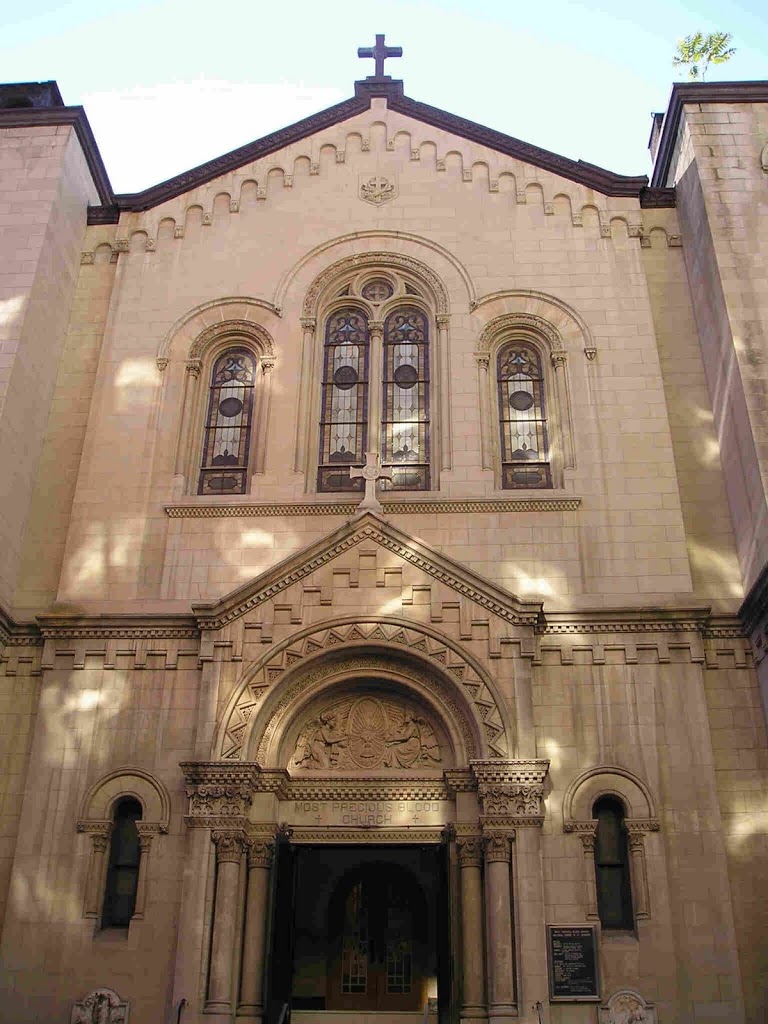
The well from which the San Gennaro Festival draws its zany carnival energy is surprisingly the church which sits its center, the birthplace of the first U.S. San Gennaro feast, at the Church of the Most Precious Blood, between Baxter and Mulberry in Little Italy.

The ‘Most Precious Blood’ in this case refers not only to Christ’s blood, but that of Gennaro, which, as I mentioned yesterday, has the uncanny ability to reliquify itself a couple times every year. This, despite being over 1,700 years old. This actually happens twice a year, like clockwork, on Sept 19, the feast day, as well as on the first Sunday in May, when Gennaro’s relics are formally moved in a procession between sacred locations in Naples, Italy.

The Church of the Most Precious Blood is of far humbler origins, tying its history to the huge influx of Italians immigrating to the United States. Although the peak of the Italian move wouldnt be reached until the 1920s, by the late 19th century there were enough Italians in the lower reaches of the Bowery that they soon began to outnumber the Irish already living there. As we spoke about in our podcast on Ole Saint Patricks (just a few blocks up from Most Precious Blood and abuts the San Gennaro Festival on its Mulberry side) Italians were forced to worship in the basements of pre-existing churchs.

As long as its existed, the Church of the Most Precious Blood has always been about money, or lack thereof. In 1888, the Vatican decreed that a parish be built specifically for the growing number of Italians. The Scalabrini Fathers tasked to construct it couldnt afford to finish it, so it passed to Franciscan Friars, who completed it in 1892.

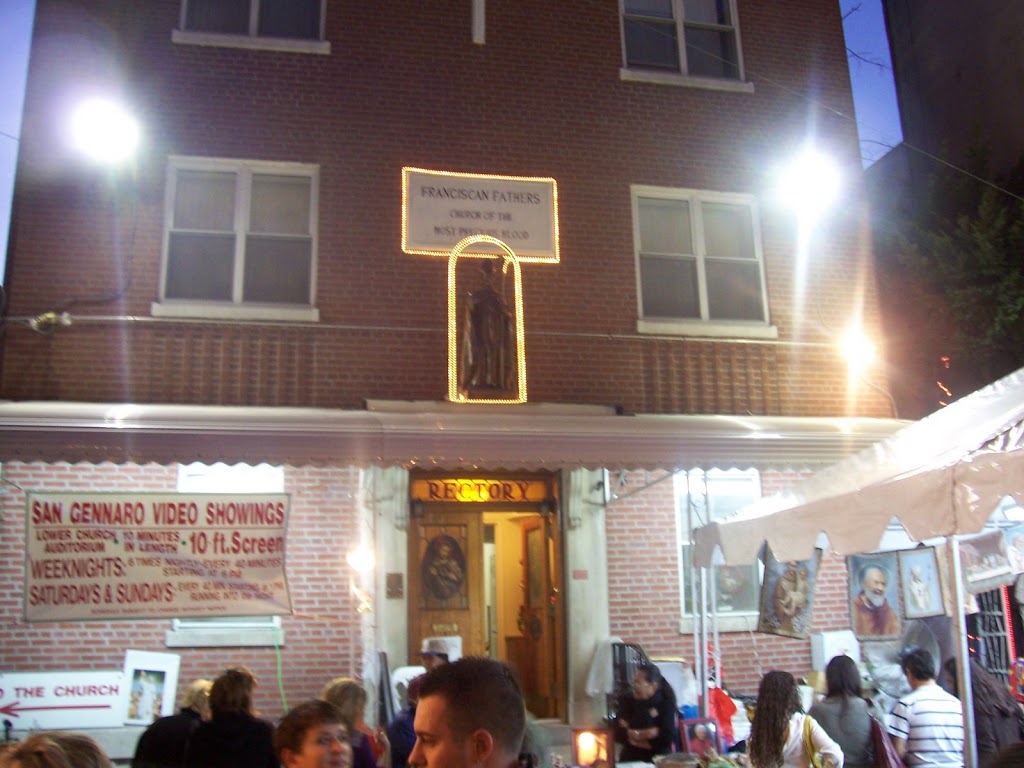
The Church has always been a bit burdened financially. In fact, the proceeds of the religious souvenirs for purchase outside go to the parish. (The pic below is of the back of the church, which faces the festival.)

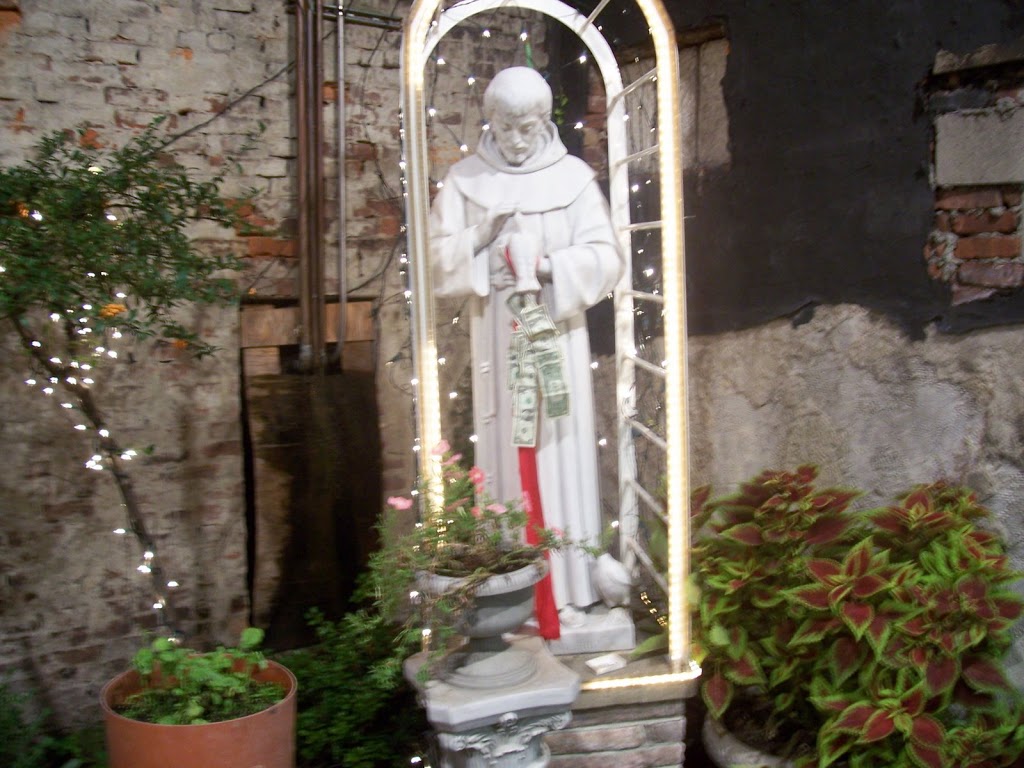
There used to be another lucrative fund-raising method during San Gennaro — gambling — which took place alongside the quaint, narrow garden. The city cracked down on this activity in the 90s when it was alledged that members of the notorious Genovese crime family were skimming some of the profits.

The current garden has as many religious statues growing as plants.

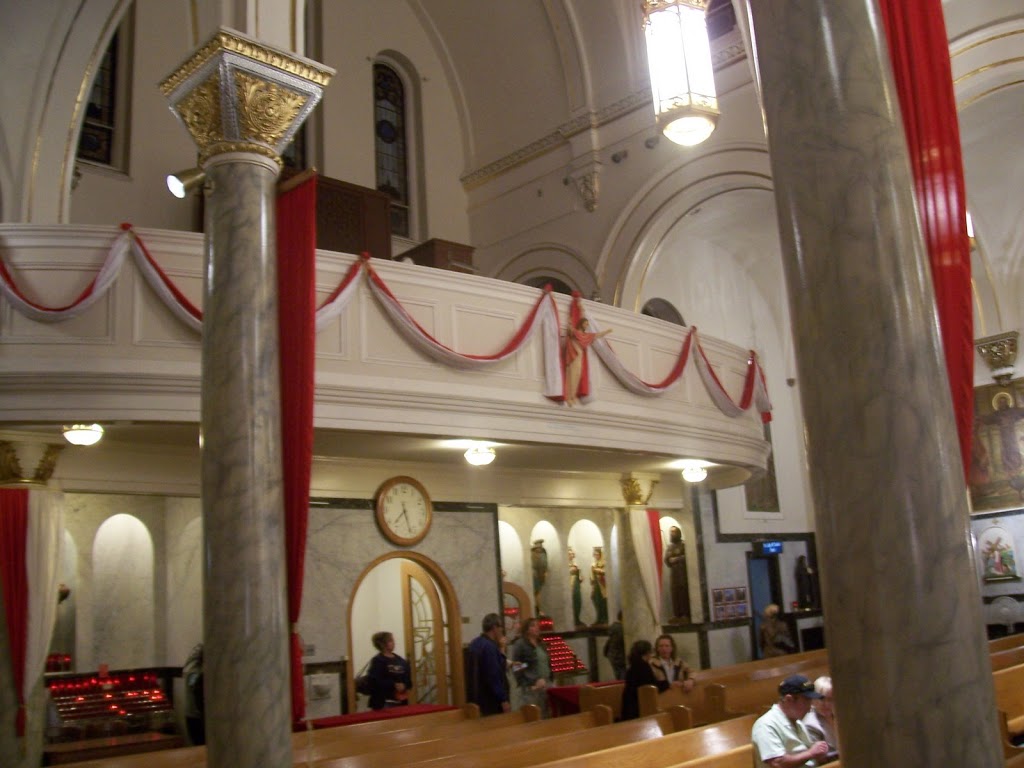
Okay, but why do I like it so much? In 1995 the interior was heavily renovated under the auspices of its leader Father Fabian Grifone. (Controversial cardinal John O’Connor called it a ‘precious jewel’.) What has essentially been done is that the original interior, a rather tasteful and solemn design with white limestone walls and murals above the altarpiece, has been crammed with multi-colored religious artifacts. Its chapels have been turned into glorious dioramas.

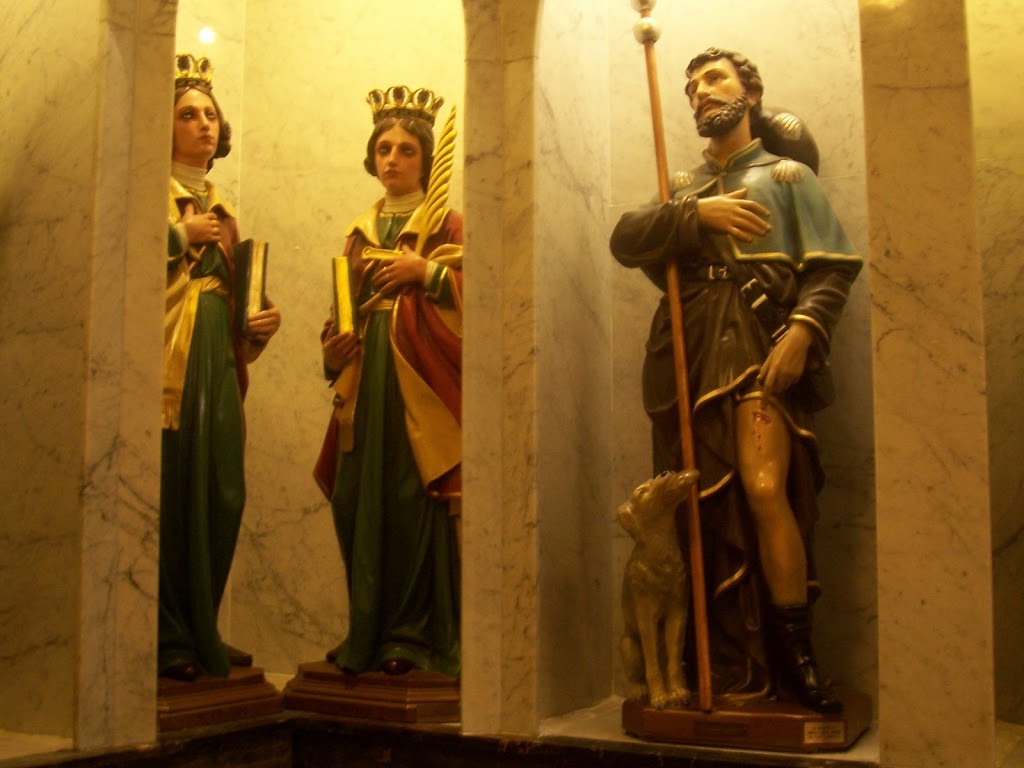
The back wall underneath the balcony is lined with a host of saints colorfully rendered and frozen in odd — some might say, disturbing — poses.

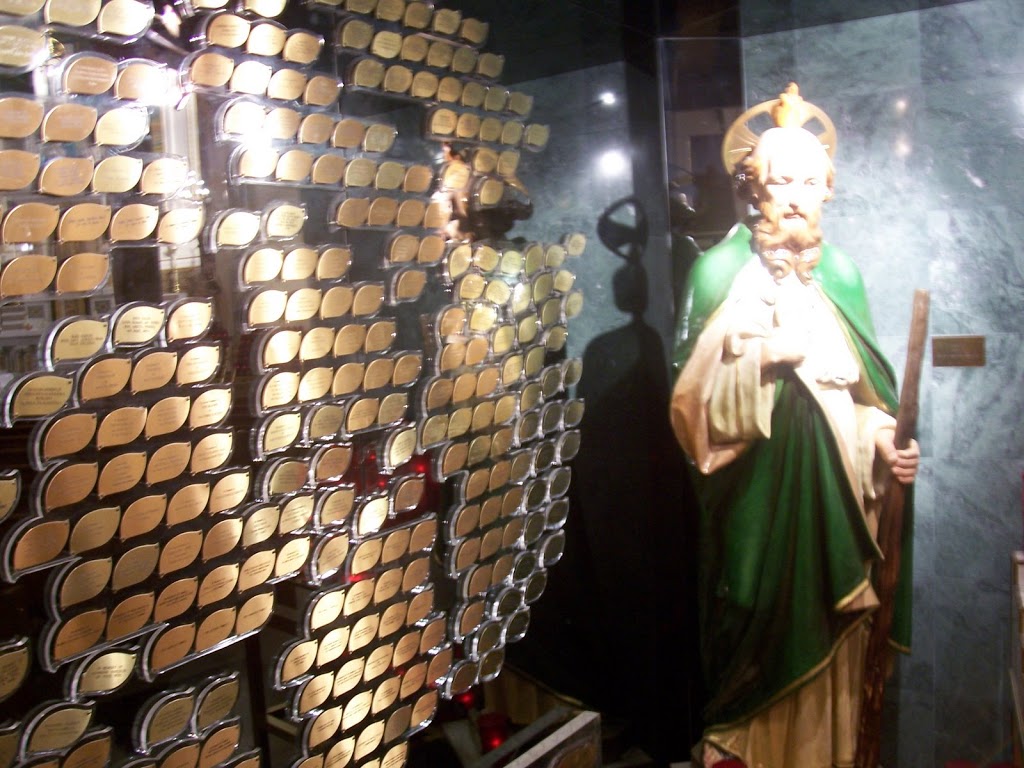
Along the left side of the main room sits the St Jude Shrine, ablaze with ‘leafs’ that parishoners can buy in memory of certain individuals. The leaves were entirely sold out, and I wonder if they’ll just keep down going alongside the wall.

Alongside the right side stands this curious piece, which I believe to be a shrine to St. Pio. To me, he looks a bit like RoboCop.

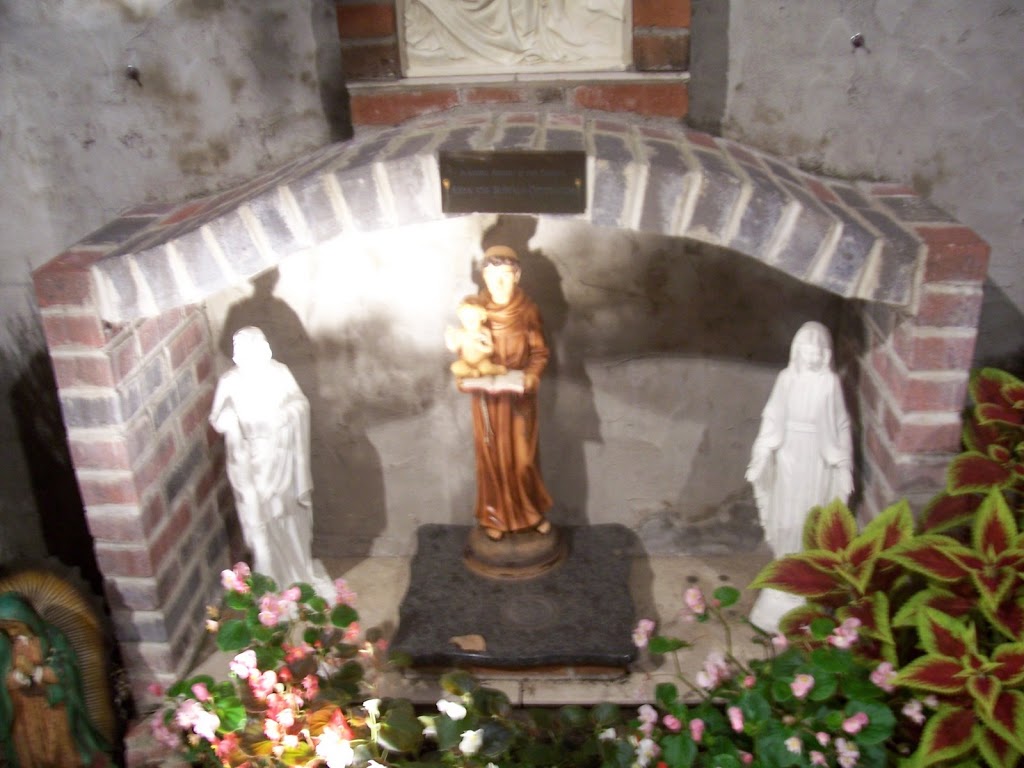
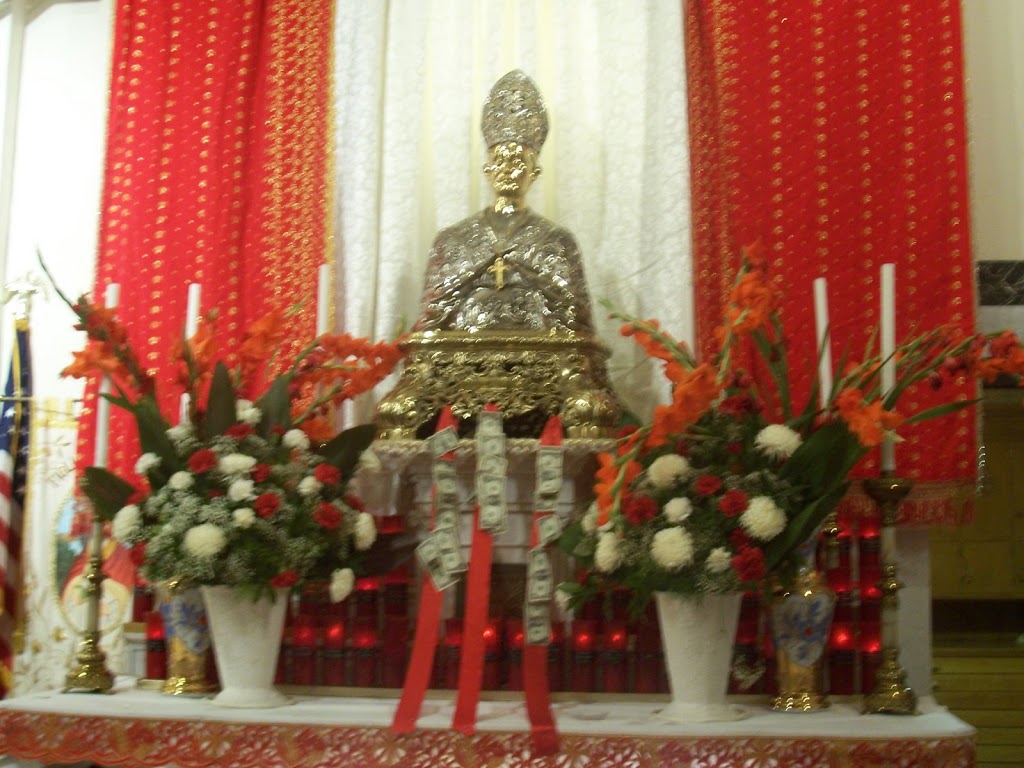
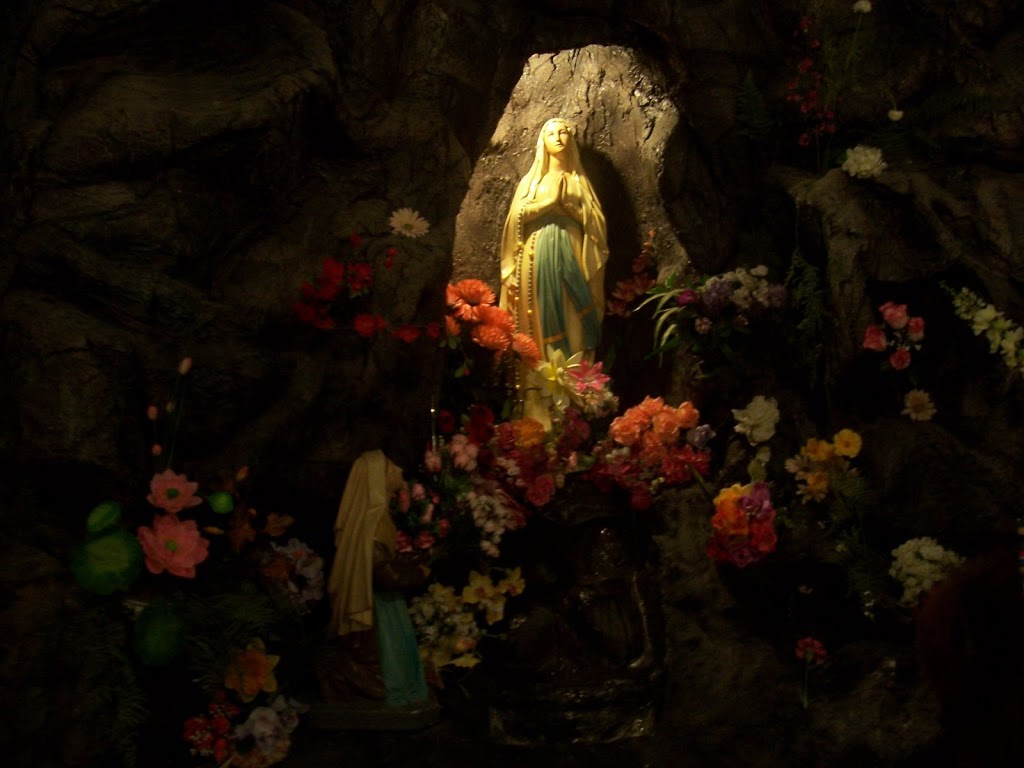
At back are two smaller rooms which contain the shrines to Gennaro and to Mary. In particular, Mary is kept within a wild set piece that would not be out of place in a fantasy film.

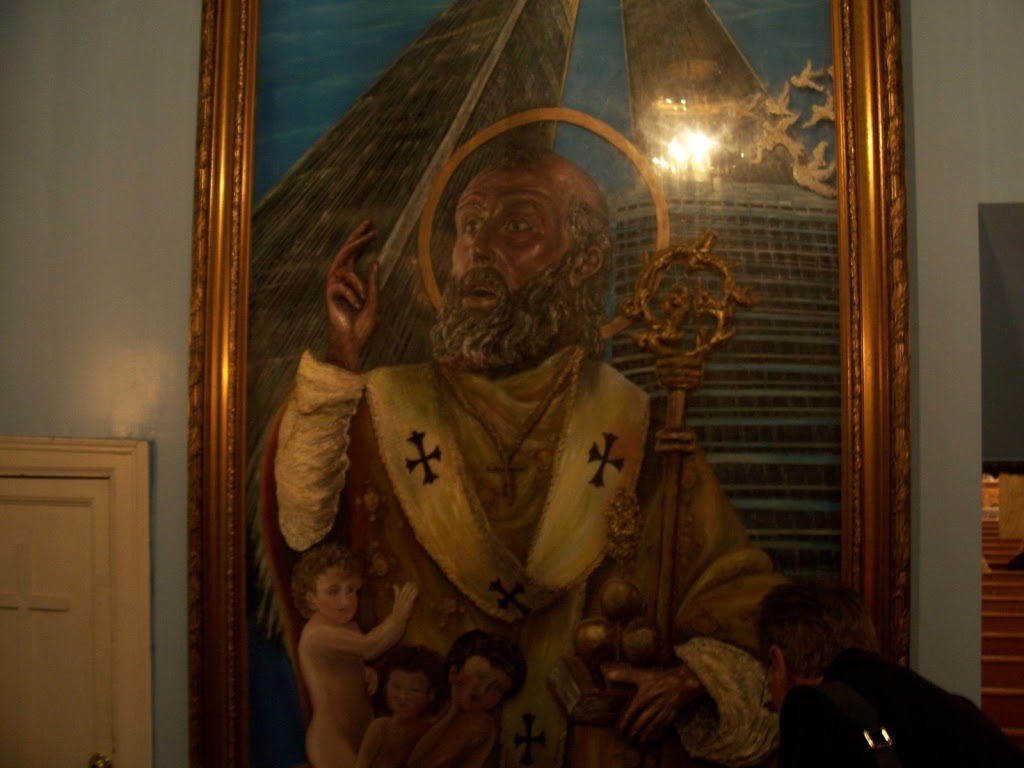
Mary shares the room with this curious painting.

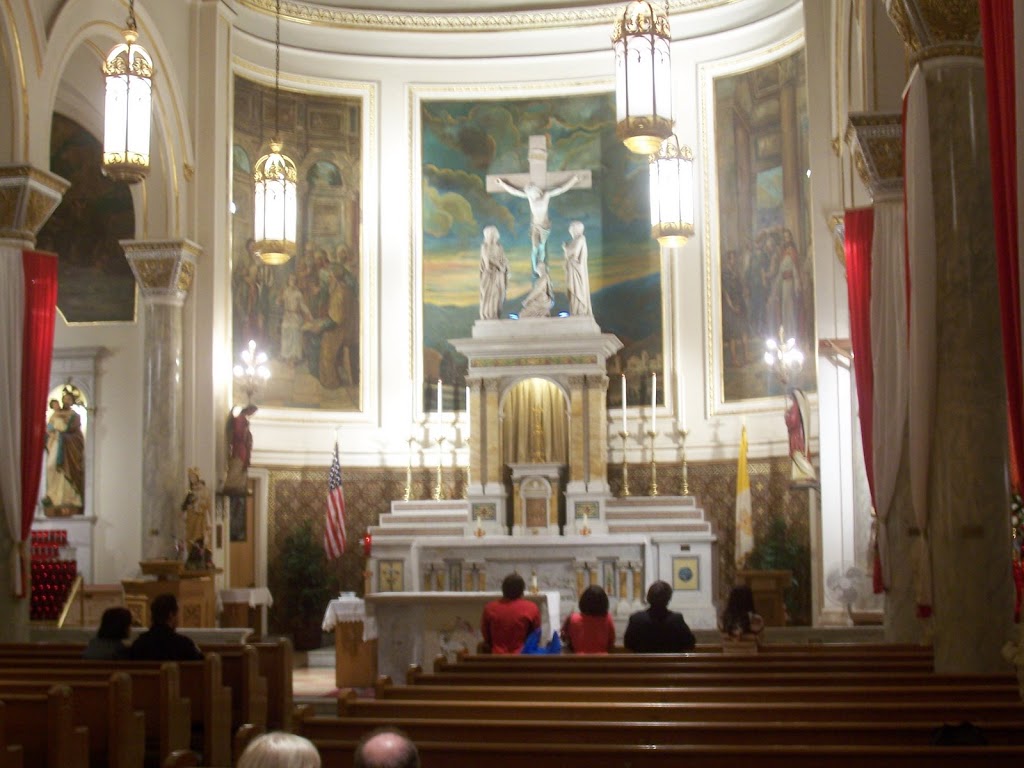
In retrospect, the alterpiece seems a bit barren, the lovely murals surrounding it in bad need of cleaning.

Most Precious Blood and the home of San Gennaro in the United States is by no means a classic standard of American church building, but it’s a heck of a lot of fun to walk throgh.

Categories
Uncategorized

San Gennaro Festival (Part 1) : Blood and Sideshows

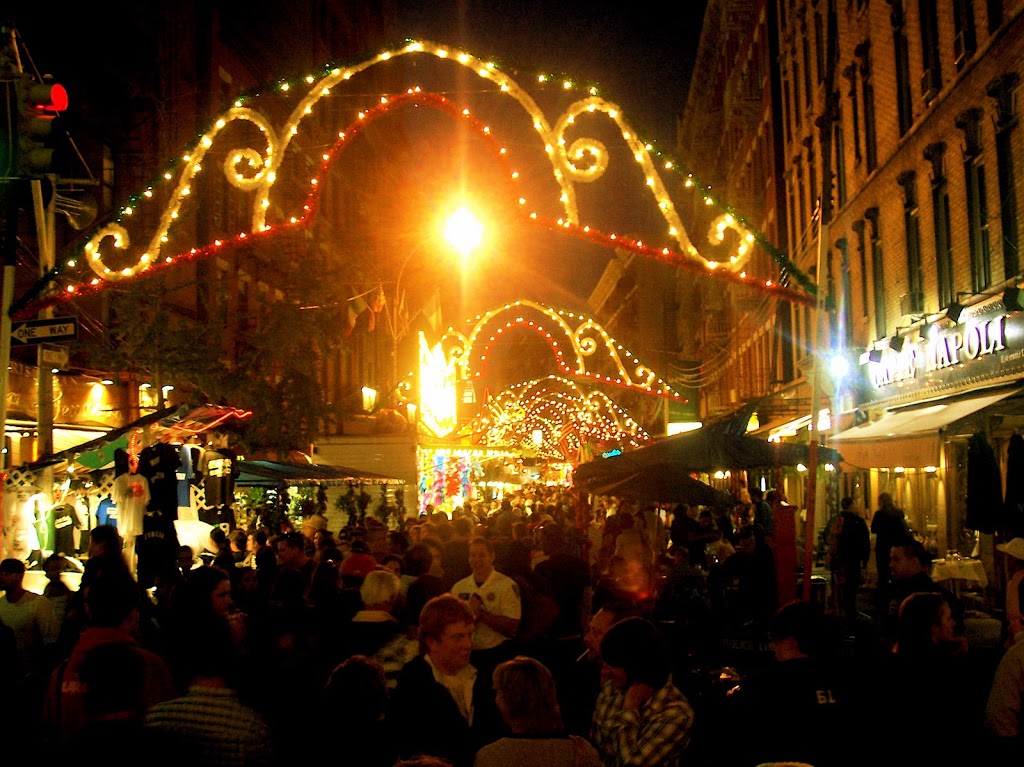
Every year for the past 80 years, Mulberry Street in Little Italy becomes a wacky religious carnival. Why the San Gennaro Festival — with its mixture of saintly reliquary, frozen daquaris, freak shows and clowns — isn’t considered profane and condemned by the Catholic Church is a mystery to me. All I know is that if you can brave the crowds, San Gennaro is one of the most festive and delicious events in New York City.

Many native New Yorkers cringe at the thought of San Gennaro; admittedly, it’s loud, it’s tacky and most of all it’s packed. It can take up to 45 minutes just to traverse those eight blocks of Mulberry, from Houston to Canal. Yet, when I can muster up the patience, I’ve always had a soft spot for the festival, and its my yearly excuse to indulge in fried foods, sugary frozen cocktails and, oh yes, the cannolis.

The festival bills itself as a celebration of Italian-American culture, but it’s clear early on that it’s really about certain perceived notions. What’s practically obscured is the fact that this merry street party has at its heart a solemn religious meaning, which began in an Italian volcano hundreds of years ago.

Saint Januarius, whom the festival celebrates, might have been right at home among the cast of “Heroes”. A Christian bishop in the time of pre-Constantine Rome (305 AD), he risked his life to visit some captured Christians held in Solfatara, a sulfuric volcano crater nearby Naples. Januarius was himself captured, tortured, thrown into a furnace where he survived, and finally beheaded. As the sufferings of Roman Catholic saints go, that’s pretty standard.

What makes him especially notable — and for that matter, the patron saint of Naples — is that his samples of his blood are brought forth during the feast in his honor and the 1,700 year old artifact reportedly re-liquifys in the hands of priests.

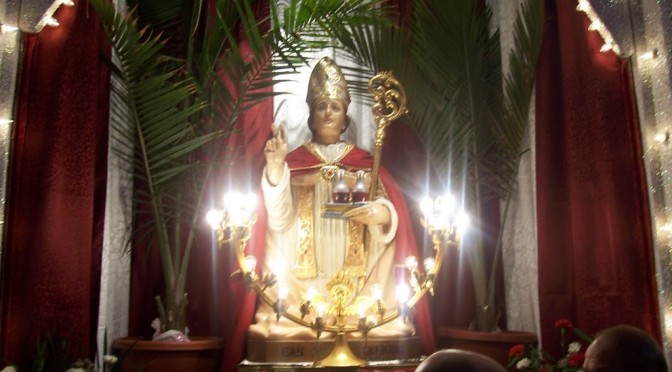
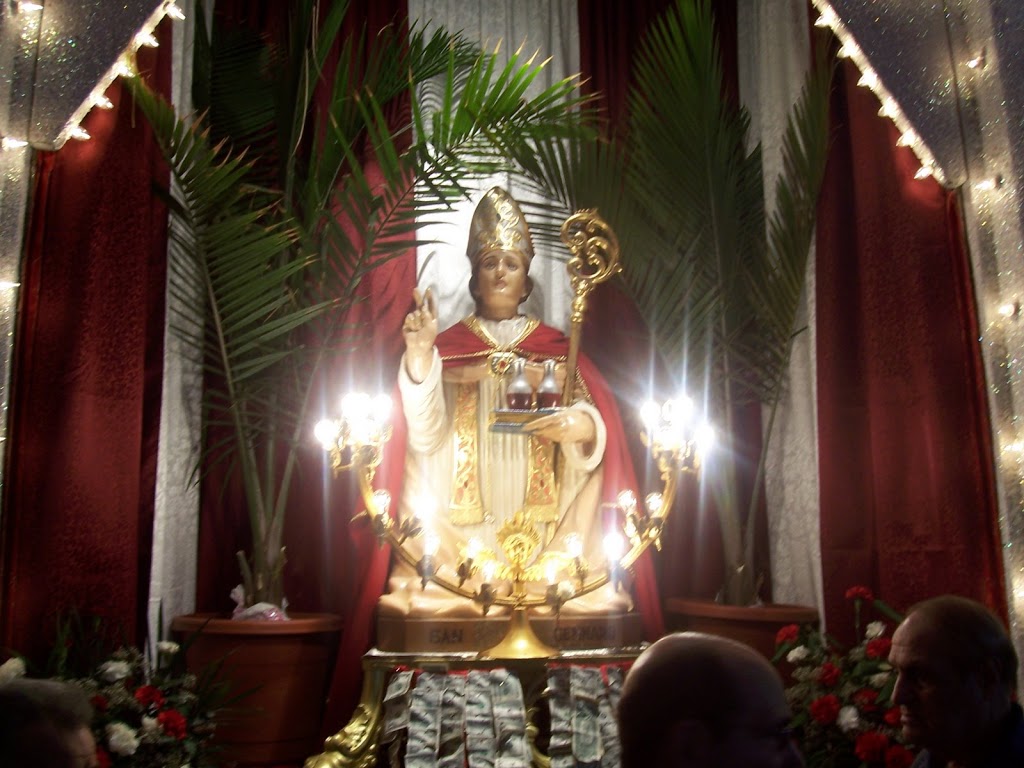
Little Italy’s 80-year-old celebration is merely an extension of the Naples event, brought over by Italian immigrants. The festival is centered at the Church of the Most Precious Blood, where the national shrine to Januarius (Gennaro) is housed, in all its gaudy glory. (More about this remarkable church in tomorrow’s blog entry). A statue of San Gennaro is paraded through the streets on Saturday, to mingle with revelers, the zeppole and the carnival rides.

Some of the things the statue of San Gennaro will pass on his way through the streets of wild Little Italy —

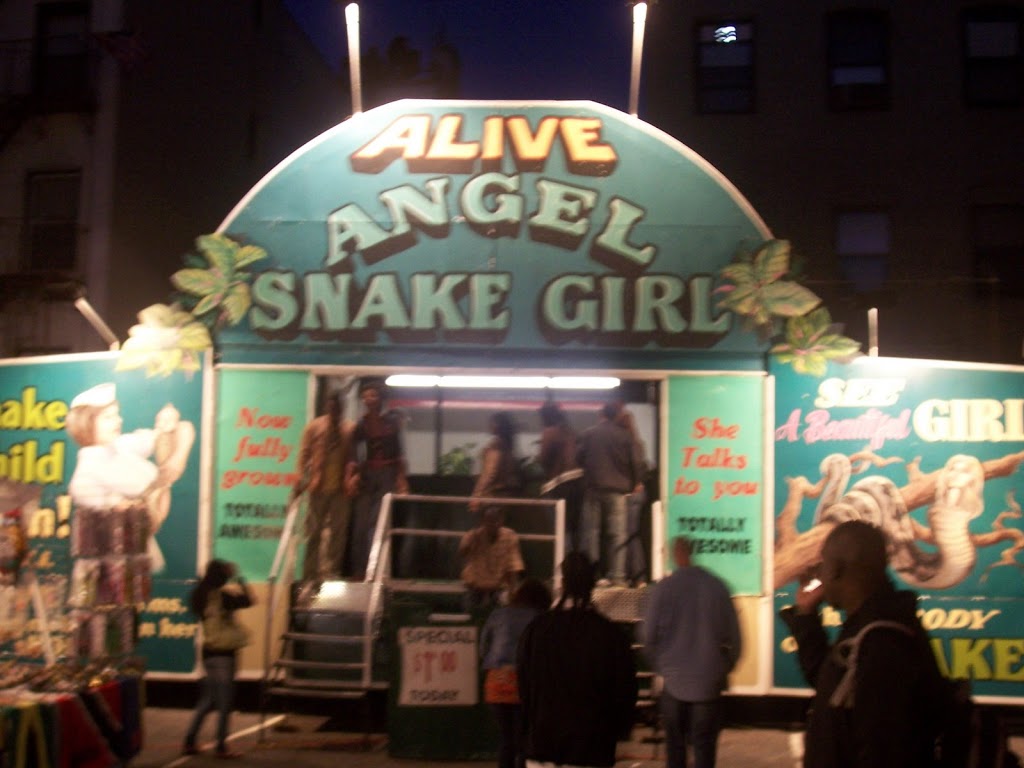
San Gennaro will have the opportunity to deliver religious guidance to the Snake Girl:

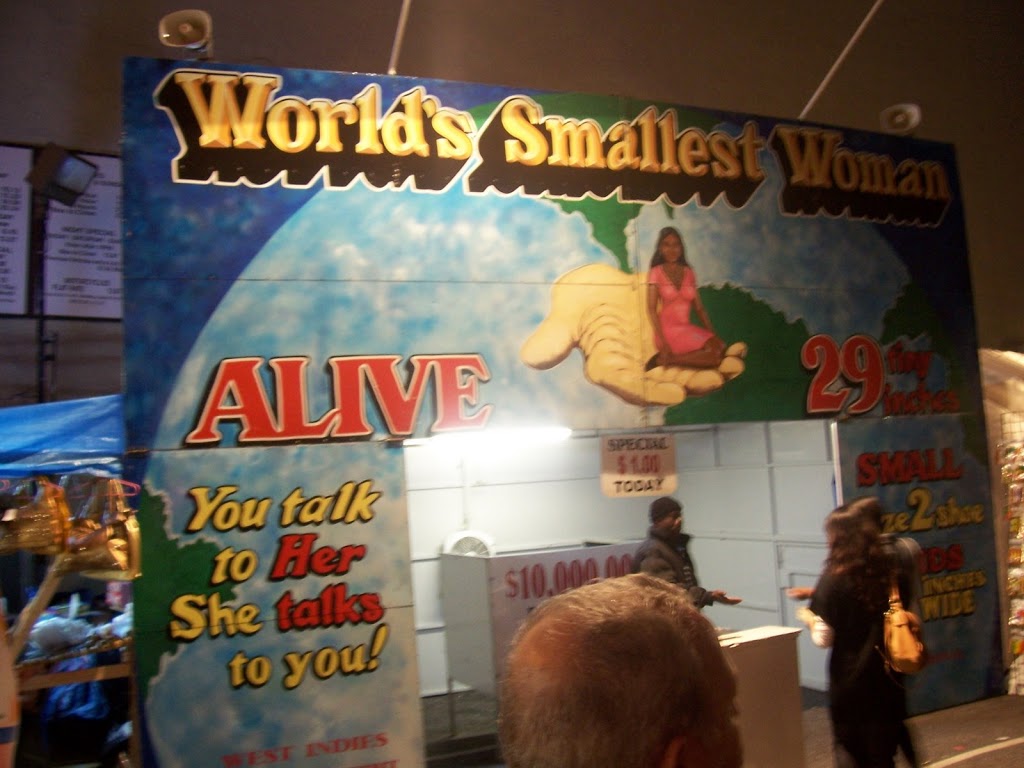
And give hope to the World’s Smallest Woman:

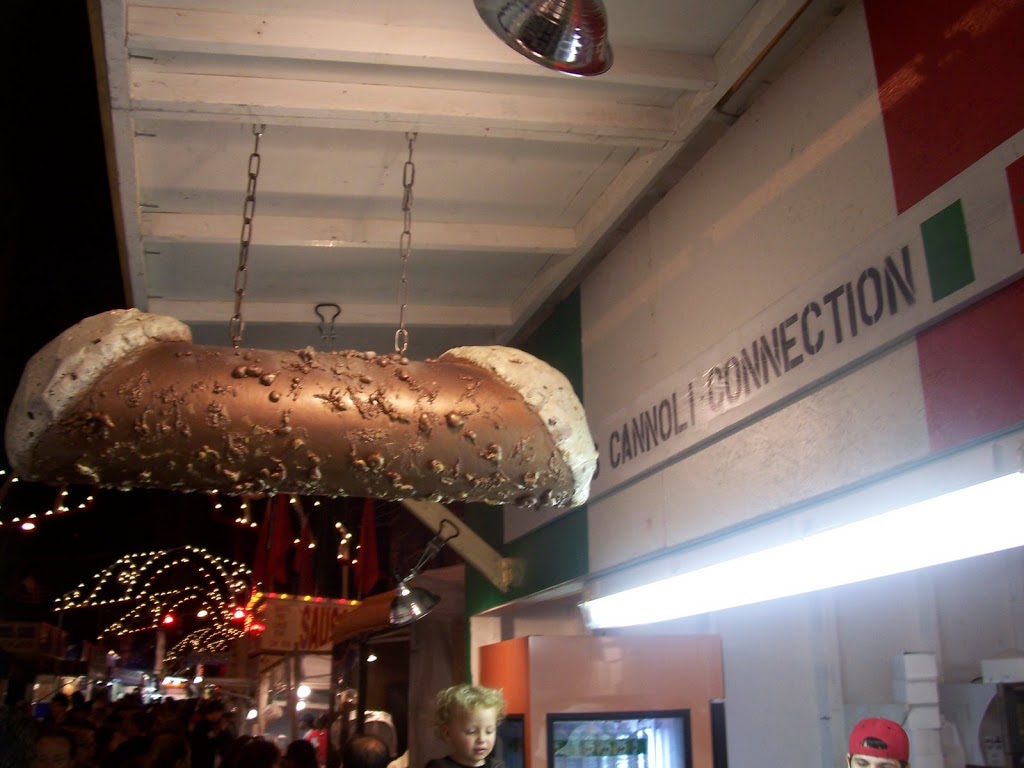
There’s plenty of cannolis to go around, although the cannoli eating contest took place last Saturday.
Check here for pictures if you really want to see what that looked like:

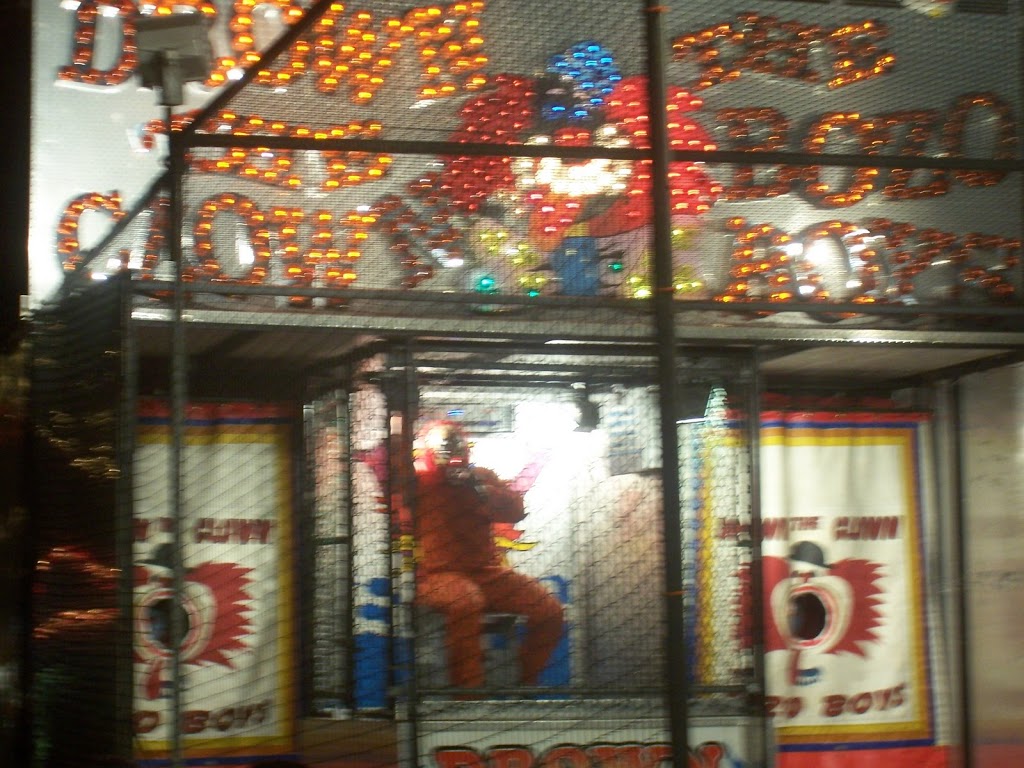
I hope San Gennaro isn’t the jealous type. The most popular event at the festival wasn’t anything going on at Most Precious Blood, but rather four blocks away, at Drown the Clown. A rude, insulting clown sat on a platform mocking the crowd, and for five dollars, you could make him shut up by throwing a ball and sinking him into the pool below. There were at least 150 people standing around and celebrating as this fellow was repeatedly thrown into the water.

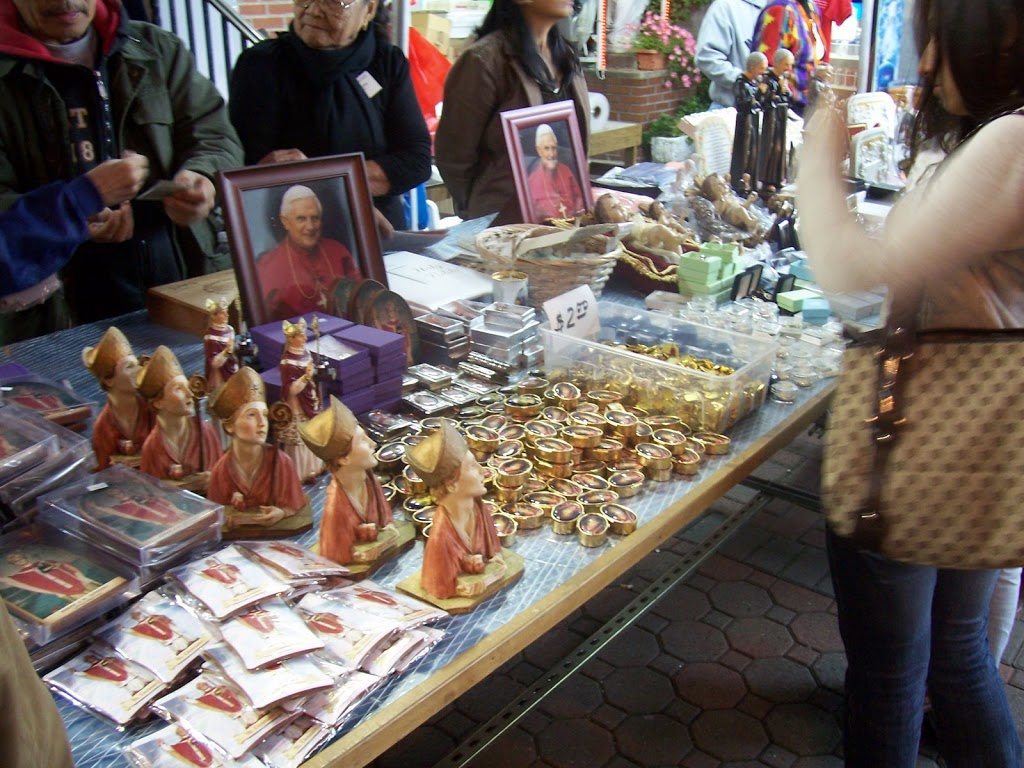
And of course if he prefers to pick up some religious themed souvenirs, there’s plenty along the way:

Or maybe something for baby Jesus:

Tomorrow: I take you inside and through the history of possibly one of the weirdest churches in the United States, the Most Precious Blood. I’ll spoil this now – it has instantly entered my Top Ten Favorite Buildings Of New York City …. though maybe not for reasons you might expect.

FYI, the current organizers of the event, Figli di San Gennaro, clearly spell the name with 2 n’s, although I believe the actual saint’s Italian name is spelled with one n – Genaro – and the two spellings are occasionally used interchangably, especially in festivals outside New York.