This classic episode of the Bowery Boys: New York City History podcast (originally released in December of 2021) is featured in this week’s episode of the History Channel podcast HISTORY This Week.
Since 2011 the Bowery Boys Podcast has revisited a few of the themes featured in this show. After listening to this episode, give these installments a try:
PODCAST The streets of New York have been lit in various ways through the decades, from the wisps of whale-oil flame to the modern comfort of gas lighting. With the discovery of electricity, it seemed possible to illuminate the world with a more dependable, potentially inexhaustible energy source.
First came arc light and ‘sun towers’ with their brilliant beams of white-hot light casting shadows down among the holiday shoppers of Ladies Mile in 1880.
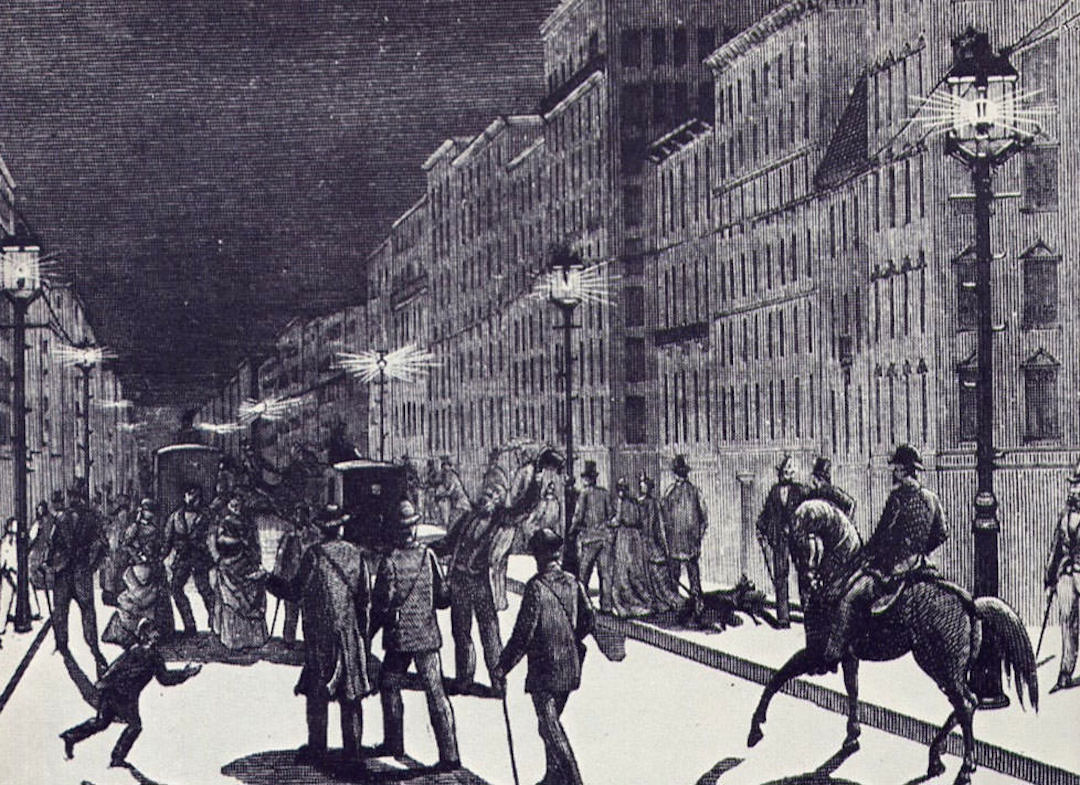
But the genius of Menlo Park, Thomas Edison, envisioned an entire city grid wired for electricity. From Edison’s Pearl Street station, the inventor turned a handful of blocks north of Wall Street into America’s first area entirely lit with the newly invented incandescent bulbs.
ALSO: It’s the War of Currents, the enigmatic Nicola Tesla and the world’s first electric Christmas lights.
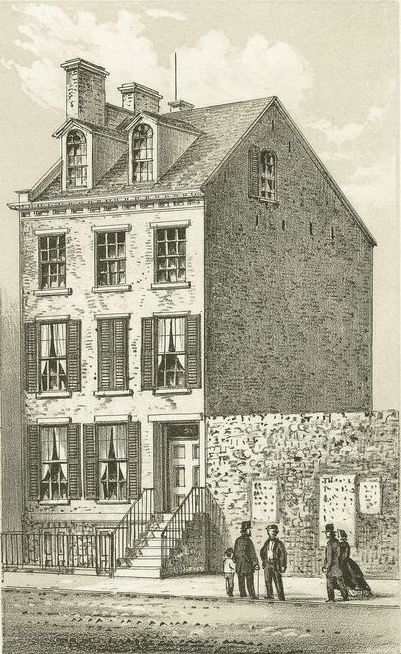
The home of Samuel Leggett, the first to be illuminated with gas lighting, at 7 Cherry Street. This home stood just a few blocks from the location of Edison’s Pearl Street Station (255-7 Pearl Street), which would also change the way people consider lighting their city. (NYPL)
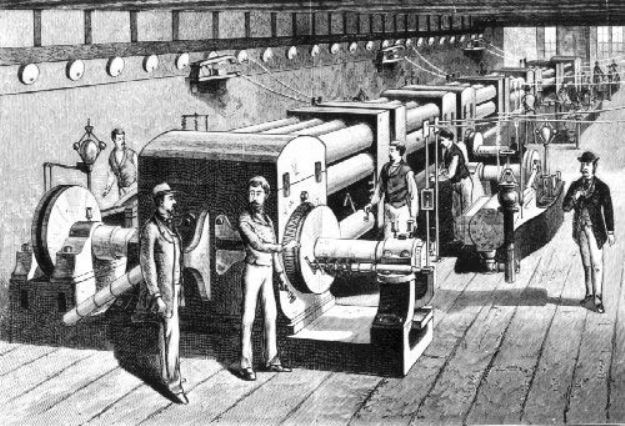
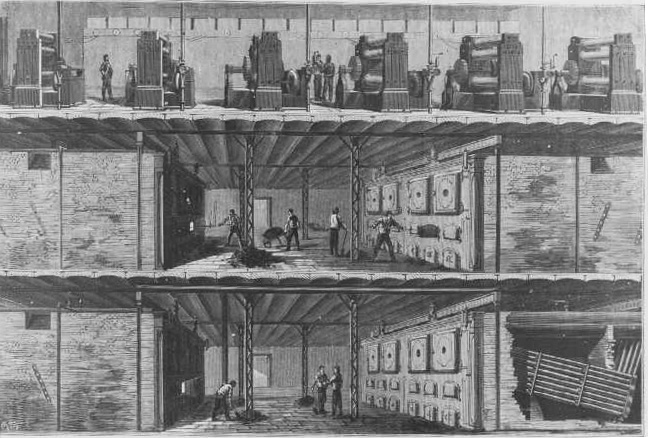
Inside the Pearl Street Station: Direct current surged through Edison’s generators to the neighboring blocks.
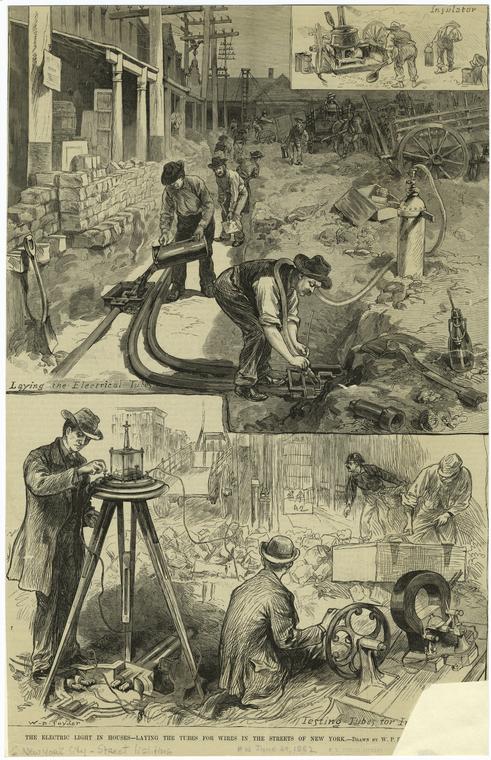
Laying the electrical wires under the streets of the blocks surrounding the Pearl Street station was an arduous, potential dangerous task. It took well over a year to complete the job. (Courtesy NYPL)
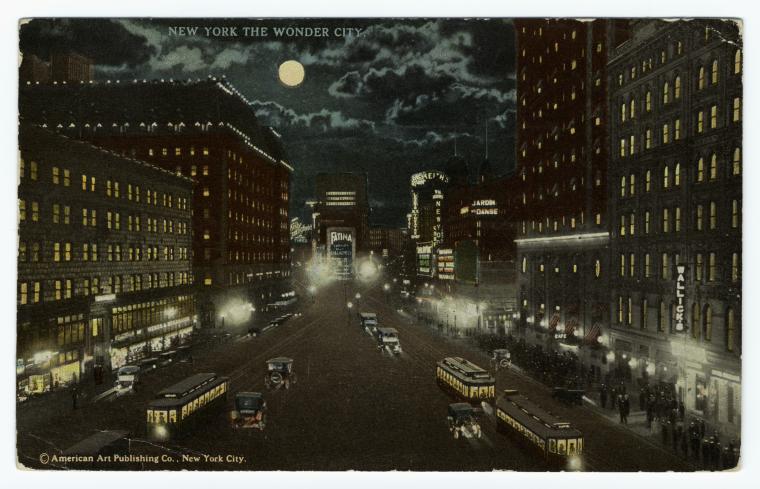
‘New York The Wonder City‘, and indeed it was, thanks to electricity. Whole neighborhoods, like Times Square and Coney Island, were defined by it. Landmarks like the Brooklyn Bridge, thoroughfares like the Bronx’s Grand Concourse and even Broadway itself were transformed at night by electric power. (NYPL)
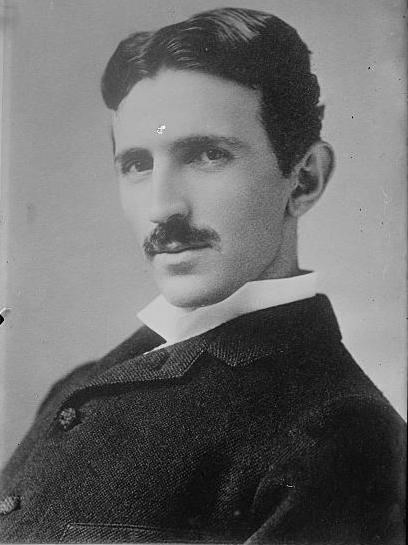
Nikola Tesla, the brilliant Serbian inventor who spent his final decades in New York living at the Hotel New Yorker.
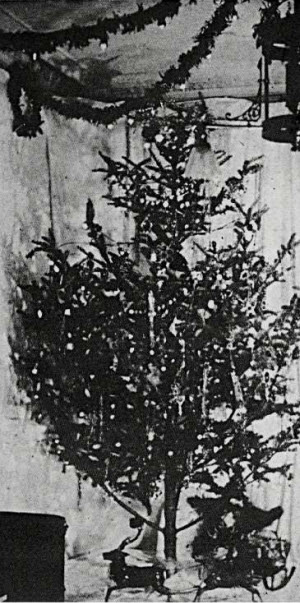
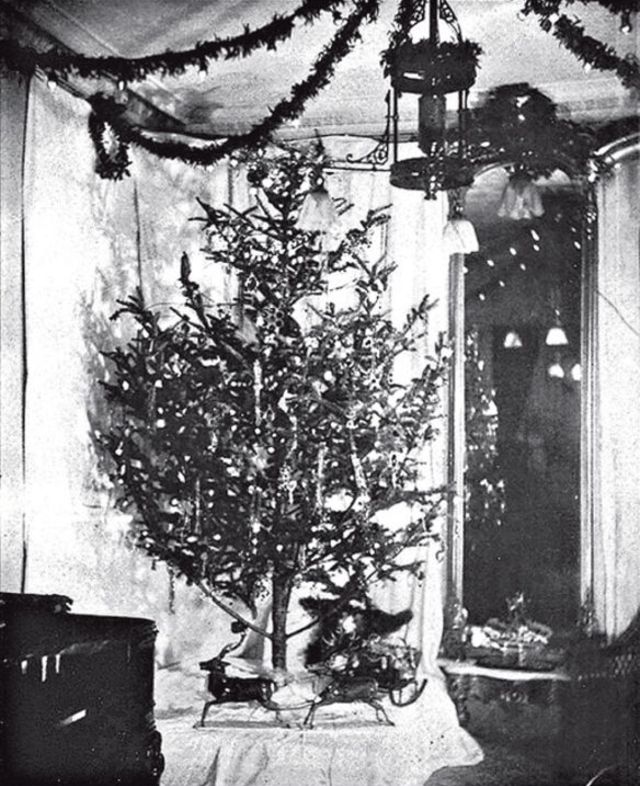
Behold! The first Christmas tree with electrical lighting, courtesy Edison employee Edward Hibberd Johnson. This tree glittered and twirled from Johnson’s home in Murray Hill. (Courtesy Jim on Light)
On the fiftieth anniversary of the invention of the lightbulb, an elderly Thomas Edison ‘reinvents’ it in 1929 at a reconstructed laboratory in Dearborn, Michigan, to the delight of Henry Ford and newly elected President Herbert Hoover.
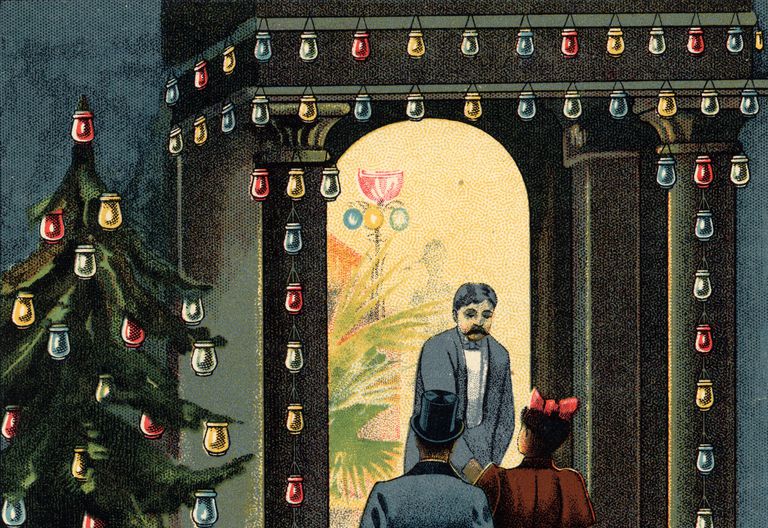
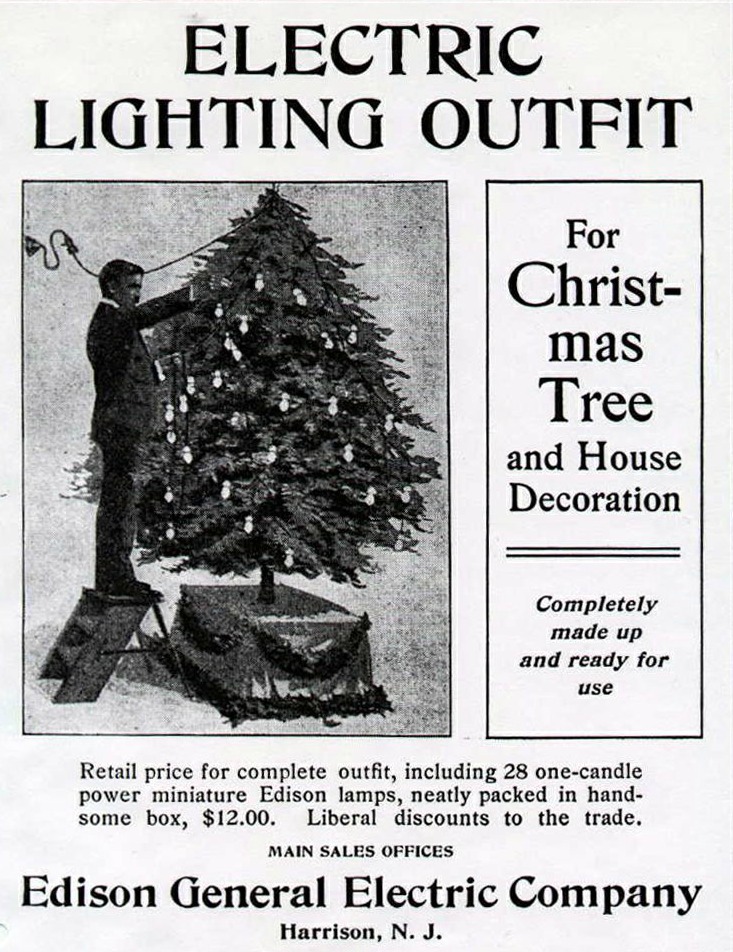
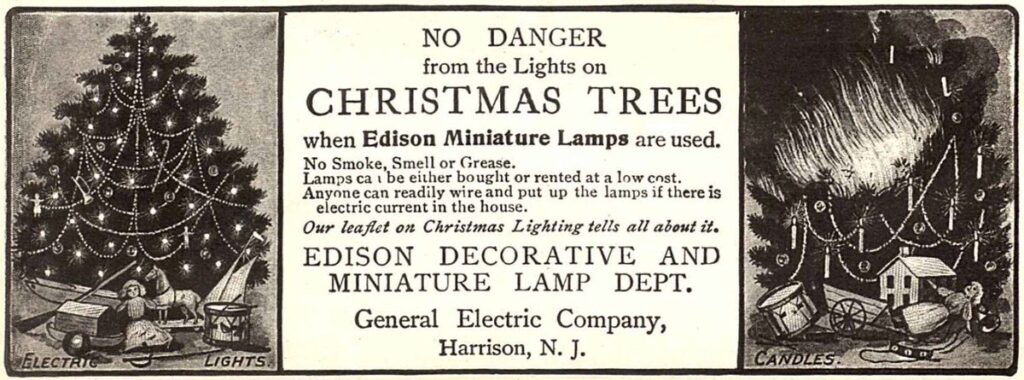
An electric Christmas lights advertisement from the 1890s. Getty Images
The world’s very first Christmas tree with electric lights was displayed in 1882 at the home of Edward Hibberd Johnson in the Murray Hill neighborhood of New York City.
Not only did it glow with this innovative new form of illumination, this Christmas tree also spun around, revolving like a flashy new car at an automobile expo.
The Christmas tree of Edward Hibberd Johnson
Two years later in 1884 the New York Times looked back fondly upon this greatly advanced version of the Christmas tree:
“The tree was lighted by electricity and children never beheld a brighter tree or one more highly colored than the children of Mr. Johnson when the current was turned and the tree began to revolve.
“It stood about six feet high, in an upper room, and dazzled persons entering the room. There were 120 lights on the tree, with globes of different colors, while the light tinsel work and unusual adornment of Christmas trees appeared to their best advantage in illuminating the tree.
“The set of lights were turned off and on at regular intervals as the tree turned around. The first combination was of pure white light then as the revolving tree tree severed the connection of the current that supplied it and made connection with the second set, red and white lights appeared. Then came yellow and white and other colors.”
The children of Mr. Johnson were witnessing a revolution. Yes an actual revolution – of the tree itself – but the beginning of an entirely new way of celebrating the holiday.
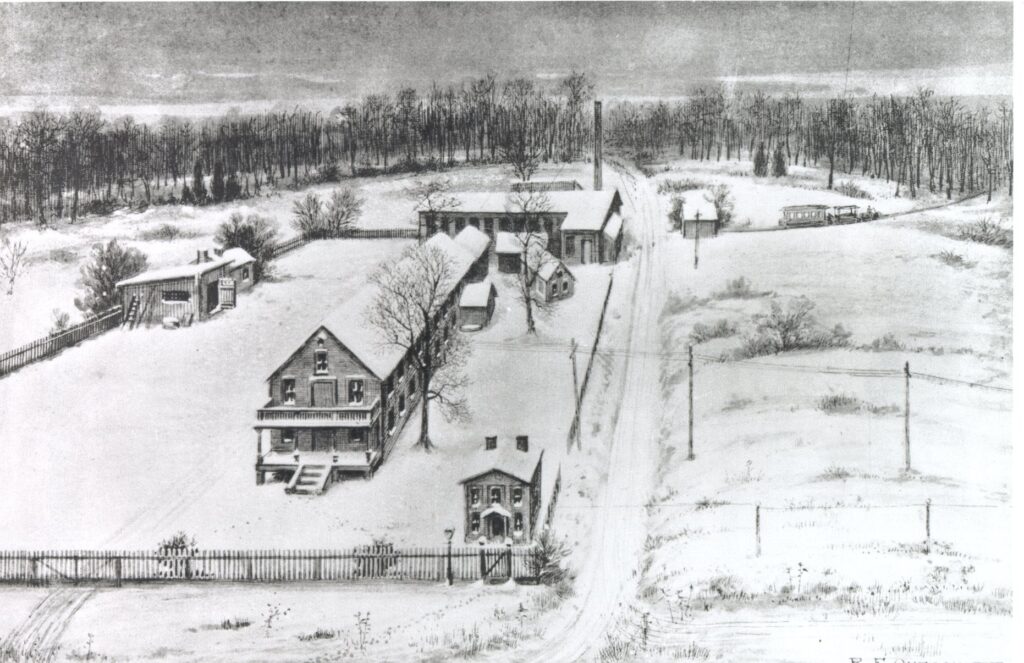
Snow covered Menlo Park
Surrounded by his wealthy investors, Thomas Edison gave the first public demonstraton of the incandescent lightbulb on December 31, 1879.
Now, believe it or not, New Yorkers were already accustomed to electric illumination during the Christmas season. The major Manhattan shopping districts were already exposed to stadium-like arc lighting, a primitive form of electric light that was too harsh and intense for everyday usage.
But Edison’s invention was vastly superior and it wouldn’t just drive away the dark. In its compact size, its durability and eventual convenience, the lightbulb would elaborate on one of candlelight’s most appealing components – mood.
The next year, on December 20, 1880, Edison had additional investors out to Menlo Park, and they were greeted with an extraordinary site.
From the NYT: “The train arrived at Menlo Park at 5:31. Darkness had settled down upon the bleak and uninviting place which Mr. Edison had chosen for his home, but the plank walk from the station to the laboratory was brilliantly lighted by a double row of electric lamps, which cast a soft and mellow light on all sides.
“The incandescent horseshoes gave out a yellow light which shone steadily and without the least painful glare and were beautiful to look upon.”
While this was not intentionally a Christmas lighting display, the arriving investors, in the holiday spirit, remarked upon the appropriate warmth and charm of the lights on the chilly December evening.
The light bulb would change the world but it would also make Edison a lot of money.
Soon Edison began aggressively promoting the various ways that electric lighting could be used to improve life – the more reasons, the more likely other investors would sign on and the more likely cities would hire Edison to install electrical power stations.
For the first time, the homes and offices of lower Manhattan would be able to light their interiors more pleasantly and conveniently than those homes with gaslight.
Whereas as the illuminations from gas would often create a sickly glow, the light from an electric glass bulb would seem romantic and alluring in comparison. Finally the candle had some competition.
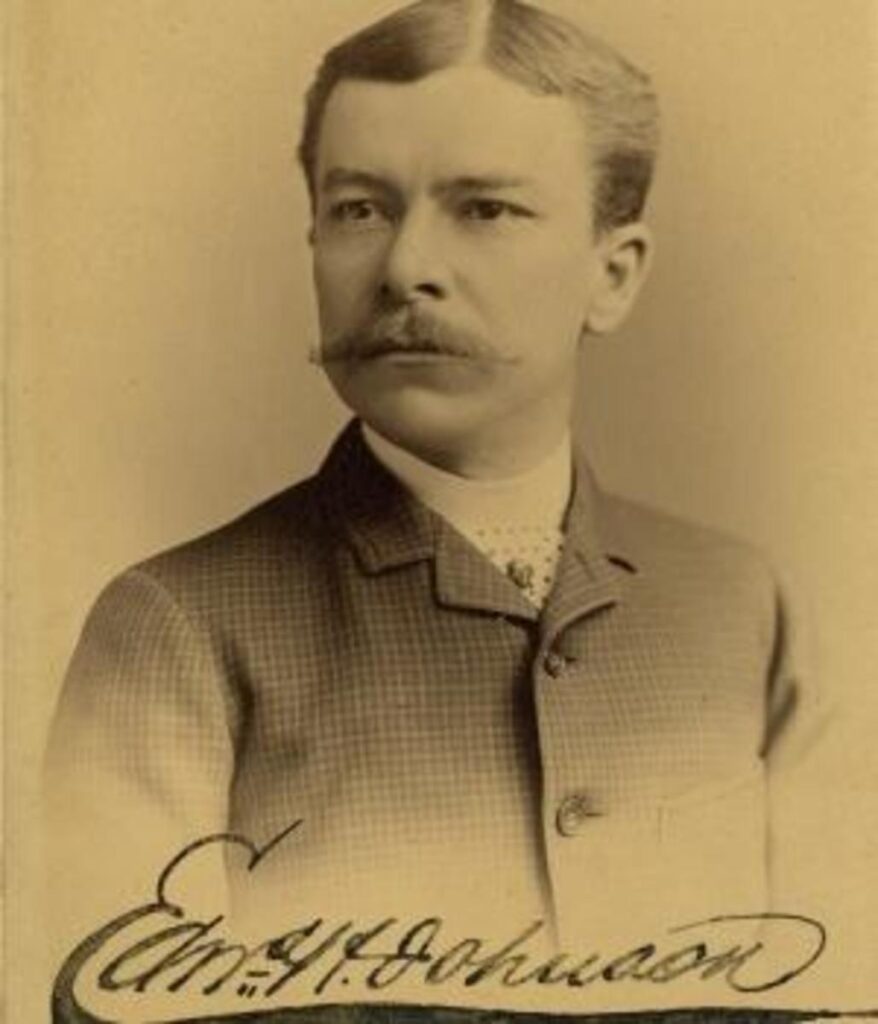
Further uptown, at the home of Edison’s friend and the vice president of the Edison Electric Company Edward Hibberd Johnson (pictured above), electricity was taking the place of a rather hazardous form of decoration.
For Johnson’s electric-tree idea took his inspiration from traditional candle-lit trees.
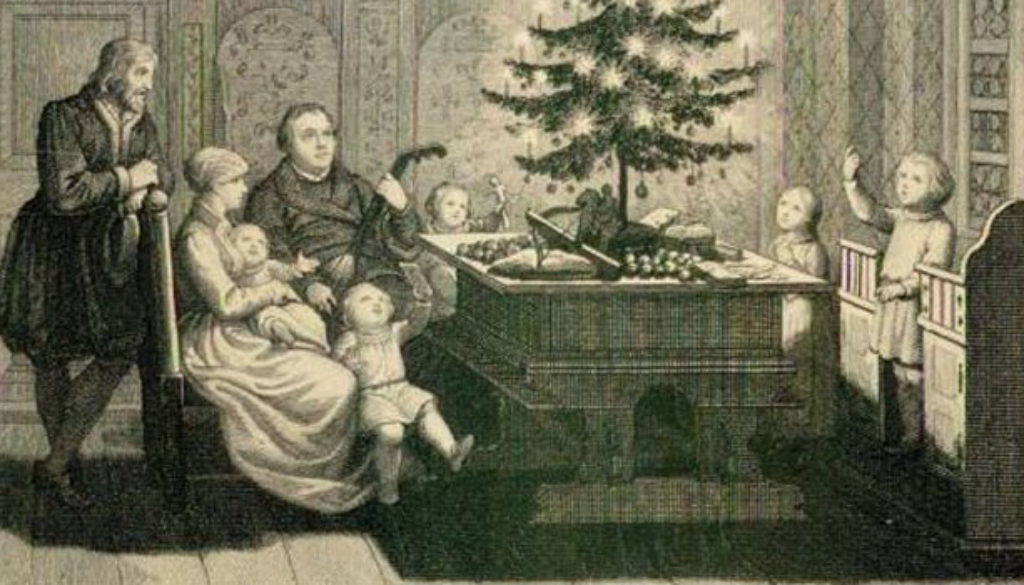
Candles in Christmas trees
In the early 19th century a Christmas tree was considered a luxury of the urban rich who could afford to have a tree cut down for them and installed in their homes. But by the 1850s people could purchase trees at the market and carry them home to decorate for the season.
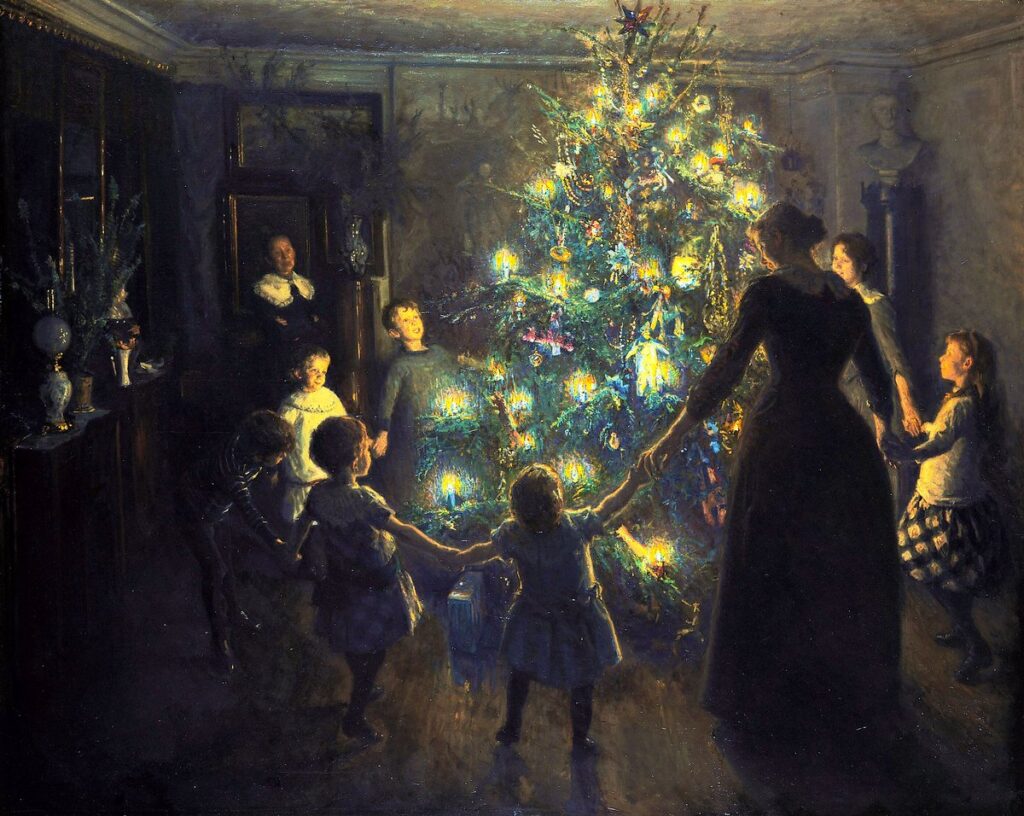
The most beautiful trees — the ones that seemed to fully embody the spirit of the season — were decorated with lit candles.
Getting a candle to stick in a tree was not easy. Some held the melted wax to branches, others pierced the candle with needles, tying them to the tree that way.
Happy Christmas (1891) by Danish artist Viggo Johansen
In 1878 an inventor named Frederick Artz devised a spring clip that could hold candles to the branches.
Now a family could attach lit candles to a Christmas tree and know — with just a touch more assurance — that the waxen dagger would not fall into the branches and burn the house down.
Keep in mind that in the 19th century Christmas trees were only installed in homes for only a few days. People did not lavishly decorate a month and a half before like we do today.
And trees were more closely monitored then. Next to the presents underneath the tree was a bucket of water.
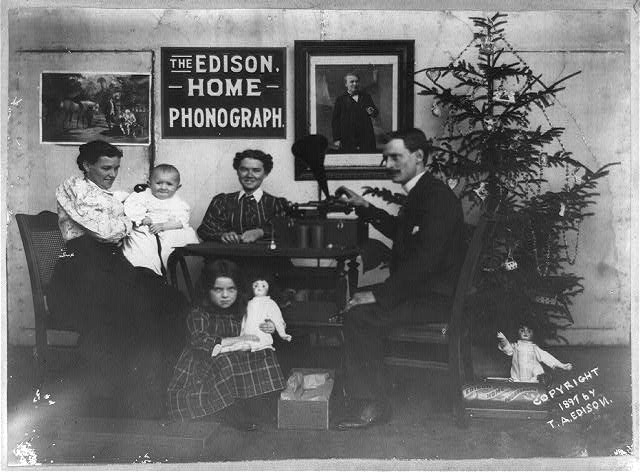
By 1908, some insurance companies refused to cover fires started by candle accidents on Christmas trees, claiming they were a clear and knowing risk.
1897 Library of Congress
So you can understand why people absolutely lit up at the idea of a Christmas tree with electric lights.
In January 1883, the journal Electrical World called Johnson’s tree on Madison Avenue the handsomest tree in the United States.
Pictures would suggest otherwise, although photographic process of the early 1880s were hardly equipt to capture such a unique and peculiar things – a rotating, brilliantly and colorful lit object of natural art.
But of course it wasn’t art. It was promotion.
With each year, Johnson would continue to let in the press into his home to report his unusual holiday marvel.
In addition he would install similar trees in places where Edison electrical power would soon be made available.
For instance, for Christmas 1883, he put up a much larger display tree at the Foreign Exposition in Boston at Mechanics Hall in Boston’s Back Bay.
From a 1904 history of Edison lighting:
“At the Boston Foreign Fair, about 1,500 Edison lamps were employed and the Christmas tree took several hundred more.
“This tree was deisgned to be operated by an automatic device which would make the light of the lamps appear and disappear in time with whatever music might be played and it was manipulated by means of a keyboard of switches, the operator being concealed at the base of the tree.
“The effect was so pleasing that Christine Nilsson, the Swedish Nightingale, who was in the audience begged to be allowed to manipulate it.”
All these wondrous, grandious displays were all for the general promotion of electrical power and not for the production of Christmas home decorating products themselves.
For at least two decades after Johnson’s extraordinary display, electric Christmas sets for the home were sheer novelty and clearly for the richest participants of the Gilded Age, those who could afford electricians and personal generators.
Consumers wouldn’t get to affordably light their home Christmas trees until the 20th century. Well, affordably can be debated.
In 1903, General Electric would finally make strings or festoons of miniature incadesent lamps – with bulbs of all colors — available for home holiday decorating. 24 bulbs for just $12! In 1903 dollars. That’s about $325 dollars today.
To decorate a tree of any meaningful size would require holiday revelers take a small mortgage out on their house.
But of course, by this time, Christmas in America was already being defined by thresholds of wealth. Christmas meant spending.
So for some, spending a week’s paycheck on Christmas lights might have been worth the heartache.
For some of course, it made more sense to RENT Christmas lights, a popular option in the year 1900.
From a General Electric Ad that year: “Edison Miniature Lamps for Christmas Treets. No Danger, Smoke or Smell. Lamps either rented or sold. Full directions furnished, enabling anyone to readily wire and put up the lamps.”
For more information, check out these Bowery Boys podcasts:
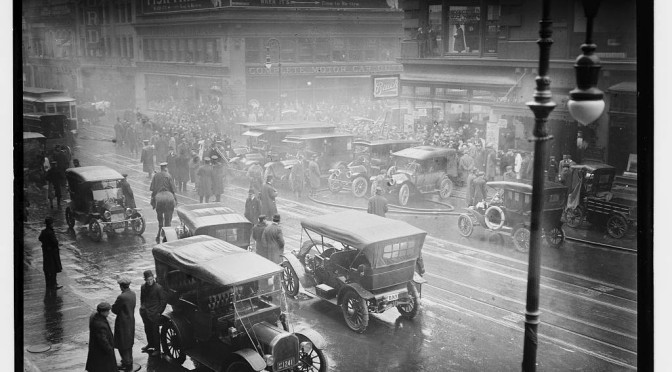
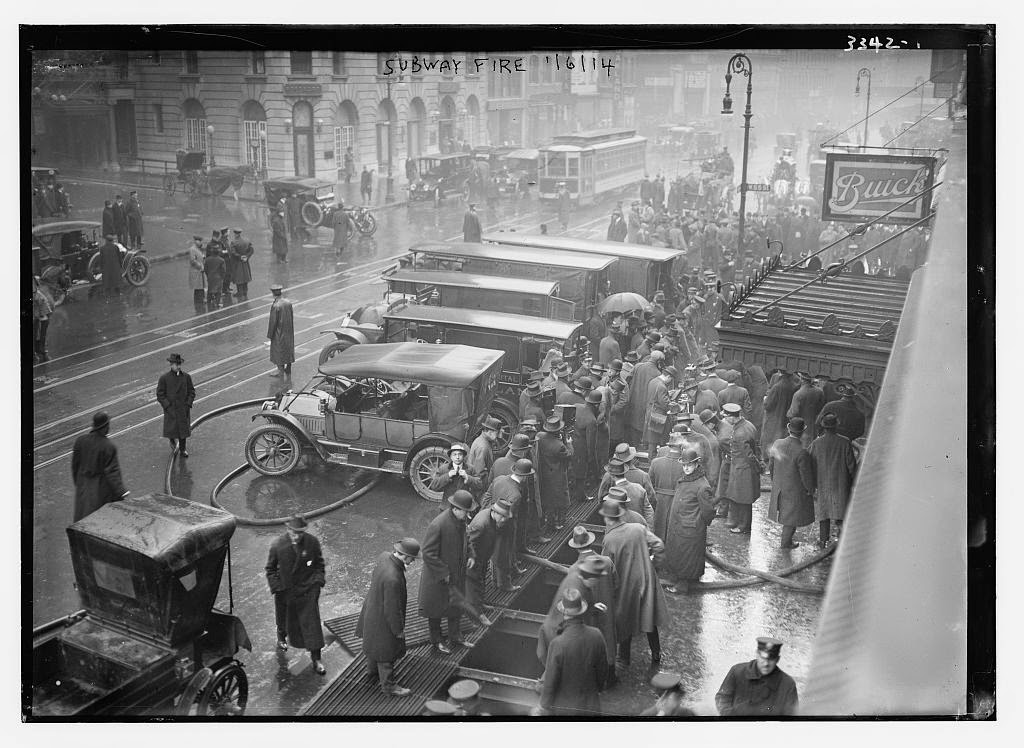
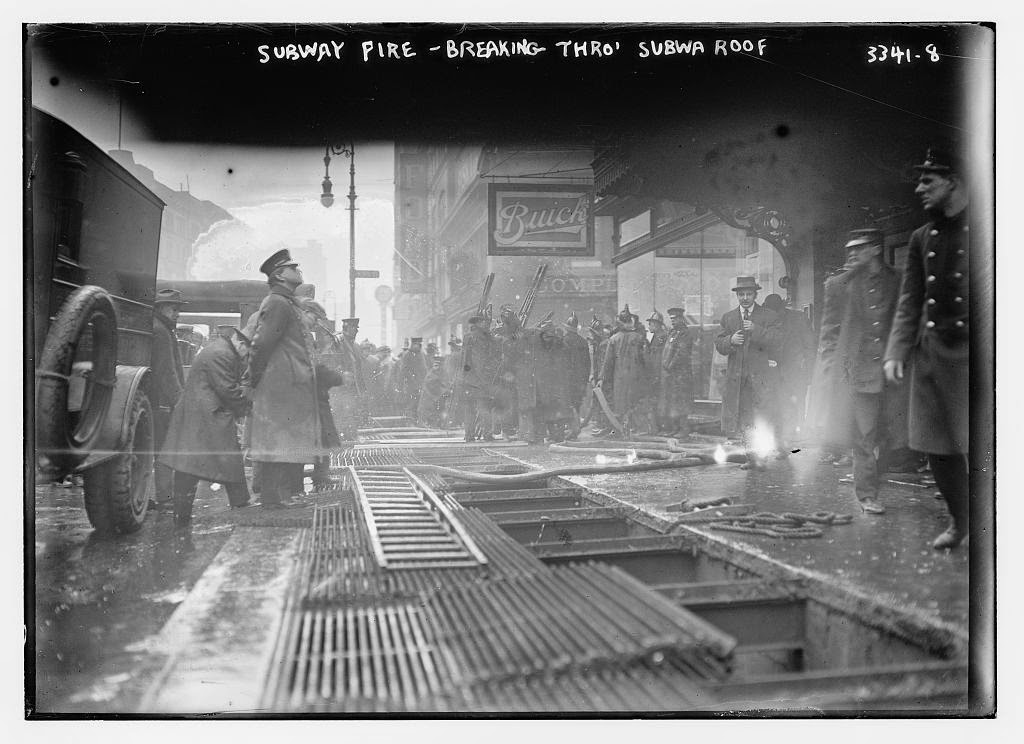
On January 6, 1915, a seemingly minor incident under the streets of Midtown caused a terrible panic, “the worst disaster in the history of the New York subway” up to that date, injuring hundreds of commuters and killing one.Â
That morning, two electrical cables feeding into manholes at Broadway and 52nd Street suddenly shorted out, causing a blackout in the subway tunnels below. The cable insulation, not fireproof, began issuing masses of “dense acrid” smoke that soon filled the tunnels.
The event occurred at the start of rush hour so there where three trains between 50th Street and Columbus Circle that were immediately affected. Over 2,500 people were trapped in the subway cars or stuck inside suddenly dark stations.
Nothing but the wires was actually on fire. Â But the billowing, toxic smoke in darkened tunnels soon caused a panic as passengers began clawing for the doors, trampling the weak underfoot.
From some newspaper sources:
“The firemen found passengers struggling to get out of the few car doors that were opened while hundreds of persons lay upon the car floors, Â having been asphyxiated or trampled on in this panic. Others escaped from cars only to fall besides the tracks blinded and with lungs full of smoke.” [New York Times]
“Blindly shouting and screaming, the passengers ran from the car they were in to the other cars, hoping to find some relief from the fumes and smoke. They knocked each other down in their wild scramble to get air and clawed each other’s clothing……In a few minutes the sound of crashing glass gave higher pitch to the panic.” [New York Tribune]
“There ensued a disgraceful and brutal battle for safety. Men and boys knocked down and trampled women and girls…….Most of the women had practically all their clothing torn off. Many of the men were stripped to the sides from the waist up.” [Evening World]
Hundreds were sent to the hospital with various injuries, mostly smoke inhalation, but many from the horrors of being trampled underfoot. Unfortunately, one woman was killed in the incident.
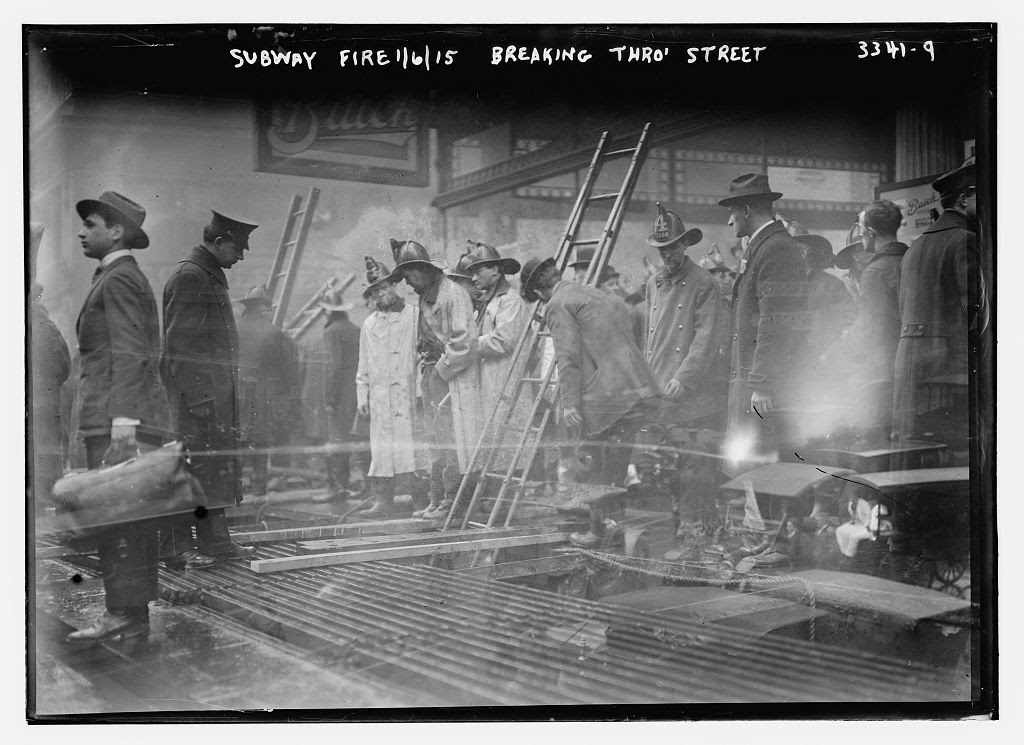
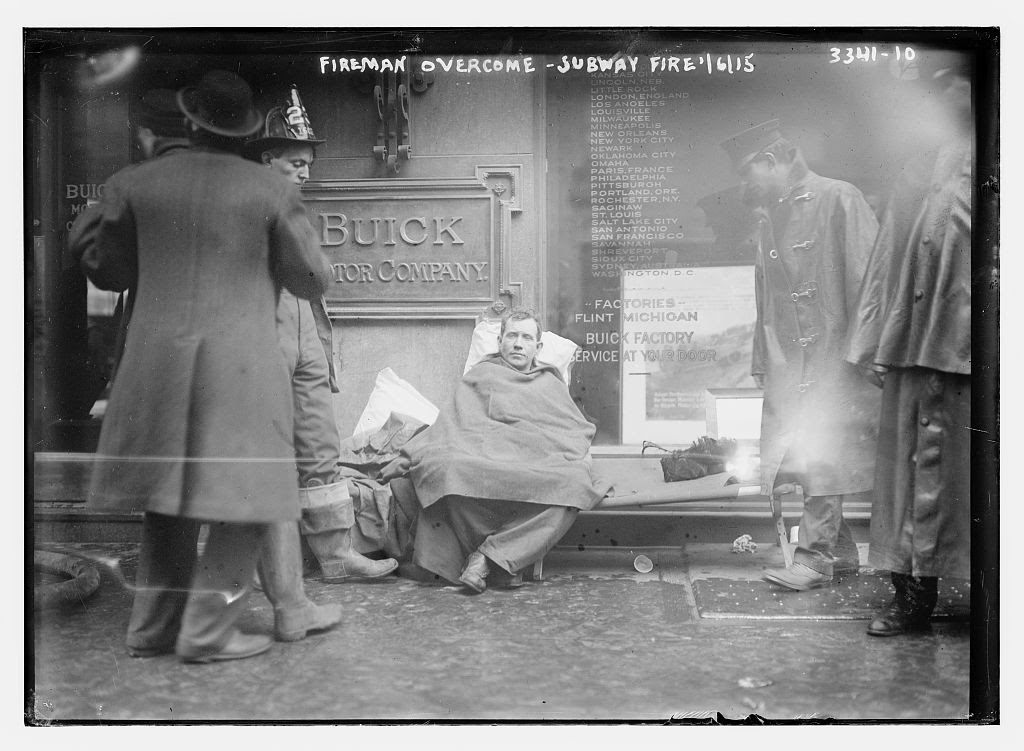
Firefighters had few options in rescuing passengers. Â Most were delivered up ladders along a small passage at 55th Street. Â The air was so toxic that many firemen were themselves hospitalized.
Subway service was naturally disrupted for a few a days afterwards. Officials initially shrugged off the incident. “In the present state of the art,” said Frank Hedley, general manager of the Interborough Rapid Transit, “there is nothing known which will prevent the recurrence of short circuits.” However, attention soon turned to woefully inadequate insulation used in subway wiring.
“New York received a warning, when hundreds of passengers were suffocated in the subway. Â The next occurrence may be far more serious in loss of life due to a similar cause — suffocation. No time should be lost remedying the most serious defect of the subway, viz. lack of suitable ventilation at all times.” [source]
Redesigned subway cars and fireproof wiring would soon ensure such a disaster would not occur again.
PODCAST This year is the 125th anniversary of one of the worst storms to ever wreak havoc upon New York City, the now-legendary mix of wind and snow called the Great Blizzard of 1888.
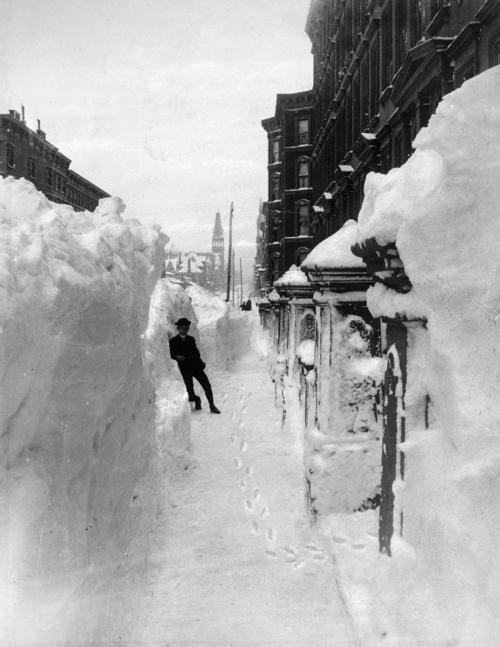
Its memory was again conjured up a few months ago as people struggled to compare Hurricane Sandy with some devastating event in New York’s past. And indeed, the Blizzard and Sandy have several disturbing similarities. But the battering snow-hurricane of 1888, with freezing temperatures and drifts three stories high, was made worse by the condition of New York’s transportation and communication systems, all completely unprepared for 36 hours of continual snow.
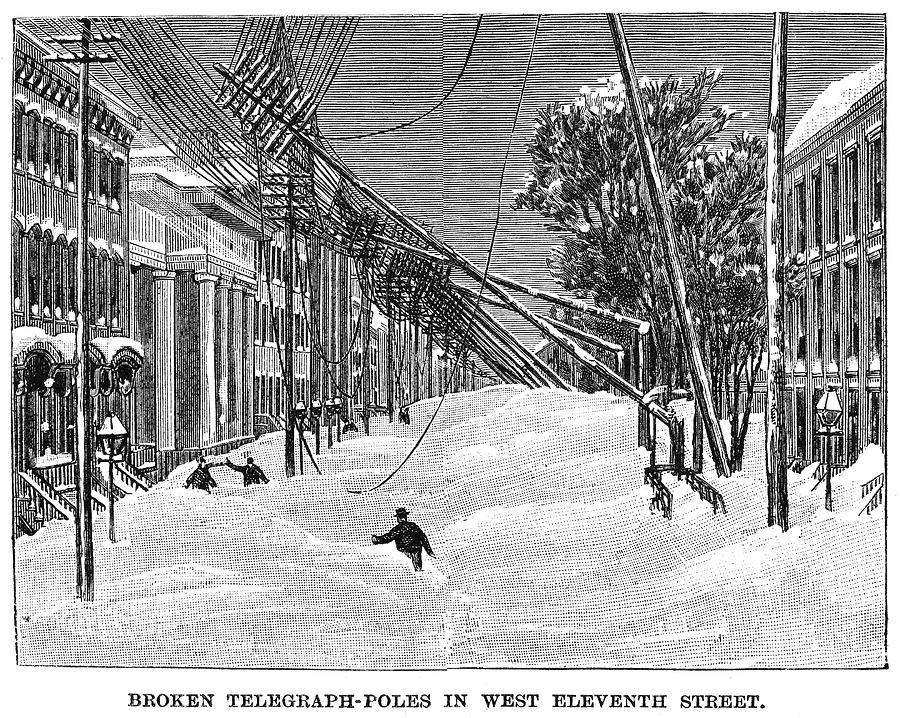
The storm struck in the early hours of Monday, and many thousands attempted to make their way to work, not knowing how severe the storm would be. It would be the worst commute in New York City history! Fallen telephone and telegraph poles became a hidden threat under the quickly accumulating drifts.
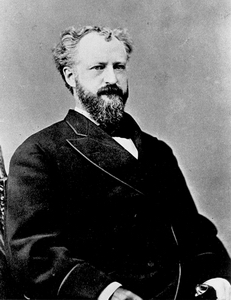
Elevated trains were frozen in place, their passengers unable to get out for hours. Many died simply trying to make their way back home on foot, including Roscoe Conkling (at right), a power broker of New York’s Republican Party.
But there were moments of amusement too. Saloons thrived, and actors trudged through to the snow in time for their performances, And for P.T. Barnum, the show must always go on!
STARRING: Hugh Grant (although maybe not the one you’re thinking)
NOTE: And, yes, we can’t believe the timing of this one, releasing on the same date of an ACTUAL blizzard. We really had this one planned for awhile, delayed it a bit because it seemed too eerie to do it so close after Hurricane Sandy.
So if you’re in New York or the northeast United States, stay inside, stay safe and let this podcast be the only dangerous snow drifts you experience this week!
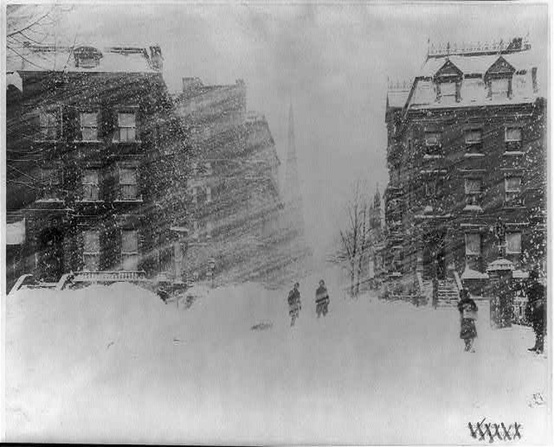
In the blizzard of 1888, the streets disappeared and the snow came down almost horizontally. Imagine being trapped at work, several miles from your home. This was the plight experienced by thousands of New Yorkers (and others throughout the northeast) that Monday. (Library of Congress)
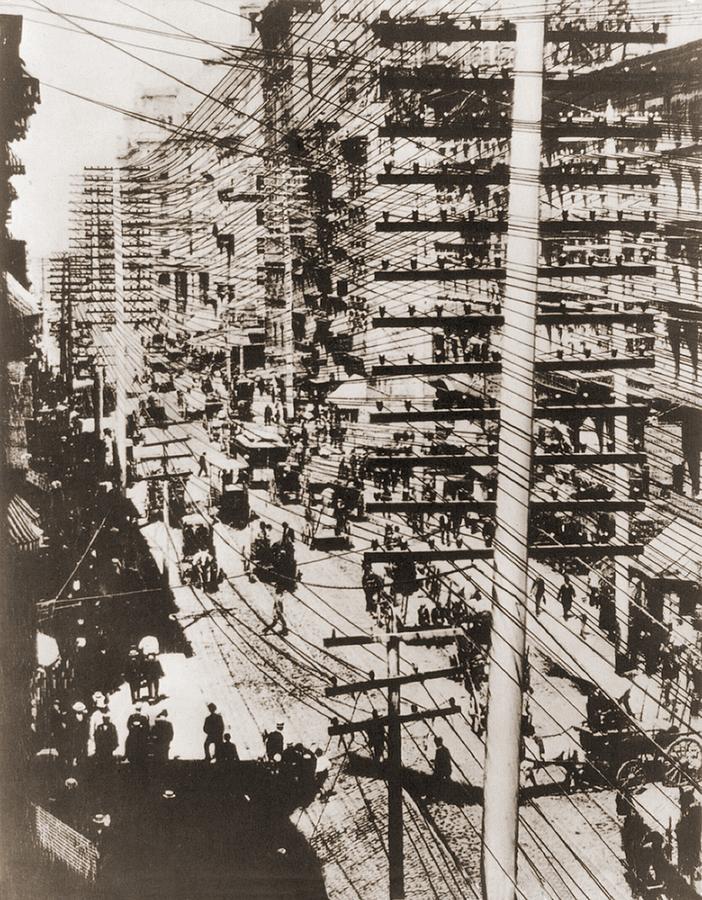
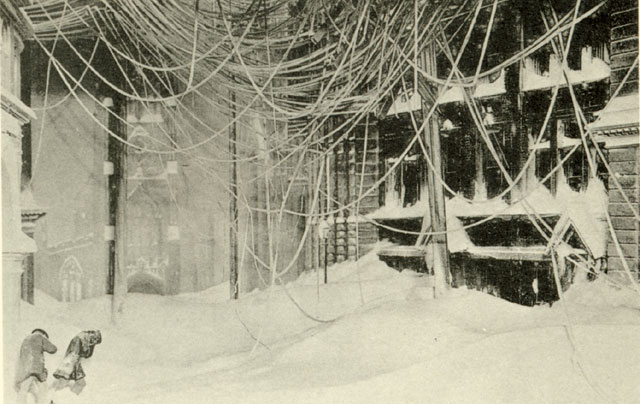
Why did the 1888 blizzard become such a hazard for New Yorkers? Let this picture be your first clue. The city was a cobweb of elevated telegraph, telephone and electric wires. This picture is from 1887. (LOC)
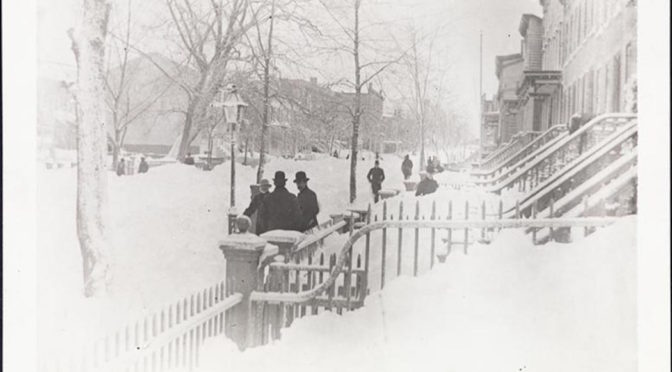
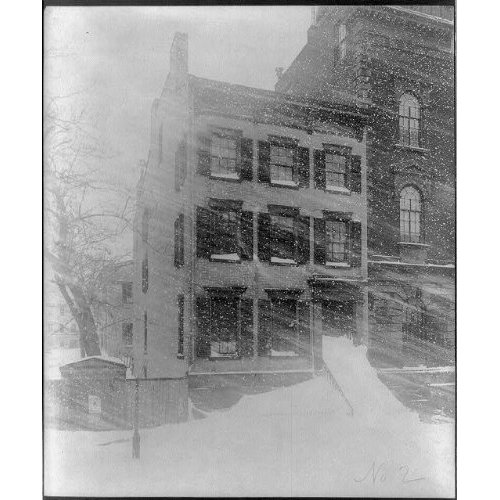
One example of a terrible (although minor) snow drift that might have kept this family in their home all day. Because of the unpredictable changes in wind, some houses might have been drift-free, while others close by completely locked in with snow. (LOC)
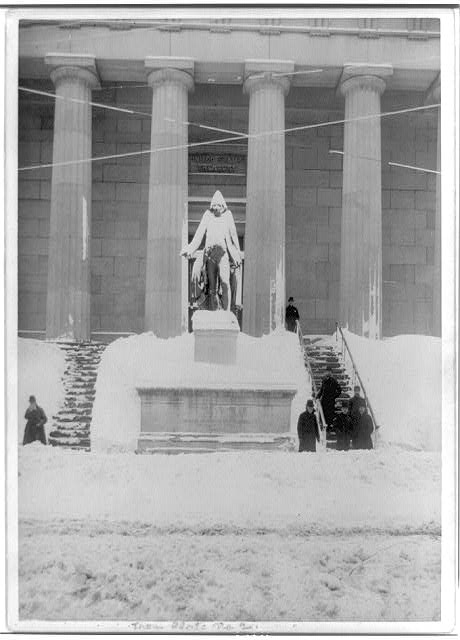
George Washington at the Sub-Treasury Building (today Federal Hall). I ran this photo a few weeks ago, but it’s so bizarre that I think it needs a second posting.
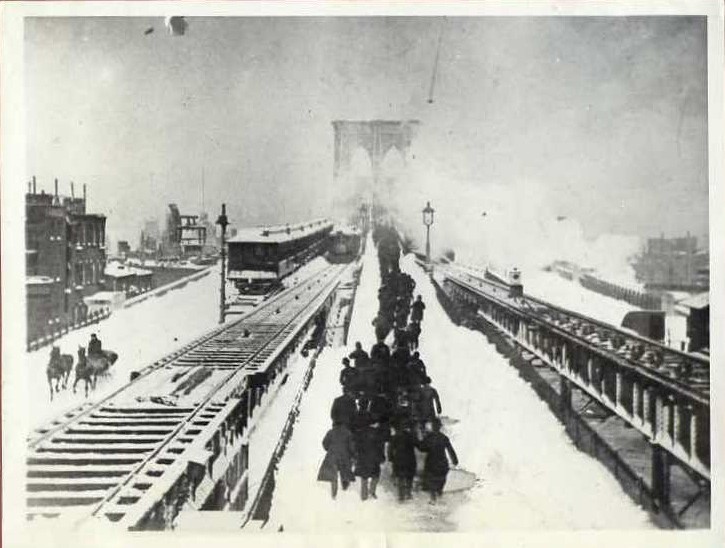
The Brooklyn Bridge, not even five years old, weathered the winds quite well, but became a hazard due to ice. In this picture, people are crossing over as there was no other way to get between Manhattan and Brooklyn. It’s not clear if any of the trains are operating in this picture.
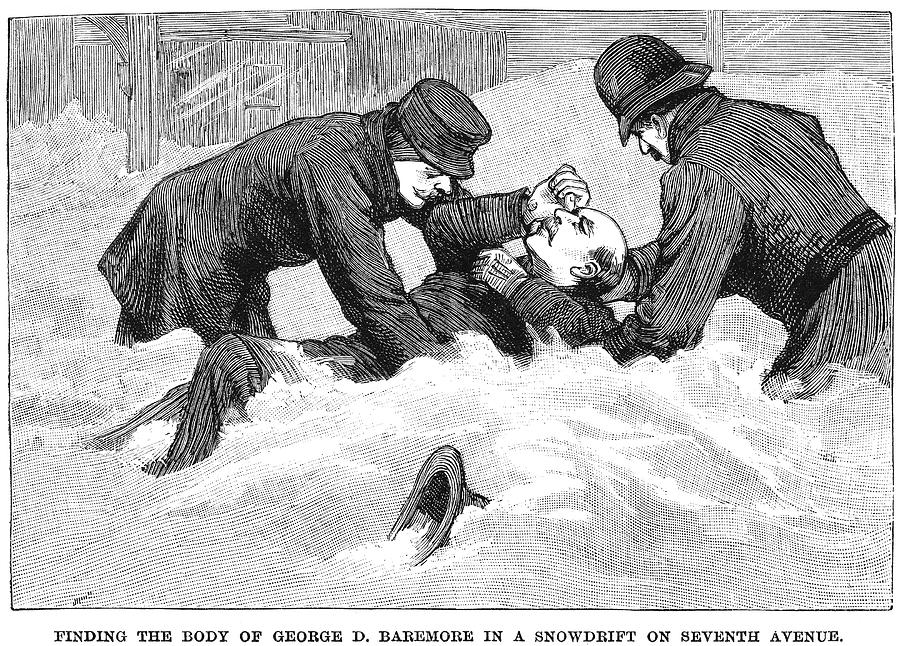
The biggest danger for those venturing outside were the hundreds of downed telegraph, telephone and electrical poles, no match for the intense gusts. The poles would quickly fall then get covered with snow, creating deadly hazards for people walking past. The snow would just as quickly cover over an unconscious individual; many New Yorkers froze to death when they fell and were instantly shrouded.
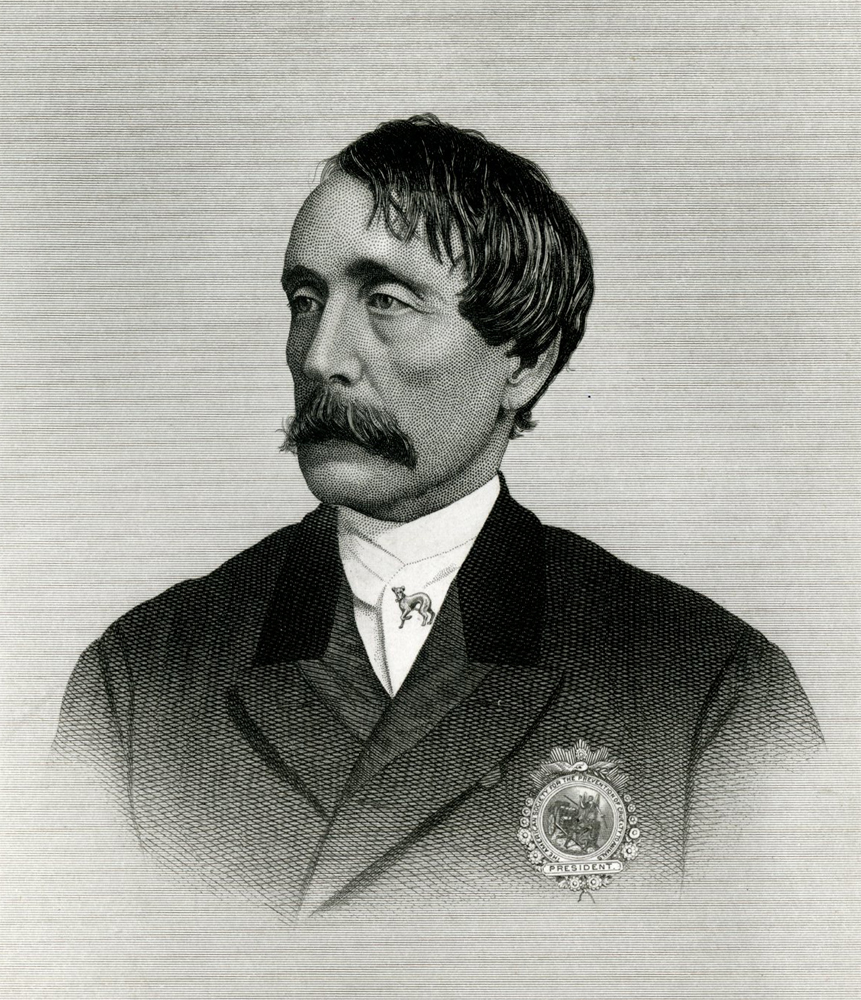
Henry Bergh, founder of the American Society for the Prevention of Cruelty to Animals. He did not survive the blizzard. (NYHS)
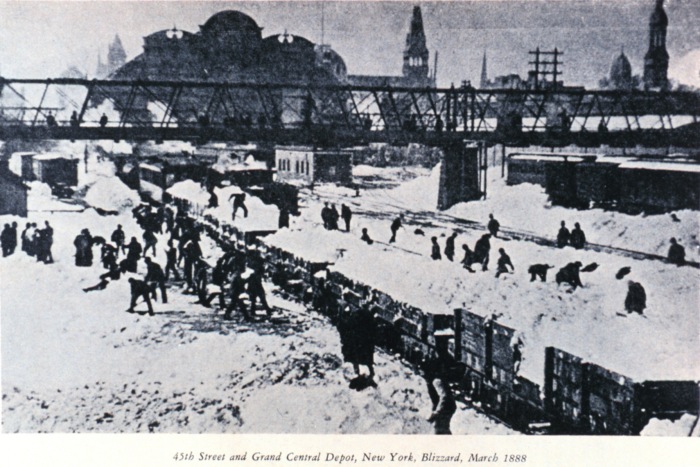
Transportation in and out of the city was at a complete standstill for half the week. Here workers frantically try to clear the way for trains going into Grand Central Depot.
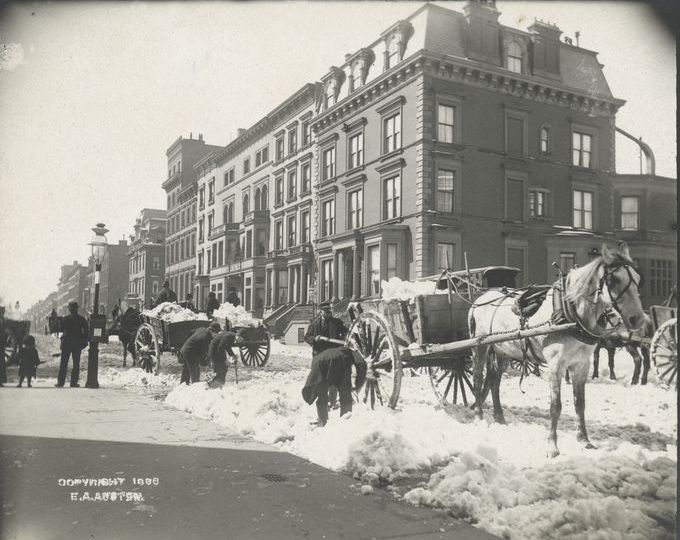
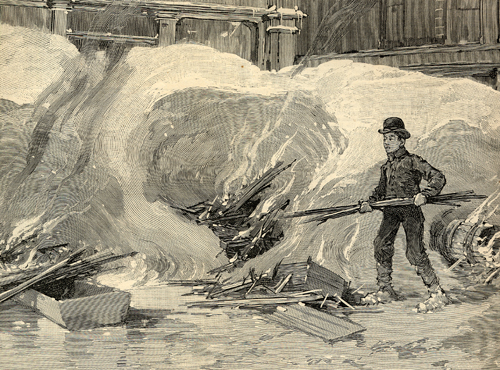
Clean-up was truly chaotic, a feeble effort by the city paired with private contractors with horses, shovels and carts. The piles of snow were taken to water’s edge and dumped, or, in a few less preferred cases, people just started bonfires and melted it away. (For a great picture of a snow dump in the river, see this photo at Shorpy of a blizzard from 1899.) Top pic courtesy LOC, at bottom Maggie Blanck.
The cover of Frank Leslie’s Illustrated Newspaper, usually one of the more sensational pieces of journalism people might have found at their newsstand.
If you were the type of child who idolized the inventor over the sports hero, then the decade of the 1900s was something of a creative revolution. Children enamored by the flurry of new inventions in the late 19th century — the railroad, the telegraph, the camera — could only imagine interacting with these devices. The Lionel train set, introduced by a toy store on Cortlandt Streetin 1900, was a perfectly marvelous device. It just wasn’t the real thing.
But with new wireless telegraphy (soon to be called ‘radio‘), one needed only the basic technology — the battery, the tubes, the coils. No tracks, no excessive lengths of wiring, no expensive film processes. A curious child could jump right into the world of radio, into the very same airwaves being used by adults.
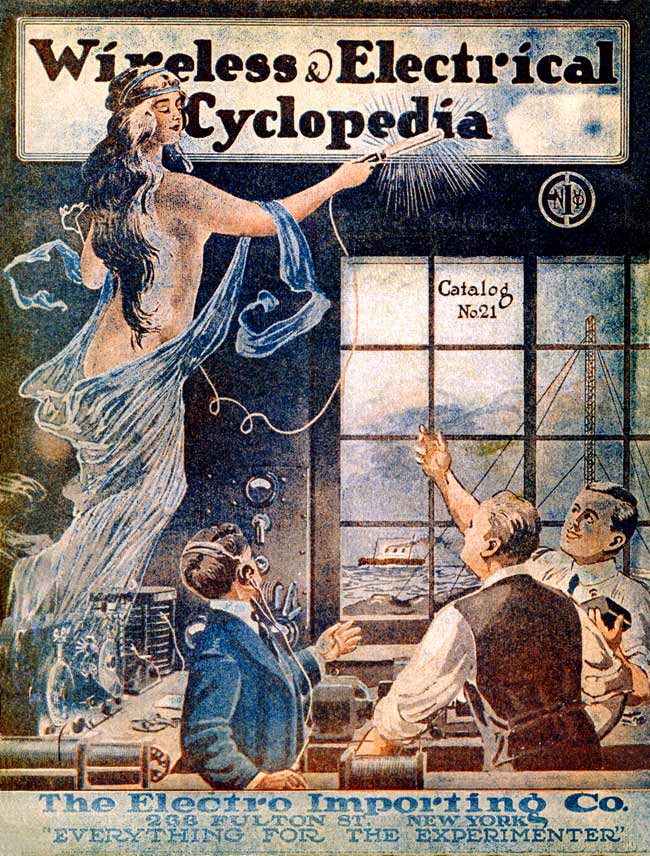
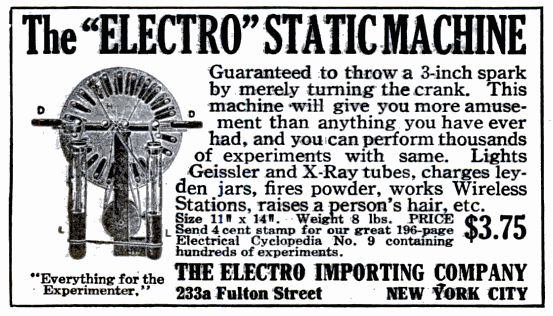
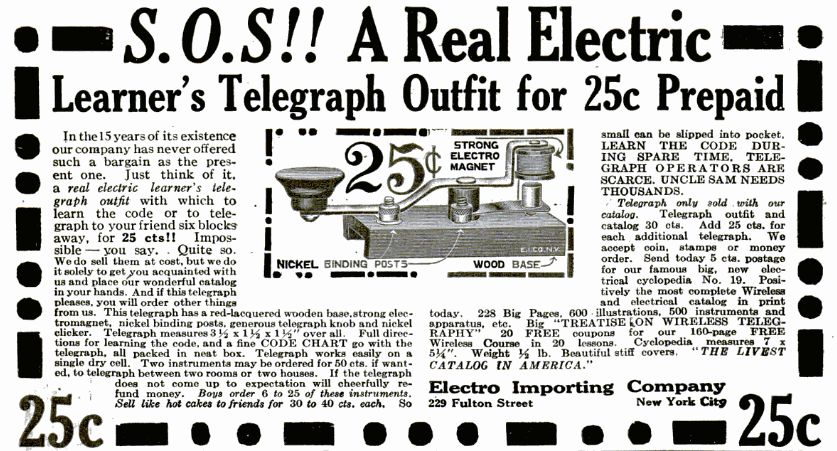
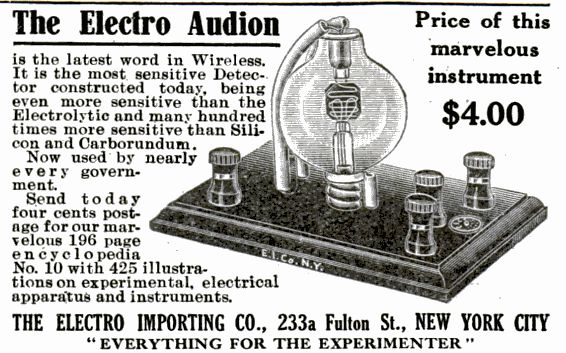
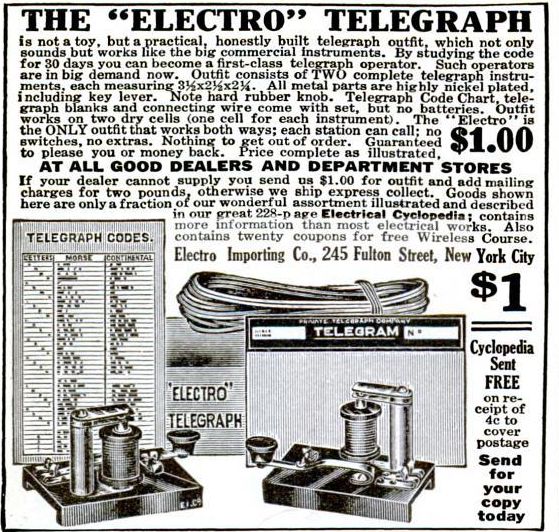
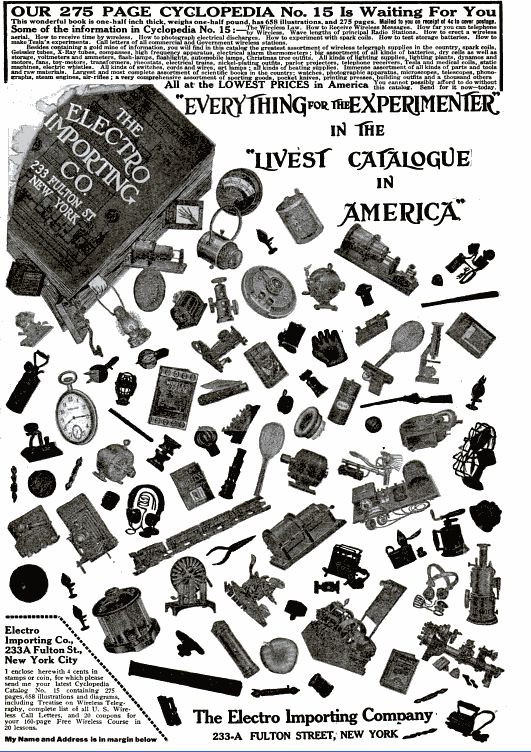
Radio technology was barely a decade old when a marvelous company appeared in downtown Manhattan called the Electro Importing Company which opened for business in 1905. They soon moved to permanent offices on 233 Fulton Street. (An ad below also listed an office at245 Fulton Street.) Although they also sold radio parts to adult wireless operators, basic receivers and transmitters could be produced and sold to children as sophisticated toys. As radio was vastly unregulated before World War I, a young boy or girl could literally send and receive transmissions from their own bedroom, sending out Morse code and picking up messages from miles away.
Just imagine having that power as a 12-year-old. One hundred years later, children would be dazzled by handheld technologies (video games, cell phones) that not even adults could explain how they work. With Electro products, children could emulate professional wireless operators and quickly understand how the core processes worked. In essence, anybody could imagine themselves on the path to becoming a great inventor. In fact, the early Electro products were almost an exact duplication of devices used by radio inventors Gugliemo Marconi and Lee De Forest.
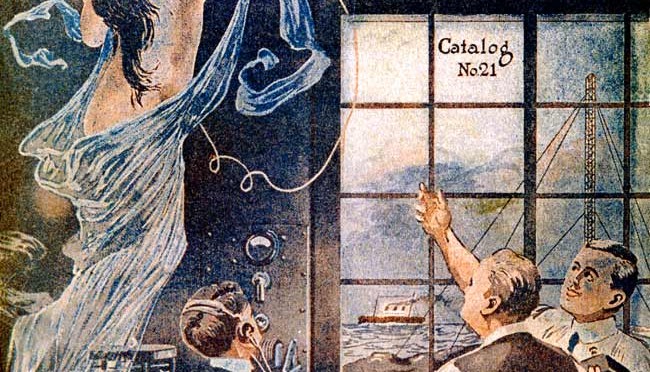
Below are a few advertisements for Electro Importing products advertised in various issues of Popular Mechanics magazine from the 1910s. Although the products were aimed at all radio enthusiasts and in one ad are explicited advertised as ‘not a toy’, their yearly catalogs — as amply illustrated for the cover above — make it clear who their desired audience was ‘every wide-awake American boy’. [source]
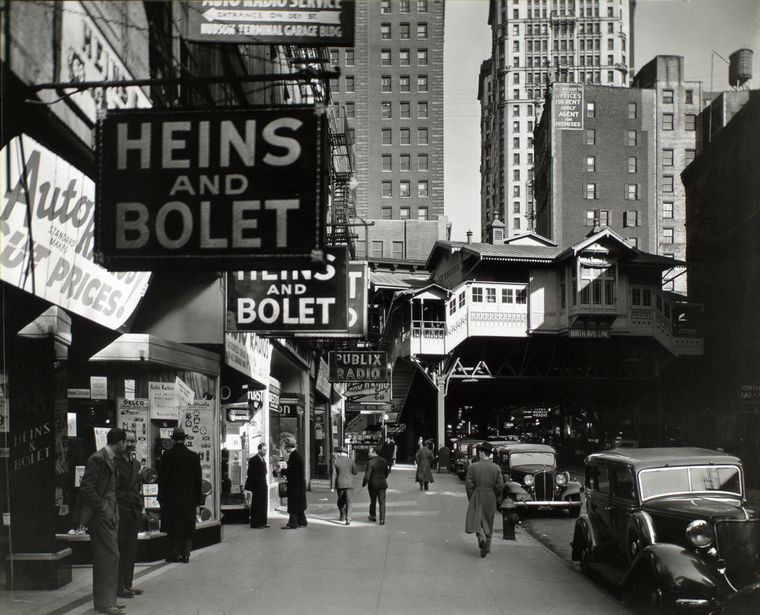
Perhaps this is coincidental, but a few years later, New York’s famed Radio Row soon developed in the neighborhood surrounding the Electro Importing offices. A mere block away, on Cortlandt and Greenwich streets, retailers specializing in home radios sprouted up in the early 1920s. Radio Row soon became the place to buy the latest in home console entertainment.
In the 1960s, the former offices of the Electro Importing Company and all of Radio Row was demolished to make way for the construction of the World Trade Center.
Below: Radio Row in 1936, photo by Berneice Abbott
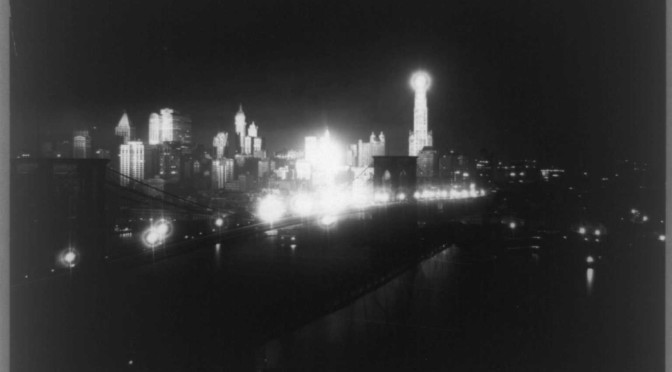
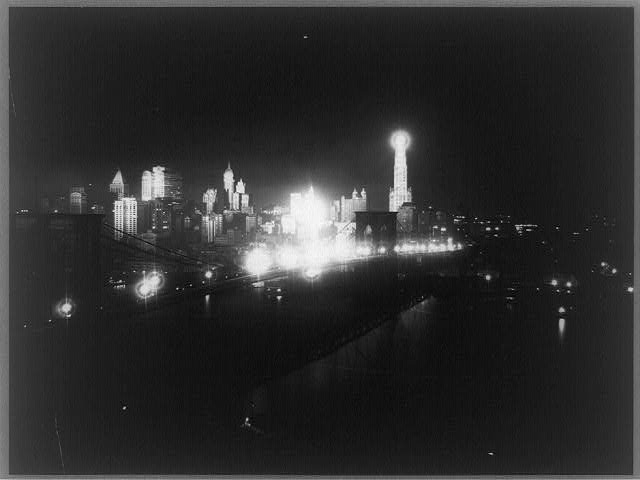
That Gotham glow: The powerful Sperry searchlight drapes the dark city in light. The Woolworth Building is lit up like a candle.
A thin, bright streak of light brushes across the sky and dances off the clouds above. With few buildings over fifteen stories and the city’s electrical lights at a fraction of the intensity that they are today, the white piercing beam would have awakened the night sky, the most powerful illumination in the sky with the exception of the moon.
It was March of 1919, and the device creating this expressionistic Gotham nightscape was the Sperry Searchlight.
Since the first arc lights installed along Broadway in 1880, New Yorkers had grown accustomed to electric light. In fact, Times Square and the stretches of Broadway had become New York’s entertainment capital because of it. But searchlights were still a bit of a novelty, devices more associated with wartime. Innovations in electrical light changed how wars were even fought; combatants in World War I aimed spots to the skies to search for enemy zeppelins and scoured the grounds below for encroaching forces.
New Yorkers would have been used to seeing searchlights atop the city’s newest, tallest buildings. The first New Year’s celebration at One Times Square used a searchlight to blanket stunned crowds below. Both the Flatiron Building and the Metropolitan Life Tower in Madison Square were equipped with searchlights during elections. They were an effective way to present information. For the 1908 presidential election, the New York Herald announced that a searchlight atop the Met Life building would swing north if William Howard Taft won and south if the victory went to William Jennings Bryan. That night, the beam turned north.
But the Sperry Searchlight was different. The powerful device, created in the mid 1910s, was described by a science journal of the day in 1917 as ‘the world’s most powerful searchlight’ and as bright as ‘the fiercest sunlight’. “The heat of its focused beam is so intense that it will set paper afire at a distance of two hundred and fifty feet …. It will burn your skin at three hundred feet.’
This intense searchlight was the product of Brooklyn innovator Elmer Ambrose Sperry, whose greatest invention, the gyrocompass, was quickly adopted by the United States Navy and almost immediately changed sea travel forever.
From the Sperry Gyroscope Company — the ten-floor building still stands at 40 Flatbush Avenue Ext. by the Brooklyn entrance to the Manhattan Bridge — the inventor and his team created a host of new items, many for the military. (Did you know that the Sperry Company created the first airplane autopilot?)
In 1919, one version of his new and improved searchlight made a test run, presumably atop the roof of the Sperry building. If you look at where the building is on a map, you can almost trace the beam from the roof along the line of its projection.
Over the Brooklyn Bridge, bouncing off the first line of buildings along the east of Manhattan, and illuminating three of New York’s tallest and best known buildings of the day — the Singer Building (center left), the Park Row building (center right), and the majestic Woolworth Building (the tallest beacon-like structure, center right).
Images like this one weren’t just documents of technological success. (Although good night photography itself was a pretty nifty trick, even in 1919.) They helped build the mythology of the city, which in 1919 was about to go down the rabbit hole of Art Deco and inspire new architects to populate the skyline with more ambitious and futuristic towers.
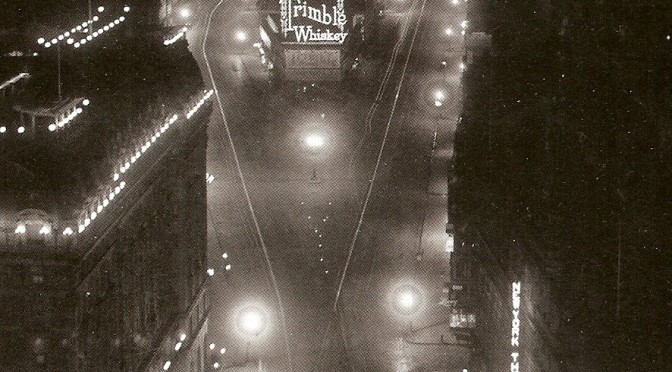
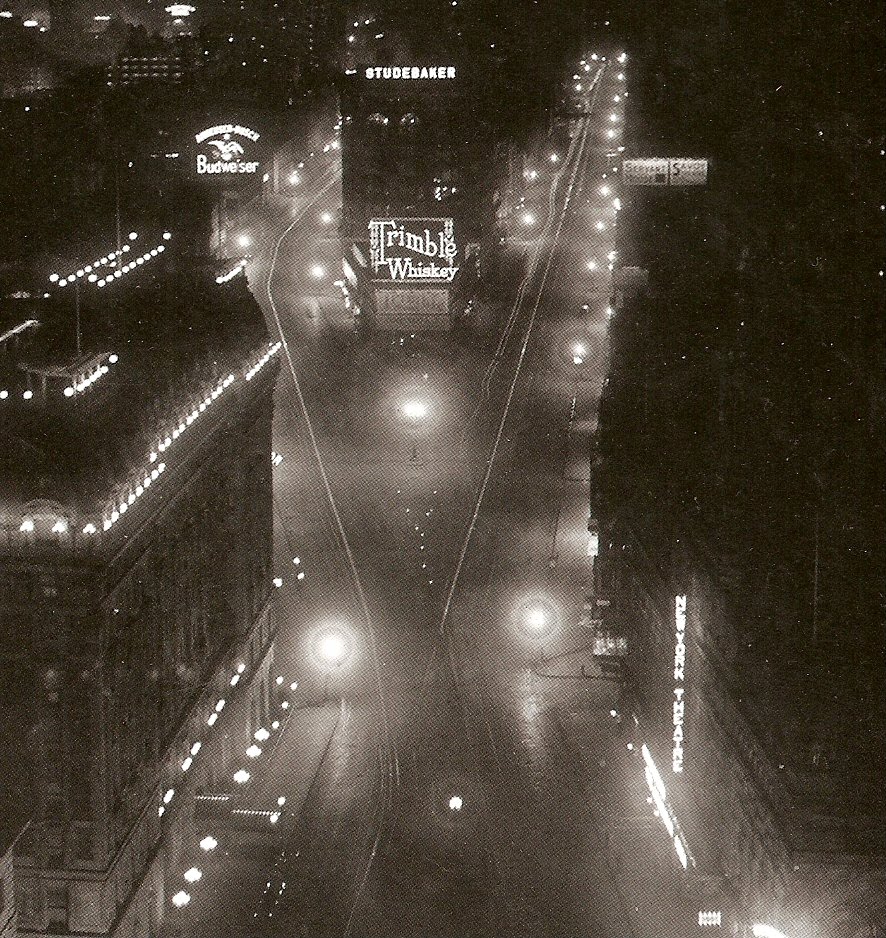
From atop the Times Tower, in 1904, another world lights up below.
The year that turned a ragged, uptown intersection into the place known as Times Square also brought an important work of advertising to the area, for a product that has been all but forgotten.
Oscar J. Gude was already a master of outdoor billboards and electric-light signs when, in 1904, his company installed a sophisticated advertisement for Trimble Whiskey, featuring two glasses in mid-toast nestled by the liquor’s fancy logo. (The glasses don’t seem to be on in the picture above.)
Gude had much better and more memorable ads throughout the city; his firm was perhaps best known for its Heinz pickle ad that hung above Madison Square. But the Trimble sign was placed on the north side of 47th Street, between Broadway and 7th Avenue, making it the first in a long line of dazzling electronic advertisements to be placed at this key intersection.
Times Square was already an advantageous place to hang things due to the sight lines created by long, even avenues. As one of the first electric signs, the Trimble name could be seen from almost a mile away down certain corridors. At night, the words ‘Trimble Whiskey’ could be seen reflecting into the new Times Square across the plaza. Theater goers leaving one of the new stages on 42nd Street stopped to take a gander at the glowing lights before boarding a trolley, or entering the crisp, new subway station.
As you can tell from the picture above, Trimble was quickly joined by a few other night lights. Bur for a time, only the street lamps, a couple small marquees and the haunting glow from the Hotel Astor were its competition.
Just a few years later, a bold corset advertisement would scandalously light that very wall. From the 1910 journal Printers Ink, the electric corset-wearer “stands out boldly against the night, at the spot where late a Trimble Whiskey sign has been wont to create thirsts by the thousand, which only the nearby gilded palaces could satiate properly.”
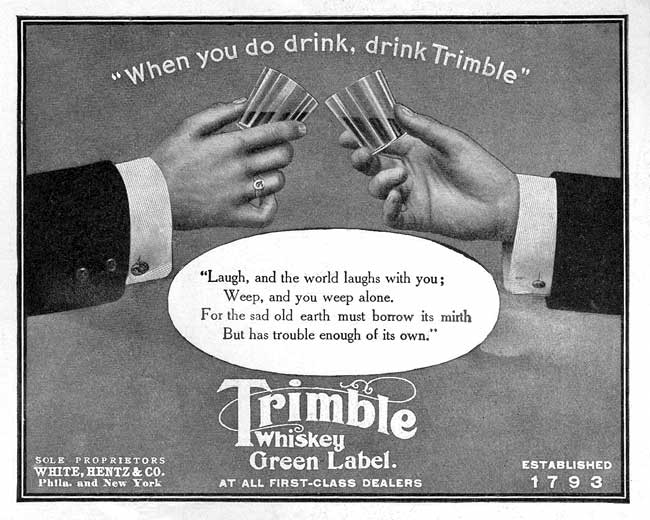
As for the liquor itself, it reportedly originates from one George Trimble who “brought this brand over the Allegheny Mountains on a Conetogas wagon” in the 1820s or ’30s. (The ad below dates its creation even further, to 1793.) It was distinguished by a green label and, despite its handsome advertisements, didn’t seem to last but for a few years more.
Below, a print ad for Trimble, featuring their signature clinking glasses, from an April 1904 issue of LIFE Magazine. [from Magazineart.org}