Could you imagine Pauline Kael‘s opinions of Netflix and Amazon growing influence over the motion picture industry? What would she say about watching The Irishman
— made by one of her favorite film directors — on an iPhone? Would she
be a fan of the Marvel Cinematic Universe? (I think we can predict that
answer.)
What She Said: The Art of Pauline Kael Film Forum: Wednesday, December 25 – Tuesday, January 7
In the hugely entertaining new documentary What She Said: The Art of Pauline Kael — now playing at the Film Forum,
a venue the legendary film critic probably popped into one or two
hundred times — the filmmaker Rob Garver invites the audience to imagine
the presence of Kael in our modern world.
It’s a fun thought experiment as there is nobody quite like Kael — in
film criticism or Twitter or any aspect of modern culture for that
matter.
Kael got her start in film criticism in San Francisco — her first published review trashed Charlie Chaplin’s Limelight. From that review:
“The Chaplin of Limelight is no irreverent little clown; his
reverence for his own ideas would be astonishing even if the ideas were
worth consideration. They are not — and the context of the film exposes
them at every turn.”
But it was her legendary run at The New Yorker magazine starting in 1967 that positioned her as the kingmaker of the modern American New Wave.
What She Said gives its audience a crash course in film
history; its dozens of licensed film clips are reason enough alone sink
back into your seat in pure delight. Kael celebrated both vanguard
directors and celebrated so-called ‘trash’ cinema.
“Seeing trash can liberate the spectator. I don’t trust anyone
who doesn’t admit having at some time in his life enjoyed trashy
American movies; I don’t trust any of the tastes of people who were born
with such high taste that they didn’t need to find their way through
trash.”
Garver deftly balances What She Said between a sequences of
nodding reverence (Kael would have had no problem with those, I suspect)
and doses of hard-spun reality.
Many filmmakers and critics hated Kael; they hate Kael — to this day.
And you hear from them. But nobody rejects her influence over the fate
of American films.
She elevated the entire medium at the exact moment when Americans
were finally responding the European New Wave. She championed the greats
and even a few not-so-greats. (As the film notes, sometimes even her
own taste was enigmatic.) She helped made American movies what they are
today — for better or worse.
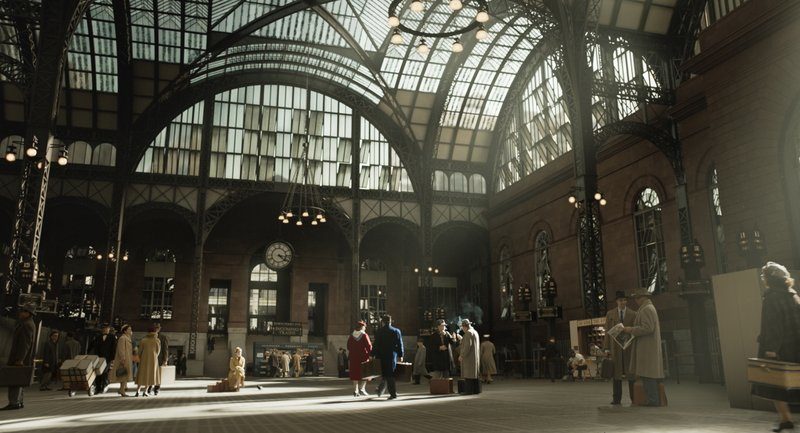
Penn Station as recreated in Warner Bros. Pictures’ drama “MOTHERLESS BROOKLYN,” a Warner Bros. Pictures release.
Motherless Brooklyn, a radical retro transformation of Jonathan Lethem’s book of the same name, refits the bright noir of the movie Chinatown into 1950s New York City. Edward Norton, who wrote and directed this adaptation, also stars as its central figure — Lionel Essrog or simply Brooklyn, a detective with Tourette syndrome and a photographic memory.
The film is a lot. Its success for you will depend on your tolerance for Norton’s performance as Brooklyn, who explodes with spontaneous verbal tics while on a labyrinthine case nodding (often blatantly, sometimes brilliantly) to dozens of classic detective tropes.
I saw it a week ago and I’m still not sure whether I loved it or detested it. It’s a movie full of wonderful concepts, fascinating history and a few failed ideas.
But if you’ve ever listened to our podcast — or spent more than five minutes on this website — then I’m pretty sure you’ll find something to admire in Motherless Brooklyn.
The list below contains no big spoilers pertaining to the film’s plot, but prepare to recognize the following historical figures and concepts. In fact you might like to listen to a podcast or two before or after you view the film. Some listening suggestions are below:
THE POWER BROKER
In many ways Motherless Brooklyn is as much an adaptation of The Power Broker as it is Lethem’s detective novel. (There are at least three character monologues that feel like information dumps from the book.)
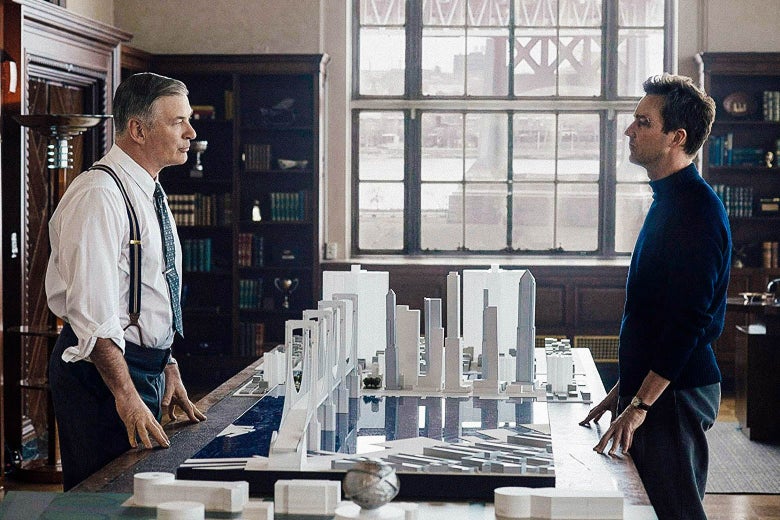
The central antagonist Moses Randolph (Alec Baldwin) stands in for Robert Moses, the unelected city official who amassed great power during the 1940s and 50s, shaping the city to his whims. By the ’50s, Moses has collected several job titles, lording over weak mayors and determining the city’s fate — with little consideration for individual community needs.
Warner Bros
TRIBOROUGH BRIDGE AND TUNNEL AUTHORITY
In Motherless Brooklyn, Moses’ instrument for change is actually called the Borough Authority, but its headquarters are located in the same place as Moses’ — Randall’s Island. Originally commissioned by the state to construct the Triborough Bridge, the authority’s merged with other city agencies under Moses.
THE GREAT MIGRATION
Thousands of African-Americans moved out of the South in the first half of the 20th century — escaping the dominance of Jim Crow laws — and many came to New York City, only to find a familiar tenor of discrimination here. By the 1940s, housing shortages in black communities like Harlem vexed African-Americans who were unable to rent from many landlords in mostly white neighborhoods.
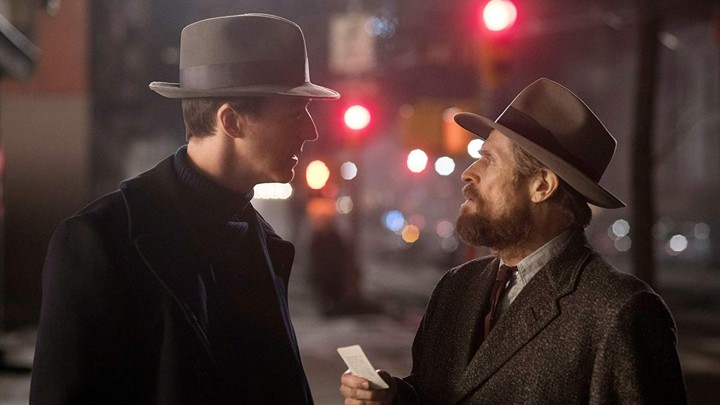
Norton with Willem Dafoe in a stand-out performance. Courtesy Warner Bros
REDLINING
The process by which banks and insurance companies, with de facto approval by the city, denied loans and mortgages to residents in predominantly minority neighborhoods, leading to the deterioration of those neighborhoods, leading them to be labeled ‘slums’. When then led to….
SLUM CLEARANCE
An urban renewal strategy popular in the mid-20th century — Robert Moses was its maestro — involving the complete demolition of neighborhoods labeled slums and relocating its displaced residents to public housing in far off (less valuable) quadrants of the city. In many cases, those neighborhoods were not ‘slums’ at all; that is, they were thriving places that just happened to be homes to black, Hispanic or Jewish residents.
EAST TREMONT
A neighborhood in the South Bronx, largely populated with working class Jewish residents, decimated by the construction of the Cross Bronx Expressway in the 1940s and 50s. From The Power Broker: “The one mile of the Cross-Bronx Expressway through East Tremont was completed in 1960. By 1965, the community’s “very good, solid housing stock,” the apartments that had been so precious to the people who had lived in them, were ravaged hulks.
Glen Wilson/Warner Bros.
JANE JACOBS
Cherry Jones plays Gabby Horowitz, a community activist very much in the mold of Greenwich Village crusader Jane Jacobs. There’s even an interesting nod to her work in Washington Square and a notable rally which took place there in 1958.
HARLEM JAZZ
Harlem’s glorious jazz-club tradition is vividly illustrated in one set piece — a smoky club called the King Rooster. The film used the actual St. Nick’s Pub (St. Nicholas Avenue at West 149th Street) which dated back to the 1930s. Sadly the club burned down in 2018 in a tragic blaze which killed a firefighter.
THE ORIGINAL PENNSYLVANIA STATION
By the 1950s, the first Pennsylvania Station — above ground, designed by McKim, Meade and White — was just a few years away from demolition. It was deteriorating and not very clean by then, but Norton thankfully recreates a fantasy, photo-perfect version of Penn Station. It’s genuinely breathtaking.
SWIMMING
Robert Moses was a champion swimmer and even let his hobby influence early policy, constructing ten massive swimming pools during the 1930s with Work Progress Administration funding. Quoting Caro: “Moses gave each of his pools … his personal attention. Under his prodding, his architects adorned them with masterful little touches; over the entrance which divided men from women as they entered the bathhouse at the Corona Pool complex sat a stork wearing an expression that made him look as if he were puzzling over the physical differences in the creatures he had brought into the world.”