An extraordinary photograph of Yiddish theater stars! Front row: Jacob Adler, Sigmund Feinman, Sigmund Mogulesko, Rudolph Marx; Back row: Mr. Krastoshinsky and David Kessler
For a passionate sub-set of New Yorkers, Mogulesko was everything.
The Romanian-born theater star Sigmund (also written as Zigmund or Zelig) Mogulesko came to America in 1886 already a star of Europe’s Yiddish theater scene. Intrepid performers like Mogulesko helped create the Yiddish theater circuit during this decade — and, by extension, vaudeville as well, since so many of its performers would start here.
When he opened the Rumanian Opera House (later, the National Jewish Theatre) on Second Avenue and Houston Street, Mogulesko wasn’t just opening a stage. It became a vital instrument of the community and a key destination in New York’s thriving ‘little Broadway’, opera stages and vaudeville houses along Houston Street and Second Avenue uniquely catering to the immigrants of the Lower East Side.
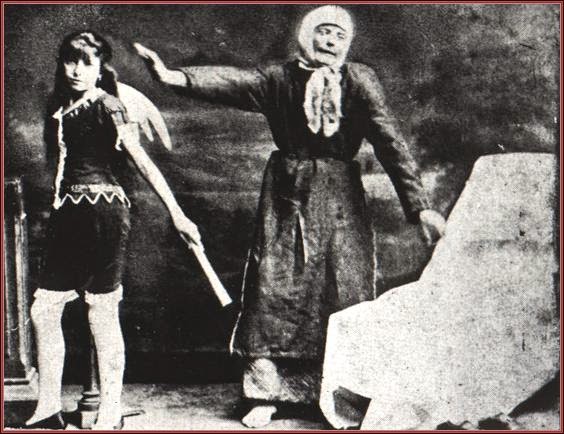
Mogulesko became America’s most popular Yiddish theater star by the 1900s, a singer and comedian with an uncanny ability to pluck the heart strings. His debut in Coquettish Ladies required a myriad of costume changes, from old to young, male to female. A Jewish historian wrote, “A born genius he was, and his personality was as marvelous as his art.” [source]
Below: Mogulesko in Joseph Lateiner’s The Dybbuk (performed in Odessa in 1884) playing the character “Grandmother Eve”
At the same time, he was little known in other parts of New York. (He allegedly never learned to speak English.) The more formal elements of the “legitimate” stage sometimes looked at the successes of the Lower East Side theater scene with bemusement and a little jealousy. “These alien citizens have a theater which they thoroughly comprehend and esteem,” said the New York Times in 1914. [source]
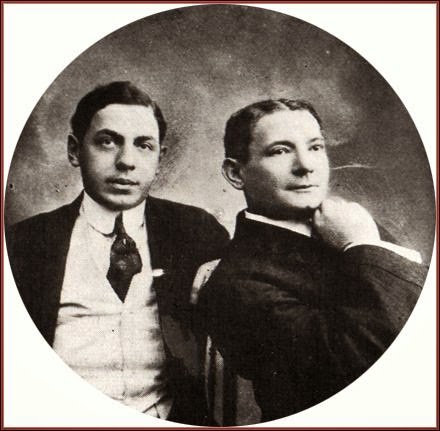
Mogulesko, at right, with his son Julius:
This accounts for the passion held by many for the performers of Yiddish stage, the embrace of an entertainment form that was undeniably theirs in language and custom. And this also accounts for the great outpouring of grief when one of its most acclaimed stars — like Sigmund Mogulesko — passed away.
His memorial service at his theater on Houston and Second Avenue caused a spectacular riot of mourning. Over 20,000 people arrived at the theater, fighting past 50 police officers swinging their clubs. “The crowd tore the theatre doors from their hinges and shattered their glass panels.” [source]
A funeral procession lined the streets all along Second Avenue, from the Hebrew Actors Club (at 31 East 7th Street) to the theater. The hearse transporting the actor’s body was engulfed “in the sea of those who hummed with queer breaks in their voices bits of the songs which had endeared the author to them.” [source] Not since the explosion of the General Slocum steamship had the Lower East Side been filled with such intense grief.
Among those who spoke at his memorial service were Jacob Adler (father of method acting coach Stella Adler) and Boris Thomashefsky, a later inspiration for the Marx Brothers and Mel Brooks. Sadness — and a certain kind of joy — permeated the service, his greatest roles and contributions to the local theater scene lauded. It was now a vital industry of New York, one that would not have thrived as it did without him.
As Moguloesko’s coffin was taken from the church, drawn by eight black horses, and carried through the falling show, all of Delancey Street was lined with thousands of mourners, watching as the hearse, now obscured in a blizzard, headed onto the Williamsburg Bridge for its eventual destination — Washington Cemetery.
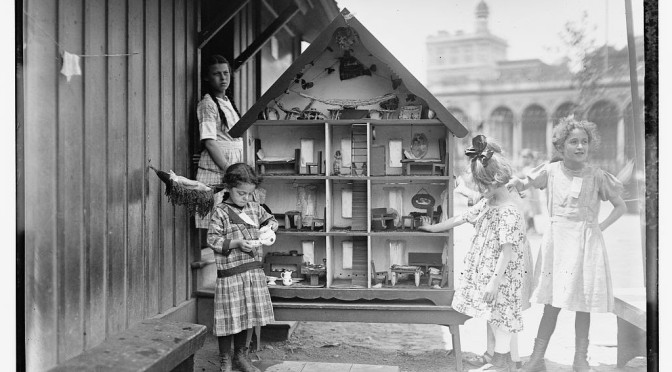
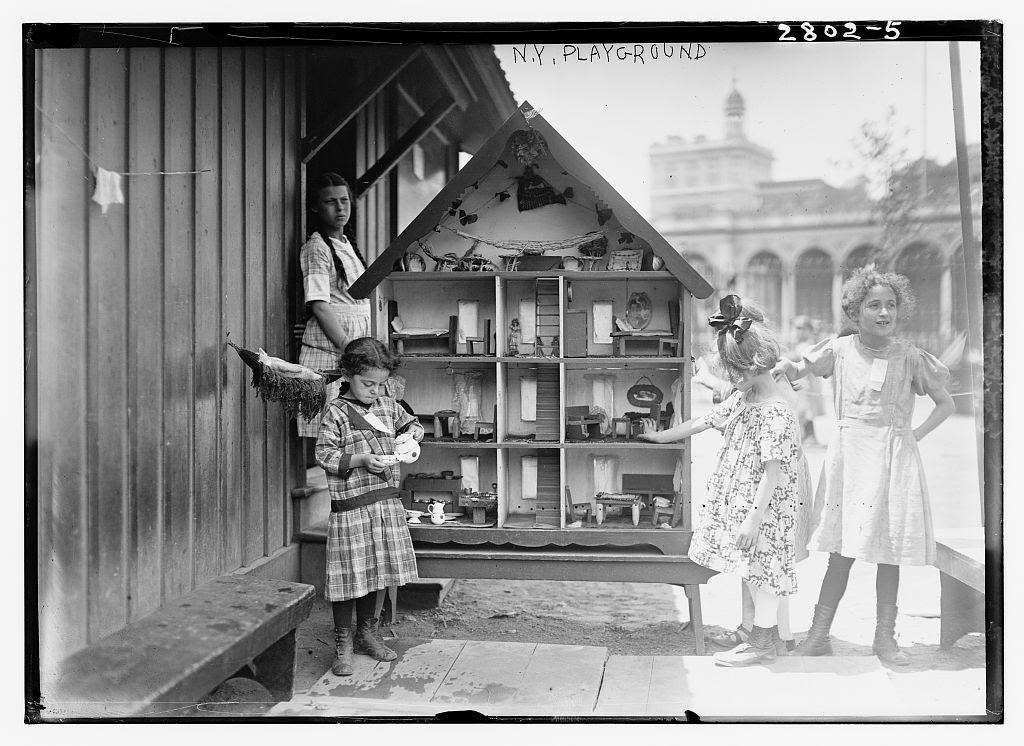
Girls with a pretty amazing dollhouse at Seward Park playground. Photo labeled August 1913
I’ll be traveling for the next few days so I’ll be posting here a bit less than normal. Next week I’ll re-post some interesting stories from the back catalog. Enjoy your weekend!
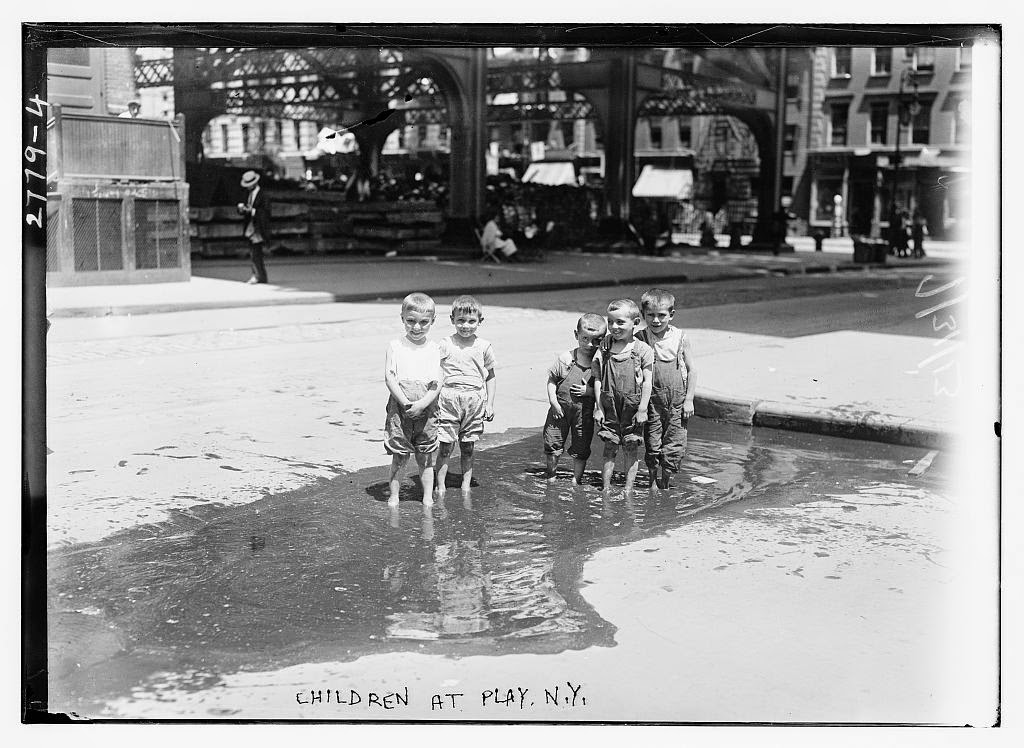
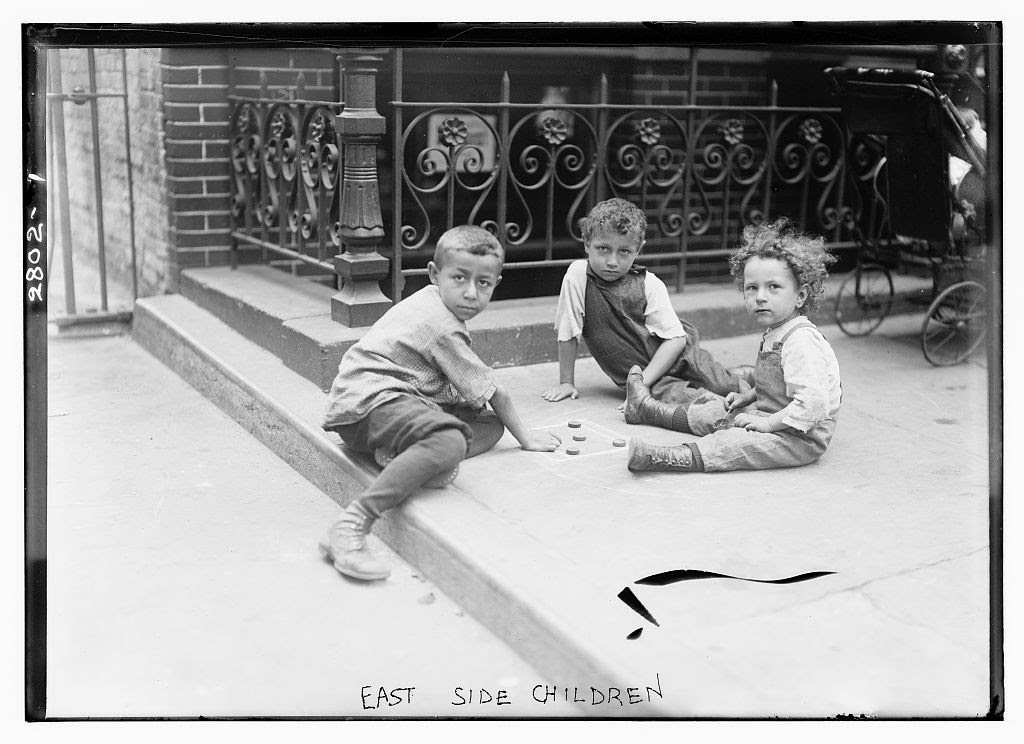
I recently discovered this first image in a collection of Lower East Side photographs, and realized how unusual it was to see pictures of children before the 1920s actually smiling and happy in photographs. This is partly due to a certain awkwardness around cameras and the relative slow process in taking a picture back then.
Also, children were usually photographed doing things that did not make them happy. The two best known social photographers of the era — Lewis Hine and Jacob Riis — were specifically trying to capture poor working and living conditions. Images of life’s little pleasures did not fit the narrative. Although in some of Hine’s photographs of tenement life, some happiness peeks through.
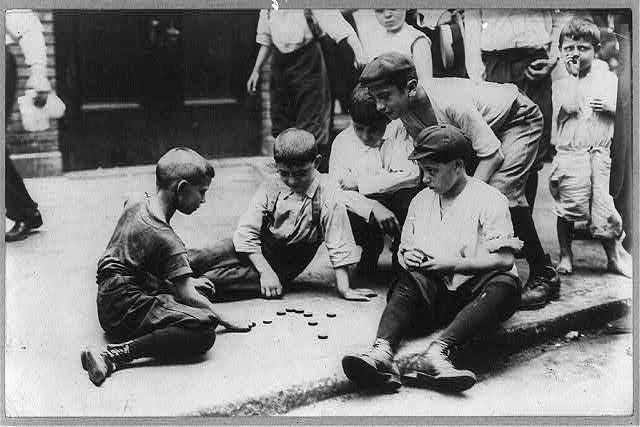
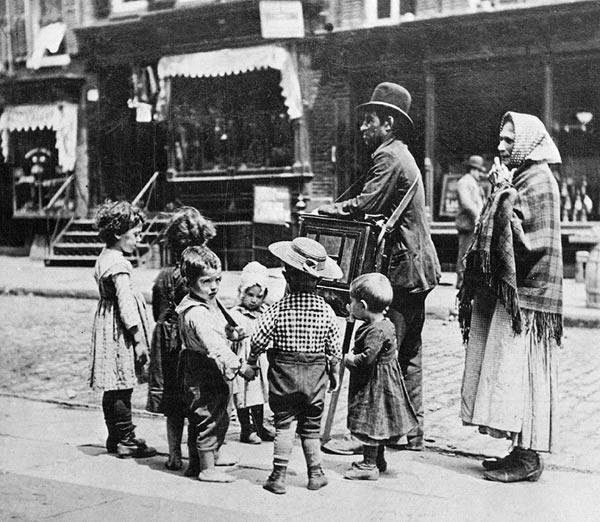
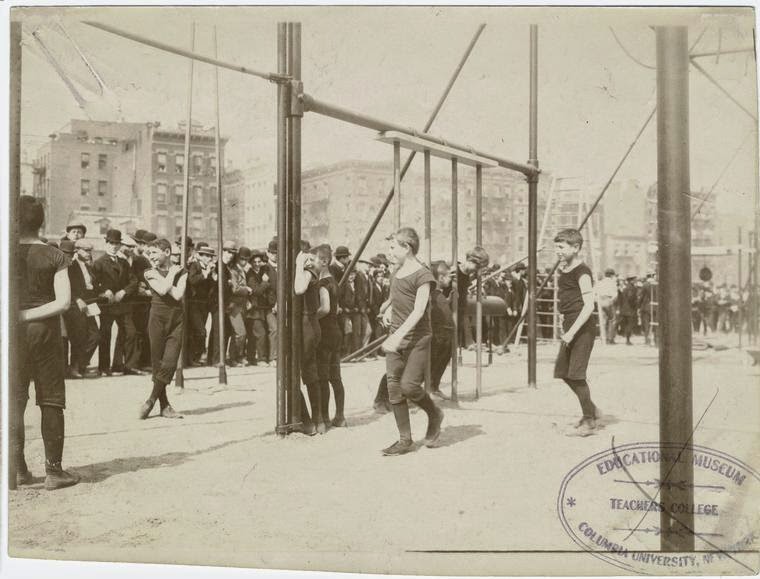
But I did find these images of kids at play, most all of them in the summer time. Take a little of their enthusiasm with you this summer! Click into the pictures for a larger view.
Children find some joy near the elevated, July 31, 1913. The kid in me wants to jump in and join them. The adult in me is thinking, “That water must be filthy.”
I believe the boys in the two pictures above are playing checkers*. Top photo is labeled August 1913, the second around the same time period. Craig on our Facebook page clarifies the images above: “I suspect that the boys in that picture aren’t playing checkers, but a distinctly NYC game called “Skully” or “Skullsy,” as some call it. At least that’s the first thing that I thought of.” Good catch!
I’m putting this in a blog post about children playing, but I do not think the boy being leaped over is having too much fun.
Children being drawn to the streets by the intoxicating sounds of the organ grinder (and monkey, although I don’t see one here).
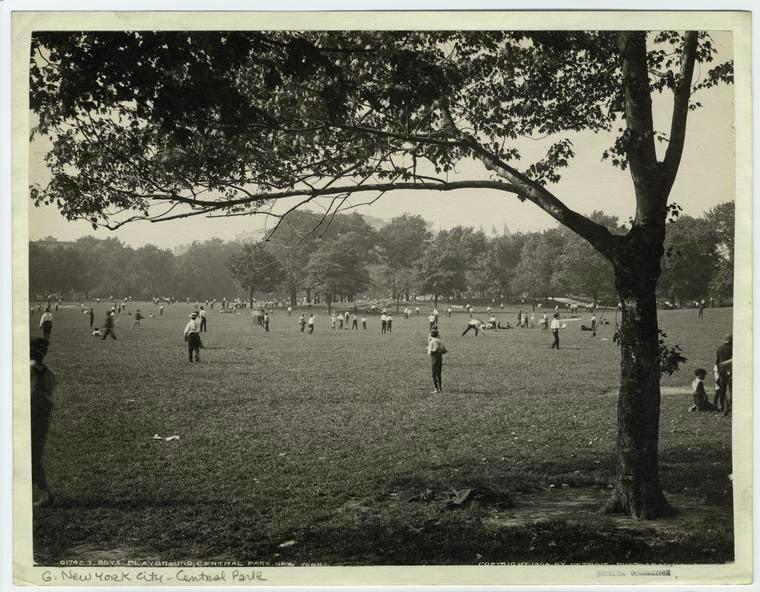
At the Seward Park playgrounds. The dark clothing doesn’t appear to make the scene very jovial, but everybody is all smiles. And a bonus picture above of boys playing in Central Park, 1904. This is a quite extraordinary picture because for half a second, I thought they were sheep.
Photos above are courtesy the Library of Congress, the Tenement Museum, and the New York Public Library
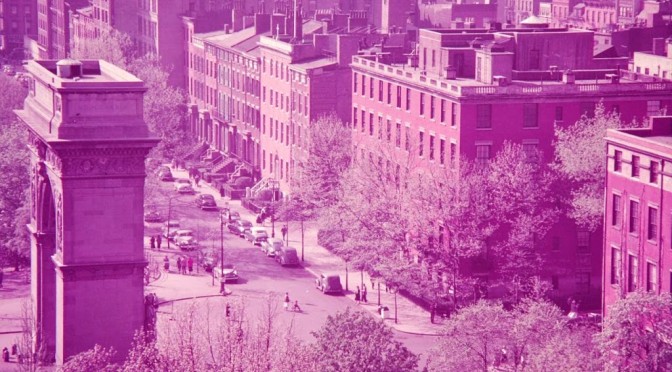
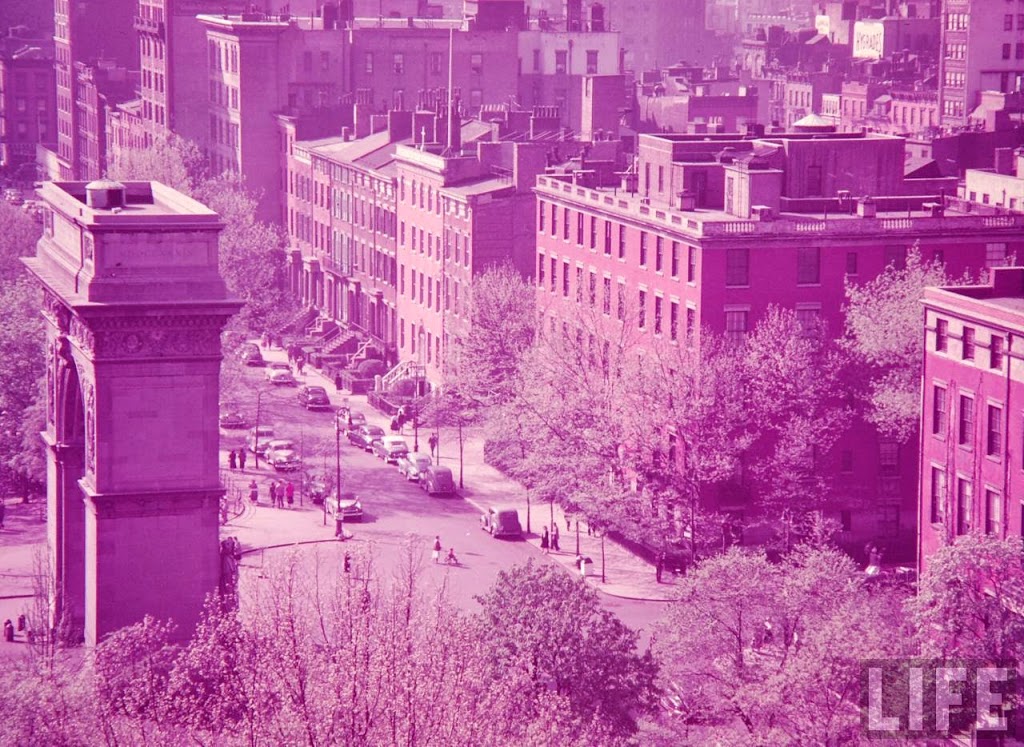
Washington Square North, looking west, 1950, photo by Walter Sanders, Life Magazine
The entire back catalog of the Village Voice, New York’s original alternative weekly, is available online through Google News. The early issues are especially full of character, a scrappy counter-culture organ which provides an interesting window into downtown Manhattan. Here are some highlights from an issue which came out fifty years ago this week:
1) Washington Square Park, both the physical epicenter of Greenwich Village and the gathering place for the Village’s various cultural factions, faced a possible makeover by the city in 1964. “This plan has two objectives. The first is to clean up the park, which is now physically run-down and neglected. The second, in response to complaints by adjacent property-owners, is to discourage beatniks and other ‘undesirable elements’ from congregating there.” [source]
The park had been a magnet for the beatnik scene since the early 1950s. The folk singers who would gather on Sunday afternoons had won a major victory in 1961 after a so-called “beatnik riot” convinced the city to allow musical crowds to congregate there
The park was eventually altered that year, but one major change would have been applauded by all — the traffic lane that cut under the Washington Square Arch and through the park was officially closed.
2) Sara D. Roosevelt Park in the Lower East Side, meanwhile, remained a disheveled dump, and the Voice clearly saw it as a symbol of the city’s neglect of the poor. “While the Parks Department is champing at the bit to pour $750,000 into Washington Square …. Sara Delano Roosevelt playground resembles a post-war Berlin. The latter, at Forsyth and Chrystie Streets, has been the scene of unrelieved wreckage for almost six years. It was torn up to make way for a subway and no one one thought to put it back together again.
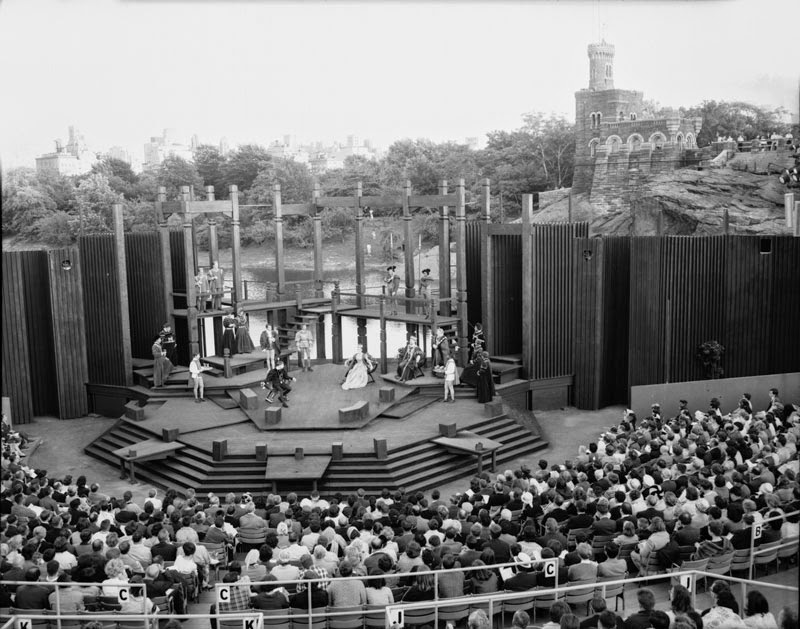
The Delacourte Theater, June 1964, a performance of Hamlet (courtesy NYC Parks)
3) The New York Shakespeare Festival has a new home at the Delacourte Theater in Central Park, but writer John Wilcock, author of the Village Square column, pines for the festival’s shaggier, less respectable days. Respectability has rendered it commonplace, according to Wilcock. Now you have to line up to grab a seat! “This is an improvement?”
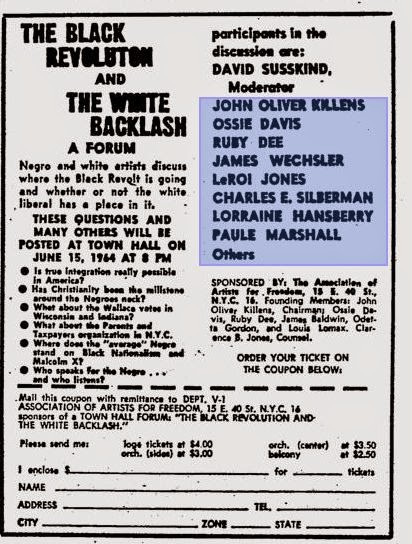
4) The Black Revolution and The White Backlash, a lecture at Town Hall, featured an interesting group of guests, including LeRio Jones (aka Amiri Baraka):
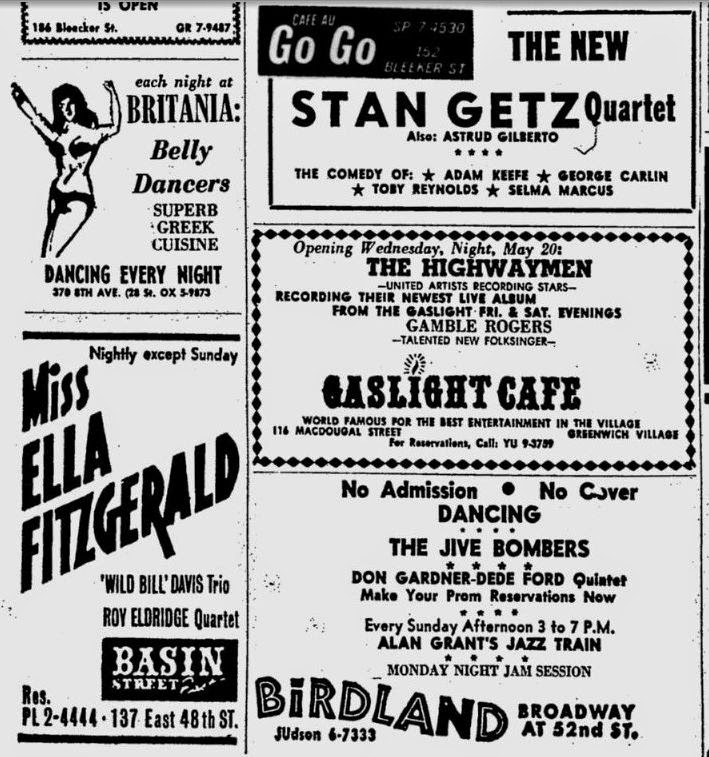
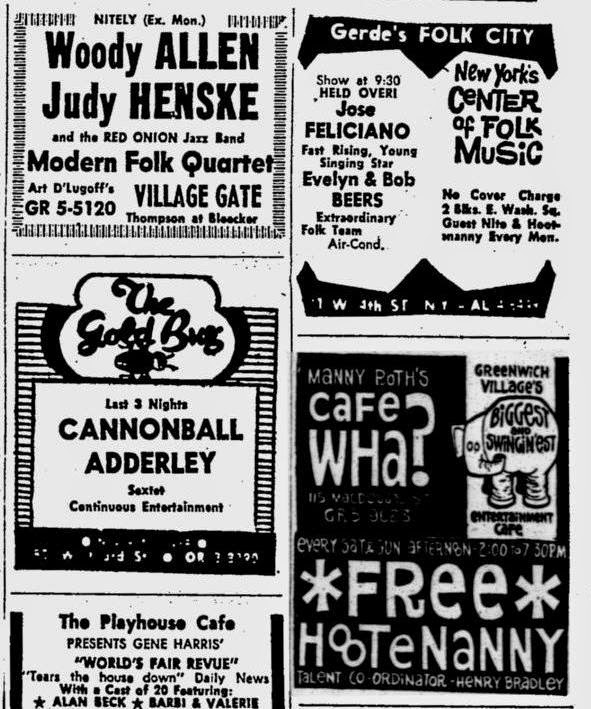
5) The jazz and folk clubs: A glorious sampling of musical icons that week — Ella Fitzgerald, Stan Getz, George Carlin, the Highwaymen, Woody Allen, Jose Feliciano, Cannonball Adderley
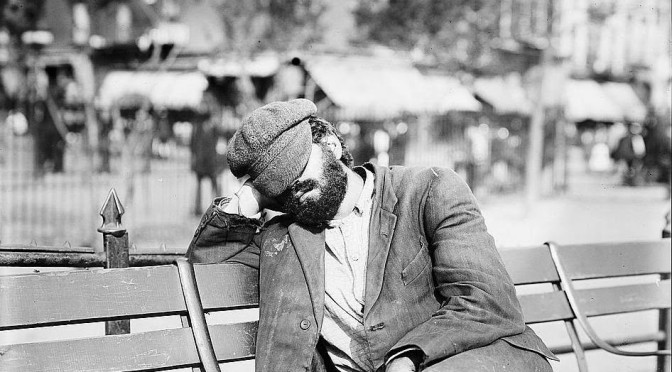
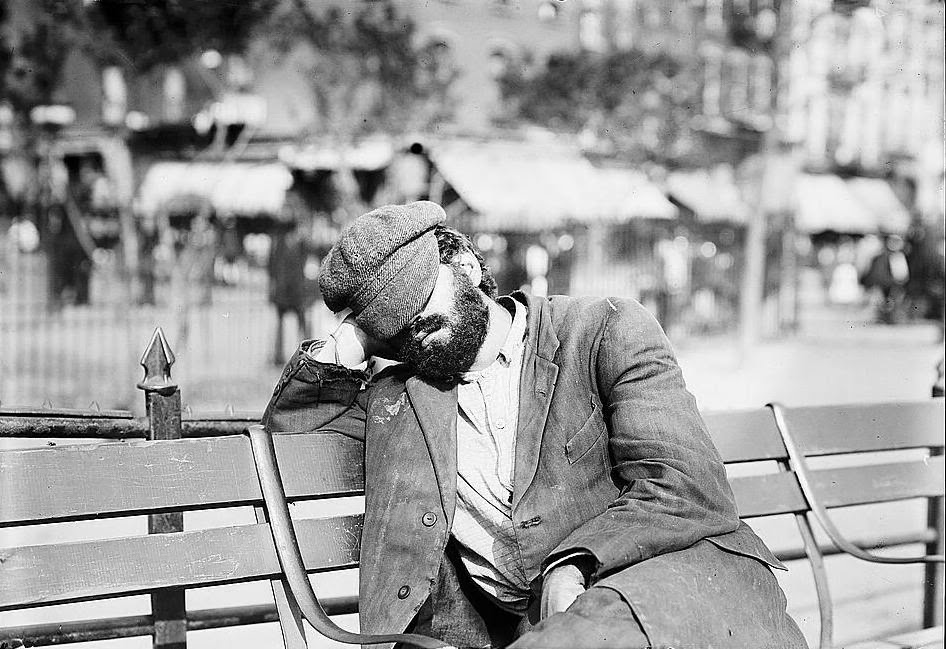
Was this photograph taken yesterday on the set of Steven Soderbergh’s new mini-series The Knick, or was it taken back in the 1910s? The answer is at the bottom of this blog post!
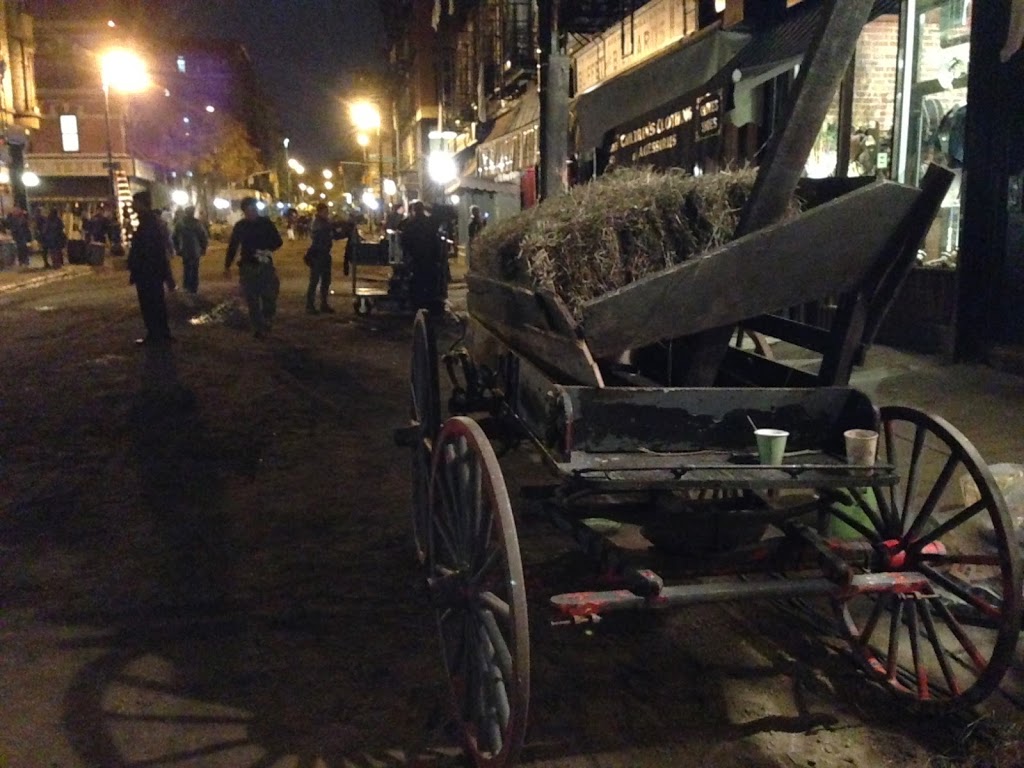
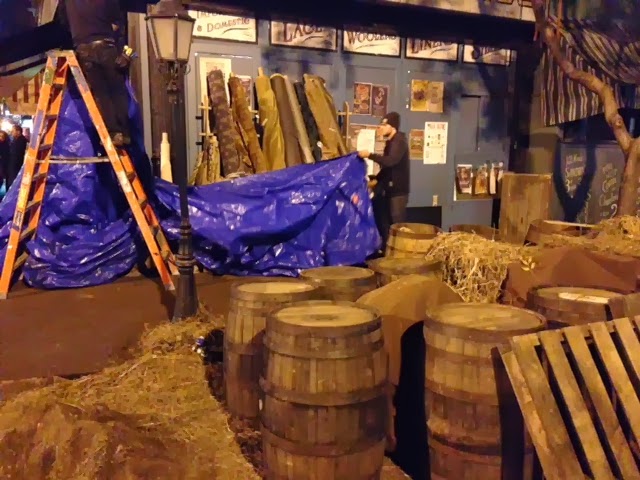
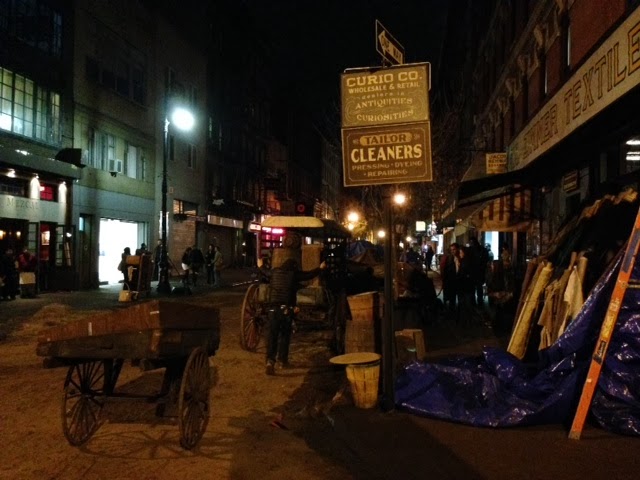
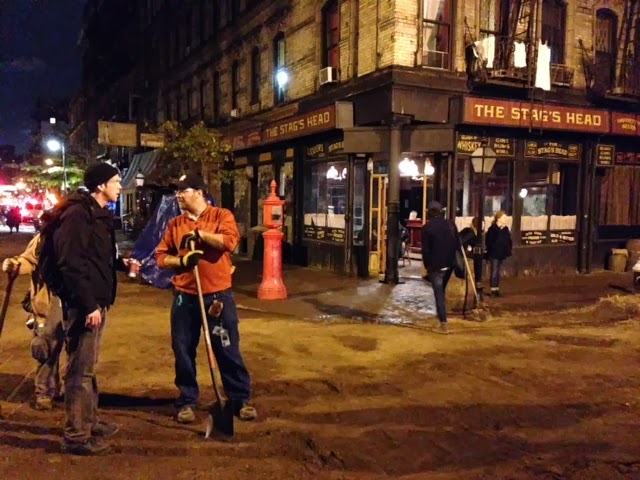
This week, a little stage magic is manifesting in the Lower East Side. The Broome Street of 2013 has been turned briefly into the Broome Street of 1910! Steven Soderbergh has been shooting his new mini-series The Knickin New York this week, a tale of old Knickerbocker Hospital set over a century ago. This required the boutique-and-lounge strewn Broome be reverted to its days of immigrants, wagons and pushcarts.
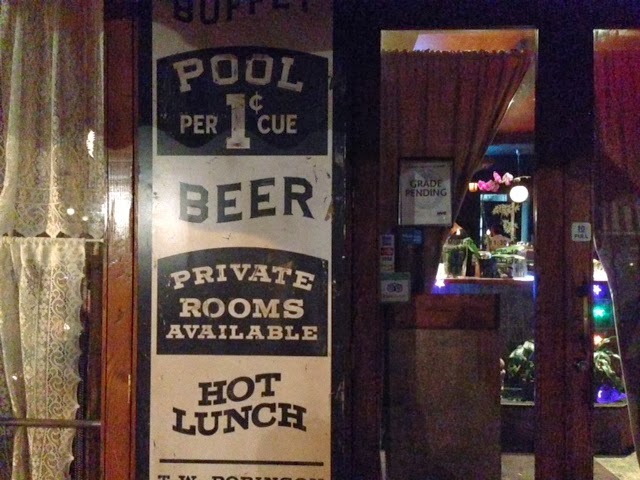
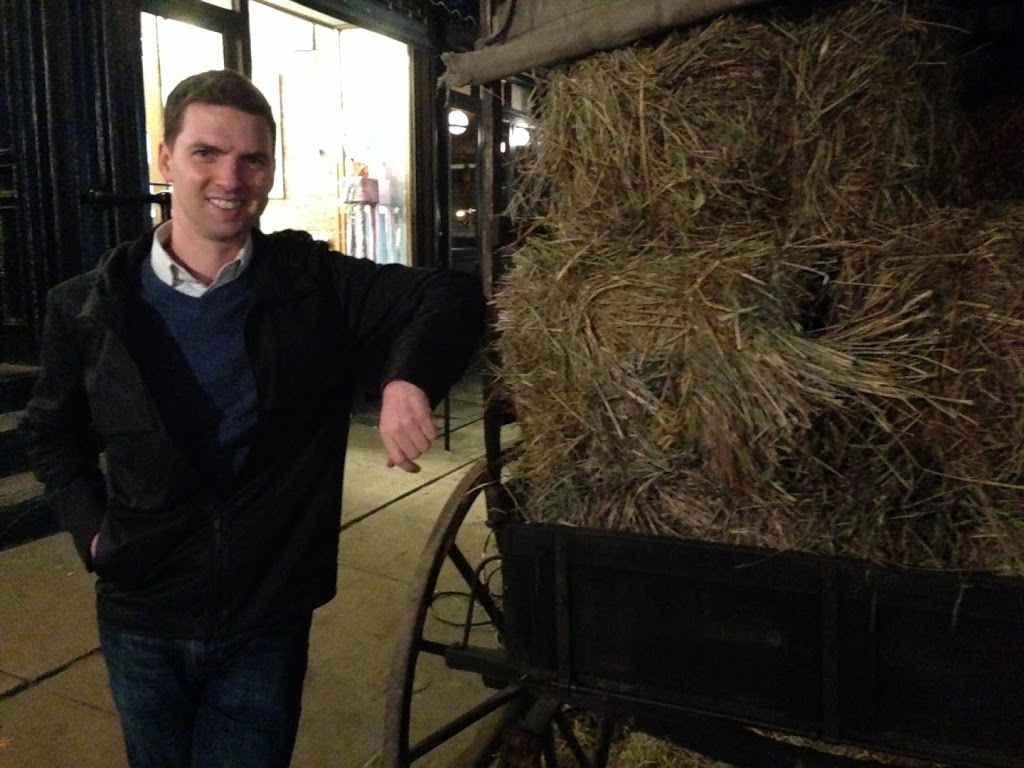
Tom wandered through the set last night and took these photographs:
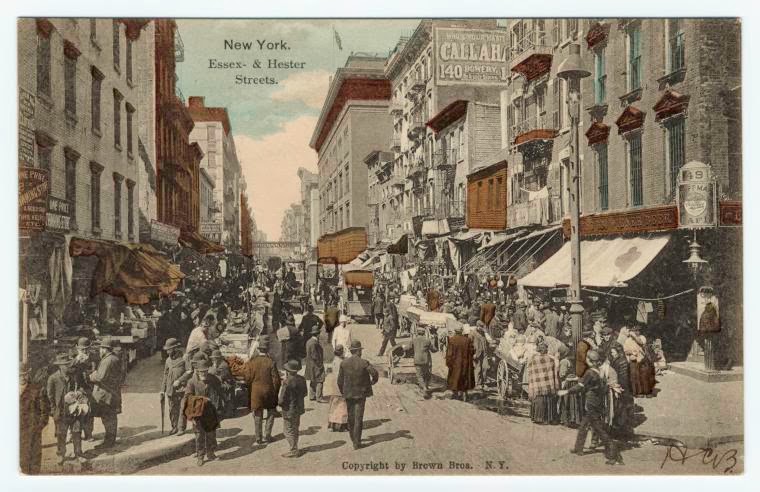
Essex and Hester Street, photo-mechanical postcard, date unknown (NYPL)
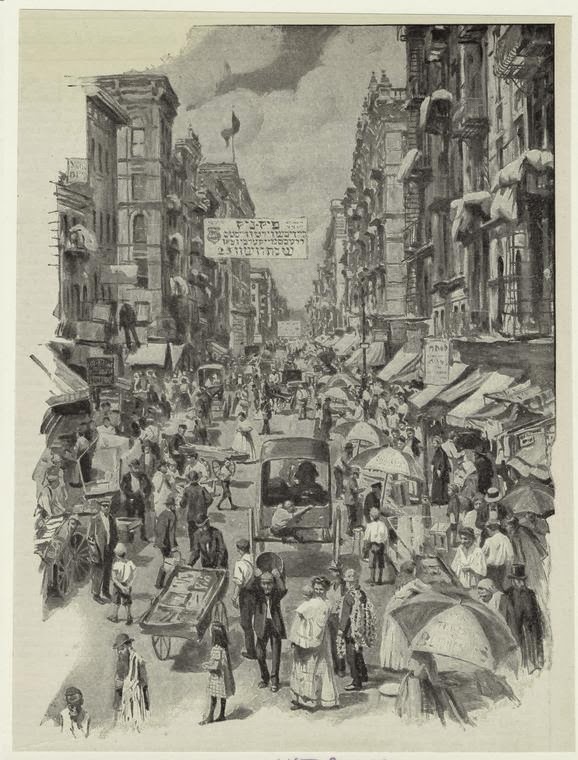
Illustration from Ladies Home Journal, Sept 1910, of a typical LES ‘street scene’ (NYPL):
As for this photograph — this is not a picture of a hipster film extra from 2013, but a man taking a brief nap in a park in the Lower East Side, photo dated 1912. ( LOC)
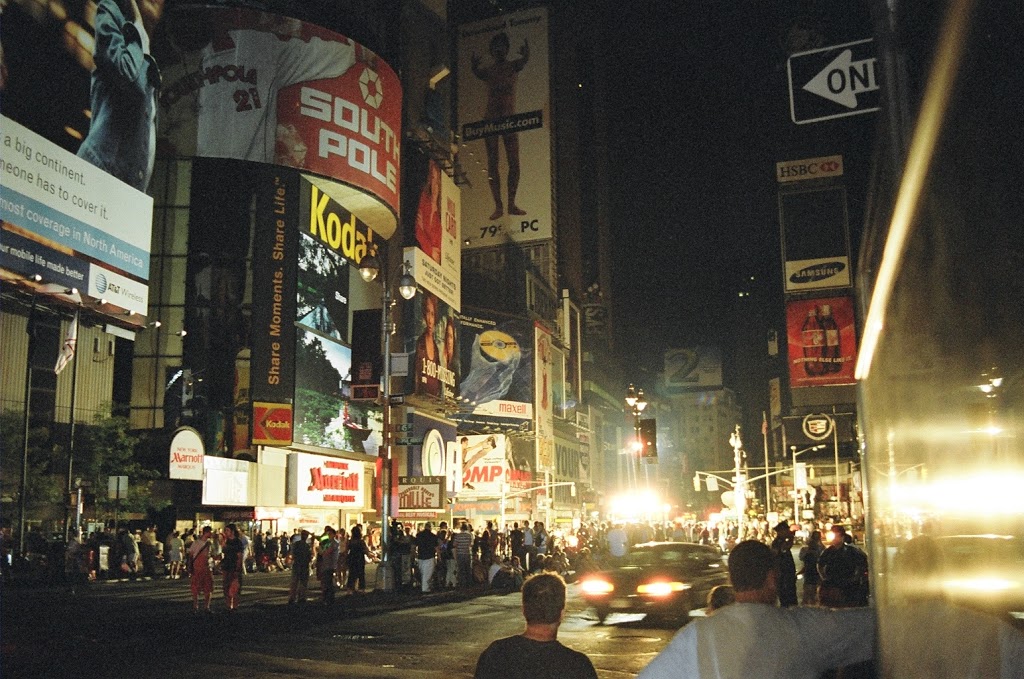
Photo above courtesy Drew Dies/Flickr He has a cool set of pictures from that day here.
Today is the tenth-year anniversary of the Northeast Blackout of 2003 which shut down power for most of New York City (and much of the Northeast) for almost 24 hours, with some areas experiencing outages well into the second day.
I was on the 35th floor of the Bertelsmann Building in the middle of Times Square. My co-workers and I traipsed down 35 floors under the glow of emergency lighting.
As ATM machines were offline, I had a grand total of $5 in my pocket, so I was unable to enjoy any of the cheap-beer and bbq fests that were underway in the East Village, as bars and restaurants rid themselves of items before they spoiled. Down in the Lower East Side, it was a lonely night under candlelight, trying to tune in updates on my old battery-operated portable television.
We still didn’t have electricity the next day, so I walked the Manhattan Bridge over to Cobble Hill, where power had been restored, and there I hung out at my friend’s shop Halcyon the entire day, a place filled with Manhattan refugees that day. I returned over the bridge in the evening, but the Lower East Side still did not have power.
The heat was slowly driving people insane; I remember seeing a woman carrying groceries for some place a few miles away and almost collapsing on the street. Had the power not returned then that evening at 10 pm, it probably would have gotten a bit messy in the LES. (It all seems so relatively manageable, of course, in light of the Sandy blackout.
Here’s a few more recollections from Twitter. If you lived in the northeast United States then, where were you ten years ago during the blackout? Leave your recollections in the notes here, or on Twitter of Facebook:
Where were you during the 2003 blackout, ten years ago today? I was on 35th floor, Times Square, $5 in pocket (no ATMs working). #blackout — The Bowery Boys NYC (@BoweryBoys) August 14, 2013
@BoweryBoys I was escorting 2 female coworkers uptown from 39st to 172nd. — Adam Vale (@Adamvale) August 14, 2013
@BoweryBoys At work, 11th floor, Midtown. Walked home to the Lower East Side with free ice cream and beers along the way. — J Cajigas (@pusher17) August 14, 2013
@BoweryBoys at work walked home. Ran into some people on the way who were in a subway tunnel when it happened glad I wasn’t on the train. — Abbie NYC (@AbbieLicious07) August 14, 2013
@BoweryBoys Stuck in New Brunswick, NJ. Spent the night at a friend’s house, then walked from Penn Station to Prospect Heights the next day. — Sunny Stalter (@slstalter) August 14, 2013
@BoweryBoys At work, midtown. Emergency lights in stairwell out, so co-worker & I used cellphone glow until rescue by person with flashlight — Amy Roth (@aimster215) August 14, 2013
@BoweryBoys Celebrating our son’s 3rd birthday. We never knew about the blackout until TV went off as our buildings have own generators. — Des Brownlie (@Desb65) August 14, 2013
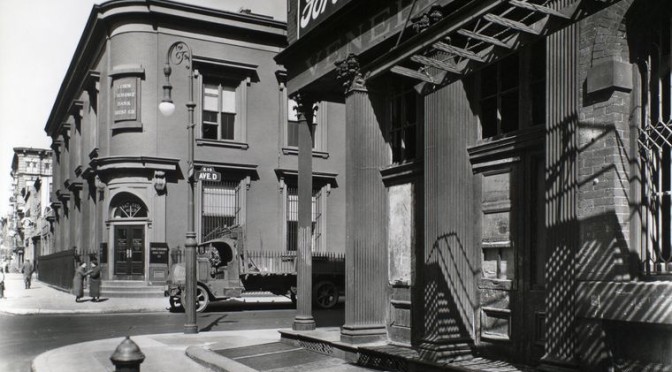
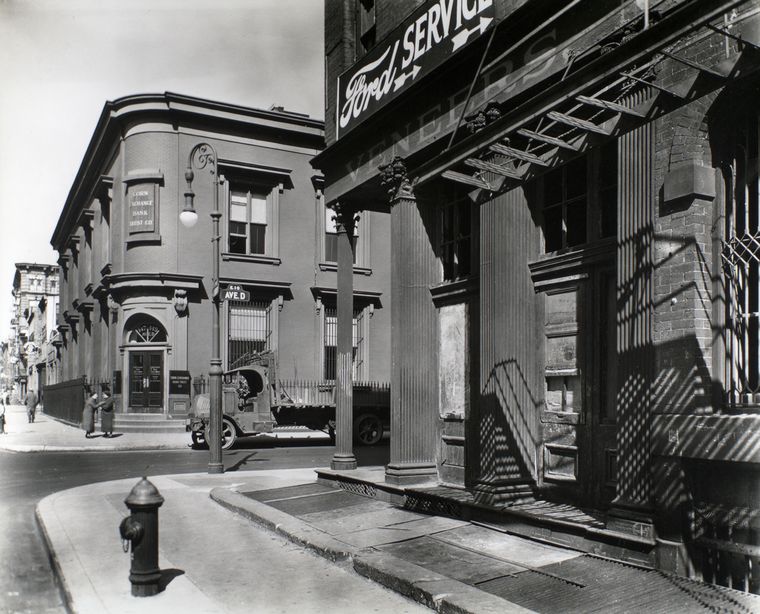
A genuine survivor: The building to the right was once the Strangers Hospital in the 1870s. This picture, by Berenice Abbott, was taken many decades later, in 1937. And the building is still around today! (Picture NYPL)
New York used to lump the sick, the poor and the homeless into one mass of needy unwanted. Since its founding, the city has struggled take care of the growing dual problems of poverty and plague, but in a way that kept the unwanted safely invisible to its wealthier classes.
With the rise of immigration starting in the 1840s, the problem became too pervasive to simply throw people into large catch-all institutions like Bellevue Hospital (which, in its early years, served as almshouse, hospital, quarantine, prison and morgue). Soon Blackwell’s Island became the solution, with a string of grim institutions lining the East River island.
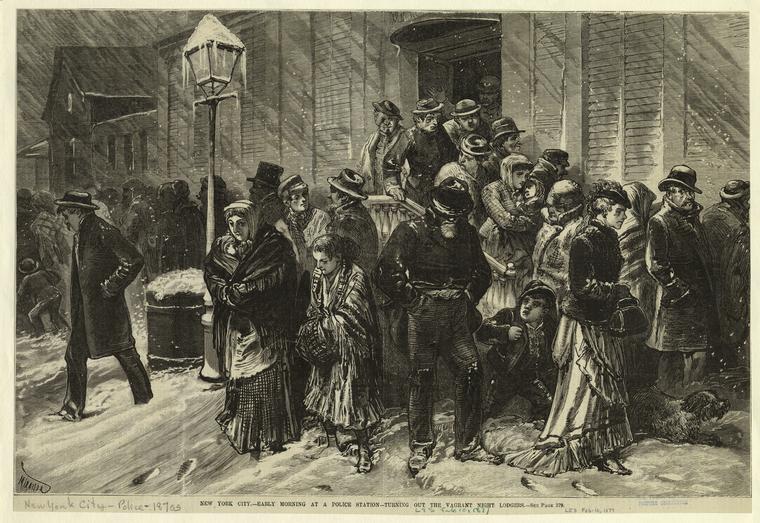
Below: For those less ‘worthy’, a cold night might have meant sleeping in the local police station. In the illustration below (1877), the homeless are turned out into the street at morning’s light. (NYPL)
Another solution for the homeless arose in 1870s in the delirious days of the scandals of the Tweed Ring.John H. Keyser made his fortune in the growing new field of indoor plumbing; in fact, he seemed to be wildly successful at it, a sudden millionaire in an era were certain men — with certain connections — grew wealthy overnight.
Keyser may have had friends in high places, but he expressed an unusual need for the common man. Perhaps his outreach was a tad cynical; the poor he helped often voted the way Keyser preferred. But with the city facing a severe poverty crisis, even the baited gesture had beneficial results.
The plumber king operated a ‘Strangers Rest’ at 510 Pearl Street in 1869, a boarding house for vagrant men and women. The vagrant house was situated halfway between City Hall and Five Points, and it operated on that spirit as well, an abode of good will and a little favoritism. You could stay if you were deemed “worthy,” meaning either good behavior or an unofficial pledge of allegiance to the Democratic Party.
The following year, Keyser purchased a building for $8,000 owned by the New York Dry Dock Company and transformed it into the Strangers Hospital, a vagrant home and care center in the vastly crowded Lower East Side. The building is still standing today at 143-145 Avenue D. Across the street is the Dry Dock Playground.
The Strangers Hospital opened in January 1871 with dozens of bed in several wards, a reading room, Russian and Turkish baths, a recreation room, and a chapel, with walls made of “India rubber, to avert the absorption of any infectious materials.”
An opening day blessing announced its unique mission: “It is not intended for the benefit of the wealthy, who in times of sickness can command the comforts of a well-ordered home and the attendance of a skillful physician or surgeon. Nor yet the beggar, who leads a life of dissolute idleness, rotating in winter and in sickness about the charitable institutions of this city. It is intended for the succor and restoration of the deserving poor……strangers — strangers to the home of plenty and comfort in which they have been born and nurtured, and from which misfortune and disease have parted them.”
In other words, you were worthy if they deemed you to be so.
It was an odd differentiation. As an accommodation for up to 200 people, it served not only as a regular treatment hospital for the ‘deserving poor’, but as a convalescent home and halfway house. Most likely, you had to be recommended but a tenant in good standing and, as I mentioned, it probably helped if you were a Democrat.
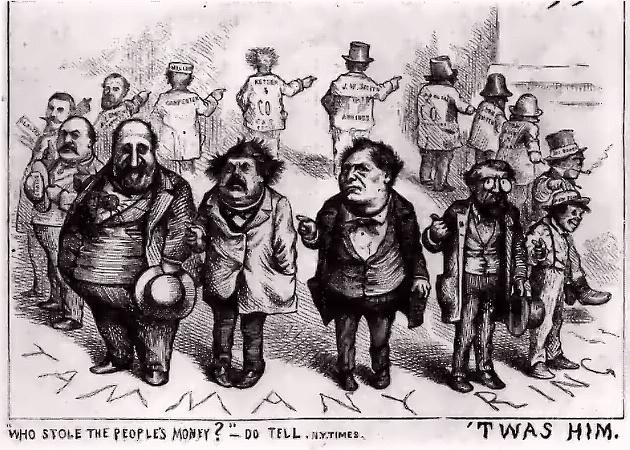
I underscore that because the Strangers Hospital didn’t last very long, closing in 1874. And this is why — Keyser was known as the ‘Ring Plumber’, a crony of William ‘Boss’ Tweed who enjoyed thousands of dollars in kickbacks and special favors. Tweed went to trial in 1873 for his crimes, and his cronies, although never formally charged, were disgraced.
Below: Keyser would have been one of the links of this chain of favoritism, envisioned by illustrator Thomas Nast
Contemporary sources of the day are not kind to Keyser, with one account call him “a real live Oily Gammon [arch-villian, from an English phrase which meant fatty ham], an Americanized specimen of the article — revised and improved in order to fit him to be a bright and shining light in the fraternity of which he is a member.”
By 1877 Keyser went bankrupt. Still, his obituary lists several more philanthropic efforts by Keyser, including a “free eating house” in Washington Square in 1888. From the headline: “Thousands were aided by Man Accused to Being Tweed’s Partner.” So whether or not his actions were sincere, he did manage to fund the feeding and caring of thousands of poor and sick New Yorkers. Where does such a legacy stand?
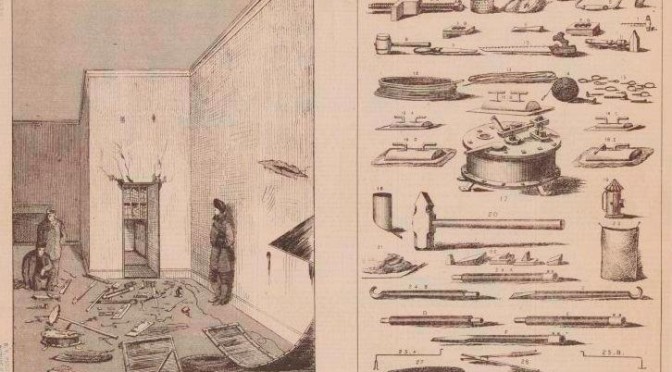
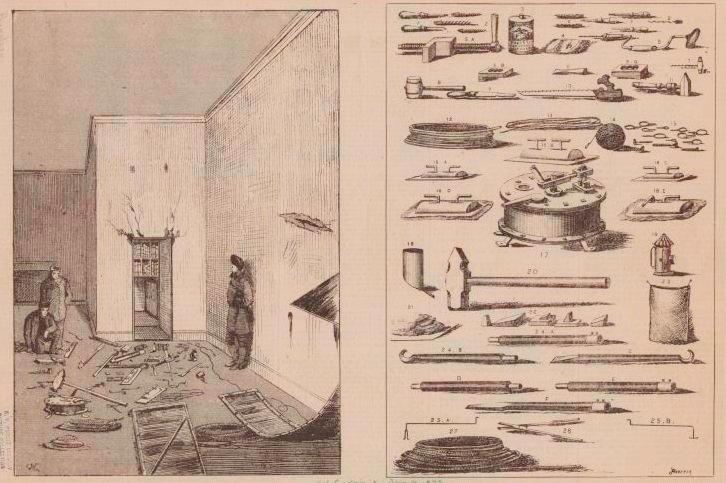
‘Red’ Leary was one of the famous bank robbers of the 1870s, assisting in heists all along the Northeast. Above is an illustration of a bank robbery in Montreal, Canada, displaying some of the tools found at the crime scene.
They don’t talk about ‘Red’ Leary anymore down in the streets of the Lower East Side. In the hipster bars and boutiques, in the graphic design firms and the Chinese foot-massage parlors, his name goes virtually unspoken.
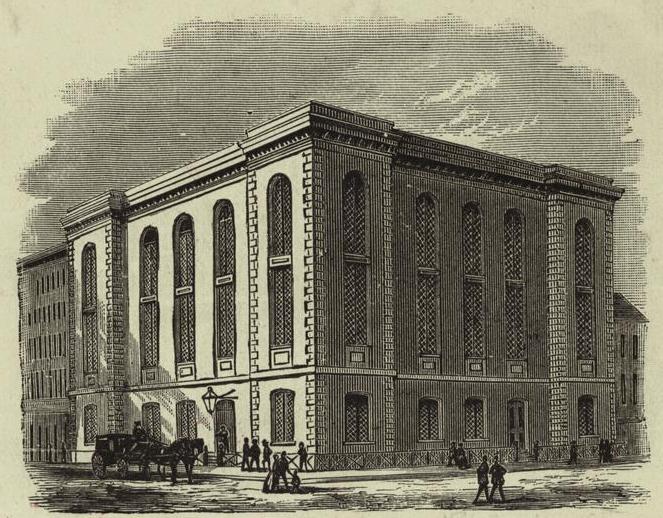
But over one hundred and thirty years ago, his unusual escape from the Ludlow Street Jail (pictured below) captivated New Yorkers, willing to overlook the rascal’s criminal misdeeds to marvel at the ambitiously planned jail break, orchestrated by his wife Kate Leary. ‘A Hero and a Burglar’ proclaimed the New York Times, appalled that teenagers were “absolutely besides themselves and exultant over the daring deed, each individual boy wishing, for the moment, that we was a Red Leary.”
John ‘Red’ Leary was one of the northeast’s most notorious bank robbers of the 1870s, frequently pairing with other known criminals of the day to pull of spectacular heists. In particular, as a part of the gang of George Leonidas Leslie (nicknamed “king of bank robbers”), Leary helped make off with thousands of dollars in stolen sums, involved in tricky operations that sometimes took years to plan.
According to Herbert Asbury, Leslie’s gang was responsible for 80% of the bank robberies between 1874-84. Not sure how that number was specifically settled on, but needless to say, as a critical member of Leslie’s operation, ‘Red’ Leary was a master at his chosen profession.
However, in December 1878, after a robbery at the Northampton Bank in Massachusetts (making off with a staggering $1.6 million), Leary was promptly captured back in New York at Second Avenue and 92nd Street, in connection with another bank robbery. It was decided to extricate Leary to Massachusetts to answer for the robbery there, so he was thrown into Ludlow Street Jail to await transferal.
Leary would be sure not to meet the same fate, thanks in part to his wife, the fiery Coney Island pickpocket Kate Leary, and some of Red’s criminal cohorts. Included among them were Shang Draper, a crooked saloon owner famous for drugging customers and shanghaiing them onto ships.
Kate had already helped her husband escape capture once before, in August 1877, when the duo eluded several officers at a hotel near Fort Hamilton in Brooklyn. A lightly guarded prison in the middle of one of the most populated neighborhoods in the world was certainly no match for a woman as determined as Kate, known as much for her intelligence as for her venality.
In May of 1879, Mrs. Leary, in disguise, rented a tenement flat next door to the jail at 76 Ludlow Street. She and her accomplices then knocked out a wall, drilling through the thick prison defenses until they broke through into the prisoner’s bathroom, perfectly timed with Red’s arrival there.
As author B.A. Botkin‘s describes: “No alarm was raised, nor was the tunnel leading to the room with its neatly piled ton of excavated brick discovered until 10:30. By that time the fugitive was on his way to Coney Island in a light truck.”
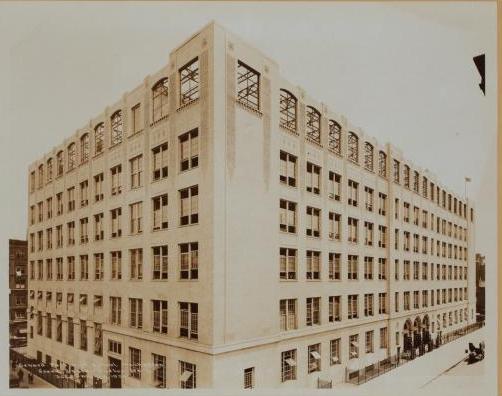
As a judge has explicitly stated that Leary would probably try to escape, the clean extraction of the high profile criminal elicited mocking scorn at the jailers and officers involved. Saving face, Ludlow officials declared Leary’s assisted release was “one of the most daring and skillfully-planned affairs of the kind to ever occur in the city,” “executed by shrewd and bold criminals.” [source] The Ludlow jail would never really shake its, shall we say, porous reputation and was eventually demolished in the 1920s. Both the jail and the address 76 Ludlow Street would make way for Seward Park High School (pictured below, from 1930)
So dramatic was the 1879 Ludlow prison break that Leary and his crew were soon turned into folk heroes by the more rebellious residents of the Lower East Side. For this reason, the Leary escape is sometimes listed as a New York urban legend. But in fact, newspapers of the day spilled over with reports of the bold getaway.
According to Botkin’s 1956 book ‘New York City Folklore’, the legend of Red Leary even briefly entered sports vernacular. “So celebrated did the exploit become, that …. [a] coach who wanted to instruct a player to break loose and steal a base simply yelled, “Red Leary!“
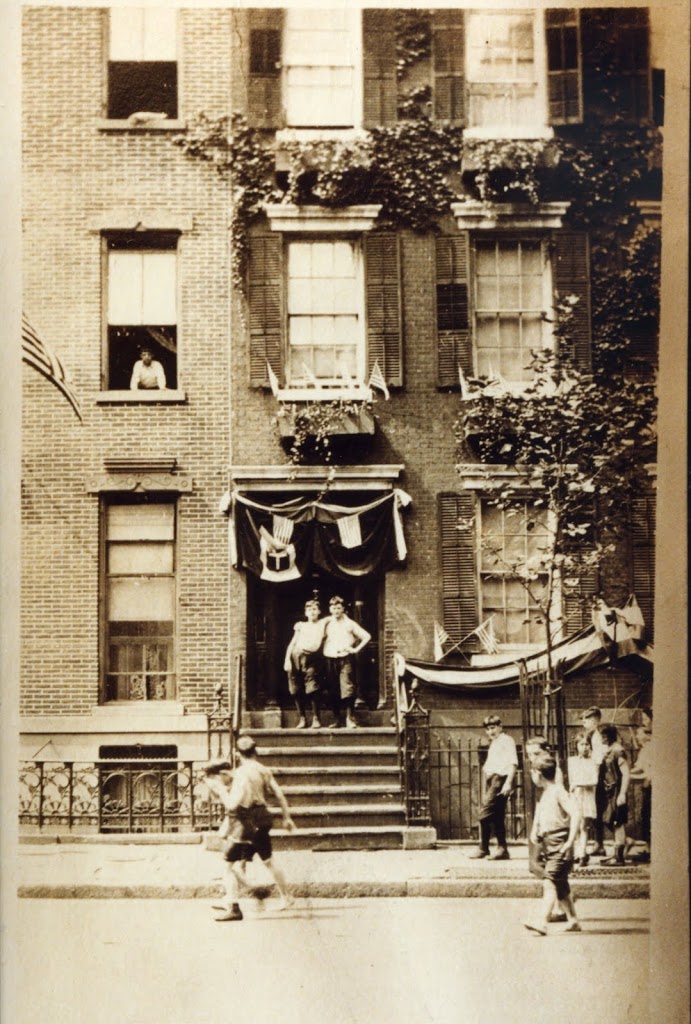
Children gallivant and pose for pictures outside 265 Henry Street, date unknown (Courtesy Henry Street Settlement)
FOR YOUR CONSIDERATIONUntil May 21st, you can vote every day in the Partners In Preservationinitiative, a program that will award grant money to certain New York cultural and historical sites among 40 nominees. Having trouble deciding which site to support? I’ll be featuring a few select sites here on the blog, providing you with a window into their history and hopefully giving you many reasons to visit these places, long after this competition is done. Read about other candidates here.
Without perhaps intending it, social services pioneer Lillian Wald, in her desire to help thousands of poor immigrant women and children in the Lower East Side, also saved a rare and forgotten part of New York City history.
The modern Henry Street Settlement is spread throughout several buildings in the neighborhood, providing health care, shelter, job training and a host of services to the community. But it started out in just three adjacent Federalist-style townhouses on Henry Street, recruited into duty by Wald and her benefactor Jacob Schiff to stem the tide of disease and harm that threatened families in the world’s most densely populated neighborhood in the late 19th century.
A Different Lower East Side As New York grew northward in the 19th century, wealthy landowners carved up their land with hopes of profit and a desire to foster New York’s next great elegant neighborhood. Revolutionary War colonel Henry Rutgers, who lends his first name to the street where the Settlement makes its home, sold off his property near Corlear’s Hook to businessmen with financial concerns along the Manhattan waterfront.
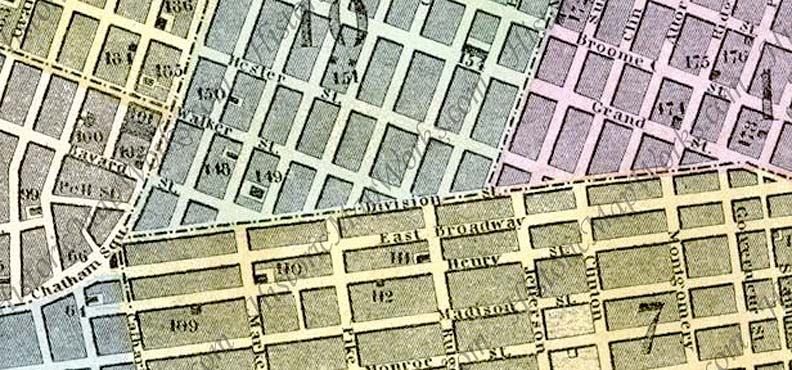
Below: An illustration from Forgotten NY, outlining the dividing line (literally, Division Street) between surrounding properties and Rutger’s own (in yellow). The buildings discussed are at Henry and Montgomery.
Many of the great shipbuilders lived in today’s Lower East Side (in the 1810s, it might have been called the Upper East Side) in fabulous residences within walking distance of the shore. Even by the 1850s, when the character of the neighborhood began to change, the mayor of New York Jacob Westervelt still resided at 308 East Broadway close to his shipyards. His neighbor at 281 East Broadway was city surveyor Isaac Ludlam.
Typical of the buildings that defined the neighborhood were 263 and 265 Henry Street, Federalist townhouses built in 1827. Its neighbor 267 Henry Street is a touch more ornate, with a different shade of brick in a Georgian Eclectic style.
Picturing these streets today lined with such buildings is requires a vivid imagination. That’s because of the sudden mass of immigrants who arrived in New York by the 1850s, moving into poorer neighborhoods along the waterfront and in places like Five Points. Most of the homes along once-elegant Henry Street were torn down and replaced with tenements. Later, many of those tenements were themselves replaced with blocks of apartment complexes in the early 20th century.
These three Henry Street buildings have survived (as well as a few others, including Ludlam’s old home) because they were repurposed by a woman of uncommon compassion, one of New York’s most important figures in health and social services.
Settling Down Lillian Wald first came to the city in 1891 as a student of New York Hospital’s nursing program. An intelligent and ambitious woman from Rochester, Wald quickly found purpose in one of the few respectable professions in the late 19th century where women could rapidly excel. She’s marveled at today as a person of extraordinary compassion. But in many ways Lillian was a modern entrepreneur, able to latch onto the progressive instincts of the day to solve the immediate social ills facing New York with great imagination and a bold lack of prejudice.
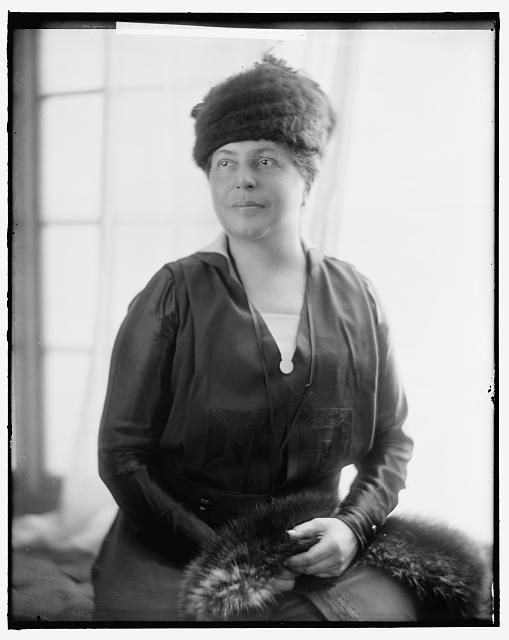
When Wald (at right) founded the Nurses Settlement in 1893, she was building upon the practices of altruistic Christian programs (like the Methodist missions into Five Points) that brought social services into the very heart of slum-filled, overcrowded neighborhoods. However Wald was Jewish, and her perspectives involving health care were profoundly nonreligious and ‘universalist’ for the day.
In that year she also met wealthy banker Jacob Schiff (who himself had immigrated to New York in 1865) who purchased the three Henry Street buildings for Wald to properly set up her nursing agency. From that moment, it became the Henry Street Settlement, housing a squad of nurses sent out into the neighborhood to tackle an ungainly number of health issues.
In an era where poor patients were often turned away from standard hospitals, Wald and her team of extraordinary women provided care for free, often risking their own lives to enter squalid tenements and exposing themselves to many illness that today have been completely eradicated. (One of her nurses, Margaret Sanger, would later become America’s leading birth control advocate.)
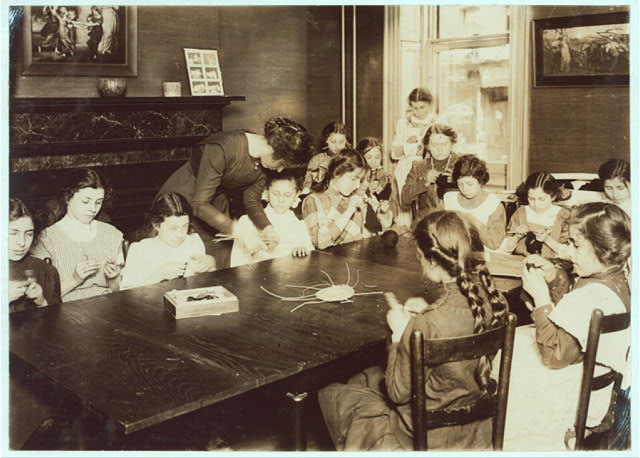
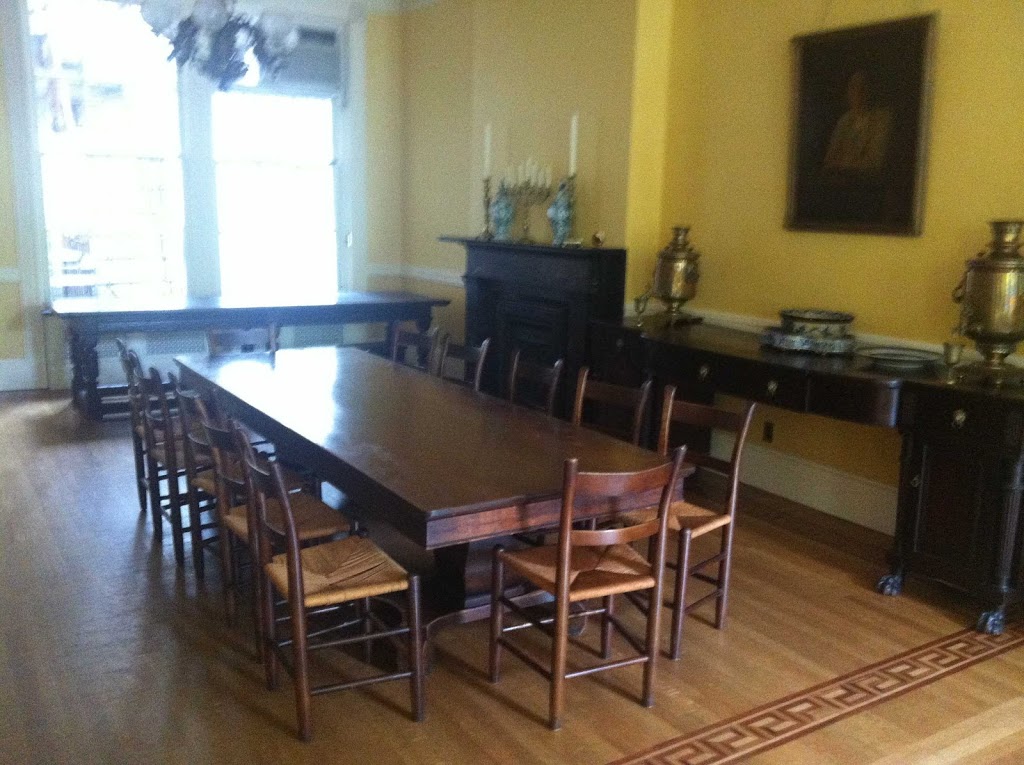
The Settlement had no problem making the former Henry Street residences into working clinics. The rooms still felt like a home in its decor, a respite for many visiting patients. The nurses lived upstairs in rows of small bedrooms, most of which today have been turned into cozy offices. The most lively (and historically important) room at the Settlement was the dining room, with large mahogany tables where Wald entertained a wide variety of guests, from poor patients to the great thinkers and Progressive voices of the day.
Below: A knitting class in the famous Henry Street dining room, May 1910. The fireplace at left is still very much intact. [LOC]
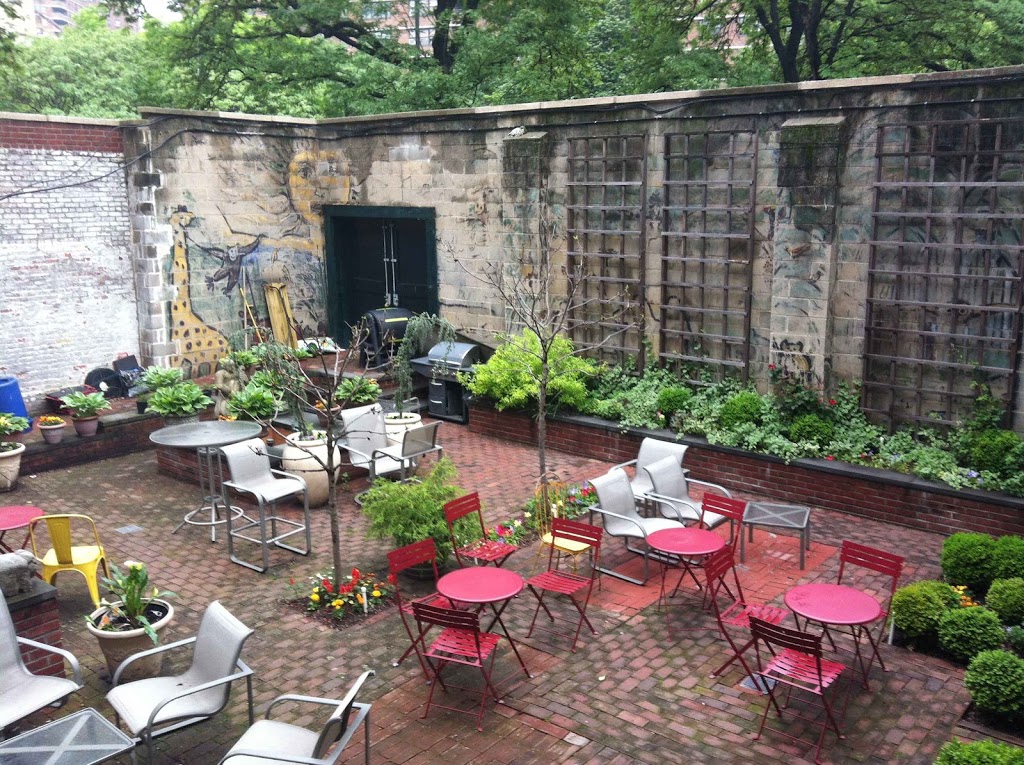
Beyond Borders The Henry Street Settlement soon expanded its mission statement to generally improve the quality of life in the Lower East Side. Concerned that neighborhood children had no place to play, Wald set aside her courtyard to become one of New York’s first playgrounds in 1902.
Below: The location of the playground, just behind the Henry Street structures.
Wald frequently held meetings here for strikers rallying against the women’s garment industry. In 1909, she invited both white and black guests for a dinner, organizing a group that would soon grow to become the National Association for the Advancement of Colored People (the NAACP).
An excerpt from her 1915 book ‘A House On Henry Street‘ illustrates the racial politics of such a seemingly simple dinner party:
“At the time of the first convention of the organization, [the NAACP] formed to further better race relations in this country, the occasion promised to be almost too serious unless some social provision were made.
I suggested a party at the House, but even the organizing committee was fearful. ‘Oh, no!’ they protested. ‘It won’t do! As soon as white and colored people sit down and eat together there begin to be newspaper stories about social equality.’
‘But two hundred members of the conference couldn’t sit down,’ I submitted. ‘Our house is too small. Everybody would have to stand up for supper.’ ‘Then it would be all right,’ they said with relief, and the party was successful.”
Above: One of the two original dining tables. Wald hosted hosted dozens of intellectual luminaries in this room, including Jane Addams, Eleanor Roosevelt, Jacob Riis and Theodore Roosevelt.
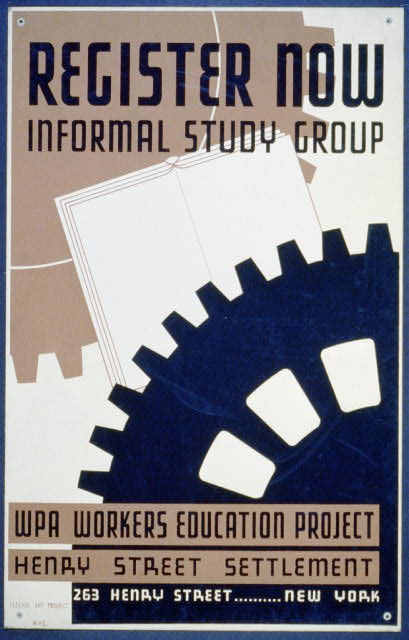
Wald would become a leading figure for New York social programs, often enlisted by the city to bring improvement to the city’s other public services. (In 1902, Henry Street’s Lina Rogers become the very first school nurse.) The Settlement even become an important venue for the arts with the debut of the Neighborhood Playhouse theater in 1915. The tradition lives on at the Abrons Arts Center, another part of the Settlement that continues to be a critical part of the Lower East Side cultural community. (At right: A flyer for a WPA meeting, between 1936-41, LOC)
Wald died in 1940, but her Henry Street Settlement has only expanded in the years since her passing. Today they have facilities in over a dozen buildings throughout the neighborhood, expanding their focus to include job training, mental health services, adult education, a shelter for victims of domestic violence and even a computer lab.
Those original three buildings, housing mostly administrative offices today, are still a wonderful expression of an early era of New York history. Traces of that history sits next to the practicalities of office life; in one room, an original kitchen hearth and brick oven from the original tenants sit next to a couple photocopiers. Employees sit at laptops in Lillian Wald’s original bedroom with its spectacular sleeping porch overlooking the former playground.
The Henry Street Settlement hopes to use the Partners In Preservation grant money to combat the challenges of keeping their nearly two-centuries old offices in working order, to upgrade and prepare these old rooms for many more decades of providing a little more life to the Lower East Side.
Disclosure: I have partnered up with Partners in Preservation as a blog ambassador to help spread the word and raise awareness of select historical sites throughout the tri-state area. Though I am compensated for my time, I have not been instructed to express any particular point of view. All opinions expressed here are strictly my own. And since writing about New York landmarks is kinda my thing anyway, I’m thrilled to share my love of these places!
Bialystoker Home for the Aged may not make it into many tourist guides, but this Lower East Side art deco artifact holds an important link to New York’s immigrant history. It was just born on the wrong side of the street, and because of that, it’s an endangered structure.
On the south side of East Broadway, between Canal and Montgomery, stands some of New York’s most important Jewish landmarks, from the towering gleam of the Forward Building to a cluster of surviving 1830s rowhouses and tenement synagogues that held the first critical waves of Jewish immigrants in the mid-19th century.
At right: The Bialystoker building on its opening in 1931 (courtesy the Museum of Jewish Heritage)
On the north side of East Broadway, however, these sorts of historical structures east of the Seward Park Library were knocked down and replaced in the 1950s with an immense cooperative village in the fashion of Stuyvesant Town, a series of housing towers interlocked with open spaces and playgrounds.
The Bialystoker building (228 East Broadway), which opened in 1931, is a relic in comparison to its immediate neighbors, a parking garage (which notably collapsed in 1999) and a banal 1960s medical building known for a chipping mural on its side and to HBO subscribers as ‘the New Zealand consulate’ on the TV series ‘Flight of the Conchords‘. (Full confession: I lived across the street for both the collapse and the filming, so I find the block particularly endearing.)
Its two-toned tannish, art deco facade by architect Henry Hurwitmakes an unusual silhouette for the neighborhood, and perhaps that alone should make it a candidate for preservation. But it’s the building’s unique history that makes a necessary keepsake of the Lower East Side.
This and many other structures around here trace to a specific immigrant lineage — the Polish Jews of Bialystok, near the border of Belarus. It’s remarkable to think of thousands of Bialystok immigrants — nearly the entire Jewish population of the city — crossing the ocean, entering Ellis Island, and settling here, and specifically here, in this area of the Lower East Side.
Around the corner, up two blocks, is the Bialystoker Synagogue, a refitted 1826 Episcopal church that collected various neighborhood Jewish congregations and moved in here in 1905. From a cursory glance at its exterior, you might never know that inside is one of New York’s most stunning synagogues. And hopefully everybody is familiar with the wondrous, doughy bialy, the cousin to the bagel, and its supreme baker Kossar’s Bialys up on Grand Street.
The synagogue is an official historic landmark, and Kossar’s a treasured stop on walking tours. The former Bialystoker nursing home has no such protections.
The elderly home was funded by a Bialystoker aid society in the 1920s as an alternative to standard city institutions. The cornerstone was laid in September 1929, accompanied by a massive parade, 25,000 people carrying “flags and banners with Jewish inscriptions and marched through Canal, Grand and other streets.” [source]
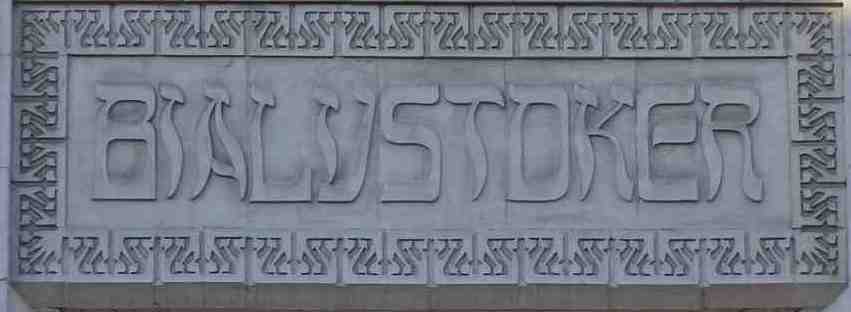
The new arrivals to the neighborhood benefited from the charity of wealthier Jewish immigrants who had arrived earlier and funded projects to ease overcrowding and providing health and education services catering to specific religious customs. The Bialystoker building is perhaps the most striking example of this beneficence. Its design is Moorish Art Deco, of a kind you might see off to a corner in Rockefeller Center. Possibly considered plain in its day, but now seen as beautiful and understated. In particular, its doorway is a marvel; the artfully carved BIALYSTOKER is joined by a dozen medallions representing the twelve tribes of Israel.
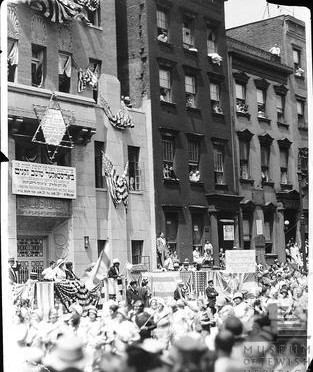
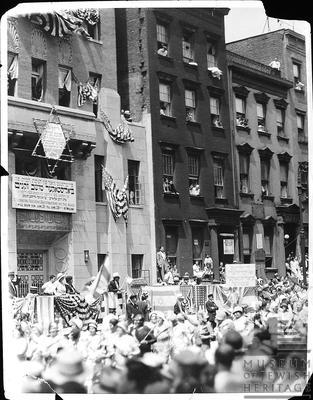
Its grand opening on a hot summer day in June 1931 was a premiere event, with another parade drawing tens of thousands, and people crammed onto rooftops and fire escapes to witness the event. Awaiting inside were rooms for several dozen residents, as well as “auditoriums, dormitories, two synagogues, sun parlors and hospital wards.” [source] The Museum of Jewish Heritage has some remarkable photographs of the opening which you can peruse here.
The nursing home has faithfully and quietly served the community for 80 years. Along the way, its seen some prominent and very, very old residents (like 111-year-old Benjamin Kotlowitz). Last year, due to mounting debts and “inadequate Medicaid reimbursement,” the home was forced to close for good.
We had a terrific time recording this year’s ghost-story show — Haunted Histories of New York. Here’s some extra details about our four subjects that were left out of this week’s show.
(By the way, if you wouldn’t mind, please vote for us in this year’s 2011 Podcast Awards. We’re in the Best Travel Podcast section. Thanks!)
Liberty Island and the Captain Kidd’s treasure
If indeed there was treasure buried on Bedloe’s Island (today’s Liberty Island), William Kidd and his motley crew would have concealed it there under the gaze of the island’s owner. In the 1690s, when Kidd would have lived in New York, the island was owned by a woman — Mary Bedlow Smith.
The small island property was originally owned by a Dutchman Isaack Bedloo, who remained in the harbor after New Amsterdam became New York in 1664. He even Anglicized his name, as evidenced by his daughter’s name. She sold the island in 1732 to one of the most wealthy and powerful men in all the British colony — Adolphe Philipse. From there, the island was often used as a quarantine station or ‘pest house’ to shelter those with communicative disease. Many hundreds of afflicted were thrown here in the mid-17th century, and many died here.
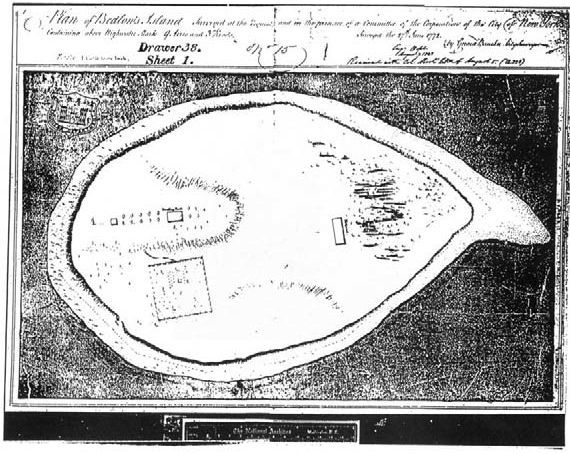
Below: A map of Bedloe’s Island in 1766, before the construction of Fort Wood. The map is strangely situated, but I believe that the stone where Kidd’s treasure was allegedly buried would have near the pointed end. (Courtesy the National Park Service.)
The Holy Ghost — Most Holy Trinity, Bushwick, Brooklyn
Some believe that Most Holy Trinity’s beloved Monsignor Michael May haunts the present halls of the church. On the occasion of May’s funeral in 1895 — he had died on the second floor of the adjoining rectory – the church nearly experienced a tragedy from which it would have surely never recovered.
A New York Times article from February 1895 reveals that a chronic weakness was discovered to the building’s architecture. As I mentioned in the podcast, vast, old passages exist underneath the church, extending to adjacent buildings. These passages had been used for safety during anti-Catholic attacks in the 1850s and even as safe havens for escaping Southern slaves on the Underground Railroad in the 1860s.
Monsignor May was so beloved that almost 5,000 people arrived for his funeral, the most the church had ever seen at one time. I’ll let the article reveal the potential horror of this situation: “Carpenters and masons at work on the vault in the basement discovered that the floor above them had sunk several inches in the centre, and that the cross beams had split, as had the big girders supporting the cross beams.”
The floor actually begin to sway in front of the masons. Within moments, the crowded church would have caved in, easily killing hundreds. What became one of the biggest gatherings in the church history would have instead become an unspeakable catastrophe.
The workmen advised the clergy to evacuate the center aisle and then worked briskly to create temporary braces. The crisis, thankfully, was averted.
The Lonely Acrobat — Ghosts At The Palace Theatre
The tragic acrobatic act at the Palace Theatre that inspired the venue’s most famous ghost story is veiled in mystery and misunderstanding. There’s many falsehoods about the incident that Tom successfully dispelled, but there’s one he missed. Most modern retellings call the acrobat in question Louis Borsolino. His actual name, according to local papers in the troupe’s hometown of Reading, PA, list hims as Louis Bossalina, pictured at right.By the way, the name of the particular trick that Bossolina was doing at the Palace Theatre that fateful day? It was called the Death Loop. He is popularly rumored to have died from the accident, an unsurprising assumption considering how many people saw the fall, knowing the name of the failed trick. In reality, Bassolina survived the ordeal and was released from the hospital nine days later. To be clear, he didn’t die at the Palace; he went on to perform with the troupe until they disbanded in 1937.
He lived a perfectly normal life outside the spotlight, for over three more decades, before dying at age 61, in August 1963. If he truly haunts the Palace today, then the torment must have possessed him so greatly during life that he continually returns for repeat performances!
As you heard in the podcast, joining Louis’ ghost at the Palace is an apparition of one of the theater’s greatest stars. Here’s a recording of Judy Garland’s curtain call from her very last performance at the Palace Theatre on August 26, 1967. Judy would be dead within two years of a drug overdose. I wonder if anybody has ever seen the ghosts of Louis and Judy on the same night?
The Tale of Two Houses — Kreischer Mansion
The famously haunted Kreischer Mansion was built for a son of brick mogul Balthazar Kreischer. He made his wealth using Staten Island clay to produce the building materials for a growing city, and he created a company town (appropriately called Kreischerville) near the Arthur Kill. But Kreischer got his start in the Lower East Side — on a street that is no longer there.
Balthazar arrived in New York in 1836 and quickly excelled in construction, in the years following the Great Fire which destroyed hundreds of structures in the heart of the old city. By 1845, Kreischer entered into the brick-making business with one Charles Mumpeson. Although they had already discovered the potential of Staten Island clay — their company was called New York and Staten Island Fire Brick and Clay Retort Works — their original factory was at 58 Goerck Street at Delancey Street.
The odd little street, which ran parallel to the East River from Grand Street to East 3rd, was a vestige of an abandoned city plan, well before the great Commissioners Plan of 1811. Casimir Goerck was the surveyor for the failed plan, working with renown designer Joseph-Francois Mangin, best known for working on New York’s new City Hall building. The plan was discarded, but two small Lower East Side streets from the plan were eventually used — Goerck Street and Mangin Street.
At right: The corner of Goerck Street and Rivington Street in 1939 (NYPL)
Kreischer maintained his brick factory here for years before moving the bulk of his operations to Staten Island. Goerck Street would disappear entirely with the construction of housing developments in the 1940s. A tiny vestige of Mangin Street, however, still hangs on, underneath the Williamsburg Bridge.
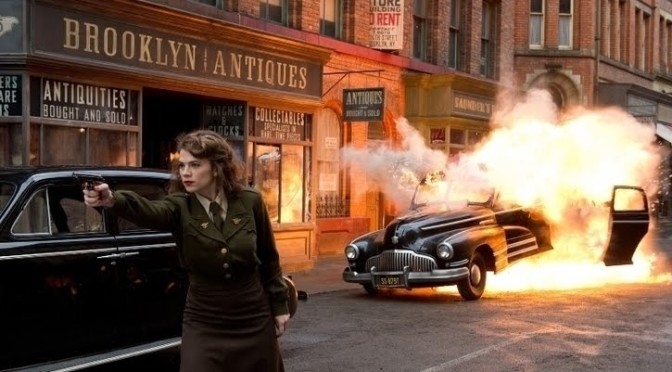
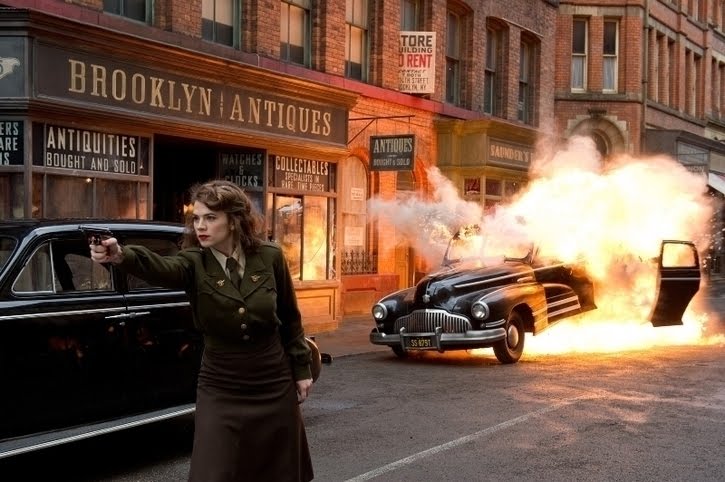
A 1940s antique store carries more than dusty lamps in the summer superhero film, ‘Captain America: The First Avenger,” which transplants its hero’s origins from the Lower East Side to downtown Brooklyn.
I know I can be a bit fanatic in my New York-centeredness, but this statement I can make with fact — the comic book industry was born in New York City. One of the earliest publishers, George Delacorte (familiar to visitors at the Central Park Zoo), founded Dell Publishing in 1921, producing pulp magazines and, eventually, comic strip collections. The publishing precursors to both DC and Marvel Comics got quiet starts in small offices in New York, and both slowly grew to dominate and define the superhero universe.
More importantly, several key comic artists and writers found inspiration in the city. Bob Kane and Bill Finger, the creators of Batman, and the hero’s first artist Jerry Robinson cooked up the character in the Bronx. Martin Nodell dreamt up the Green Lantern from inspiration found at a 34th Street subway station. A bespeckled boy from Brooklyn, Gardner Fox, ditched a law career for a typewriter where he created The Flash.
None are perhaps as famous as Stan Lee, born on the Upper West Side, and the father and co-creator of an entire stable of Marvel Comics’ classics, including Spider-Man, Iron Man and the Hulk. And one of comics’ most influential artists, Jack Kirby, was born and raised in the tenements of the Lower East Side.
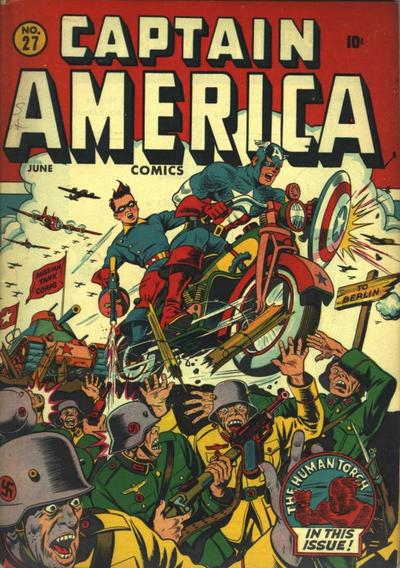
At the start of World War II, Kirby met writer Joe Simon, a photo retoucher living in Morningside Heights, and the two found success in creating a host of classic comic creations. Chief among them was the patriotic themed Captain America. Steve Rogers, a meek young illustrator, wants to fight for his country but suffers from classic comic-book weakling syndrome. A government experiment grants Rogers superhuman powers and a flamboyantly bright uniform, the better to fight Nazi and various supervillians.
Now, after all that set up about New York’s importance to comic-book creation, Rogers actually represents the top of a rarer class — superheroes who are actually born in New York City, according to their origin tales. Rogers, much like his creator Kirby, is from the Lower East Side.
In the new movie, “Captain America: The First Avenger,” the creators have transplanted the origin of the hero — as well as his sidekick Bucky — to Brooklyn*. Not only is Rogers from the mean streets of downtown Brooklyn, but the Army has a super-secret laboratory hidden within a dusty old antique store. (Talk about adding some pizazz to the Fulton Street Mall!)
In the film, 1940s Brooklyn is actually played by Manchester, England, and quite well in my opinion. But it does beg a question — in the various fictional comic book realms, how many superheroes are actual New Yorkers?
The first place to look is amongst the roster of Marvel Comics heroes. DC Comics originally set many of its tales in fictional cities — Metropolis, Gotham City, Keystone City, Star City — and many of its greatest characters are from otherworldly locations (Krypton, Mars, the island of Themyscira). Lee’s philosophy with the creation of Marvel Comics was to root heroes in realistic places and problems, a reaction to DC’s fantastical remove.
The Lower East Side’s Captain America was inherited by Marvel in the early ’60s, but the company created many of its own local heroes. A small sampling includes:
— Peter Parker, transformed by radioactive insect bite to become Spider-Man, is perhaps New York’s most famous native, a resident of Forest Hills, Queens
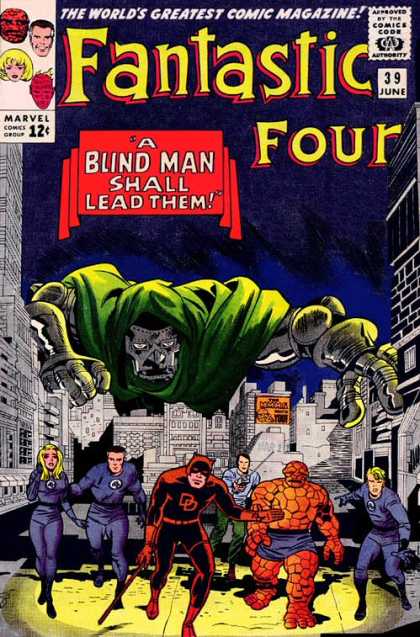
— Another Lower East Side native was scrappy young Benjamin Grimm. He befriended Columbia University college student Reed Richards, who had fallen in love with Long Island girl Sue Storm. Along with Sue’s brother Johnny, the quartet were bathed in cosmic rays to become the Fantastic Four, who donned fabulous blue costumes and set up headquarters in midtown Manhattan at the Baxter Building, overlooking Grand Central. (By the way, Tony Stark, aka Iron Man, is also a Long Island native.)
— Meanwhile, over in Hell’s Kitchen, more radiation — how is it safe to live here?! — blinds the son of a noted boxer who is later killed by gangsters. (I haven’t seen the original issue, but I’m guessing he fought at Madison Square Garden, located in Hell’s Kitchen in the 1960s.) That child, Matthew Murdock, grows up to develop extra-sensory powers and a taste for red spandex, as the Daredevil.
— I’m imagining that young Daniel Rand grew up on the Upper East Side somewhere when his wealthy father took him to the mystical disappearing city of K’un L’un, where Rand develops superhuman martial arts abilities and renames himself Iron Fist. Back in 1970s New York, quite naturally he pairs with Harlem gangster-turned-dogooder Luke Cage. Occasionally, the duo run into that Brooklyn-born hothead Ghost Rider.
— Then there’s that constant reminder of the dark, crime-infested side of 1970s New York with the vigilante called The Punisher, avenging the death of his family in Central Park at the hands of a bloodthirsty mob boss.
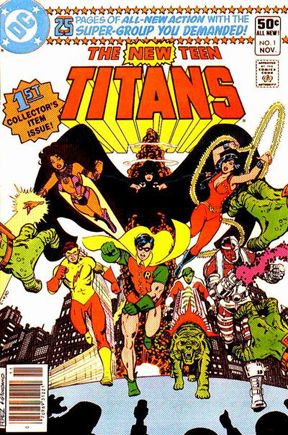
By the late 1970s, there were at least a good couple dozen superheroes flying over the heads of New Yorkers. And other heroes from other comic companies soon joined them. DC Comics saw the benefit in entering the world of actual cities by the early 80s. The popular Teen Titans housed their curious T-shaped headquarters on an unnamed island in the East River. In the alternate universe inhabited by the Watchmen, this team not only watched over the city, one of them eventually destroyed it!
By the mid-’80s, independent publishers began to creep into territory dominated by DC and Marvel, presenting starker, edgier tales. The most successful of these, the Teenage Mutant Ninja Turtles, were characters literally born in the New York sewer system. The comic itself, however, was created in Massachusetts.
With the development of companies like Dark Horse and Image, the modern comic book industry has developed far afield of New York. But just in case all of New York’s caped crusaders are otherwise engaged, we always have Professor Xavier’s School for Gifted Youngsters — the headquarters for the X-Men — just up in Westchester County!
*Apparently, Steve Rogers actually does moves to Brooklyn at some point in his long career. Red Hook, in fact! Perhaps they sell one of those nifty shields at IKEA…
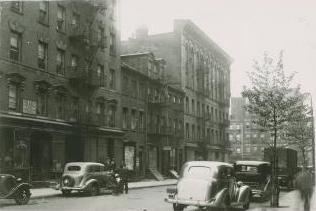
Lonely tenement on Avenue C and 13th Street, near many homes of the Triangle Fire victims. photo by Percy Loomis Sperr [NYPL]
From cable television to museums and campuses all over the city, you’ve been able to find a host of remembrances of the tragic fire at the Triangle Shirtwaist Factory one hundred years ago. At the bottom of this post, I’ll reprint my list from a couple weeks ago (with a couple new additions) outlining some easy ways to learn about the history.
I wanted to focus on something a little different. Thanks to the research of Michael Hirsch and the Kheel Center at Cornell University [found here], it’s possible to actually come up with a map of the homes of all 146 victims of the Triangle fire. It would look something like the map below. Just zoom into it to look at the individual sites and take a gander at which neighborhoods and boroughs that were most affected:
NOTE: The addresses are accurate, but a few of the points are approximately placed. In a few cases, the streets no longer exist, so I placed the points in close vicinity.
To nobody’s surprise, the neighborhood most devastated by the tragedy is the Lower East Side (The east side above Houston Street — i.e. today’s East Village — didn’t take that new designation until the 1960s.) There doesn’t seem to be a block in the neighborhood with an empty home that day one hundred years ago.
A few years before the Triangle fire, the Lower East Side has experienced an even more ghastly tragedy — the explosion of the General Slocum paddle steamer on June 15, 1904. Among the 1,021 victims of that horrific event, most lived in this neighborhood and specifically in the German area of Kleindeutschland. As the victims were mostly women and children, the disaster effectively marked the end of the German enclave here. New York wouldn’t see such a large loss of life until September 11, 2001.
The deaths of the 146 garment workers on March 25, 1911, did not produce the same effect to the neighborhood, but certainly the loss was gravely felt in tenements and houses throughout the city. The map shows that the disaster’s immediate impact reverberated even into the other boroughs.
East vs. West
Of the 146, most all of them were born in three countries — Italy, Russia or Austria. A handful were born in the United States, presumably the children of first generation immigrants. So its no surprise most of them found homes in the Lower East Side, still the heart of immigrant life in the early 20th century. But I really didn’t expect it to be so decisive. Outside of a small cluster of people who lived in Greenwich Village close to the factory, there were no victims who listed addresses anywhere on Manhattan’s west side — not in Hell’s Kitchen, the Upper West Side, or anywhere else.
Yorkville and Beyond
I’m fascinated by those who lived further out, near the growing immigrant village of Yorkville on the Upper East Side, for instance. A great many took streetcars and elevated trains into work from Brooklyn and the Bronx, and some might even have taken advantage of the new subway (although in 1911, its route was very limited). No surprise that none of them lived in Queens; the ethnic neighborhoods of that borough would really flourish after the 1920s.
And then there’s young Vincenza Billota, a 16 year old girl who lived out with her uncle in Hoboken, NJ — the only one of the victims to commute into the city. Her uncle came in from New Jersey that night to identify Vincenza who burned alive inside the factory. He identified her because her shoes had recently been repaired; he recognized the cobbler’s work.
Missing TenementsThere’s something moving about finding and identifying the homes of the victims. Most of these people had no solid roots, no property they owned. Only an address, a home they most likely shared with family members and other tenants. Every year the sidewalks outside these addresses are marked with chalk, the names and ages written on the ground as a yearly reminder. You can look at a photo array from the most recent chalk excursions here.
They didn’t live in fabulous Beaux-Arts mansions or apartment buildings. Their homes were tenements, most overcrowded and poorly maintained. Thus, many of the actual buildings themselves are gone. In the cases of the victim’s homes on Monroe Street, even most of the street itself is gone, replaced with more modern housing projects. At left, 135 Cherry Street, the home of fire victim Rose Cirrito. The photo is from 1939 (courtesy NYPL); the entire row of buildings was later demolished.
509 East 13th Street was the home to two Italian girls, Antonietta Pasqualicchio and Annie L’Abate, and an older Italian woman Annina Ardito, who all lost their lives that day. But that building has been replaced with a most modern apartment.
Family and Friends
To grasp a disaster of this magnitude — at a vantage one century later — you have to deal with it in generalities. The victims were mostly girls, mostly immigrants, mostly uneducated. However, by singling out a particular address, the individual tragedies come into focus. And oddly, you get to place that person’s life next to what inhabits that address today. In the case of the Lower East Side, some of these places are now restaurants, bars and luxury condos.
143 Essex Street was the home of two victims — two teenage brothers Max and Sam Lehrer from Austria. Both had arrived in the United States via Ellis Island in 1909; another Austrian, Sigmund Freud, also arrived at Ellis Island that year. Last year, that building itself caught on fire.
Young Jennie Stellino had lived in New York since she was 12 years old; she died in the blaze at age 16. She walked to the factory every day from her home at 315 Bowery, one of the few with a fairly easy commute. Jennie survived the blaze but died from her burns three days later. Decades later, the building at that address became internationally renown for the tenant at its ground floor, CBGB’s.
I’m not sure there’s even a 35 Second Avenue anymore. The street is inhabited by a diner and a few bars today; the Anthology Film Archives sits across the street. But it was the home to three women who lost their lives that day — Catherine Maltese and her two daughters.
________________________________________________________
There are several events lined up for this evening and throughout the weekend. You can find the whole lineup at the website Remember The Triangle Fire.
Here’s some ways to get yourself caught up on the facts of the event, in time for memorial ceremonies on March 25:
Press: Lots of articles will be generated about the fire, but I recommend you start with the excellent coverage by the New York Times, including a story last week about researcher Michael Hirsch and his quest to identify the last six remaining victims of the fire whose names until now had been unknown. [New York Times]
Books: There are several books in print, both non-fiction and narrative retelling, but the one I can most passionately recommend is Dave Von Drehle‘s ‘Triangle’ The Fire That Changed America‘, focusing on some of the early voices for worker’s rights and unrest prior to the tragedy. And Von Drehle’s depiction of the fire itself is both methodical and heartbreaking.
Websites: The School of Industrial and Labor Relations at Cornell University has organized an extraordinary repository of information about the event and the aftermath, including a huge collection of photographs and audio interviews from some of the survivors. [Remember The Triangle Factory Fire]
Podcast: And finally, I recorded a podcast on the Triangle Factory Fire back in April 2008 (Episode #42) that gives a dramatic overview of the event. You can check it out by downloading it straight from this link or getting it on iTunes from our back catalog feed Bowery Boys: New York City History Archive.
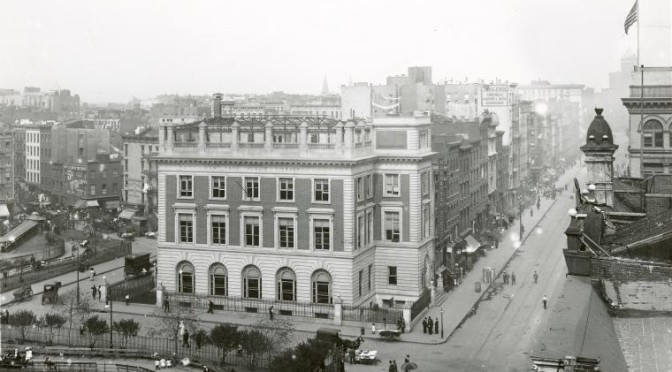
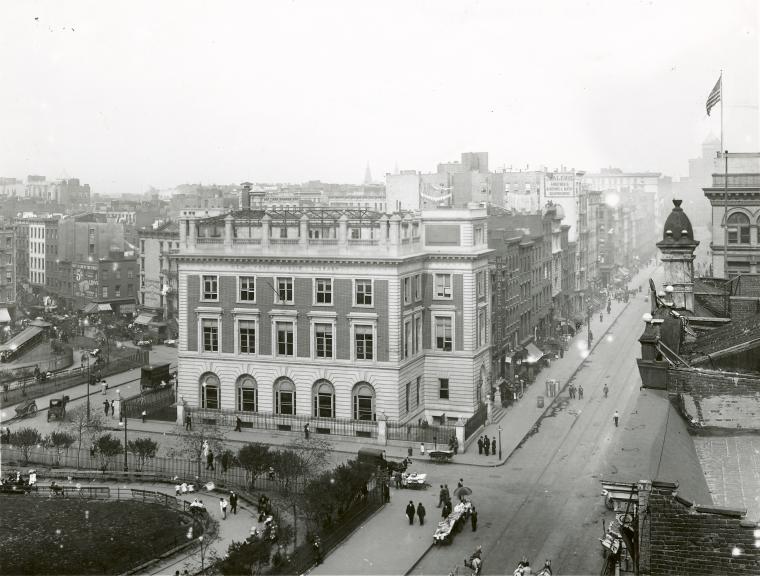
Above is a picture, facing east, of Seward Park Library in the ‘lower’ Lower East Side at 192 E. Broadway (picture taken in 1911). This spectacular branch library, funded by Andrew Carnegie, opened in November 1909, two years before the 42nd Street main branch opened. All of the housing behind the library to the east has since been demolished.
The nearby park in the foreground is still there, but the small extension of Jefferson Street which separate them has been turned into a paved, closed off pedestrian plaza. The streets seen in the left of the photograph are completely gone.
The library was built by the firm Babb, Cook and Welch, whose accomplishments from the Gilded Age are seldomly still found today. But, in fact, one of the firm’s lead architects William Cook was part of a committee which included Charles McKim (of McKim, Mead and White) and John Carerre (of Carerre and Hastings, who ultimately designed the famous 42nd Street branch) to standardize library designs in the city. Those two better known firms got most of the commissions; however the Seward Park library remains one of Babb, Cook and Welch’s best known remaining public works.
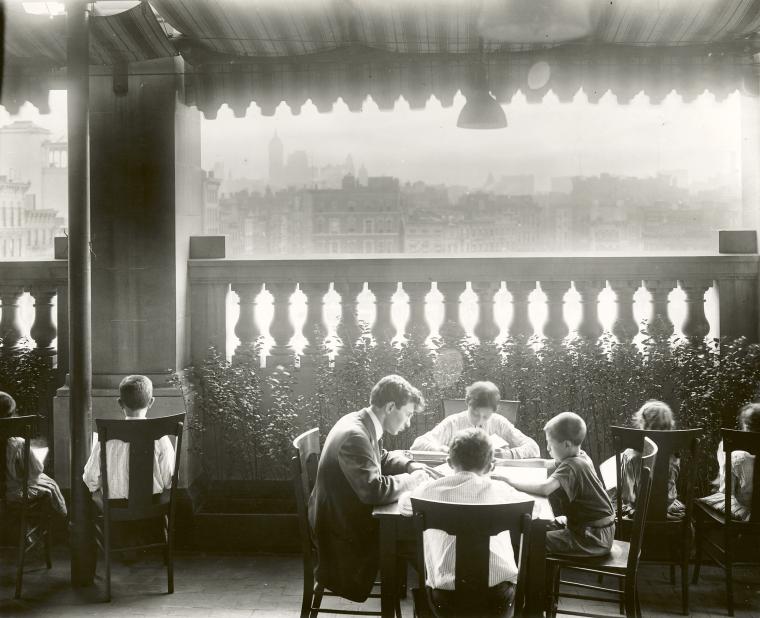
During the library’s first years, readers were actually allowed onto a “roof garden.” According to a New York Times article from 1910, “There will be awnings over the top to shield from sun and the occasional shower; tables around which the readers can congregate, and a network of electric bulbs strung over the top so that there will be plenty of light for the industrious who wish to study.”
Below: children and adults alike on Seward Park’s roof garden
Adults were even allowed onto the roof late into the evening, including “mothers who wish to do their sewing out of doors.”
Although this grand structure was placed here in 1909, it was certainly not the neighborhood’s first library. Once the domain of the private sector, libraries were provided by philanthropic organizations such as the Aguilar Free Library Society, which began offering a reading room for New Yorkers at this very address starting in 1891.
Aguilar’s East Broadway library, “where the readers are nearly all Hebrew,” featured over 140,000 thousands books, the most popular being ‘Uncle Tom’s Cabin’ and ‘Around The World In 80 Days”. This library was sold in 1902 and remade as the building which stands there today.
The Seward Park Library has gone through two major renovations, the most recent in 2004, bringing back most of the building’s original lustre. As evidenced by this photo, little around it remains from its original condition.
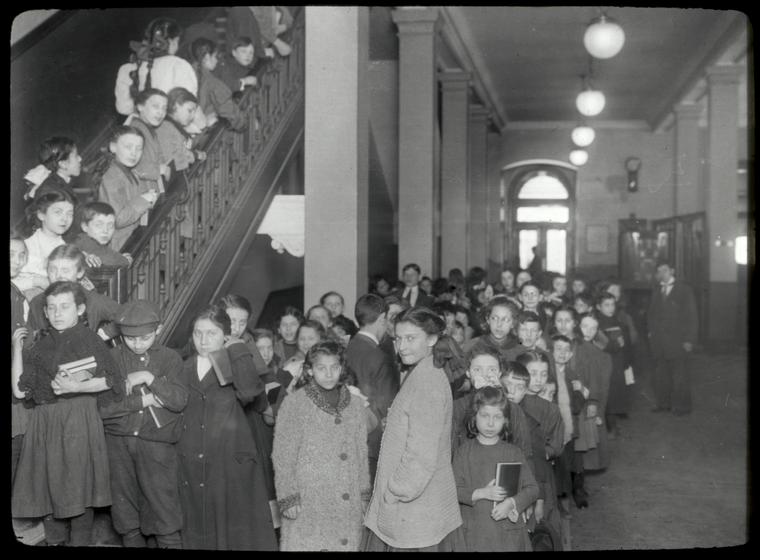
Of course, children have changed as well. Outside of a reading by Stephenie Meyer, can you imagine this mob scene at a library today? (Photo by Lewis Wickes Hine)
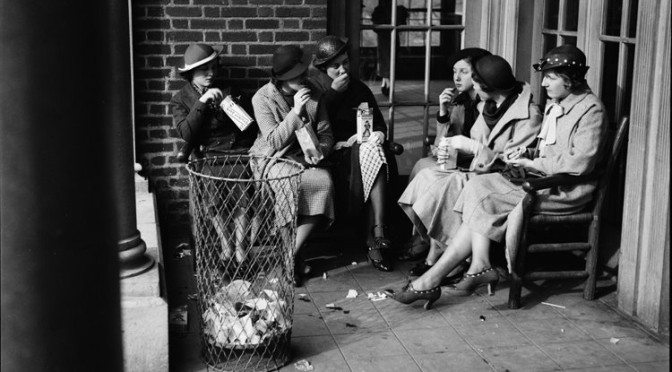
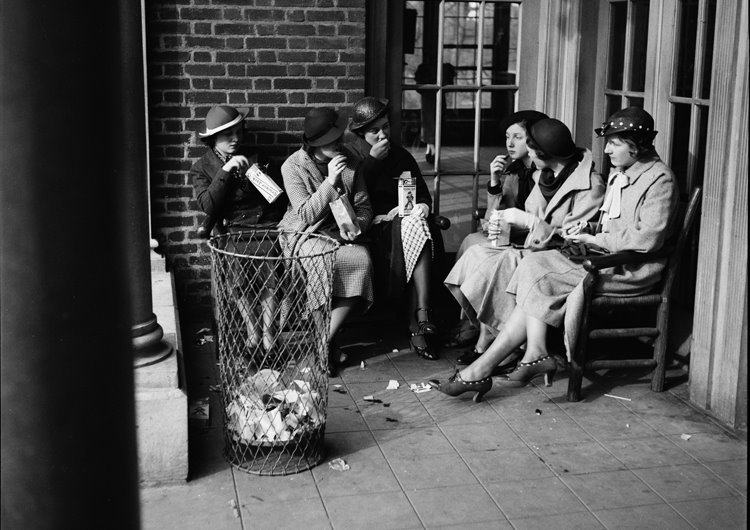
ABOVE: These are the ladies who lunch in Prospect Park 1935
We talk about a lot of white men on the Bowery Boys podcast. When
discussing the mainstream history of the city, it’s pretty unavoidable.
Men had the money, the power, the influence. Not to mention most of the
corruption, the crime, the scandal.
So as Women’s History Month draws to a close (okay, I’m one day
late), I thought I’d make a very opinionated list of the 25 women who
made the biggest impact to the city of New York, at least as seen by
this humble blogger and podcaster.
There have obviously been many, many New York-based women whose
contributions changed the country and the world. There are your
feminists (Elizabeth Cady Stanton), your activists (Ella Baker), your
entrepreneurs (Estee Lauder), your tastemakers (Diana Vreeland) and your
entertainers (Madonna).
But these 25 helped shape
the actual city itself. The neighborhoods, populations and culture, to
be sure. But most importantly, they each effected perceptions of the
city, both to its residents and outward to the world. (Thus, for
instance, you’ll note my heavy emphasis on preservationists.)
This is not an ultimate list. I obviously do not know the impact of
every woman who ever lived in New York City. Many women communicated
power through wealth and property; I don’t have the social register from
every season and cannot gauge the influence of every bold-faced name.
These are just 25 that have crossed my path since we started the Bowery
Boys that I just wanted to celebrate today.
I’ve obviously missed out on a few, so if you have a
particular favorite that’s missing, please put them in the comment
section. At the bottom I have a list of ladies that made my personal
honorable mention. So here we go!
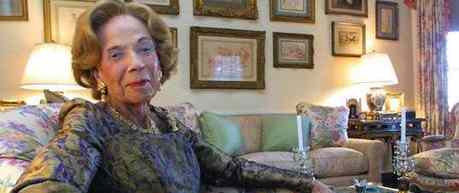
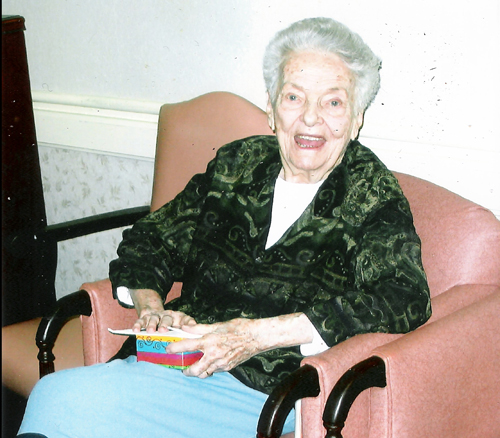
Brooke Astor (1902-2007)
Philanthropist
She was the last of the socialites, as they say. The queen of old
American money, for 105 years Astor ruled as the last official vestige
of one of Manhattan’s wealthiest families, setting a standard for
philanthropy and sadly leaving an uncertain legacy amid scandals
involving her heirs.
Power is the ability to do good things for others. — Brooke Astor
Alice Austen (1866-1952)
Photographer
Few saw the Gilded Age city quite as Austen did, a Staten Island
native who captured the beauties of New York, the horrors of Ellis
Island’s quarantine station, and the wonders of the world, but probably
took her best shots from her own backyard at Clear Comfort, in Rosebank,
SI.
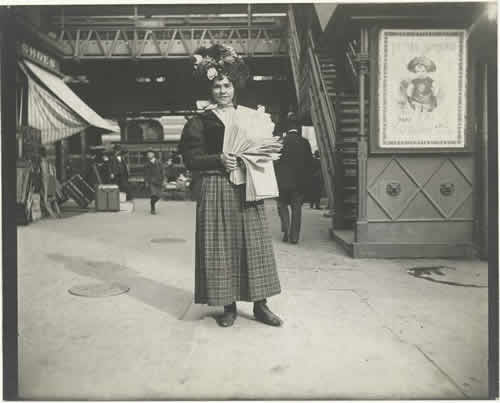
Below: a girl newsie in 1896, as captured by Austen
Nellie Bly (1864-1922)
Journalist
Her bravery, curiosity and outright nerve made her a writer of
international fame, one of the first investigative journalists in the
age of sensational journalism. But the story that put her on the map was
her undercover expose at Blackwell’s Island, ripping open the abuses of
New York’s island of untouchables, changing how the city thought about
both the infirm and the incarcerated.
Could I pass a week in the insane ward at Blackwell’s Island? I said I could and I would. And I did. — Nellie Bly
Margaret Corbin (1751-1800)
Revolutionary
Things were so precarious in the fall of 1776, the dawn of the
Revolution, that anyone who lived in New York might have turned the tide
of war. Many women did their part to battle the British, from Mary Lindlay Murray the to the mysterious Agent 355,
a shrouded spy among the British. But Corbin is notable not just for
particular bravery but for sacrifice; she continued to lob cannon fire
at the British from Fort Washington in today’s Washington Heights well
after her husband was killed. Corbin herself was later imprisoned by the
British. Today the street along Fort Tryon is named for her.
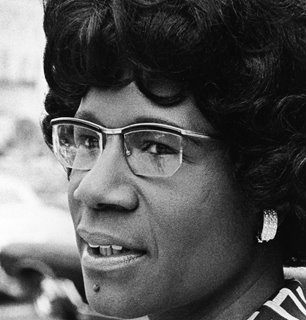
Shirley Chisholm (1924-2005)
Trailblazer
The pride of Bedford-Stuyvesant maneuvering through the precarious world
of New York politics, Chisholm won a seat in the state legislature in
1964 but always dreamed to represent Brooklyn on a national level, in
the U.S House of Representatives. She finally got her wish to represent
her neighborhood when redistricting lines were finally redrawn — finally
allowing a black candidate to run (and win) in a largely black
community — and won her seat in Congress in 1968. Shirley never
disguised her ties to her beloved Brooklyn neighborhood, even as a
candidate for president of the United States.
That I am a national figure because I
was the first person in 192 years to be at once a congressman, black
and a woman proves, I think, that our society is not yet either just or
free. — Shirley Chisholm
Margot Gayle (1908-2008)
Community leader
Gayle, who died last year at age 100, loved her Victorian
architecture and in particular cast-iron, the antiquated style of
downtown New York warehouses. Seeing destruction imminent, she decided
to save what she considered one of the city’s most neglected treasures.
Forming her first community group in the 1950s to save castle-like
Jefferson Market Courthouse, Gayle galvanized a grassroots architecture
movement.
There might be no SoHo without Gayle; as a campaigner, her work in
saving and preserving this heretofore disregarded part of downtown led
to one of Manhattan’s great neighborhood success stories. The SoHo Cast
Iron Historic District exists due to her efforts. And, more importantly,
her work became a template for how future neighborhoods could be
revitalized. (Read her Times obituary here).
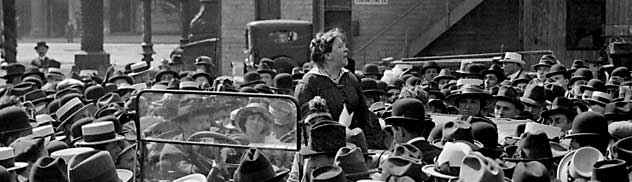
Emma Goldman (1869-1940)
Agitator
Probably the most influential anarchist in American history, Goldman
promoted the rights of workers and upended the role of women in New York
politics. The Russian-born activist made her name on the streets of
Manhattan, stirring Bohemia and workers alike, butting heads with most
of New York’s leading industrialists in the process.
Her views are controversial, often horrifying by today’s standards.
(She once ordered the assassination of Henry Clay Frick, for instance.)
But her powers as an orator and rabble-rouser are unquestioned; her
stirring words in Union Square (pictured above) during the panic of 1893
gave voice to the outrage of the city.
If voting changed anything, they’d make it illegal. — Emma Goldman
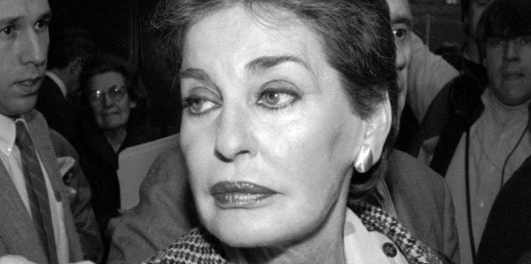
Leona Helmsley (1920-2007)
Magnate
Leona and her husband Harry reigned over a vast Manhattan empire of
highrises and hotels, permanently changing Park and Madison avenues,
helping transform New York into a city of condominiums. Her status as
the Queen of Mean also formed the modern caricature of overbearing and
out of touch wealthy elite. Later convicted of tax evasion, Leona died
in 2007 a laughing-stock. (That Suzanne Pleshette film
didn’t help either.) But her reach extends through many of the city’s
great iconic buildings, including the Empire State Building, which she
and her husband once managed.
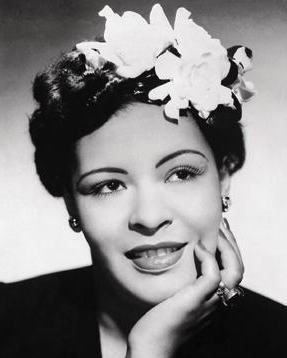
Billie Holiday (1915-1959)
Chanteuse
Of all the thousands of entertainers that have left their imprint on the
city, Holiday’s is the one that makes the deepest impact. Her entire
story — her birth, her rise to fame, her indiscretions and her tragic
death — takes place in New York. Her greatest performances electrified
and reshaped race assumptions in 1930s and 40s nightlife; legendary
nights at places like Cafe Society ensured entertainment would no longer
be strictly a black and white affair. Her performance style is emulated
nightly in cabarets and clubs throughout the city.
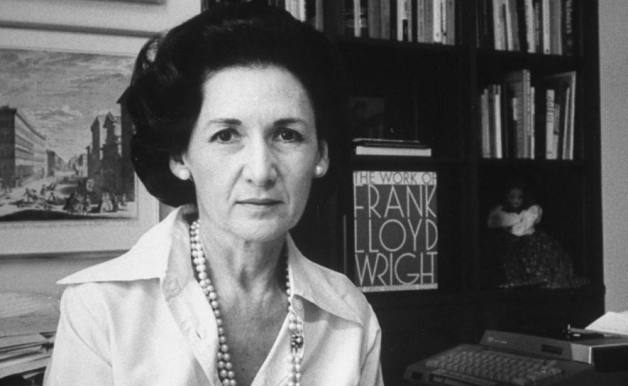
Ada Louise Huxtable (1921-2013)
Critic
She is the best known woman in twentieth century architecture, and she
isn’t even an architect. It’s hard to analyze the history of any
building without first checking in with Ada to see what she has to say
on the matter. Her writing is elegant, persnickety, direct and
affectionate to architectural aesthetic as a whole, and New York City in
specific. As a writer for the New York Times and Wall Street Journal,
Huxtable directed New York’s architecture scene from behind her desk,
excoriating designers for excess or dullness, praising beauty when it
improved the city’s legendary skyline.
I like old buildings that are
intriguing and quite wonderful but don’t make the history books. What
you discover is there’s a little group of people that have been admiring
them quietly by themselves all along. — Ada Louise Huxtable
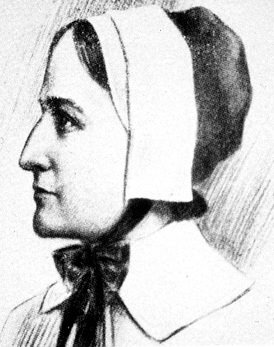
Anne Hutchinson (1591-1643)
Dissident
Escaping persecution in both Puritan Massachusetts and Rhode Island,
religious revolutionary Hutchinson and her followers settled in today’s
area of the North Bronx in the 1640s, one of two significant female
leaders in the early New York area. Although she was later murdered —
Lenapes wiped out the settlement in 1643, a victim of New Amsterdam’s
persistent conflicts with native tribes — she still leaves her mark
today. The Hutchinson River and Parkway both carry her name.
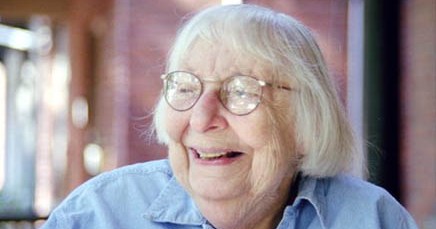
Jane Jacobs (1916-2006)
Community defender
Her theories on urban life have benefited many North American cities,
but it was her struggles to save neighborhoods from Robert Moses and
the rise of car culture in the 1950s and 60s that make her most
influential today. The entirely of downtown Manhattan has her to thank
for fighting back — and ultimately defeating — Moses’ destructive Lower
Manhattan Expressway proposal. The theories described in her classic
“Death and Life of Great American Cities” were shaped from observing
life from her window at 555 Hudson Street in the West Village.
Cities have the capability of providing something for
everybody, only because, and only when, they are created by everybody. —
Jane Jacobs
Lady Deborah Moody (1586 – 1659)
Founder
The British-born Moody, like Hutchinson, took to the unknown when
persecuted for her religious beliefs. With the permission of William
Kieft, the “dangerous” Moody set up the colony of Gravesend in 1645,
becoming the first female founder of an American colony. Gravesend was
one of the original towns of Brooklyn and is still the name of a south
Brooklyn neighborhood today.
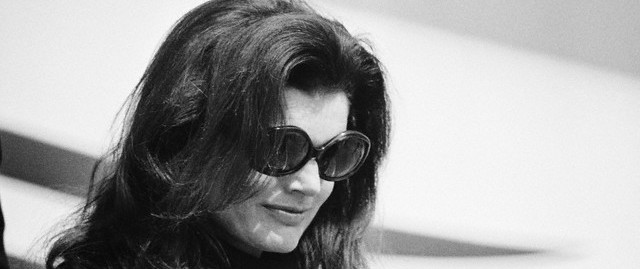
Jackie Kennedy Onassis (1929-1994)
Icon
Settling in New York after the deaths of two husbands, Onassis was
the biggest bold-faced name in the city, famously suffering the
intrusive effects of paparazzi. However she used her headline grabbing
name wisely as a member of the Municipal Art Society, helping defend
Grand Central Station, Columbus Circle and Staten Island’s Snug Harbor
from modification or outright destruction. The Central Parks reservoir
is named in her honor, and MAS gives out a yearly Jackie Kennedy Onassis
Medal to noteworthy New Yorkers. (Margot Gayle received it in 1997.)
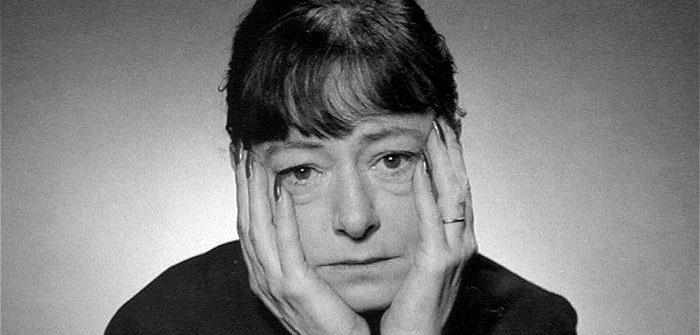
Dorothy Parker (1893-1967)
Wit
As doyenne of the Algonquin Round Table, Parker had the sharpest
friends in town in the 1920s. Her droll charm helped create the
archetype of New York caustic intellectualism, something Woody Allen,
Fran Lebowitz and an entire culture of New Yorker readers can well
recognize.
I’d rather have a bottle in front of me, than a frontal lobotomy. — Dorothy Parker
Abby Aldrich Rockefeller (1874-1948)
Collector
She could very well have stayed in the sidelines with the other
spouses of multi-millionares. But Abby’s tastes and passions for modern
art led her to an astonishing collection she kept on an upper floor of
her townhouse, away from her husband J.D. Rockefeller Jr., who didn’t
much care for those odd little pictures. Years later, that townhouse
would give way to Abby’s pet project, the Museum of Modern Art, one of
the most influential galleries for 20th Century art. Her memory is kept
alive at the museum with the Abby Aldrich Rockefeller Sculpture Garden.
Emily Warren Roebling (1843-1903)
Bridge Builder
Construction on the Brooklyn Bridge had barely begun when her husband
and master engineer Washington Roebling came down with crippling
symptoms of the Bends. Emily at first operated only as his eyes and
ears, but soon grew into the role of leading the completion of New
York’s first great bridge. Ceremonially, she was the first person to
cross it.
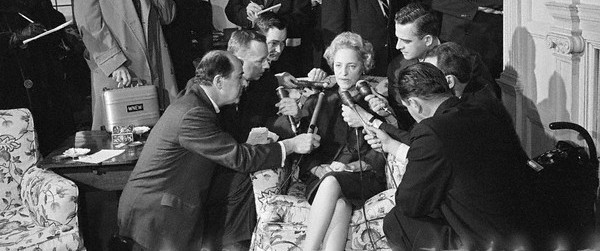
Eleanor Roosevelt (1884-1962)
World Leader
One of the most powerful American women to have ever lived was a New
Yorker through and through. Her aristocratic name may have opened doors
for her early on, but her compassion and ingenuity would soon set her
apart, first as a social worker in Manhattan slums, then as the spouse
of a governor and president. She returned to New York after FDR’s death
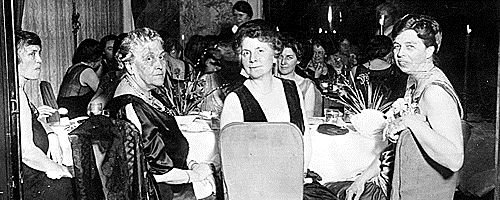
to become a U.S. delegate to the United Nations. (Above: Eleanor with
New York City society women.)
Beautiful young people are accidents of nature, but beautiful old people are works of art. — Eleanor Roosevelt
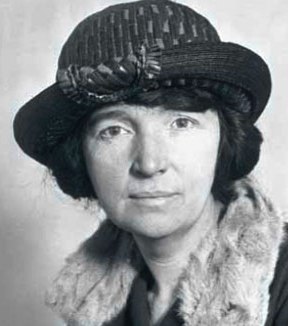
Margaret Sanger (1879-1966)
Rebel
Her influence in the fields of reproduction and birth control would
eventually go global, but all nurse Sanger really wanted to do at first
was help out women in the Lower East Side. From her work in the slums,
Sanger believed radical action was neccessary to control the rising tide
of pregnancies, leading to larger families and greater poverty. In 1917
she opened New York’s first birth control clinic in Brooklyn and was
promptly thrown in jail. Ten years later, her innovations as an educator
in birth control — she’s the mother of Planned Parenthood! — would
catch on worldwide.
During these years in New York more and more my calls began
to come from the Lower East Side, as though I were being magnetically
drawn there by some force outside my control. — Margaret Sanger
Verna Small (1916-2008)
Preservationist
Small is the queen of Greenwich Village, a fiesty, often poetic
community leader who provoked residents into lobbying for historic
preservation. She organized or led one group after another, all in an
effort to preserve the remainder of the Village before developers could
sweep it away. She succeeded. Today it seem impossible that the Village
was ever in that much danger at all. Her many years with the Landmarks
Committee in the 1980s assured the rest of the city would benefit from
her tender loving care.
The attitude of the Village was ‘We’ve got to catch up with Brooklyn Heights!’ —Verna Small
Dorothy Schiff (1903-1989)
Publisher
Native New Yorker Schiff owned the New York Post from 1939 to the 1970s
and eventually shaped its editorial policy as publisher, the first New
York woman to do so. Her stinging, left-leaning views and saavy tastes
for great writers turned the once tame newspaper into the city’s most
successful tabloid. Her sudden decision to sell it to Rupert Murdoch in
1976 led to the decidedly different, far more sensational Post we’re
familiar with today.
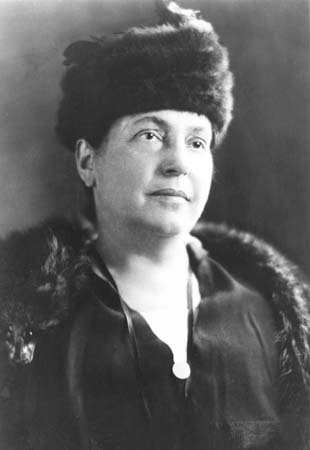
Lillian Wald (1867–1940)
Social Worker
The patron saint of the Lower East Side, devoted nurse Wald helped
found both the Henry Street Settlement and the National Association for
the Advancement of Colored People. Her desire to help New York’s poorest
consumed her life. Her altruism helped save thousands of lives and set
the standard modern social work and nursing. If that isn’t enough, her
innovations from everything to playgrounds and school lunch programs
redefined New York education and reverberated throughout America. Um,
what have you done today to help your fellow man?
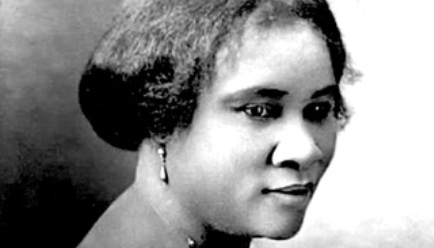
Madam C.J. Walker (1867-1919)
Tycoon
Walker, a self-made entrepreneur and hair product queen, was the
richest and most powerful woman in Harlem, during the neighborhood’s
pivotal years of growth in the dawn of the Harlem Renaissance. (Some
sources say she was America’s first female millionaire.) She shattered
color and gender barriers, employing hundreds of other black women and
eventually leaving most of her wealth to notable African-American
organizations. Walker’s daughter A’Lelia was a patron of many great
writers of the Renaissance era.
And her name? She was once married to a man named Charles Joseph Walker; he left in 1910, but the C.J. — and the Madam — stayed.
Edith Wharton (1862-1937)
Observer
Wharton was a woman of ultimate privledge in Gilded Age New York but
had an uncanny ability to describe it. Our notions of what upper-crust
New York was at this time are shaped in part by her novels and short
stories. Her creations Lily Bart and the Countess Ellen Olenska are
still the best evidence we have of the absurdities and restraints
upper-class New York.
A New York divorce is in itself a diploma of virtue. — Edith Wharton
Gertrude Vanderbilt Whitney (1875-1942)
Patron
Gertrude, the daughter of Cornelius Vanderbilt, turned her powerful
name, untold wealth and fascinations with art into an endeavor that
would benefit the general public, eventually founding the Whitney Museum
in 1931. But unlike Abby Rockefeller, Whitney actually was an artist
herself, a sculptrress and a habitue of turn-of-the-century Greenwich
Village bohemia. Gertrude’s daughter Flora Payne Whitney would go on to
head her mother’s museum for decades.
And 25 more that I didn’t get to write about this time around:
ABOVE: These are the ladies who lunch in Prospect Park 1935
We talk about a lot of white men on the Bowery Boys podcast. When discussing the mainstream history of the city, it’s pretty unavoidable. Men had the money, the power, the influence. Not to mention most of the corruption, the crime, the scandal.
So as Women’s History Month draws to a close (okay, I’m one day late), I thought I’d make a very opinionated list of the 25 women who made the biggest impact to the city of New York, at least as seen by this humble blogger and podcaster.
There have obviously been many, many New York-based women whose contributions changed the country and the world. There are your feminists (Elizabeth Cady Stanton), your activists (Ella Baker), your entrepreneurs (Estee Lauder), your tastemakers (Diana Vreeland) and your entertainers (Madonna).
But these 25 helped shape the actual city itself. The neighborhoods, populations and culture, to be sure. But most importantly, they each effected perceptions of the city, both to its residents and outward to the world. (Thus, for instance, you’ll note my heavy emphasis on preservationists.)
This is not an ultimate list. I obviously do not know the impact of every woman who ever lived in New York City. Many women communicated power through wealth and property; I don’t have the social register from every season and cannot gauge the influence of every bold-faced name. These are just 25 that have crossed my path since we started the Bowery Boys that I just wanted to celebrate today.
I’ve obviously missed out on a few, so if you have a particular favorite that’s missing, please put them in the comment section. At the bottom I have a list of ladies that made my personal honorable mention. So here we go!
Brooke Astor (1902-2007)
Philanthropist
She was the last of the socialites, as they say. The queen of old American money, for 105 years Astor ruled as the last official vestige of one of Manhattan’s wealthiest families, setting a standard for philanthropy and sadly leaving an uncertain legacy amid scandals involving her heirs.
Power is the ability to do good things for others. — Brooke Astor
Alice Austen (1866-1952)
Photographer
Few saw the Gilded Age city quite as Austen did, a Staten Island native who captured the beauties of New York, the horrors of Ellis Island’s quarantine station, and the wonders of the world, but probably took her best shots from her own backyard at Clear Comfort, in Rosebank, SI.
Below: a girl newsie in 1896, as captured by Austen
Nellie Bly (1864-1922)
Journalist
Her bravery, curiosity and outright nerve made her a writer of international fame, one of the first investigative journalists in the age of sensational journalism. But the story that put her on the map was her undercover expose at Blackwell’s Island, ripping open the abuses of New York’s island of untouchables, changing how the city thought about both the infirm and the incarcerated.
Could I pass a week in the insane ward at Blackwell’s Island? I said I could and I would. And I did. — Nellie Bly
Margaret Corbin (1751-1800)
Revolutionary
Things were so precarious in the fall of 1776, the dawn of the Revolution, that anyone who lived in New York might have turned the tide of war. Many women did their part to battle the British, from Mary Lindlay Murray the to the mysterious Agent 355, a shrouded spy among the British. But Corbin is notable not just for particular bravery but for sacrifice; she continued to lob cannon fire at the British from Fort Washington in today’s Washington Heights well after her husband was killed. Corbin herself was later imprisoned by the British. Today the street along Fort Tryon is named for her.
Shirley Chisholm (1924-2005)
Trailblazer
The pride of Bedford-Stuyvesant maneuvering through the precarious world of New York politics, Chisholm won a seat in the state legislature in 1964 but always dreamed to represent Brooklyn on a national level, in the U.S House of Representatives. She finally got her wish to represent her neighborhood when redistricting lines were finally redrawn — finally allowing a black candidate to run (and win) in a largely black community — and won her seat in Congress in 1968. Shirley never disguised her ties to her beloved Brooklyn neighborhood, even as a candidate for president of the United States.
That I am a national figure because I was the first person in 192 years to be at once a congressman, black and a woman proves, I think, that our society is not yet either just or free. — Shirley Chisholm
Margot Gayle (1908-2008)
Community leader
Gayle, who died last year at age 100, loved her Victorian architecture and in particular cast-iron, the antiquated style of downtown New York warehouses. Seeing destruction imminent, she decided to save what she considered one of the city’s most neglected treasures. Forming her first community group in the 1950s to save castle-like Jefferson Market Courthouse, Gayle galvanized a grassroots architecture movement.
There might be no SoHo without Gayle; as a campaigner, her work in saving and preserving this heretofore disregarded part of downtown led to one of Manhattan’s great neighborhood success stories. The SoHo Cast Iron Historic District exists due to her efforts. And, more importantly, her work became a template for how future neighborhoods could be revitalized. (Read her Times obituary here).
Emma Goldman (1869-1940)
Agitator
Probably the most influential anarchist in American history, Goldman promoted the rights of workers and upended the role of women in New York politics. The Russian-born activist made her name on the streets of Manhattan, stirring Bohemia and workers alike, butting heads with most of New York’s leading industrialists in the process.
Her views are controversial, often horrifying by today’s standards. (She once ordered the assassination of Henry Clay Frick, for instance.) But her powers as an orator and rabble-rouser are unquestioned; her stirring words in Union Square (pictured above) during the panic of 1893 gave voice to the outrage of the city.
If voting changed anything, they’d make it illegal. — Emma Goldman
Leona Helmsley (1920-2007)
Magnate
Leona and her husband Harry reigned over a vast Manhattan empire of highrises and hotels, permanently changing Park and Madison avenues, helping transform New York into a city of condominiums. Her status as the Queen of Mean also formed the modern caricature of overbearing and out of touch wealthy elite. Later convicted of tax evasion, Leona died in 2007 a laughing-stock. (That Suzanne Pleshette film didn’t help either.) But her reach extends through many of the city’s great iconic buildings, including the Empire State Building, which she and her husband once managed.
Billie Holiday (1915-1959)
Chanteuse
Of all the thousands of entertainers that have left their imprint on the city, Holiday’s is the one that makes the deepest impact. Her entire story — her birth, her rise to fame, her indiscretions and her tragic death — takes place in New York. Her greatest performances electrified and reshaped race assumptions in 1930s and 40s nightlife; legendary nights at places like Cafe Society ensured entertainment would no longer be strictly a black and white affair. Her performance style is emulated nightly in cabarets and clubs throughout the city.
Ada Louise Huxtable (1921-2013)
Critic
She is the best known woman in twentieth century architecture, and she isn’t even an architect. It’s hard to analyze the history of any building without first checking in with Ada to see what she has to say on the matter. Her writing is elegant, persnickety, direct and affectionate to architectural aesthetic as a whole, and New York City in specific. As a writer for the New York Times and Wall Street Journal, Huxtable directed New York’s architecture scene from behind her desk, excoriating designers for excess or dullness, praising beauty when it improved the city’s legendary skyline.
I like old buildings that are intriguing and quite wonderful but don’t make the history books. What you discover is there’s a little group of people that have been admiring them quietly by themselves all along. — Ada Louise Huxtable
Anne Hutchinson (1591-1643)
Dissident
Escaping persecution in both Puritan Massachusetts and Rhode Island, religious revolutionary Hutchinson and her followers settled in today’s area of the North Bronx in the 1640s, one of two significant female leaders in the early New York area. Although she was later murdered — Lenapes wiped out the settlement in 1643, a victim of New Amsterdam’s persistent conflicts with native tribes — she still leaves her mark today. The Hutchinson River and Parkway both carry her name.
Jane Jacobs (1916-2006)
Community defender
Her theories on urban life have benefited many North American cities, but it was her struggles to save neighborhoods from Robert Moses and the rise of car culture in the 1950s and 60s that make her most influential today. The entirely of downtown Manhattan has her to thank for fighting back — and ultimately defeating — Moses’ destructive Lower Manhattan Expressway proposal. The theories described in her classic “Death and Life of Great American Cities” were shaped from observing life from her window at 555 Hudson Street in the West Village.
Cities have the capability of providing something for everybody, only because, and only when, they are created by everybody. — Jane Jacobs
Lady Deborah Moody (1586 – 1659)
Founder
The British-born Moody, like Hutchinson, took to the unknown when persecuted for her religious beliefs. With the permission of William Kieft, the “dangerous” Moody set up the colony of Gravesend in 1645, becoming the first female founder of an American colony. Gravesend was one of the original towns of Brooklyn and is still the name of a south Brooklyn neighborhood today.
Jackie Kennedy Onassis (1929-1994)
Icon
Settling in New York after the deaths of two husbands, Onassis was the biggest bold-faced name in the city, famously suffering the intrusive effects of paparazzi. However she used her headline grabbing name wisely as a member of the Municipal Art Society, helping defend Grand Central Station, Columbus Circle and Staten Island’s Snug Harbor from modification or outright destruction. The Central Parks reservoir is named in her honor, and MAS gives out a yearly Jackie Kennedy Onassis Medal to noteworthy New Yorkers. (Margot Gayle received it in 1997.)
Dorothy Parker (1893-1967)
Wit
As doyenne of the Algonquin Round Table, Parker had the sharpest friends in town in the 1920s. Her droll charm helped create the archetype of New York caustic intellectualism, something Woody Allen, Fran Lebowitz and an entire culture of New Yorker readers can well recognize.
I’d rather have a bottle in front of me, than a frontal lobotomy. — Dorothy Parker
Abby Aldrich Rockefeller (1874-1948)
Collector
She could very well have stayed in the sidelines with the other spouses of multi-millionares. But Abby’s tastes and passions for modern art led her to an astonishing collection she kept on an upper floor of her townhouse, away from her husband J.D. Rockefeller Jr., who didn’t much care for those odd little pictures. Years later, that townhouse would give way to Abby’s pet project, the Museum of Modern Art, one of the most influential galleries for 20th Century art. Her memory is kept alive at the museum with the Abby Aldrich Rockefeller Sculpture Garden.
Emily Warren Roebling (1843-1903)
Bridge Builder
Construction on the Brooklyn Bridge had barely begun when her husband and master engineer Washington Roebling came down with crippling symptoms of the Bends. Emily at first operated only as his eyes and ears, but soon grew into the role of leading the completion of New York’s first great bridge. Ceremonially, she was the first person to cross it.
Eleanor Roosevelt (1884-1962)
World Leader
One of the most powerful American women to have ever lived was a New Yorker through and through. Her aristocratic name may have opened doors for her early on, but her compassion and ingenuity would soon set her apart, first as a social worker in Manhattan slums, then as the spouse of a governor and president. She returned to New York after FDR’s death to become a U.S. delegate to the United Nations. (Above: Eleanor with New York City society women.)
Beautiful young people are accidents of nature, but beautiful old people are works of art. — Eleanor Roosevelt
Margaret Sanger (1879-1966)
Rebel
Her influence in the fields of reproduction and birth control would eventually go global, but all nurse Sanger really wanted to do at first was help out women in the Lower East Side. From her work in the slums, Sanger believed radical action was neccessary to control the rising tide of pregnancies, leading to larger families and greater poverty. In 1917 she opened New York’s first birth control clinic in Brooklyn and was promptly thrown in jail. Ten years later, her innovations as an educator in birth control — she’s the mother of Planned Parenthood! — would catch on worldwide.
During these years in New York more and more my calls began to come from the Lower East Side, as though I were being magnetically drawn there by some force outside my control. — Margaret Sanger
Verna Small (1916-2008)
Preservationist
Small is the queen of Greenwich Village, a fiesty, often poetic community leader who provoked residents into lobbying for historic preservation. She organized or led one group after another, all in an effort to preserve the remainder of the Village before developers could sweep it away. She succeeded. Today it seem impossible that the Village was ever in that much danger at all. Her many years with the Landmarks Committee in the 1980s assured the rest of the city would benefit from her tender loving care.
The attitude of the Village was ‘We’ve got to catch up with Brooklyn Heights!’ —Verna Small
Dorothy Schiff (1903-1989)
Publisher
Native New Yorker Schiff owned the New York Post from 1939 to the 1970s and eventually shaped its editorial policy as publisher, the first New York woman to do so. Her stinging, left-leaning views and saavy tastes for great writers turned the once tame newspaper into the city’s most successful tabloid. Her sudden decision to sell it to Rupert Murdoch in 1976 led to the decidedly different, far more sensational Post we’re familiar with today.
Lillian Wald (1867–1940)
Social Worker
The patron saint of the Lower East Side, devoted nurse Wald helped found both the Henry Street Settlement and the National Association for the Advancement of Colored People. Her desire to help New York’s poorest consumed her life. Her altruism helped save thousands of lives and set the standard modern social work and nursing. If that isn’t enough, her innovations from everything to playgrounds and school lunch programs redefined New York education and reverberated throughout America. Um, what have you done today to help your fellow man?
Madam C.J. Walker (1867-1919)
Tycoon
Walker, a self-made entrepreneur and hair product queen, was the richest and most powerful woman in Harlem, during the neighborhood’s pivotal years of growth in the dawn of the Harlem Renaissance. (Some sources say she was America’s first female millionaire.) She shattered color and gender barriers, employing hundreds of other black women and eventually leaving most of her wealth to notable African-American organizations. Walker’s daughter A’Lelia was a patron of many great writers of the Renaissance era.
And her name? She was once married to a man named Charles Joseph Walker; he left in 1910, but the C.J. — and the Madam — stayed.
Edith Wharton (1862-1937)
Observer
Wharton was a woman of ultimate privledge in Gilded Age New York but had an uncanny ability to describe it. Our notions of what upper-crust New York was at this time are shaped in part by her novels and short stories. Her creations Lily Bart and the Countess Ellen Olenska are still the best evidence we have of the absurdities and restraints upper-class New York.
A New York divorce is in itself a diploma of virtue. — Edith Wharton
Gertrude Vanderbilt Whitney (1875-1942)
Patron
Gertrude, the daughter of Cornelius Vanderbilt, turned her powerful name, untold wealth and fascinations with art into an endeavor that would benefit the general public, eventually founding the Whitney Museum in 1931. But unlike Abby Rockefeller, Whitney actually was an artist herself, a sculptrress and a habitue of turn-of-the-century Greenwich Village bohemia. Gertrude’s daughter Flora Payne Whitney would go on to head her mother’s museum for decades.
And 25 more that I didn’t get to write about this time around:

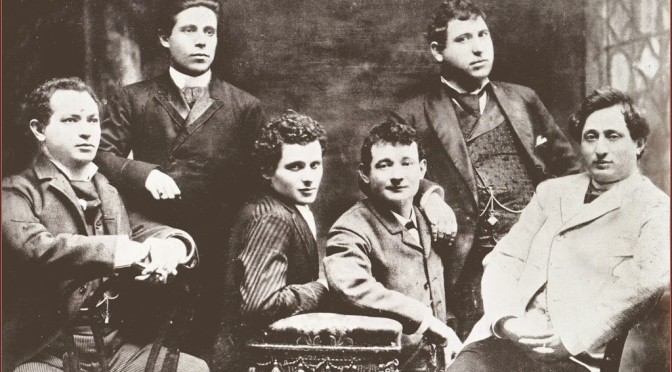

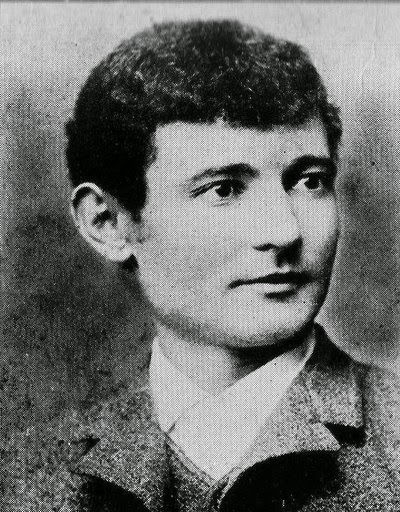 For a passionate sub-set of New Yorkers, Mogulesko was everything.