Categories
Podcasts

PODCAST: Webster Hall

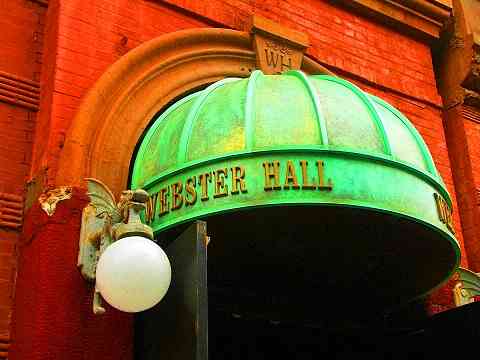
Webster Hall, as beautifully worn and rough-hewn as it was during its heyday in the 1910s and 20s, disguises a very surprising past, a significant venue in the history of the labor movement, Greenwich Village bohemia, gay and lesbian life, and pop and rock music. Its ballroom has hosted the likes of Emma Goldman, Marcel Duchamp, Elvis Presley, Robert F Kennedy and Madonna. Listen in to find out how it got its reputation as ‘the devil’s playhouse’.

Listen to it for FREE on iTunes or other podcasting services. Or click this link to listen to the show or download it directly from our satellite site.

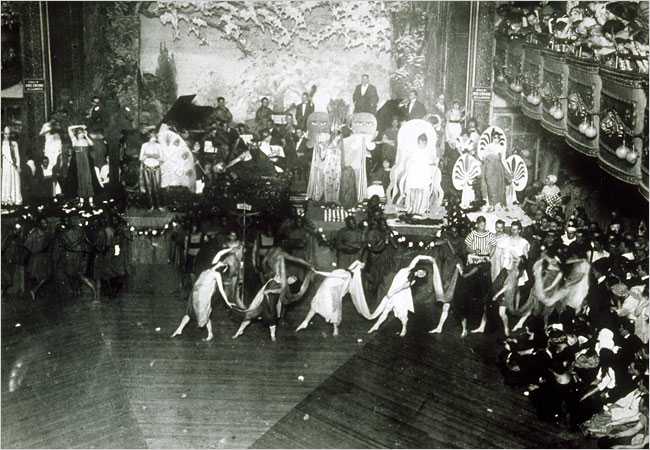
Webster Hall in its first decade of the 20th century….

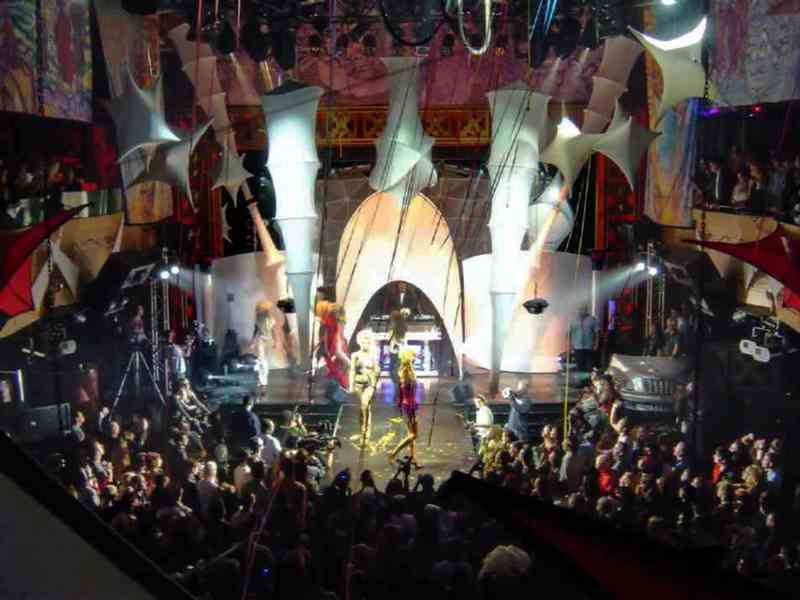
…and the first decade of the 21st century

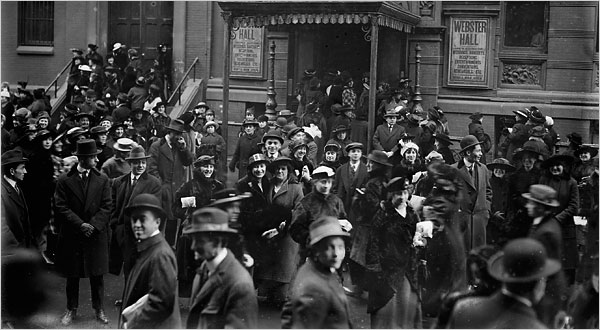
Outside the club during a labor rally in the 1910s (pic courtesy Library of Congress

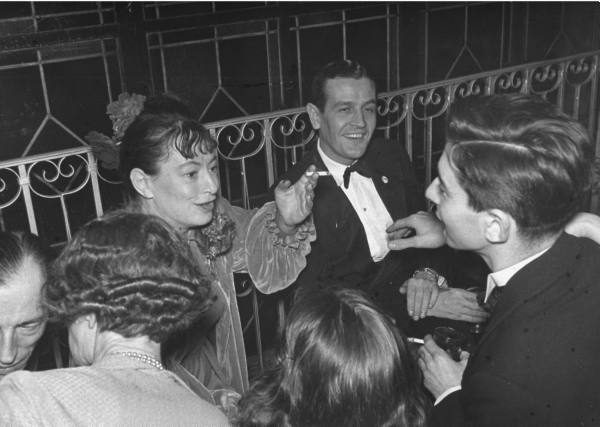
Dorothy Parker arrives at Webster Hall in 1938 with husband Alan Campbell

In its years as an RCA recording studio, Webster Hall saw most of the greats of pop, jazz, classical and Broadway making albums here.

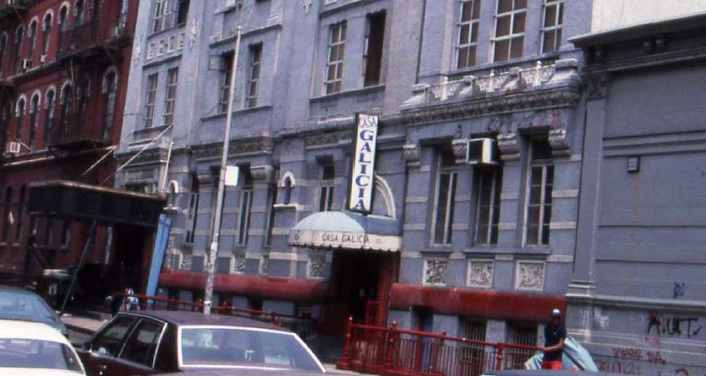
As the Casa Galicia during the 1970s

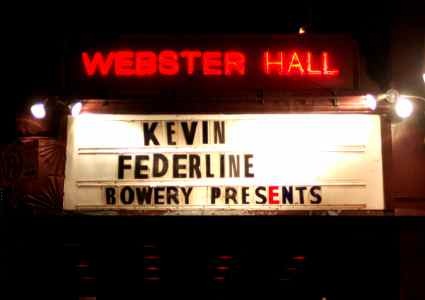
Elvis, Madonna, Lena Horne, Louis Armstrong, Frank Sinatra, James Brown, Jefferson Airplane, Run DMC, Prince, U2 — all the greats have performed at Webster Hall. And then there’s ….

Categories
Podcasts

PODCAST: The Guggenheim Museum

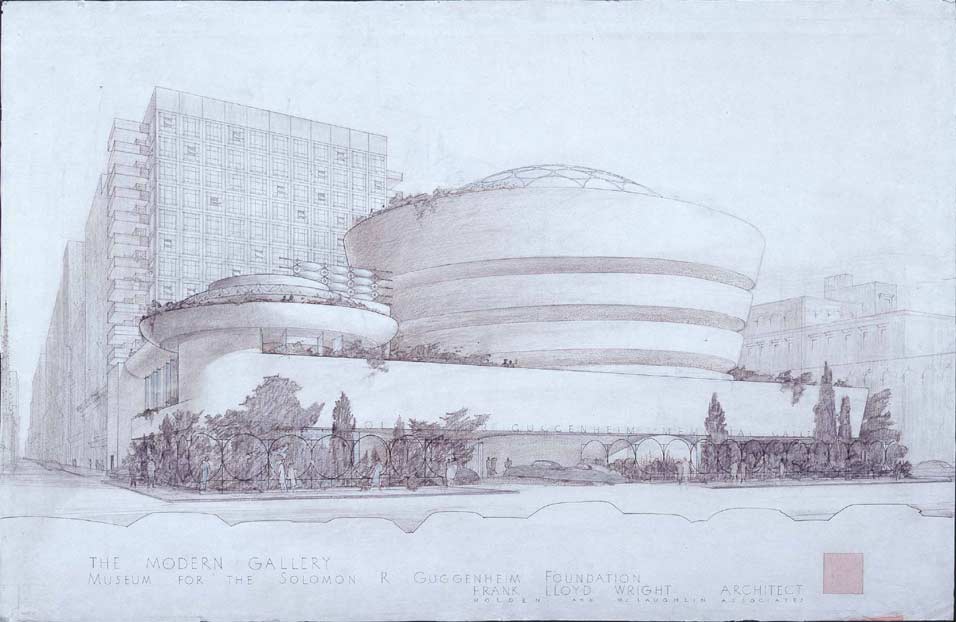
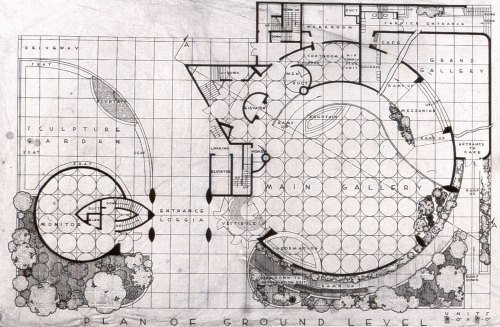
The spiral-ramped wonder that is the Guggenheim Museum began as the dream of two colorful characters — a severe German artist and her rich patron art-lover. So how did they convince the most famous architect in the world to sign on to their dream for a modern art “museum temple”? Come meander with us through the Guggenheim’s quirky history. Co-starring Robert Moses!

Listen to it for free on iTunes or other podcasting services. Or you can download or listen to it HERE

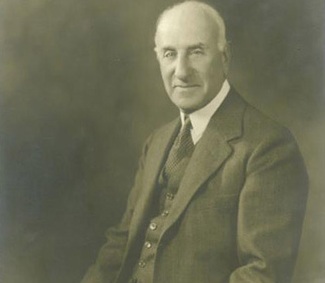
Solomon Robert Guggenheim — his love for artwork late in life culimated in one of the world’s most impressive collection of modern art

“Yellow Red and Blue” by Vassily Kandinsky, a particular favorite of Solomon’s who would end up owning over 120 paintings by the abstract artist.

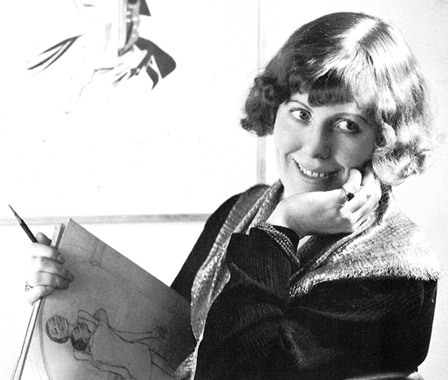
The enigmatic Hilla Rebay, muse and adviser to Solomon and the original curator to what would become the Guggenheim Museum — until she was unceremoniously dumped by the trustees after Solomon’s death

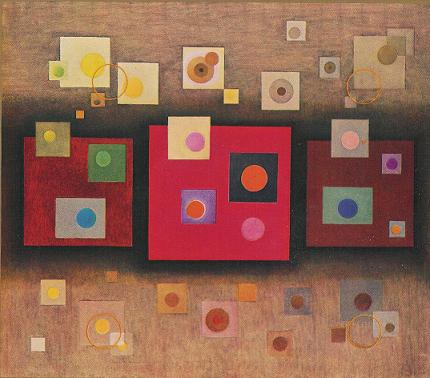
“Squares”, a work by Rudolf Bauer, whose relationship with Rebay and the Guggenheim would quickly sour

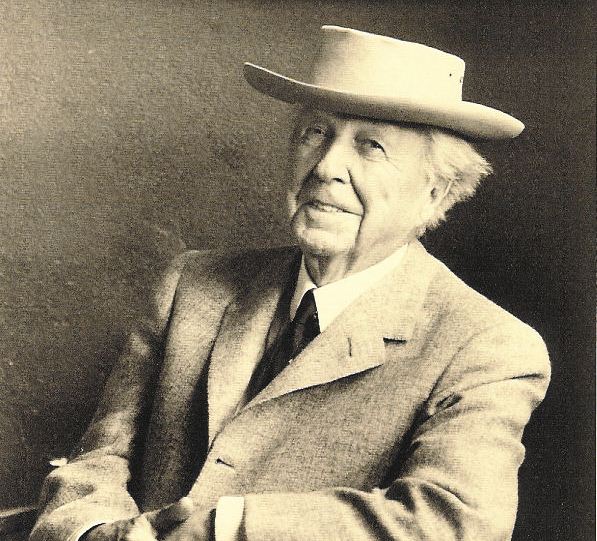
Photographer Alfred Eisenstaedt captures Frank Lloyd Wright in his final days, an iconic architect who would go out on top with the construction of the museum

During construction: the distinctive curves were created by essentially creating a plywood mold and having the concrete sprayed from the inside.

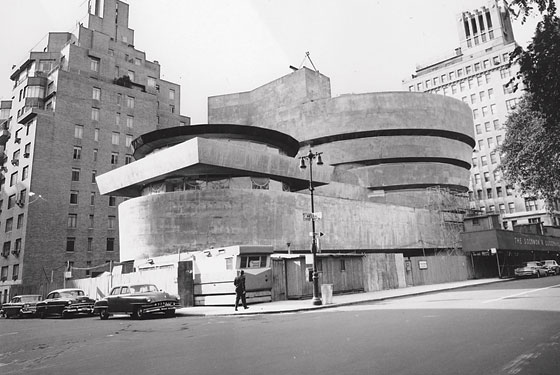
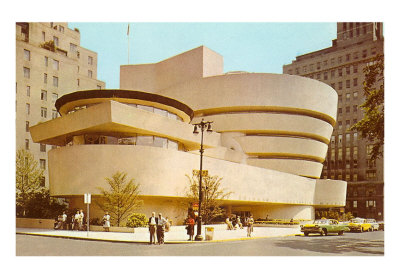
The museum, right before its opening in 1959. (Pic courtesy New York Magazine.)

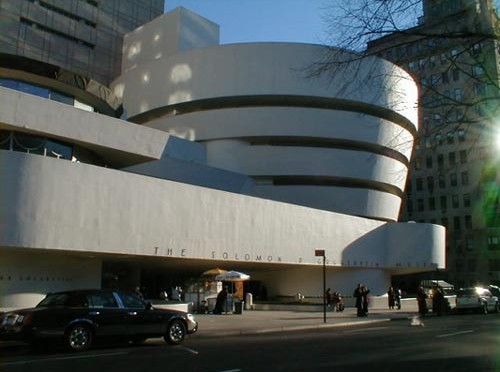
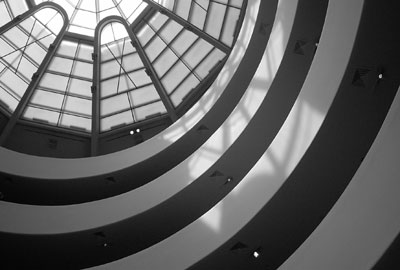
Like a typical Wright creation, the museum seems both natural and alien at the same time. Natural light streams in at unusual angles.

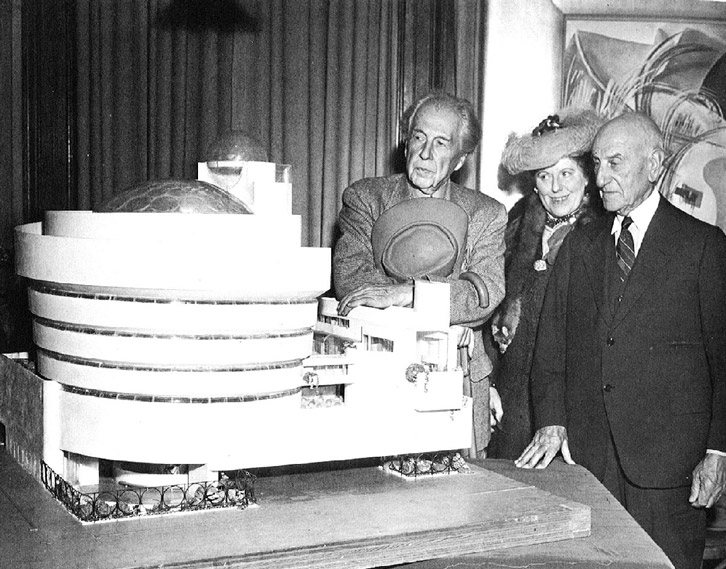
Solomon, Hilla and Frank stand admiring a model of their future museum.

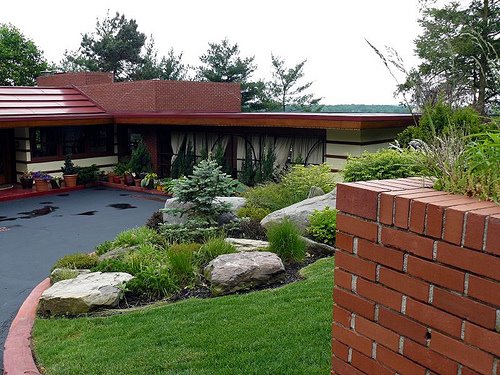
CORRECTION: In the podcast I incorrectly state that Wright had already built a house in Staten Island before getting the commission to build the Guggenheim. In fact, he was hired to build the private residence well after receiving the museum job. The home, called The Crimson Beech, is located in Lighthouse Hill. Apparently it leaks.

Having fun with the Guggenheim’s different exterior shades

Park Avenue’s stylish slaughterhouse

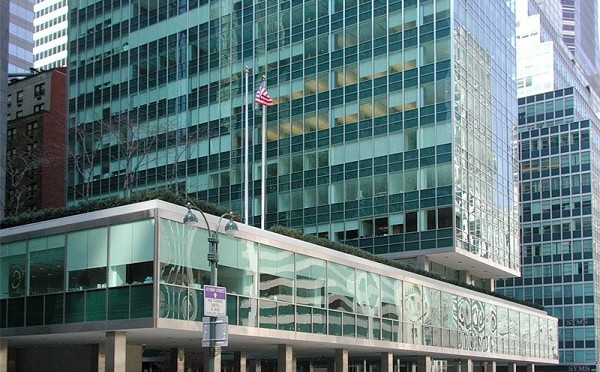
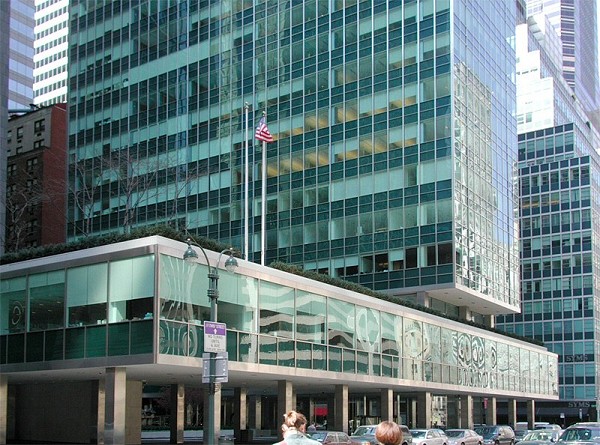
The Lever House at 390 Park Avenue, along with the United Nations building, ushered in New York’s obsession with the International Style of architecture in the 40s and 50s — clean and blocky thin glass icons in the sky. It’s no surprise to find the building was built in 1952 for a soap manufacturer, the Lever Brothers. The soap has since gone from the interiors of this sleek and cool structure, but they’ve been replaced with something more bizarre — human and animal gore.

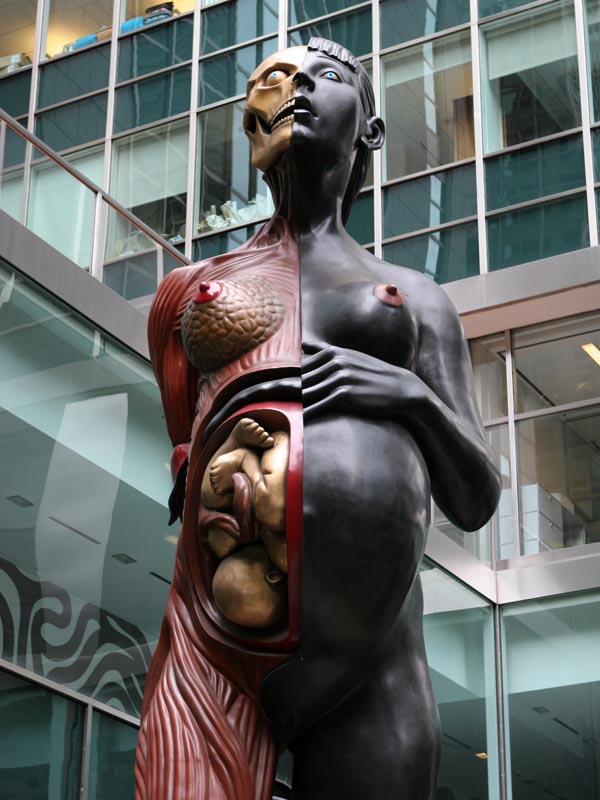
Or rather, the aesthetic purveyor of such gore, the inimitable Damien Hirst. The Satan spawn of the British art scene, whose sometimes seemingly simple work bursts with shock value (and later, high price tags), has been a favorite of patron and German real estate mogul Aby Rosen, who just happens to own the Lever House.

Rosen is an art collector and enthusiast, hiring Whitney Museum curator Richard Marshall in 2004 to spice up the once frigid plaza and the redesigned William T. Georgis Lever lobby with some truly eye catching pieces.


The Lever has already seen such vivid works by artists like Jorge Pardo, Peter Wegner, A.V. Day (a dramatic, fabric-rent ‘Bride Fight’), and Jeff Koons (literally many blow-up Incredible Hulk dolls). Corridors within the Lever house works by Jean-Michel Basquiat and Andy Warhol.

But Hirst is the Lever’s golden boy, giving the outdoor plaza a striking 34 foot tall naked pregnant ‘Virgin Mother’ (at left), in the Hirst fashion with most of her skin falling off. According to Interior Design, The lady “looks directly into the Lever Brothers corporate cafeteria.” As of last year, she has a twin across the pond in London at Royal Academy of Arts.

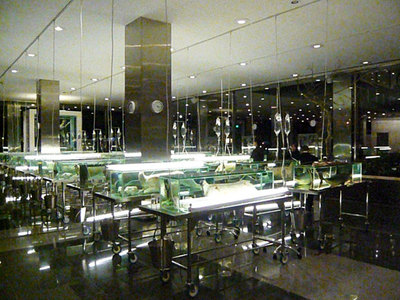
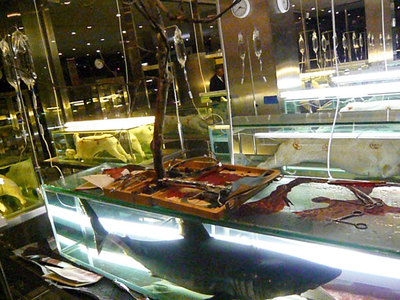
Until mid-February, you can catch more Hirst wrecking havoc in the Lever lobby as well. Laboring under the title “School: The Archaeology of Lost Desires, Comprehending Infinity, and the Search for Knowledge,” the entire lobby if filled with animal carcasses behind glass, often paired with furniture.

A couple images from the exhibit are below. Why not stop by on your lunch break today?

Photos from Slamxhype by Paul Mittleman

What about the old New Museum?

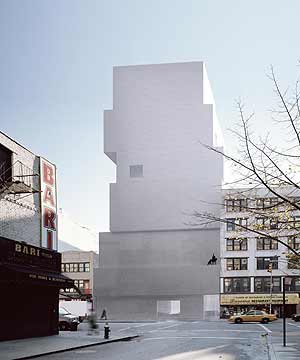
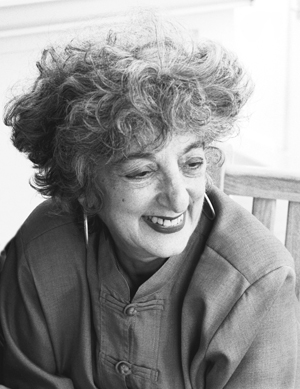
The oddest thing to ever peek its head above the Bowery, the brand new New Museum of Contemporary Art, captured the culture headlines last week during its week-long opening. Critics, even the toughest ones, praised its architecture by Kazuyo Sejima and Ryue Nishizawa of the Japanese firm Sanaa, admired its open gallery spaces glowing with natural light, and generally liked the art displays from around the world. The only thing missing from the downtown hoopla is the woman who started it all — Marcia Tucker.

Brooklynite Tucker might have greeted the success of the new New Museum as mixed bag: thrilled at reaching new audiences, wary of how such attention might censure the core philosophy — presenting new international voices in art, artists that might not find their footing in the current ‘modern art’ world.

Tucker was a curator at the Whitney Museum of Art from 1969 until 1977, when poor critical reception of her exhibit on artist Richard Tuttle got her fired. She then opened the first New Museum, on a single modest floor of the New School’s social research building, at Fifth Avenue and 14th St. You had to walk through a lobby and over book-burdened students to get to the gallery, yet even then, according to a critic in 1981, the artist displayed were unconventional, and “by any imaginable objective standard they vary enormously in the degree of their success.”

Tucker was fascinated in giving spaces to the artistic voices underneath the radar of traditional galleries. Her obituary describes her philosophy succinctly: Tucker “wanted the museum to welcome art that was excluded elsewhere because it was difficult, out of fashion, unsalable or made by artists who were not white or male or straight.”

In the 80s, she naturally moved to the heart of the world’s art scene, Soho, to a basement gallery in the Astor Building at 583 Broadway, between Prince and Houston. Although larger than the typical Soho gallery, its unglamorous basement locale allowed for peculiar gallery spaces perfectly in line with selections of art from around the world — Cameroon, Chile, Bulgaria, Cuba, Turkey, Poland and dozens of other countries. In 2000, the New Museum opened a then-unprecedented gallery to digital artwork.

The plans for the new space were unveiled in 2004, at a cost of $35 million dollars. New Yorkers have been anxious for the opening ever since the building’s clean, alien-like facade started hovering above the Bowery streets. Tucker never got to see the spectacular final product; she died in California on October 17, 2006 of cancer. At an affectionate memorial service held in January of this year, artist John Baldessari paid her the ultimate compliment: ““I thought I was pretty wiggy, but she was wiggier than I was.”