Categories
Health and Living Newspapers and Newsies Podcasts

Nellie Bly: Undercover in New York’s Notorious Asylum for the Insane

The story of New York World reporter Nellie Bly as she poses as a mental patient to report on the abuses of Blackwell’s Island’s Lunatic Asylum.

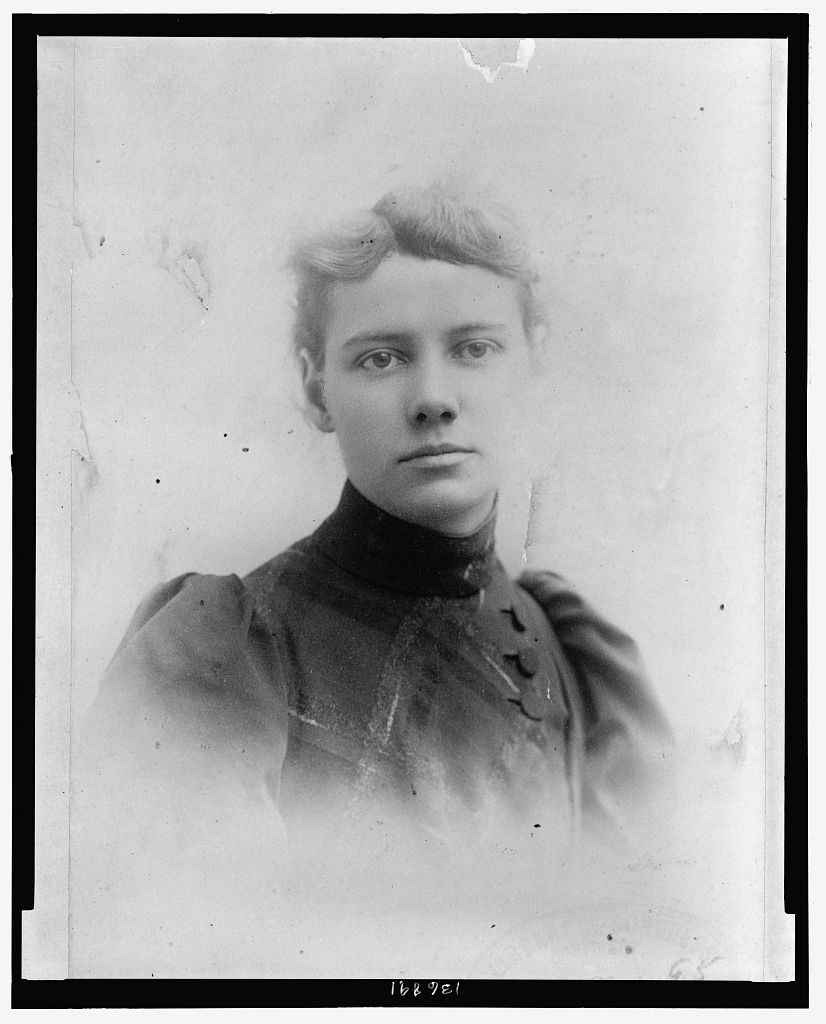
PODCAST Nellie Bly was a determined and fearless journalist ahead of her time, known for the spectacular lengths she would go to get a good story. Her reputation was built on the events of late September-early October 1887 — the ten days she spent in New York’s most notorious insane asylum.

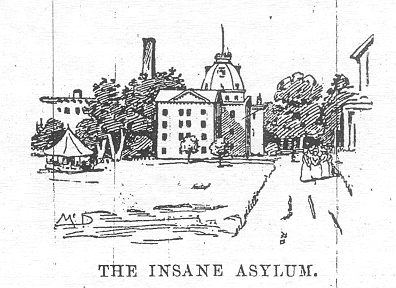
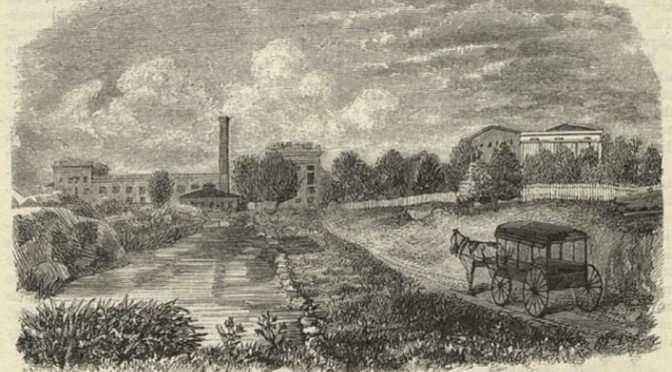
Since the 1830s Blackwell’s Island had been the destination for New York’s public institutions of an undesirable nature — hospitals for grave diseases, a penitentiary, an almshouse, even a quarantine for smallpox. There was also a mental institution — an insane or lunatic asylum — rumored to treat its patients most cruelly.

51

The ambitious young reporter decided to see for herself — by acting like a woman who had lost her mind. Her ten days in this particular madhouse — the basis of her newspaper articles and a book — would expose the world to the sinister treatment of the mentally ill and the loathsome conditions of New York institutions meant to care for the most needy.

But would the process of getting this important story lead Nellie herself to go a little mad? And once she got inside the asylum, how would she get out?

ALSO: Not only is a vestige of the asylum still around today, you can live in it!


The Bowery Boys: New York City History podcast is brought to you …. by you!

We are now producing a new Bowery Boys podcast every two weeks. We’re also looking to improve the show in other ways and expand in other ways as well — through publishing, social media, live events and other forms of media. But we can only do this with your help!

We are now a member of Patreon, a patronage platform where you can support your favorite content creators for as little as a $1 a month.

Please visit our page on Patreon and watch a short video of us recording the show and talking about our expansion plans. If you’d like to help out, there are five different pledge levels (and with clever names too — Mannahatta, New Amsterdam, Five Points, Gilded Age, Jazz Age and Empire State). Check them out and consider being a sponsor.

We greatly appreciate our listeners and readers and thank you for joining us on this journey so far. And the best is yet to come!


Nellie Bly, the bold journalist with extraordinary will and panache, tackled a number of strange assignments in her life, starting with her virtuoso performance getting into the Blackwell’s Island insane asylum.

7f5ab10e286c50902324b51b1b1a3a51

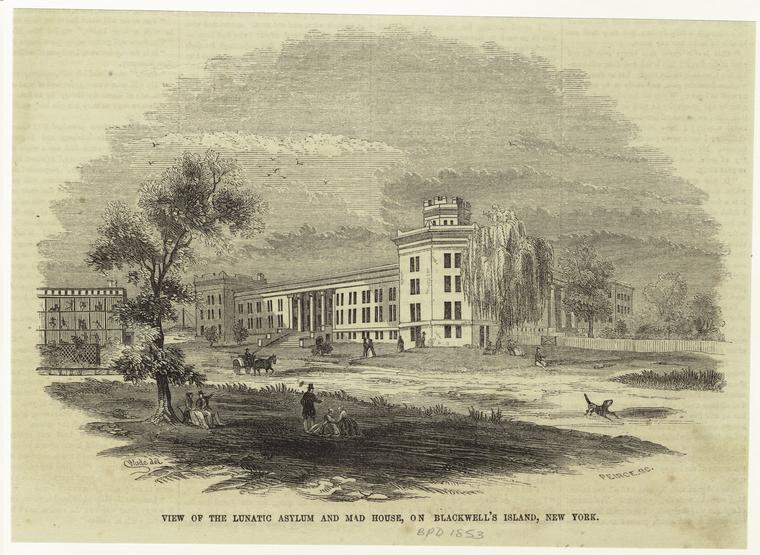
Blackwell’s Island Lunatic Asylum from 1853, rendered by William Wade

Courtesy NYPL
Courtesy NYPL

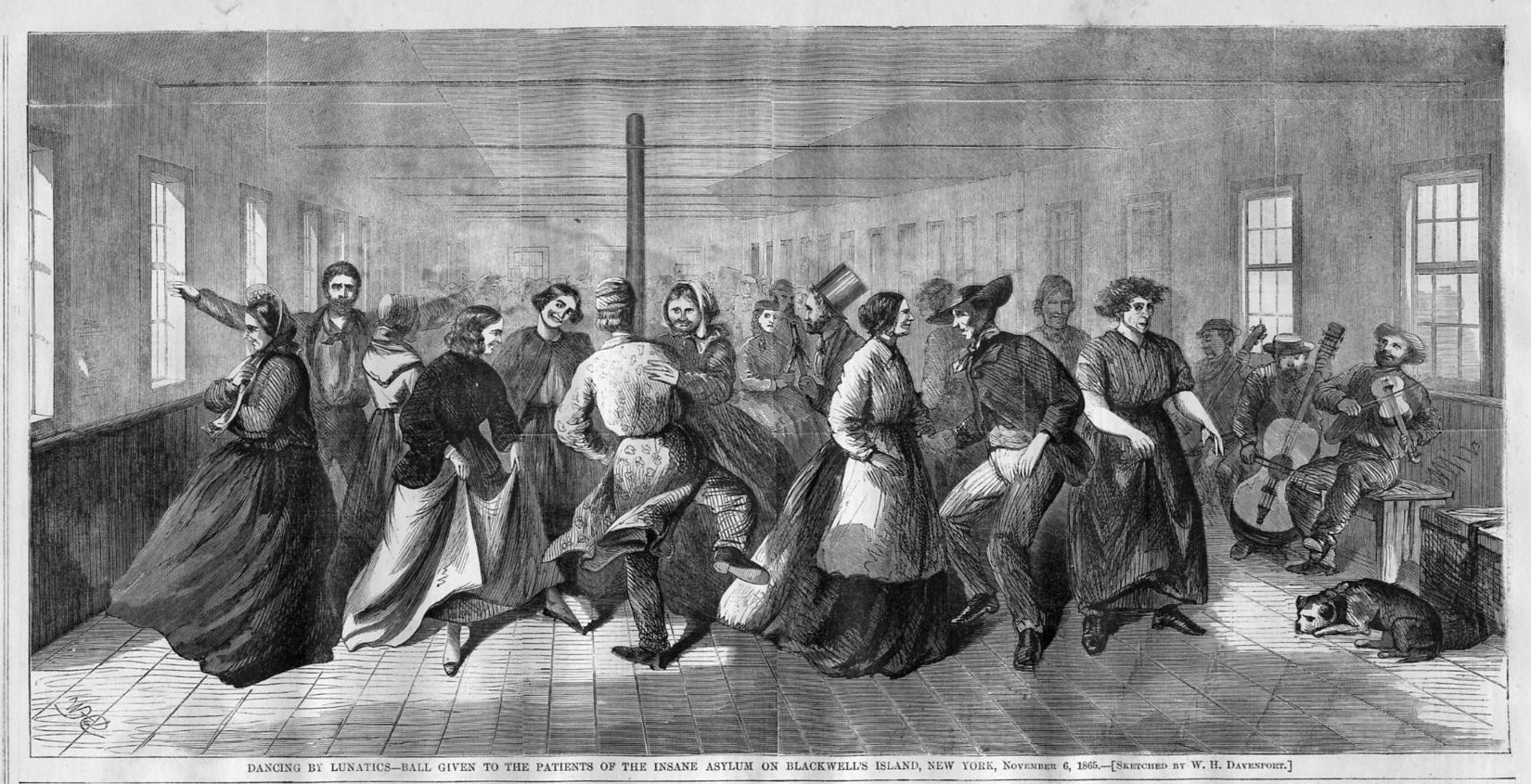
A newspaper clipping from 1865 — “Dancing by lunatics — Ball given to the patients of the Insane Asylum on Blackwell’s Island”

1

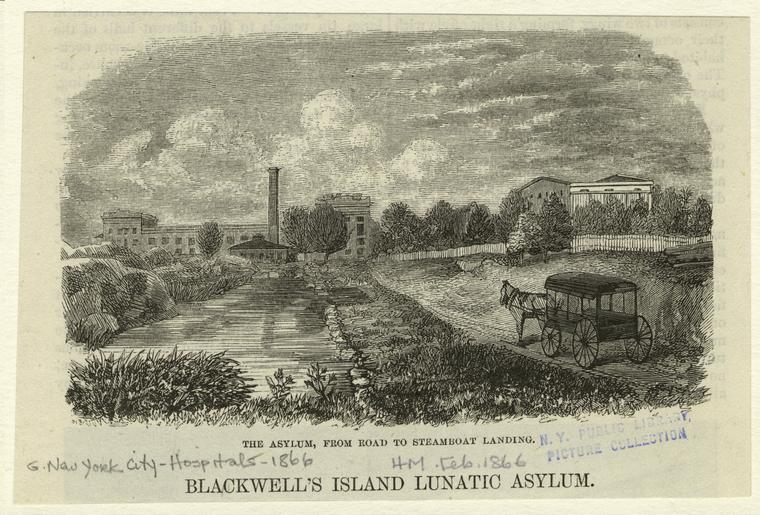
Another view of Blackwell’s Island Lunatic Asylum, pictured here in 1866 “from road to steamboat landing.”

Courtesy NYPL
Courtesy NYPL

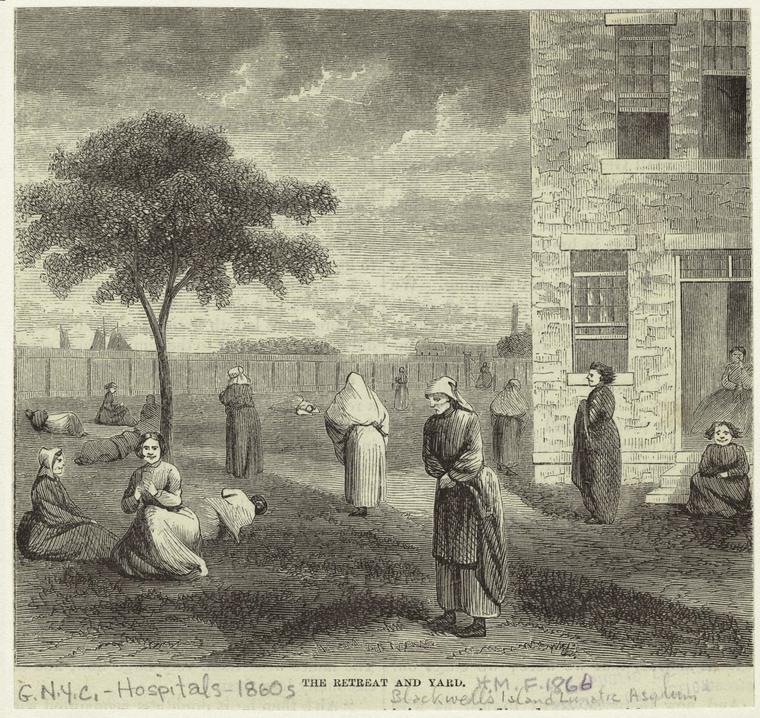
On the grounds of the asylum the ‘Retreat and Yard’, where Nellie would later roam with the other patients.

Courtesy NYPL
Courtesy NYPL

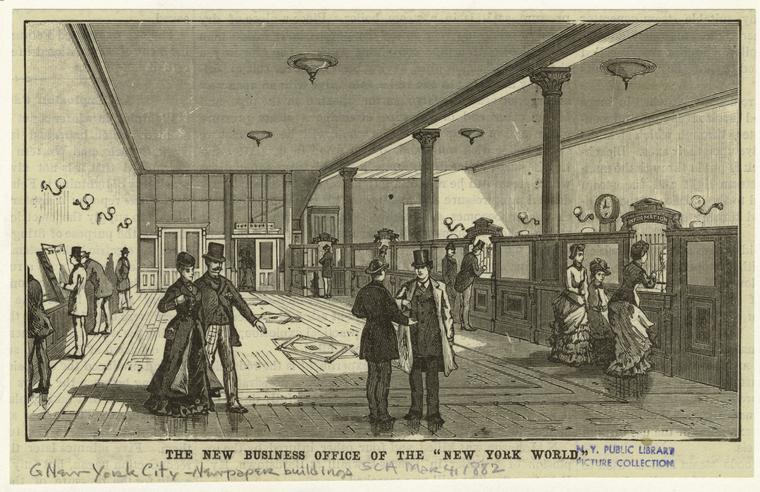
Inside of the offices of the New York World in 1882

Courtesy NYPL
Courtesy NYPL

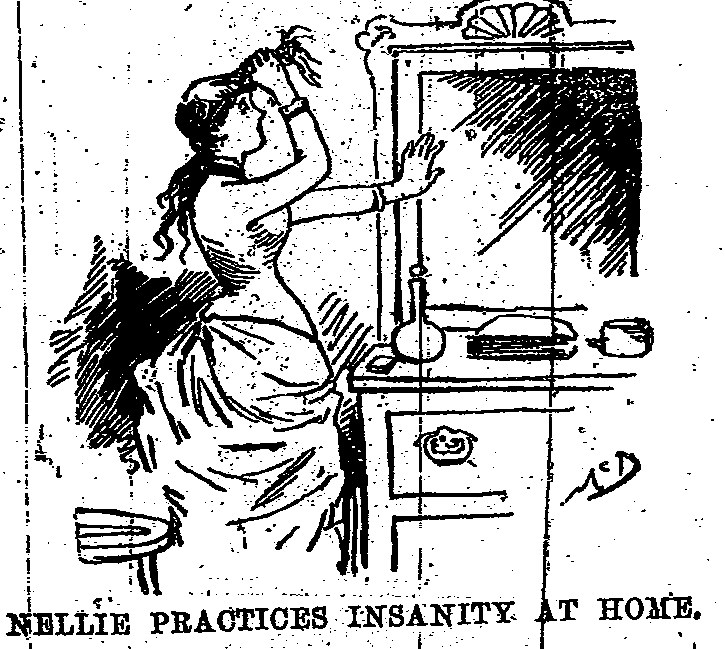
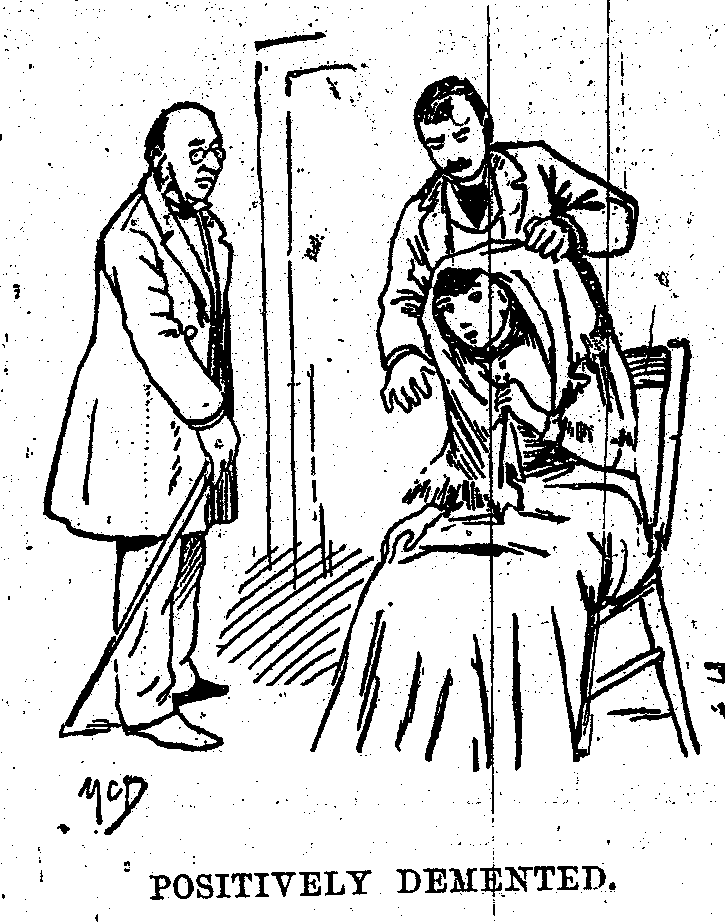
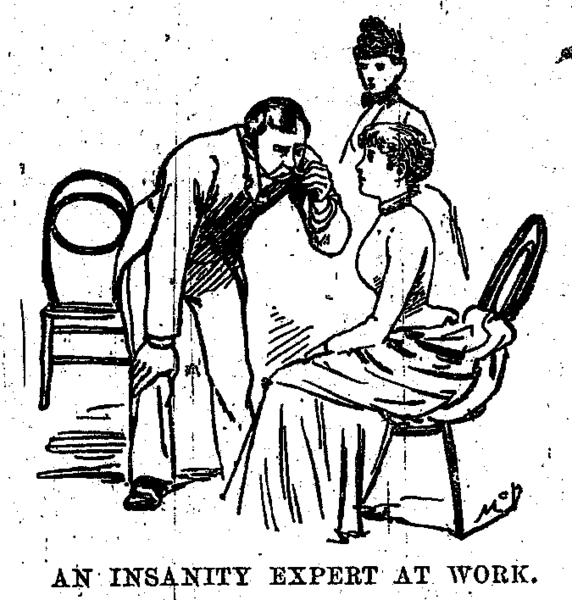
Some images from the New York World and the book Ten Days In A Madhouse

1

2

3

From the first article which ran on October 9, 1887

1

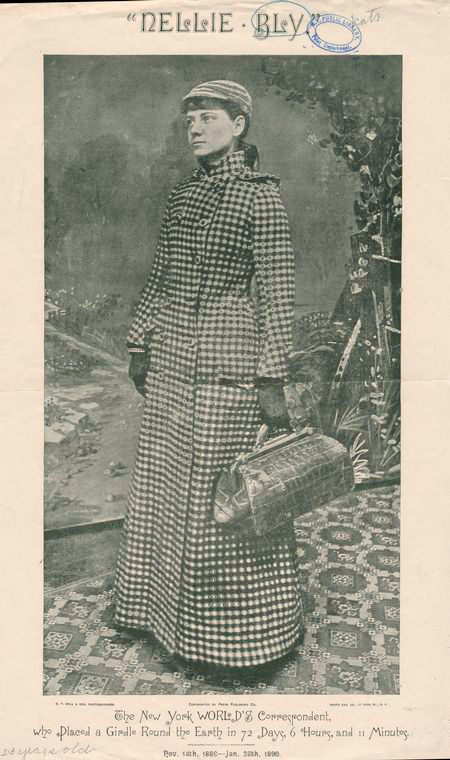
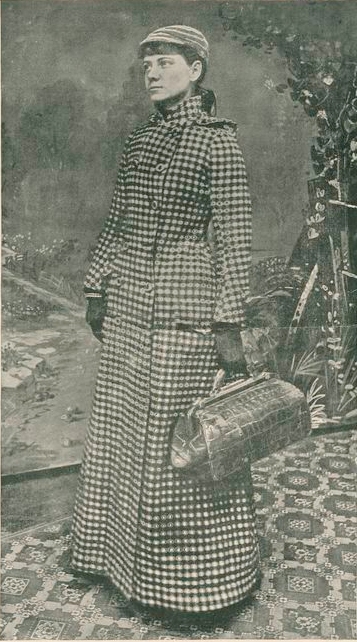
A famous photo of Nellie Bly taken during her trip around the world.

Courtesy New York Public Library

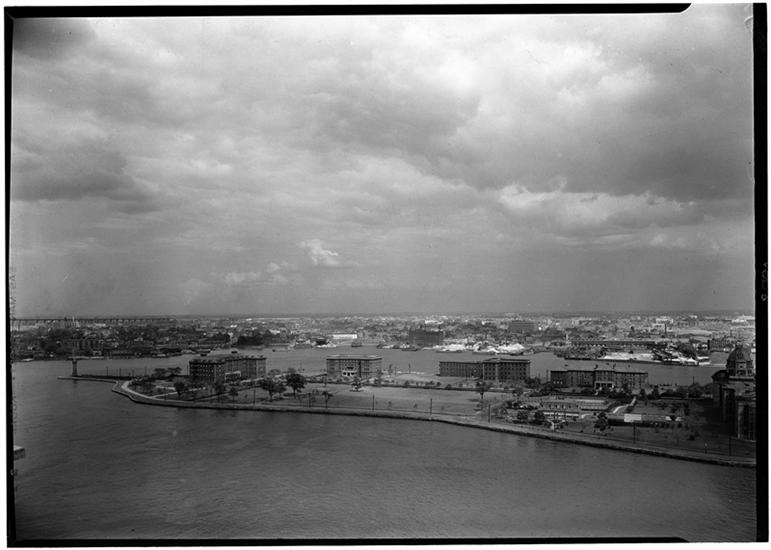
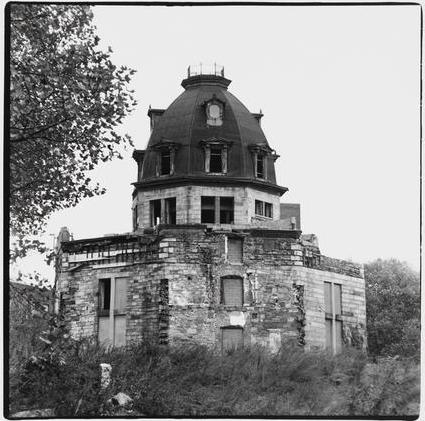
Blackwell’s Island was later named Welfare Island (before its following name change to Roosevelt Island in the 1970s). Below you can see the Octagon at the far right of this image.

Samuel H. (Samuel Herman) Gottscho, photographer, Courtesy Museum of the City of New York

The remaining ruins of the mental asylum. It was later turned into a condominium and apartment building.

ruin
Edmund Gillon photographer. Courtesy Museum of the City of New York
Categories
Bowery Boys Bookshelf

A chat with Matthew Goodman, author of ‘Eighty Days’

So how do you follow two journalists around the world, in opposite directions and from the vantage of almost 125 years in the future?  I asked Matthew Goodman, the author of “Eighty Days: Nellie Bly and Elizabeth Bisland’s History-Making Race Around the World,” this month’s Bowery Boys Book of the Month, about the two competitors and the challenges of Victorian era travel.

Bowery Boys: So just how insane was it for a woman to travel alone around the world – not to mention two women, going in the opposite direction? How many traditions of propriety were they shattering by accomplishing this?  

Matthew Goodman:  By 1888 Nellie Bly had established herself as a star reporter for The World, Joseph Pulitzer’s widely read newspaper.  But when she went to her editors to propose a solo race around the world to beat Phileas Fogg’s eighty-day mark, the idea was soundly rejected.

This was a time, after all, when male newspaper editors didn’t feel comfortable sending their female reporters across the city, much less around the world.   Editors didn’t think it was appropriate for a female reporter to go out by herself out night, or in the rain, or into tenements or dancehalls or barrooms or wherever else a story might lead them, much less consort with criminals and policemen and other unsavory characters.  Such behavior was considered improper, undignified, unseemly – in a word, unladylike.

Moreover, any woman attempting to travel around the world would surely require a battery of steamer trunks, to carry all of the ball gowns and so forth that, of course, she would require. And so, when Bly proposed her trip, The World’s business manager told her firmly, “Only a man can do this.” (To which Bly just as firmly replied, “Very well, then. Send your man, and I will start the same day for some other newspaper and I’ll beat him.”)

A year later, when The World’s circulation had started to decline, Bly’s editors finally gave her permission to set out around the world. To do so, Bly insisted on carrying everything she would need for her trip in a single handbag, measuring sixteen by seven inches at its base. Not only did she want her travel to be as efficient as possible, she also wanted to give the lie to the time-worn notion that a woman required more luggage to travel than did a man. (That leather bag would eventually become iconic, and today it is on public display at the Newseum in Washington, D.C.)

BB:  Nellie Bly is of course a classic figure of the Victorian era but Elizabeth Bisland is relatively unknown. Were there any challenges in bringing Bisland’s tale up to the pace of Nellie’s – the more familiar of the two tales?

MG:  I knew right from the beginning that I wanted this to be a double narrative – half of it told from Nellie Bly’s point of view, half of it from Elizabeth Bisland’s. Which meant that Bisland’s story would need to be just as richly detailed and compelling as Bly’s – a challenge, as you point out, given that no one had ever written any substantial account of her life and she is today almost entirely unremembered.

So I set to work attempting to learn everything that there was to know about Elizabeth Bisland. Fortunately, Bisland had written a book about her race around the world (as had Bly), so I read that first.  Then I read everything else she had ever written – which included a novel and several collections of essays, as well as many dozens of newspaper articles. On the Internet I tracked down a number of her descendants, and they generously shared with me unpublished family histories, letters, photographs, and newspaper clippings about their beloved ancestor.

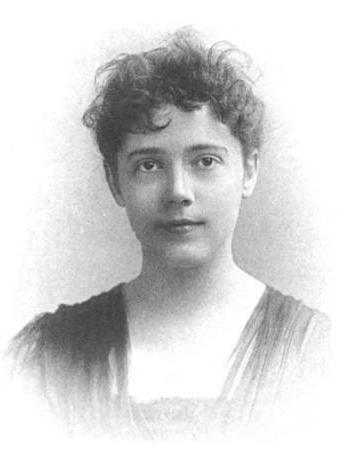
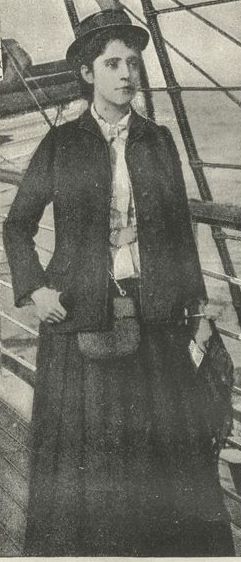
At left: Elizabeth Bisland, from her book written about her journey called A Flying Trip Around The World

At Tulane University I discovered a little-known trove of Bisland’s letters from the last years of her life, which filled in a lot of details that even her family members didn’t know. Over time I was able to develop a very strong sense of who this remarkable woman was; as it turned out, she was this incredibly erudite, cosmopolitan poet and essayist who had grown up on a ruined Louisiana plantation (where, for instance, she taught herself French as she churned butter so that she could read Rousseau’s Confessions in the original language!), who wrote gorgeously but whose books are all, sadly, out of print.

She is someone who deserves to be far better remembered than she is, and if Eighty Days can bring her to the attention of a new generation of readers, then I’ll be extremely gratified.

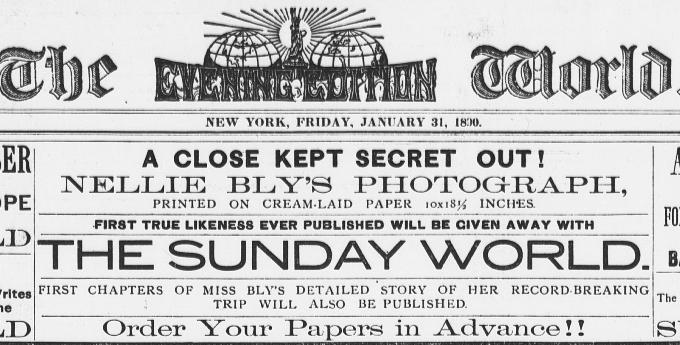
Above: One of dozens of issues of the New York World that used Bly and her adventures to sell papers — before, during and after the race!

BB:  The two travelers take nearly the very same path across the world, from opposite directions of course. I love the exact moment in the book where their paths cross (although of course they never realize it). Were Bly and Bisland driven by similar desires – competition, fame, or the chance to make history perhaps? 

MG:  One of the things I loved about writing this book was that the two main characters – while both pioneering young female journalists – were so different from each other.  Nellie Bly was this scrappy, ambitious, driven investigative reporter from coal country in western Pennsylvania, who always sought out the most sensational news stories; Elizabeth Bisland was a genteel, elegant poet from New Orleans who derided most newspaper reporting as “a caricature of life.” Bisland hosted literary teas in her little apartment on Fourth Avenue; Bly was a regular at O’Rourke’s saloon on the Bowery!

And their very different personalities were reflected in their attitudes toward the race itself.  Bly was deeply competitive (it was part of what made her such a good newspaperwoman), and she was desperate to win the race – she was constantly worrying about schedules and departure times, and was constantly urging ships’ captains to make more speed. On more than one occasion she was heard to say that she would rather die than return to New York behind time.

For Bisland, on the other hand, the trip became an opportunity to see the world, which she would not have had otherwise. She fell in love especially with Japan, to which she returned twice later in life.  In her subsequent book about the trip, she never once used the word “race” to describe it, preferring the word “journey.”  Bly sought out the celebrity that came from the race, immediately embarking on a forty-city lecture tour; Bisland, wanting to escape the public’s attention, sailed to England, where she lived for a year.   She later wrote that she wanted to live the rest of her life in such a way that her name would never again appear in a newspaper headline.

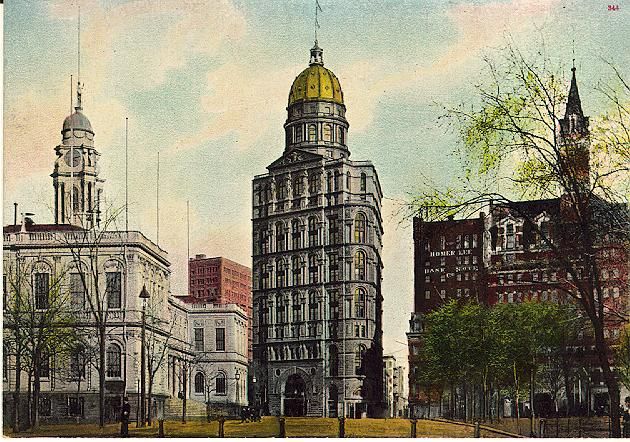
Above: The New York World Building, completed in 1890, the year Bly completed her trip around the globe.

BB:  Your last book The Sun and The Moon was about a fabulous New York media hoax.  In Eighty Days, the publications in question are in fact recounting real events.  But I cannot imagine, given the ethics of the day, that everything you were discovering in them about Bly and Bisland was completely accurate.  Did you find anything unusual in your research about these publications’ treatment of the race? 

MG:  Perhaps not surprisingly, a lot of the initial coverage of the race was rife with mistakes, as New York’s newspapers, caught unawares by the story, tried to pin down just who these two young women were.

For instance, one newspaper claimed, confusingly, that both reporters were being paid by The World (why that paper would send two competitors around the world was not explained). The Tribune even ran a story that claimed that not two but three reporters were racing around the world!

The more substantial inaccuracies, though, were to be found in The World’s own stories about Nellie Bly.   Bly and The World jointly participated in a kind of mythologizing of their star reporter, creating an air-brushed portrait of a plucky, independent, light-hearted, pretty, energetic young American woman – just the sort of heroine the paper’s readers wanted.  Indeed, the most egregious rewriting of Bly’s history came in a story – surely approved by Bly herself – that promised “an authentic biography of The World’s globe-girdler.”

BB:   There should be a side project where you yourself trace the steps of Bly and Bisland, approximating their forms of transportation (no airplanes!)  Is that technically possible and how long do you think it take you – or would you have the stamina of your two heroines? 

MG:  My sense is that it would be technically possible. (I seem to recall a PBS series of some years ago in which Michael Palin, of “Monty Python” fame, traveled around the world in such a manner and accomplished the feat in just under eighty days.)

It would be possible, however, for someone other than I.  I do love to travel, and would very much love to go to many of the places Bly and Bisland visited – such as Hong Kong or Sri Lanka, not to mention Jules Verne’s estate in Amiens, France – but after a few weeks spent aboard ship or in a railway carriage, I’m pretty sure I’d start planning my return to dear old Brooklyn.

Categories
Bowery Boys Bookshelf

The Amazing Race: In ‘Eighty Days’ Nellie Bly tries to outdo Jules Verne while a New Orleans writer vows to beat both


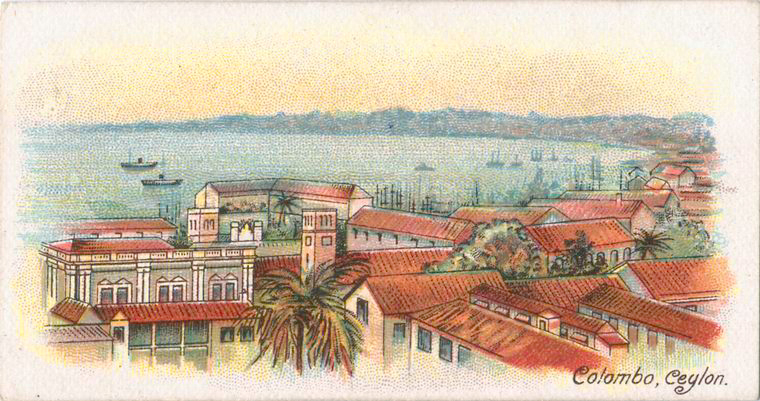
Greetings from Columbo, Ceylon, one of the many glamorous destinations you’ll visit in Matthew Goodman’s new book.

BOWERY BOYS BOOK OF THE MONTH Each month I’ll pick a book — either brand new or old, fiction or non-fiction — that offers an intriguing take on New York City history, something that uses history in a way that’s uniquely unconventional or exposes a previously unseen corner of our city’s complicated past.  Then over the next month, I’ll run an article or two about some of historical themes that are brought up in the selection. 
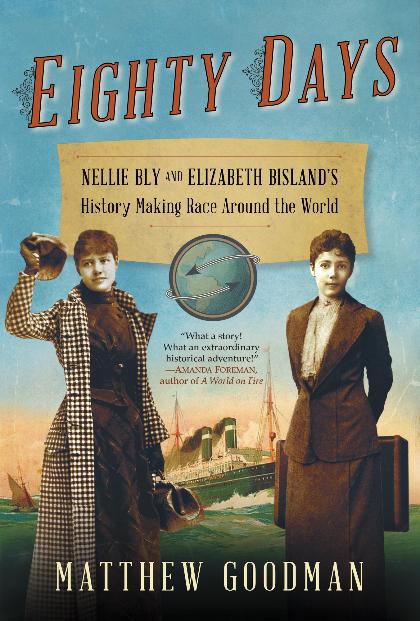
Eighty Days: 
Nellie Bly and Elizabeth Bisland’s History-Making Race Around The World
by Matthew Goodman
Ballantine Books

One under appreciated facet of the Gilded Age is Western civilization’s almost addictive need to push its innovations past their upper limits within the framework of a literal competition — not just in mere quest for improvement, but in a tangible victory over its lessers.  Beauty, in a machine, meant winning.
The value of human life became secondary in the furious race of locomotives crossing vast plains of the United States, or of cross-country automobile competitions over terrain hardly suited for rubber tires, or later the famed air races of early aviation daredevils.

Speed was perfection, but it also came attached with cash prizes (from newspaper moguls or sponsors who benefited from the technology), ticker-tape parades and instant fame.

In 1873, well before the first automobiles and airplanes, one well-noticed gauntlet was thrown by the French writer Jules Verne, who created the character of Phileas Fogg, then sent him “Around the World In Eighty Days.”  The hugely popular novel celebrated both primitive and modern forms of transportation, but a principal theme was the value of speed and modern man’s victory over distance.  The world, already prevailed over by the interests of empire, could now be circumnavigated.

But could this feat be performed by an actual human? And, more daring still, could it be done by a woman?

In Matthew Goodman‘s breathless, exotic new history Eighty Days: Nellie Bly and Elizabeth Bisland’s History-Making Race Around The World, two extraordinary woman attempt to meet Verne’s challenge.  Or rather, challenges made by their New York editors, inspired by Verne’s best-selling novel and dazzled by the possibilities of an impossible quest creating splashy headlines to sell newspapers in 1889.

You are most likely familiar with Bly, the vanguard young journalist best known for her daring exposes for the New York World.  Posing as a patient in Blackwell’s Island’s lunatic asylum in 1887, Bly revealed deep-seeded abuses within the system.  Almost as importantly, Bly helped define investigative journalism along the lines of stunt work.  She was a Victorian era reality star of sorts, fearlessly defying conventions.

On November 14, 1889, Bly began her quest to beat Phileas Fogg, boarding a steamer for England on her way around the globe. What she did not know then is that the race to beat a fictional character had now been joined by somebody quite real — the journalist Elizabeth Bisland (pictured at left).

A native of New Orleans and a habitue of New York literary salons, Bisland was assigned to take a similar journey by her editor at The Cosmopolitan (precursor to today’s Cosmopolitan magazine).  With less than a day’s notice, he sent Bisland on a trip around the world on the same day — and going in the opposite direction.

Eighty Days is a tale of stops and starts, of telegraph offices and train stations, of foreign places narrowly observed by its two competitors.  Luckily, Goodman doesn’t leave you sitting with the two women, who are sometimes too tired, too rushed or too incurious to explore their surroundings.

With beautiful prose, like a craning camera, Goodman provides sumptuous detail to these fantastic and sometimes mysterious worlds — Hong Kong, Brindisi, San Francisco, Yokohama, the towns along the Suez Canal.

It becomes very clear that this is indeed a trip around the world, but along a fairly narrow band anchored by British ports.  Bly cannot stand the British;  Bisland comes to adore them.  Their personalities are reflected in their empathy.  Bisland mourns a nameless Chinese man who has died aboard her ship.  Bly, at times surprisingly unconcerned of certain conditions, buys a rowdy monkey who accompanies her for the last leg of her trip, to the great alarm of baggage handlers.  Bisland seems the more introspective, Bly the more entertaining companion.

I hate to conjure reality television for a second time in this review, but the competition within Eighty Days, so well paced by Goodman, really comes down to making connections, as often illustrated in CBS’s “The Amazing Race.”  Again, it comes down to the alleged speed of certain vessels, whether they arrive on time, and the abilities of Bly and Bisland to maneuver through foreign countries — many times unaccompanied — to arrive at their next destination.

At right: Nellie Bly, ready for action!

Eighty Days is a romp around the planet, but it returns periodically to Park Row in New York, where Bly’s newspaper has turned her journey into a best-selling sensation.  Thousands enter a contest to guess the exact time that she will finish her trip.

Like those many newspaper readers, you’ll be scrambling to guess which competitor will arrive in New York first — and, more importantly, what unfortunate event might prevent the other from victory.

Goodman’s latest tale expands upon themes he conjured up in his last book, The Sun and The Moon, another tale about fantastical journalism, regarding the Great Moon Hoax perpetrated by the New York Sun in 1835.  Newspapers are perhaps more accurate in 1889 but no less sensational.

Jules Verne himself makes an appearance too, hosting one of the competitors at his home in Amiens, France.  “She is trim, energetic, and strong,” remarks Jules’ wife Honorine.  “I believe, Jules, that she will make your heroes look foolish. She will beat your record.”

COMING FRIDAY: An interview with Matthew Goodman, the author of Eighty Days!

Pictures courtesy New York Public Library. Book cover courtesy Ballantine

Categories
Podcasts

Hoaxes and Conspiracies of 1864: The Confederate Plot to Torch New York

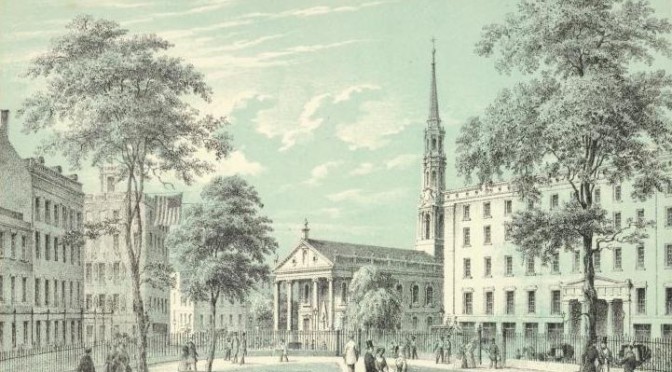
Barnum’s American Museum at left (the building with the flag) and the Astor House at right, from the vantage of City Hall Park, circa 1850. Both buildings were victims of the Confederate plot of 1864 to burn the city.

PODCAST We’re officially subtitling this ‘Strange Tales of 1864’, presenting you with a series of odd, fascinating stories from one pivotal year in New York City history. With the city both fatigued by the length of the Civil War and energized by Union victories, New Yorkers were often at their best — and their worst.

The city unites around an unusual parade — the first regiment of African-American troops — even as it elects a pacifist mayor sympathetic to the Southern cause. A grand and flamboyant fair, uniting the community, offers up a surprising New York tradition — the theme restaurant. Meanwhile, a local newspaper editor devises an elaborate hoax to get rich quick off the gold market.

But with the November re-election of Abraham Lincoln also comes a deadly threat — a Confederate conspiracy aimed at New York’s luxury hotels. Tune in as we recount the botched plot to destroy New York in an conflagration of ‘Greek fire’.

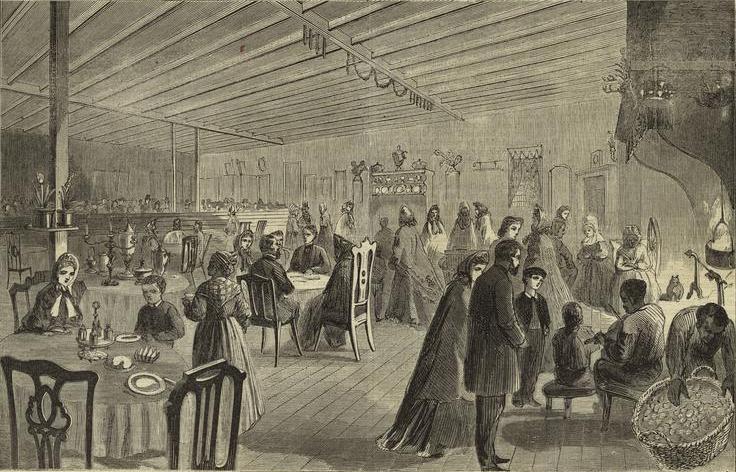
The Knickerbocker Kitchen, a featured restaurant at New York’s Metropolitan Fair. Women dressed in traditional Dutch and Colonial garb and served items believed to be popular with the residents of old New Amsterdam. [NYPL]

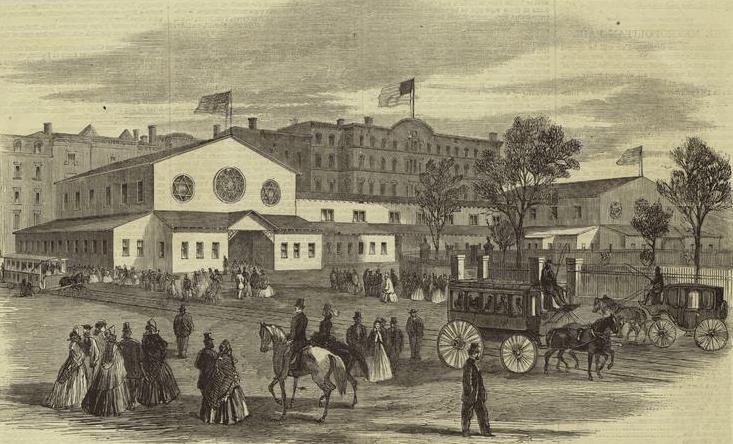
Pavilions were specially constructed around Union Square for the Metropolitan Fair, which raised money for the U.S. Sanitary Commission.

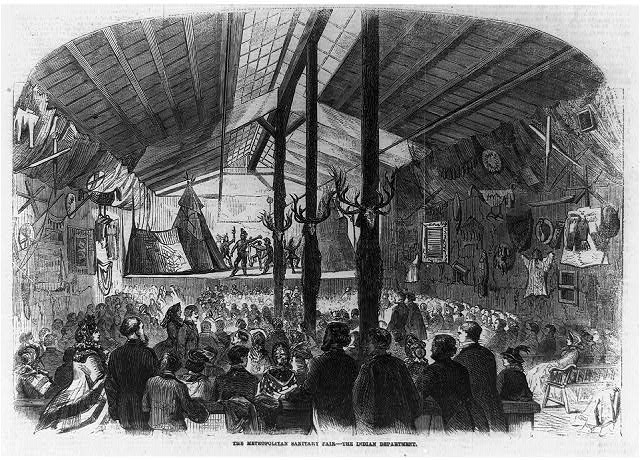
The ‘Indian Department’ at the Metropolitan Fair. [Library of Congress]

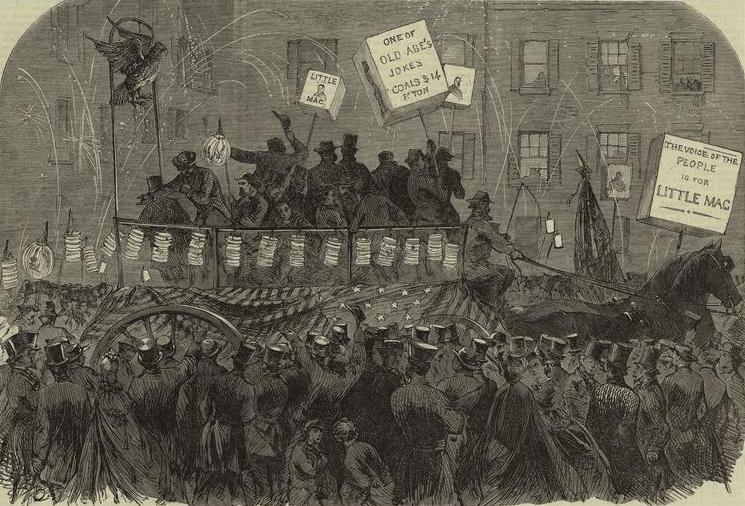
A nighttime ‘torchlight’ rally for presidential candidate George McClellan, the clear choice for New Yorkers in 1864. For a Democratic stronghold like New York, the former general was an especially appealing alternative to Abraham Lincoln. [NYPL]

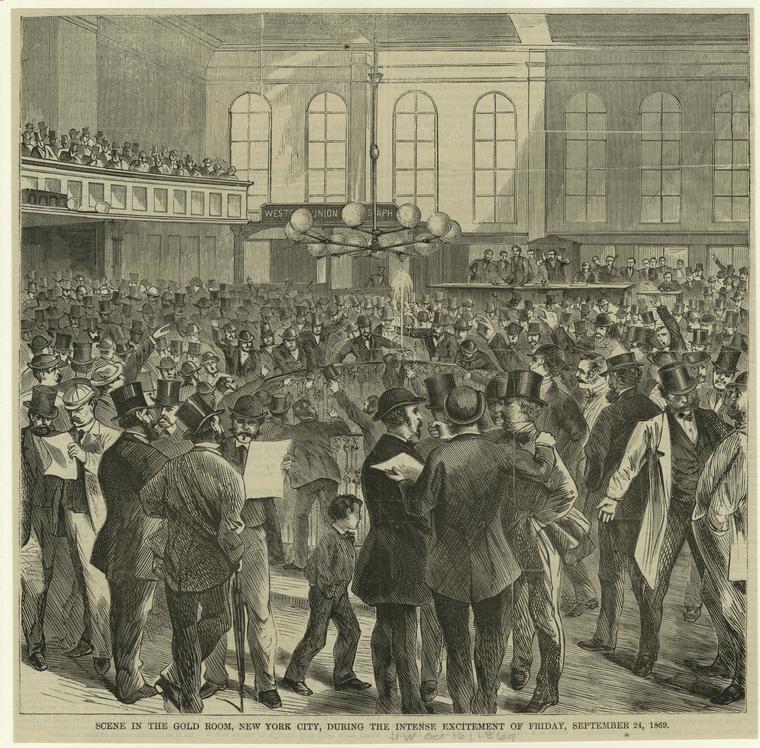
A scene from the New York Gold Room, epicenter of American gold speculation. During the Civil War, traders would buy and sell based upon Union victories and defeats. The trade was also susceptible to false information, such as the events of the Gold Hoax of 1864. (NYPL)

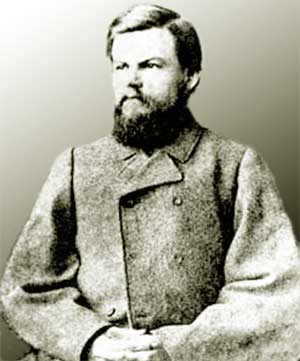
Robert Cobb Kennedy, the only one of the Confederate conspirators to be caught. He was executed at Fort Lafayette in 1865, a couple weeks before the end of the Civil War.

Lots of hot air: Joseph Pulitzer’s failed balloon stunt

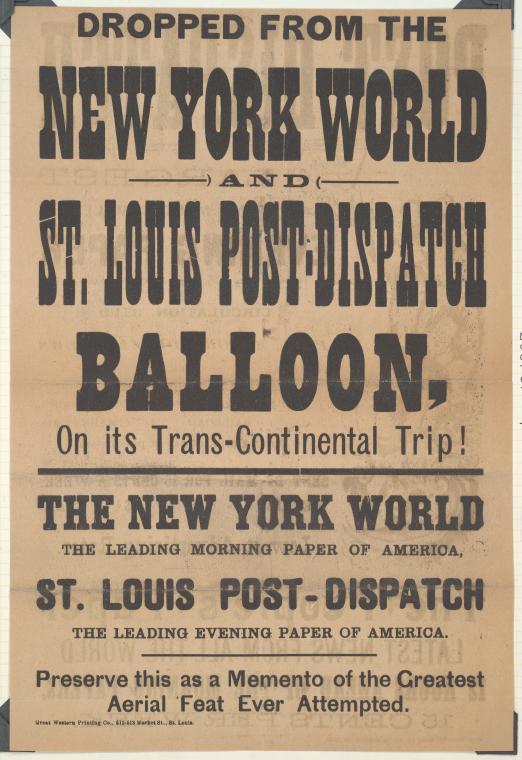
Collectors Item! If you lived in rural Illinois in 1887, you might have found one of these flyers on your roof or along the side of the road.

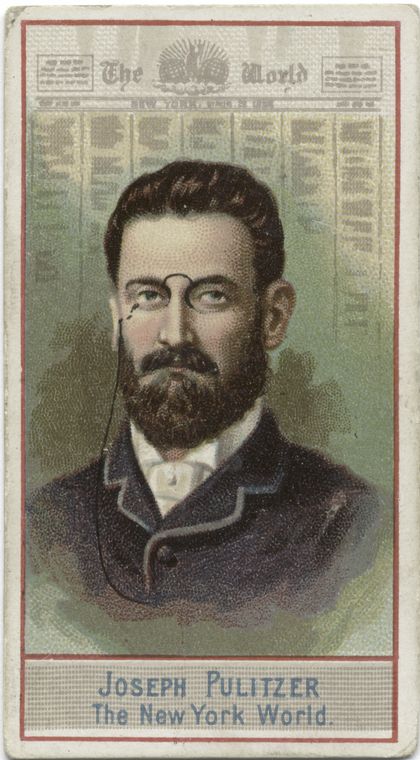
Joseph Pulitzer, that icon of late 19th century sensationalistic journalism, did everything imaginable to promote his popular newspaper the New York World. Not everything worked.

Pulitzer bought the paper in 1883 and immediately transformed the broadsheet into a juicy scandal sheet, the prop by which many of the tenants of yellow journalism were formed. The publisher had already purchased a share in the St. Louis Post-Dispatch and one day decided to loop the two possessions together in a wild, aerial promotion.

Jules Verne had published ‘Around the World In 80 Days’ in 1873, and Pulitzer hoped to render the excitement of that adventure novel into a promotional tool. So in 1887, he launched a hot-air balloon from St. Louis with an eventual destination of Manhattan. Each day, reporters at each paper would update captivated audiences as to the balloon’s progress using telegraphs sent along the balloon’s route.

Along that route, thousands of flyers like the one above would be thrown from the balloon to shower stunned individuals below, from Illinois and along the Rust Belt to Pennsylvania.

The voyage was vigorously hyped by Pulitzer and several name reporters wanted to ride in the balloon, including Nellie Bly, who would later get her scoop for Pulitzer exposing the sorry conditions at New York’s mental asylum on Blackwell’s Island.

Pulitzer rejected her, thinking the assignment too dangerous for a woman; however, after her success at Blackwell’s, she would get a more ambitious balloon voyage, embarking on a true around-the-world voyage for Pulitzer in 1889.

The vessel was launched with great fanfare on June 17, 1887. There was even an injury (“Prof. Moore Slightly Injured by A Falling Sand-bag.”) But public interest overall was muted at best and the stunt was eventually ignored. With no audience following its foray, the balloon never even completed its journey.

Perhaps that’s for the best as the balloon had a pesky time stying aloft anyway; on its first evening, it landed with a thud in Hoffman, Illinois, and had to be re-launced.

Image above courtesy NYPL Digital Gallery

Categories
Podcasts

Newsies vs the World! The Newsboys Strike of 1899

Are you tough enough to mess with them?

PODCAST Extra! Extra! Joseph Pulitzer and William Randolph Hearst vs. the newsboys! Pandemonium in the streets! One hot summer in July 1899, thousands of corner newsboys went on strike against the New York Journal and the New York World. Throngs filled the streets of downtown Manhattan for two weeks and prevented the two largest papers in the country from getting distributed.

In this episode, we look at the development of the sensationalist New York press — the birth of yellow journalism — from its very earliest days, and how sensationalism’s two famous purveyors were held at ransom by the poorest, scrappiest residents of the city. The conflict put a light to the child labor crisis and became a dramatic example of the need for reform.

Crazy Arborn, Kid Blink, Racetrack Higgins and Barney Peanuts invite you to the listen in to this tale of their finest moment, straight from the street corners of Gilded Age New York.


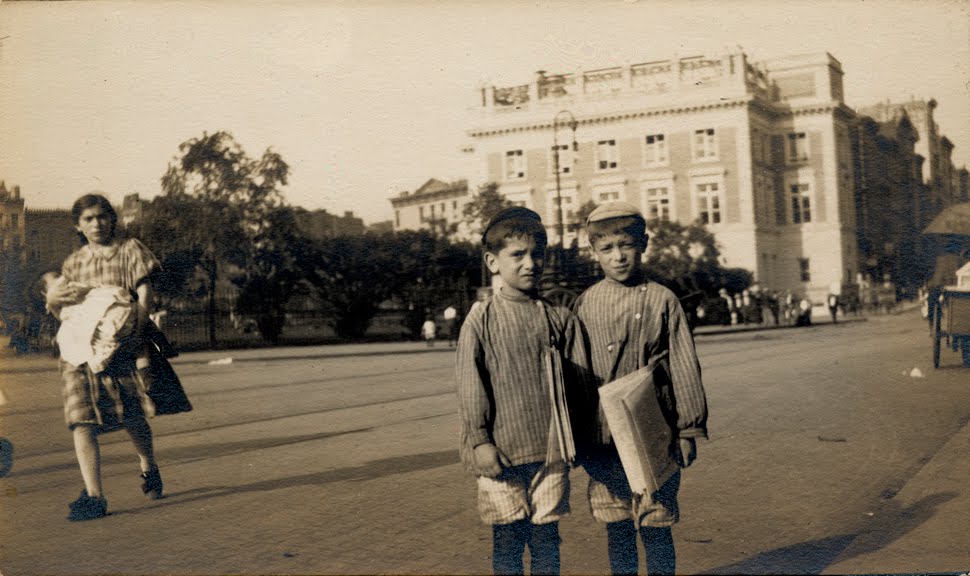
Newsboys in front of Seward Park. Caption: “Eisenberg Brothers, living at 27 Lewis Street. Benjamin, 8 years old, and John 10, selling Jewish papers [assumably the Forward] on East Broadway near Rutgers Street.” By Lewis Hine (Courtesy NYHS)

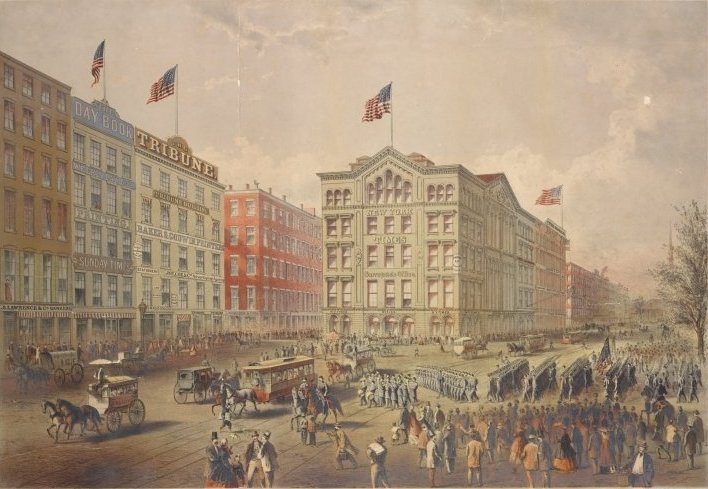
Printing House Square, in a print from 1866, and the world of newspaper publishing in the mid-19th century. This was the heart of journalism in New York, where the streets reeked of ink, reporters and editors darted back and forth from their offices, and newsboys gathered to pick up their morning bundles of hot-off-the-press editions. (NYPL)

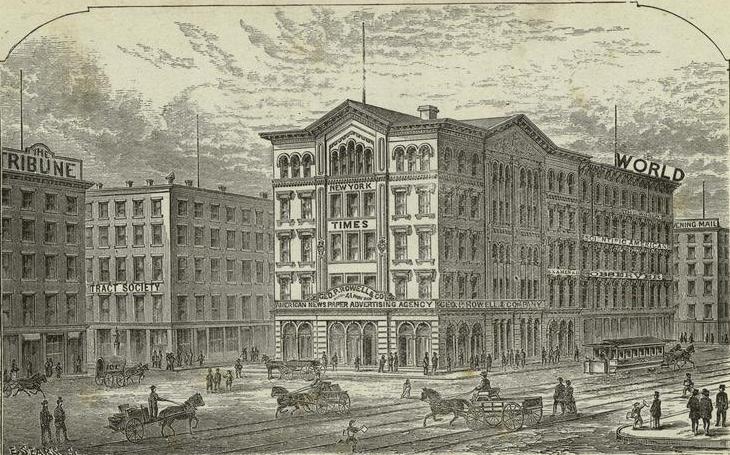
From another angle (print is labeled from 1870s) we see the offices of the Trubune, the Times and the World. The New York World at this time was under publisher Marble Manton was disreputable and unsuccessful.

The fate of the New York World was transformed when it was purchased by innovator Joseph Pulitzer, who modernized the publication — introducing such staples of cover photographs and banner headlines — and increased its popularity through sometimes sensational articles. (NYPL)

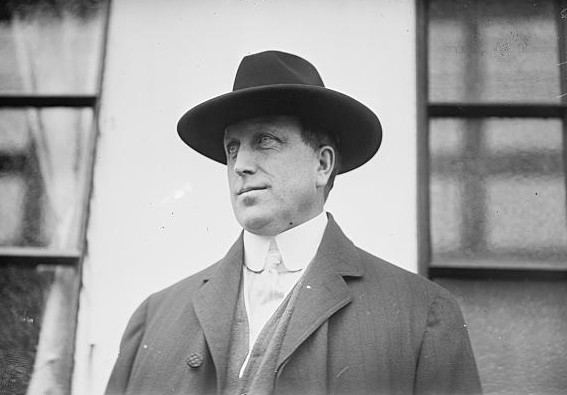
Not to be outdone, William Randolph Hearst stepped into the publishing fray in 1896 with the New York Morning Journal, matching the World head to head in pulling out the stops to increase circulation and ad revenue.

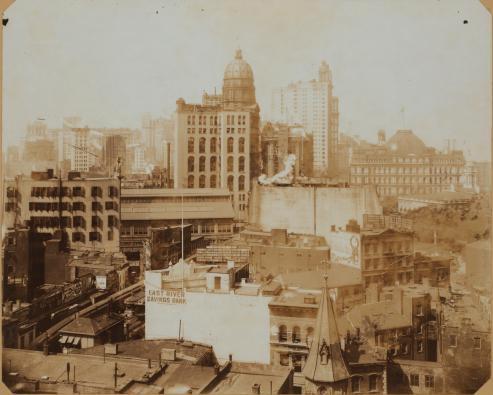
This is Duane Street in the early 1900s. I’m including this picture because the Newsboys Lodging House, where many of the strikers resided for a nickel a night, was located at 9 Duane Street, in the shadow of the World’s distinctive tower.

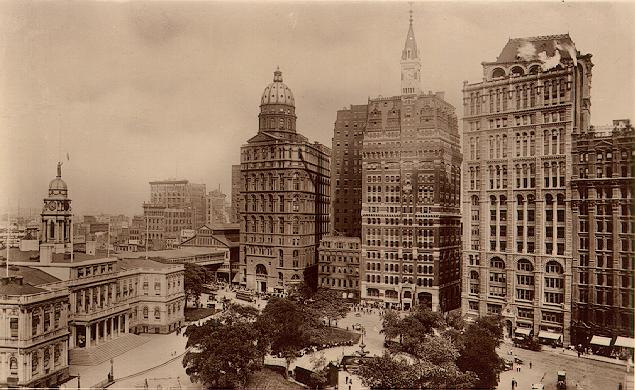
Pulitzer’s World Building from Park Row, designed by George Post, was at one time the tallest building in the world. It sits near the Tribune building, at center.
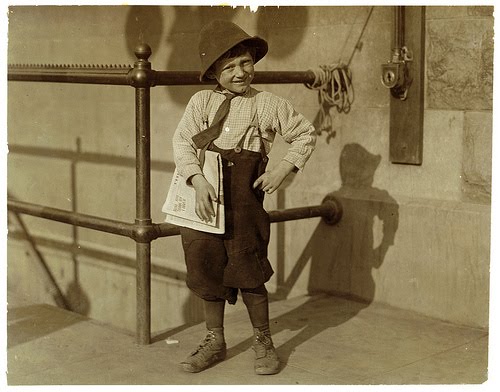
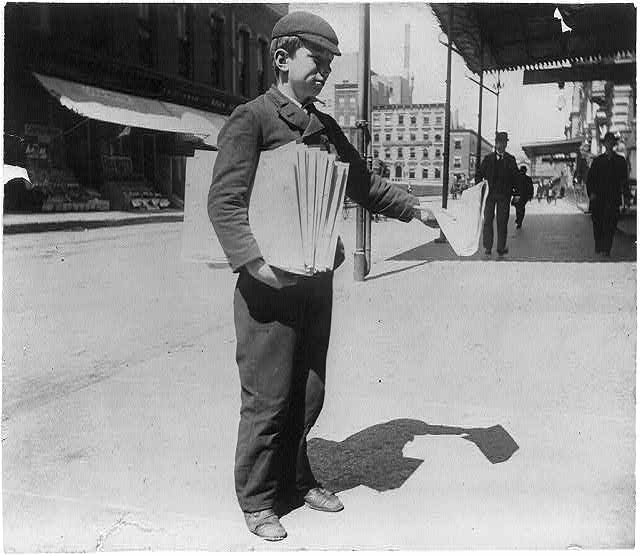
Newsboys were not the ‘plucky’, can-do ambitious entrepreneurs that pop culture has made them out to be, although sometimes (like this guy) they come close.

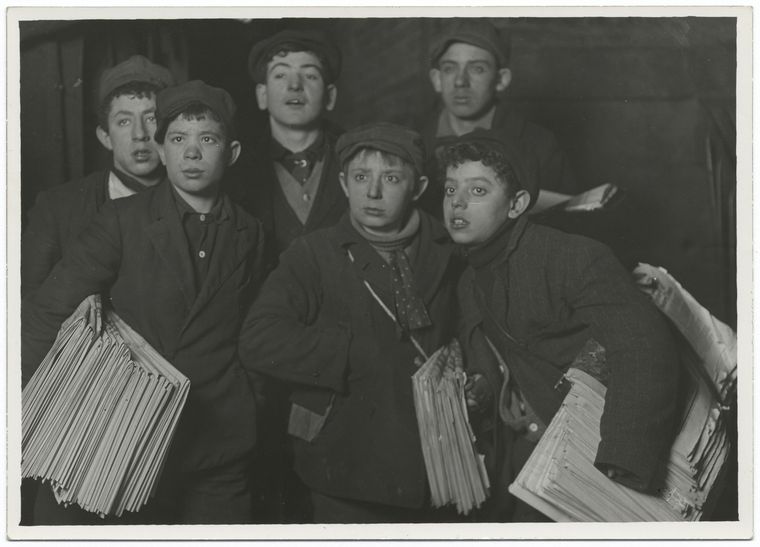
A Lewis Hine photograph with the caption “Group of newsboys starting out at Brooklyn Bridge early Sunday morning.” The newsies got up every morning to pick up their bundle of newspapers. New York newspapers raised the price of these bundles during the Spanish-American War, when circulation increased. When the war was over, many newspapers lowered the price. All but the World and the Journal. [NYPL]

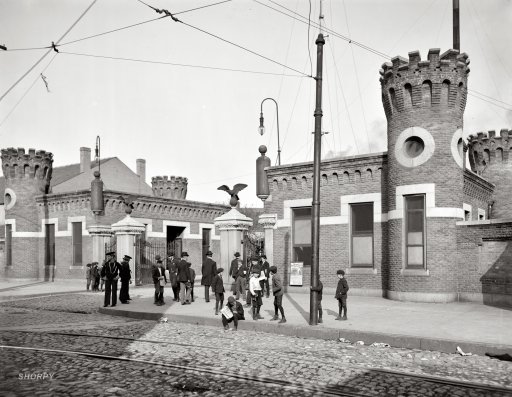
A cluster of newsboys, amongst sailors and businessmen, out at the Brooklyn Navy Yard, 1903. Brooklyn newsies had taken on the newspapers via a strike as far back as 1886 and joined their Manhattan counterparts in fighting back at Pulitzer and Hearst.(Courtesy Shorpy, who has a beautiful larger version)

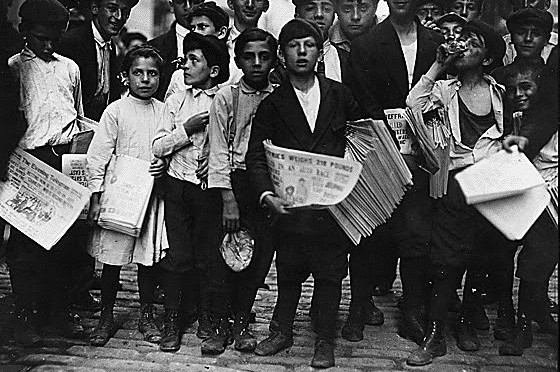
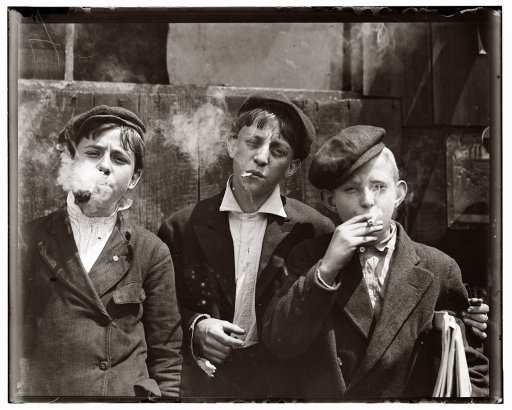
The life of the newsie aged children prematurely. Getting up early, staying up late, most of them homeless and scrounging for nickels and dimes to survive, the 19th century newsboy got by on emulating adulthood. The boys below were photographed by Lewis Hine in St. Louis. (from Shorpy, who have a larger view)

Hine and Staten Islander Alice Austen are the two most well-known photographers of everyday life in New York and captured life on the streets in all its unglamorized tarnish. Below, Austen captures a newsie hard at work in 1906.

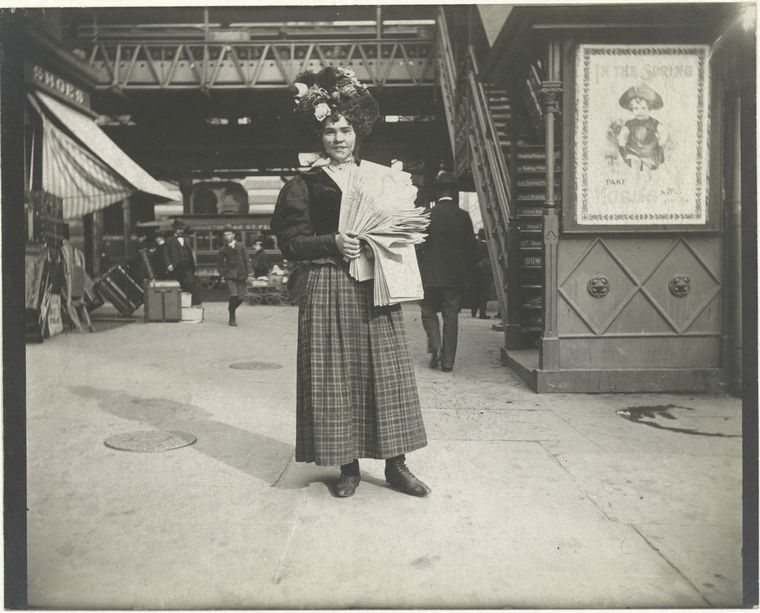
Although most newsies were boys, there were many newsgirls as well, such as this young lady in a fetching hat. Photo by Alice Austen. [NYPL]

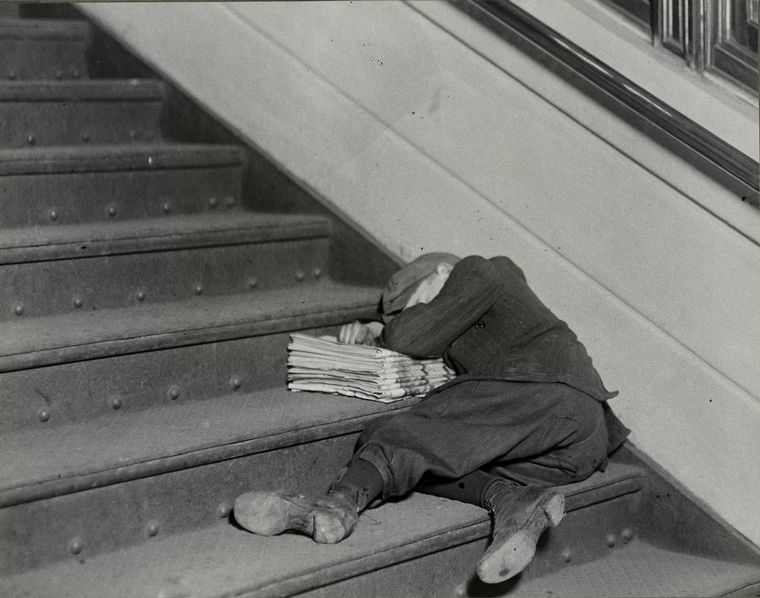
Even with aid organazations like the Children’s Aid Society and lodging homes for wayward waifs, many newsboys lived their entire lives on the streets. The picture below is from 1912, by Hine. (NYPL)

Why do photographs of young kids from this era seem to resonate so strongly? You can look at these pictures and see your own children, nieces and nephews and neighbors. As children — particularly poor ones– have few of the fashionable trappings of adults of this era, we’re able to recognize common expressions. I highly recommend checking out the collections of Lewis Wickes Hine and Alice Austen at both the New York Public Library Digital Collection and the Library of Congress.

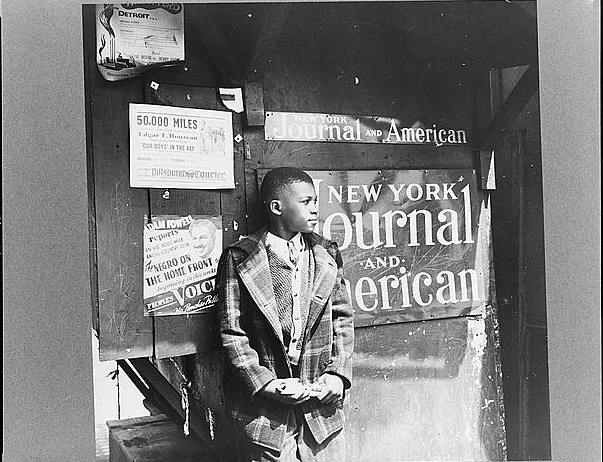
Finally, here’s a one more photograph from 1943 of a modern newsie, decades after the strike, by another great photographer Gordon Parks (yes, the director of Shaft). I like that he’s standing in front of a sign for the Journal-American, the newspaper that Hearst’s Journal morphed into.
[LOC]

And I couldn’t close without a little nod to that oft-maligned, cult classic Newsies , featuring fictional portrayals of Racetrack Higgins, David Simmons and of course Kid Blink (in a reduced role from his actual participation in the strike) (Thanks to Pengo for the link suggestion)

Finally I deeply apologize: I’m sadly aware that my impersonation of a newsboy’s dialect had a bit of an Ozark twang in it! I was never meant for the stage, I guess….

Know Your Mayors: William Jay Gaynor

Our modest little series about some of the greatest, notorious, most important, even most useless, mayors of New York City. Other entrants in our mayoral survey can be found here.

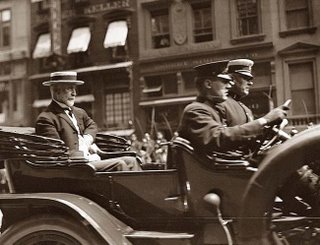
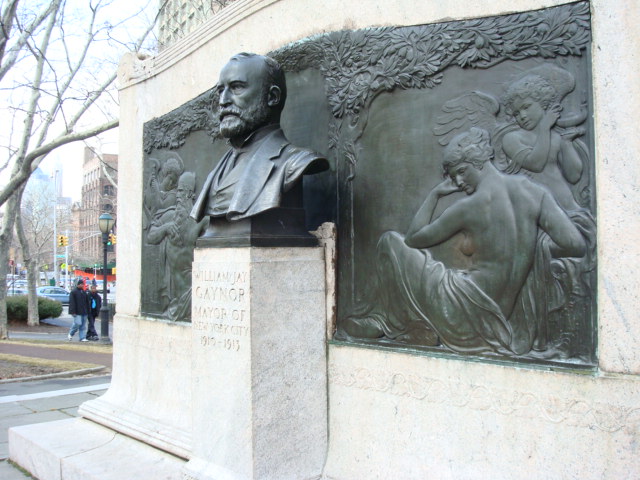
Walk from Manhattan over the Brooklyn Bridge, take the first ramp off the bridge, turn right to Cadman Plaza, and you will run smack dab into a marble slab and the stoic bust (see below) of William Jay Gaynor, mayor of New York City from 1910 to 1913. Very few mayors are honored with statuary in this city, especially a mayor with so short a term in office. Gaynor’s term represented a shakedown of traditional New York Tammany politics, a true bureaucratic reform movement.

But Gaynor is perhaps best remembered as being the only New York mayor to become target of an assassination attempt and to eventually die of his injuries.

It wasn’t supposed to play like this at all. Tammany Hall, entering the dusk of its influence by the early 20th century, thought they had a ringer with Gaynor, a state Supreme Court justice for 14 years chosen to run by still-powerful political machine. One of his opponents — William Randolph Hearst — an early admirer who warned Gaynor to publicly reject his corrupt Tammany sponsors.

Hearst needn’t have worried. Once elected, Gaynor flummoxed his Democratic forebears by eshewing the usual political favors to Tammany cronies and actually hiring qualified individuals in chosen fields. His swiftly became no one’s pawn.

Gaynor continued to live in Brooklyn — 20 Eighth Avenue in Park Slope, to be precise. On his first day of work, he actually walked from home, over the Bridge, and right into City Hall.

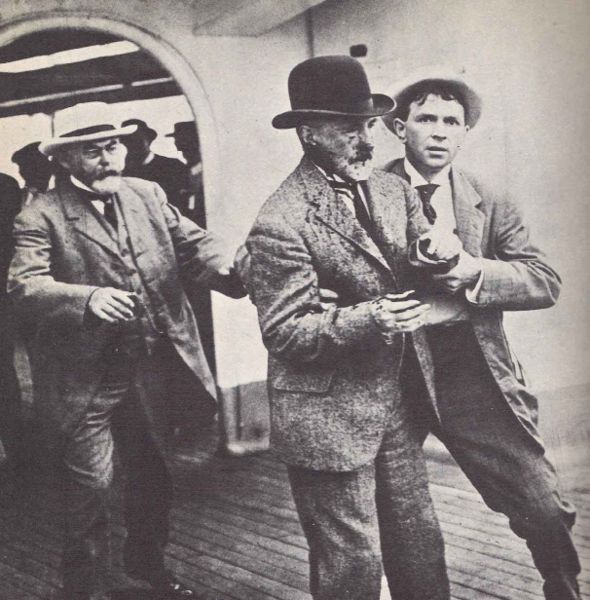
While vacationing on the ocean liner SS Kaiser Wilhelm der Grosse, a disgruntled city employee James J. Gallagher, fired from his job on the docks, took out his frustration on Gaynor, shooting him through the back of the neck. Gallagher claimed, “He took away my bread and meat. I had to do it.” Really, James?

Unbelievably, a photographer for the New York world William Warnecke happened to catch the incident, which quickly became one of the most startling photographs in the short history of photo-journalism:

Gaynor recovered somewhat, although the bullet would remain lodged in his throat, and his entire term of mayor, he would remain weakened and haggard. He would even use the injury as a reason to get out of discussing delicate subjects, saying, “Sorry, can’t talk today. This fish hook in my throat is bothering me.”

The brush with death, paired with his remarkable house-cleaning at City Hall, quickly transformed him into a popular leader, with talk of even running for president. Tammany wouldn’t help him with another term for mayor, naturally, but he was immediately nominated as an independent.

Somebody should have told Gaynor, however, that he should have avoided ocean liners. On Sept. 4 1913 he boarded the ocean liner Baltic for yet another oceanic vacation and six days later was found dead on a deck chair, his body finally giving in to lingering internal injuries. Curiously, Gaynor’s would-be assassin Gallagher had died just a few months prior — at an insane asylum in Trenton, New Jersey.

The New York Press ran a further appreciationof the Gaynor monument itself. Or maybe you’d like to read his extravagent obit from the New York Times.