Categories
Parks and Recreation Podcasts

The Secrets of Gramercy Park (and you don’t even need a key)


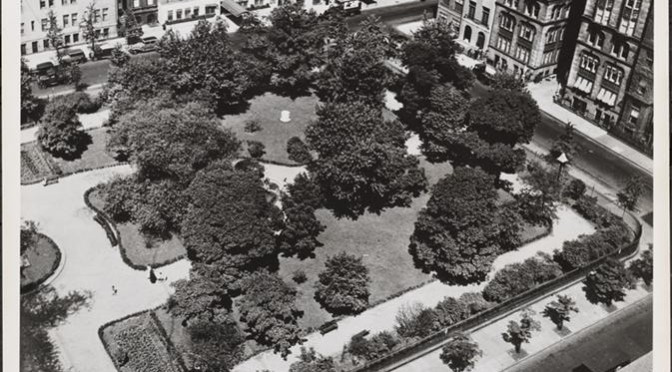
PODCAST Gramercy Park is Manhattan’s only private park, a prohibited place for most New Yorkers. However we have your keys to the history of this significant and rather unusual place, full of the city’s greatest inventors, civic leaders and entertainers.
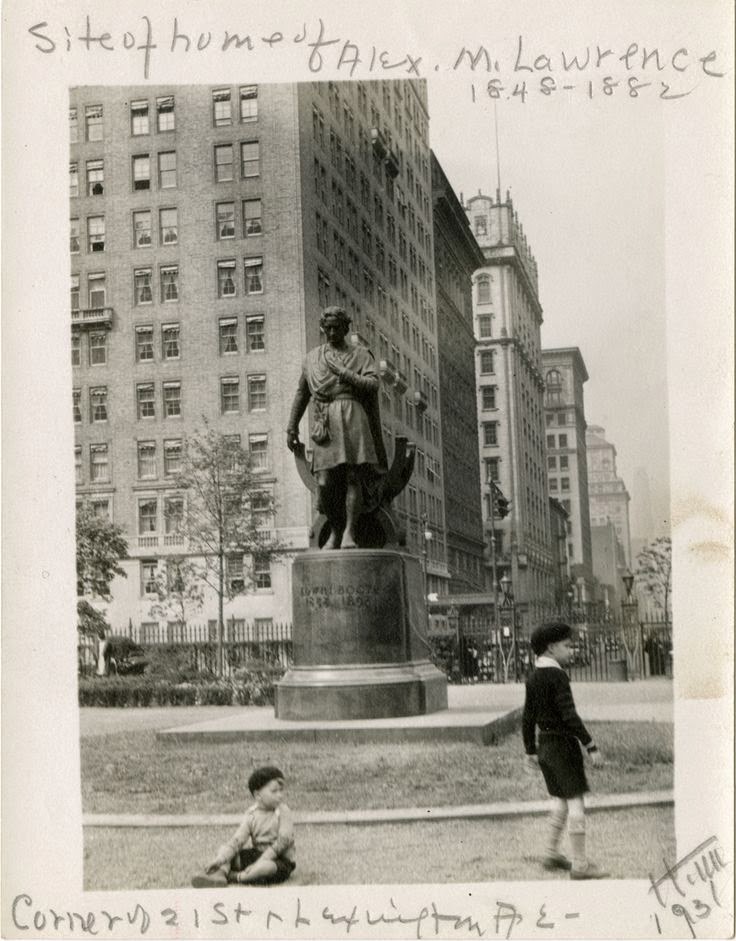
Literally pulled up from swampy land, Gramercy Park naturally appealed to the city’s elite, a pocket neighborhood with classic old brownstones so vital to the city’s early growth that two streets sprang from its creation — Irving Place and Lexington Avenue.

Within the story of Gramercy Park there are echoes of modern debates over class and land usage. The area’s creator Samuel Ruggles was a New York developer before his time, perfecting techniques that modern developers are still using to convince both the city and its residents of the importance and vitality of their high-end projects.

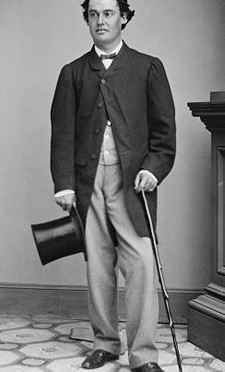
At right: Inside the park with Edwin Booth (Photo by Helaine Magnus, courtesy NYHS)

In this show, we give you an overview of its history — a birds eye’s view, if you will — then follow it up with a virtual walking tour that you can use to guide yourself through the area, on foot or in your mind. (You can follow along virtually starting here.) In this tour, we’ll give you the insights on an early stop on the Underground Railroad, the house of a controversial New York mayor, a fabulous club of thespians, and a hotel that has hosted both the Rolling Stones and John F. Kennedy (though not at the same time).

ALSO: We tell you the right way to get into Gramercy Park — and the wrong way.


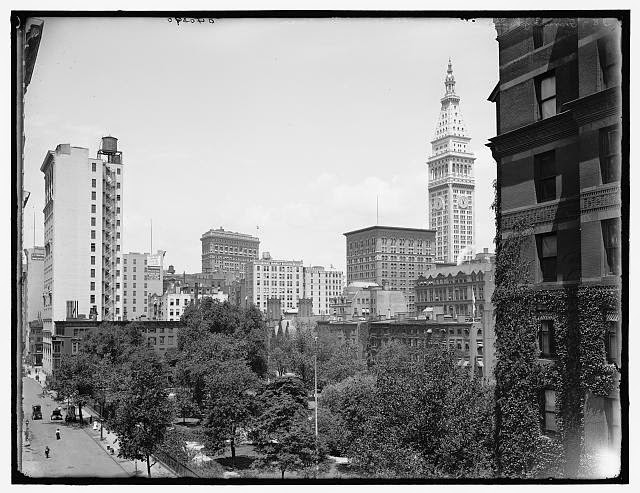
Below: Looking west onto Gramercy Park, photo between 1909-1915.  You can see both the Flatiron and the Metropolitan Life Tower in the distance. [LOC]


And we would like to thank our sponsors:

Squarespace, the all-in-one platform that makes it fast and easy to create your own professional website or online portfolio. For a free trial and 10% off (your first purchase), go to squarespace.com and use offer code BOWERY.


Audible, the premier provider of digital audiobooks. Get a FREE audiobook download and 30 day free trial at www.audibletrial.com/boweryboys. Over 150,000 titles to choose from for your iPhone, Android, Kindle or mp3 player Audible titles play on iPhone, Kindle, Android and more than 500 devices for listening anytime, anywhere.


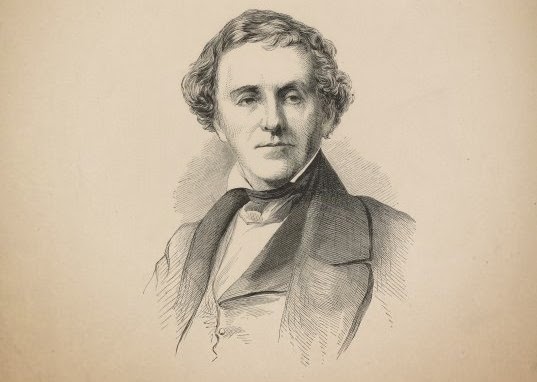
Samuel Ruggles, the mastermind behind the Union Square and Gramercy Park developments, two parks with drastically different fates. While Union Square would eventually be considered ‘the people’s park’ and a center of working class protest, Gramercy Park would retain its guarded, exclusive character.
A 1831 map outlining the lands owned and developed by Samuel Ruggles. Lexington Avenue and Irving Place have already been planned by this time. (Courtesy MCNY)
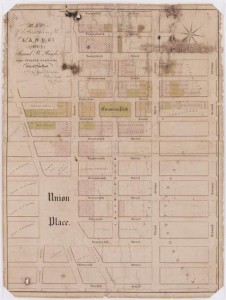
Lands of Samuel B. Ruggles in the Twelth Ward in the City of New York

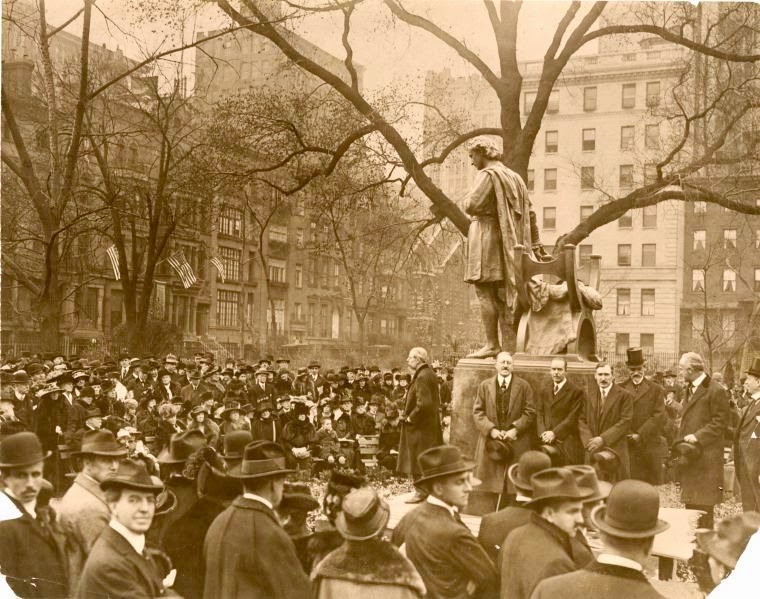
The 1918 unveiling of Gramercy Park’s one permanent resident — the statue of Edwin Booth. (NYPL)
The esteemed Dr. Valentine Mott who lived (with his large family) at 1 Gramercy Park. 
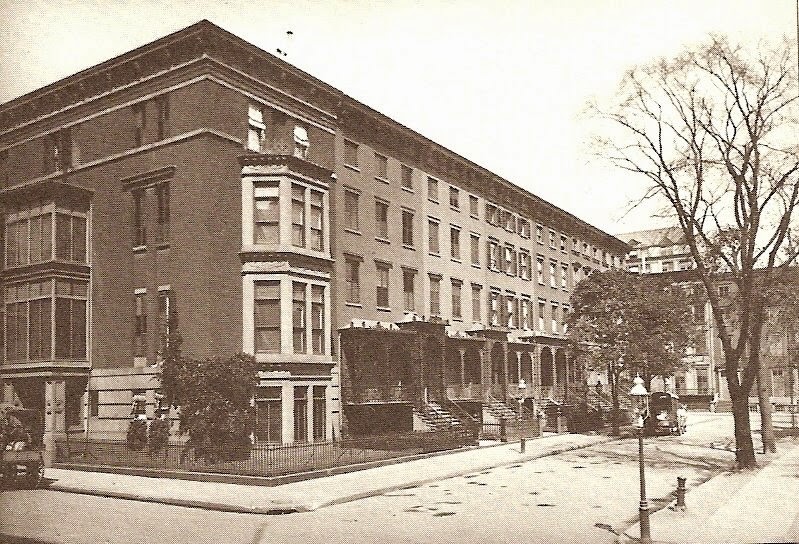
3 and 4 Gramercy Park from 1935 — and they look exactly the same today! The lampposts indicate that this was once the home of former mayor James Harper.  (Photo by Berenice Abbot, NYPL)

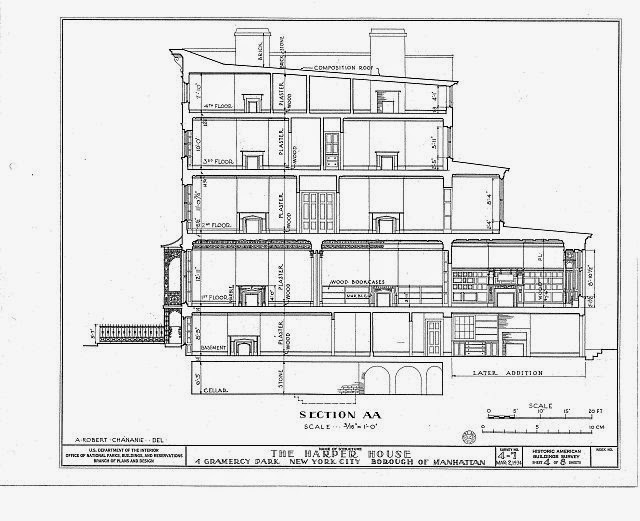
A architectural cross-section of 4 Gramercy Park, showing the size of the house.
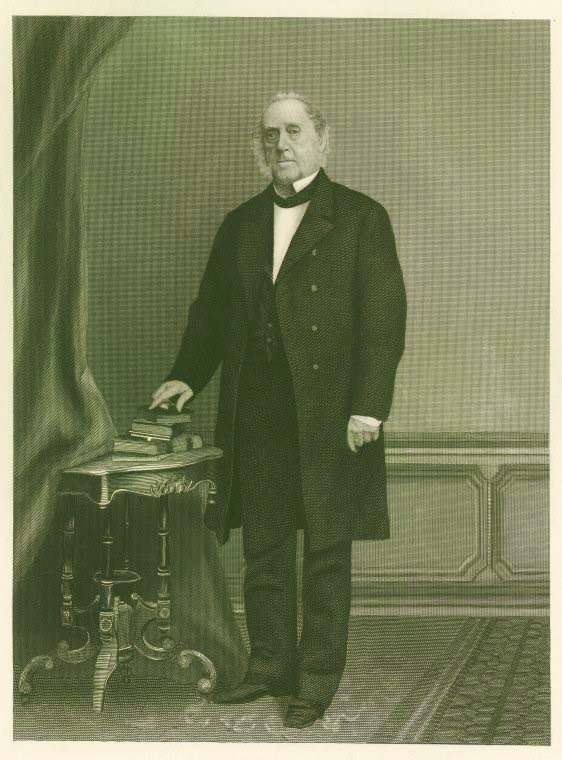
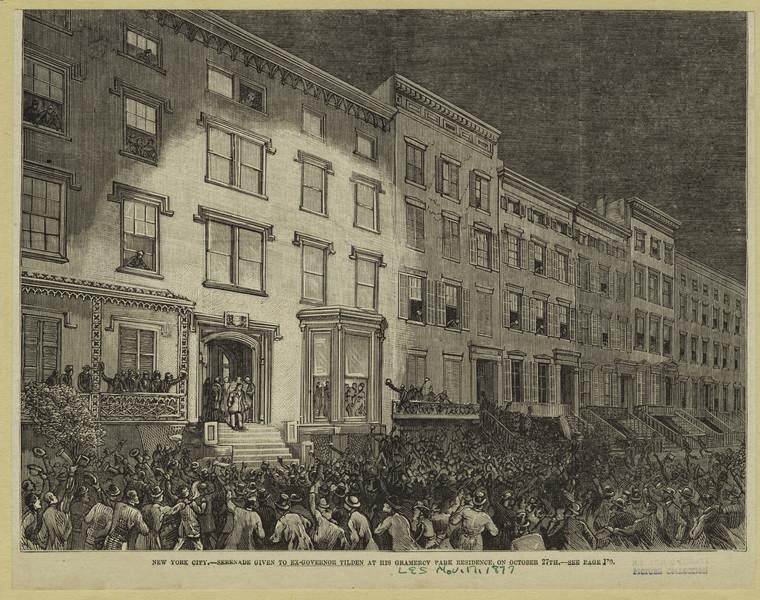
New York governor and almost-U.S. president Samuel Tilden lived in Gramercy Park. His home would later be transformed into the National Arts Club.
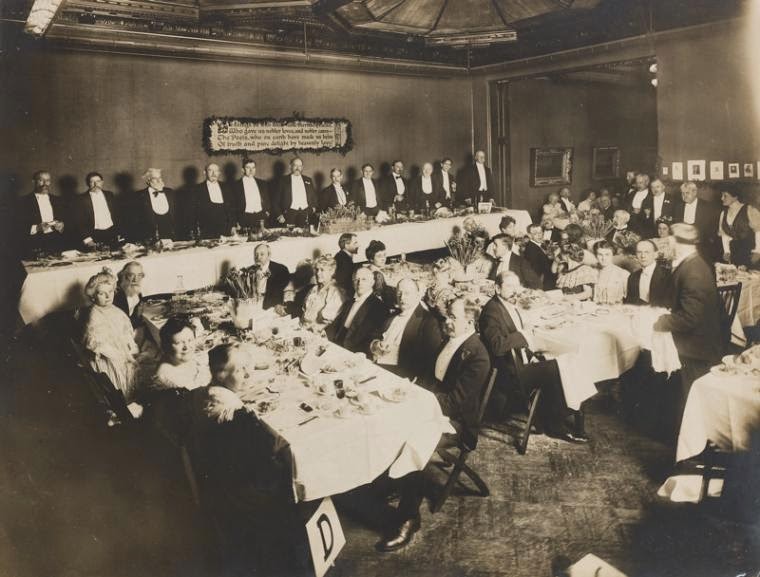
Enjoying a banquet at the National Arts Club in 1908. As you can see, the membership has always been open to both men and women, a trait few social clubs of the day enjoyed. (NYPL)
The Players Club in 1905. In this photo the building is mournfully adorned in black crepe in honor of the actor Joseph Jefferson.

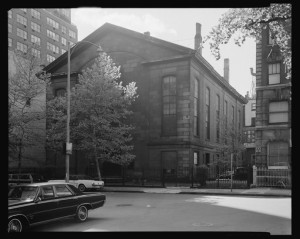
The Friends Meeting House in 1965. It would become the Brotherhood Synagogue ten years later. (Courtesy Wurts Brothers, MCNY) 144 East 20th Street. Exterior of Friends Meeting House.
Children within the park, 1944. The Edwin Booth statue stands in the background here (MCNY)
Child drinking from water fountain, Gramercy Park

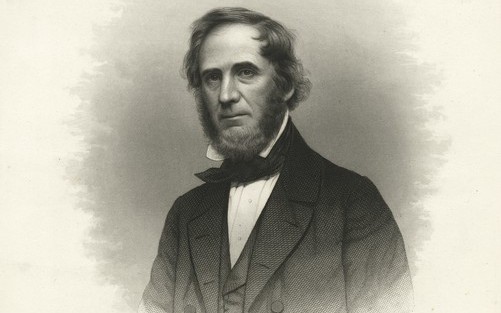
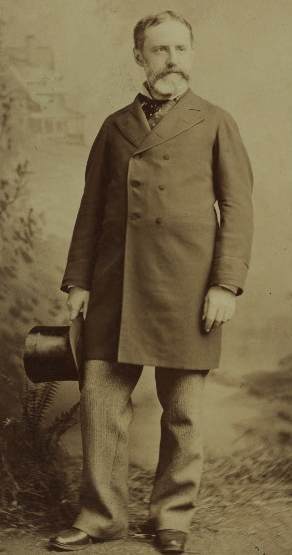
Mayor Daniel Tiemann, colorful man of Manhattanville

KNOW YOUR MAYORS Our modest little series about some of the greatest, notorious, most important, even most useless, mayors of New York City. Other entrants in our mayoral survey can be found here.

Mayor Daniel F. Tiemann

In office: 1858-1859

Once upon a time there was a village called Manhattanville, a small, originally Quaker community that planted itself between a bustling but still bucolic section of Bloomingdale Road (later Broadway) and the Hudson River. A remnant of the old village remains in the small neighborhood that shares its name today, north of Morningside Heights between 122nd and 135th streets on the west side.

Founded in 1806 the village grew due to its proximity to a major artery that led to the city of New York, but its fortunes really multiplied due to a developing port industry along the water. Together with its sister village Harlem, they grew into healthy rural communities.

In 1850s, the most powerful man in Manhattanville was Daniel Fawcett Tiemann. He was actually born down in New York, at a house on Nasssau and Beekman to German immigrants; he would later return to govern the city from City Hall, just two blocks away from his birthplace.

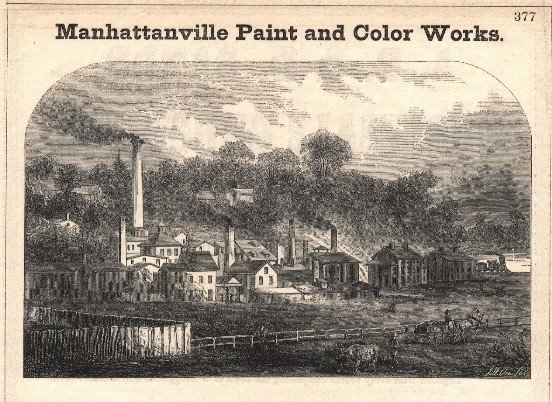
Daniel was the paint king of New York, a trade he learned from his father, working in the original Tiemann paint factory at 23rd and 4th Avenue (today’s Madison Square park). He and his brother Julius eventually inherited the family business and moved it into the rural pastures of Manhattanville. Soon D.F. Tiemann & Company Color Works took up a dozen buildings and dominated the industrial character of the village.

Notably, Edward Leslie Molineux, later to be both a Union general and the father of convicted (and famously acquited) 19th century murderer Roland Molineux, was a clerk in Tiemann’s firm and later a close political associate.

Tiemann had his eyes quite literally set on City Hall even at a early age. “I saw them building the present City Hall and we all thought that it was too far away from the business centre,” he once recollected. Young Tiemann frequently reminsced of his glorious youth, skating on Collect Pond and later fishing in the newly dug canal.

BELOW Color me impressed: the Manhattanville paint empire of New York mayor Tiemann

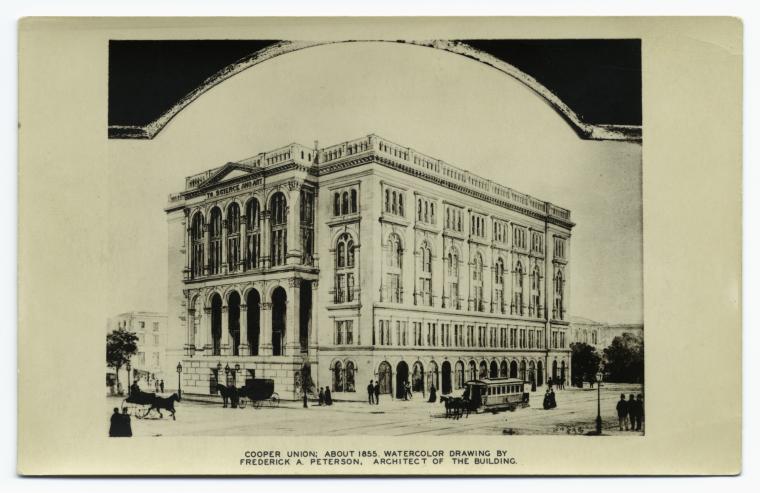
Luckily he had very strong ties to one of New York’s most prominent families, the clan of Peter Cooper. In fact Tiemann married Cooper’s niece and would eventually became a founding trustee in Peter’s pet project, Cooper Union, in 1859. (Marrying into the Cooper clan is always good for one’s prospects, as Abram Hewitt also found out.)

His family background, business acumen and solid nativist appeal recommended him for public office, particular in the years when corruption and chaos seemed to reign supreme in City Hall, namely the administration of wily Fernando Wood.

In 1857 a coalition of different parties united behind unblemished, teetotaling Tiemann, including the ‘People’s Union Party’ (composed of merchants), the American Party (a nativist, anti-immigrant party) and even Tammany Hall — who had kicked Wood out just the year previous.

That October 1857, Tiemann handily beat Wood by 22,000 votes. It should be noted, however, that Tiemann’s support was as much anti-Wood as it was pro-Tiemann. “If I succeed in the business of the Mayoralty as well as I have in making paint…I should be satisfied,” Daniel proclaimed at his victory.

Tiemann inherited a nearly bankrupt city government, tapped dry with graft and unable to sustain itself. In fact, by October 1858, City Hall itself was actually put up for auction, and the wealthy Tiemman had to personally buy it (for $50,000!) and eventually gave it back to the city.

The new mayor did bring a modicum of reform to city government throwing out a few corrupt officials, including the laughably crooked street commissioner Charles Devlin. But Tiemann was fighting upwind and his political coalition immediately fractured.

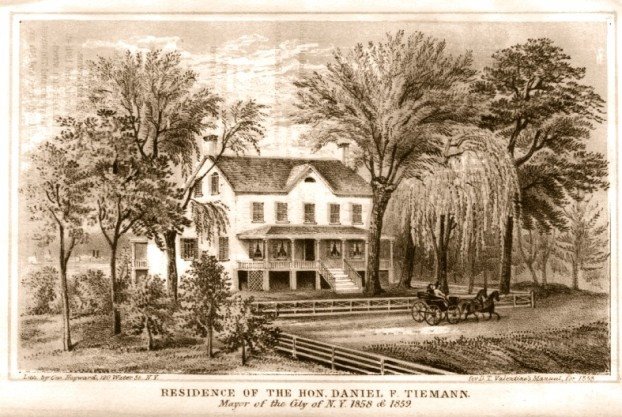
Below: Tiemann’s home in upper Manhattan

Much happened in the city under his watch, including further development of Central Park and the ground-breaking of new St. Patrick’s Cathedral. But his greatest contribution is something we take for granted today. In a burst of common sense one night, Tiemann proposed that street names be attached onto lampposts for better visibility, as opposed to being stuck to the face of corner buildings.

His greatest claim to fame, however, was as one of the first voices that traveled the newly laid Atlantic cable, which connected North America to Europe for the very first time. “Mayor Tiemann to the Lord Mayor of London. Enthusiastic Celebraton of the Event of the Age. A UNIVERSAL JUBILEE. NEW-YORK IN A BLAZE. Grand Exhibition of Fireworks in the Park,” boasted the Times headline.

Wood’s supporters had never warmed to Tiemann and staged a comeback. And the paint king had even expended Tammany’s good graces; in the election of 1859, they backed William Havemeyer who was mayor of New York before and would become mayor of New York again, 13 years later. But he would not become mayor of New York today. After keeping the seat warm for two years, Tiemann was replaced by Fernando Wood. It would be the start of a tumultuous tenure.

Tiemann would later become a state senator but his heart would always be in the family business. He settled for the rest of his days in a beautiful home (pictured above) built near his paint plant. He finally died in 1899 at age 95, a staple of New York life who had seen it from bottom to top grow from a port town into the biggest, most important city in the world.

Mayor Edward Cooper, chip off the ole block

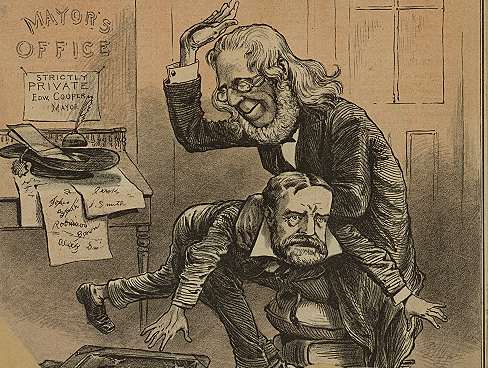
ABOVE: Puck Magazine satirizes father and son, Peter and Edward Cooper

KNOW YOUR MAYORS Our modest little series about some of the greatest, notorious, most important, even most useless, mayors of New York City. Other entrants in our mayoral survey can be found here.

Mayor Edward Cooper

In office: 1879-1880

Many of us must inevitably live in the shadows of the achievements of our parents. Edward Cooper, while no slouch, suffers from the competing bios of two great men in his family — papa Peter Cooper, New York’s cleverest industrialist, and brother-in-law Abram Hewitt, a transformative city leader.

Like Hewitt, Cooper too was mayor of New York, from 1879-1880. Cooper’s tenure wasn’t exactly memorable, but the years following up to it certainly were.

Edward was born on the outskirts of town (i.e., 28th Street and today’s Park Avenue South) in October 1824, the only surviving son of Peter and his wife Sarah, a child with the unique advantage of having one of America’s leading inventors to apprentice from. Peter was already wealthy from his Kips Bay glue factory and employed his free time tinkering, experimenting and dreaming. In fact, Edward was celebrating his third birthday when Peter brought into this world another of his pride and joys — the Tom Thumb, the first operable, steam-powered train engine.

Not surprising, Edward quickly followed his father’s intellectual lead. During his early days in public school, “it was often said of him that there was never a time in his life when he would not sit up half the night to solve a difficult problem in mathematics or engineering which were his especial delights.” Like father, like geek!

Edward went to Columbia University where he befriended his fellow student Abram Hewitt, and the two set out for an educational European vacation in 1844. On the way back however, they were both nearly killed in a shipwreck, stranded with the crew for many days without food or water,

Leave it to outrageous hearsay, but allegedly during this shipwreck, according to Edward’s own obituary, he was almost cannibalized for food by the survivors.

“One report had it that the castaways were so hungry that lots were cast to see who should be eaten. Mr. Cooper drew the unlucky number, but Mr. Hewitt asked to take his place.

“I have brothers,” Mr. Hewitt said, but you are your father’s only son and his life is wrapped up in you. Let me take your place.” Now that’s friendship!

This devastating experience drew the Coopers and the Hewitts together. In fact, Hewitt would later marry Edward’s only sister Sarah Amelia. Edward and Abram, meanwhile would go into the ironworks business together, with capital from Peter Cooper. The results would make them very rich men with foundries in Trenton, New Jersey, producing “mortar beds and gun carriages” in the years leading up to the Civil War.

In 1865, Peter gave control of his coveted glue factory to Edward and soon young Cooper became as distinguished a New York business man in his own right. Just in time to pursue a political career.

Edward was a Democrat, but not of the tainted Tammany Hall stripe. Cooper came from the short-lived rival and reform-minded Irving Hall, battling to sweep away city hall corruption as practiced by the machinations of the other, far powerful Democratic machine. In fact, he would prove instrumental — both through his close friend Samuel Tilden, and as a member of the reform Committee of 70 — in helping bring down the ring of Boss Tweed and the corrupt mayoralty of A. Oakley Hall. He later ardently supported his friend Tilden during his contentious run for the White House in 1876.

The rift was caused by two rival party bosses — John Morrissey, a prize-fighter turned state senator who drew men like Cooper by recoiling from the excesses of Tweed-style politics, and ‘Honest’ John Kelly, who at first rallied in reform rhetoric with Tilden and others but later rebuffed his former allies when he became New York comptroller.

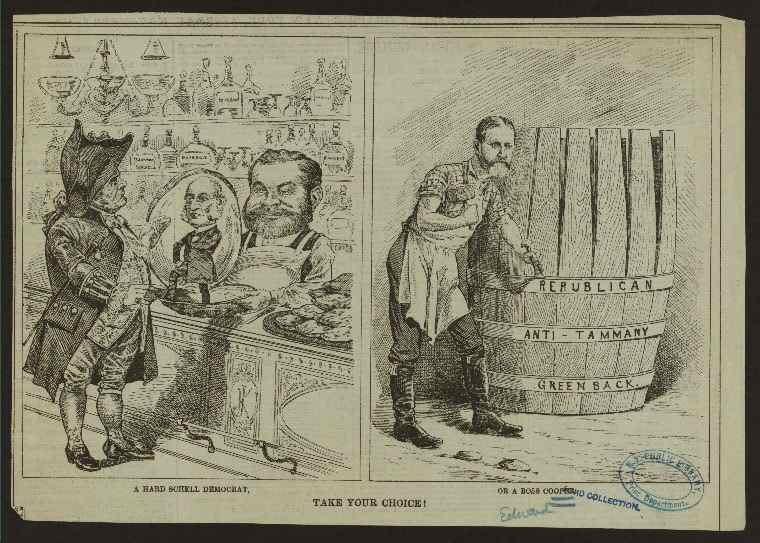
Morrissey ran for state legislature defeating Tammany stalwart August Schell. August turned around and ran for mayor, but this time it was Edward Cooper who defeated him in the fall of 1878. (Ironically, Cooper had to cull together a coalition of Republicans and anti-Tammanys in order to claim victory.)

Below: the electoral decision between Schell and Cooper, as seen through the satire a political cartoon.

The conflict above between Morrissey and Kelly deserves some greater inspection in this column at a later date. Only know that it was John Kelly’s ascension into the comptroller seat before Cooper became mayor that basically ensured Cooper would not be any kind of an effective mayor at all.

Most of Cooper’s time was spent in political infighting, and his prime objective — to reform the corrupt police department — was continually met with criticism, mostly led by Kelly.

Let’s just say, Kelly and Cooper really didn’t get along. Or, in Kelly’s own words, “Let, Edward Cooper, that infamous hypocrite who occupies the Mayoralty chair know that, after his betrayal of the Democracy, he is no nearer Heaven, nor Samuel Tilden near the White House, than they were before!”

Interestingly, Cooper is front and center of a small but precious moment in New York history: the debut of Cleopatra’s Needle, the 3,500 year old obelisk from Egypt planted in Central Park on Oct 9, 1880.

Near the end of his life, Edward would take another, more familiar and far less strenuous office — the president of Cooper Union — in 1898. He died seven years later, in 1905.

Categories
Podcasts

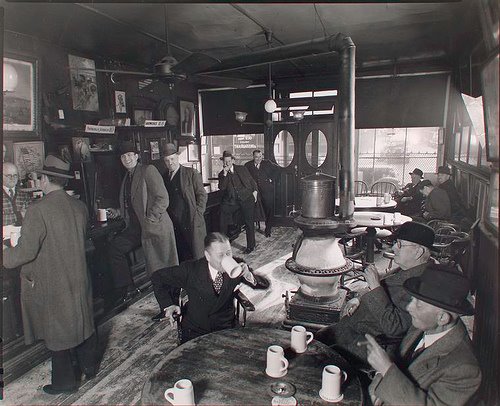
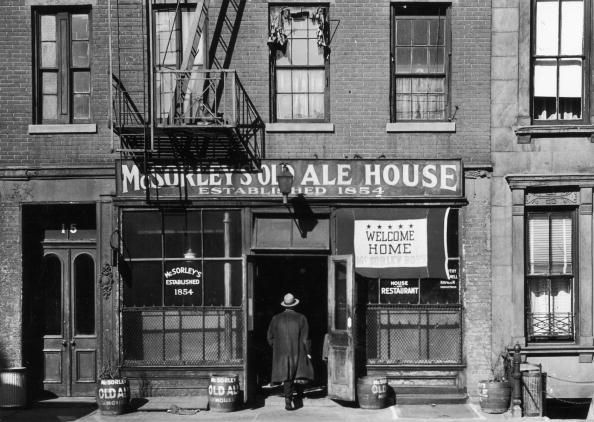
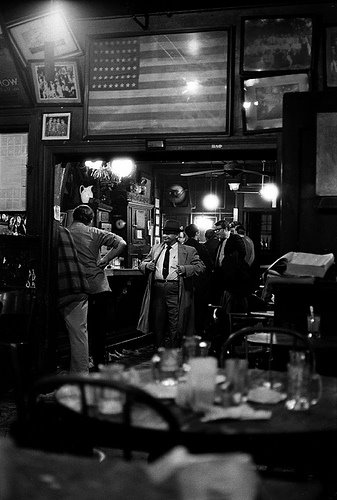
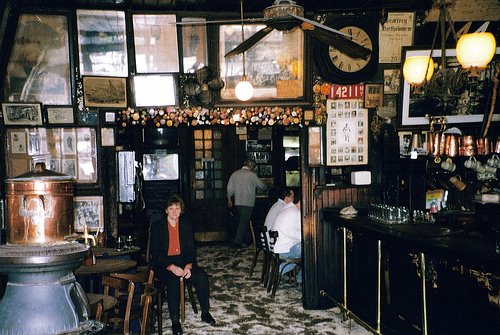
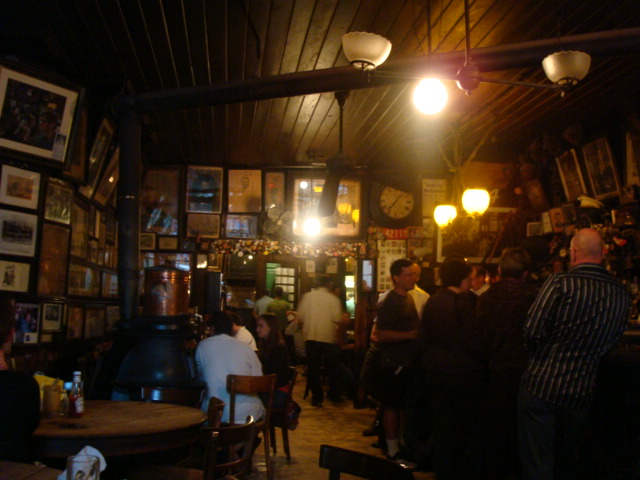
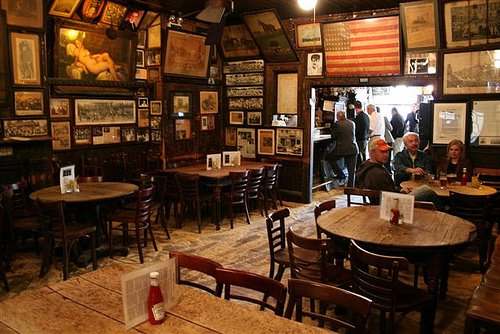
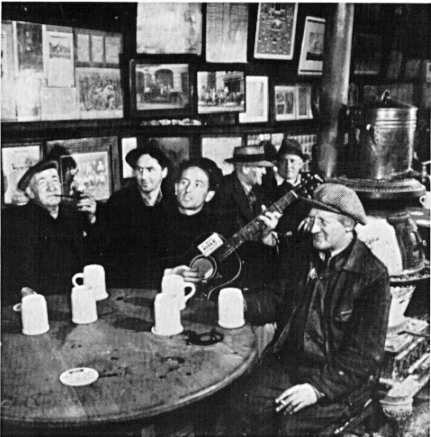
PODCAST: McSorley’s Old Ale House

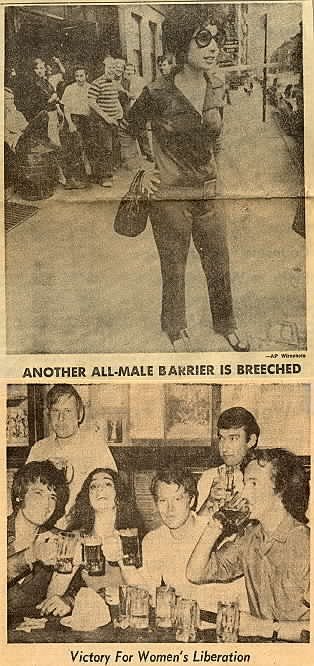
Grab yourself a couple mugs of dark ale and learn about the history of one of New York City’s oldest bars, serving everyone from Abraham Lincoln to John Lennon — and eventually even women!

Listen to it for free on iTunes or other podcasting services. Or you can download or listen to it HERE

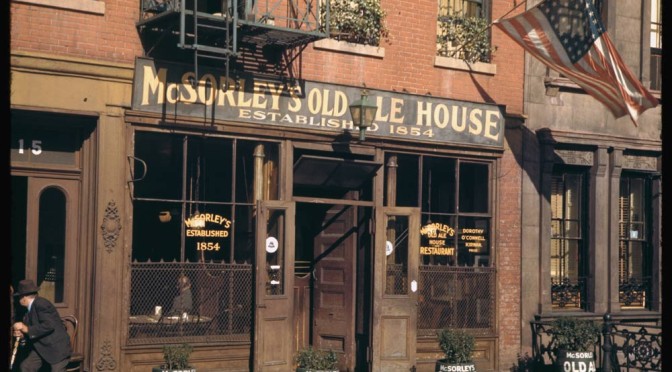
McSorley’s through the ages. Here’s one from 1937:

The outside from 1945

1969:

1998:

And McSorley’s today

The backroom:

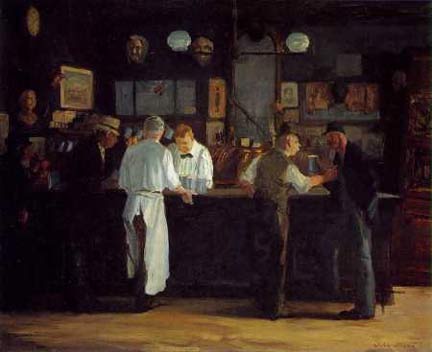
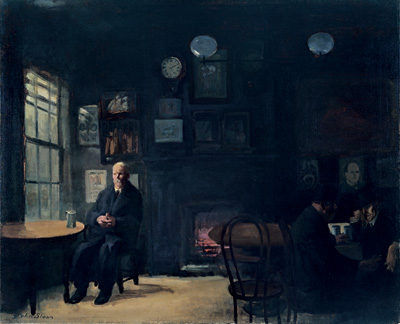
Two of John Sloan’s most famous works, with McSorley’s as its subject:

Woody Guthrie hams it up by the coal burning stove.

Women win the right to vote: dark ale or light ale!

New York City’s curious, modern-day Olympus

Most small community colleges feature a statue or two honoring somebody specifically related to the campus. Even massive schools could invite their monuments over for a small dinner and have room for you and your friend from out of town.

Bronx Community College would need a fairly large banquet hall. This school in University Heights, the Bronx, is a kooky mix of classical Stanford White-designed buildings (from the days when New York University camped here) to some rather awkward concrete classrooms typical of schools that flourished in the 1970s.

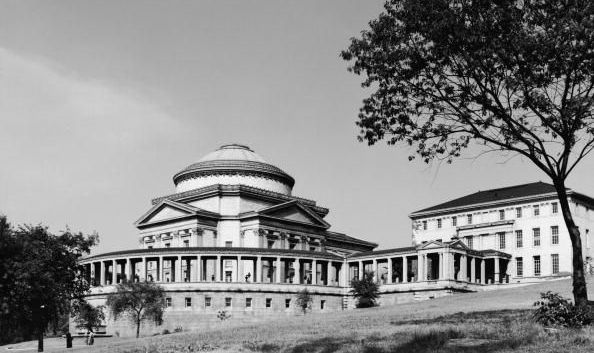
One of the stranger acquisitions BCC received when it took over the NYU campus in 1973 was a prestigious hall of fame featuring the biggest names in American history. Let me clarify. They don’t own a hall of fame. They have THE Hall of Fame.

Tucked on a scenic cliff overlooking the Harlem River (and with the Cloisters well in sight), the Hall of Fame for Great Americans was an ambitious project constructed in 1900 with the idea of immortalizing the Americans with significant contributions to science, the arts, politics and the military. Spearheaded by then-chancellor Henry Mitchell MacCracken, the project is the first real memorial ‘hall of fame’ concept to be executed in the United States.

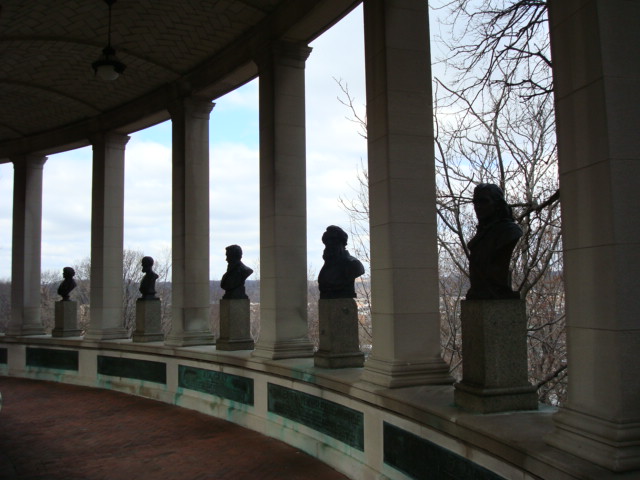
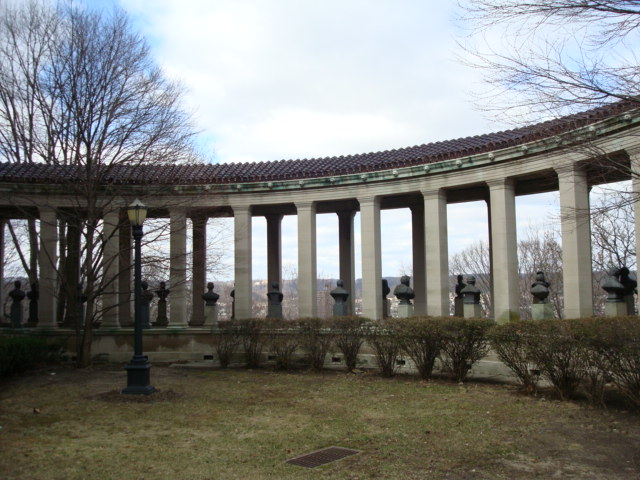
The spacious colonnade tucked behind the White-designed Hall of Philosophy, you are thrown back into a mix of turn-of-the century scholarly aesthetic and the belief of equating the American movement with ancient Roman and Greek forefathers.

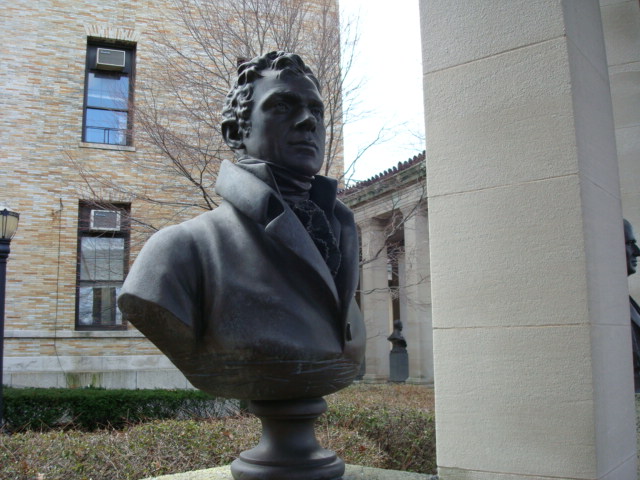
With room for 102 sizable busts (although there are only 98), the colonnade winds around the contours of the hill, spotlighting American icons. John Marshall sits astride Henry Clay. Harriet Beecher Stowe is a few busts down from brother Henry. George Washington AND George Washington Carver are close enough, they could play catch (if they had arms).

The Hall of Fame is a true curiosity in the ‘roadside attraction’ sense. Once a fabled hall with prestige enough that newspapers would lobby for nominees, there haven’t been any new inclusions since the 1960s. (Three more ‘American icons’ — Clara Barton, Andrew Carnegie and Luther Burbank — were elected in 1976, but nobody ever made busts for them!) Once NYU sold the campus, the colonnade was neglected, the hall of fame virtually forgotten.

It has been recently renovated, and the BCC keeps this well-preserved secret maintained. I went this weekend, stayed for about an hour, and didn’t see a soul. It’s worth a visit for the view, although you might want to wait until spring to appreciate the foliage.

Fun Hall of Fame trivia:

— One bust sits apart from the others, partially because he’s the only non-American — the Marquis de Lafayette

— The bust of Stephen Foster in inscribed with the music and lyrics to ‘Swanee River’

— Actor Edwin Booth sits serenely looking out at the river, while the man his younger brother assassinated, Abraham Lincoln, has a less interesting view

— Hey! We’ve actually done whole podcasts on four members of the Hall of Fame — Beecher, Washington Irving, Peter Cooper and Alexander Hamilton

— The bust of female astronomer Maria Mitchell creeps me out to my very soul

How to get there: #4 train to Burnside Avenue. Walk west to University Avenue and one block north to the college.

Categories
Podcasts

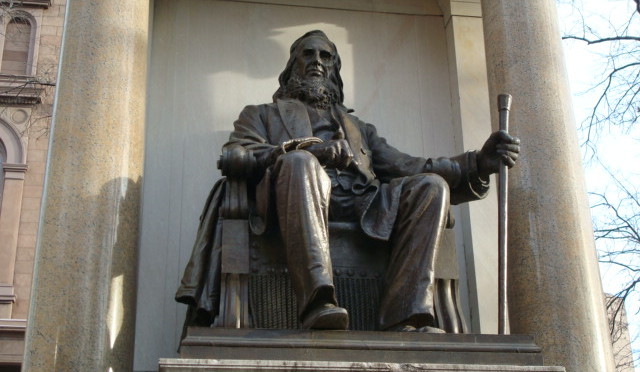
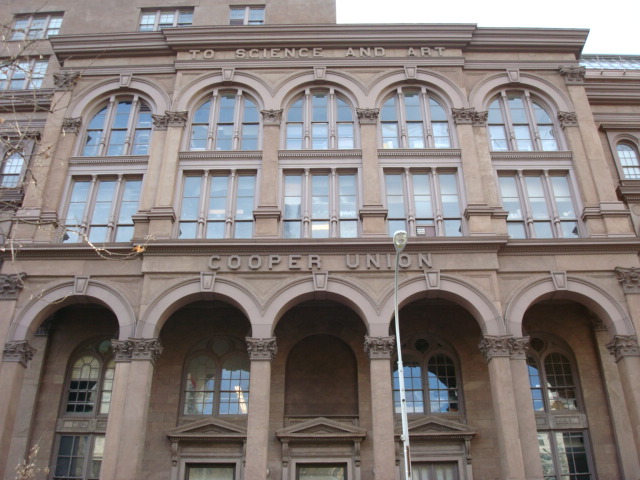
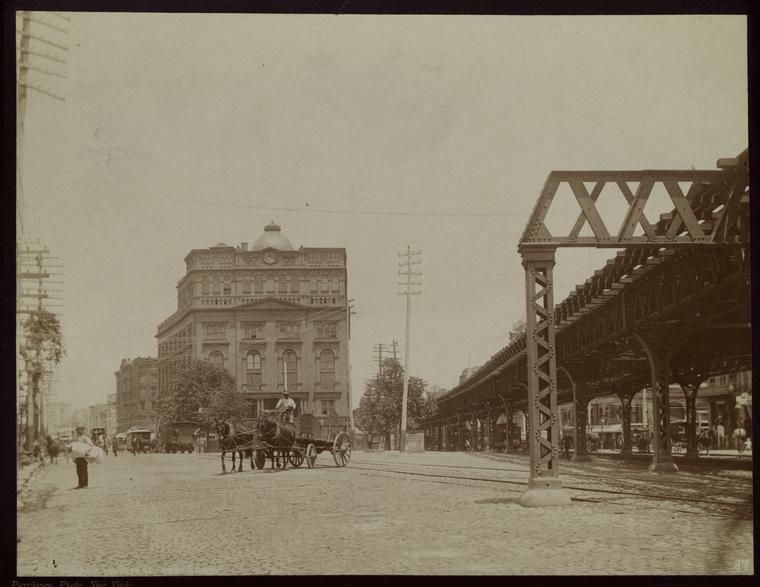
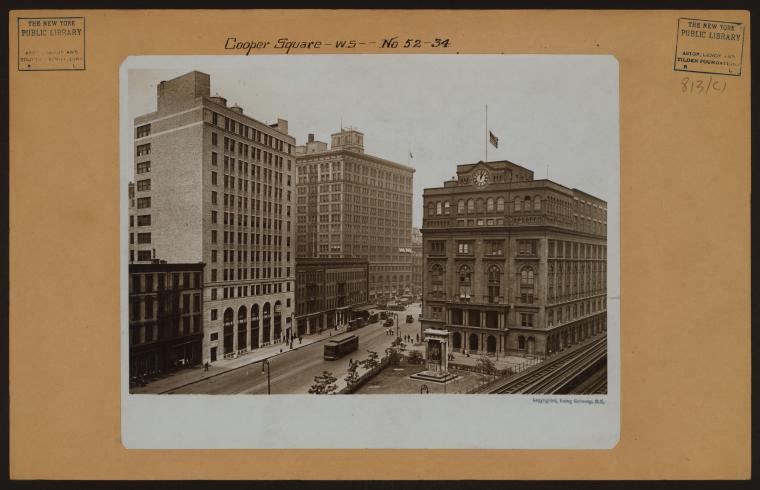
PODCAST: Peter Cooper and Cooper Union

Cooper Union is one of New York City’s more storied institutions, not only fostering the best and brightest of art and architecture, but playing host to presidents and activists. Also, find out a little about its amazingly resourceful founder Peter Cooper

Listen to it for free on iTunes or other podcasting services. Or you can download or listen to it HERE

Know Your Mayors: Abram S. Hewitt

Our modest little series about some of the greatest, notorious, most important, even most useless, mayors of New York City. Other entrants in our mayoral survey can be found here.

Abram Hewitt could easily be considered a very pivotal mayor in New York City, given the significant development and personal connections he had to the heart of the city. However a shipwreck very nearly did him in before he could even get started.

Hewitt, born upstate in Haverstraw, attended Columbia and taught mathmatics, where he became friendly with a student he was tutoring, Edward Cooper. The two of them later voyaged to Europe in 1844, but on the way back to America, their ship capsized off the coast of Cape May.

He, Edward and the crew were later rescued, but the experience affected Hewitt deeply (and rather vaingloriously): “It taught me…that my life which had been miraculously rescued belonged not to me, and from that hour I gave it to the work which from that time has been in my thoughts — the welfare of my fellow-citizens.”

It had a more lucrative effect as well; for Edward Cooper happened to be the only son of industrialist Peter Cooper. Hewitt’s bravery bonded him with the Cooper family, becoming lifelong friends with Edward and marrying Edward’s sister Sarah.

He helped found Trenton Iron Company with the Coopers and became the first to experiment with the inexpensive steel-producing Bessemer process in the United States.

But politics was soon in Abram’s sights, especially with the crumbling of Boss Tweed’s Tammany Hall after his fall in 1871. Hewitt reorganized that once-corrupt Democratic political machine with political rewards for himself, elected to the U.S. House of Representatives in 1874.

He even tried his hand at national politics, managing Samuel Tilden’s nearly-successful quest for the White House in 1876. Remember this from history class? Despite Tilden winning the popular vote, an electoral fiaso gave the election to Rutherford B Hayes.

As Hewitt held court in Washington — becoming, in Henry Adams’ words “the most useful public man in Washington” — his close friend and brother-in-law Edward Cooper would be elected mayor of New York in 1879.

Hewitt’s connections in Washington would assist in getting the neccessary attentions brought to the building of the Brooklyn Bridge. Although David McCullough dryly notes that Hewitt might have inadvertantly helped weaken the Bridge by helping deliever the wire bid to Brooklyn native (and total fraud) J. Lloyd Haugh. (More about him in last week’s podcast.) Hewitt would give a most stirring speech during the Bridge opening ceremony in 1883.

Finally, Hewitt himself would become mayor of New York City in 1886 during a heated election in which a candidate by the name of Theodore Roosevelt would place third.

Hewitt strong distain for corruption in city politics ran him against his old organization Tammany Hall. He also had strong moral convictions, fighting to keep city saloons closed on Sunday. (This did not endear him to many people.) However, he strongly advocated the creation of new city parks and began work on a much-delayed underground train system — which Tweed’s machine had stalled for years. In fact, Hewitt is considered the “Father of the New York Subway.”

He was defeated in 1888, partially due to angering the Irish community because he refused to attend the St Patricks Day Parade. (Hewitt tended to be of a more nativist stripe; among other demands, he required all immigrants take a literacy test.)

He spent his later years as a philanthropist, on the boards of the Carnegie Institution and the Museum of Natural History. When he died in 1903, Andrew Carnegie himself claimed the former mayor was “America’s foremost private citizen“.