Categories
Those Were The Days

Lovely photos of the horrible New York garbage strike of 1911

New York street cleaners and garbage workers (sometimes referred to as ‘ashcart men’) went on strike on November 8, 1911, over 2,000 men walking off their jobs in protest over staffing and work conditions.

More importantly, that April, the city relegated garbage pickup to nighttime shifts only, and cleaners often worked solo. This may have been acceptable in warmer weather, but winter was approaching.

At a union rally that evening, a union representative proclaimed, “A 200-pound can was a mighty big load for one man to lift into a garbage wagon ……. [Our] men are already falling ill with pneumonia and rheumatism and … they demanded the right to work in the sunlight and the warmer weather of the daytime.”
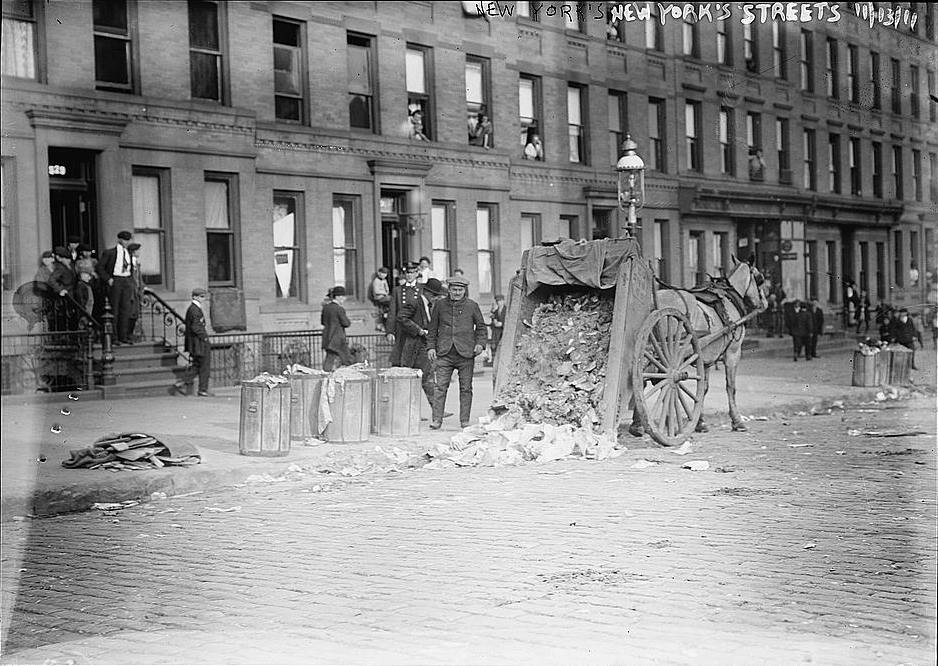
In total, almost over 2,000 workers left their jobs in retaliation, “because they didn’t like to work in the dark,” said the New York Sun, derisively. [source]
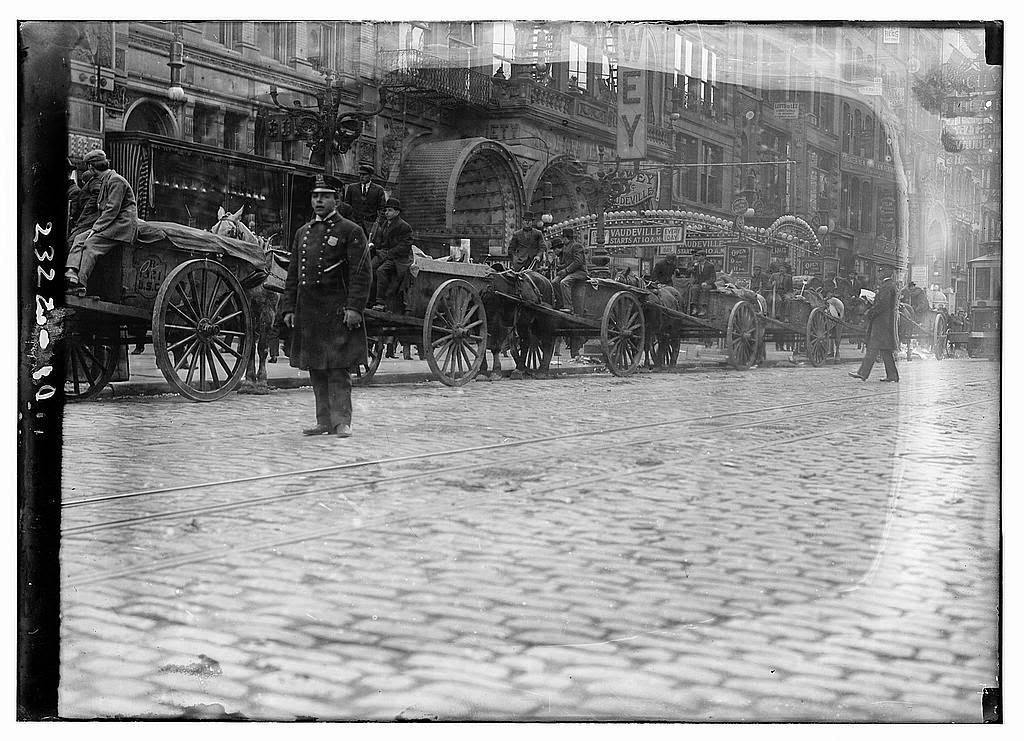
By Nov. 11, garbage was heaped along street corners, and coal ash swirled into the street, creating a blackened, smelly stew along the cobblestones.

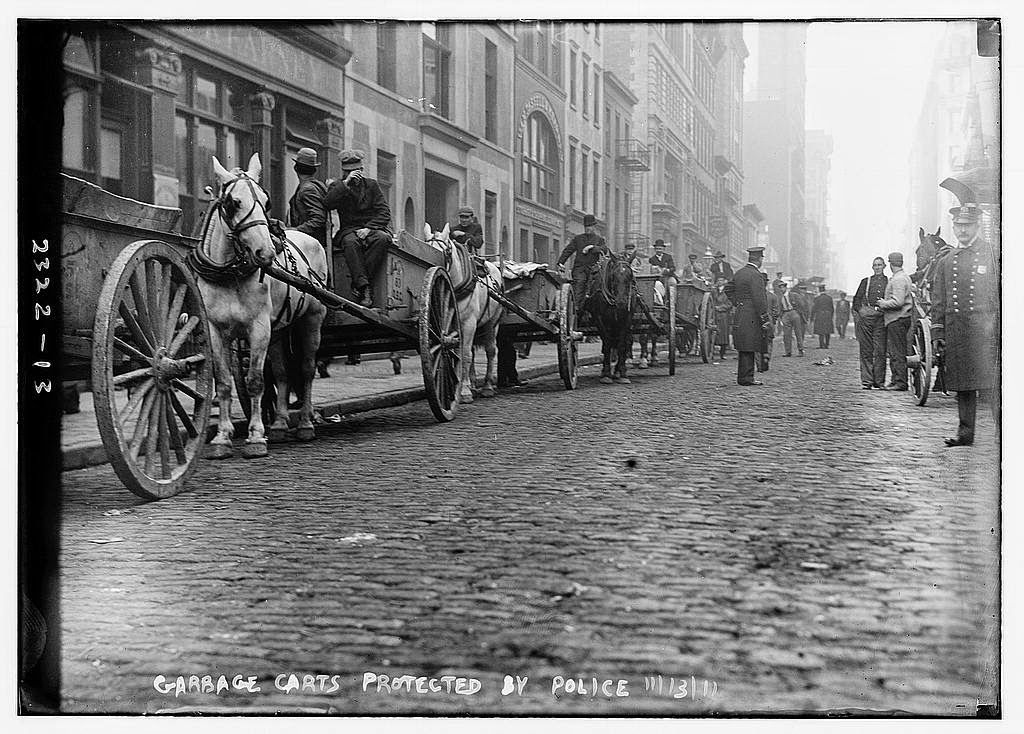
The city brought in temporary workers to carry off the more egregious piles of filth away, but harangues and violence by union protesters –“mobs assaulting and stoning drivers” — required they be protected by police.

New Yorkers had lived through such a strike before, as recently as 1907, but strikers found little public support this time around.

Newspapers, little sympathetic to the strikers, highlighted the growing threat of disease and the perceived selfishness of the workers.

“The right to strike of public employees, who enjoy the advantage of being listed in the civil service, is more than doubtful,” said the New York Times.

During bouts between strikebreakers and police, over two dozen people were injured and one man was even killed by a falling chimney.

Meanwhile, Mayor William Jay Gaynor was resolute in rejecting the cleaners demands. The efforts of the workers failed, and many went back to their jobs the next week, some heavily penalized for their participation in the strike.

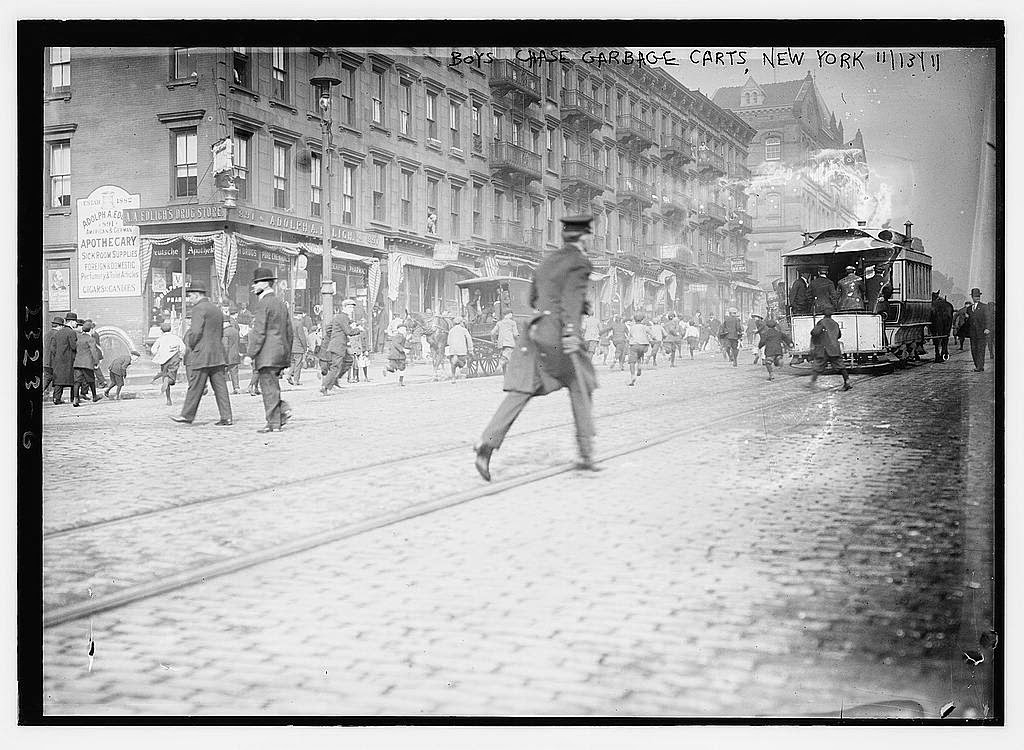
Here are a few images from those foul-smelling days. These photographs are far more pleasant to look at than they must have been to shoot:

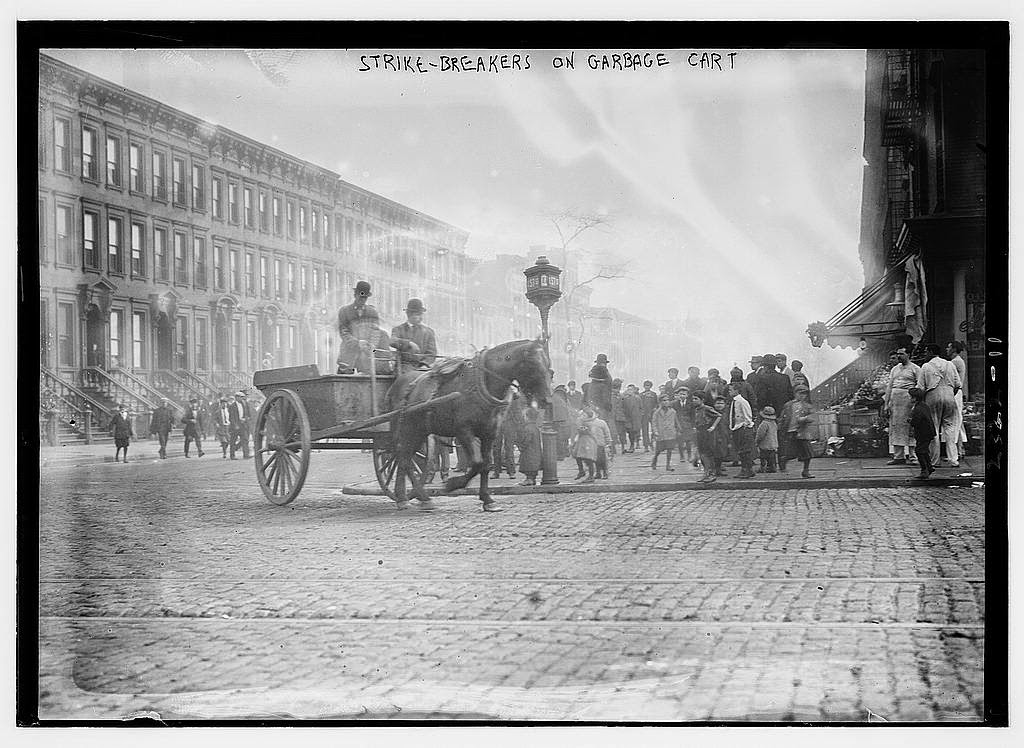
Horse-drawn garbage wagons collect trash during the four-day garbage strike.
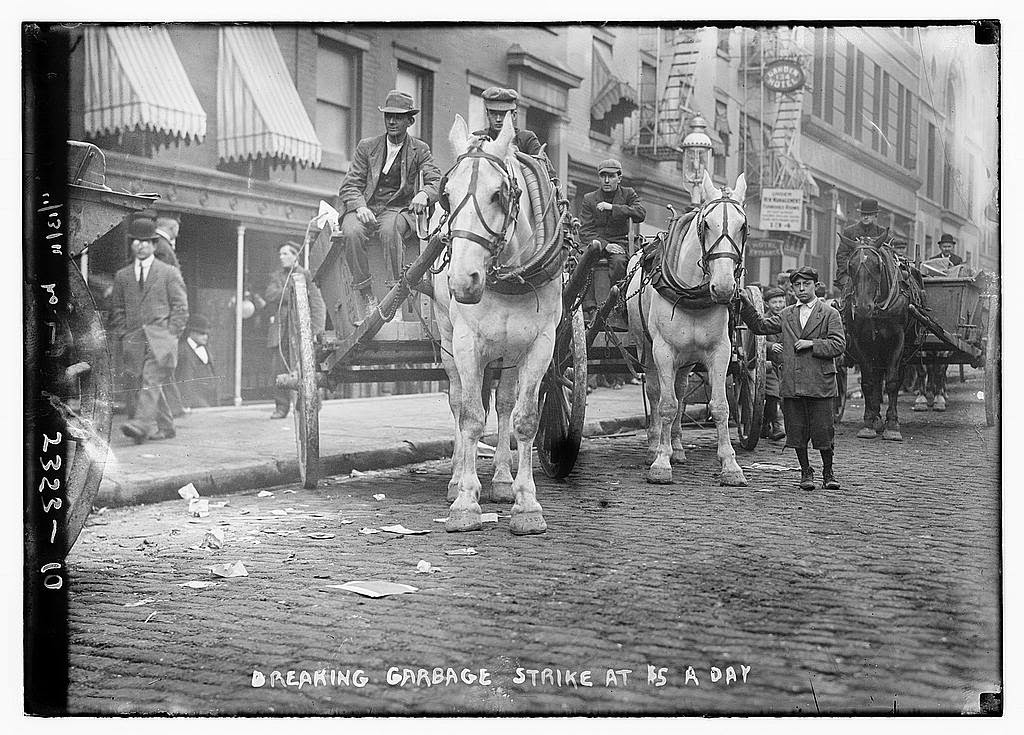
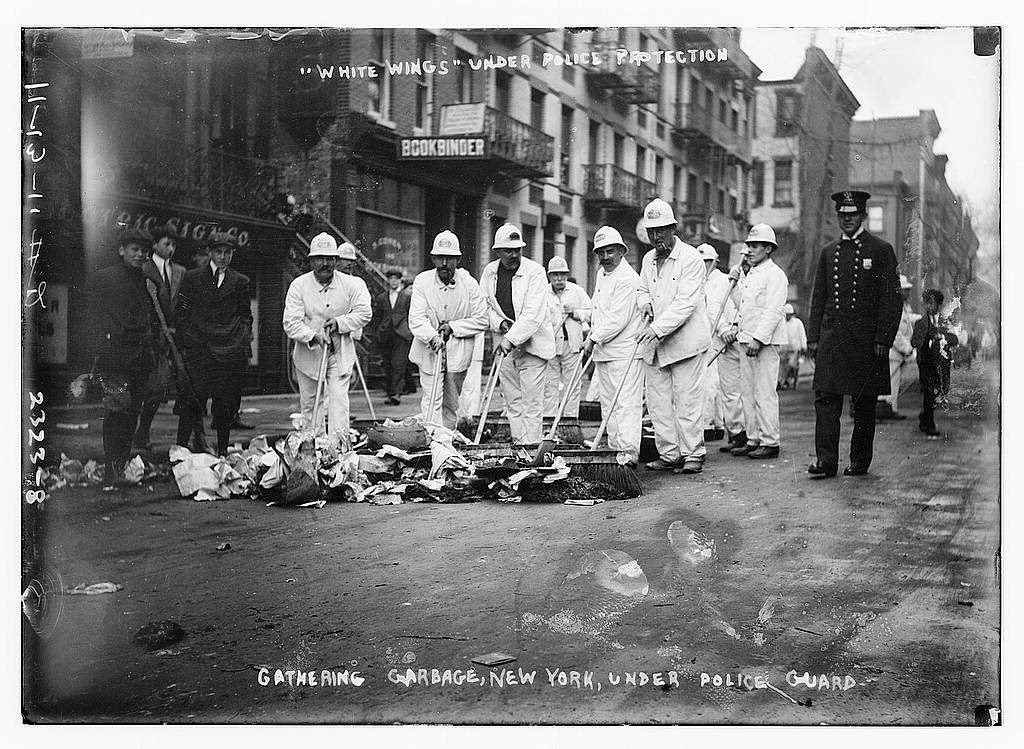
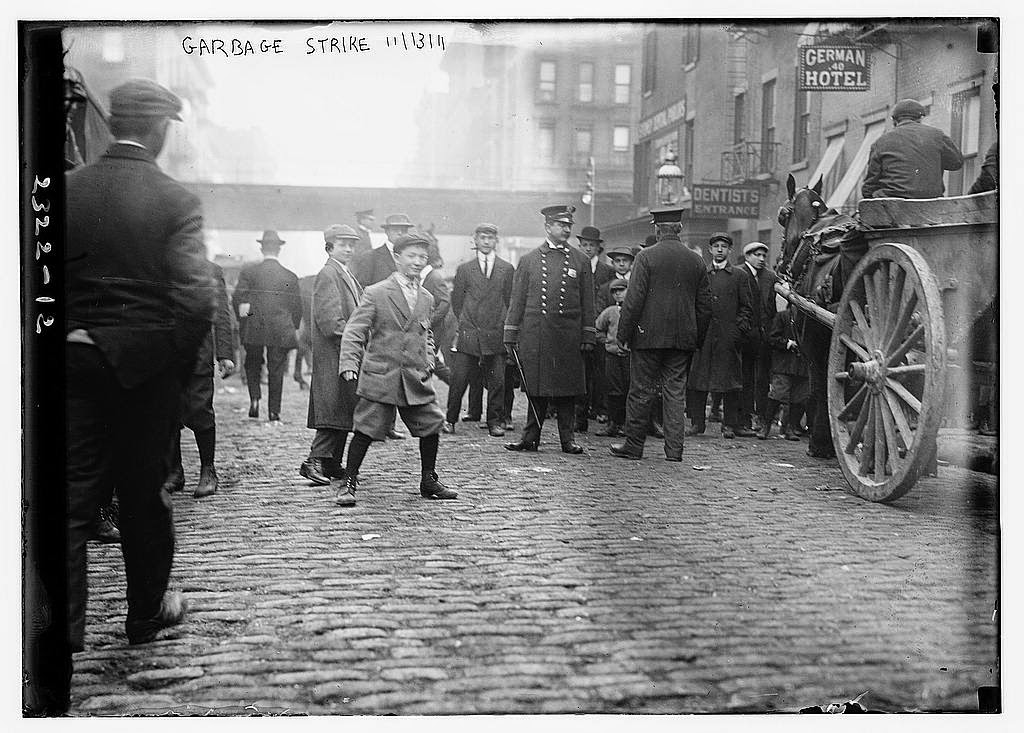
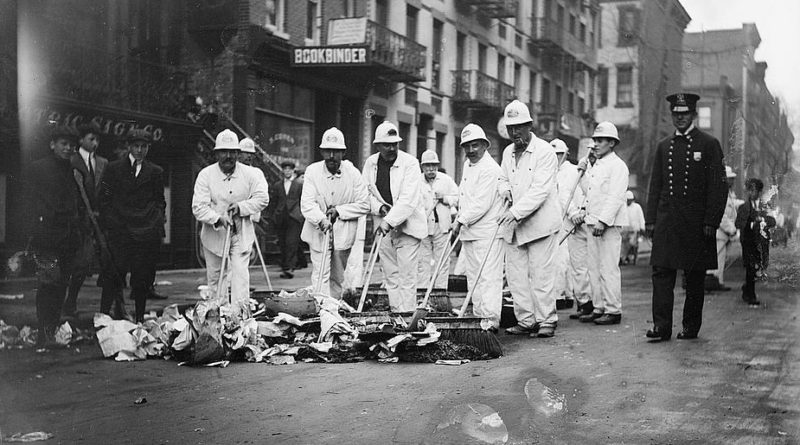
Police protection those who broke from the strikers to clean the city streets.
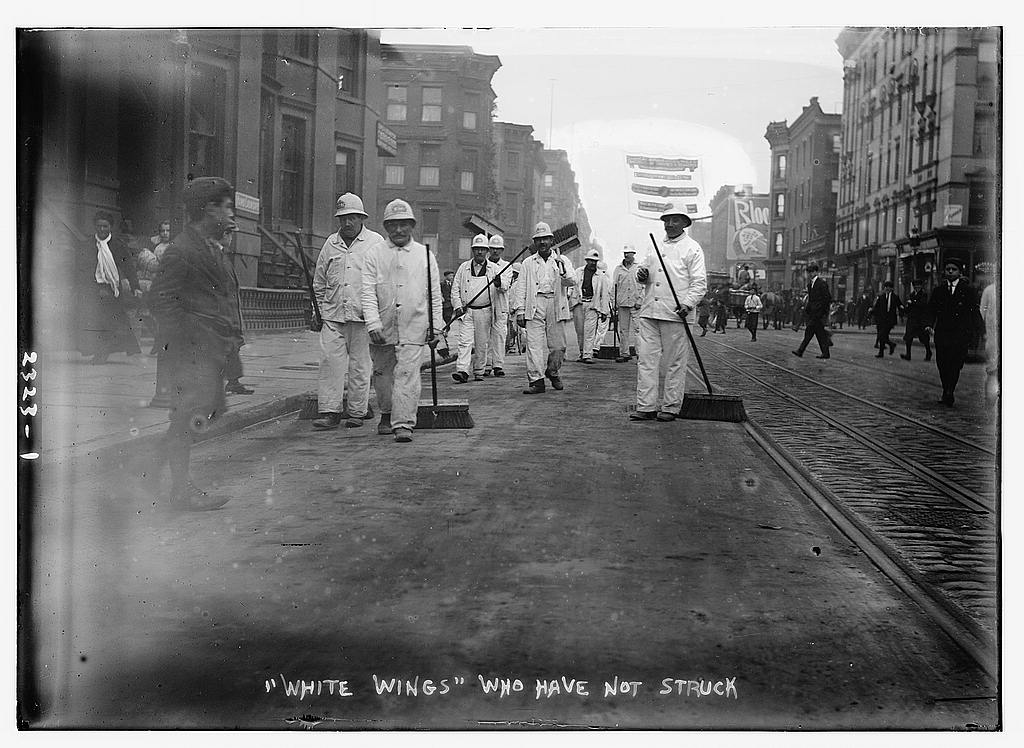
The city shipped in workers from out of town to sweep the streets during the strike
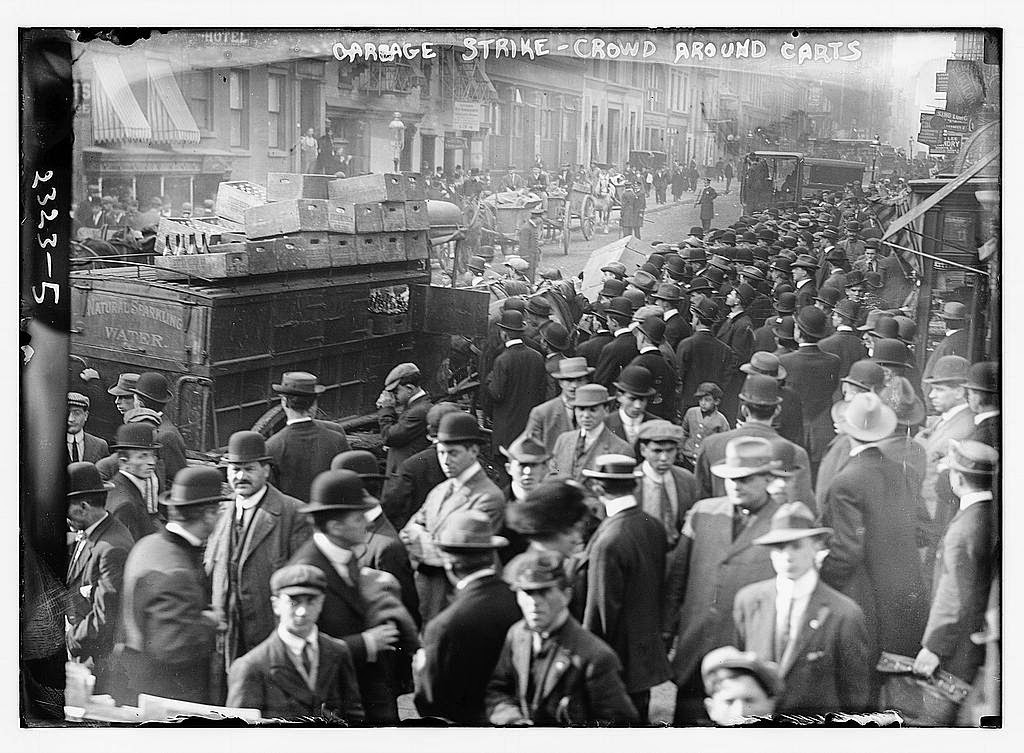
Crowds form in the streets watching the garbage carts go by. I don’t know whether these are strikers or just curiosity seekers
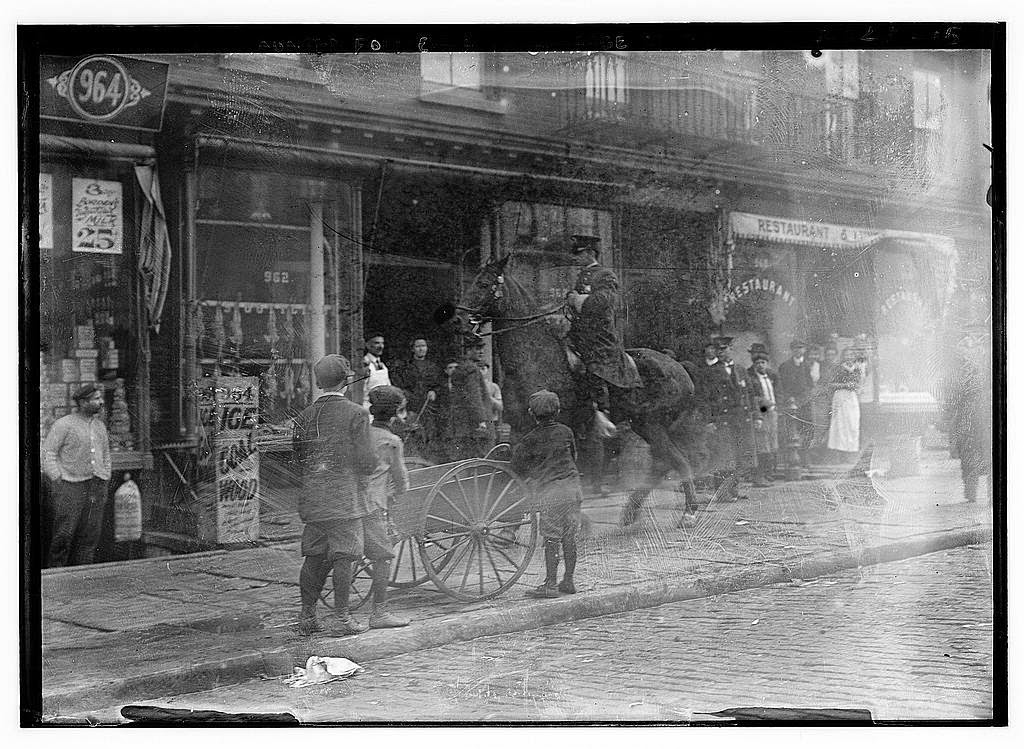
Boys captivated by the mounted police guarding the garbage carts. In the second photograph, a couple rowdy boys are actually chasing after a garbage cart.
This vehicle is pelted with stones at the corner of East 57th Street.
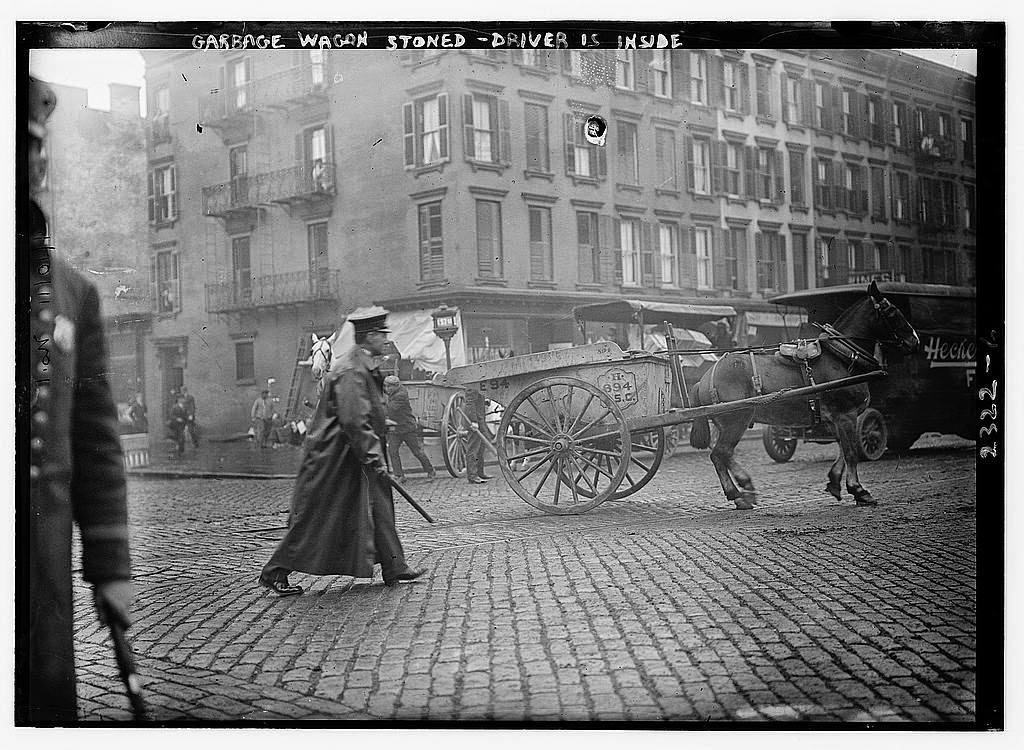
Another set of strike breakers rush by this street corner in their garbage cart.
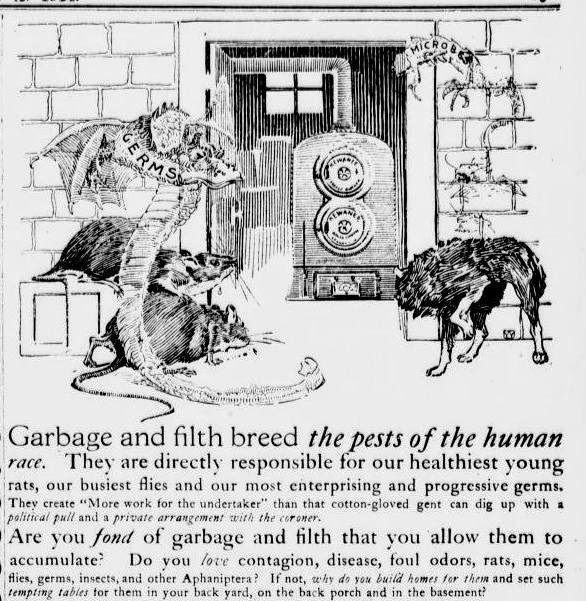
Meanwhile, a boiler company took advantage of the strike to run this grim advertisement for their garbage burners in the New York Sun.
This photo series courtesy the Library of Congress.
Categories
Health and Living Podcasts

Talking Trash: A History of New York City Sanitation

PODCAST: A history of all things trash in New York City.

Picture New York City under mountains of filth, heaving from clogged gutters and overflowing from trash cans. Imagine the unbearable smell rotting food and animal corpses left on the curb. And what about snow, piled up and untouched, leaving roads entirely impassable?

This was New York City in the mid 19th century, a place growing faster than city officials could control. It seems impossible to keep clean.

In this episode, we chart the course to a safer, healthier city thanks to the men and women of the New York City Department of Sanitation, which was formed in the 1880s to combat this challenging humanitarian crisis.

And along the way, we’ll stop at some of the more, um, pungent landmarks of New York City history — the trash heaps of Rikers Island, the mountainous Corona Ash Dump, and the massive Fresh Kills Landfill.

PLUS: We’ll be joined by two special guests to help us understand the issues surrounding New York City sanitation in the 21st century:

Robin Nagle is a Clinical Professor at NYU and the Anthropologist in Residence for New York City’s Department of Sanitation, and the author of Picking Up – On the Streets and Behind the Trucks with the Sanitation Workers of New York City.

Maggie Lee is the records management officer in the Sanitation Department, and also serves as the deputy director for Museum Planning for the Foundation for New York’s Strongest.

LISTEN NOW — THE STORY OF NEW YORK SANITATION

To get this week’s episode, simply download or stream it for FREE from iTunes, Stitcher, Spotify or other podcasting services. You can also get it straight from our satellite site.

Or listen to it straight from here:

New York Public Library
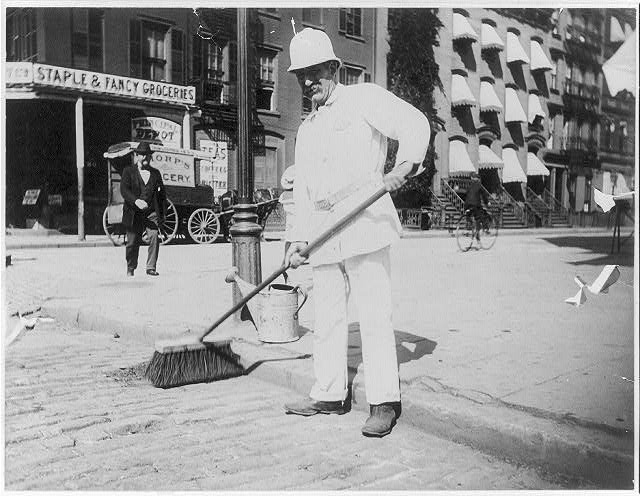
1896 street cleaner and member of Waring’s ‘white wings’, photograph by Alice Austen
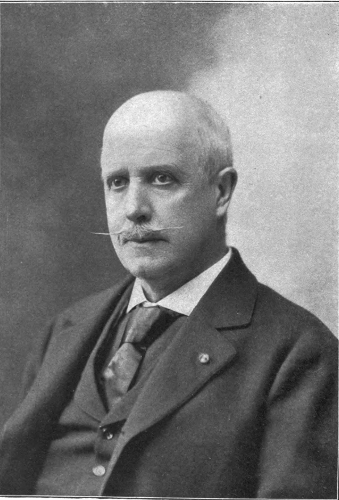
Colonel George E. Waring Jr., who changed the course of New York City life with the development of a rigorous new sanitation process in the city.
The ‘White Wings’ on parade, 1903, filmed for the Edison Company.
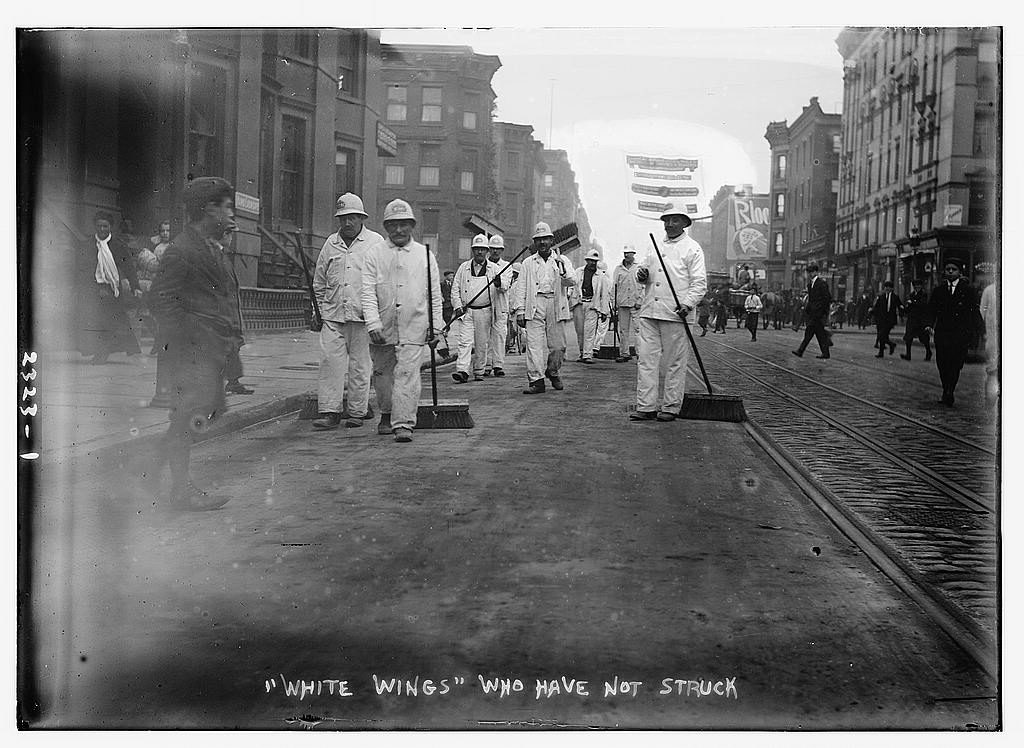
Photo shows men in white uniforms and hats with brooms in the street to sweep trash during the New York City garbage strike, Nov. 8-11, 1911. (Source: Flickr Commons project.)
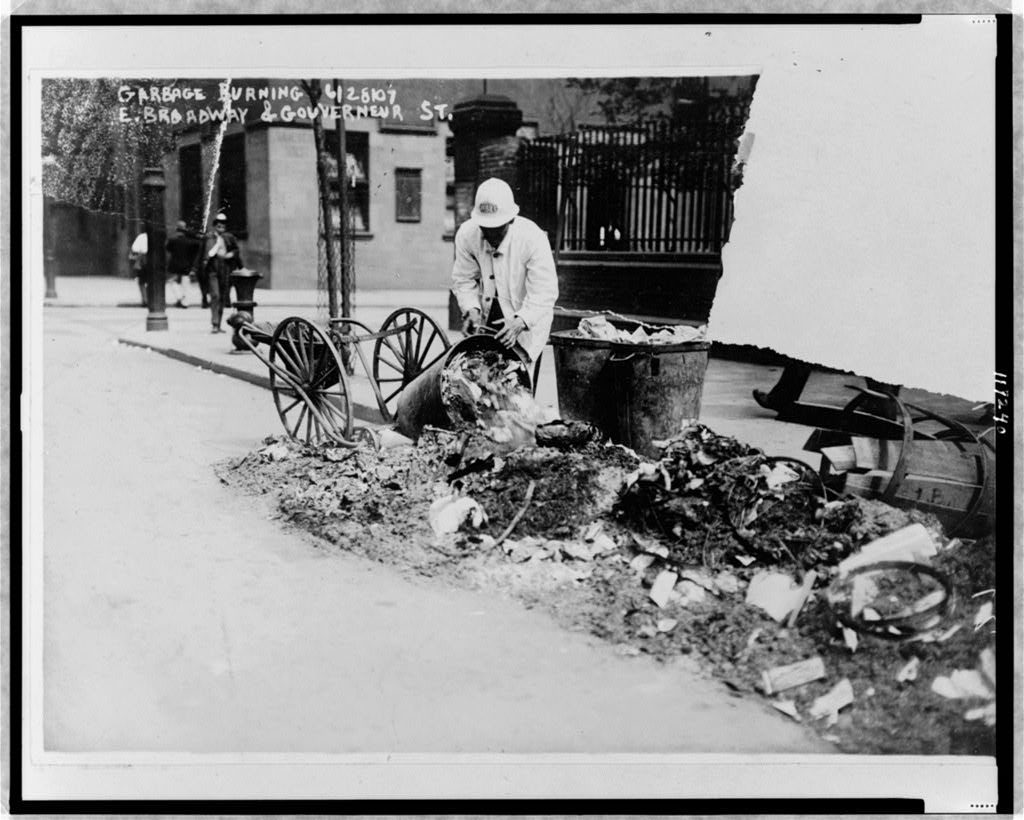
[Garbage burning at East Broadway and Gouverneur Street, New York City] Created / Published 1907 June 28. Courtesy Library of Congress
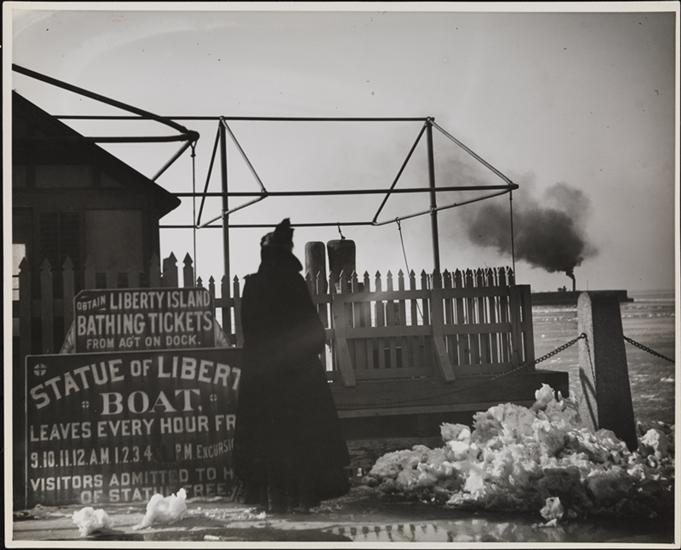
In the distance you see the incinerator located on Governor’s Island, operating at full capacity. Circa 1900. Photographer Robert Bracklow, image courtesy Museum of the City of New York.
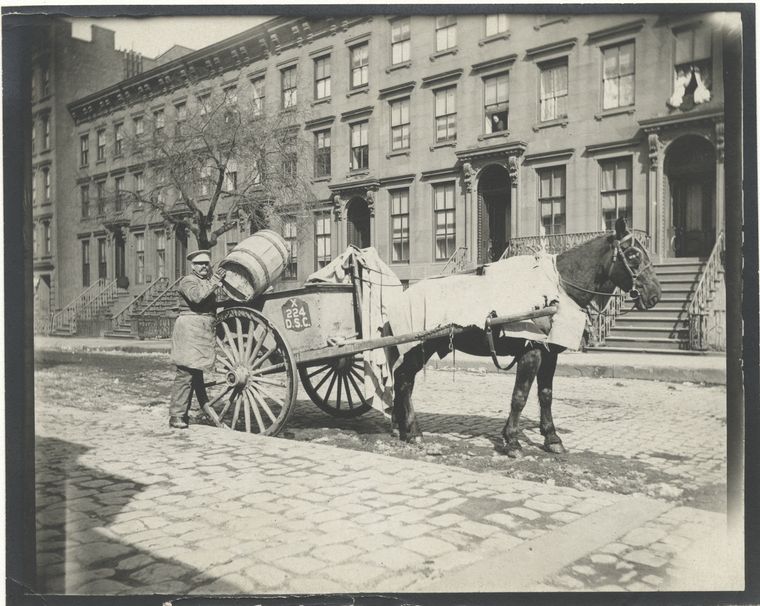
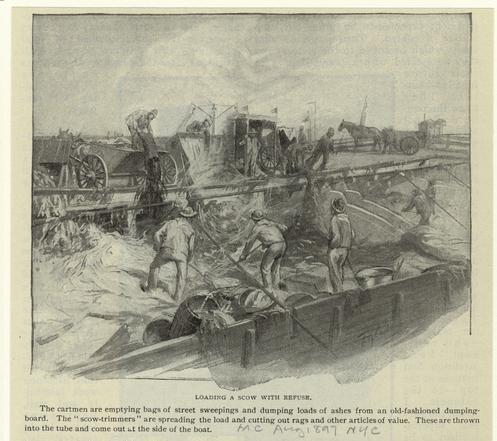
A sanitation worker carting carting away a full barrel of ash. The open cart would be filled, taken to barges, then sent to far-away dumps. In the 1910s, Brooklyn ash went to Corona.
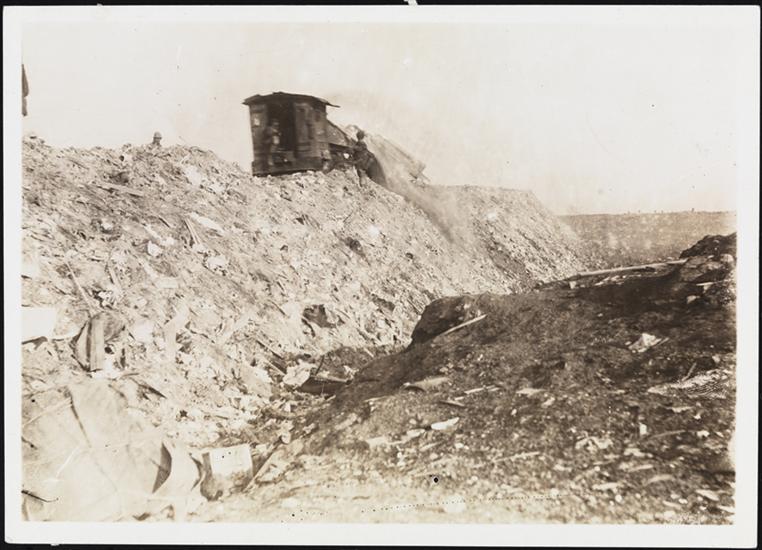
Rikers Island, 1915, a post-apocalyptic sea of trash. (Image courtesy the Museum of the City of New York)
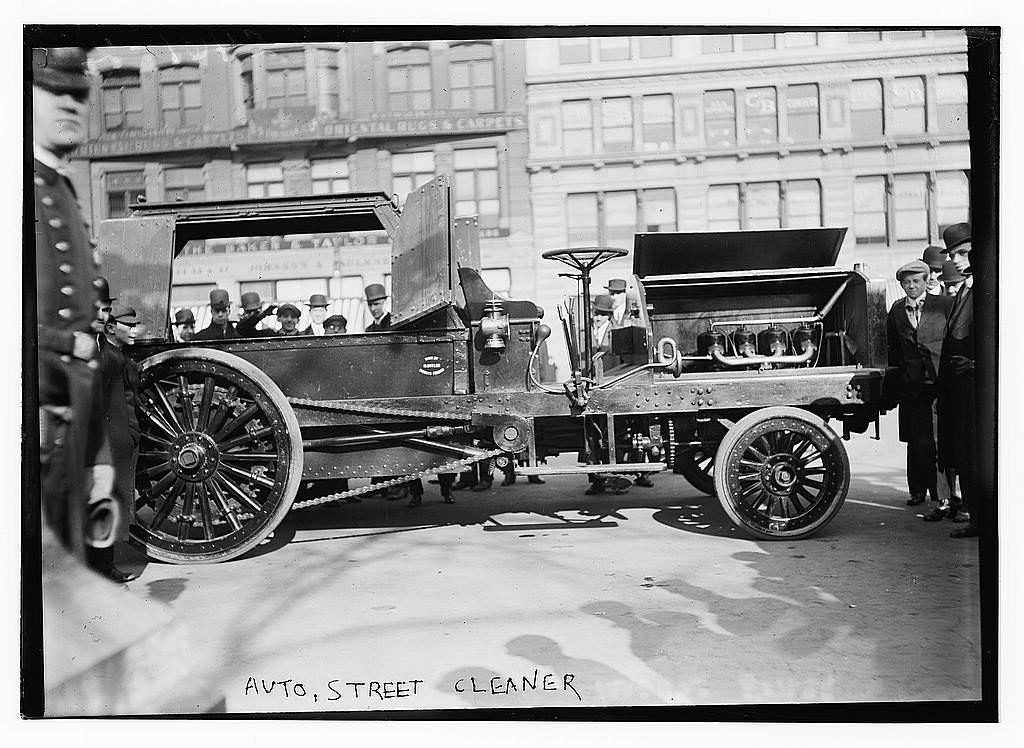
A fancy auto street cleaner, 1920. Photo courtesy Library of Congress
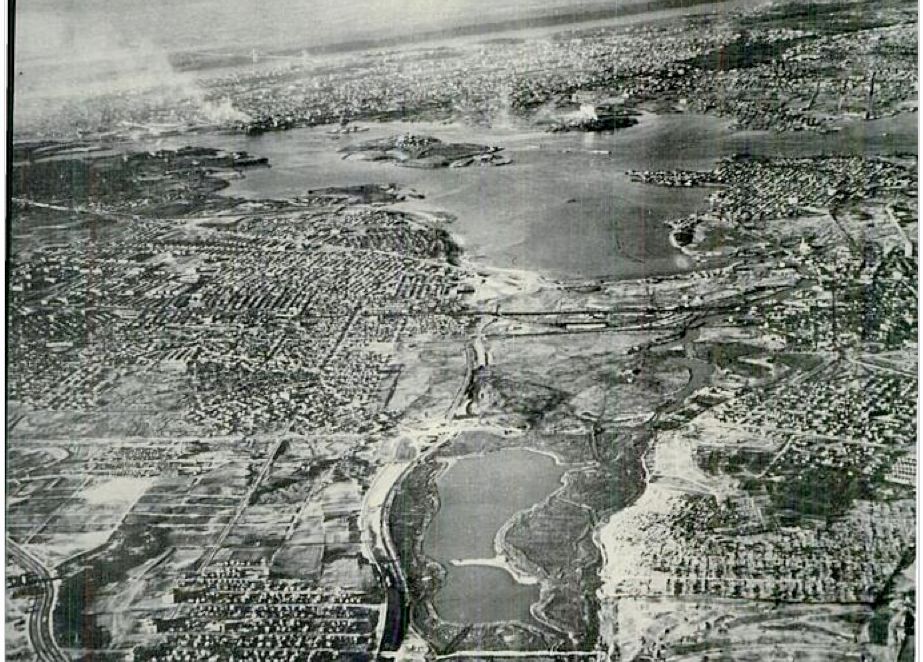
The Corona Ash Dump as seen from overhead. Rikers, also a destination for the city’s waste, can be seen in the bay. Courtesy CUNY
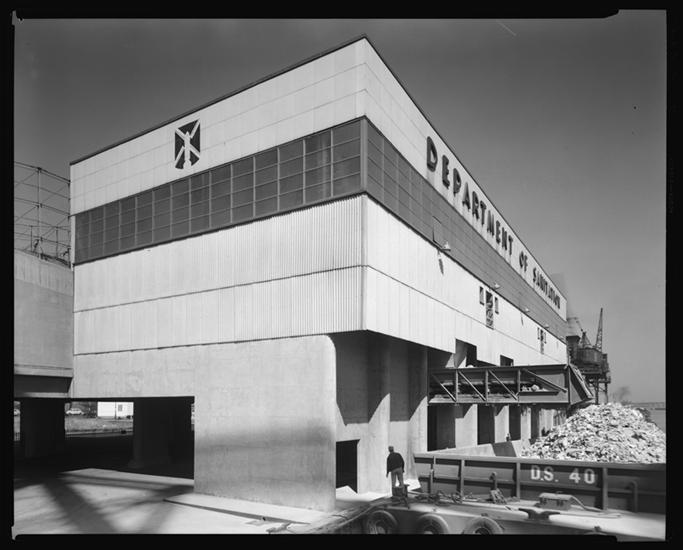
View of garbage disposal plant at the foot of 60th Street and the East River, 1946. Photo by the Wurts Brothers, courtesy the Museum of the City of New York
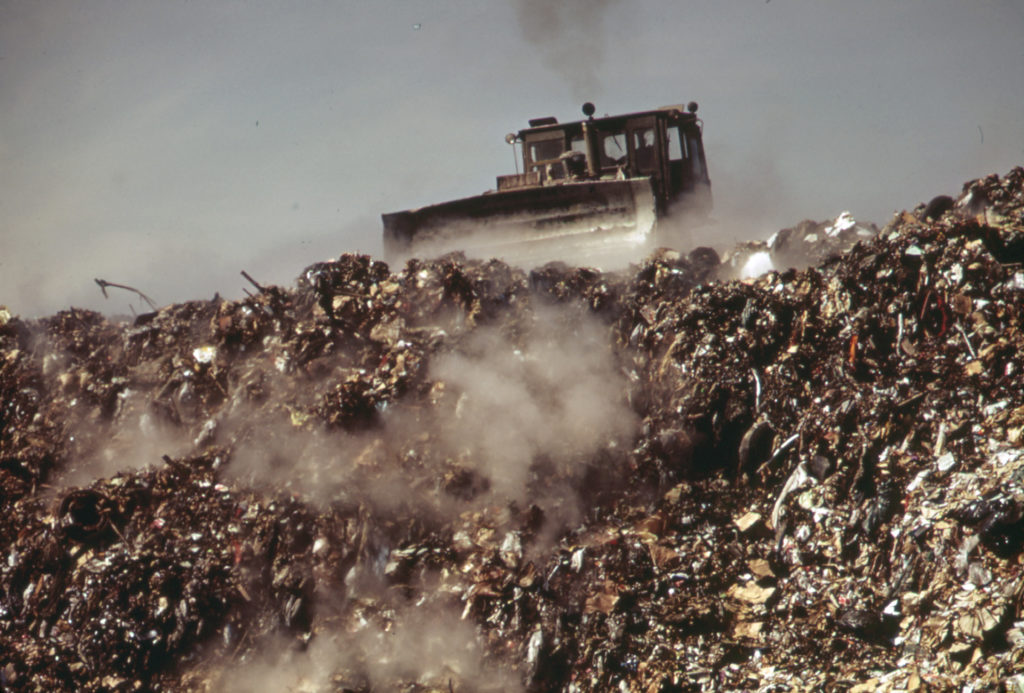
Freshkills Landfill, 1973. Gary Miller photographer
Our guest Robin Nagle giving a fascinating TED Talk on the subject!

PLACES TO VISIT

Hunter East Harlem Gallery: What is Here is Open: Selections from the Treasures in the Trash Collection” — an art show centered around pieces thrown out with the trash, which is currently running at the Hunter East Harlem Gallery at 119th and 3rd Avenue through September 14, 2019. (See some images of the exhibition below.)

Freshkills Park: See for yourself the unbelievable transformation from notorious dump to breathtaking new park

Photos by Tom Meyers

FURTHER LISTENING:

Listen to these shows in our back catalog for more information on subjects mentioned in this show —

The Blizzard of 1888 proved that New York’s fledgling Department of Sanitation had its work cut out for them.

Rikers Island had a truly unusual history that goes far beyond its current function as a controversial jail complex.

The World’s Fair of 1939 was planted atop the site of a notoriously ghastly ash dump:

FURTHER READING FROM THE WEBSITE:

Know Your Mayors: A Profile of Mayor Williams Strong

The Corona Ash Dump: Brooklyn’s burden on Queens, a vivid literary inspiration and a bleak, rat-filled landscape

The Origin of Snow Removal for All New Yorkers, Rich or Poor

Lovely Photos of the New York Garbage Strike of 1911

FURTHER BOOK READING:

Picking Up: On the Streets and Behind the Trucks with the Sanitation Workers of New York City by Robin Nagle

History of Public Health in New York City 1625-1866 by John Duffy

Fat of the Land: Garbage of New York — The Last Two Hundred Years by Benjamin Miller

Gotham Unbound: The Ecological History of Greater New York by Ted Steinberg

Noxious New York: The Racial Politics of Urban Health and Environmental Justice by Julie Sze

__________________________________________________________________________

The Bowery Boys: New York City History podcast is brought to you …. by you!

We are now producing a new Bowery Boys podcast every other week. We’re also looking to improve and expand the show in other ways — publishing, social media, live events and other forms of media. But we can only do this with your help!

We are now a member of Patreon, a patronage platform where you can support your favorite content creators.

Please visit our page on Patreon and watch a short video of us recording the show and talking about our expansion plans. If you’d like to help out, there are six different pledge levels. Check them out and consider being a sponsor.

And join us for the next episode of the Bowery Boys Movie Club, an exclusive podcast provided to our supporters on Patreon.

We greatly appreciate our listeners and readers and thank you for joining us on this journey so far.

Categories
Planes Trains and Automobiles

New York City’s “stripped and abandoned” car crisis

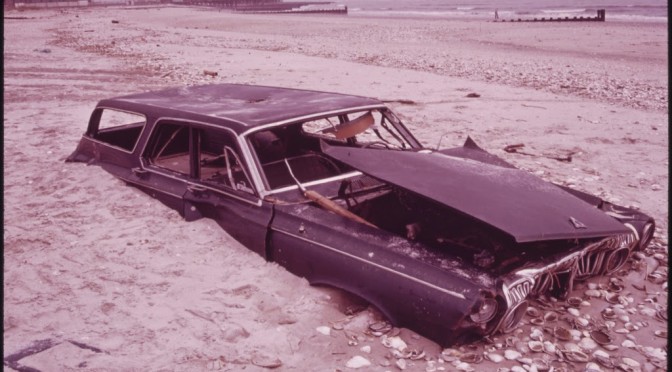
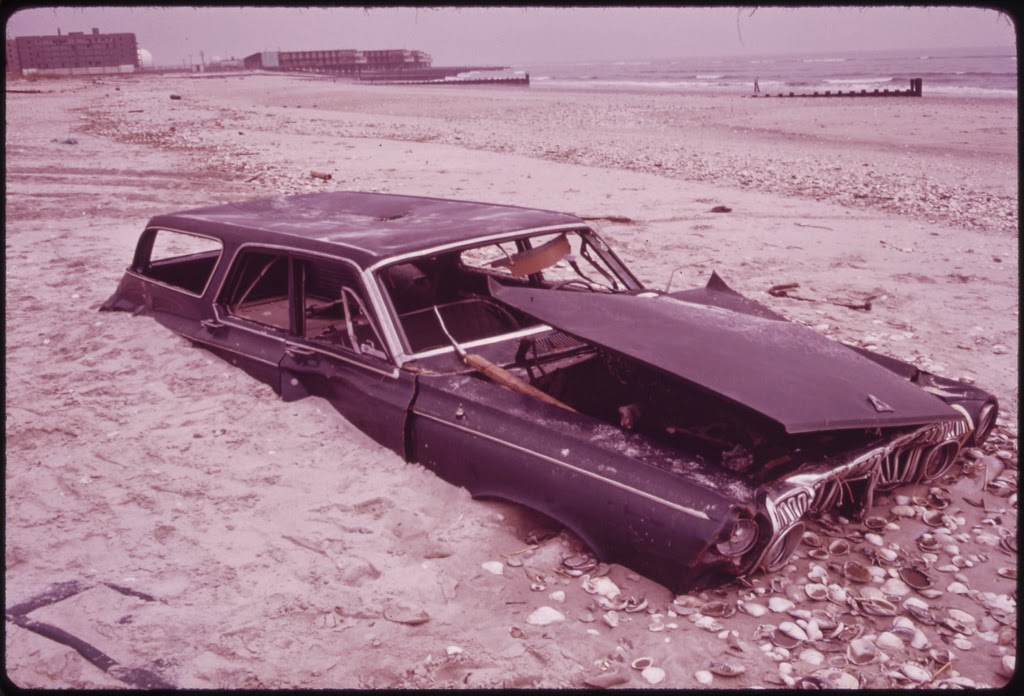
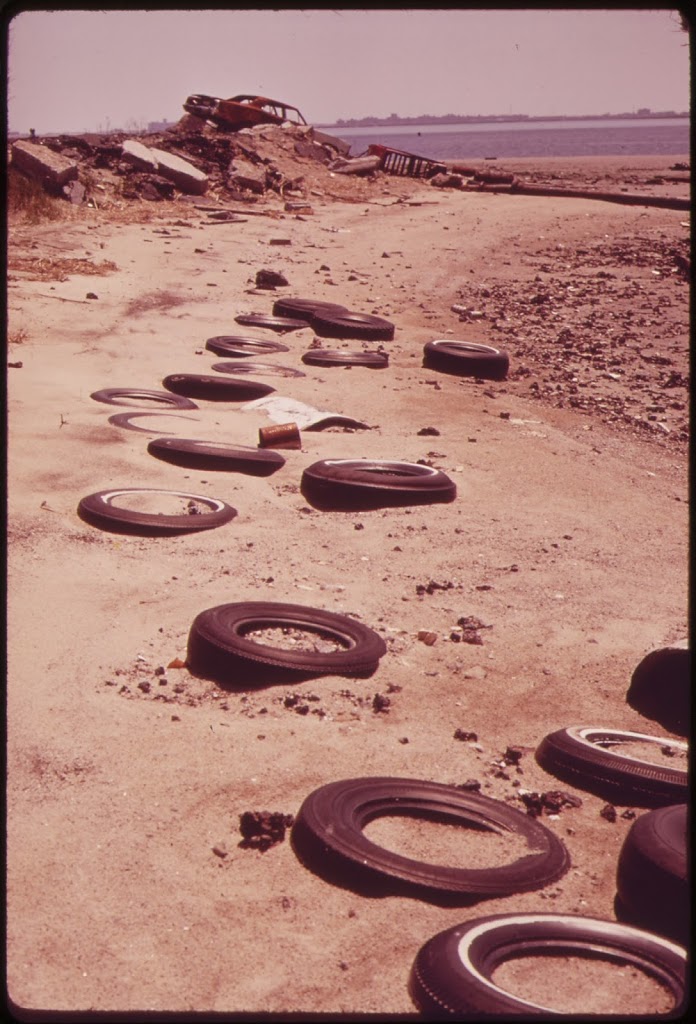
The fate of an automobile at Breezy Point, 1973 (Courtesy US National Archives)

The abandoned car, that most dramatic symbol of urban blight, is a sight that has pretty much vanished from most New York City streets. (Most, not all.)

In a city refitted for the automobile by the mid 20th century, people just began leaving their cars everywhere, either vandalized beyond repair or too expensive to tow when their vehicles became unusable. These husks of metal were scavenged for parts, then left to rust, the city’s sanitation crews unable to keep pace of the growing problem.

I recently found an intriguing article in New York Magazine from 45 years ago, titled “Stripped and Abandoned,” outlining the causes of the city’s sudden population of vehicular remains:

“Last year, by Department of Sanitation records, 31,578 cars were abandoned in New York City. Some were wrecks; some were stolen, then stripped; some were involved … in minor highway mishaps which caused their owners to leave them — to expert instant strippers, who evidently abound.”

By 1969, the problem had grown so unwieldy that the city hired third-party contractors to take care of most of it, but its budget for such removal would only shrink as the city entered the hard-knock 1970s.

Within a few years, the city would not even bother to remove such blight from certain neighborhoods.

“At any one time,” wrote author Fred Ferretti in 1969, “there are about 2,000 cars strewn about the highways and local streets.”

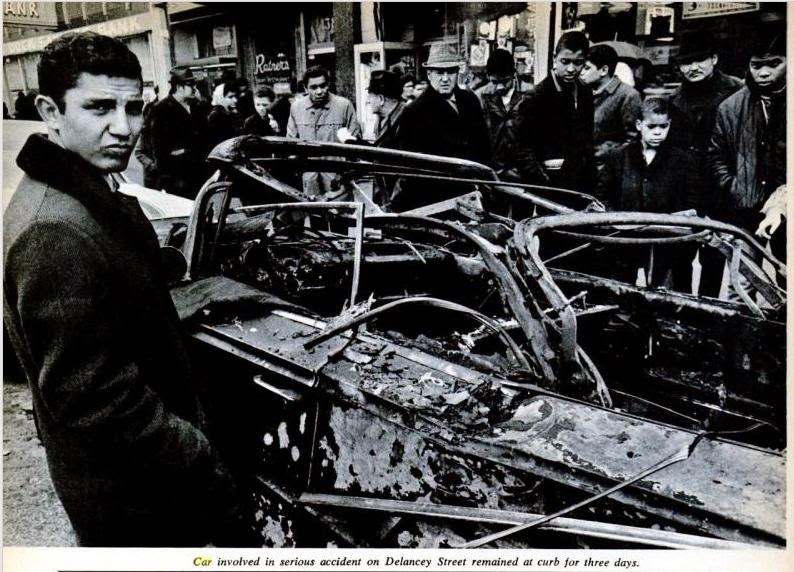
Below: From the New York Magazine article, the fate of a vehicle in Clinton Hill, Brooklyn, and on Delancey Street in the Lower East Side (photos by Robert D’Alessandro):

In 1970, standing in stark contrast to a city of polluted, automotive remains, one artist at the very first Earth Day celebration in Union Square attempted to address the problem.  A crushed sedan sat alongside the environmental merriment with a sign: “57,742 Cars Removed in 1969; 21,635 Removed in 1970, as of April 21.”  The New York Times would later note a total of 72,961 abandoned cars in 1970. [source] [source]

They weren’t just eye sores. What wasn’t pilfered or siphoned out was left to rot in the elements, leaking oil, attracting vermin.

New York City was only one problem spot within a new American crisis, with millions and millions of cars across the country already overfilling scrap yards. Here, however, it was a harbinger of hard times on the way.

“Everywhere you look, there are abandoned cars, stripped and junked,” said one resident of Brownsville, Brooklyn, returning to his deteriorating neighborhood in 1970.

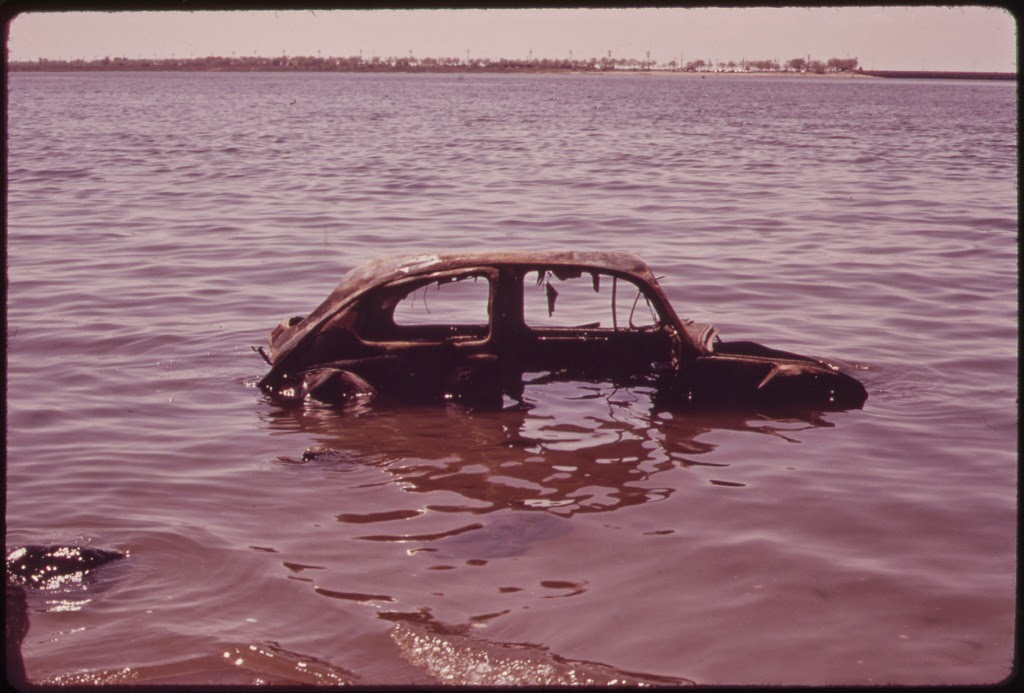
A car almost completed ingested by Jamaica Bay, 1973  (Courtesy US National Archives)

Abandoned vehicles became the New York Sanitation Department’s biggest issue in the 1970s, although by the new decade, there was some improvement. According to a New York Times article from 1981:

“Total abandoned-car collections declined from more than 79,000 in 1978 to 33,112 last year and to 14,900 in the first half of this year, officials said. Robert Hennelly, chief of cleaning operations, said he thought the drop was ”perhaps because the cost of cars has gotten so high that people are holding on to them longer.”

Some cynically still considered the abandoned vehicle to be a recognizable mark of New York City, even in the 1980s, a sort of native animal.

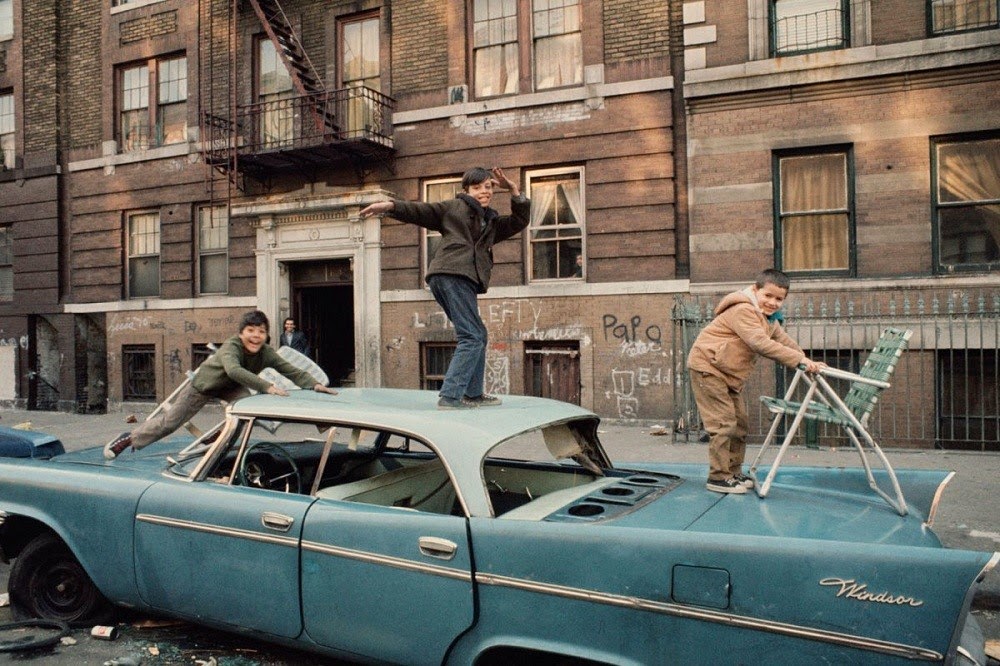
Not that an abandoned car couldn’t have some useful purpose, as this picture by Camily Jose Vergara illustrates. (Click here for more of his terrific photography)

With the general infrastructural improvement of the city during the 1990s, the beast had receded somewhat from view in most neighborhoods.

There are still abandoned cars galore — here’s the city’s current policy for reporting derelict vehicles — but few are so unscrupulously picked clean or left to decay into a rusty shell.

Below: As with the others above, Jamaica Bay 1973, near JFK Airport (US National Archives)