Eleven breathtaking views of the New York Herald Building, one of midtown Manhattan’s earliest tourist attractions

Click into the images within this post for a more closeup view!

When the extravagant James Gordon Bennett Jr. decided to move the offices of the New York Herald from grimy, old Park Row to the frenzy of uptown Manhattan, he wanted something spectacular and eye-catching.  As we mentioned in our newest podcast on the history of Herald Square, Bennett went the opposite direction of newspaper publisher Joseph Pulitzer, who remained on on Park Row and put his publication in the tallest building in the world (the New York World tower, completed in 1890).

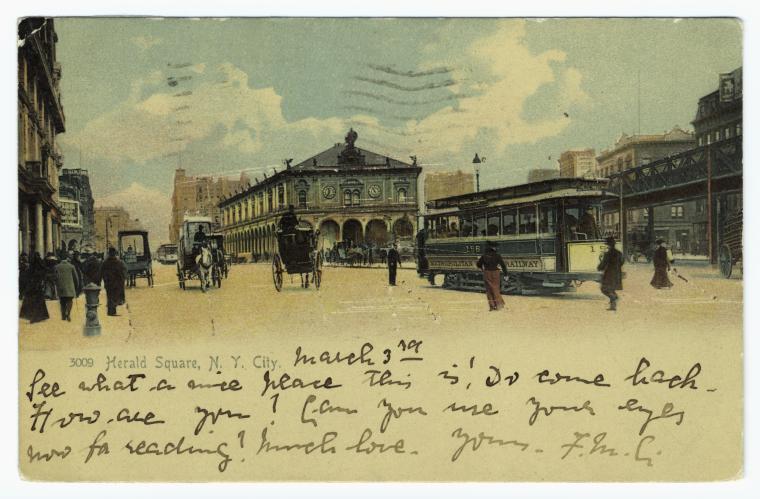
Bennett’s New York Herald Building, completed in 1894, sat at 35th Street between Sixth Avenue and Broadway, on the north side of the square his building would soon give its name. He wanted the structure to align with the theaters and hotels of the area; as designed by Stanford White, the New York Herald Building doesn’t tower over the neighborhood.

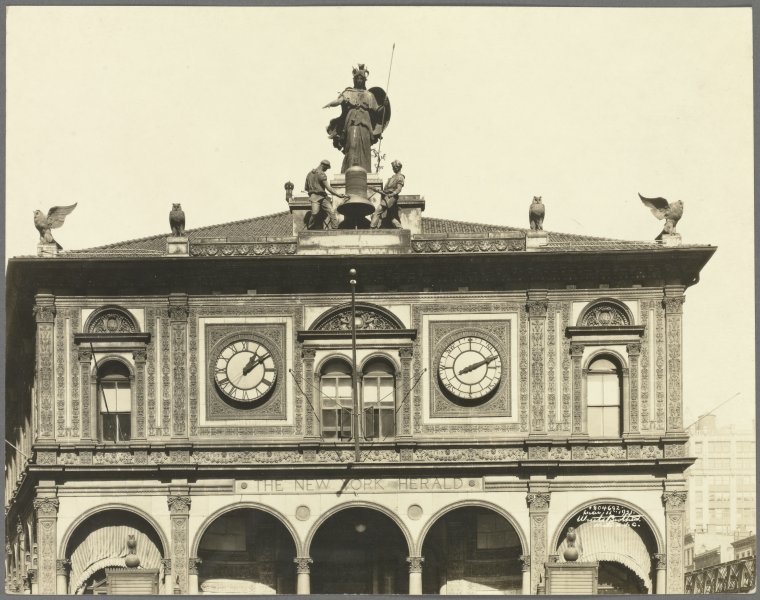
He wanted the newspaper to be essential to the rhythm and energy of this bustling intersection. It does so with its mysterious and fanciful ornamentation, its spooky owls, its ornate clock tower and its mechanical bell-ringers.

Below: the New York Herald Building, at 35th Street, between Sixth Avenue and Broadway, a frilly Italian-style structure at the nexus of a growing New York in the 1890s. [LOC]
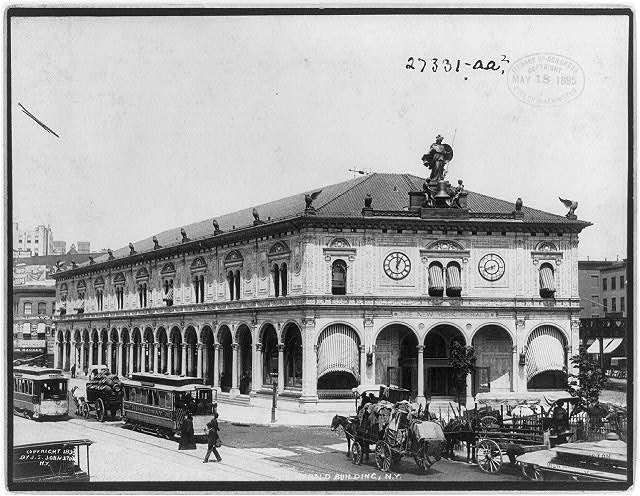
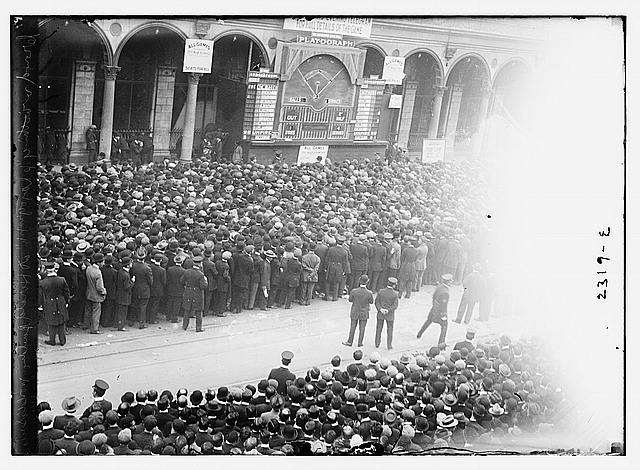
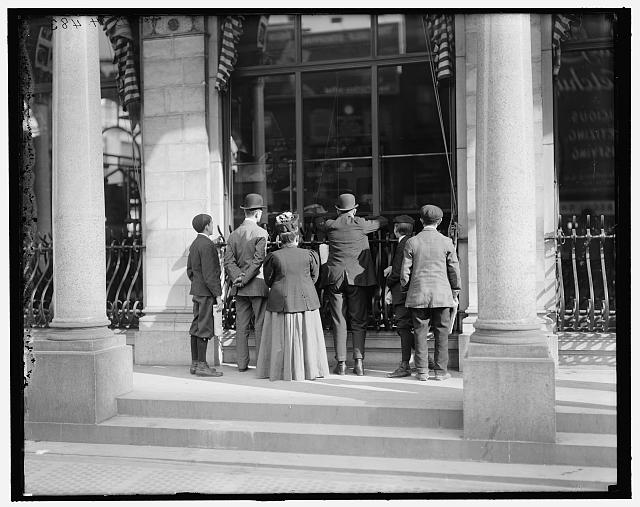
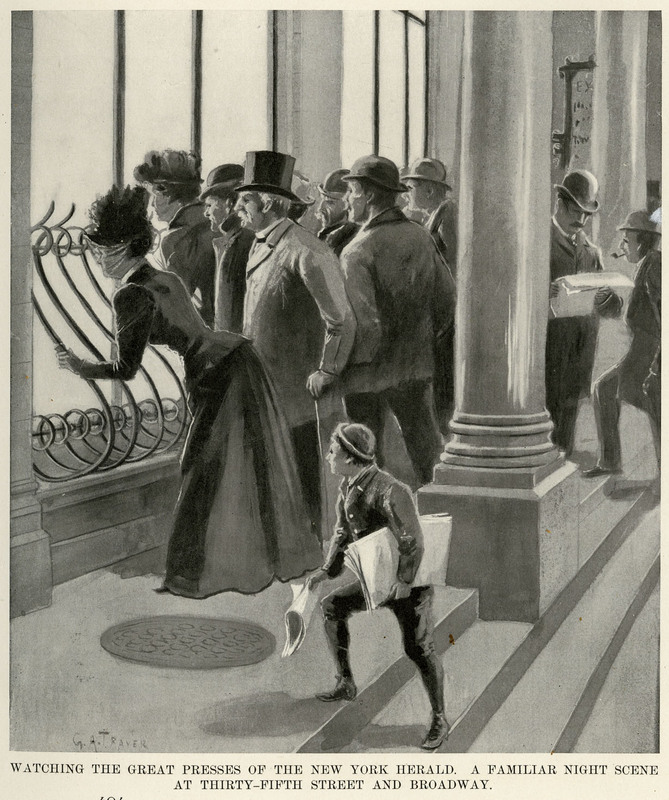
But the building became a component of the square with its open windows displaying the printing presses inside. Visitors would stand gawking as the presses furiously went about print the late-day editions. In the era before radio and television, the results of sporting events would be displayed on a billboard or “Play-o-Graph” that would attract thousands. It would be here that thousands of New Yorkers would gather to get the results of the World Series between the Red Sox and the Giants — occurring just uptown at the Polo Grounds!

The New York Herald Building became one of midtown Manhattan’s first big draws for regular New Yorkers and visitors to gather, get news, set their watches, dazzle at modern technology and ogle at the curious mix of high and low culture that sped through here. One decade later, Times Square would bring the same kind of excitement to another Broadway intersection.

Here are some additional views of the Herald Building, many romantic, most unbelievable, especially if you consider what sits there today:

Thousands of men gather to watch the results of the 1911 World Series — between the New York Giants and the Philadelphia Athletics — displayed on a “Play-o-Graph” at Herald Building. Sports results were telegraphed from inside the building, and a mini baseball diamond was regularly updated, mirroring the real time action. [LOC]
Spectators watch the Herald presses in action. {LOC}
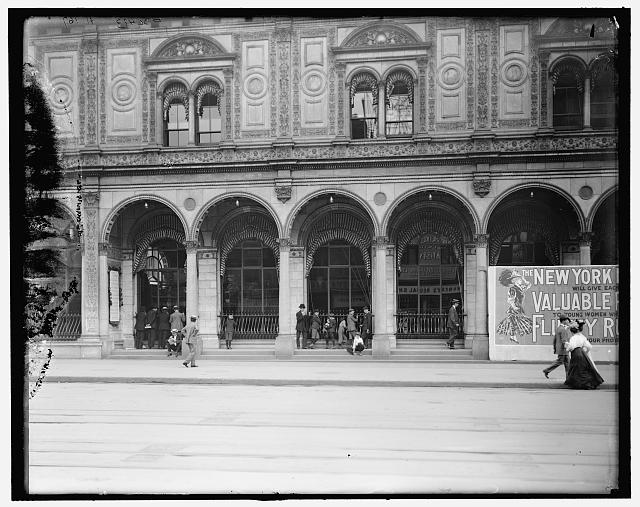
From the Appleton publication The New Metropolis, 1899 (courtesy CUNY)
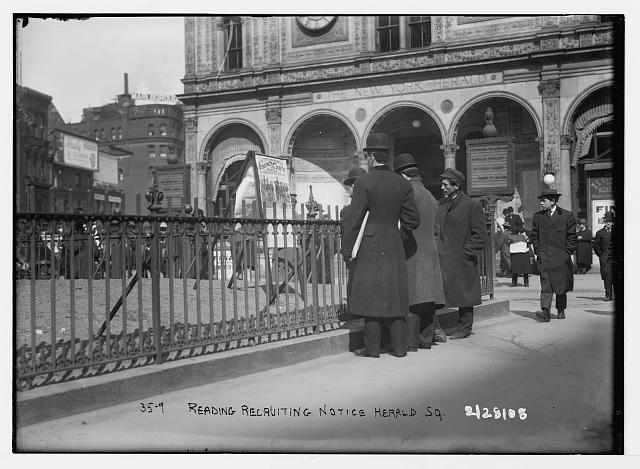
The square in front of the Herald Building would also be used for immediate announcement, often taken right from the telegraph. These men are reading a military recruitment advertisement. [LOC]
A closeup of the ornate clock, with the goddess Minerva, its two bell ringers Scruff and Guff, and the series of owls perched at various spots around the building. From March 1921 (Courtesy NYPL)
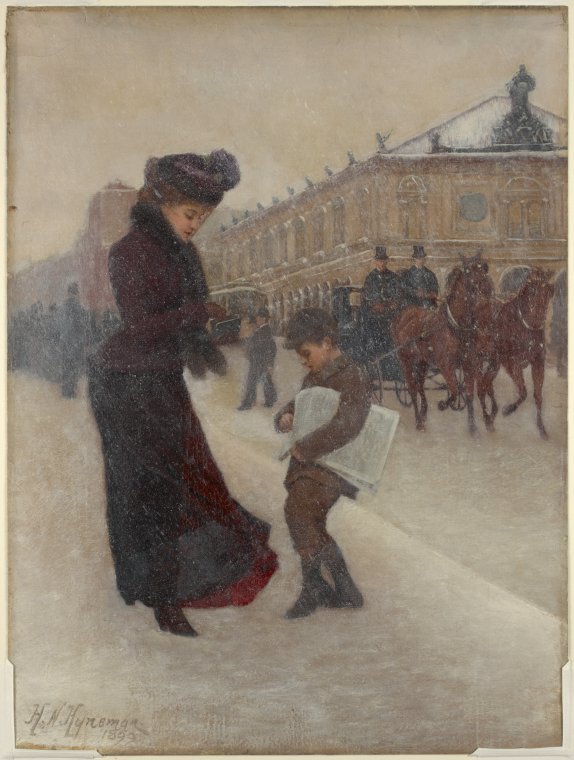
A painting by Herman Hyneman from 1899, depicting a Herald newsie and a customer in the snow. [NYPL]
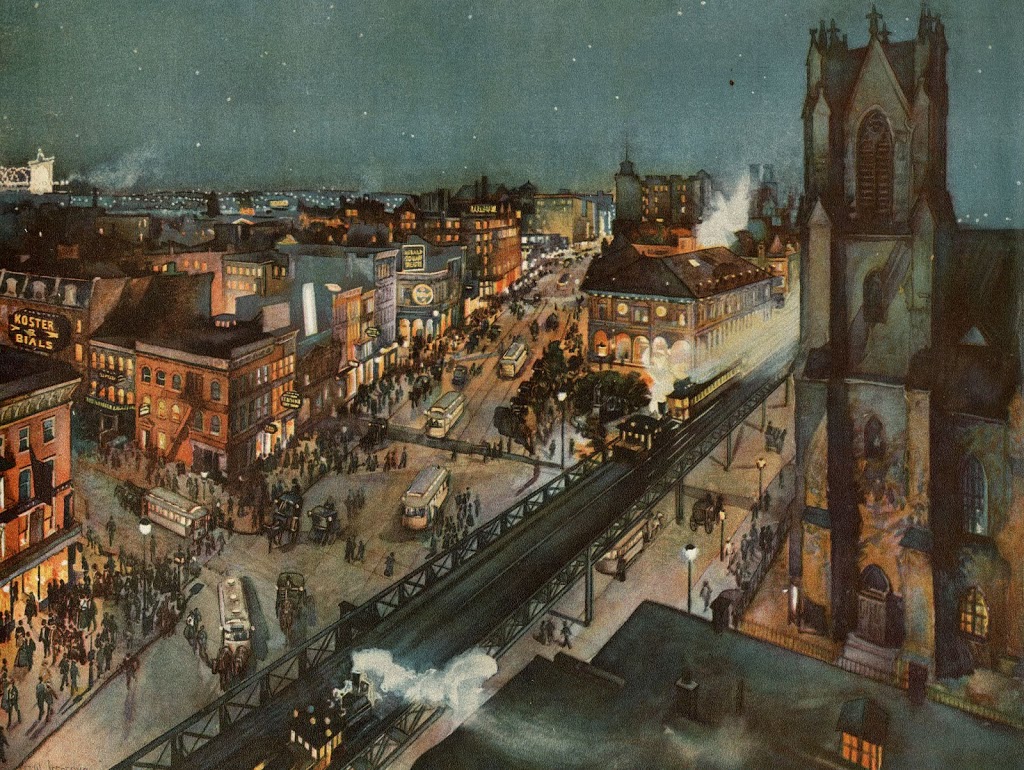
Also from The New Metropolis, an owl’s-eye view of Herald Square, from 1899.  The caption: “This is a vibrant reproduction of a color print by Canadian-born artist Charles William Jefferys (1869-1951) who once worked at the New York Herald. The Broadway Tabernacle Church, the 6th Avenue elevated train, the Herald Building and several theatres, including Koster and Bial’s, are depicted. The streets are teaming with cable cars, horse drawn vehicles and pedestrians.” Courtesy CUNY
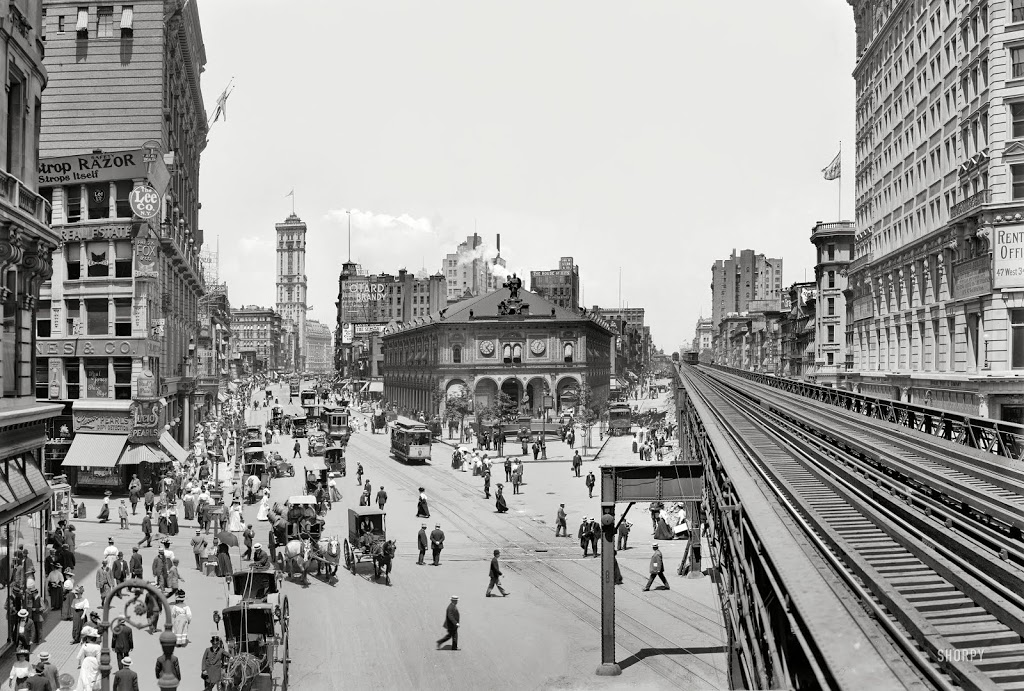
And finally, an overhead view of the entire square. This is an image that was cleaned up and published by the great photo blog Shorpy. Click into the picture to see a rather magnificent view of the surroundings. Trust me, you may waste five minutes just looking at this one….
Categories
Uncategorized

The Royal Tourist: Queen Elizabeth visits New York City

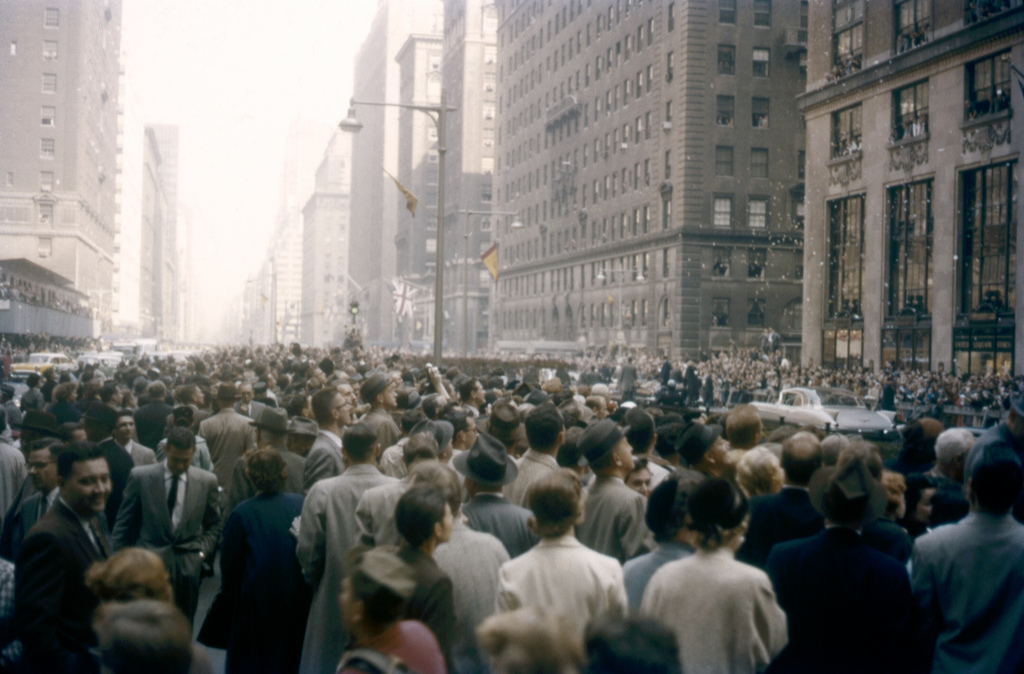
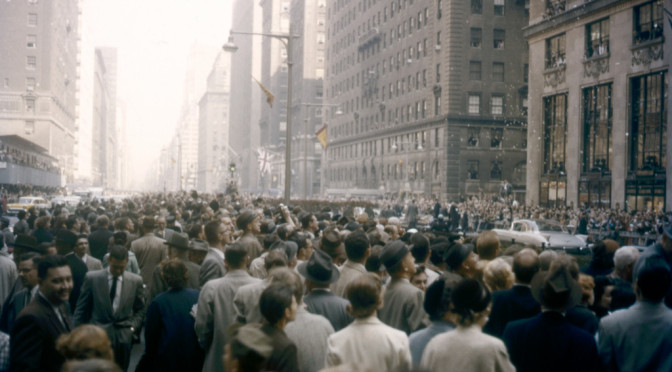
New Yorkers greet the Queen with a tickertape parade in 1957. Courtesy jeffs4653/Flickr 

What do you buy a queen on her Diamond Jubilee, celebrating 60 years on the British throne?

Well, most royal figures are quite difficult to buy for, but luckily, Queen Elizabeth has already revealed her preference in local department stores.

For back in 1976, the woman who never goes shopping found herself one late afternoon perusing the merchandise at Bloomingdale’s department store.

Queen Elizabeth has been to New York three times during her sixty year reign over the Commonwealth.

In a couple cases, she came specifically to address the governing body at the United Nations Headquarters but managed to squeeze in a few extra activities each time, befitting her status as one of New York’s wealthiest, most high profile tourists.

She first arrived in 1957, via Staten Island, riding over to Manhattan in an Army ferryboat. In the harbor, she caught sight of the newly built replica of the Mayflower (the Mayflower II), fresh from its completed voyage retracing the Pilgrims’ course over the Atlantic.

The Queen was practically wide-eyed during the ticker tape parade in her honor, with over a million New Yorkers lining the streets to see the young monarch, from City Hall to the Waldorf-Astoria.

Her favorite moment arrived after the UN session, when she was whisked to the top of the Empire State Building to gaze out of the hazy city.

Like any great New York trip, she was out too late, arriving at Idlewild Airport at 2 in the morning for her trip home.

She shared her thoughtful take on her experiences here: “The mental pictures of New York are nearer reality than those of any other city.”

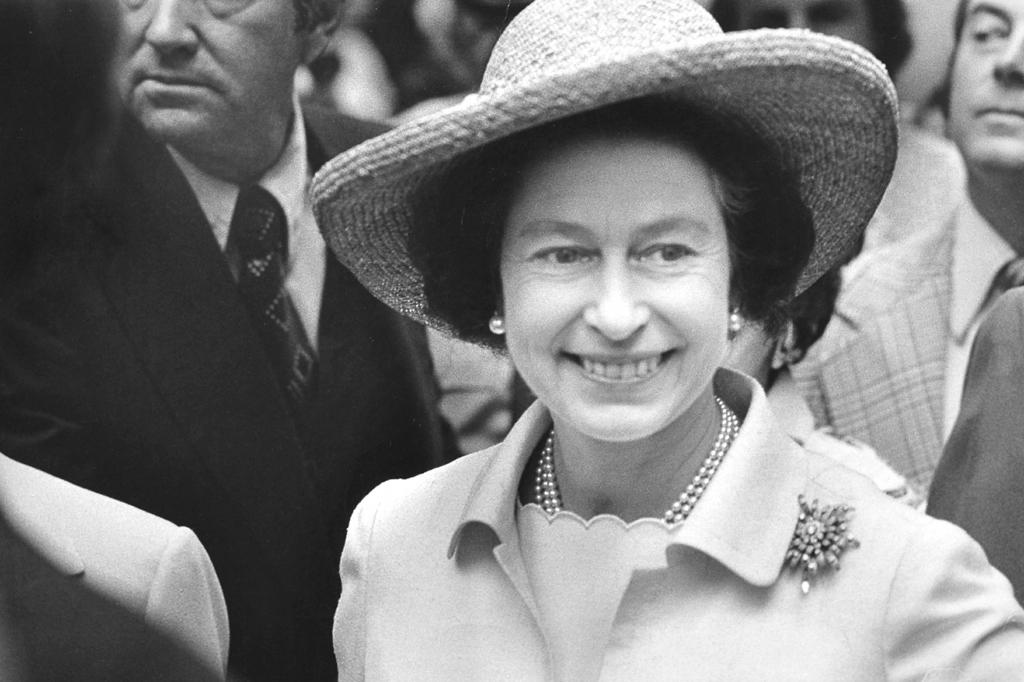
Below: Queen Elizabeth on her second visit to New York, 1976, courtesy Madison Guy/Flickr

In 1976, she and Prince Phillip returned the city, a bit older and less desirous of scaling skyscrapers this time around.

As part of the city’s bi-centennial celebrations — and perhaps inspired by the Mayflower on her previous visit — the Queen decided to participate in a little historical reenactment herself.

Most famously, the Queen graced the steps of Trinity Church to receive back rent owed the crown — 279 peppercorns. (I wonder where they found peppercorns in 1976 Manhattan, this being the days before Whole Foods?) A bronze plaque presently marks the spot at Trinity where she accepted the peppercorns.

After a luncheon at the Waldorf (“relaxed, animated and fairly hungry”), the royals fit in a couple unusual stops.

The first was a spot of afternoon tea at the Morris-Jumel Mansion, accompanied by the Daughters of the American Revolution. Afterwards, they sped downtown for a tour of Bloomingdale’s, not only stopping traffic, but reversing it, to allow the Queen to exit her vehicle from the right side.

She quietly moved from floor to floor, admiring the many displays of products of British make, particularly the pottery and furniture. She was also greeted to a private fashion show, Her Majesty led through a room of mannequins garbed in the latest stylish trends from 1976.

Along the way, a few American designers made appearances to greet Queen Elizabeth, including Calvin Klein.

What accounts for such an unusual detour in the Queen’s itinerary?

Apparently, bedazzled by her 1957 trip, she wanted to do as New Yorkers do. Or, as a representative of Bloomingdale’s remarked, “we thought — and the Queen agreed — that it would be a very American experience for her to go amidst all the crowds and just pretend she might be shopping.” [source]

If the entire event seems a tad surreal to you, this was then reinforced by the presentation of a Sioux peace pipe to the Queen, meant to “symbolize the peace that has existed between Great Britain and the United States.”

This would be her lasting memory of New York for 35 years, until 2010, when she returned again for a few hours to address the UN and to visit Ground Zero.

Given the sobriety of her visit, she did little sightseeing but braved the 100-degree weather with her trademark stolid grace.