Categories
Holidays Newspapers and Newsies

How New York newspapers covered the first Labor Day — September 5, 1882

Clothing cutters, horseshoers, shoemakers, upholsterers, printers, house painters, freight handlers, cabinet makers, varnishers, cigar makers, bricklayers and piano makers.

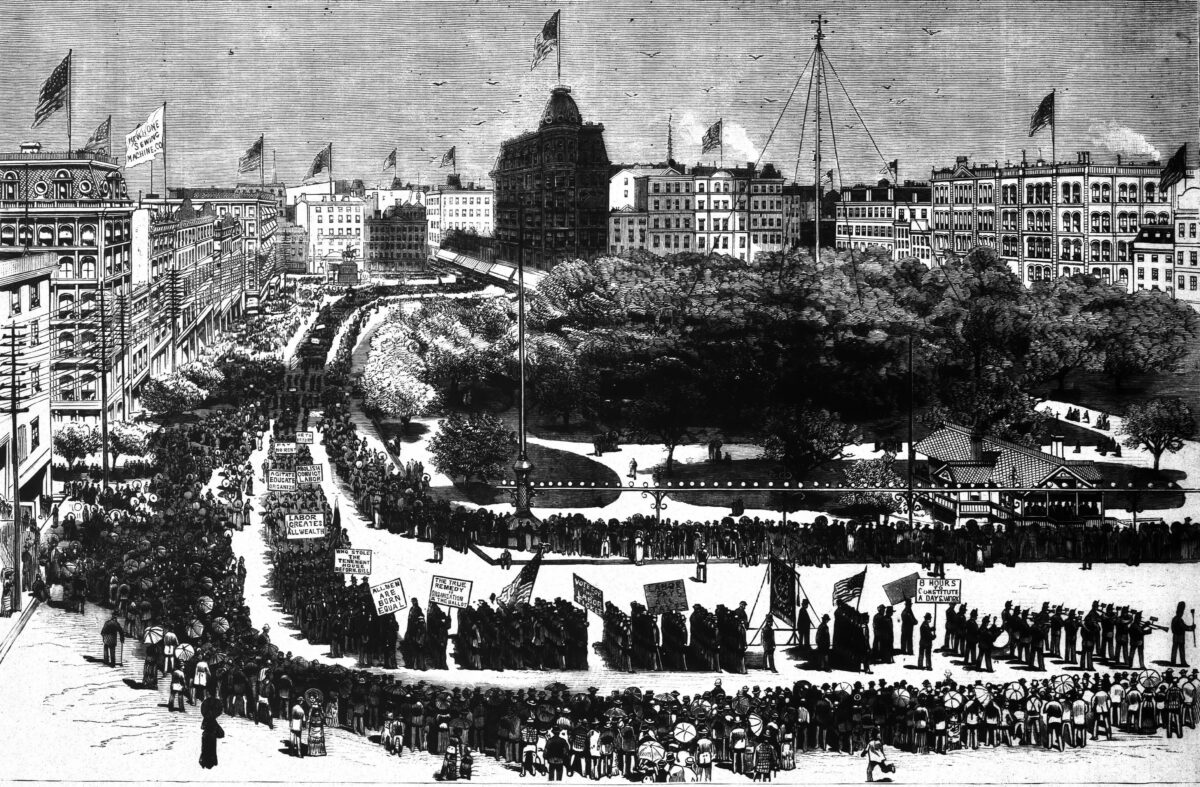
The first American Labor Day began on September 5, 1882, with 10,000 workers from a wide variety of occupations circling Union Square, then parading up to the area of today’s Bryant Park. (A picnic ‘after party’ of sorts took place at a park at today’s Columbus Avenue and 92nd Street.)

Individual workers organizations had taken to the street before, sometimes violently. But this peaceful protest, this public solidarity, took the issues of New York laborers to the heart of the city in a way that could not be ignored.*

*New Yorkers got the Labor Day idea from Canada. Read more about the differences between May Day and Labor Day in this article

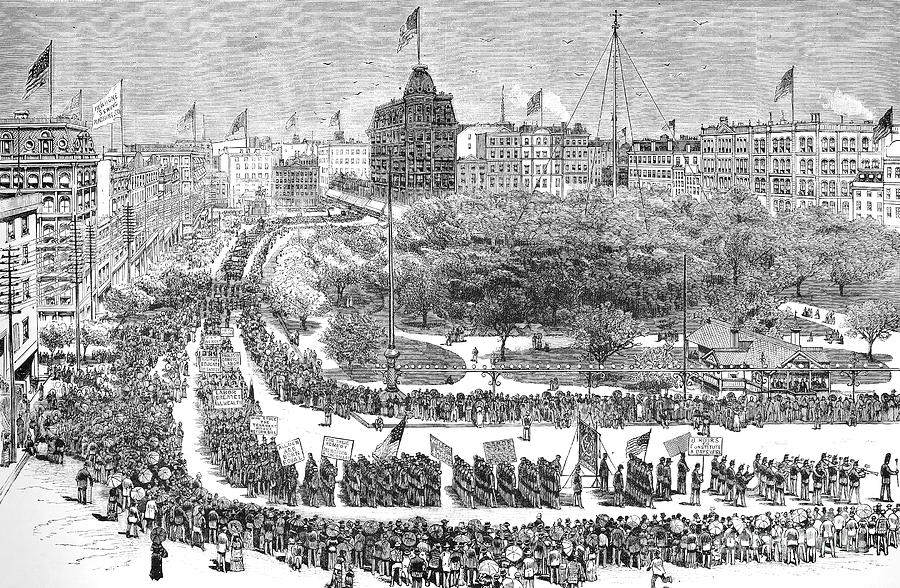
Illustration of the first Labor Day parade around Union Square, 1882
We take it for granted today. Labor Day is no more than a day off for most people today.

But looking at the original press notices from newspapers of the day (from the following day, September 6, 1882) suggest an event certain New Yorkers recognized as monumental.

Others considered it trivial, a nuisance or even a dangerous gathering of malicious intent.

Union Square would continue to be the location of Labor Day festivities for decades afterwards. The image below is of a parade from 1909 (courtesy LOC):
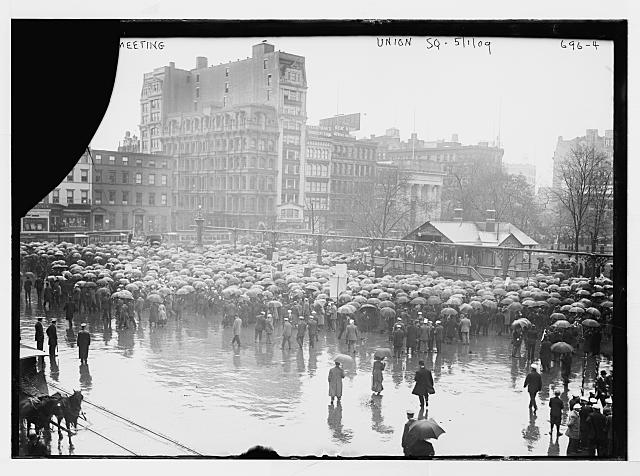
The New York Tribune begins nice enough. “The men who took part in the labor parade generally appeared to be persons of no small intelligence.” The paper’s vitriol was saved for the leaders of the movement, in this case organizers from the Central Labor Union, “demagogues of the worst kind.”

“It is a pity that workingmen allow themselves to be so cheapened.” The Tribune accuse the organizers of an ulterior motive — political chest-thumping.

“But it is not at all unlikely that certain demagogues and dishonest leaders thought it a good time of year to show the two great political parties that there are ten thousand ballots in this city in the hands of men who … might be at the disposal of somebody — for a consideration.”

Indeed, there would be a statewide election exactly two months later, sweeping a host of Democrats into office, including Grover Cleveland into the governor’s office.

Even their reporting of the parade itself is tinged with a little condescension.

“The parade of workingmen yesterday morning was not nearly as large as was expected by the leaders.  This is probably due to the unwillingness of many workmen to lose a day’s work.”

Labor Day parade in Union Square, 1887 (NYPL)
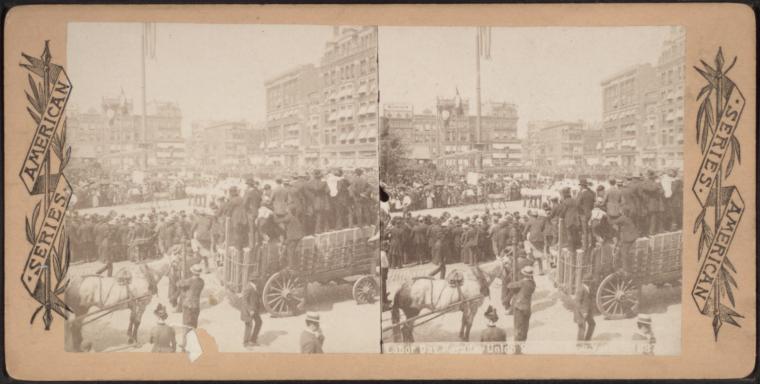
The New York Times seemed to find the parade slightly whimsical, almost superfluous. It echoed the disappointing turnout, but describes the event as calm, “conducted in an orderly and pleasant manner.”

The coverage focuses undue attention on the paraders’ fashionable attire.

“The great majority smoked cigars.” However they stress that the good behavior is attributable to the fact that organizers banned alcohol. This detail is mentioned in no other coverage that I read.

Where the Tribune attested the lower-than-expected turnout to men not leaving their posts, the Times found a different reason — “due to the fact that [laborers] preferred to enjoy the day in quiet excursions in Coney Island, Glen Island and elsewhere.”

Children at the Union Square Labor Day parade, 1909 (NYPL)
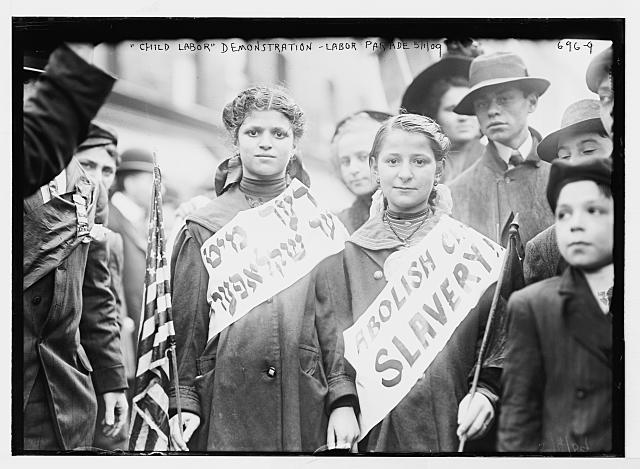
The enthusiastic New York Sun describes it as a dry and brutal day. “[T]he rays of sun even in the early morning were very hot, and not a breath of wind brought relief from the oppressive heat.”

The same parade considered disappointing by the Tribune and the Times was conversely described by the Sun as a mob scene.

“As far ahead as one could see and as far down the side streets as forms and faces could be distinguished, the windows and roofs and even the lamp posts and awning frames were occupied by people anxious to get a good view of the first parade in New York of workingmen of all trades united in one organization.”

Far from a nuisance, the Sun recognized the parade as an important banner moment in history. Its description of events is truly painstaking.

Many newspapers outside New York mentioned the parade the following day.  St. Paul’s Daily Globe in Minnesota said “the great labor demonstration today was a success,” quoting a number in attendance (20,000) almost double the actual projected number.

So did the Dallas Daily Herald, who put the event on their front page.

Meanwhile, it should be noted that most major New York newspapers neglected to put the labor parade on their front pages.
Categories
On The Waterfront

In 1863, the Russians invaded New York City

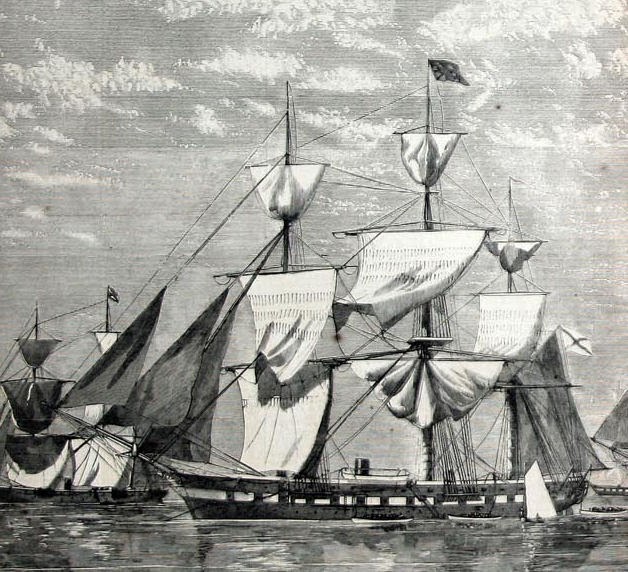
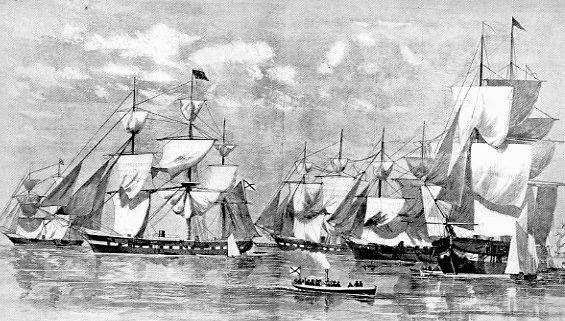
In 1863, New Yorkers flocked to the waterfront to see a startling sight — Russian war ships in New York Harbor. They were here as a display of force, but not to threaten the United States.
The fleet of Russian ships, sailing into New York Harbor in September 1863, as depicted by Harper’s Weekly.

Russia’s Atlantic Squadron, as the fleet was known, was patrolling the Atlantic Ocean as a show of strength against England’s Royal Navy.

They arrived in the harbor on September 24, 1863, initially anchoring in Flushing Bay, and stayed in the city for a couple months. (A description of the various Russian vessels can be found in this 1863 New York Times report.)
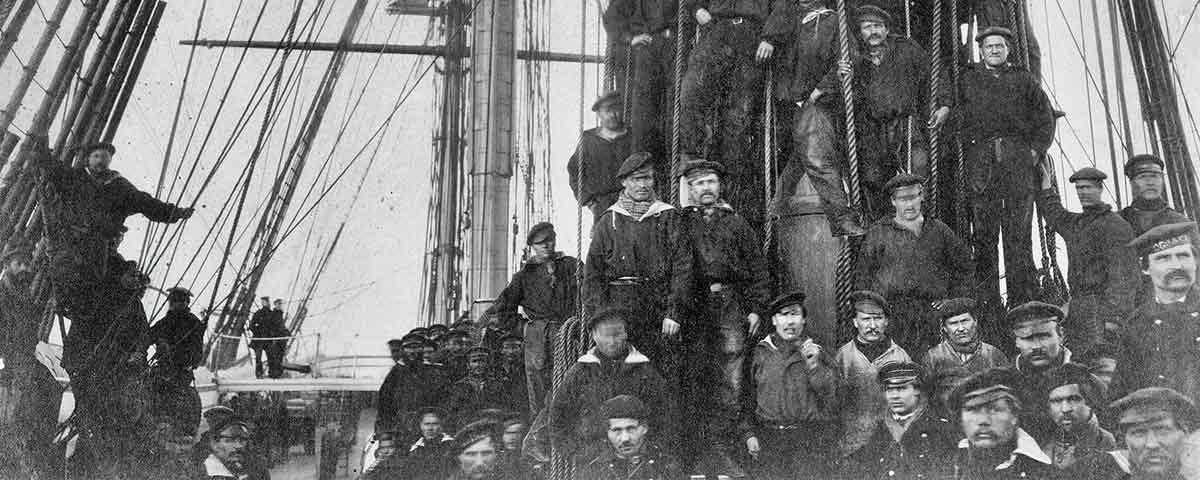
The fleet was led by the massive frigate Alexander Nevski (pictured below), an American-designed ship commissioned and built by the Russian government.
A reporter for Harper’s Weekly, joining a reception onboard the vessel, praised its beauty.  “A lady with the most immaculate skirts and kid gloves can move any where, on deck or below, without danger of soiling either, so perfectly clean every thing about the ship is kept.”

America was in the midst of the Civil War, and New York itself was still recovering from the Draft Riots that July. 

Many Americans believed the appearance by the Russians underscored a healthy support for the Union over the Confederacy, but most scholars today believe the Russians were acting with far more self-interest.

Still, most New Yorkers embittered by war welcomed the impressive show by friendly foreign powers, kicking off “a slight craze in the public mind.” 

Harper’s Weekly remarked, ” [E]very citizen felt bound to do what in him lay to testify to the Russians our sense of gratitude for the friendly manner in which Russia has stood by us in our present struggle, while the Western Powers [England and France] have done not a little to work our ruin.”

New Yorkers marveled at the mighty mast of the Alexander Nevsky, “lying almost on a line westward from Trinity Church,” as it shot off its cannons and a band on-board attempted to play ‘Yankee Doodle Dandy.’

The ship officially docked on the west side at 23rd Street, and the procession, joined by city leaders, marched through the streets (pictured at left, courtesy NYPL), past Union Square and down Broadway.

“[T]he scene became splendidly animated.  The moving pageant rolled in a glittering stream down the broad thoroughfare between banks of upturned human faces, the trappings of the equipages, the gold and silver epaulets of the Muscovite guests and the sabres, helmets, and bayonets of the escort reflecting back in unnumbered dazzling lines the glory of the evening sun.”

In particular, New York women were captivated by the brawny Russian contingent in their handsome uniforms.  “Throngs of ladies in the windows most vigorously waved their ‘kerchiefs, to the great delight of the Russian officers, who never left off bowing, smiling, and even uttering their thanks aloud, while they doffed their gold-laced chapeau.”

(Not every woman was infatuated. The following day, two Russian officers reported being robbed by three women “at a disreputable house.“)

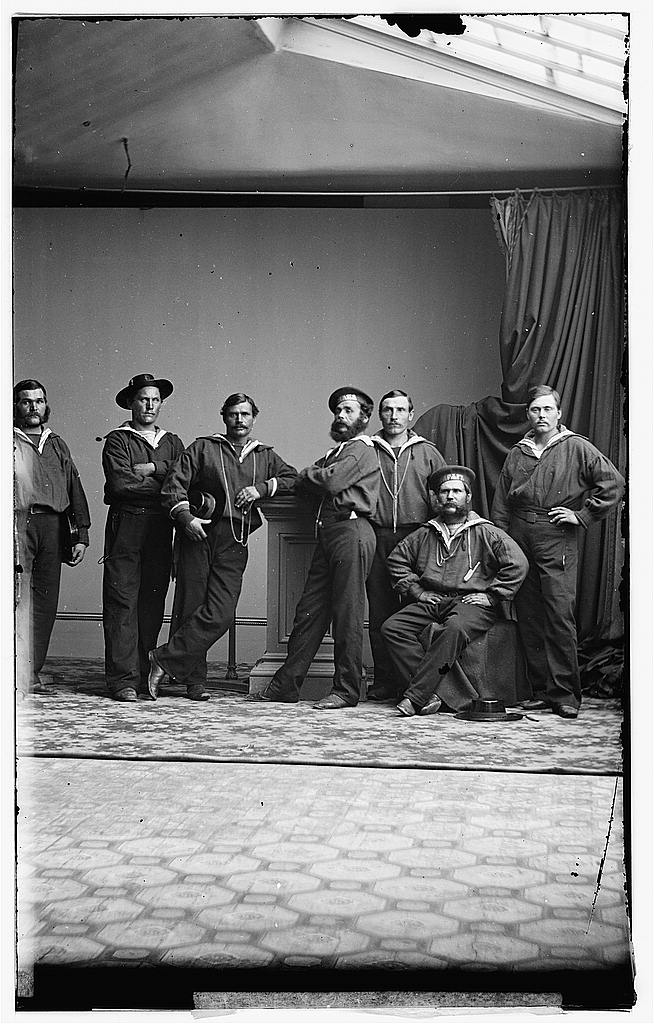
Below: A group of Russian soldiers, taken October 1863, courtesy Library of Congress


The finest hotels of New York were adorned with American and Russian flags. Tiffany’s, at its location on Broadway between Prince and Spring Streets, unfurled a gigantic Russian banner that stretched the length of the building.

Throughout the following weeks, the Russians were continually feted by the grateful Americans.  At a dinner with Mary Todd Lincoln and other American dignitaries, Mrs. Lincoln toasted the Russians for their kindness. 

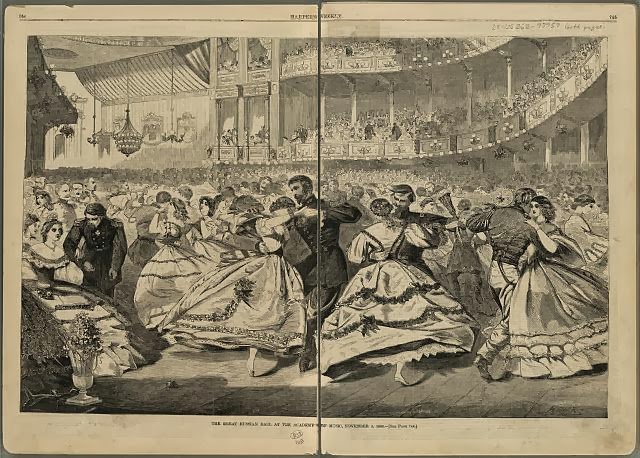
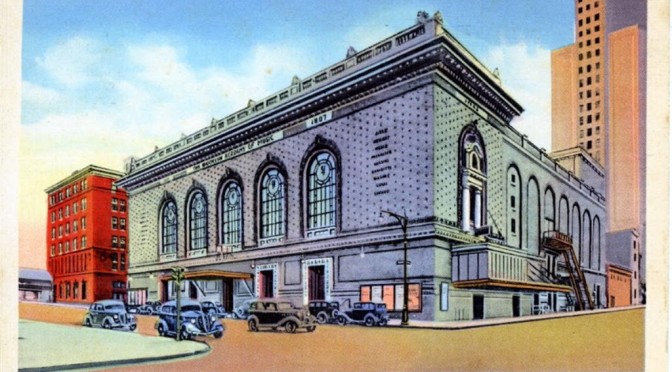
Russian dignitaries frequently met with Mayor George Opdyke and the Common Council and were wined and dined at virtually every hotel in town, including an opulent banquet at the Academy of Music in early November (depicted below in an illustration in Harper’s Weekly).


“They are dined, walked, driven, and are, with unconcealed gratification, availing themselves of the many opportunities of seeing us and all around and about us,” said the New York Times that October. “Yesterday, a number visited Central Park and enjoyed its fine drives and beautiful walks; others were whirled to High Bridge, and others were entertained with City sights of interest.”

The Russian ships would remain in American waters for almost seven months, darting up and down the coast, including a period of time in Washington D.C.

ORIGINALLY PUBLISHED ON THIS WEBSITE IN 2013.

Categories
Wartime New York

New York doughnut history: From Washington Irving’s olykoeks to doughnut huts in Union Square

Today is National Doughnut Day which is not a real holiday although that shouldn’t stop you from celebrating in whatever powdered, glazed, creme-filled way you see fit.

However you will be surprised to learn that this day traces its roots to the Salvation Army and World War I.

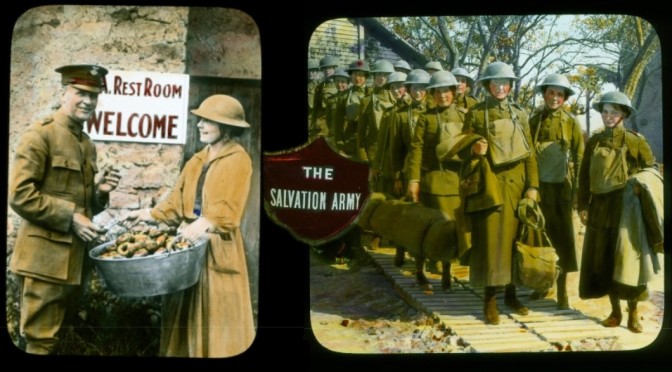
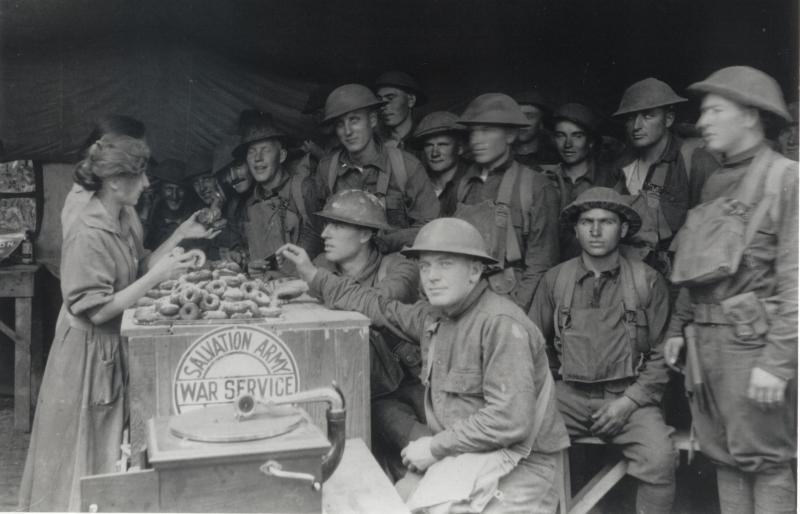
To provide for the American troops fighting in France in 1917-18, Salvation Army workers set up small tents or ‘huts’, providing the comforts of home, with nourishing meals, a quiet place to write letters or to get clothing mended.

Time to make the doughnuts: A Salvation Army hut during World War I (Courtesy the Salvation Army)

There were actually several dozen of these Salvation Army huts already set up in the United States near military bases so the tradition was simply transferred over to Europe when the war began, with workers often setting up huts in abandoned or even bombed-out buildings.

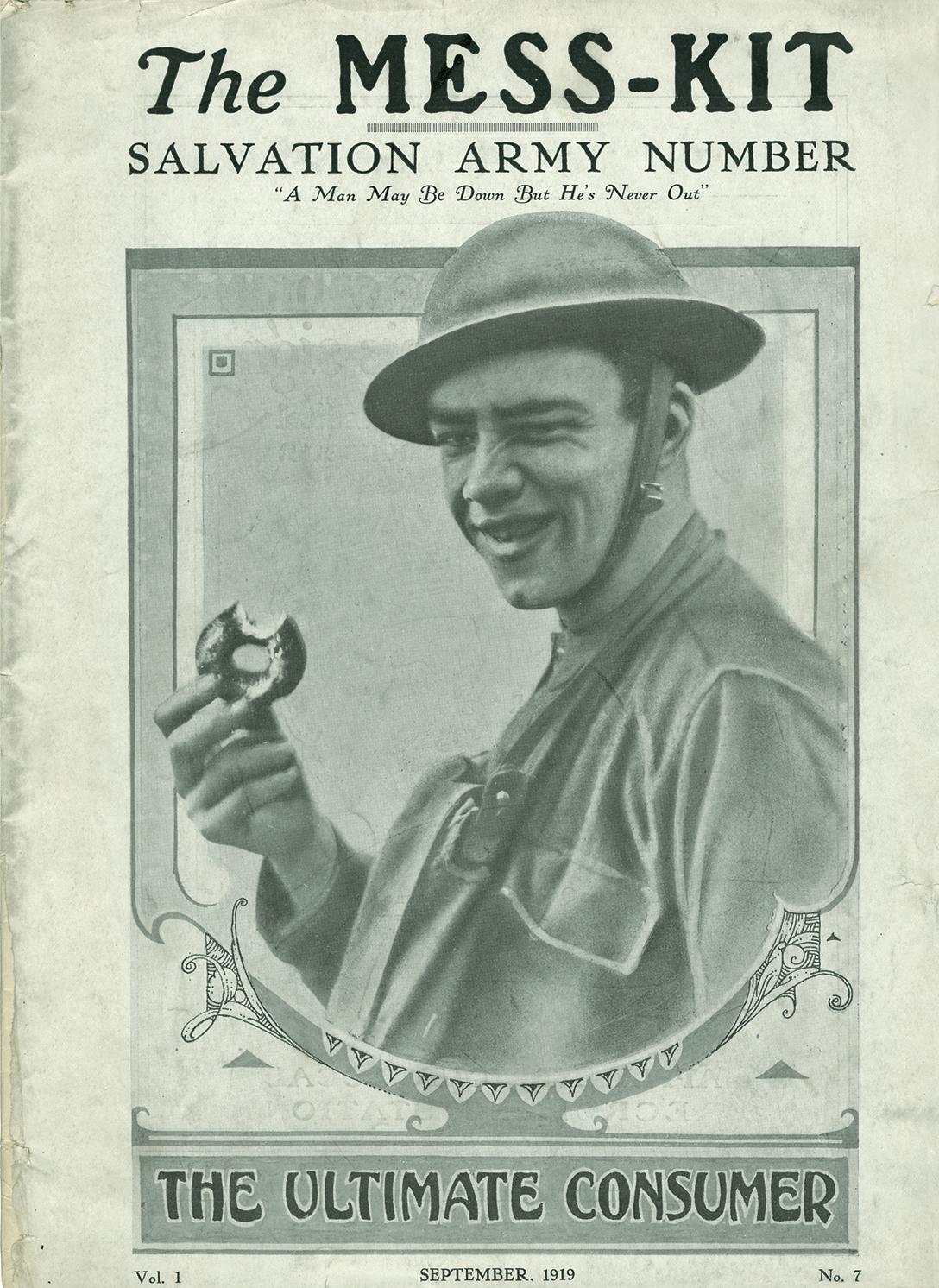
Below: A doughboy eating a doughnut on a 1919 magazine cover. (LOC)

8616914748_9dd3a80bf3_o

What brings greater pleasure than a baked good? But the Salvation Army couldn’t transport large baking ovens, so they improvised with the doughnut, deep-frying dough on small portable stoves.
Irving and the Oly Koek

The round pastry was not invented by the Salvation Army.  Indeed, Washington Irving himself is credited with the first mention of the doughnut in print back in 1809.

Regaling on old Dutch custom, he writes “[I]t was always sure to boast of an enormous dish of balls of sweetened dough, fried in hog’s fat, and called dough-nuts, or oly koeks: a delicious kind of cake, at present known scarce to this city, except in genuine Dutch families.”

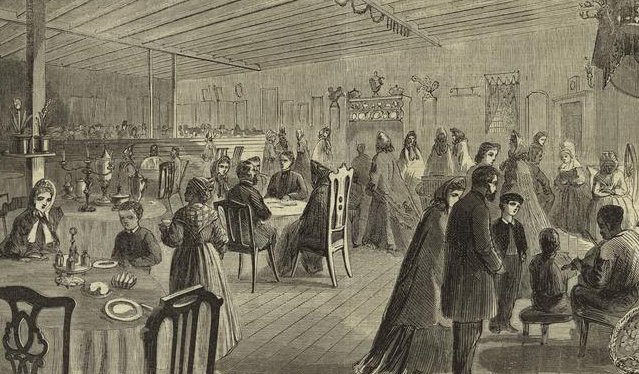
Above: A scene from the Knickerbocker Kitchen in 1864 (NYPL)

Due to their ease of preparation, doughnuts became associated with wartime cuisine.  But even the original Dutch ‘oly koeks’ made a wartime return as well, brought back as a fund-raiser during the Civil War, sold during the 1864 Metropolitan Fair in the Knickerbocker Kitchen, a sort-of theme restaurant where Dutch delights were sold.

The Battleship in Union Square

Interestingly, the Knickerbocker pavilion was located just off of Union Square. Many decades later, the doughnut would return to Union Square for yet another war-related pageant.

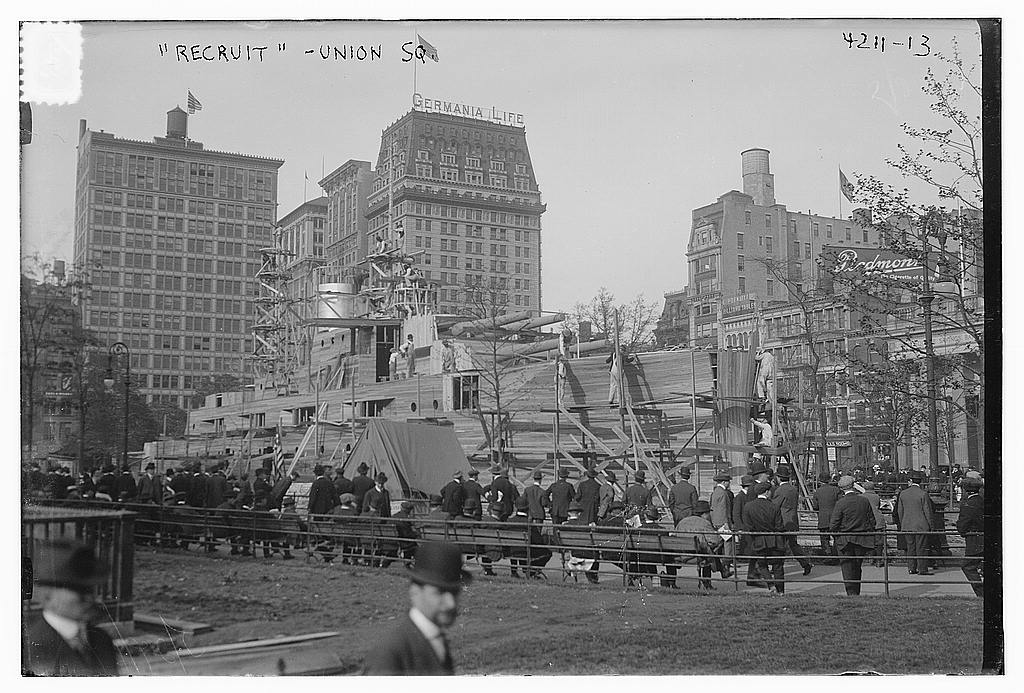
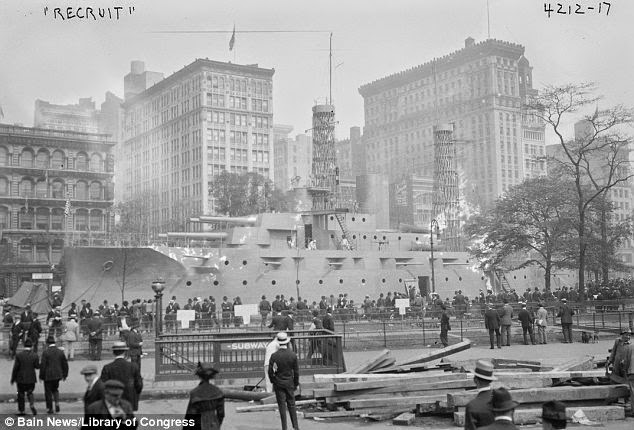
In 1917, during World War I, the U.S. Navy set up a curious recruitment tool in Union Square — a life size wooden battleship called, appropriately, the USS Recruit.

Courtesy Library of Congress

Once the war was over, the Salvation Army thought it would be a kind gesture to those New Yorkers were fought in the war to recreate their welcoming war huts. And it made natural sense to set one up here in Union Square, next to the wooden battleship and conveniently located near their headquarters on West 14th Street (still there today).

The Salvation Army’s Union Square hut opened for business January 12, 1919, with a grand ceremony around the USS Recruit and military officers from the Brooklyn Navy Yard.

Inside Salvation Army workers were busily preparing the doughnuts, using the same tools as on the battlefield.  It was led by Adjutant Violet McAllister, one of the original “doughnut sweethearts” of the war, with “flour on her nose and a great white apron over her khaki uniform.

That day over 1,000 doughnuts were prepared, many for soldiers returning from the war.  In emulation of the war front huts, the Union Square edition was “open every day for reading, writing and gossip, with doughnut and coffee for 10 cents for all men in uniform.” [source]

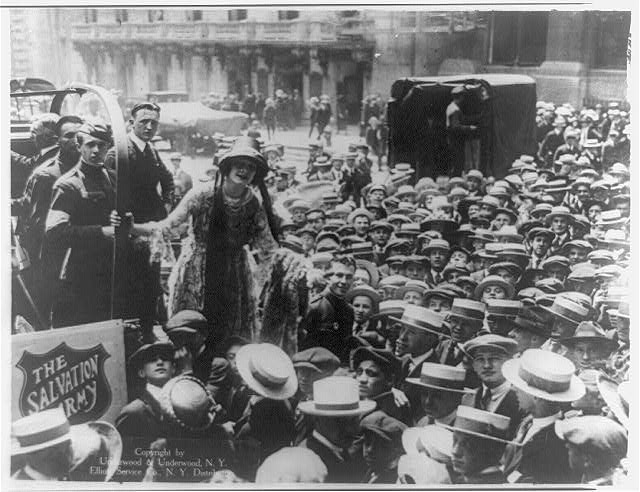
Above: Silent film star and New Yorker Martha Mansfield sells doughnuts for $1 apiece on the streets of New York during a fundraiser for the Salvation Army. (LOC)

Doughnuts on Every Corner

To those at home, observing the battles of World War I from afar, the doughnut became a symbol of the war effort (although the word doughboy is not related.)  A month before the Treaty of Versailles was signed, Salvation Army volunteers sold doughnuts on street corners throughout the city and even auctioned off doughnuts on the steps of the Sub-Treasury Building (today’s Federal Hall), with one doughnut being sold for $5,000!

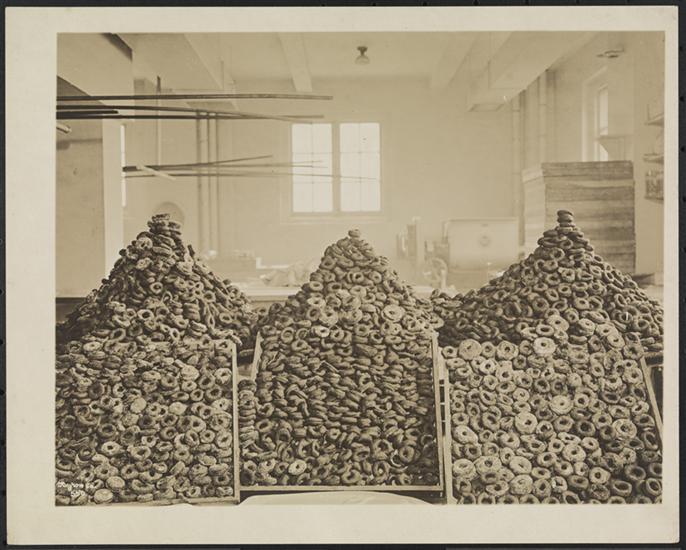
Below: The doughnuts were prepared at the Hotel Commodore, Lexington and 42nd Street.

Courtesy Museum of the City of New York

By 1920, the battleship — and I assume the doughnut hut as well — were dismantled.  In 1938, two decades after World War I, the Salvation Army started National Doughnut Day as a fundraiser and in honor of its phalanx of busy doughnut makers.

New Yorkers of course no longer needed to associate this food with wartime activities as the pastry soon sprang up at every lunch corner and automat in town.

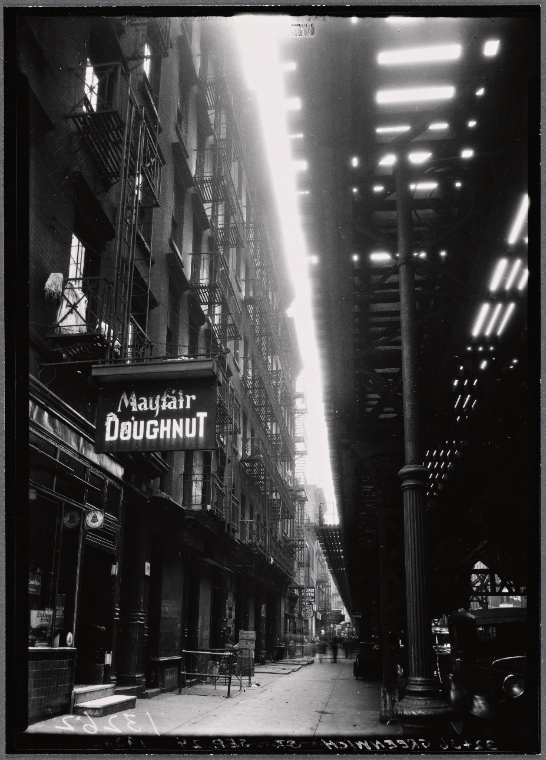
Below: Mayfair Doughnut under the elevated at 32-36 Greenwich Street (courtesy NYPL)

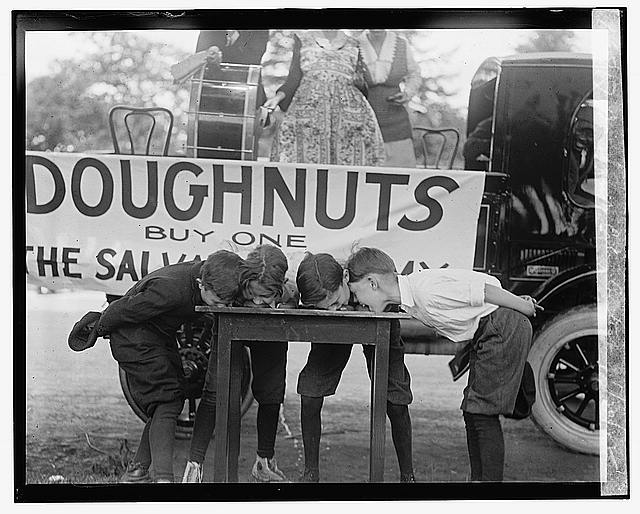
A doughnut eating contest from 1922. I’m not sure this is from New York City, but how could I overlook this hilarious picture? (LOC)

Categories
Health and Living

Earth Day in New York City 1970

Mayor John Lindsay pulled out all the stops for the first official Earth Day on April 22, 1970, with such a show that one could be mistaken in the belief that the holiday was created here. (It was officially sanctioned in San Francisco the year before.)

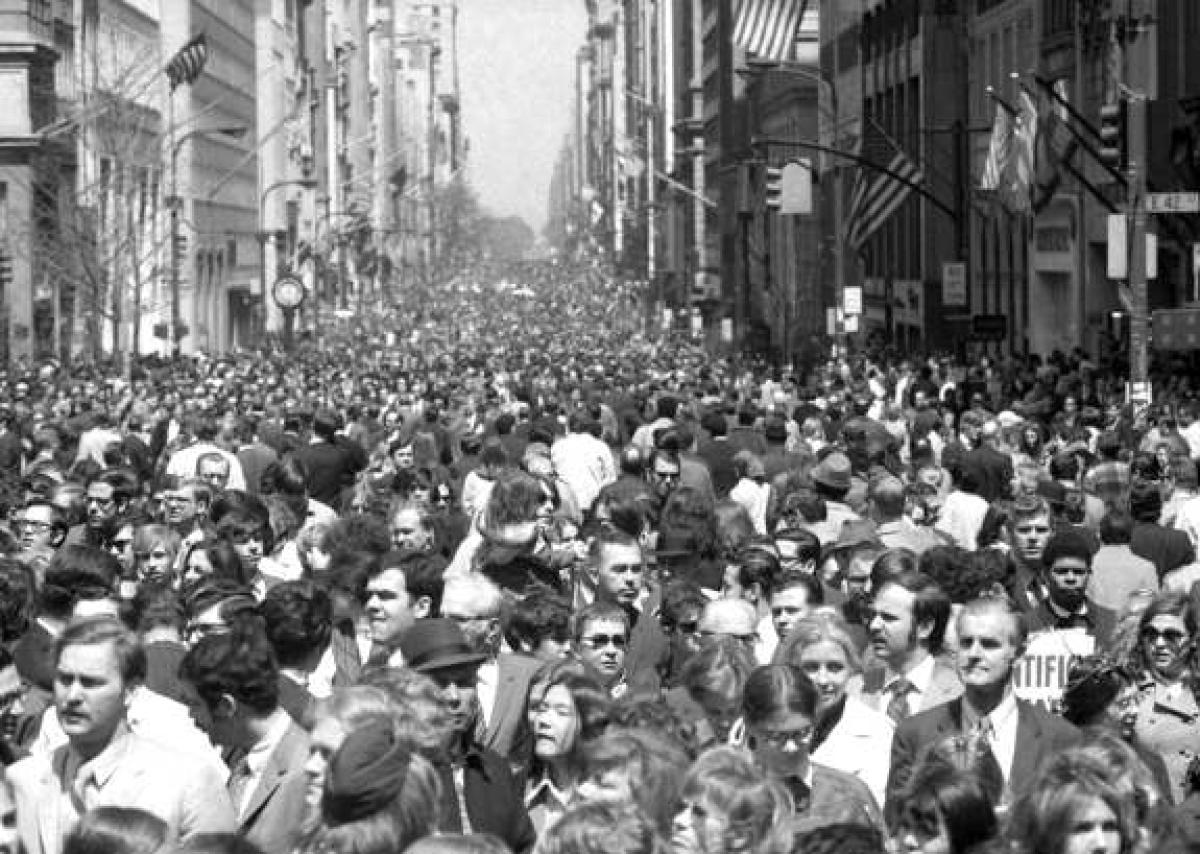
In honor of the inaugural environmental holiday, Lindsay authorized Fifth Avenue closed for two hours, the streets filled with thousands of celebrants and protesters.

The event culminated in Union Square, where the mayor — along with actors like Paul Newman and Ali McGraw — spoke to encouraging crowds about a cleaner city. Fourteenth Street between Third and Seventh Avenues was also shut down for an ‘ecological carnival’, which might not sound as fun as a real carnival. Except this was 1970, after all.

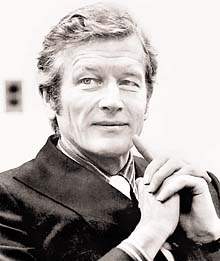
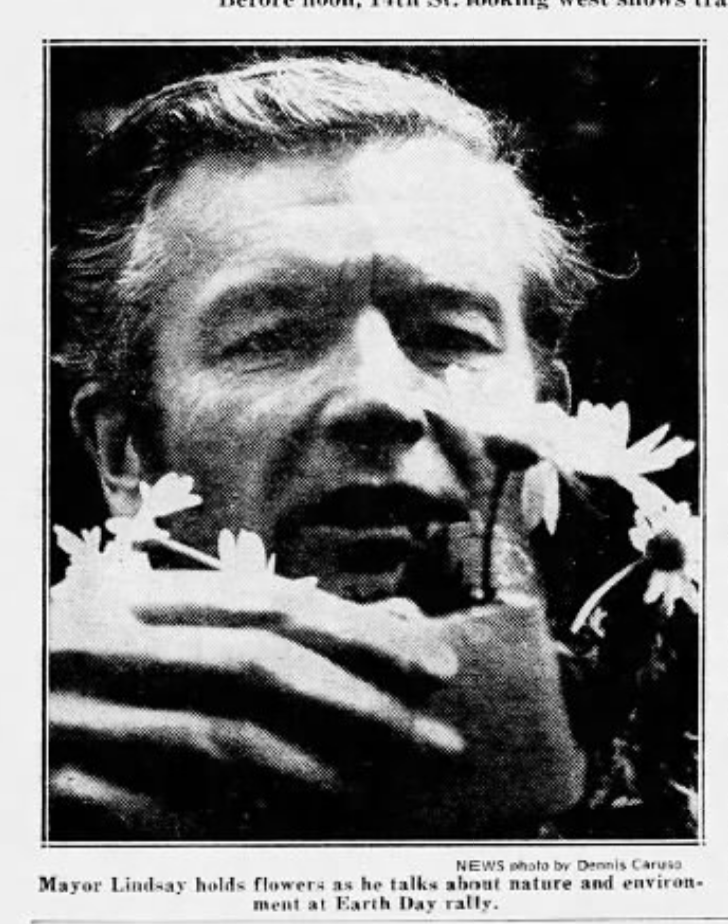
Was Lindsay (left) before his time in his passion for pollution? Maybe. More likely, his constituents were.

By 1970 the mayor was attempting to appeal to the true sensibility of the urban bohemian, allowing ‘be-ins’ in Central Park and promoting a virtue of ‘Fun City’, “a phrase that embodied the hope of New Yorkers for a more livable city,” according to biographer Vincent Cannato. In fact, Earth Day was modeled after the Vietnam-era ‘teach-in’, essentially an educational outreach mixed with a smidgen of good times.

Lindsay: “[T]he city is contributing a billion dollars over the next ten years to mass transit construction. And then more, more and more we are discouraging automobile use in the central business areas.” (Look here for the rest of the interview with Lindsay in Union Square talking to NBC about the first Earth Day.)

“If you’re not part of the solution, you’re part of the pollution,” added governor Nelson Rockefeller in a speech to the crowds.

1

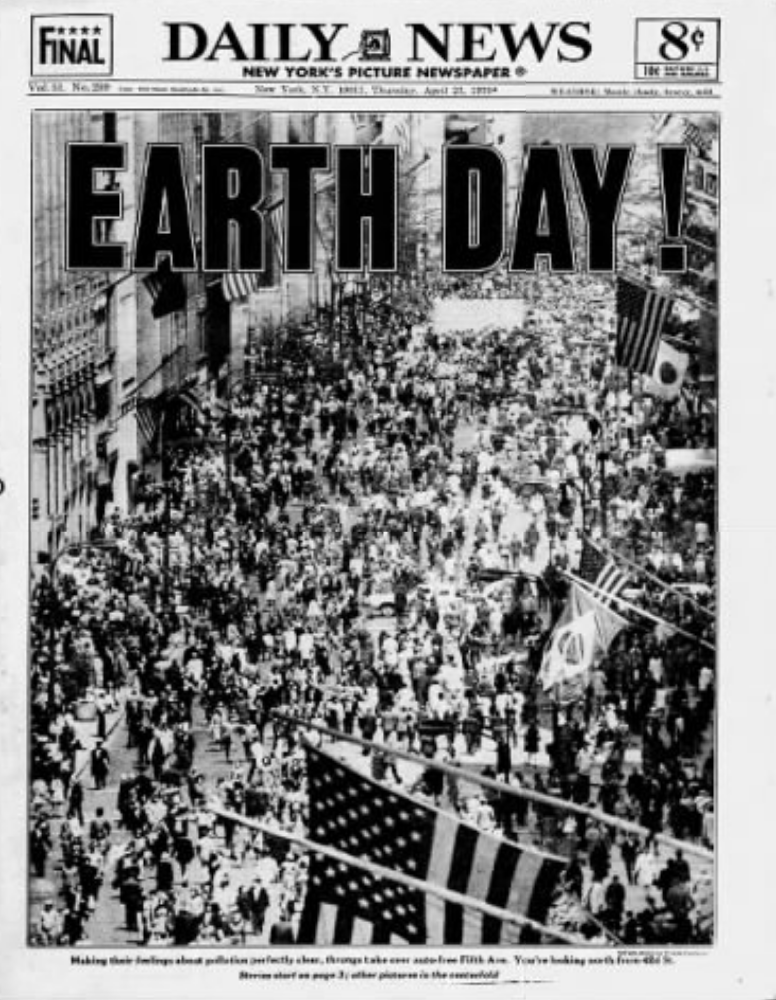
Above: Throngs enjoy a cleaner world by cramming themselves on Fifth Avenue during the city’s very first Earth Day celebration

The massive rally, with a 100,000 in attendance, reportedly left little pollution in its wake (although that seems a tad revisionist to me). Crowds occasionally attacked gas-guzzling, pollutant-making cars as they went by, and one group of demonstrators curiously dragged around a net filled with rotting fish, shouting “This could be you!”

Lindsay would later close Fifth Avenue to traffic for several weekends that summer.

From the New York Daily News

Flash forward to 2019 — the city often hosts Summer Streets car-free weekend, allowing pedestrians and bikers to enjoy city streets without automobiles.

In fact, this Saturday is Car Free Earth Week, “opening thirty blocks of Broadway from Times Square to Union Square for people to explore on foot during event hours, 9:00 AM to 3:00 PM.” And in uptown Manhattan, Car Free Earth Day opens up 9 blocks on St. Nicholas Avenue from 181st Street to 190th Street. [More details here]

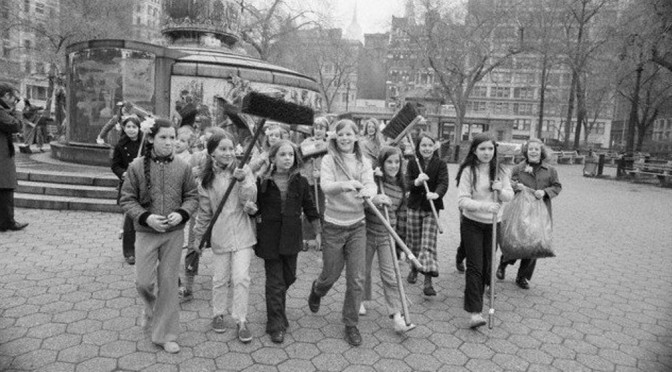
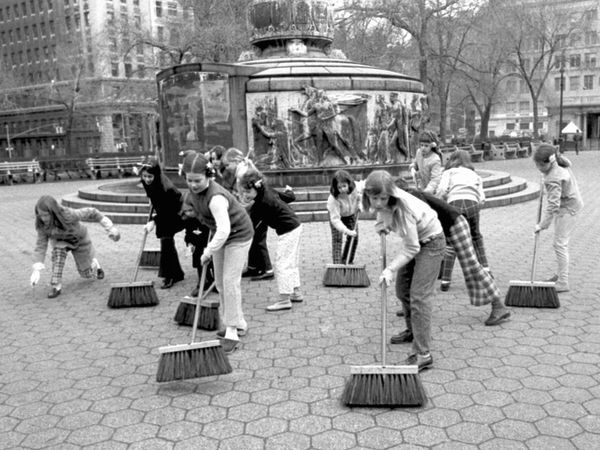
Below: This gang of adorable, broom-wielding Union Square scalawags prepare to attack the city’s grime

Courtesy AP
Courtesy AP
Categories
Landmarks Podcasts

The Origin of Broadway: The Story of a Street

PODCAST What makes a street so extraordinary that it becomes a destination in itself? What makes it Broadway? This is the history of New York City’s most famous street and a progression through the entire history of the city.

In this episode, Tom is joined by Fran Leadon, the author of a new history of Broadway, called Broadway: A History of New York in 13 Miles.

We’ve discussed Broadway, the street, in just about every show we’ve done — as so many of the city’s key events have taken place along Broadway or near it. And that’s also the point of Fran’s book — by telling the story of a street, you’re actually telling the story of the entire city.

On today’s show, we’ll be discussing how Broadway moved north — literally, how did it expand, overcoming natural obstacles and merging with… or avoiding… old, pre-existing roads, and how did it take such an unusual route?

And perhaps most surprisingly, how did Broadway survive the Commissioner’s Plan of 1811 which imposed a rigid street grid on the city?

You’re in for a few surprises.

To download this episode and subscribe to our show for free, visit iTunes or other podcasting services or get it straight from our satellite site.

You can also listen to the show on OvercastGoogle Music and Stitcher streaming radio.

________________________________________________________

The Bowery Boys: New York City History podcast is brought to you …. by you!

We are now producing a new Bowery Boys podcast every other week. We’re also looking to improve the show in other ways and expand in other ways as well — through publishing, social media, live events and other forms of media. But we can only do this with your help!

We are now a member of Patreon, a patronage platform where you can support your favorite content creators for as little as a $1 a month.

Please visit our page on Patreon and watch a short video of us recording the show and talking about our expansion plans. If you’d like to help out, there are five different pledge levels (and with clever names too — Mannahatta, New Amsterdam, Five Points, Gilded Age, Jazz Age and Empire State). Check them out and consider being a sponsor.

We greatly appreciate our listeners and readers and thank you for joining us on this journey so far.

_______________________________________________________

You can read Greg’s review of Fran Leadon’s book from a couple months ago here. “Fran Leadon, an architect and co-author of fifth edition of the AIA Guide to New York City, is a perfect biographer for Broadway, a main character in the development of one of the world’s great cities. His book is dense, richly written and researched, loaded with a million fun anecdotes.”

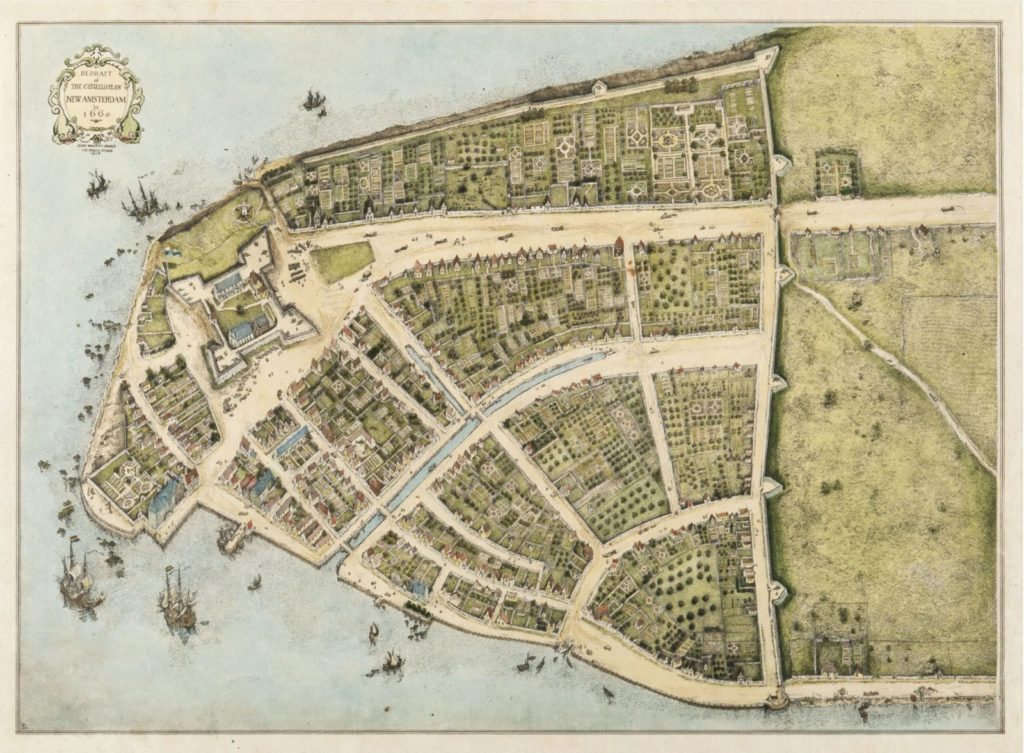
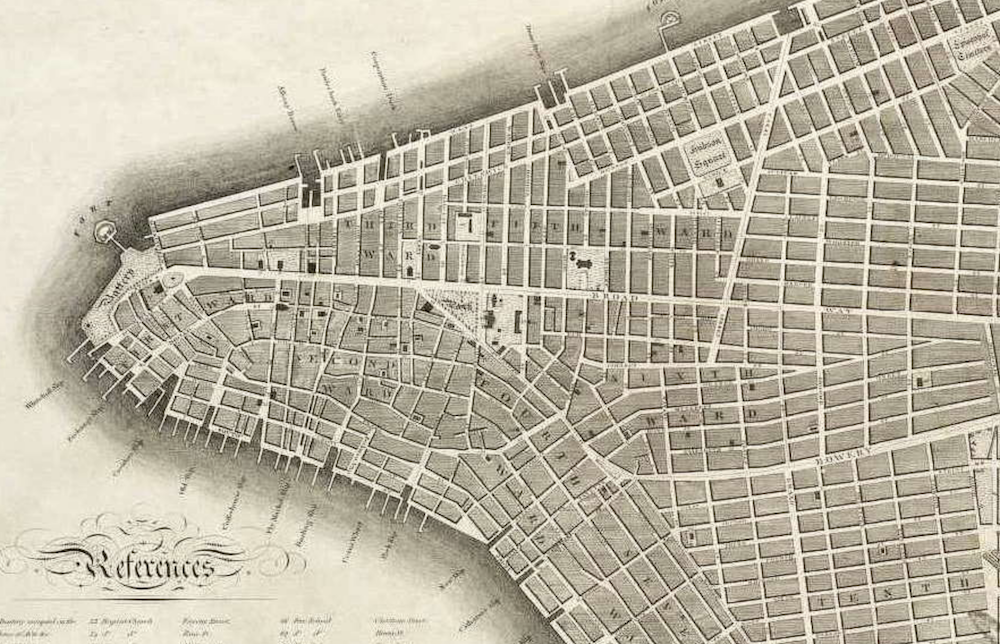
The beginning of Broadway — from a map of New Amsterdam and one from the Commissioners Plan

New York Public Library

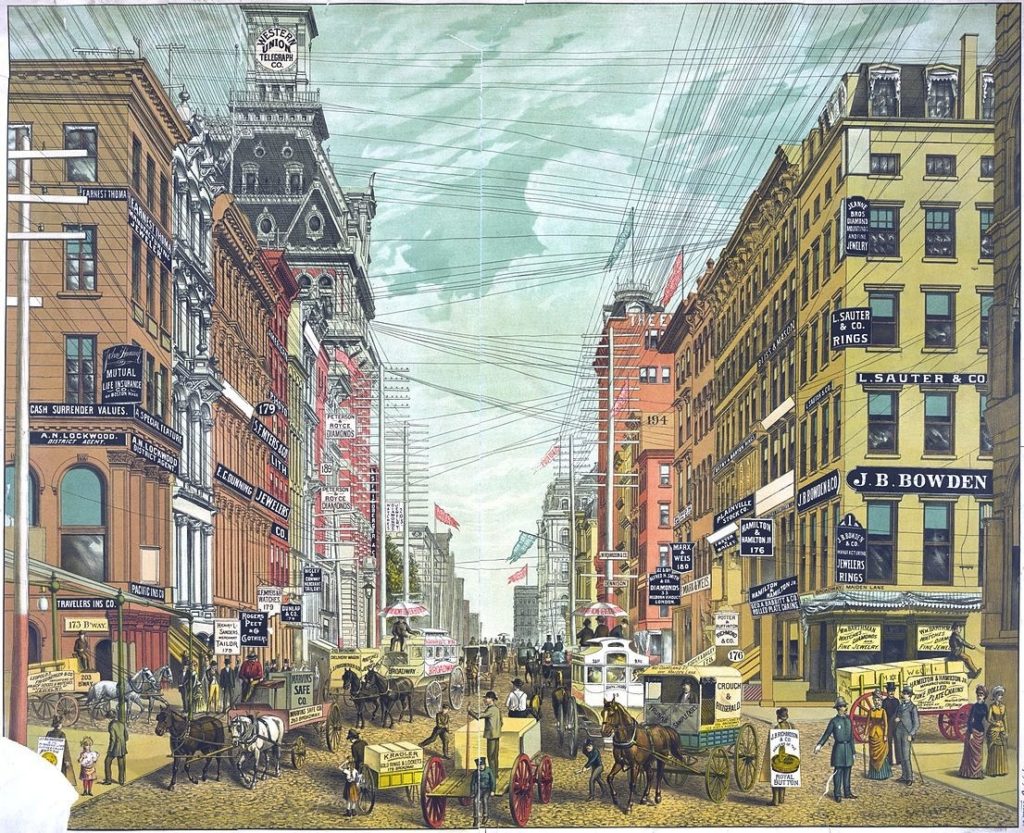
Undated image of the commerce of Broadway. The Western Union building was located on Broadway and Dey Street, placing this view in lower Manhattan. Note the telephone and telegraph wires!

Library of Congress [No Date Recorded on Shelflist Card]

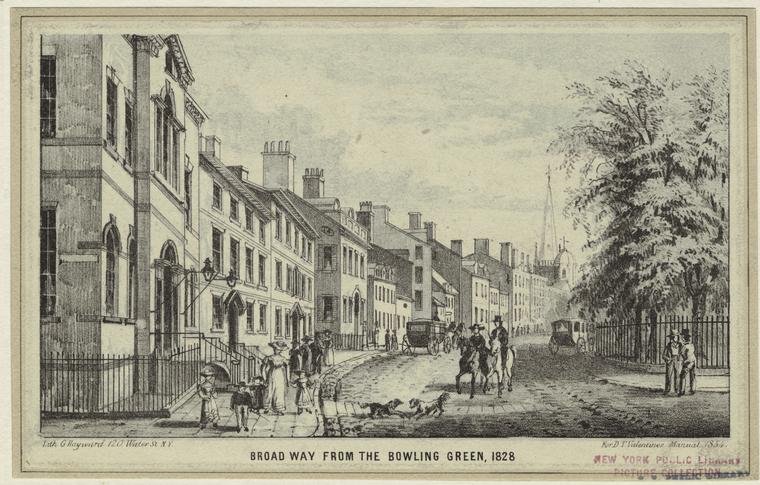
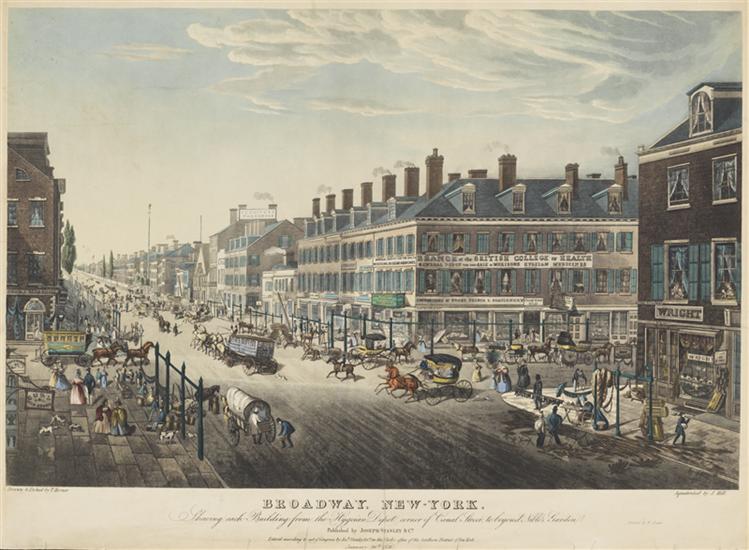
Broadway at Canal Street, 1836, in a lithograph by T. Hornor

Museum of the City of New York

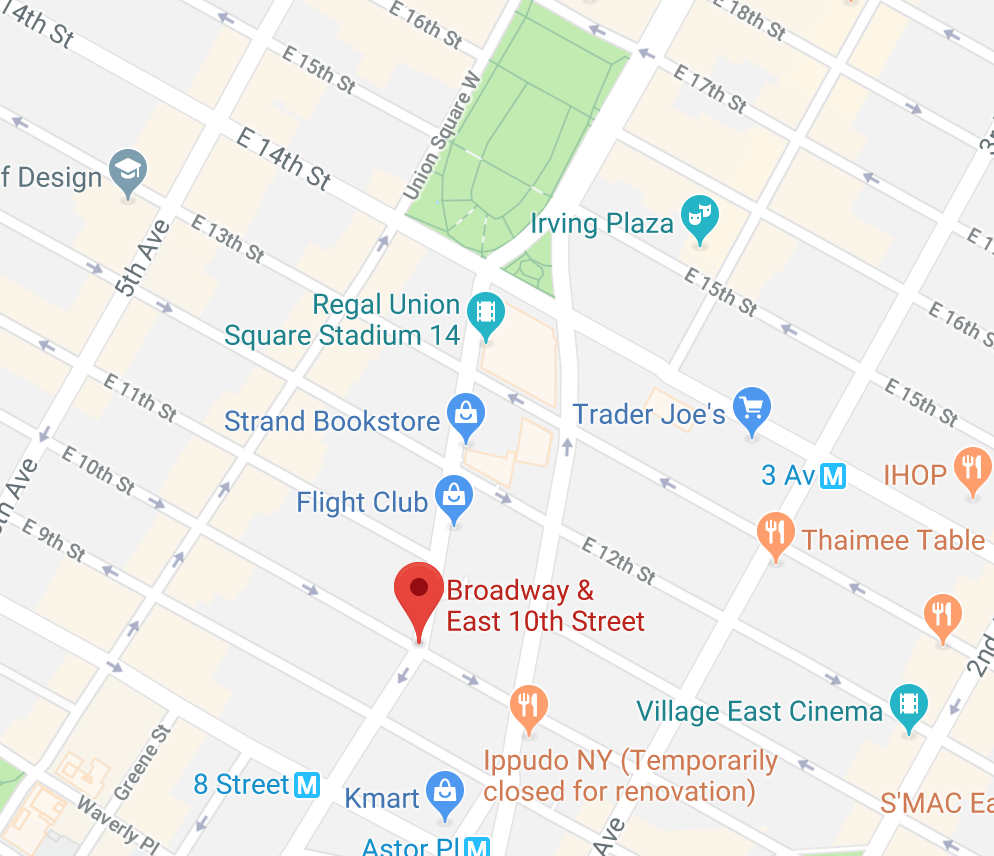
The unique ‘Broadway bend’ that begins on 10th Street, attributed, some say, to the farm of Henry Brevoort.

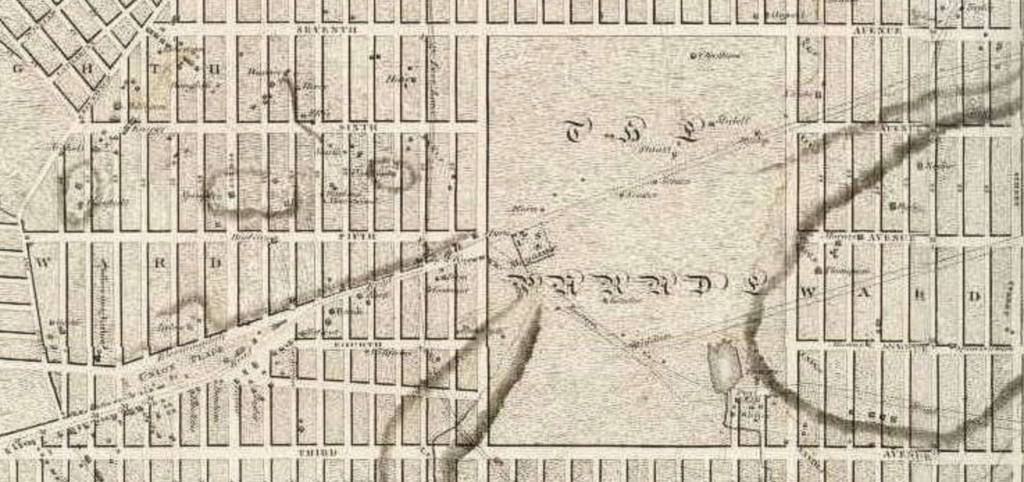
From the Commissioners Plan of 1811, both Broadway and the Bowery were to ‘disappear’ into a massive open space called the Parade.

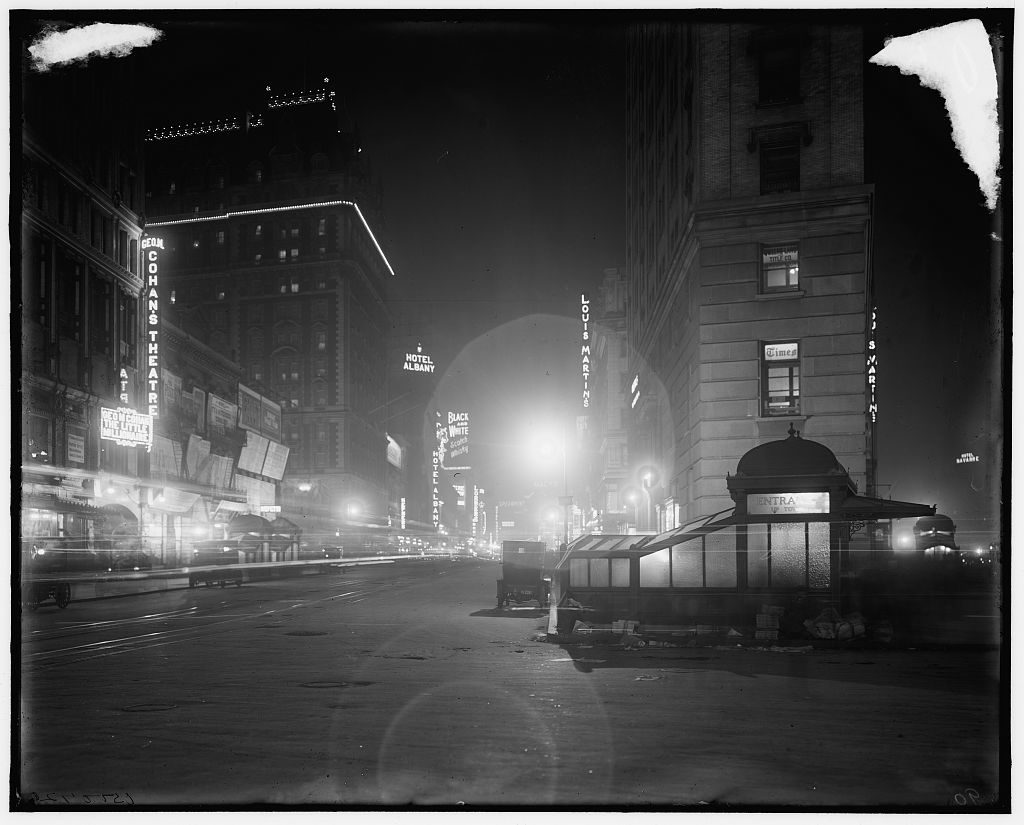
The glamour of Broadway and 42nd Street as it heads into Times Square. Broadway’s many ‘accidental’ plazas are responsible for most of New York’s cultural hubs. Thanks to the subway and proximity to the two major train stations, the ‘center of it all’ seemed to remain in Times Square, even as the city continued to move further northwards.

Library of Congress

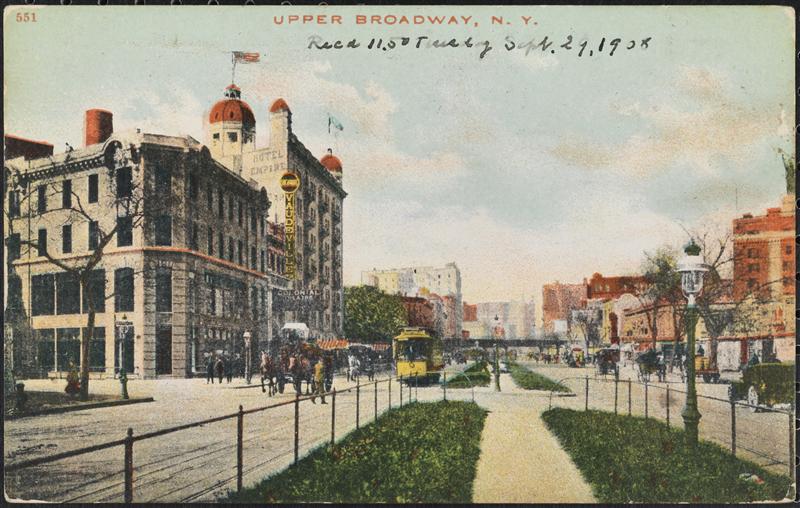
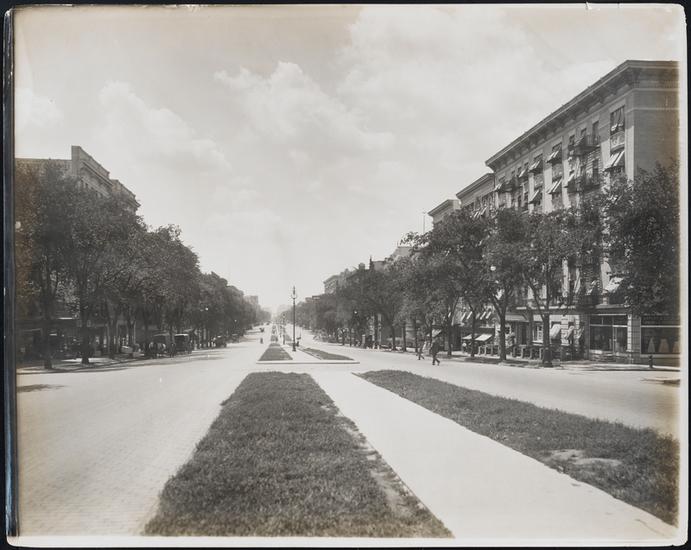
Broadway at West 62nd Street and at West 153rd Street, circa 1900-1915. City planners had an opportunity to make Broadway in upper Manhattan into a grand boulevard, Paris-style.

Museum of the City of New York
Museum City of New York
Categories
Parks and Recreation Podcasts

The Secrets of Gramercy Park (and you don’t even need a key)


PODCAST Gramercy Park is Manhattan’s only private park, a prohibited place for most New Yorkers. However we have your keys to the history of this significant and rather unusual place, full of the city’s greatest inventors, civic leaders and entertainers.

Literally pulled up from swampy land, Gramercy Park naturally appealed to the city’s elite, a pocket neighborhood with classic old brownstones so vital to the city’s early growth that two streets sprang from its creation — Irving Place and Lexington Avenue.

Within the story of Gramercy Park there are echoes of modern debates over class and land usage. The area’s creator Samuel Ruggles was a New York developer before his time, perfecting techniques that modern developers are still using to convince both the city and its residents of the importance and vitality of their high-end projects.

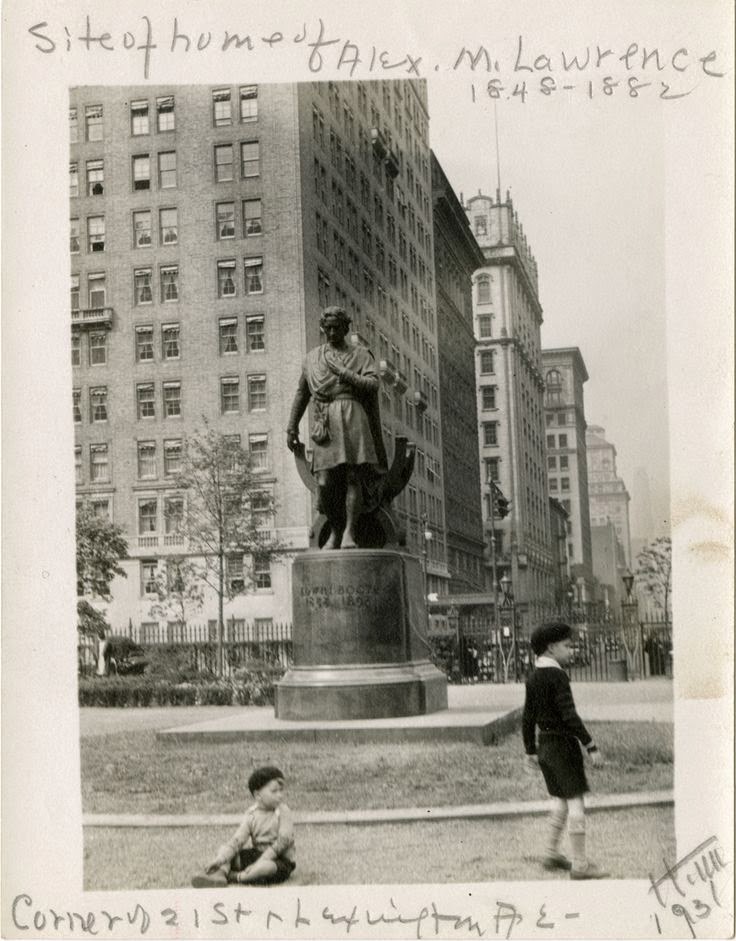
At right: Inside the park with Edwin Booth (Photo by Helaine Magnus, courtesy NYHS)

In this show, we give you an overview of its history — a birds eye’s view, if you will — then follow it up with a virtual walking tour that you can use to guide yourself through the area, on foot or in your mind. (You can follow along virtually starting here.) In this tour, we’ll give you the insights on an early stop on the Underground Railroad, the house of a controversial New York mayor, a fabulous club of thespians, and a hotel that has hosted both the Rolling Stones and John F. Kennedy (though not at the same time).

ALSO: We tell you the right way to get into Gramercy Park — and the wrong way.


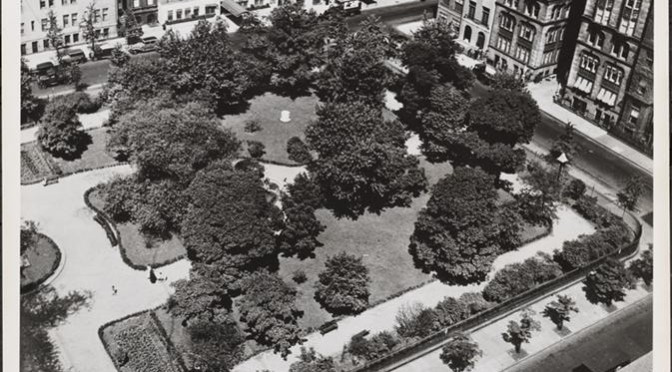
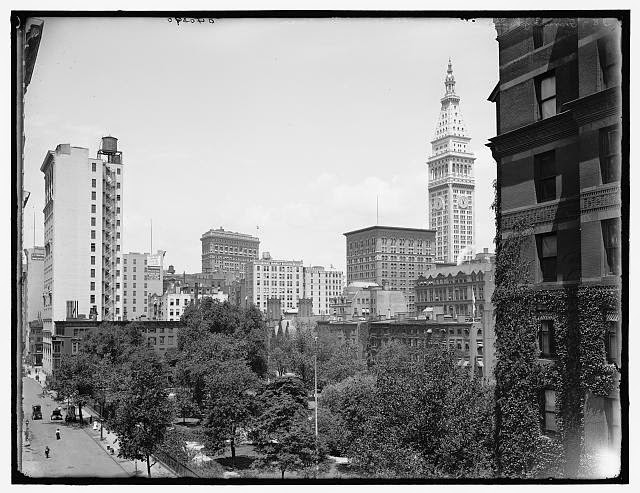
Below: Looking west onto Gramercy Park, photo between 1909-1915.  You can see both the Flatiron and the Metropolitan Life Tower in the distance. [LOC]


And we would like to thank our sponsors:

Squarespace, the all-in-one platform that makes it fast and easy to create your own professional website or online portfolio. For a free trial and 10% off (your first purchase), go to squarespace.com and use offer code BOWERY.


Audible, the premier provider of digital audiobooks. Get a FREE audiobook download and 30 day free trial at www.audibletrial.com/boweryboys. Over 150,000 titles to choose from for your iPhone, Android, Kindle or mp3 player Audible titles play on iPhone, Kindle, Android and more than 500 devices for listening anytime, anywhere.


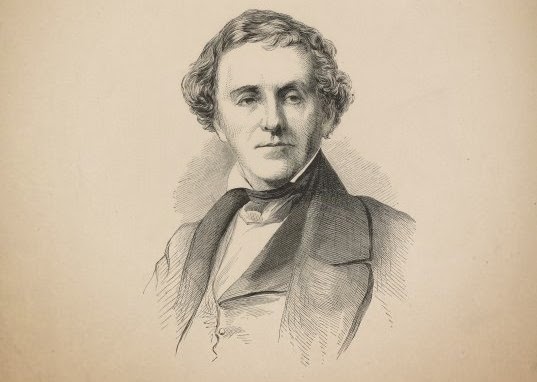
Samuel Ruggles, the mastermind behind the Union Square and Gramercy Park developments, two parks with drastically different fates. While Union Square would eventually be considered ‘the people’s park’ and a center of working class protest, Gramercy Park would retain its guarded, exclusive character.

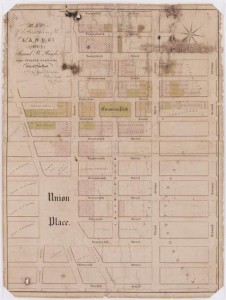
A 1831 map outlining the lands owned and developed by Samuel Ruggles. Lexington Avenue and Irving Place have already been planned by this time. (Courtesy MCNY)

Lands of Samuel B. Ruggles in the Twelth Ward in the City of New York

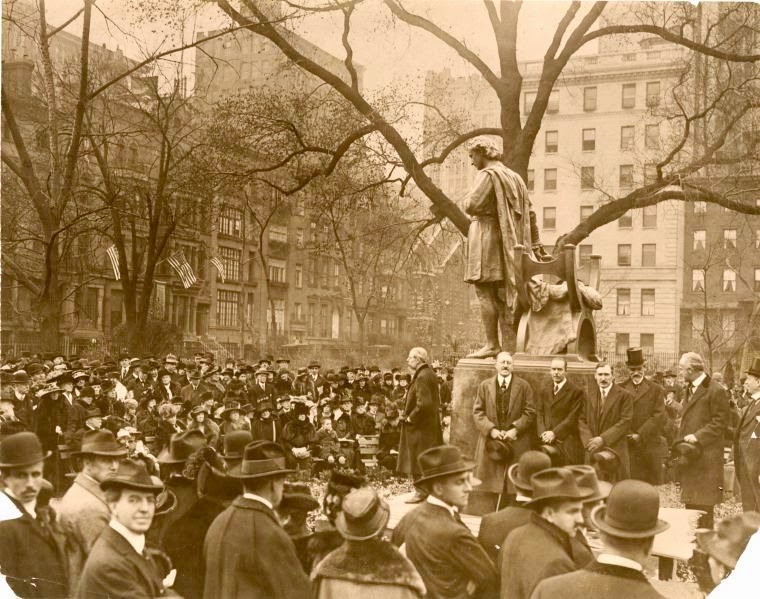
The 1918 unveiling of Gramercy Park’s one permanent resident — the statue of Edwin Booth. (NYPL)

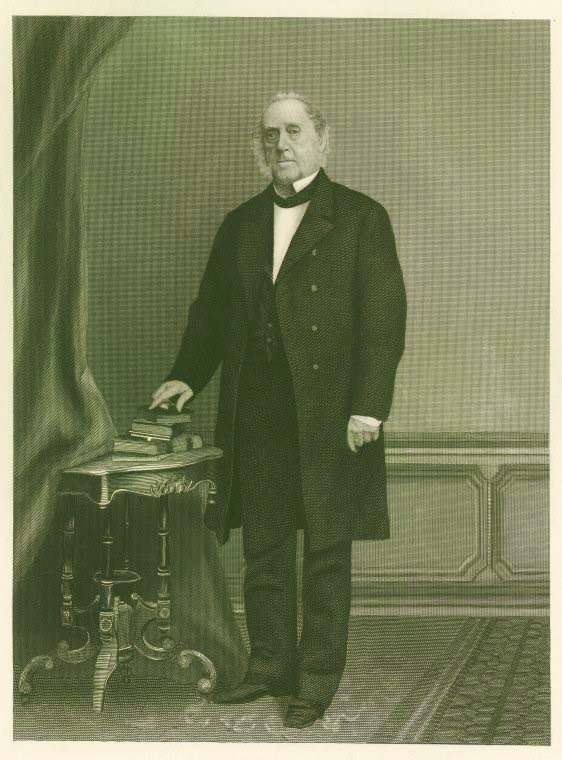
The esteemed Dr. Valentine Mott who lived (with his large family) at 1 Gramercy Park. 

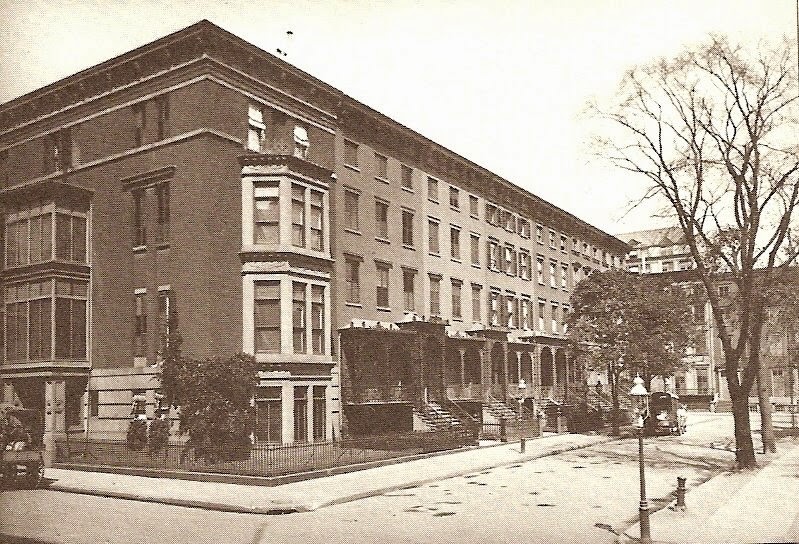
3 and 4 Gramercy Park from 1935 — and they look exactly the same today! The lampposts indicate that this was once the home of former mayor James Harper.  (Photo by Berenice Abbot, NYPL)

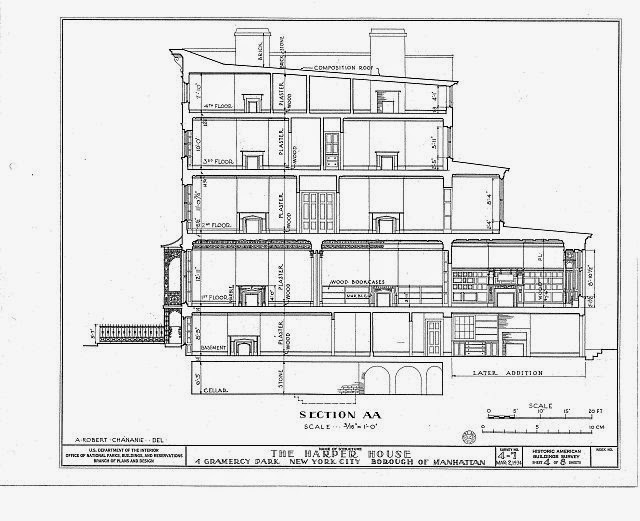
A architectural cross-section of 4 Gramercy Park, showing the size of the house.

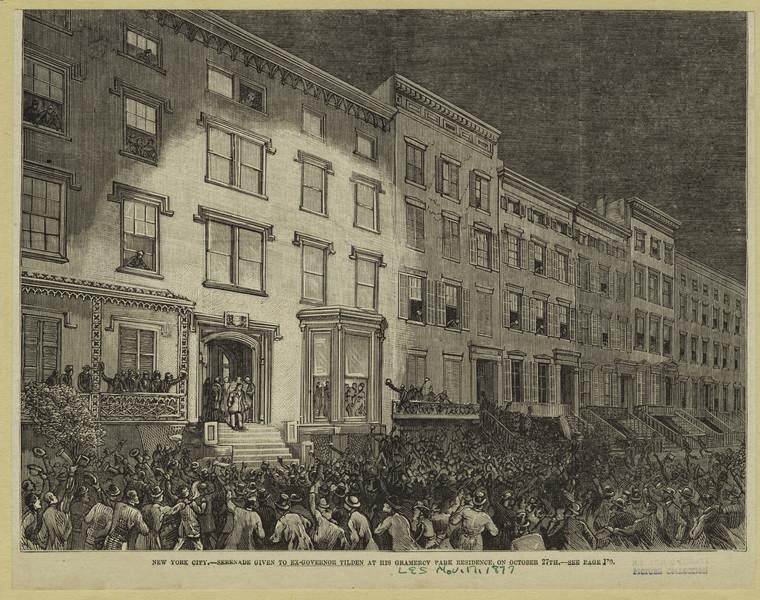
New York governor and almost-U.S. president Samuel Tilden lived in Gramercy Park. His home would later be transformed into the National Arts Club.

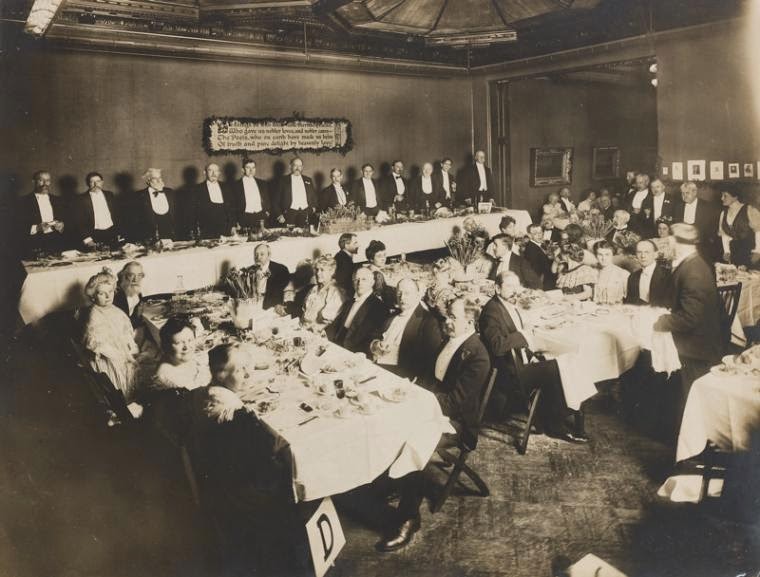
Enjoying a banquet at the National Arts Club in 1908. As you can see, the membership has always been open to both men and women, a trait few social clubs of the day enjoyed. (NYPL)

The Players Club in 1905. In this photo the building is mournfully adorned in black crepe in honor of the actor Joseph Jefferson.

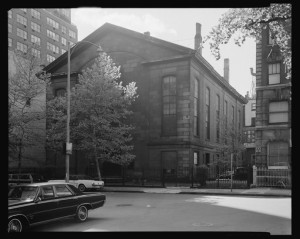
The Friends Meeting House in 1965. It would become the Brotherhood Synagogue ten years later. (Courtesy Wurts Brothers, MCNY) 144 East 20th Street. Exterior of Friends Meeting House.

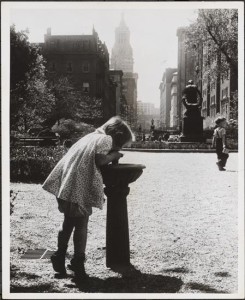
Children within the park, 1944. The Edwin Booth statue stands in the background here (MCNY)

Child drinking from water fountain, Gramercy Park
Categories
Amusements and Thrills Bridges

The ten greatest fireworks displays in New York City history

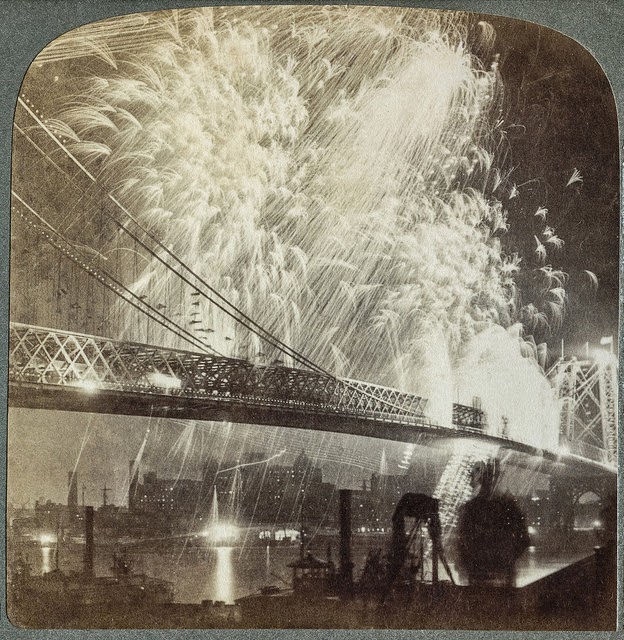
Above: One of my favorite pictures of the Williamsburg Bridge, at its opening in 1903
Nothing befits a fireworks display quite like a skyline to frame it, and no city has a skyline quite like New York City.  And so, despite the obvious dangers of setting off thousands of pounds of explosives in a crowded, flammable city, the city has been subject to some of the most beautiful feats of pyrotechnics in American history.
Here are ten of the greatest examples in the city’s history — celebrations not only of holidays, but vivid displays that highlighted the finest landmarks and accomplishments:

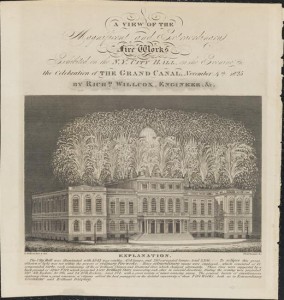
A View of the Magnificent and Extraordinary Fire Works Exhibited on the N.Y. City Hall

1. Opening of the Erie Canal — November 4, 1825
“On November 4, 1825, a spectacular extravaganza celebrated the just finished Erie Canal. City Hall, brilliantly illuminated, proudly overlooked a fireworks display in the park. There was good reason to celebrate:  the canal was the match that lit the fuse that detonated the boom of the 1830s” — Mark Caldwell, New York Night
(Illustration by John Francis Eugene Prod’Homme, Image courtesy MCNY)


2. Celebration for the Transatlantic Telegraph Cable — September 1-3, 1858
This called for a variety of elaborate pyrotechnic displays, including one 21-part program, which included “some new principles were attempted for the first time in the pyrotechnic art,” “two light houses connected by a line of rolling waters, on which the ships slowly moved towards their destination” and “all the splendor of the dazzling colors, assisted by all the mechanical contrivances of which the art is capable”. [source]

Incidentally, this fireworks festival caught City Hall on fire, burning down the cupola! (NYPL)


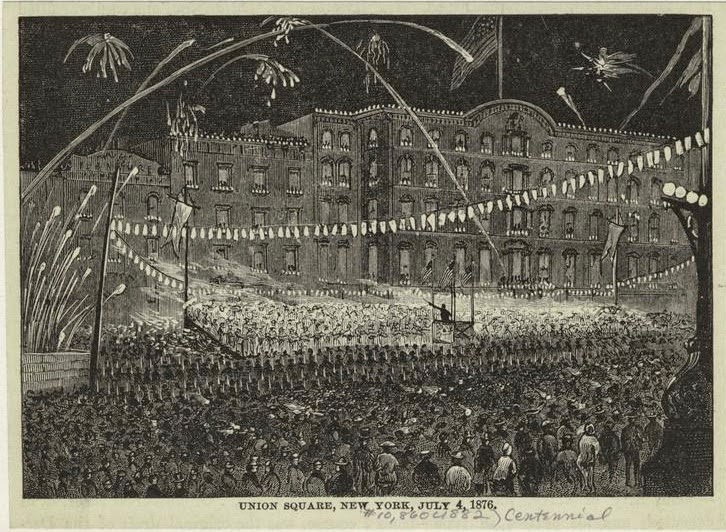
3. American Centennial — July 4, 1876
The all-day centennial celebration culminated in fireworks “representing the Goddess of Liberty sitting on a cloud in the act of greeting,” as well as several street-level “allegoric representations” illuminated in colorful fireworks. [source]


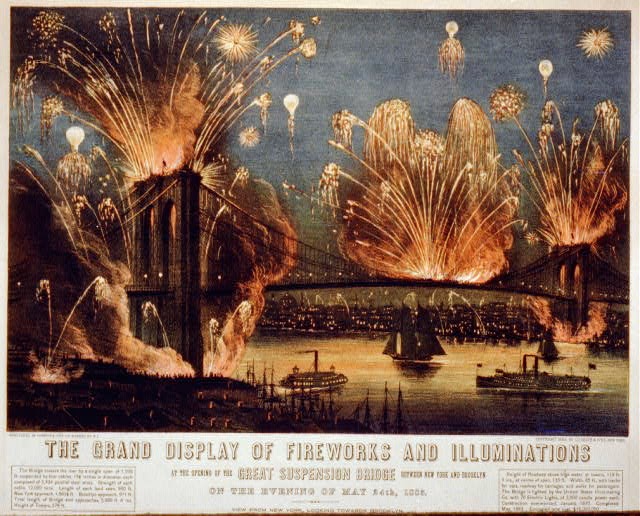
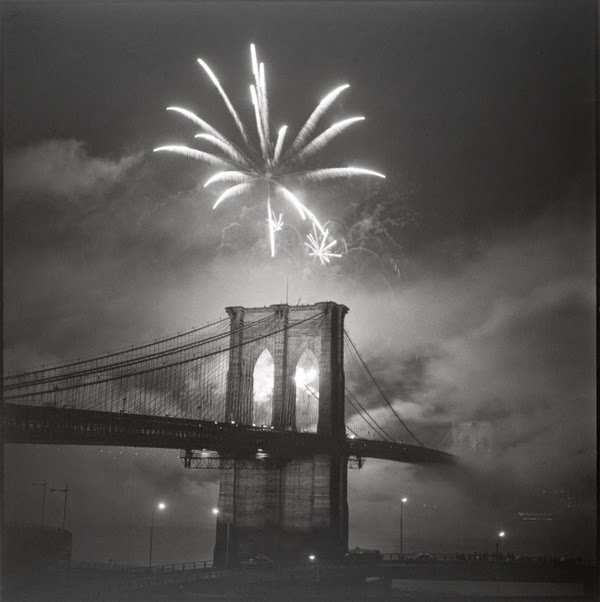
4. Opening of the Brooklyn Bridge — May 24, 1883
“Forty pyrotechnists superintended the display. There were 6,000 four-pound skyrockets, 400 bombshells and 125 fountains of colored lights.  Zinc bombshells of about ten inches in diameter were fired from mortars 500 feet in the air. Each bombshell held 600 stars of various colors.  A newly-invented rocket was displayed.  It held seven parachutes of cloth.  From these hung colored balls of fire.  The rockets burst, leaving the parachutes floating in the air. Five of these rockets were fired at once.  The result was thirty-five balls of colored fire floating in the air…..” [source]


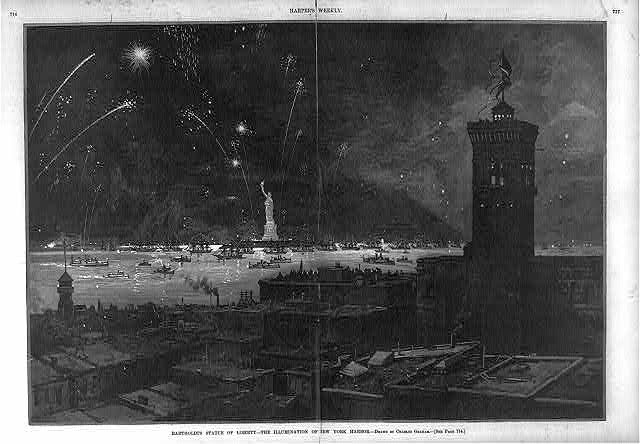
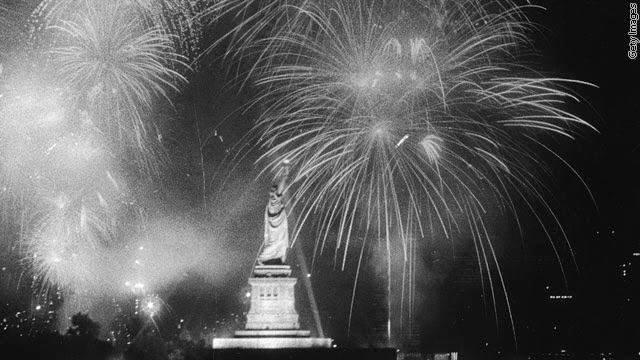
5. Dedication of the Statue of Liberty — October 28, 1886
Well, actually, three days later, on November 1.  A soggy day killed off the fireworks on the day of the statue’s dedication, but were finally launched the following Monday.

“At precisely the hour fixed there came a burst of kaleidoscopic lights from Bedlow’s and Governors Island, and in an instant the air was filled with flying fire balls of every color of the rainbow.”


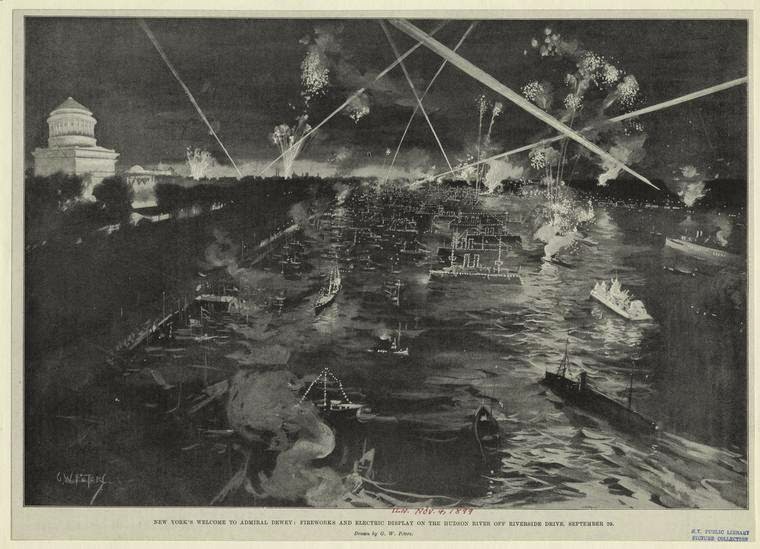
6. Hero’s Welcome for Admiral George Dewey — September 29, 1899
The arrival of Admiral Dewey, the face of the U.S.’s victory in the Spanish-American War,  inspired an exuberant celebration throughout the city.

“The day of Dewey celebration on the water ended in a roaring, popping, banging blaze of glory last night. Fireworks displays lit up the east side, the west side and all around the town. Not only did great boats loaded down with fireworks sweet down all the water-ways and circle about the lower Bay, but in the parks throughout the middle of the city the sky was painted red, white and blue and all the other shades of color known to the pyrotechnic art. ” [New York Sun]  (Illustration by GW Peters, courtesy NYPL)

7. Opening of the Williamsburg Bridge — December 19, 1903
“Then, without warning, the bridge was suddenly transformed into a sheet of flame.  From tower to tower the flames turned and writhed and flared high in the air, illuminating the waterfront for blocks.  Then came a kaleidoscopic medley of colors, red, green, purple, orange, violet — more colors than French ribbon dealer could enumerate — from huge rockets that sails two hundred feet above the bridge.” [source]

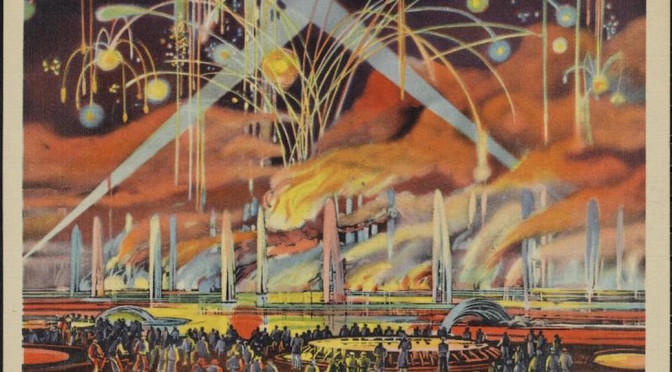
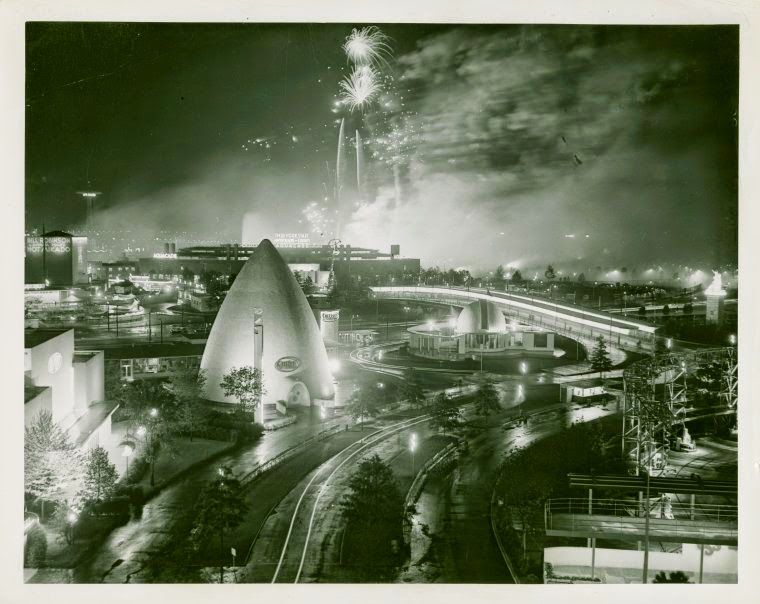
8. New York World’s Fair — July 4, 1939
“Fireworks colored the sky with the red, white and blue of the nation’s colors over the World’s Fair Grounds last night as two spectacular and elaborate displays of fire, water and music were set off, first from the Lagoon of Nations in the exhibit area and a short while later from Fountain Lake in the amusement area.”


9. America’s Bicentennial — July 4, 1976
This event was notable not only for its visibility across the nation — thanks to a television special — but it was the first fireworks display sponsored by Macy’s.   “New York Harbor became more brilliant than Broadway last night as the biggest and most colorful fireworks display in the city’s history exploded for half an hour in celebration of the nation’s Bicentennial.” [NYT]


10. Brooklyn Bridge 100th Birthday — May 24, 1983
“Then the sky simply exploded with fireworks. Red, white and blue shells, golden comets changing to silver, crackling stars in red and green, appeared to fill the entire sky, while hundreds of thousands of people gasped at the sheer dazzle of it all.” [New York Times]
(Bruce Cratsley, courtesy Brooklyn Museum)

Categories
Wartime New York

Decorating the Flatiron Building with cannons and silver coins

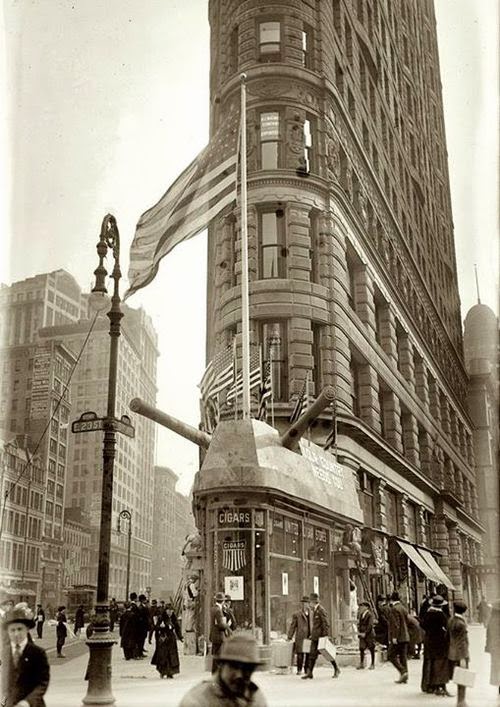
At the very first-floor corner of the Flatiron Building once sat the trusty United Cigar Store.  Being so striking a location in such an unusual building, the cigar store was often decorated occasions.

For instance, one hundred years ago today (April 1, 1914), the windows were filled with 7,150 silver dollars as part of a promotion by the New York Tribune for a newspaper quiz.

“The money is in shining, new silver dollars, and the glittering pile possessed marked magnetic qualities, drawing thousands of shoppers and business men.  The situation of the window gave Broadway and Fifth Avenue equal and simultaneous opportunities to gaze at the treasure.” [source]

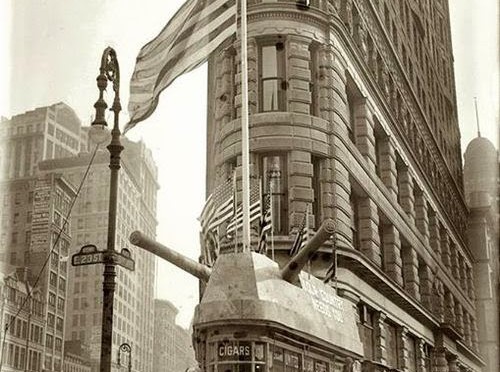
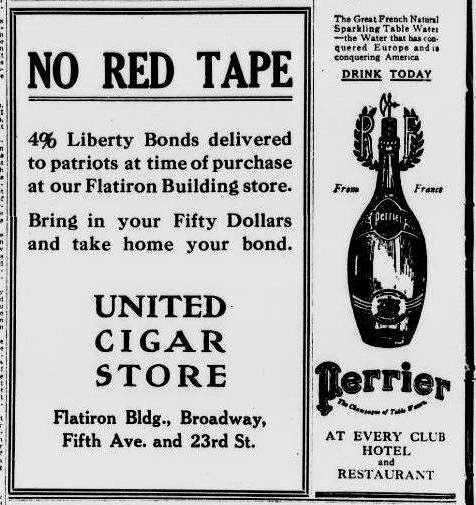
Something more unusual arrived atop the little cigar store a few years later.  With America’s entry into World War I, the patriotic owner of the cigar store donated the space for a recruiting center for the U.S. Navy.  Atop the store were decorative flags and replicas of naval cannons.  A war-stamps salesman would stand astride the cannons and beckon pedestrians to purchases war stamps.

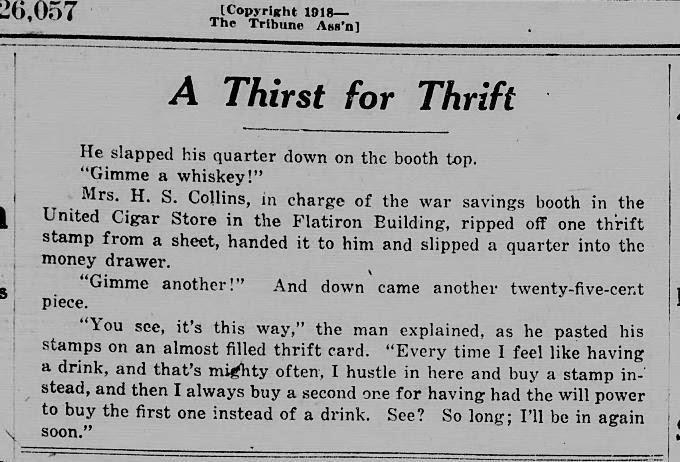
The flamboyant show had a profound effect, as illustrated in this front-page anecdote from March 20, 1918

For a time, the cigar store was one of New York City’s centers for the war effort, an ideal and attractive spot in one of New York’s busiest intersections.  During one such campaign drive, society ladies operated the booths inside while the military band played on the roof, between the cannons.  During the day, there were various demonstrations on front of the cigar store, including one for the Browning machine gun!

To give you a little bit more context of how dramatic this all was, down the street in Union Square sat a wooden Naval battleship, the U.S.S. Recruit.  (Read more about New York’s World War I efforts in my article last year on the history of the wartime doughnut.)

Categories
Health and Living

America’s first free animal hospital, at 350 Lafayette Street, with a roof garden for sick horses

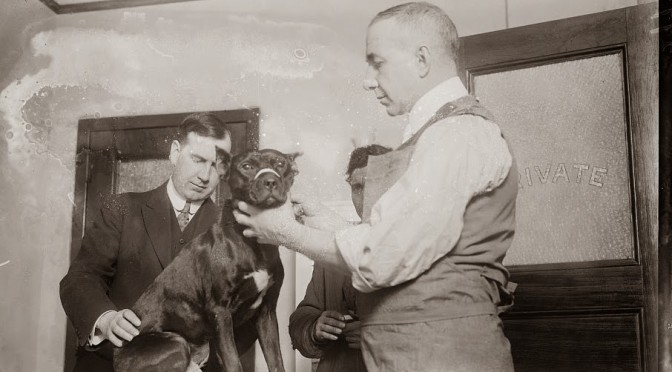
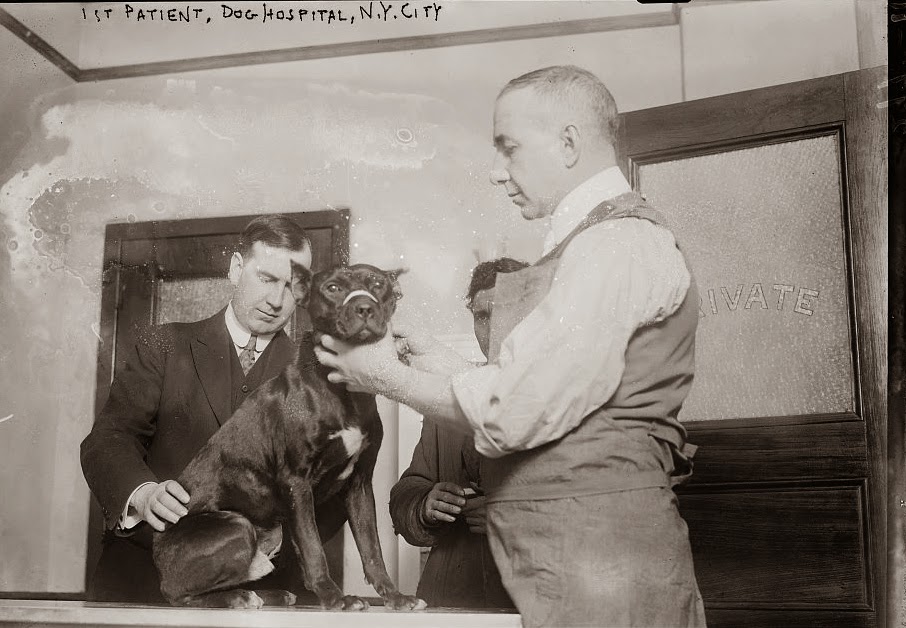
The first official patient of the Free Hospital and Dispensary for Animals at 350 Lafayette Street, under the care of veterinarian Bruce Blair.

The American Society for the Prevention of Cruelty to Animals (ASPCA) was formed in 1866 by philanthropist Henry Bergh.  Eight years later, he helped co-found the New York Society for the Prevention of Cruelty to Children.

Yes, animals came first.  Animals were not only better understood than children, they were instrumental to the daily flow of the city.  Almost every vehicle on the street was horse powered.  The skills of animal husbandry and veterinary medicine were adequately developed in a country that was mostly rural, while the psyches of the human adolescent were only just being appreciated.

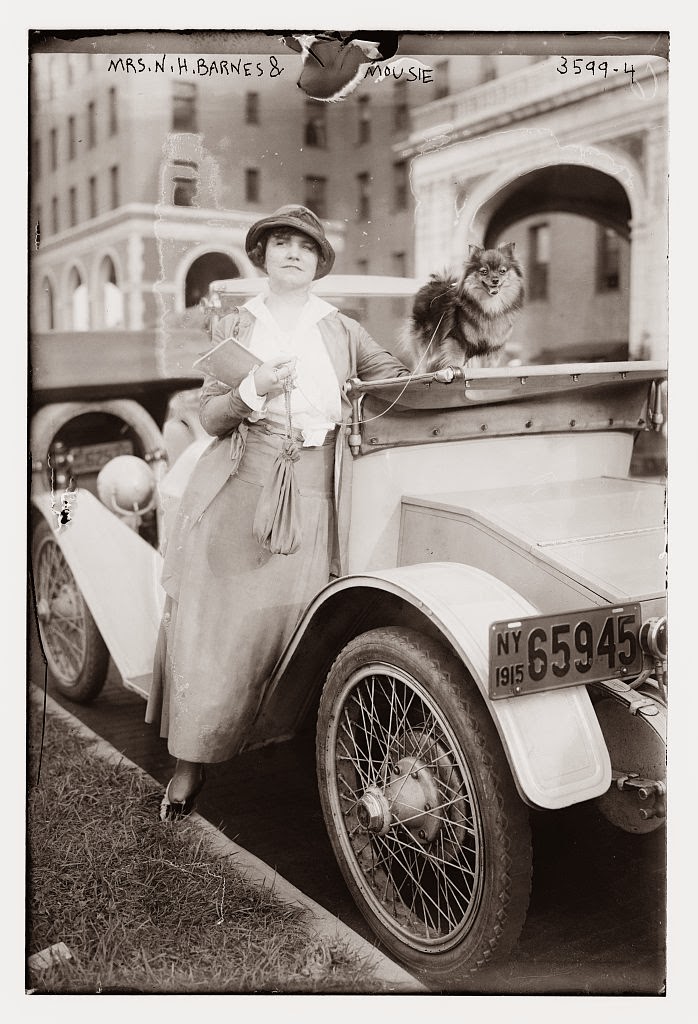
At right: Mrs. N.H. Barnes and her dog Mousie, circa 1910-1915, courtesy Library of Congress

And don’t underestimate the power of the upper crust and their favorite luxury items — exotic pets.  New Yorkers were perhaps empathizing with animals, if not exactly knowing how to treat them.

After all, the menagerie of the Central Park Zoo was created from the bad decisions made by wealthy people, regretting their decisions in bringing unusual animals into their homes.  In 1907, New York even experienced a bit of a monkey craze, with dozens of small primates becoming adorably mischievous fashion accessories.

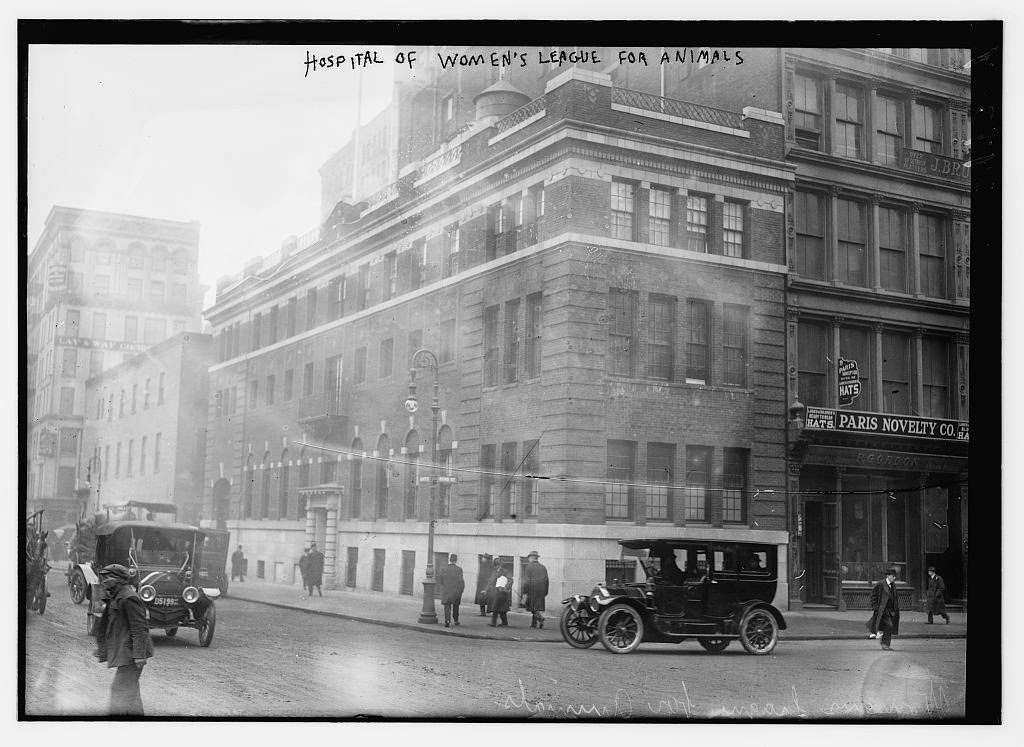
Animal rights became an interesting tangent of New York’s progressive movement, a focus on the well-being of four-legged creatures that culminated, one century ago this week, in the opening of the Free Hospital and Dispensary for Animals (at 350 Lafayette Street), the first institution of its type in the United States.

Like many progressive institutions of the day, the animal hospital was a life’s ambition for a wealthy socialite — in this case, Ellin Prince Speyer, the wife of railroad banker James Speyer (founder of the Provident Loan Society.)

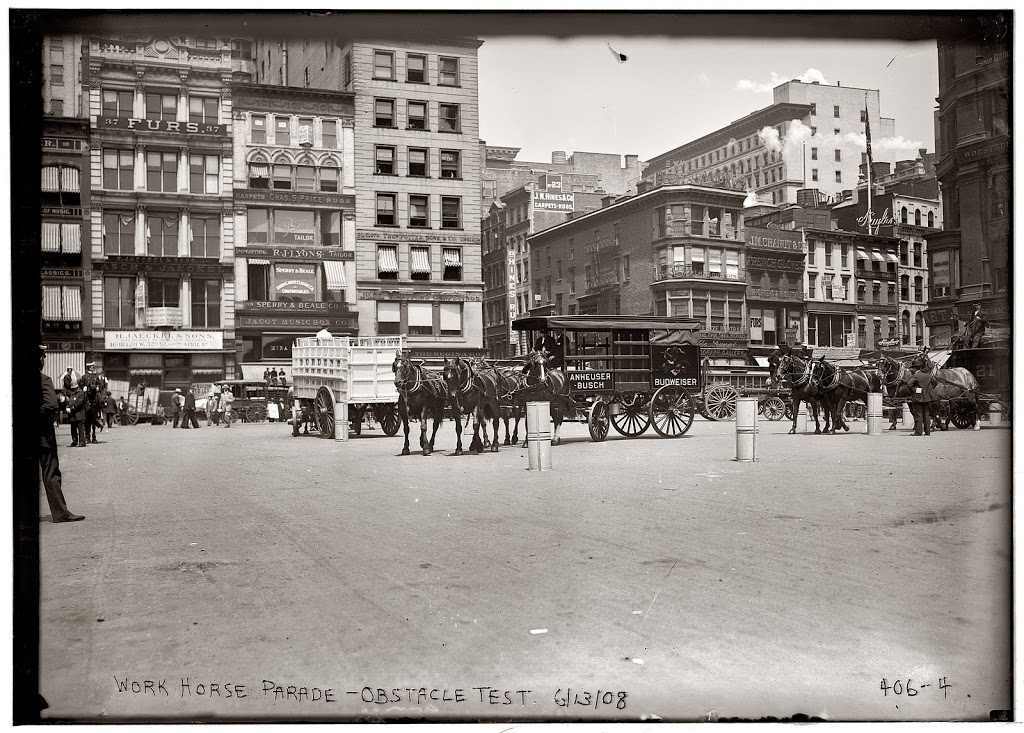
Above: Work horses compete in an obstacle course in Union Square, during the Work Horse Parade of 1908. Picture courtesy Shorpy

Speyer formed a Women’s League of the ASPCA in 1906 and quickly organized public displays that would bring attention to the plight of work animals.  The following year, on Memorial Day, she organized the first annual Work Horse Parade with contests and exhibitions, all in an effort to bring attention to the condition of horses on city streets.

People were given prizes if their old horses were in good shape!  “An effort has been made to induce the peddlers and hucksters of the city to enter,” said the New York Times.

The Women’s League provided watering station for horses during the summer and even free “horse vacations,” renting a farm in upstate New York for the care of older animals.

But the League was concerned with the health of all animals, not just horses.  (Indeed, the New York Sun takes note of Mrs. Speyer’s favorite animal — “the life saving Japanese spaniel Trixie.”)  Members visited area schools to lecture on the proper care and feeding of pets, speaking to the young owners of dogs, cats and birds.

They believed that beneficence to the animal kingdom was a signal to a healthy, moral household.  “You don’t find wife-beaters who are fond of pets and lovers of animals,” said the League in an editorial in 1912.

This sophisticated devotion to animal care was considered truly unique. For instance, when an impressive animal clinic opened at Cornell University in 1911, the New York Times replied with the headline, “Where Sick Animals Are Cared For Like Humans.

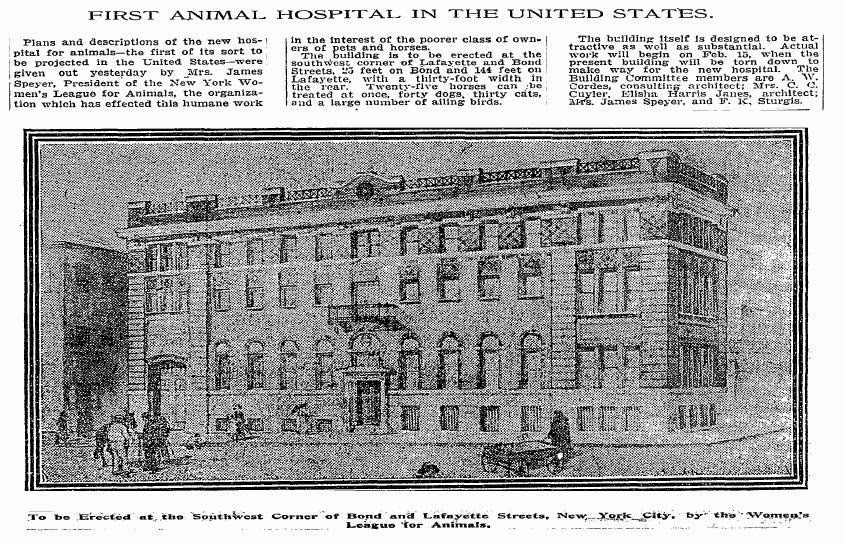
From the New York Times, February 1913

Speyer opened a small animal clinic in New York that same year, but it was woefully inadequate to the needs of New York’s animal population.  So, with the help of lavish benefits and donations from other wealthy families (including many of her banking friends), the Women’s League raised $50,000 and opened up a proper animal hospital on March 14, 1914, the first animal hospital of its kind in the United States.

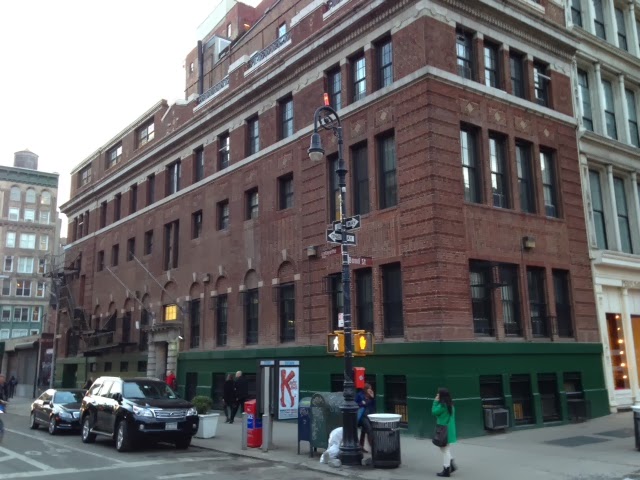
The five-story building is still there today.  New York’s first free animal hospital could accommodate fifty horses and 150 cats and dogs. “There are also operating rooms where every modern appliance for animal surgery is at hand.” [source]

Horses were mostly kept and operated upon on the second floor.  But a rooftop garden accommodated the most sickly horses in need of fresh air and sunshine, lifted there by a large, state-of-the-art elevator.  I suppose it was also used for patients from the third floor — dogs, cats and birds.  Autopsies were also conducted on the roof, and dead animals were disposed of in a basement incinerator. (The Times actually calls it ‘the death room.’)

Perhaps most curious of all — an entire floor was given over to a new apartment for the hospital’s lead veterinarian Dr. Bruce Blair (pictured at top) and his new bride.

On its opening on March 14, Speyer showed the waiting dignitaries a mysterious envelope which contained a $1,000 bill, anonymously donated for the purposes of buying the hospital’s first animal ambulance.

Perhaps the hospital’s most famous patient on opening day was not not a horse, but a green parrot named Abe, who was a bit of a minor film star in 1914.  I believe this was the star of the 1914 Oliver Hardy film The Green Alarm.

Today, the Animal Medical Center  traces its lineage to this first animal hospital and to Speyer’s organization.  It moved to its current location on the Upper East Side in 1962. (You can read more about their history here.)

Here’s the building as it looks today:

Categories
Pop Culture

The first Sherlock Holmes film ever was made in Union Square. And the second? In Flatbush, Brooklyn

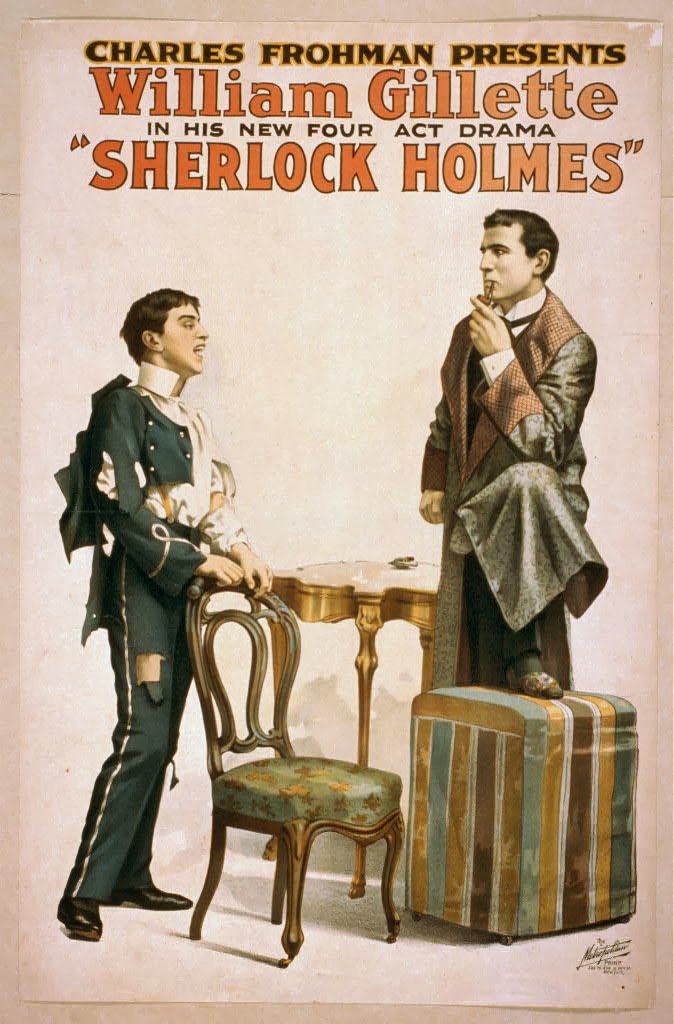
Above: While Sherlock Holmes made his film debut in 1900, he hit the stage a bit earlier.  William Gillette was the most acclaimed Sherlock of the day, touring the United States in a play he co-wrote with the detective’s creator Sir Arthur Conan Doyle.  After a tryout in Buffalo, the play made its debut at the Garrick Theatre (67 West 35th Street) in New York on November 6, 1899.

There are two varieties of Sherlock Holmes these days — the British alternative kind (Sherlock, with Benedict Cumberbatch) and the New York variant (Elementary, with Jonny Lee Miller).  You might naturally assume that Cumberbatch’s Sherlock Holmes is closer in spirit to the original stories by Sir Arthur Conan Doyle.  But the modern-day CBS variation, which is filmed in New York City, actually brings the classic detective stories back to its original roots in the cinema.

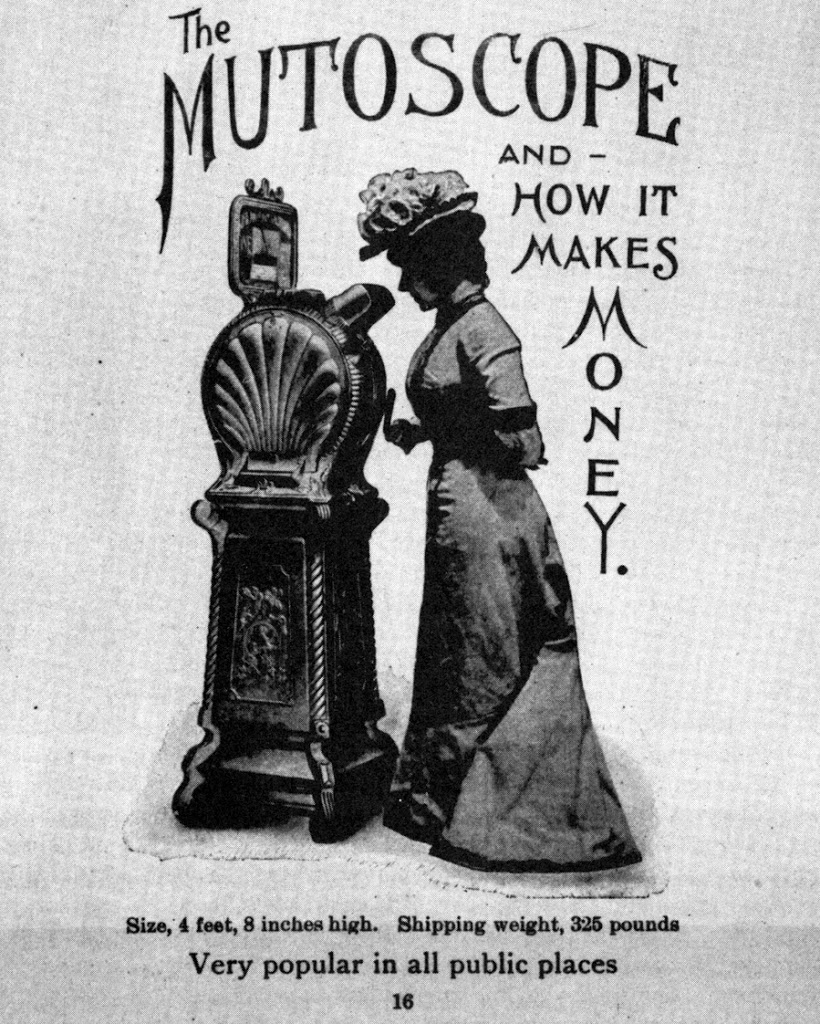
The first attempt to bring Sherlock Holmes to the film medium was in the year 1900 with Biograph-Mutoscope’s Sherlock Holmes Baffled.  Mutoscope films were not projected, but rather, displayed in a stand-alone box for a single person to view, the images moving with the help of a hand crank.  (At right: An 1899 trade advertisement for the Mutoscope).

Most early Mutoscope films were documentary in nature (often boxers or acrobats), similar to those for Thomas Edison‘s Kinetoscope.  The very first movie made in the city of New York was a boxing match featuring Young Griffo, made for another competing film device, the Eidoscope, and filmed atop old Madison Square Garden.

Due to the short running time of films made for these private viewing consoles, the first narrative films were crude, silly and often confusing, throwing viewers into an action scene that abruptly stops.   That is the case with Sherlock Holmes Baffled, seen here in its entirety:

Outside of the title card, the move bares no traits of Sherlock Holmes whatsoever.  It seems to merely borrow the name to present a wacky narrative involving the detective discovering a thief who then disappears and re-appears at a whim.

The movie was made at Biograph’s revolving rooftop studio at 841 Broadway in Union Square.  That original building was demolished at some point to make way for the Roosevelt Building.  In an accidental tie to its movie heritage, across from the Roosevelt is the Regal Union Square Stadium multiplex, which has undoubtedly seen more sophisticated Sherlock Holmes movies (such as the Robert Downey Jr. version) since it was constructed in 1998.

The identity of the actor who played the first Sherlock Holmes is apparently unknown.

Biograph would continue using Union Square as a site for film production.  They moved to another studio in 1906 — just up the street, at 11 14th Street — where they produced ever more extravagent movies, including a reinactment of the San Francisco earthquake, rushed into theater just months after the disaster struck the West Coast city on April 18, 1906.

From my original article:  “What seems especially brazen about this fabrication is that it was being created in New York’s Union Square, even as San Francisco’s public square of the same name sat in ruins.”

Five years later, a slightly more recognizable Sherlock Holmes can be seen in The Adventures of Sherlock Holmes, or Held For A Ransom.  In this version, Sherlock is played by vaudeville star Gilbert Anderson, best known for his appearance in The Great Train Robbery. (He was later renamed ‘Bronco’ Billy Anderson due to his later fame as an early cowboy film star.)  

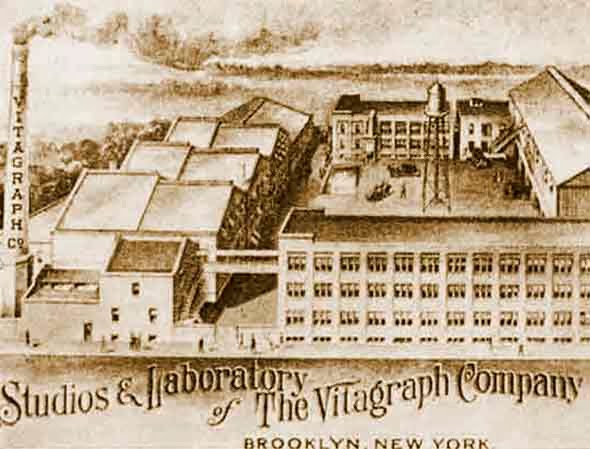
This, too, was filmed in New York — at Vitagraph Studios in Flatbush, Brooklyn!  Pictured below:

Top picture courtesy the Library of Congress

Categories
Health and Living Those Were The Days

Close shave: A century ago, barbers riot through New York, leaving half-shaved men in vacated barber shops

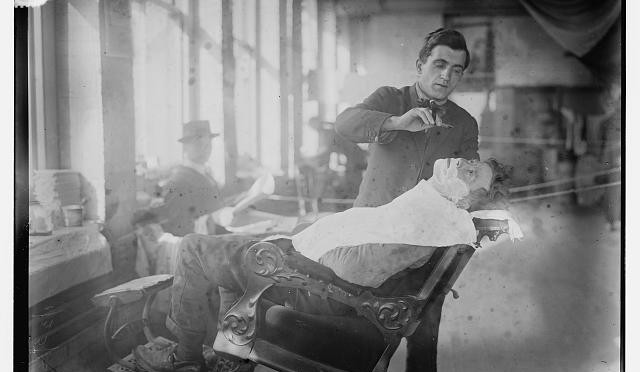
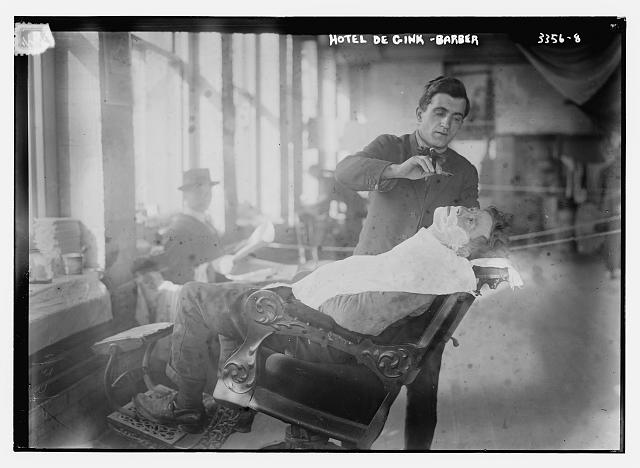
A barber shop at the Hotel de Gink on the Bowery, circa 1910-15 [LOC]

The fight for worker’s rights swept through a variety of occupations over a century ago as New York City laborers rebelled against unfair corporate practices and unsafe working conditions.

Garment workers marched the avenues in protest following the tragic Triangle Factory fire of 1911, as did underpaid street cleaners and ashcart men, leaving heaps of un-retrieved rubbish on the street in protest.  The following year, the waiters and staff of dozens of New York’s finest hotels took to the streets for better pay. Why, by 1913, even some players on the Brooklyn Dodgers were unionizing!

And one hundred years ago this month, it was the barbers turn to march.
Many of the same leaders from other occupational strikes were at the center of the barber strike, which got its footing in the Brooklyn neighborhood of Brownsville.  Soon, barbers across the city had dropped their razors and foaming brushes and left work in consolidation for better hours.
A letter-writer to a wonderfully named 1913 journal called Journeyman Barber, Hairdresser, Cosmetologist and Proprietor wrote, “I will say that on a certain bright morning in the month of May, I found that the entire barber industry was paralyzed.  Nearly 13,000 workingmen were out on strike. Isn’t that a miracle?  Thirteen thousand barbers on strike!”
Mayhem reigned upon the craggy, unshaven faces of Brooklyn men.  “From Bushwick to Bay Ridge haggard men go about with the telltale blemish encroaching upon their visages like a noxious fungus.  Half-shaved men slink about the alleys, avoiding the light of day.” [source]
Scenes of violence did erupt throughout the city, as strike-breakers were attacked and angry mobs filled the street.  A mob of 5,000 strikers — “singing socialistic songs,” noted the New York Tribune — clashed with police in Brownsville on May 7th, customers fleeing barber shops in “a shower of vegetables” and the occasional flying rock.

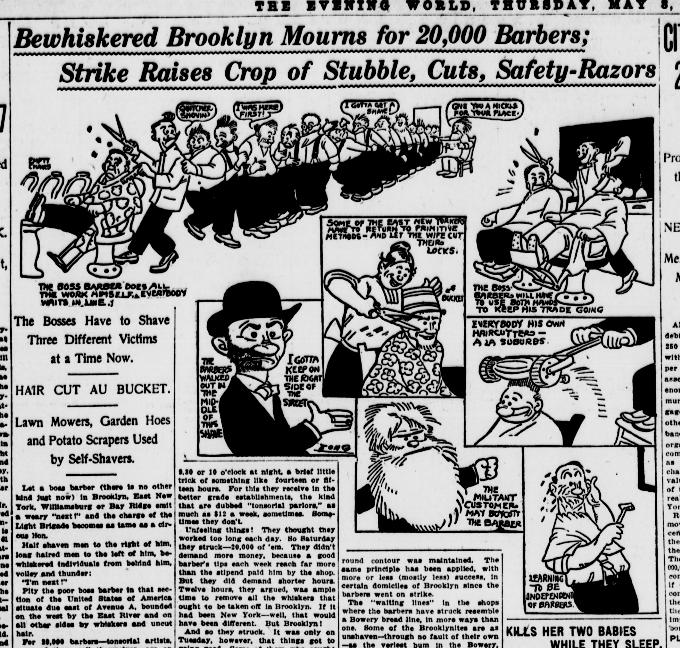
Below: a cheeky editorial cartoon from the May 8th 1913 Evening World

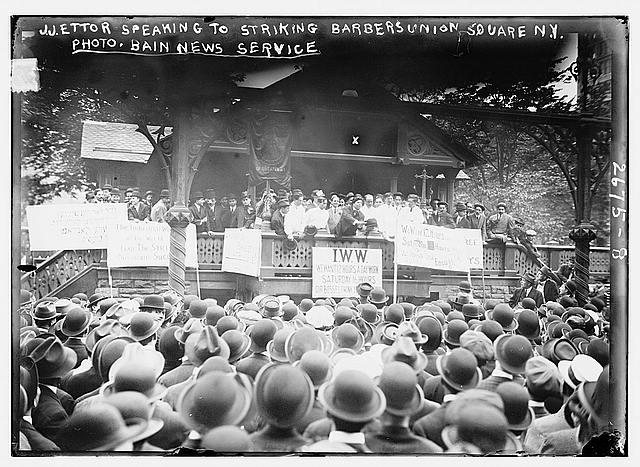
A couple days later, thousands of barbers marched across the Brooklyn Bridge to Union Square, gathering up working men along the way, emptying barber shops of employees and leaving stunned customers in their chairs.  In Union Square the strikers heard speeches from organizers including Joseph James Ettor (pictured below), who had helped organize the waiter’s strike just a few months before.

The Evening World makes curious note of one exception to this striking throng. “ONLY LADY BARBERS WORK IN BROOKLYN WHILE MEN STRIKE” went the headline.  “Such a business as the feminine barber shops did!”

Manhattan barbers joined their Brooklyn brothers by mid-month, setting up a Manhattan strike headquarters at 140 Second Avenue.  (Today, that the address of the Ukrainian East Village restaurant.)  Arlington Hall at nearby St. Mark’s Place was the scene of several union gatherings for striking barbers.

Descriptions of rioting barbers sound a bit like scenes from the Civil War draft riots, although much of that description was the newspaper flourish of the day.

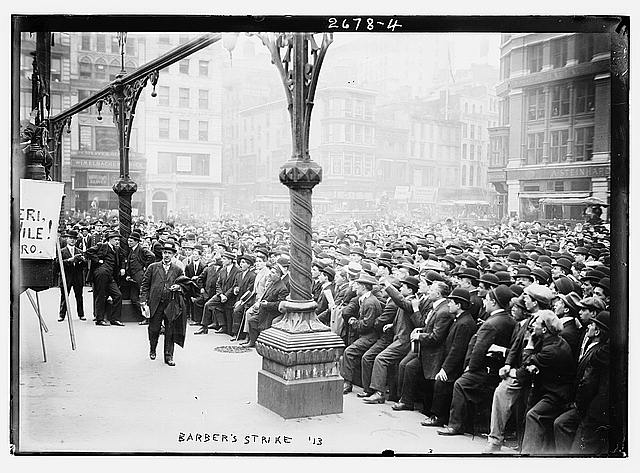
Below: Thousands of barber shop workers and their supporters gather in Union Square in 1913. I believe this is the northwest corner of the park. (LOC)

But it does sound like a violent few days in Manhattan.  Shop windows were smashed by rioters in the Ladies Mile shopping district, and altercations with store owners put many in the hospital.  The Sun noted: “Window smashing and attacks on workers, common all day, culminated in dozens of small riots all over the city, so many and so rapid that police headquarters heard of them in bunches.”

Eventually, the strike proved a success, as barbershop owners agreed to worker’s demands.  According to one source, instead of working up to 92 hours a week, employers now agreed to the relatively mild 62 hours a week for their workers, with one entire day off on Sunday! [source]

“2,300 Boss Barbers Capitulate,” declared the Evening World on May 30th. “Brooklyn Strike Over.” By the first of June, it was safe again to go to a barber shop.

Categories
Podcasts

The Brooklyn Academy of Music: Enduring floods, fires and snobbery to become New York’s oldest home for the arts

PODCAST One of America’s oldest cultural institutions, the Brooklyn Academy of Music (or BAM) has an unusual history that spans over 150 years and two separate locations. We trace the story from the earliest roots of a Manhattan-Brooklyn rivalry and a discussion of high-class tastes to the greatest stars of the performing arts, including a couple tragic tales and a bizarre event involving the mother of modern dance.

Featuring horse tricks, French balls, a ‘flirtation’ post office, a bit of ski jumping.and a cavalcade of BAM’s greatest stars — Enrico Caruso, Merce Cunningham, Edwin Booth and his brother John Wilkes Booth!

ALSO: We uncover what may be the very first foreign films ever shown at the Brooklyn Academy of Music, many decades before the opening of their movie theaters.


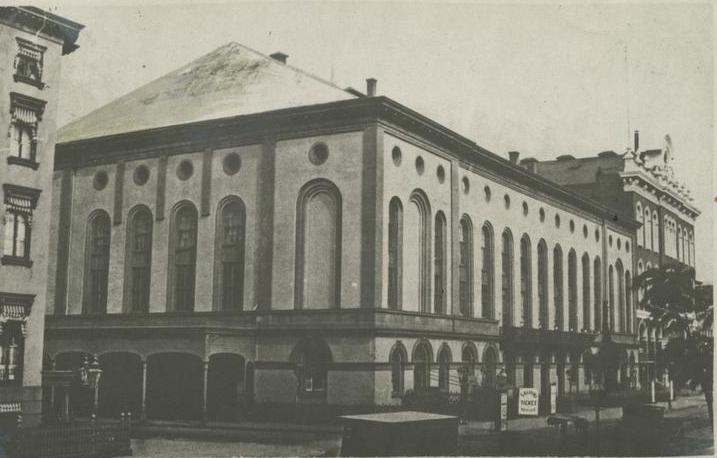
The first Brooklyn Academy of Music, on Montague Street, nearby Brooklyn City Hall. Among the decades of great events here were Brooklyn’s Sanitary Fair, a speech by Booker T. Washington, an amusing lecture by Mark Twain and the final stage performance of Shakespearean actor Edwin Booth. (source)

The building was destroyed by fire in 1903, and not everybody was sad to see it go. Here’s actual film footage of the flames atop the old Brooklyn building:

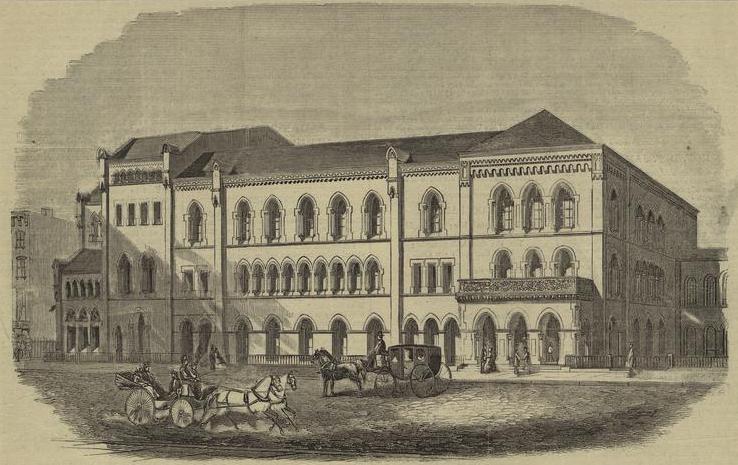
Compare this to New York’s own Academy of Music, at 14th Street and Irving Place. Although this venue brought the American debuts of many famous operas (including Carmen), festivities deteriorated once the Manhattan wealth moved up to the Metropolitan Opera House. This building was demolished in 1926. [source]

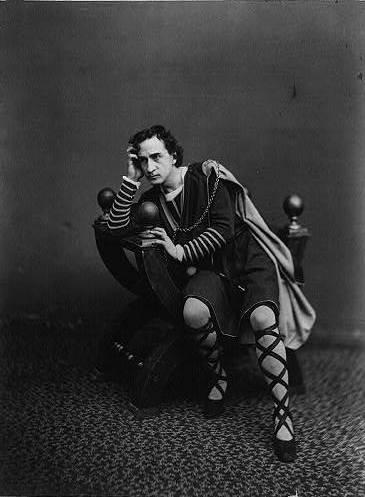
Edwin Booth, in his signature role as Hamlet, 1870. If some at the original Brooklyn Academy of Music had had their way, Booth would never have performed there! [LOC]


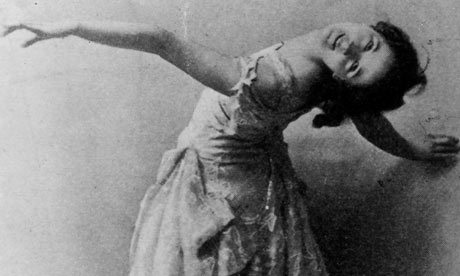
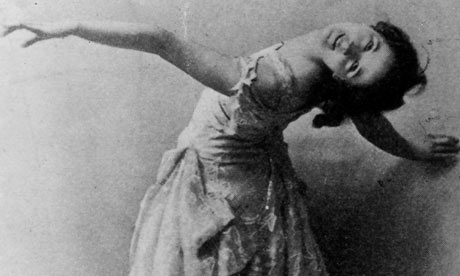
Isadora Duncan, who brought modern dance to BAM, and it never left. (source)


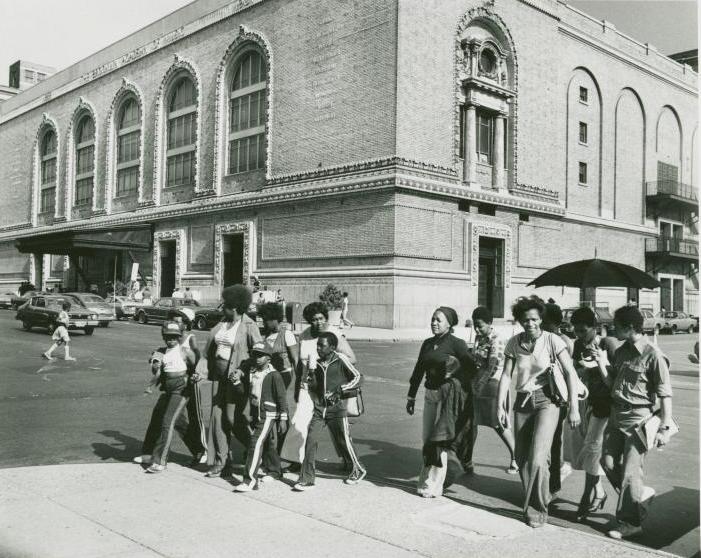
BAM in 1978: After a few decades of hardship, the venue, at its new home on Lafayette Avenue, rebounded in the 1960s, serving the artistic passions of the neighborhood and fostering a provocative relationship with the biggest names in avant garde performance. (Pic by Dinanda Nooney, NYPL)

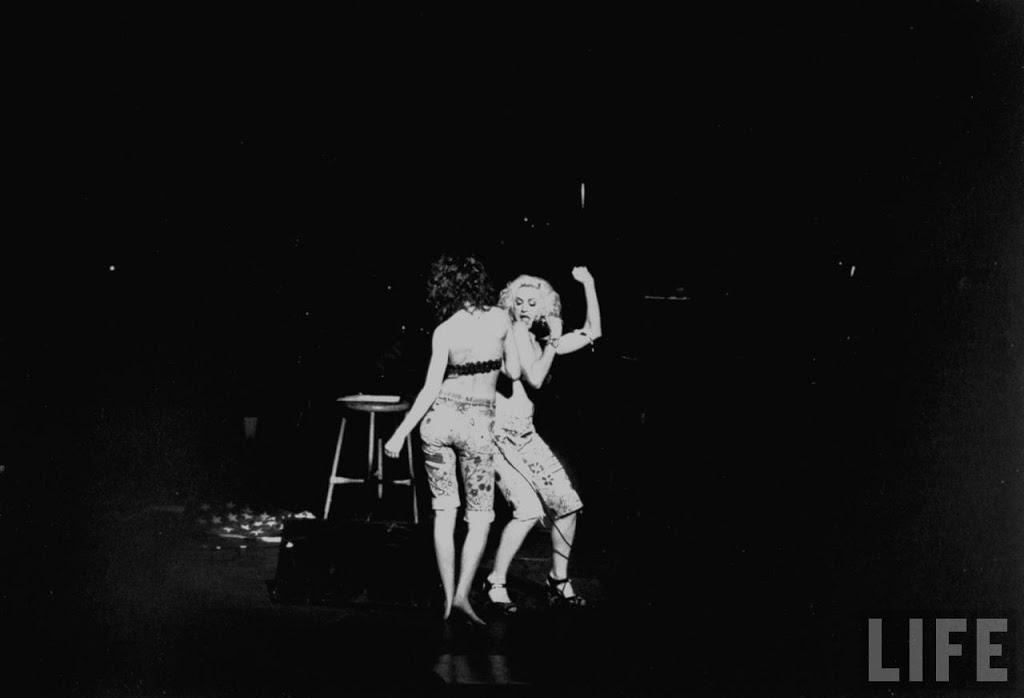
The fascinating directions that BAM executive direction Harvey Lichtenstein took the venue opened its stage up to new and exciting performances. And, often, a raucous good time as well, as with this 1989 rain forest benefit, featuring Madonna and Sandra Bernhard. (Photo by Albert Ferreira, LIFE)

MORE PICTURES ON THE WAY LATER THIS WEEKEND

For more information on their schedule, visit the BAM website. They also have a great history blog BAM 150 Years where we obtained some of our information.

Categories
Mad Men

‘Mad Men’ notes: The secrets of the New Yawk accent


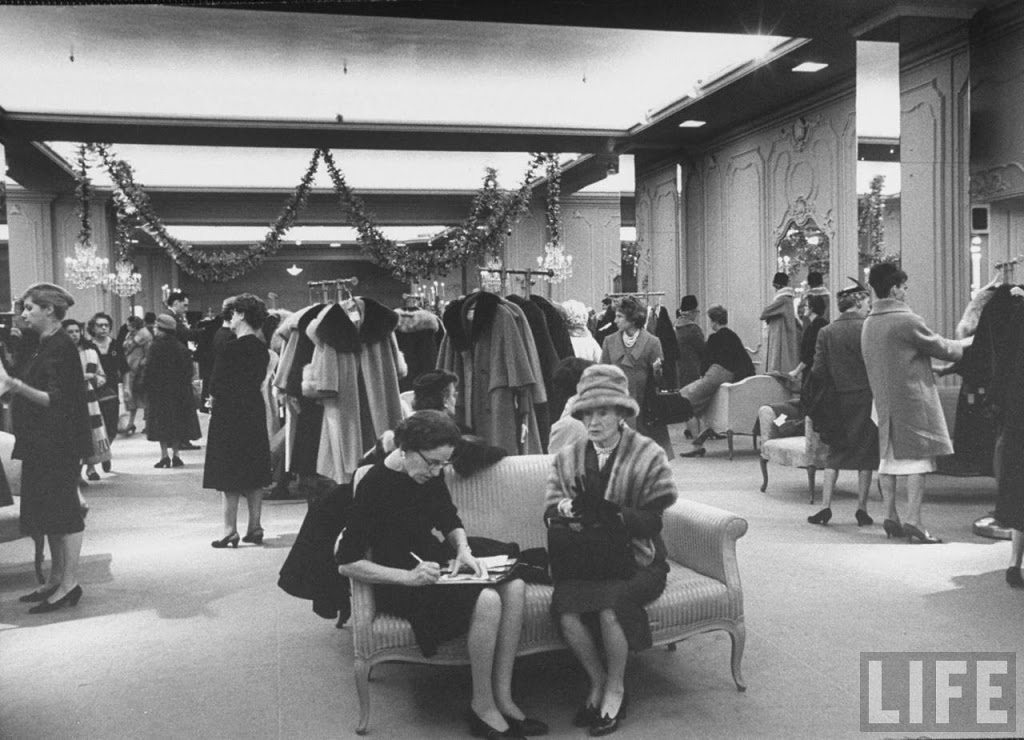
On the upper floor — or flooah? — with the upper crust: Ladies coats at Sak’s Fifth Avenue in 1960, photo by Alfred Eisenstaedt (LIFE)


WARNING The article contains a few spoilers about last night’s ‘Mad Men’ on AMC, so if you’re a fan of the show, come back once you’re watched the episode.

A culture clash between New Yorkers from different races and classes came barreling through the storyline of ‘Mad Men‘ this week. While Peggy Olson had an awkward bonding moment with the new black secretary Dawn, a morbidly ill Don Draper took out his emotional tensions on the new Jewish copywriter Michael Ginsberg.

As revealed last week, Ginsberg is a ‘real’ New Yorker, living in a tiny apartment with his very devout father with a thick Yiddish accent. This week, Draper chastised the casual, Brooklyn-esque tone of Ginsberg voice, possibly implying a dig at the character’s Jewish roots. In response, Ginsberg defended his ‘regional accent’ and pointed out that Don, too, had an accent. The new kid eventually shines at a pitch meeting emulating a presentation style (and even vocal techniques) ripped from the Draper playbook

On a personal note, I’ve been fighting with accents my whole life, born with an Ozarks drawl only to develop the standard Midwestern ‘newscaster’ voice by high school, then living in New York for almost two decades and now slowly beginning to sound like it. So I found Don’s personal affront particularly interesting, as everything about him is a facade, including the voice. (I also went to school with fellow Missourian Jon Hamm, but that’s for another posting.)

Until last night, it never occurred to me that the secret to New York’s modern local tone — the many borough-specific variants of the New Yawk accent, if you will — was actually ‘discovered’, academically speaking, in a published study released in 1966, the year this season of ‘Mad Men’ is set.

Linguist expert William Labov was a Columbia University doctoral student in the early 1960s when he embarked on an extraordinary and influential study of the New York accent, the results of which were released as The Social Stratification of English in New York City in 1966.

The standard New York accent was historically presented as street jargon, whether it be the New York Times writing out the words of newsboys phonetically (“Dere’s tree t’ousand of us and we’ll win sure”) or the broad slang-filled movies of the Bowery Boys acting troupe (“Whadda ya hear! Whadda ya say!”). Upper class New Yorkers from old families frequently carried a New England lilt in their voices.

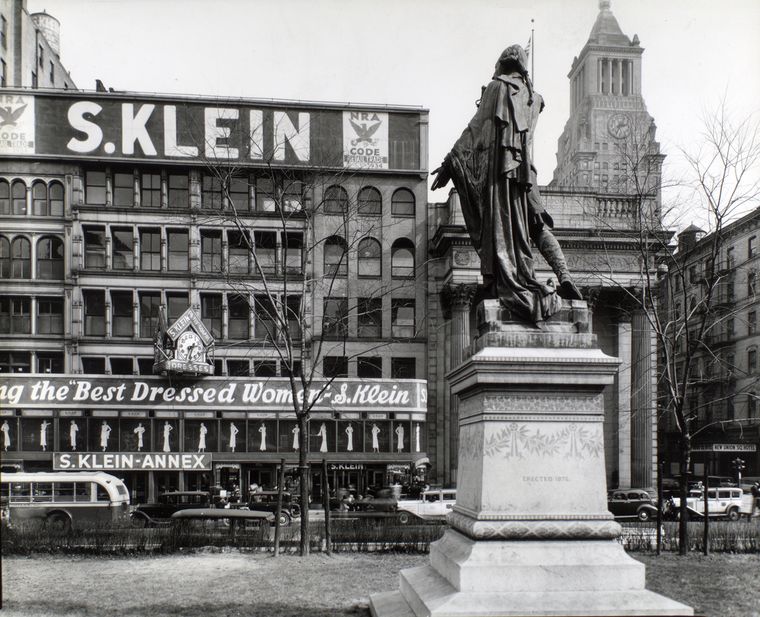
What seems inherent from comparing those two examples was flatly proved by Labov’s fascinating experiments done in three New York City department stores — the affordable S. Klein’s in Union Square, the higher priced Macy’s in Herald Square, and the very exclusive Saks Fifth Avenue — attracting shoppers from different social classes.

Below: Klein’s ‘on the Square’ in 1936, photo by Berenice Abbott.

I would have loved to have assisted Mr. Labov out with his experiments. Throughout the day, he asked employees from each store where the women’s coat department were located. In the case of these three stores, it was on the fourth floor. Or the fowth flooah or even the fowt flooah. When asked to repeat what they said, people would most likely restate ‘fourth floor’ with the -r more carefully said, as though it was their accent that had caused the confusion.

Those employees of S. Klein were far more likely to lose their -r sounds, while those from Saks were least likely. But Labov’s study found an additional quirk. On higher floors, where more expensive items were sold in each case, people more likely kept their -r sounds.

His conclusion found that “rhocity increased with the prestige of the department store” and that it even increased within the store itself. How the words were clearly pronounced and presented did not specifically depend on the geographical origin of the speaker, but on socioeconomic considerations. Labov concluded that New Yorkers of the 1960s generally disliked their own accents and subconsciously chose to mask it. “The term ‘linguistic self-hatred’ is not too extreme to apply to the situation,” he stated in his report. “As far as language is concerned, New York City may be characterized as a great sink of negative prestige.” [source]

Labov’s 1966 study is considered one of the most important linguistic findings of the late 20th century. Today Labov is considered the father of sociolinguistics. Whether his conclusions still apply today is a question for modern researchers. But they add an interesting new context to this burgeoning competition between Draper and Ginsberg, a symbolic competition between the ‘fake’ and the ‘real’.

A chemical company in Union Square sells a kingly elixir

One hundred years ago today (June 23), the big news was the coronation of England’s King George at Westminster Abbey. Judging from the New York papers, American fascination with this event makes the recent royal nuptials of William and Kate seem like a forgettable folly. The June 23, 1911, issue of the New York Tribune is filled with illustrations of queens, crowns and processions.

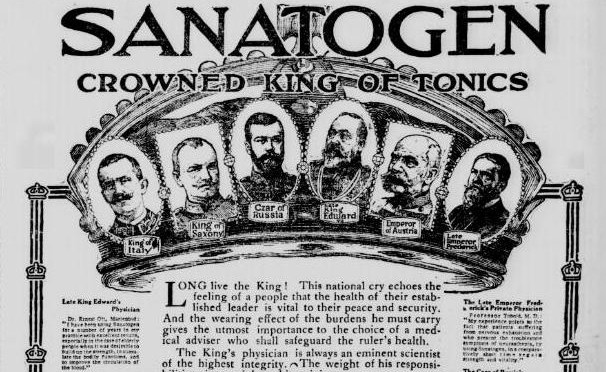
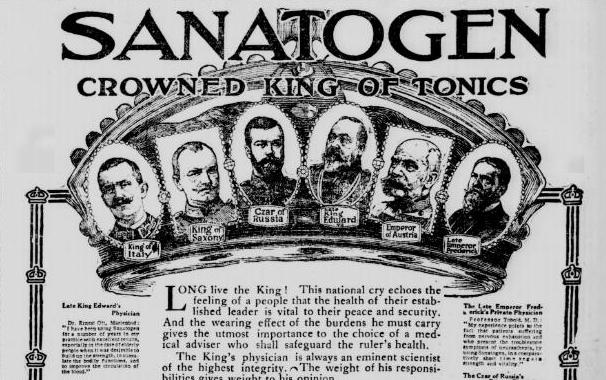
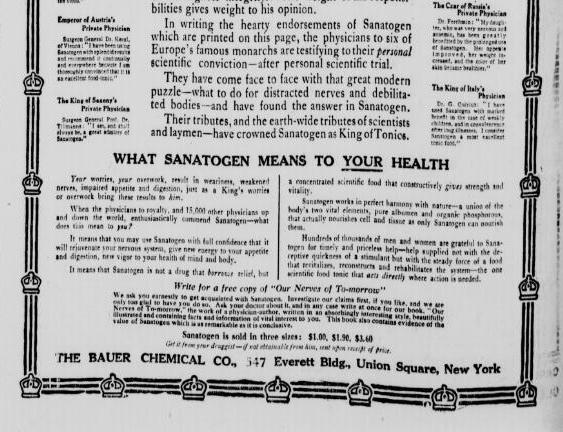
What grabbed my attention, however, was the king-themed advertisement that ran big and bold on the second page. Here are two sections of it (the original is here):

Sanatogen was a kind of vitamin water, “a concentrated scientific food that constructively gives strength and vitality.” According to this advertisement, most of the crowded heads of Europe swear by it!

What caught my interest, however, was the location of its American distributor — the Bauer Chemical Co. in Union Square. A chemical company in one of New York’s most bustling public spaces?

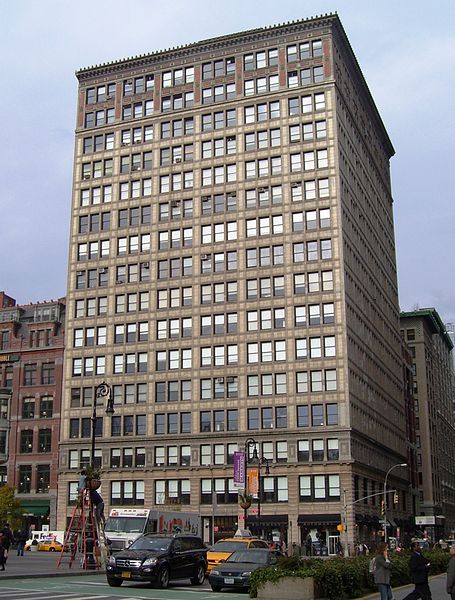
Bauer was located in the Everett Building*, at the northeast corner of the park, right across the street from the Germania Life Insurance Company Building and, back in 1911, catty-corner from the headquarters of Tammany Hall. The Everett, with its simple and rigid face, was designed by Starret & Van Vleck, famous for their department-store designs. Indeed, the uptown flagships of Lord & Taylor and Bloomingdale’s look like more elegant versions of the Everett.

Bauer moved in sometime after the Everett’s opening in 1908. They were the exclusive distributor of Sanatogen in the United States and seem to have done quite well by it. “Nerves have a Hunger of their Own,” said one ominous 1916 advertisement. “Sanatogen helps satisfy it.” It also cures “Neurasthenia” and “Cholera Infantum.” Remarkable!

The reason anybody really knows The Bauer Chemical Company is that it was a party in a landmark U.S. Supreme Court case, Bauer & Cie. v. O’Donnell, a case involving the sale of Sanatogen, essentially affirming that selling the product below the suggested price to customers, as one druggist O’Donnell attempted, did not violate the terms of license.

After the trial, it appears the company moved a block over to Irving Place by the mid 1910s. I’m not sure what happened to them after that. However, although King George is long gone, you can still buy Sanatogen in the U.K.! And their products seem to be labeled to accurately describe their recommended usage.

*The Everett Building is named for the Everett House, a luxury accommodation that once sat at this very corner. In its day, the Everett played host to many a Democratic bigwig — Tammany was across the street after all — and, since we’re on a British royal kick, once housed the Prince of Wales in 1860.

The San Francisco Earthquake, as recreated in New York


San Francisco burns — in New York

The first American newsreel debuted just over one hundred years ago, representing the first real attempt to contextualize the moving images of actual events into a stream of information that could emulate a newspaper. The French film company Pathe and the New York-based Vitagraph both debuted edited silent newsreels in the city in 1911.

Before this time, actual events where contained in straightforward ‘news films’ or actualities that were presented at Nickelodeons and other exhibition spaces alongside narrative fiction shorts. As a result, there wasn’t a strict need to display accuracy in filming real life.

Biograph Studios was especially guilty of this. From its studios at 11 East 14th Street in New York’s Union Square and in locations nearby, the film company recreated a variety of news events. Audiences could be easily fooled in 1906; real events, from moving trains to boxing matches, already seemed fantastic to eyes untrained to cinema. And so, sometime in the spring of 1906, it didn’t seem like a bad idea to the Biograph production team to simply recreate the San Francisco earthquake, one of the worst natural tragedies in American history.

The devastating quake that rocked the California coast on April 18, 1906, killed over 3,000 people and nearly wiped the young city off the map. But with one exception (which I’ll mention), nobody was filming it, much less capturing it in a way that could encapsulate the horror and damage it caused.

Enter Biograph general manager George E. Van Guysling. He and his crew produced an elaborate model of San Francisco at their 14th Street studio, a mini-metropolis of cardboard and clay, replete “a yawning cavity which appeared to split the city in two.” As a camera took note, the New York film crew pulled San Francisco asunder, setting it ablaze.

It seems to be this must have looked spectacularly fake to our eyes today, a regular Ray Harryhousen-type production from a 1960s monster movie. But the eye of the film goer was not as explicitly trained to spot fabrication in 1906, nor were audiences jaded enough to expect it.

What seems especially brazen about this fabrication is that it was being created in New York’s Union Square, even as San Francisco’s public square of the same name sat in ruins.

Biograph quickly put the film into circulation, and the footage was a hit with shocked and amazed audiences. Allegedly, both the mayor of San Francisco and one of California’s senators thought the footage to be real. (Of course, that would have required a fortuitous placement of camera at just the right time and place.) Had it been taken for the fake that it was, the studio’s cavalier recreation of a disaster that killed over 3,000 people would probably not have been as warmly received.

A San Francisco filmmaker named Henry Miles did in fact record some of the earthquake in action. (The earthquake actually destroyed his own film studio in the process.) Being real footage, it was apparently not as perfectly framed as Biograph’s fake movie. As a result, when Miles released it for distribution, it was not a success, according to author Raymond Fielding and his book on the history of the newsreel.

Faking the events would not be the norm. Edison’s film studio, of course, was adept at successful ‘news films’, and clearly unstaged events — from European coronations to parades down Broadway — would be hits with audiences. In fact, Edison even filmed the aftermath of the San Francisco earthquake, and the footage provides some of the most powerful images of the tragedy:

Not surprisingly, one of the first disasters to be filmed in New York was the blaze that destroyed the Powers Film Studio in the Bronx in June 1911. After all, the cameras were already there! The New York Times proclaimed: “MOVING PICTURE FIRE CAUGHT BY CAMERA; Man Behind the Film Snaps the Players as They Escape from Canned Drama Plant.”

But even with the introduction of journalistic standards and the somewhat legitimate format of the newsreel, filmmakers still frequently fudged real news events. (After all, don’t they sometimes do that today?)

Even the renown March of Time newsreels, produced by Henry Luce at their midtown offices at 460 West 54th Street, was known to fabricate events in the 1940s. During World War II, according to author Richard Koszarski, producers regularly had the New York area stand in for Nazi Germany. “When suitable footage of Nazi beer halls was unavailable, a brauhaus in Hoboken served just as well; ‘concentration camp graveyards’ were constructed on Staten Island; the newsreel’s own offices doubled as Nazi Party headquarters.”