Categories
Uncategorized

The Royal Tourist: Queen Elizabeth visits New York City

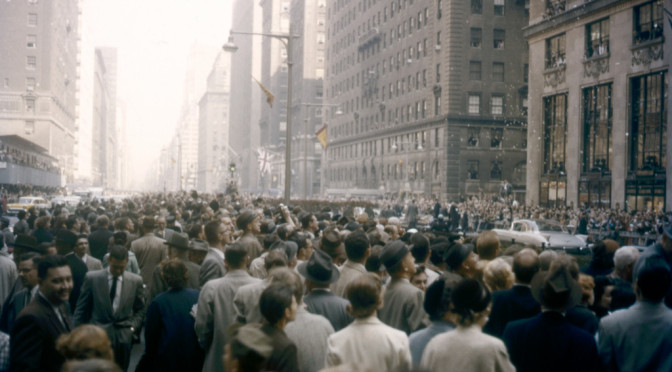
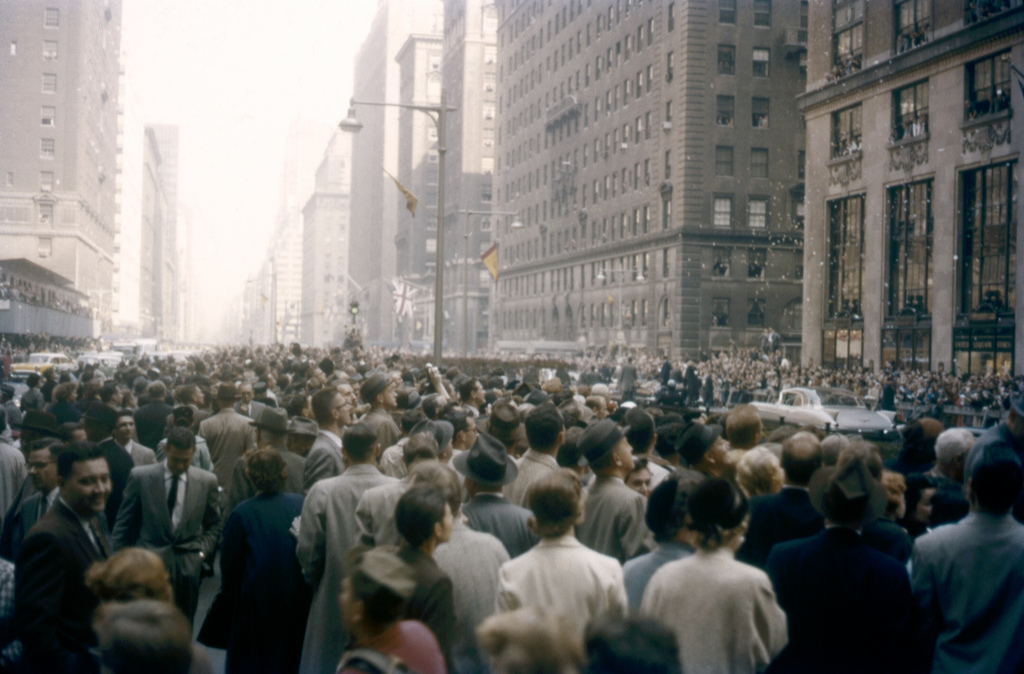
New Yorkers greet the Queen with a tickertape parade in 1957. Courtesy jeffs4653/Flickr 

What do you buy a queen on her Diamond Jubilee, celebrating 60 years on the British throne?

Well, most royal figures are quite difficult to buy for, but luckily, Queen Elizabeth has already revealed her preference in local department stores.

For back in 1976, the woman who never goes shopping found herself one late afternoon perusing the merchandise at Bloomingdale’s department store.

Queen Elizabeth has been to New York three times during her sixty year reign over the Commonwealth.

In a couple cases, she came specifically to address the governing body at the United Nations Headquarters but managed to squeeze in a few extra activities each time, befitting her status as one of New York’s wealthiest, most high profile tourists.

She first arrived in 1957, via Staten Island, riding over to Manhattan in an Army ferryboat. In the harbor, she caught sight of the newly built replica of the Mayflower (the Mayflower II), fresh from its completed voyage retracing the Pilgrims’ course over the Atlantic.

The Queen was practically wide-eyed during the ticker tape parade in her honor, with over a million New Yorkers lining the streets to see the young monarch, from City Hall to the Waldorf-Astoria.

Her favorite moment arrived after the UN session, when she was whisked to the top of the Empire State Building to gaze out of the hazy city.

Like any great New York trip, she was out too late, arriving at Idlewild Airport at 2 in the morning for her trip home.

She shared her thoughtful take on her experiences here: “The mental pictures of New York are nearer reality than those of any other city.”

Below: Queen Elizabeth on her second visit to New York, 1976, courtesy Madison Guy/Flickr
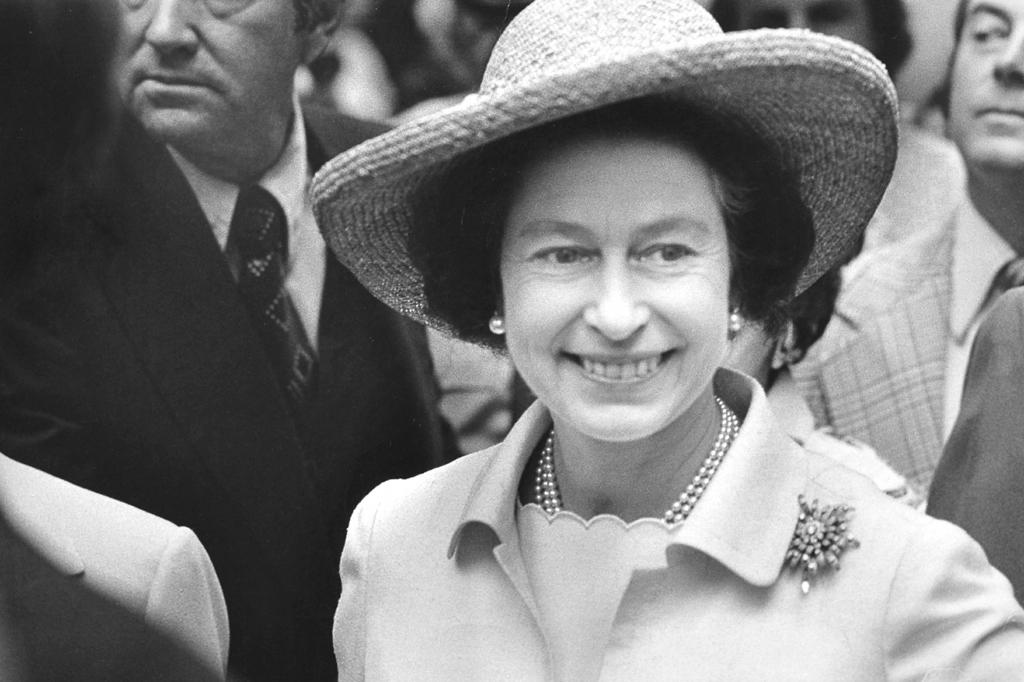
In 1976, she and Prince Phillip returned the city, a bit older and less desirous of scaling skyscrapers this time around.

As part of the city’s bi-centennial celebrations — and perhaps inspired by the Mayflower on her previous visit — the Queen decided to participate in a little historical reenactment herself.

Most famously, the Queen graced the steps of Trinity Church to receive back rent owed the crown — 279 peppercorns. (I wonder where they found peppercorns in 1976 Manhattan, this being the days before Whole Foods?) A bronze plaque presently marks the spot at Trinity where she accepted the peppercorns.

After a luncheon at the Waldorf (“relaxed, animated and fairly hungry”), the royals fit in a couple unusual stops.

The first was a spot of afternoon tea at the Morris-Jumel Mansion, accompanied by the Daughters of the American Revolution. Afterwards, they sped downtown for a tour of Bloomingdale’s, not only stopping traffic, but reversing it, to allow the Queen to exit her vehicle from the right side.

She quietly moved from floor to floor, admiring the many displays of products of British make, particularly the pottery and furniture. She was also greeted to a private fashion show, Her Majesty led through a room of mannequins garbed in the latest stylish trends from 1976.

Along the way, a few American designers made appearances to greet Queen Elizabeth, including Calvin Klein.

What accounts for such an unusual detour in the Queen’s itinerary?

Apparently, bedazzled by her 1957 trip, she wanted to do as New Yorkers do. Or, as a representative of Bloomingdale’s remarked, “we thought — and the Queen agreed — that it would be a very American experience for her to go amidst all the crowds and just pretend she might be shopping.” [source]

If the entire event seems a tad surreal to you, this was then reinforced by the presentation of a Sioux peace pipe to the Queen, meant to “symbolize the peace that has existed between Great Britain and the United States.”

This would be her lasting memory of New York for 35 years, until 2010, when she returned again for a few hours to address the UN and to visit Ground Zero.

Given the sobriety of her visit, she did little sightseeing but braved the 100-degree weather with her trademark stolid grace.
Pope-fest 2008: The Holy (Sight) See

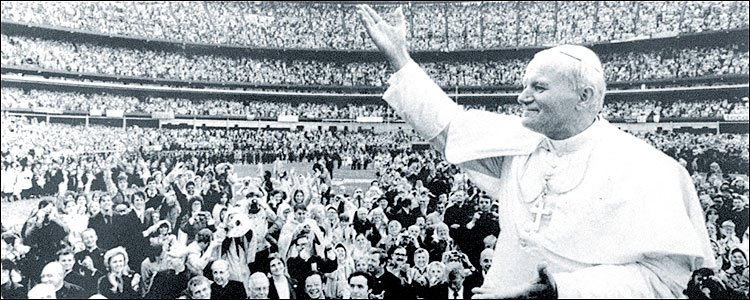
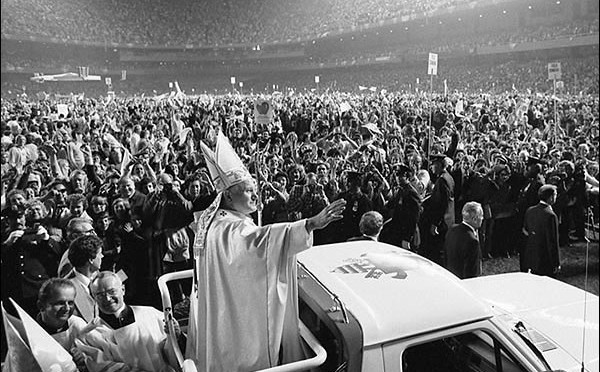
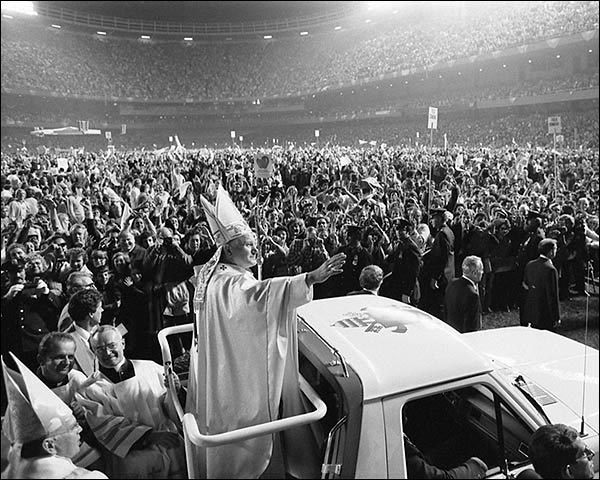
Pope John Paul greets the crowds at Yankee Stadium

Welcome Benedict! I’m not Catholic, but I do love a good papal visit to New York City. Nothing could be more absurd. The leader of the Catholic Church, a man who traces his spiritual lineage all the way back to the apostles — delivering mass at Yankee Stadium, traipsing Fifth Avenue in his sacred robes. I hope that person who dresses as Sesame Street’s Elmo in front of Rockefeller Center waves to Benedict as he enters St. Patrick’s Cathedral on Friday.

Only the Marquis de Lafayette and the Beatles have been treated to more rapturous displays of welcome by New York City residents. The city has been host to three previous papal visits, and in each case, St. Patrick’s has naturally been the manic center of activity. In fact each visit is immortalized on a plaque in front of the cathedral. Although with each trip, the pope in question managed to find a couple other unique corners of the city to visit as well.

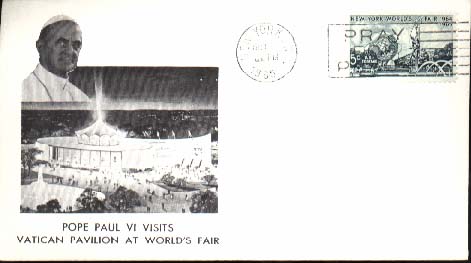
Perhaps the strangest was the very first — Pope Paul VI, the controversial leader who presided over the Second Vatican Council and made a name for himself traveling all over the world. Finally in an era were a man could be both pope and jetsetter, Pope Paul arrived in New York in October of 1965 and promptly went to visit his roommate, who was performing in a fair.

That roommate would be Michelangelo’s Pieta, on loan from St. Peter’s hallways to the Vatican pavilion at the 1964-65 World’s Fair. The Pope visited the Fair on Oct 4, 1965, on a busy day that also included mass at Yankee Stadium (the first papal mass ever in the United States), an address to the United Nations, and a meeting in the city with president Lyndon Johnson at the Waldorf=Astoria.

Today a rounded bench, or exedra, sits in Flushing Meadows park honoring the moment Pope Paul visited the Pavilion. (It seems that whenever a Pope hovers in a place for more than a few minutes, a plaque or monument springs up in its place.)

By the way, I found this extraordinary page full of great photos about the Pope-mobile, the superfine limousine used by the Pope during his visit.

But its Pope John Paul who’s the real New York favorite; he held the office for so long that he managed two trips to Gotham City — in 1979 and 1995.

His October 1979 trip was like a rock concert tour, also swinging through Philadelphia, Boston, D.C., Chicago and Des Moines. Part of the enthusiasm was because John Paul, at 58 years old, had just been appointed the year before.

As a cardinal, he had already held mass at Yankee Stadium, so by the time he did it again on October 2, 1979, he was as much a fixture as Reggie Jackson. Rain greeted over 9,000 cheering worshippers — or fans — and, according to legend, when the Pope mounted the ballfield to address the crowd, the rain showers stopped. And as a blessing for Mets fans, the next day the Pope also held rapt an audience of 52,000 at Shea Stadium (pictured below).

But like all rock stars, the Pope couldn’t complete his New York odyssey without a performance at Madison Square Garden. Although John Paul also addressed the U.N. and a St Patrick’s audience during that trip, he’s best remembered by many for his inspirational address on October 3rd to 19,000 city children.

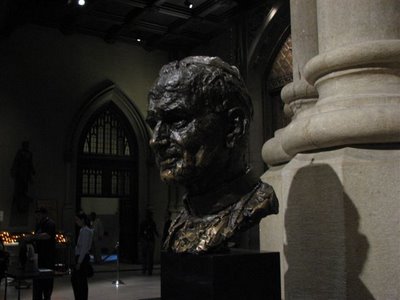
St Patrick’s honored his Holiness’s visit in 1979 by installing a bust (see below). But he would be back. On almost exactly the same day, sixteen years later.

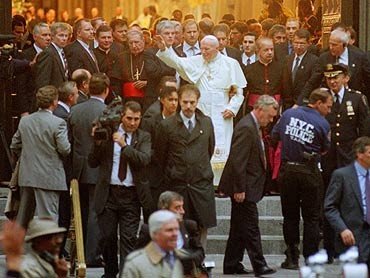
New York City in 1995 was a vastly different city and John Paul returned for a longer visit — four days in total in the entire New York area — on October 4th. This time, instead of just delivering messages to the clergy gathered at St. Patrick’s, he spontaneously decided he wanted to walk around the block. And why not? You’ve got shopping, Saks, street vendors selling Pope souvenirs!

Below: the Pope prepares for his light stroll

The Pope also finished off his collection of performing in gigantic venues for mass — holding court in Giants Stadium, the Aquaduct Racetrack in Ozone Park and eventually to 100,000 people on the great lawn in Central Park.

From there, the elderly leader of the Catholic Church gave the city the ultimate shout-out: “This is New York! The great New York! This is Central Park. The beautiful surroundings of Central Park invite us to reflect on a more sublime beauty: the beauty of every human being, made in the image and likeness of God. Then you can tell the whole world that you gave the pope his Christmas present in October, in New York, in Central Park.”

Pope Benedict, here for two days (April 19-20), has broken the apparently holy tradition of visiting New York in the first week in October. But Benedict, as the cardinal formerly known as Joseph Ratzinger, actually visited the city in that lesser role in 1988, where apparently he was met with protest from gay activists and shunned by some prominent Jewish leaders.

This year, he intends to hit all the “usual” Pope spots — St. Patricks, the United Nations, Yankee Stadium — but has added a couple surprising detours: Park East Synagogue and Ground Zero. At this rate, he might even stop in to see an off-Broadway show! Is Nunsense still playing?

Categories
Podcasts

PODCAST: The United Nations Headquarters

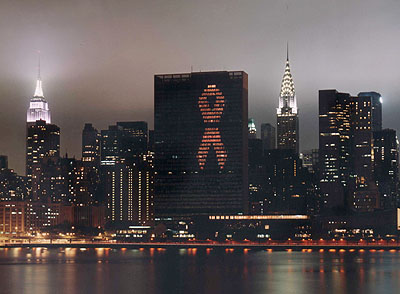
(Secretariat Tower, in a dazzling light show during a special session on the international HIV/AIDS crisis.)

It’s the only area of Manhattan that actually belongs to the world (literally). Come along with the Bowery Boys as we cut the security line to uncover the true story about the unusual headquarters of the United Nations, and why they ended up in New York City in the first place.

Listen to it for free on iTunes or other podcasting services. Or you can download or listen to it HERE

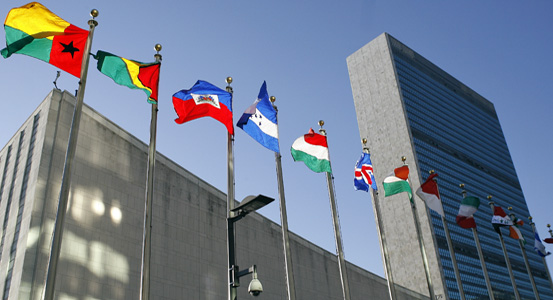
Yesterday was United Nations Day, marking the anniversary of the creation of the UN Charter by its five originating members (Soviet Union, China, Britain, the United States and France) and 46 other signatary nations. Currently there are 192 member nations.

The grounds of the United Nations are alive with an assortment of unusual sculptures from around the world. Although not open to the public, you can easily see most of these through the fence:

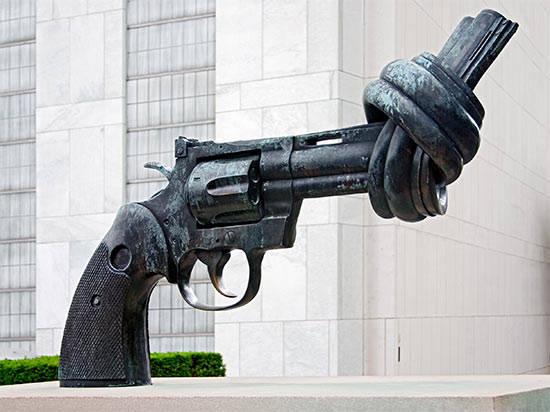
From Luxembourg, the very popular Knotted Gun, by Fredrik Reuterswärd, titled ‘Non Violence’ no explanation neccessary:

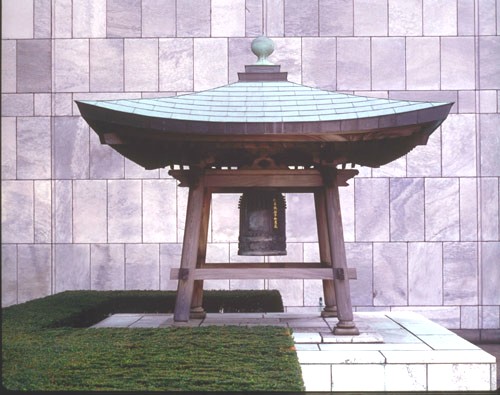
The Japanese Peace Bell, a gift from Japan before they were even members of the United Nations, holds a special significance on the UN grounds. It tolls twice a year, for the vernal equinox and on the first day of General Assembly.

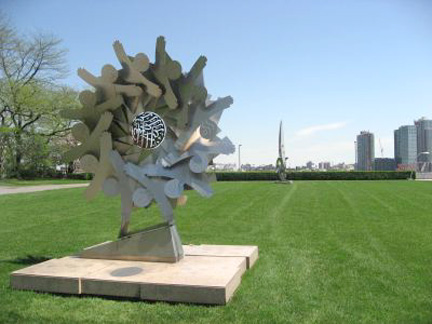
The circular Solidarity Among Sisters was a gift from ‘Arab women’ crated by Silvio Russo, “shaped … in the form of an abstract image of a number of women, each of whom is holding out her hand to the next.”

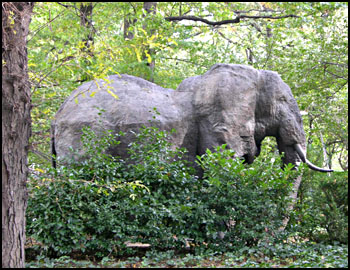
Tucked in the trees at the end of the garden is ‘Sleeping Elephant’, a bronze sculpture from three nations (Kenya, Namibia and Thailand) and cast from an actual living elephant by sculptor Mihail. Believe it or not, the size of its, um, ‘member’ was a point of contention when it was first installed in the park.

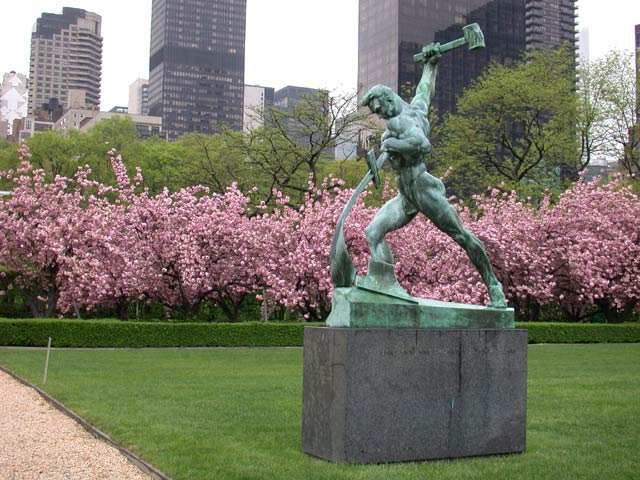
The most renown of all the sculptures is probably Let Us Beat Swords Into Plowshares an Evgeniy Vuchetich creation donated by the Soviet Union

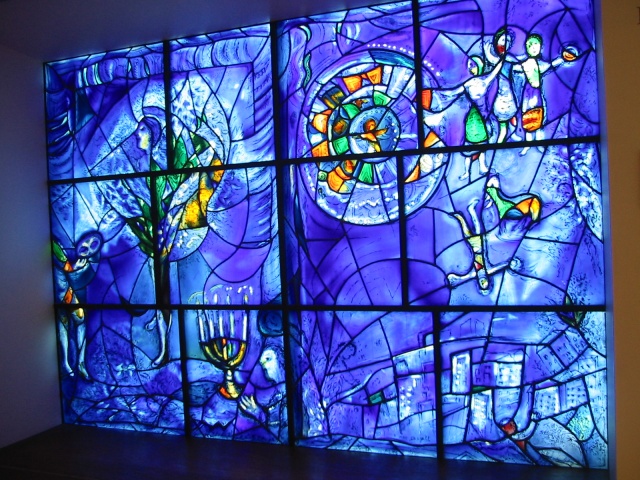
Additionally, the lobby of the UN has one object of significant note — a striking stained glass window commemorating the life of Dag Hammarskjold by French painter Mark Chagall:

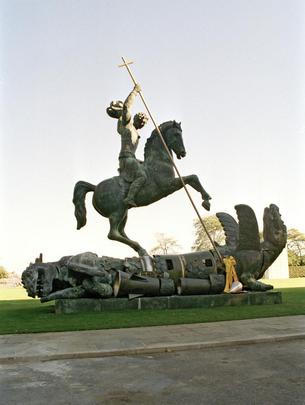
Then of course there’s the most striking piece of all — ‘Good Defeats Evil’, by Georgian artist Zurab Tsereteli, a rather controversial gift from the Soviet Union in 1990. It conjures the legend of St. George slaying the dragon, with nuclear arms filling the role of the slayed beast.