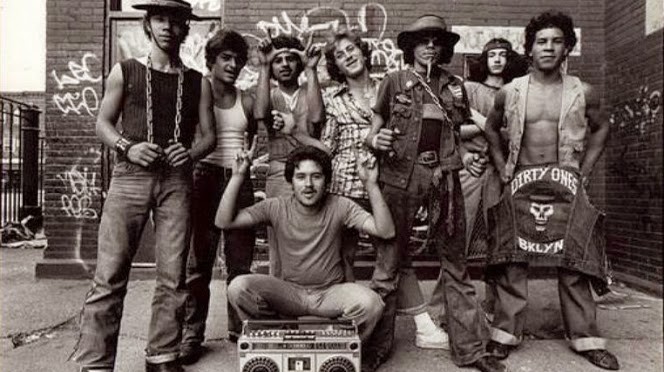
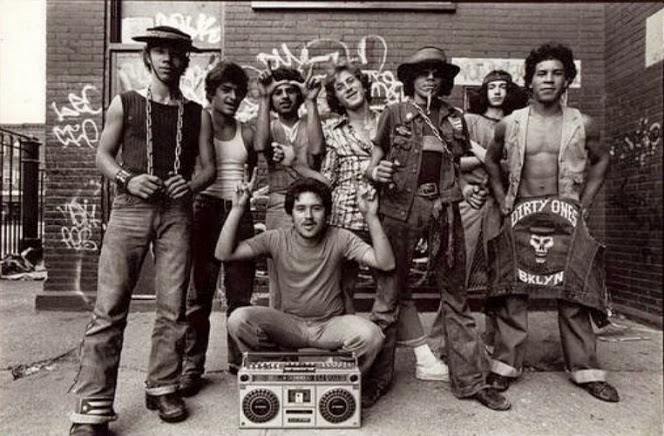
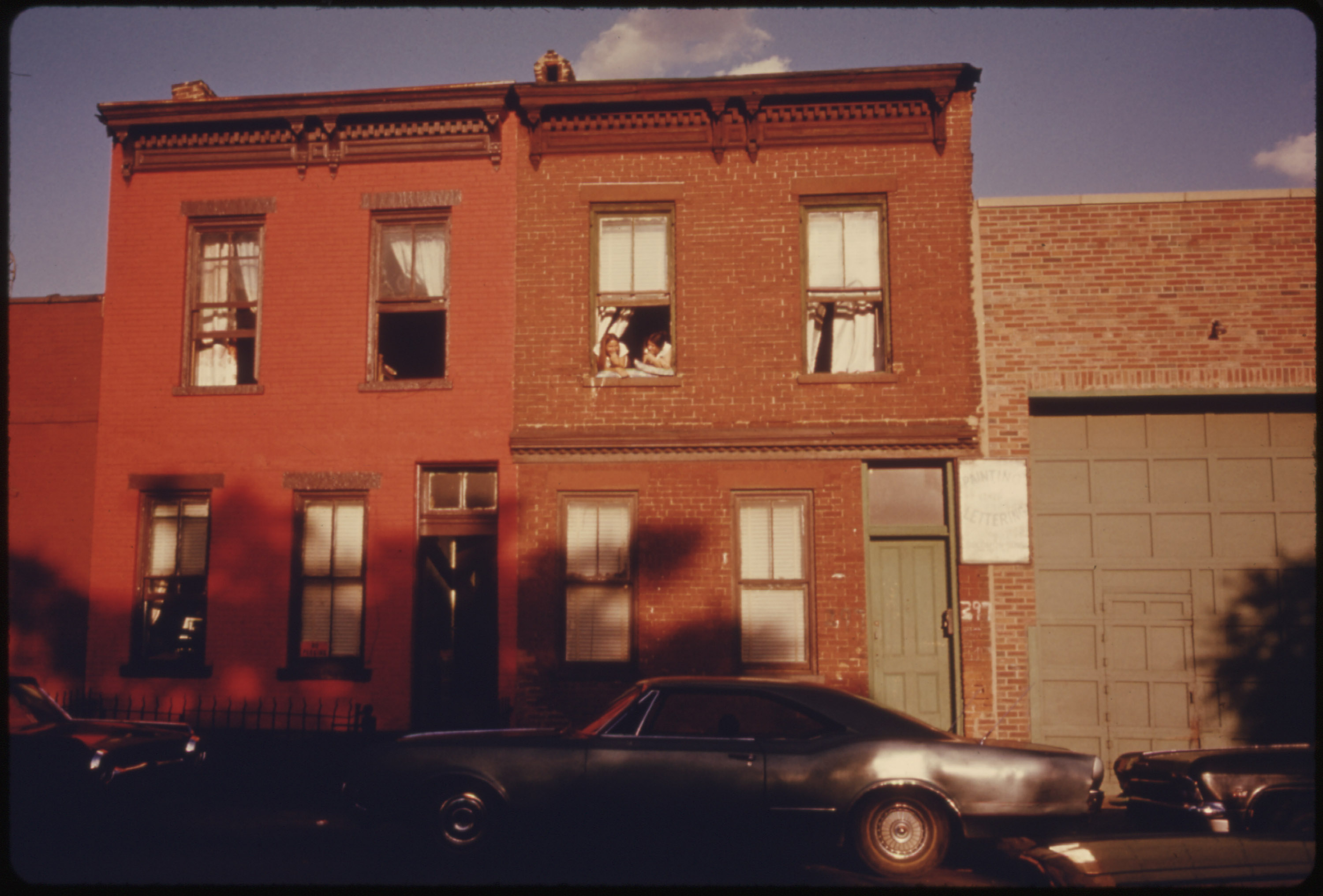
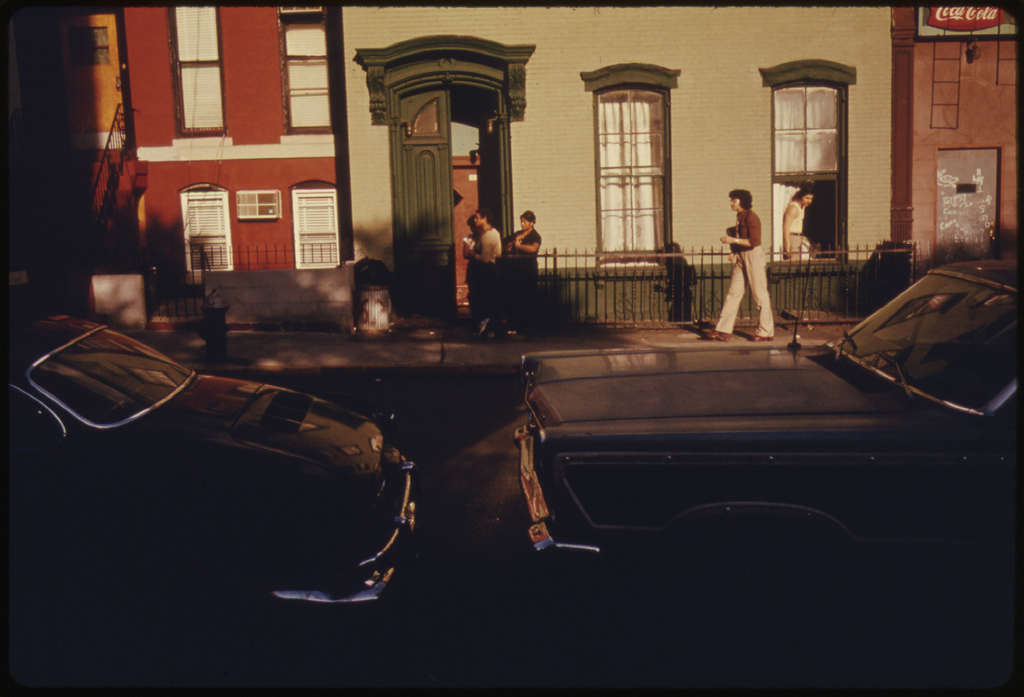
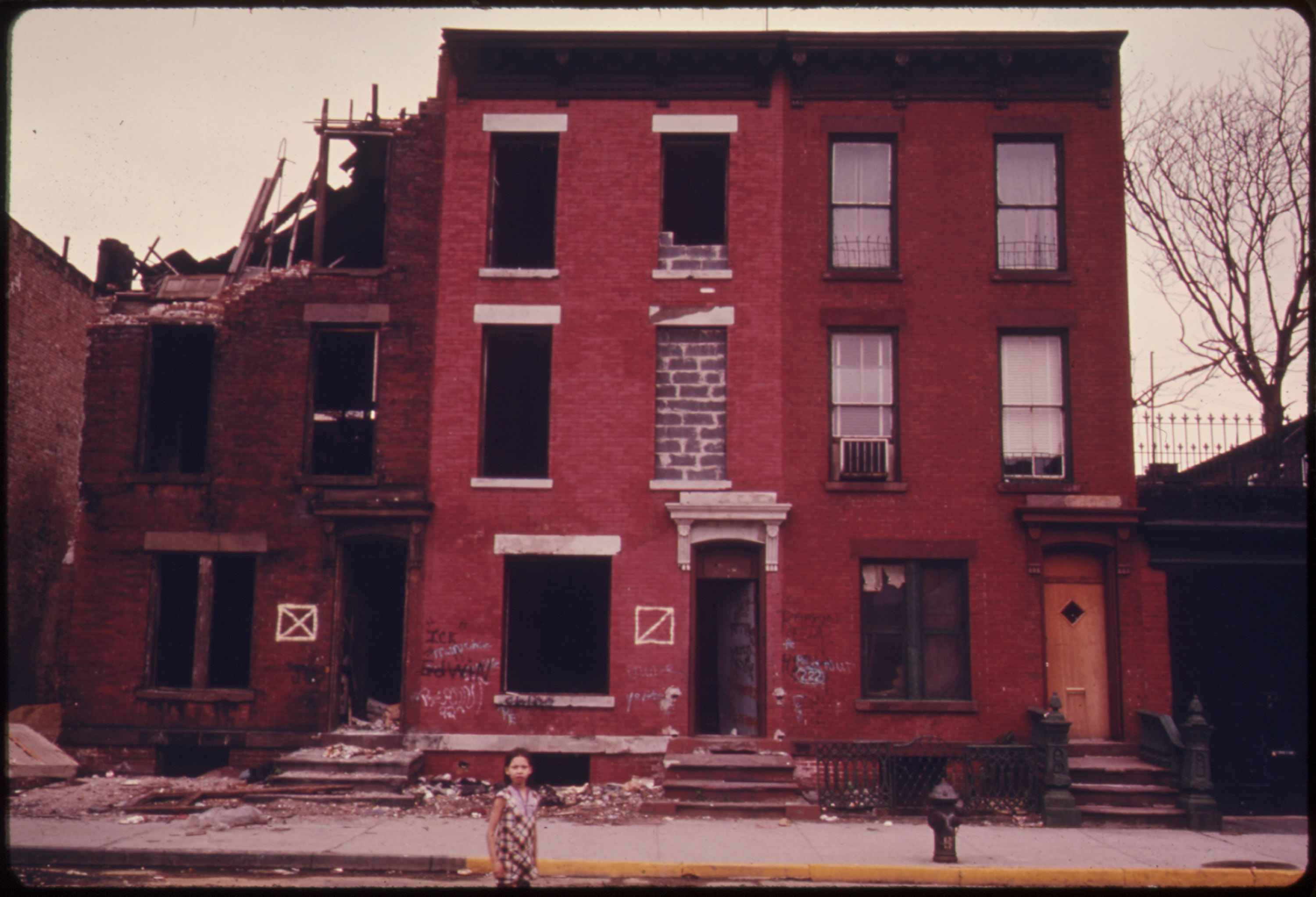
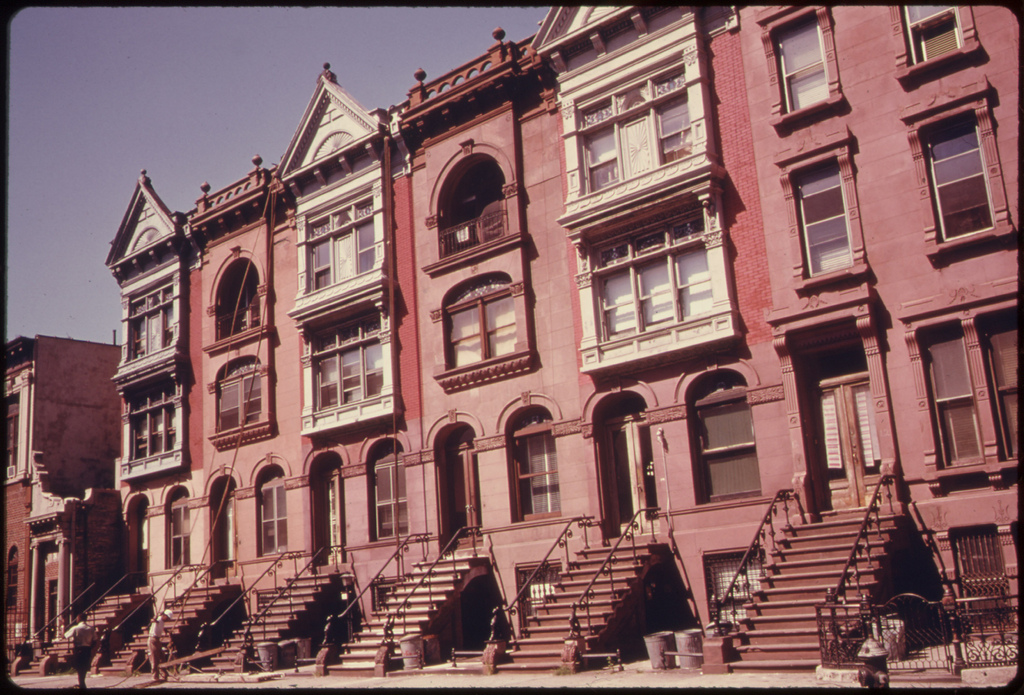
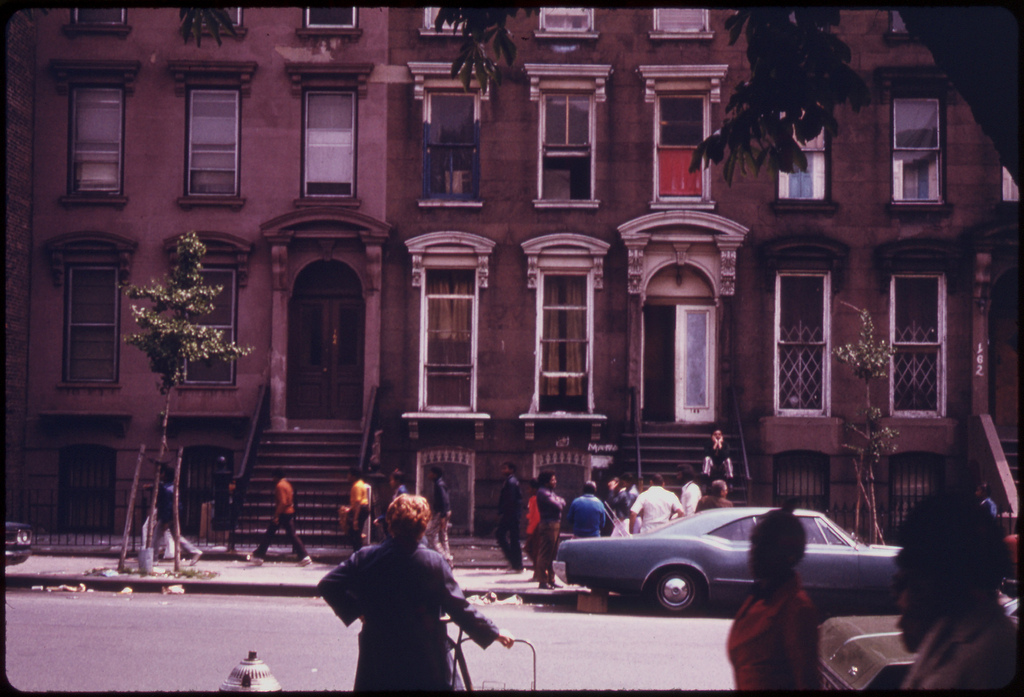
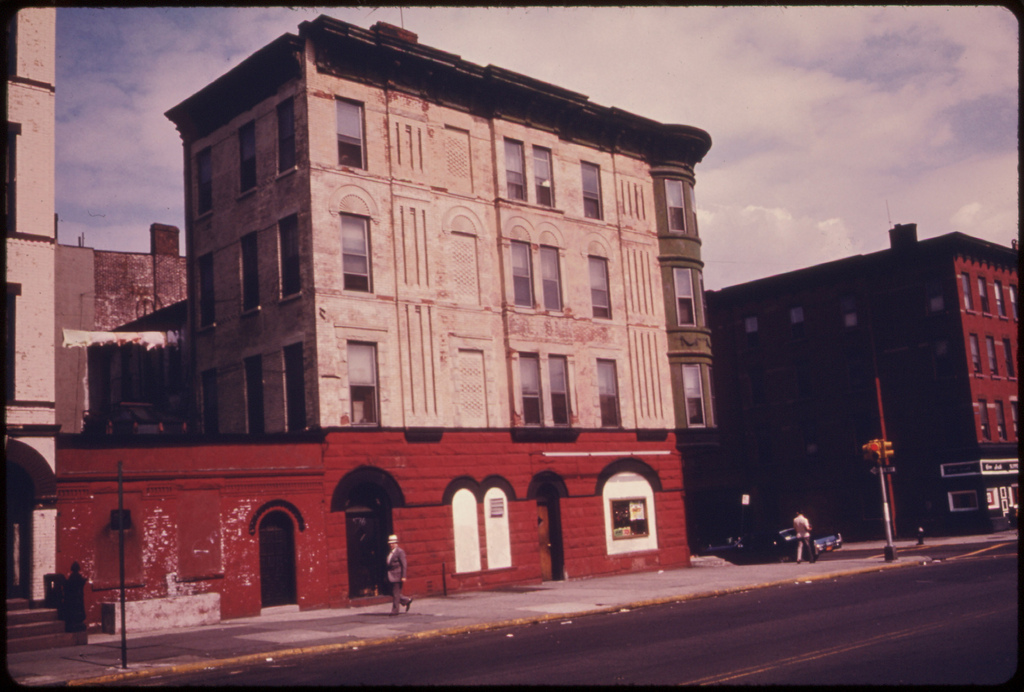
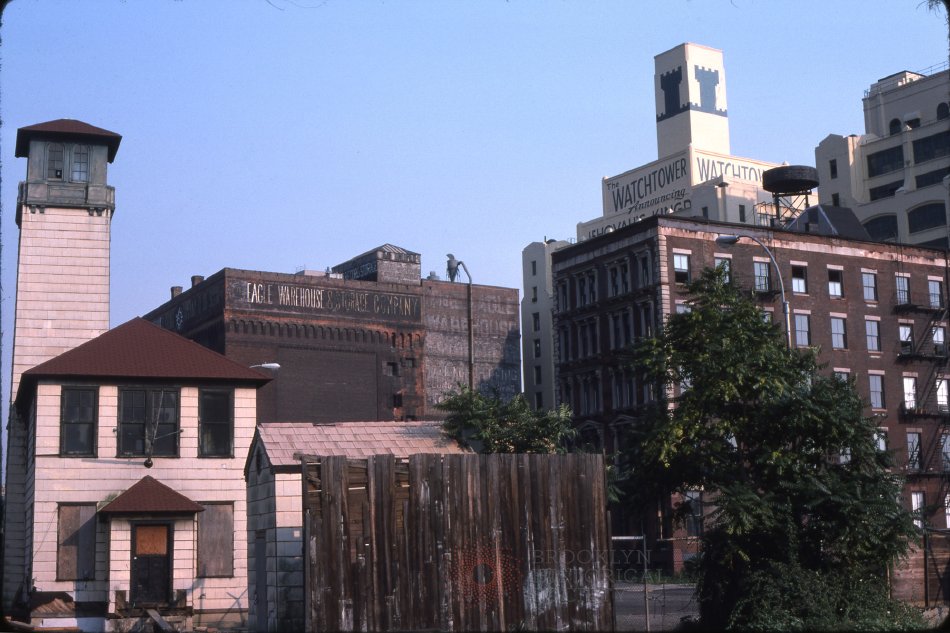
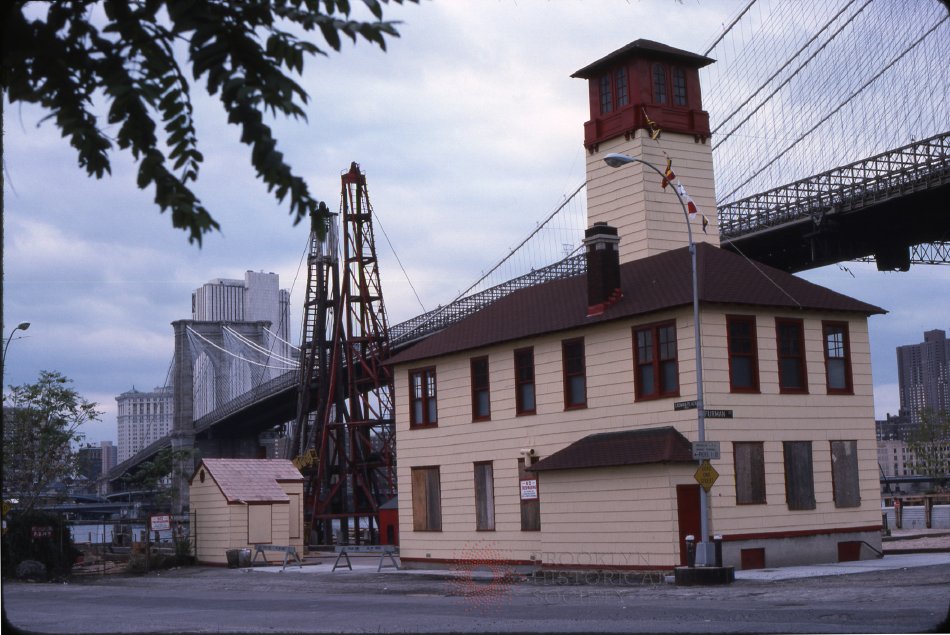
For this article, I look at what some of the dangerous undercurrents to life in Williamsburg, Brooklyn, in 1981. “By the 1970s, Williamsburg was best known for its steeply rising crime rate, harboring both violent street-gang activity and organized crime.” You can read the whole article here.
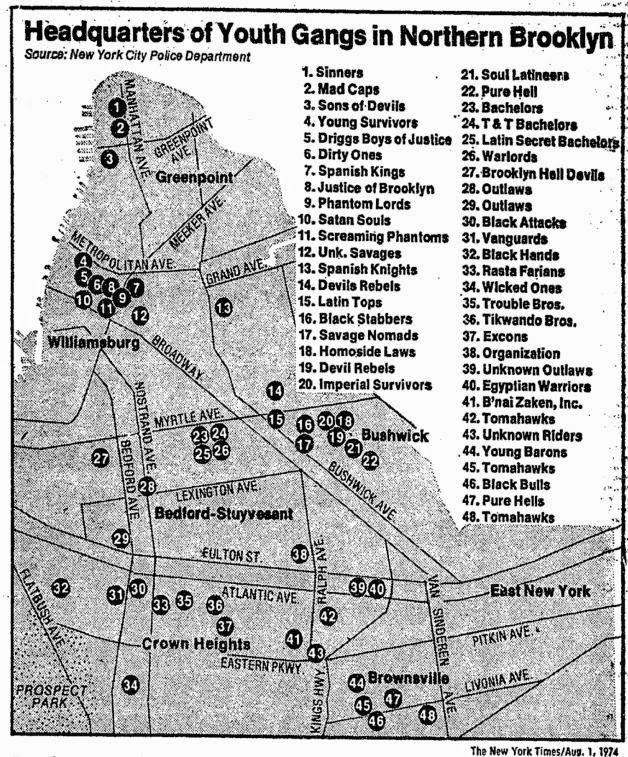
During my research for this piece, I found this rather startling map in the New York Times, August 1, 1974, charting out the various turfs of northern Brooklyn street gangs.
This is not a souvenir from the film The Warriors, but an actual list of the many violent gangs which kept Brooklyn a very dangerous place to walk around in during the 1970s.
Gang activity was so especially vicious at this time — particularly gang-vs-gang violence — that Luis Garten Acosta, the founder of El Puente youth outreach program, called northern Brooklyn ‘the killing fields’ in 1981.
I dug a little further to find some specific incidents which involved some of these gangs. I’ve put numbers by the gangs so you can find their dedicated turf on the map above:
— September 16, 1972 — A gang altercation among the members of the Young Barons (44) resulted in the death of one young man and another whose nose was cut off.Â
— August 21, 1973 — Several members of the Devils Rebels (19) were walking around Bushwick when they were accosted by the Screaming Phantoms (11). Two boys associated with the Devils Rebels were stabbed and killed. Police report “the Screaming Phantoms operated out of the Williamsburg area and had been ‘way out of their area’ at the scene of yesterday’s gang fight.”
— October 12, 1973 — Several gangs have been cast as extras in a new film called The Education of Sonny Carson, including the Tomahawks (48), Pure Hell (22) and the Unknown Riders (43).
— February 25, 1974 — The Times reports on the extortion schemes of various northern Brooklyn gangs, mentioning the Outlaws (28,29), the Tomahawks (48), the Jolly Stompers (not listed) and B’Nai Zaken (41).
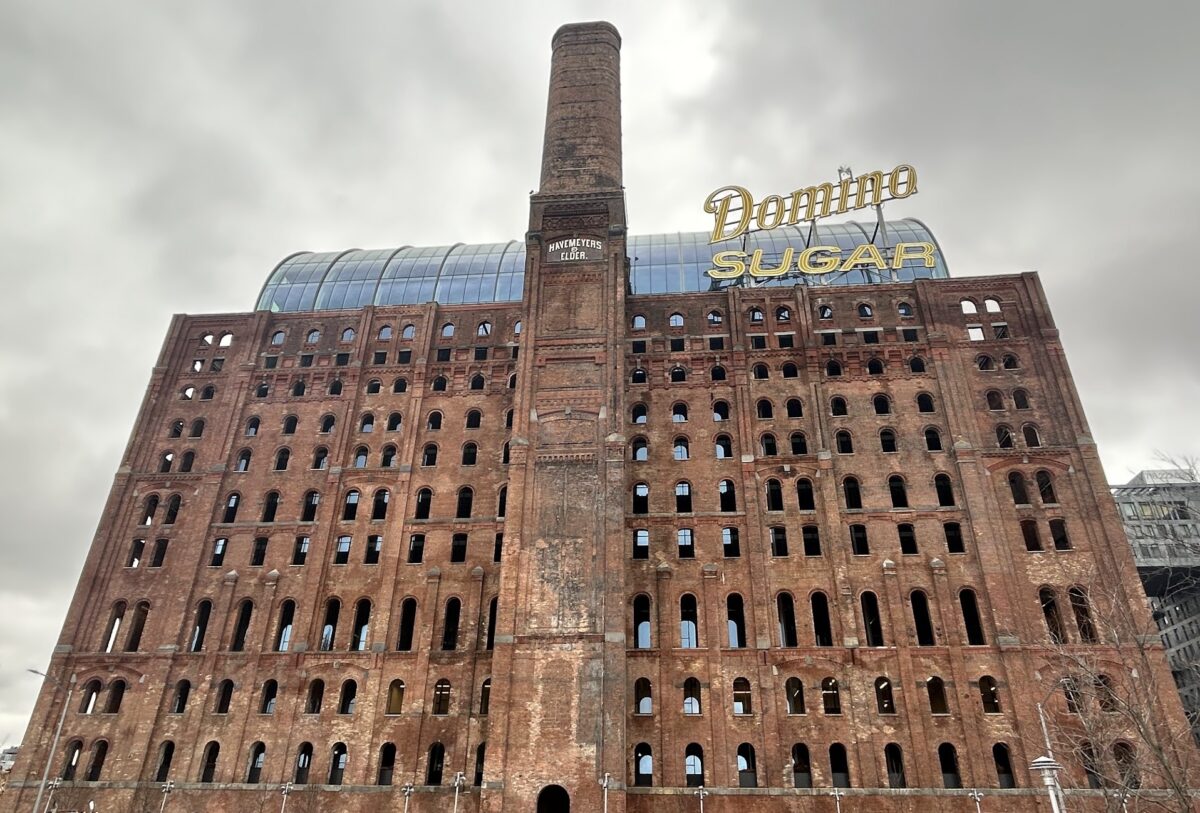
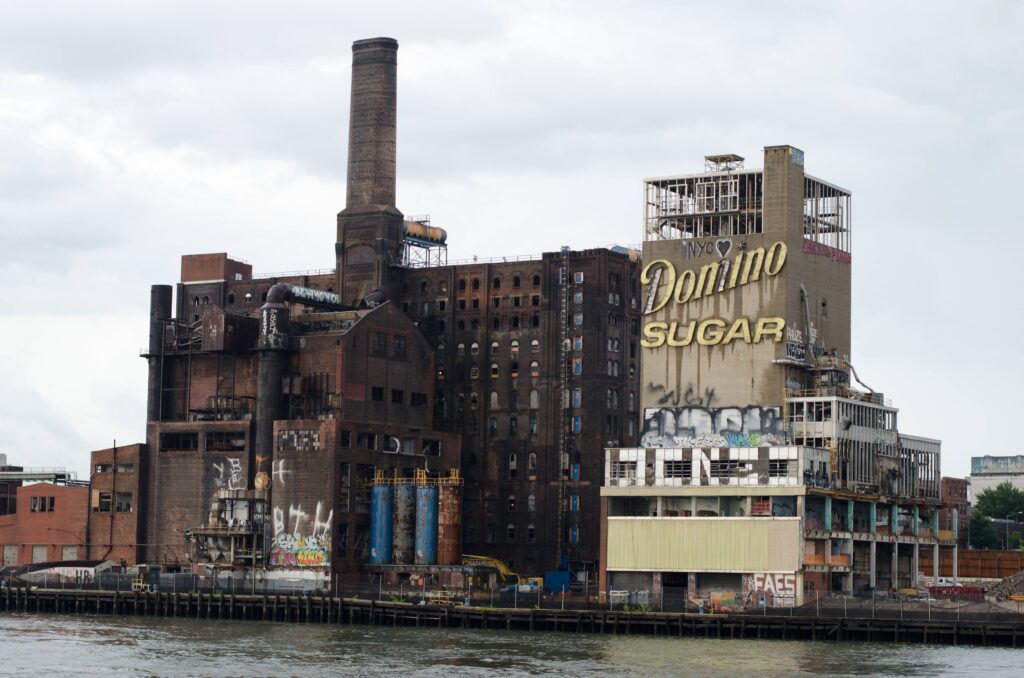
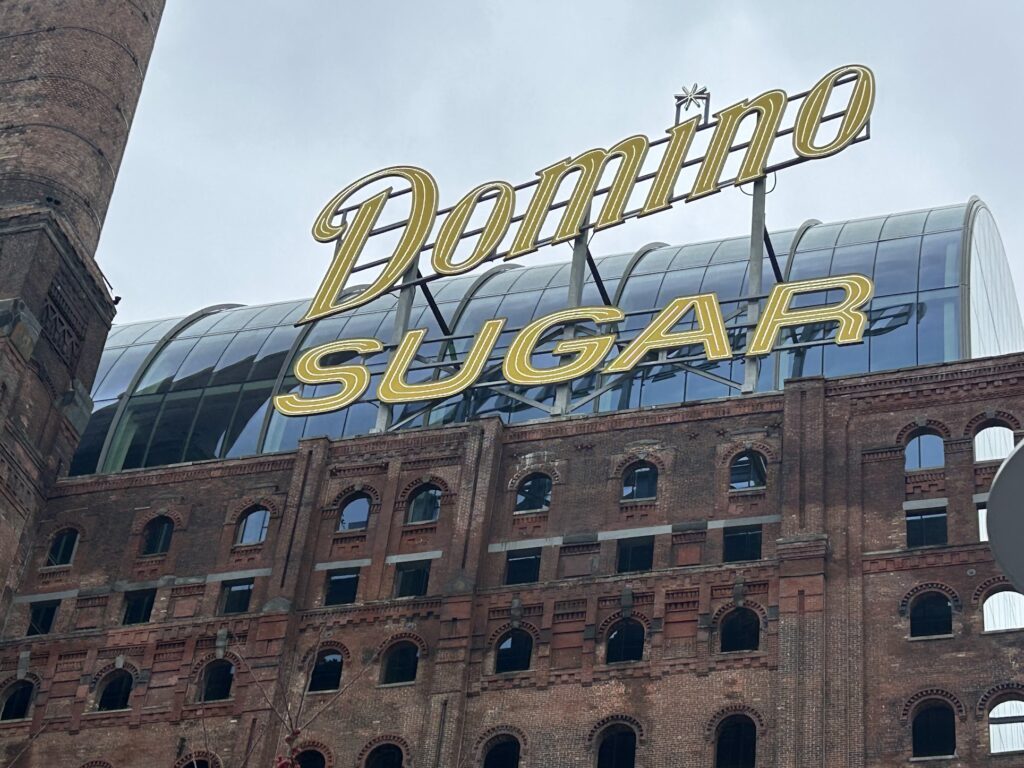
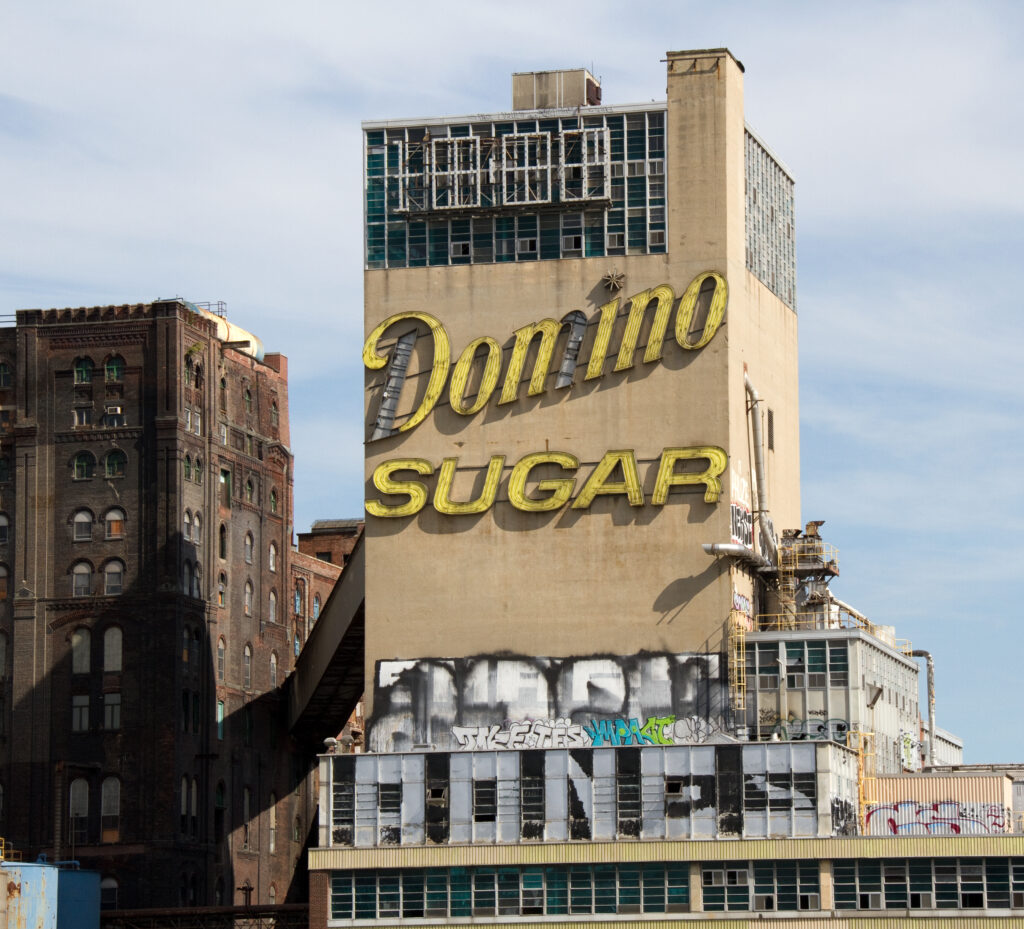
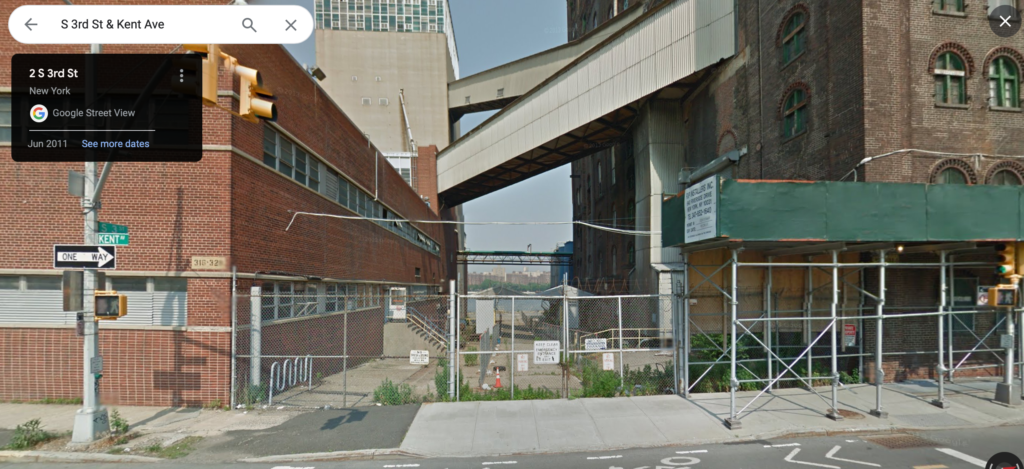
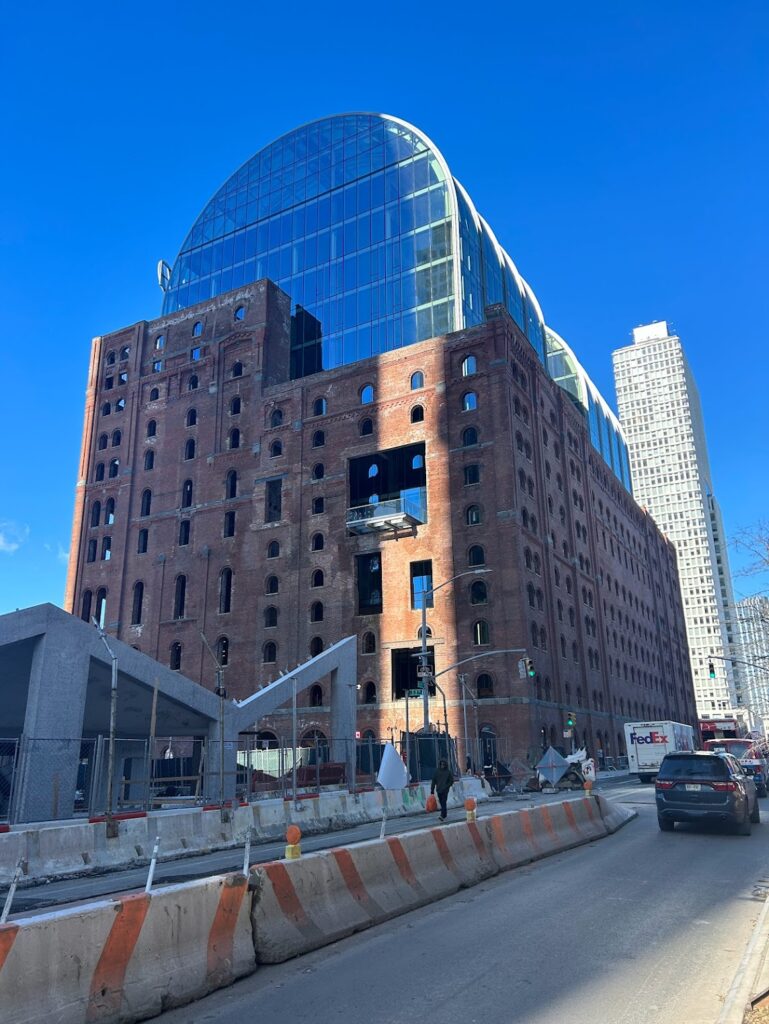
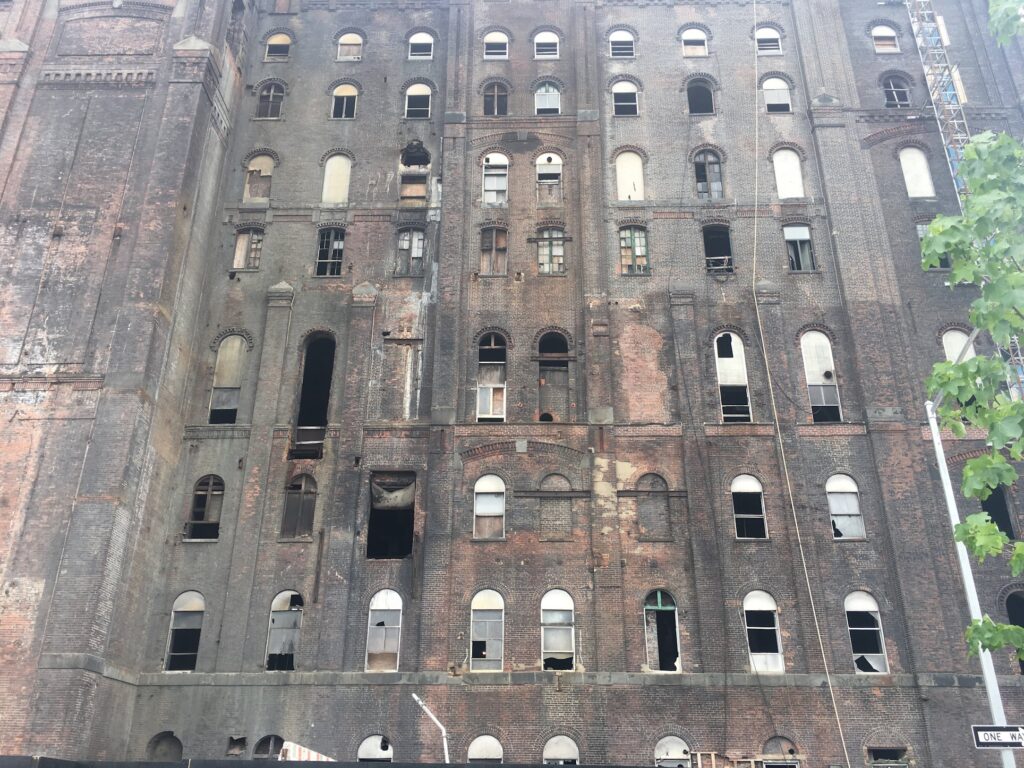
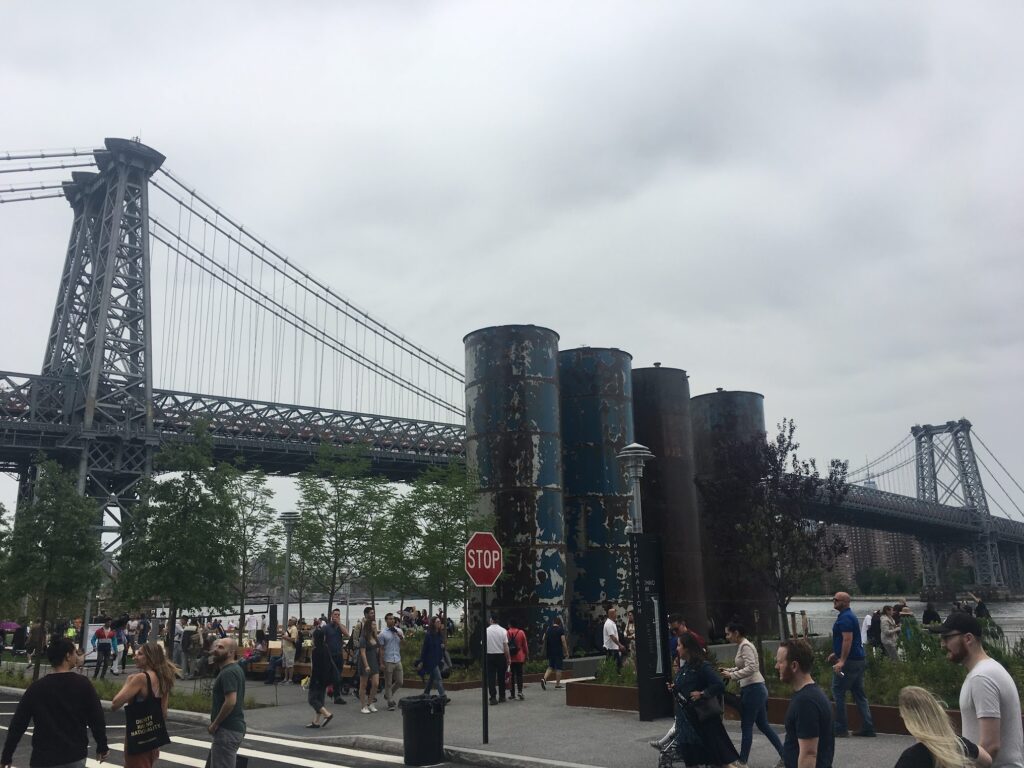
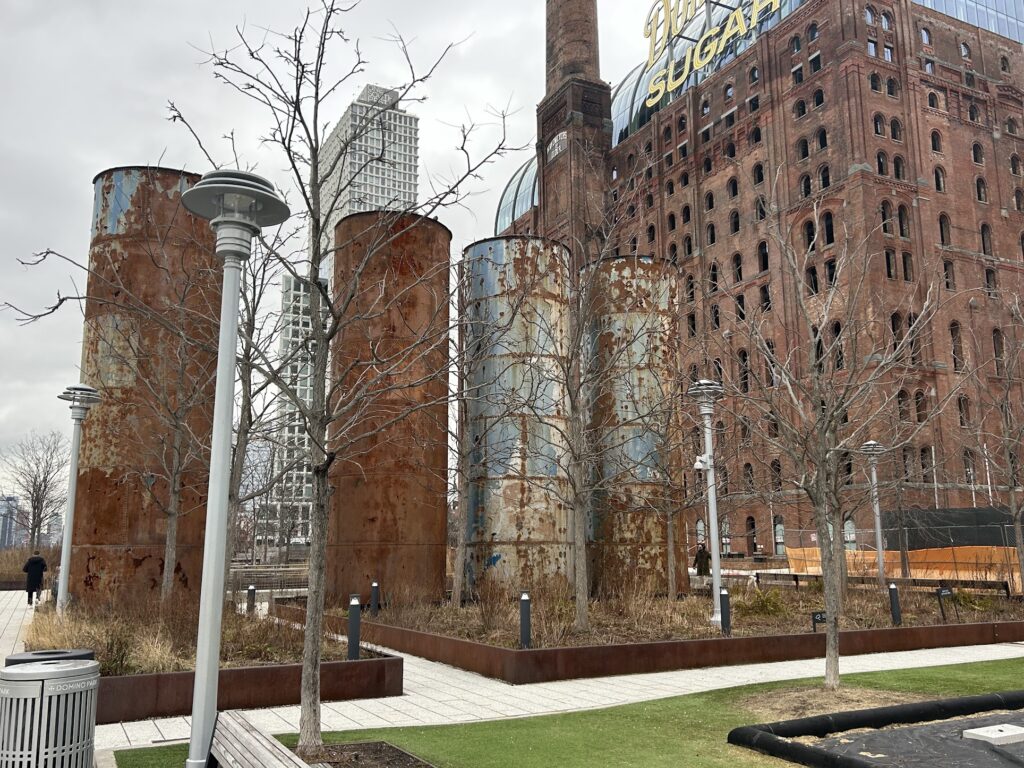
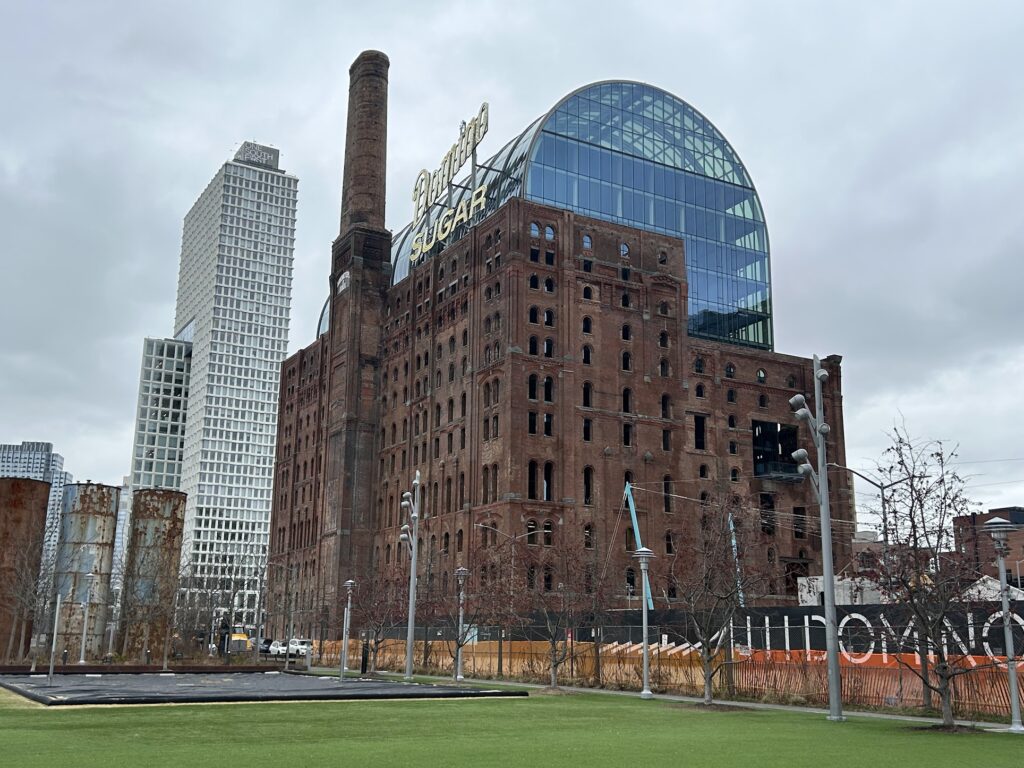
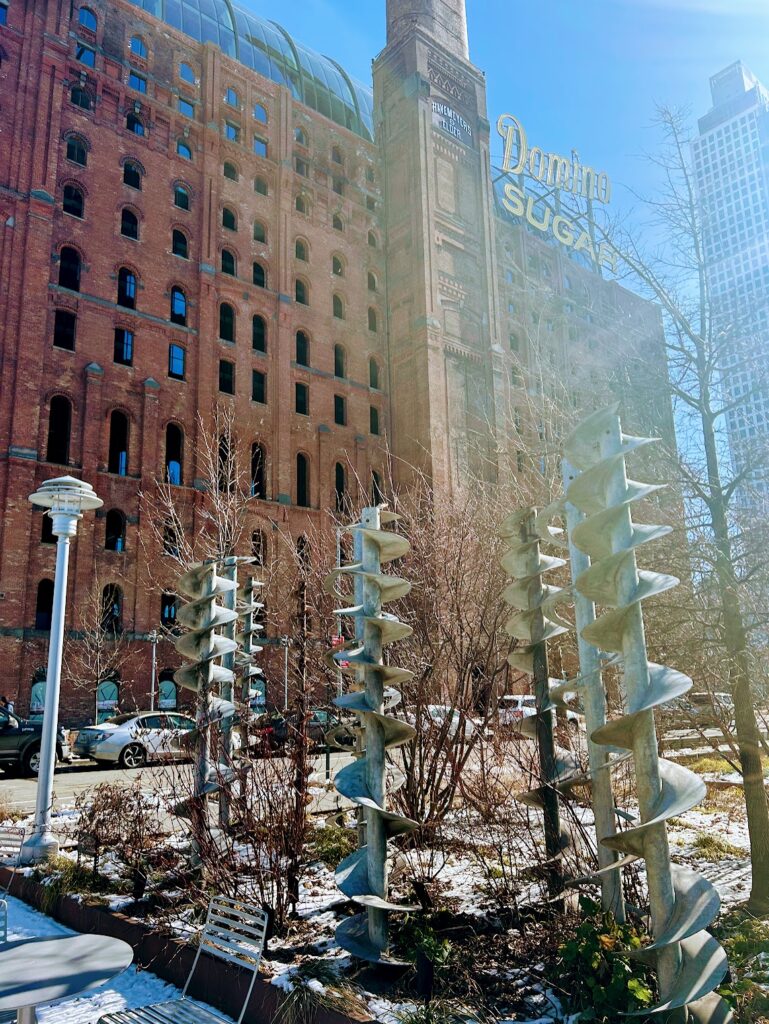
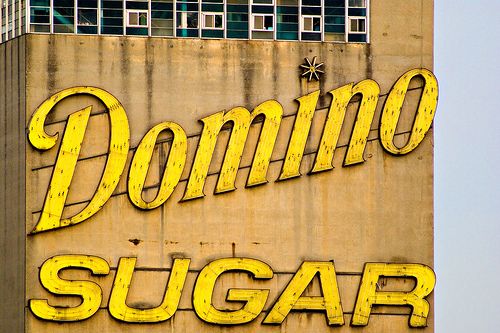
The Brooklyn waterfront was once decorated with a yellow Domino Sugar sign, affixed to an aging refinery along a row of deteriorating industrial structures facing the East River.
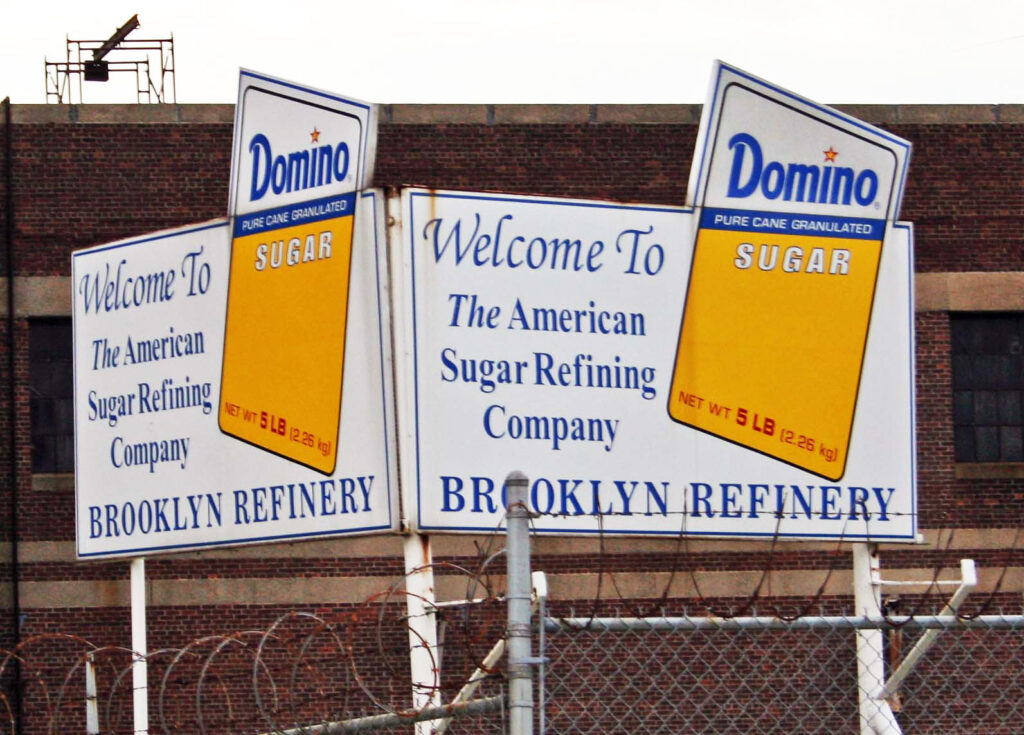
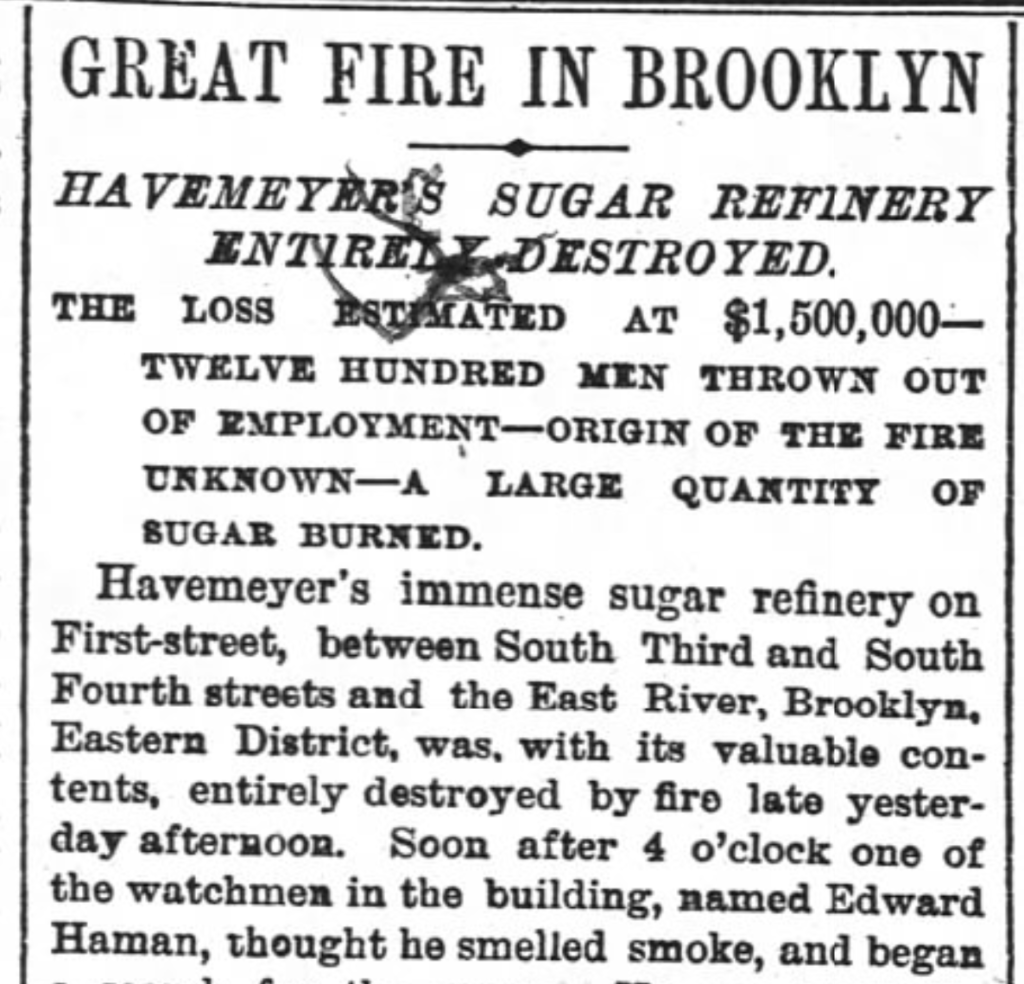
The Domino Sugar Refinery, completed in 1883 (after a devastating fire destroyed the original), was more than a factory. During the Gilded Age and into the 20th century, this Brooklyn industrial landmark was the center of America’s sugar manufacturing, helping to fuel the country’s hunger for sweet delights.
But the story goes further back in time — back hundreds of years in New York City history. The sugar trade was one of the most important industries in New York, and for many decades, if you used sugar to make anything, you were probably using sugar that had been refined in New York.
Domino Sugar Refinery in the 2010s/Photo mypene/reddit
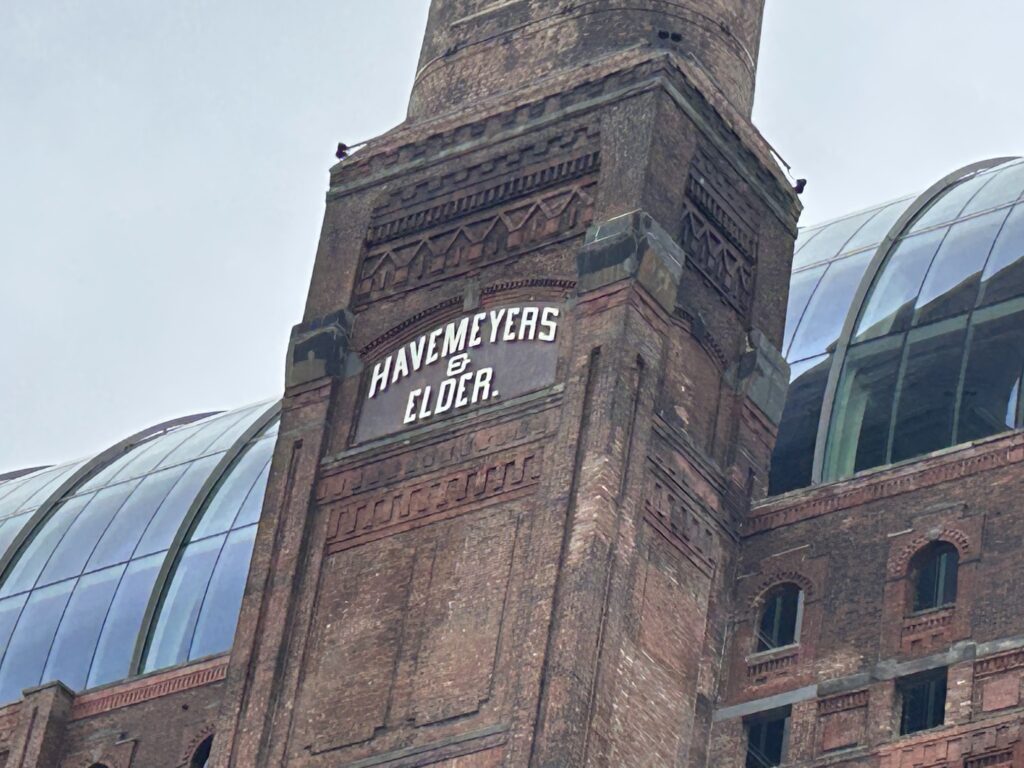
Sugar helped to build New York. Thousands and thousands of New Yorkers were employed in sugarhouses and refineries. And of all the sugar makers, there was one name that stood above the rest — Havemeyer!
The Havemeyers were America’s leading sugar titans. By the 1850s they had moved their empire to the Brooklyn waterfront – and the neighborhood of Williamsburg.
Their massive refinery helped establish the industrial nature of Williamsburg, leading to a rush of sugar manufacturers to Brooklyn, most of which would then be absorbed into the Havemeyer’s operation.
Photo by Greg Young
But this story is even larger than New York, of course. It encompasses the transatlantic slave trade, political influence in the Caribbean, Cuba-United States relations, and the sorry working conditions faced by Hayemeyer’s underpaid employees.
PLUS: It’s Dumbo vs Williamsburg in the Coffee and Sugar War of the 1890s!
LISTEN NOW: BEHIND THE DOMINO SIGN
Photo taken 2010, courtesy wburg/FlickrTony Hisgett from Birmingham, UK 2011
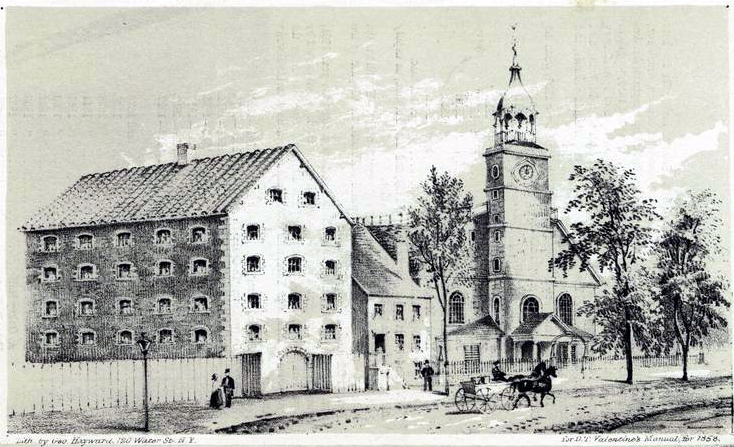
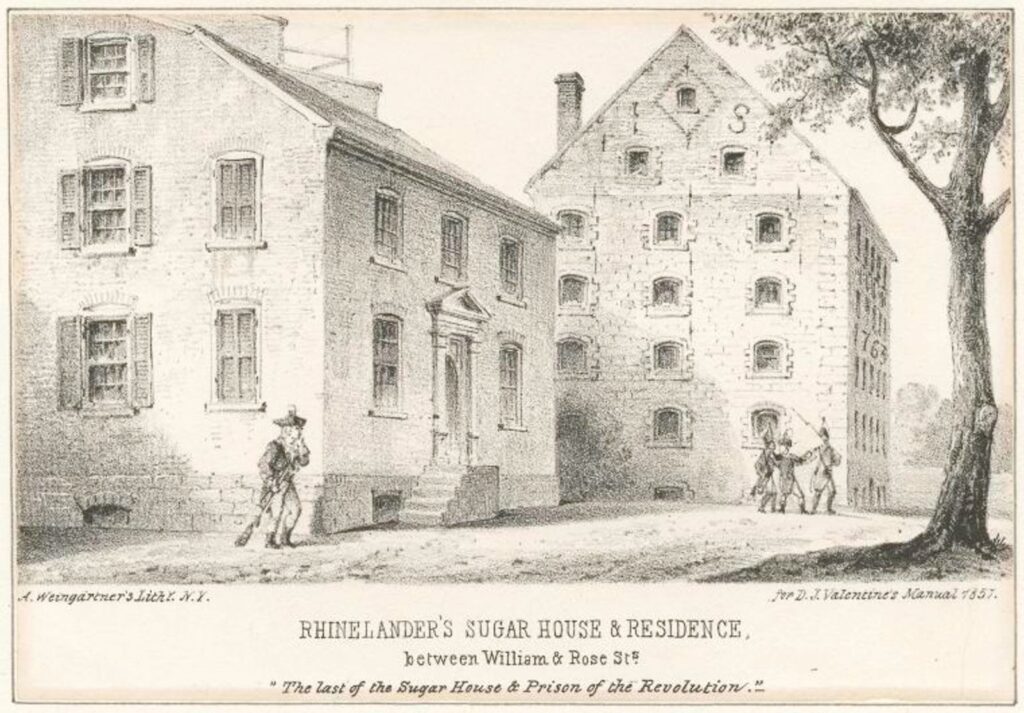
The Livingston Sugar House, on Liberty Street, and the Rhinelander Sugar House, between William & Duane Streets in New York. They were the city’s largest buildings which is why both were repurposed as prisons during the Revolutionary War.
NYPL
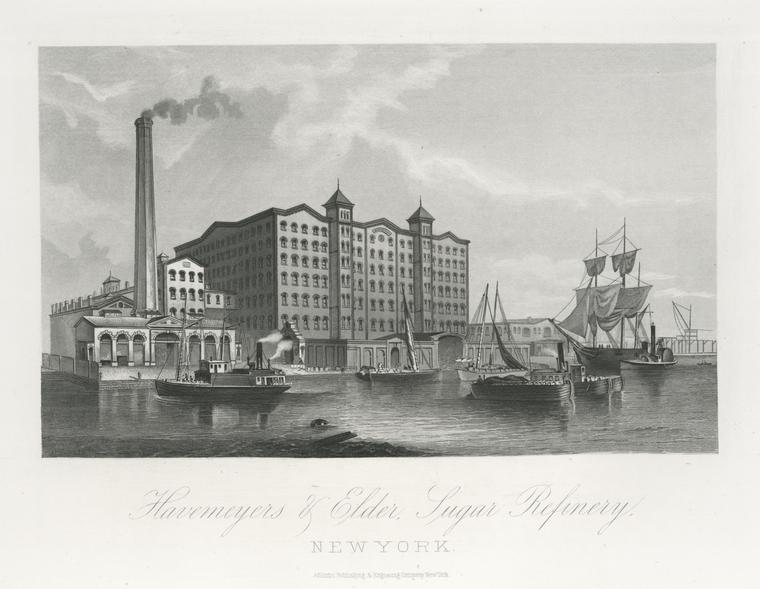
The original Havemeyer sugar refinery on the Brooklyn waterfront before the fire, 1876.
The original factory before the fire, 1876. New York Publc Library
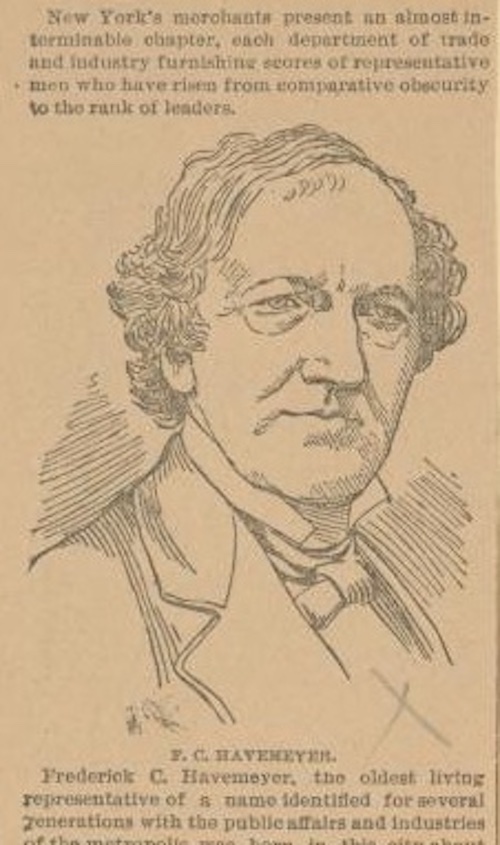
Frederick Havemeyer, NYPL
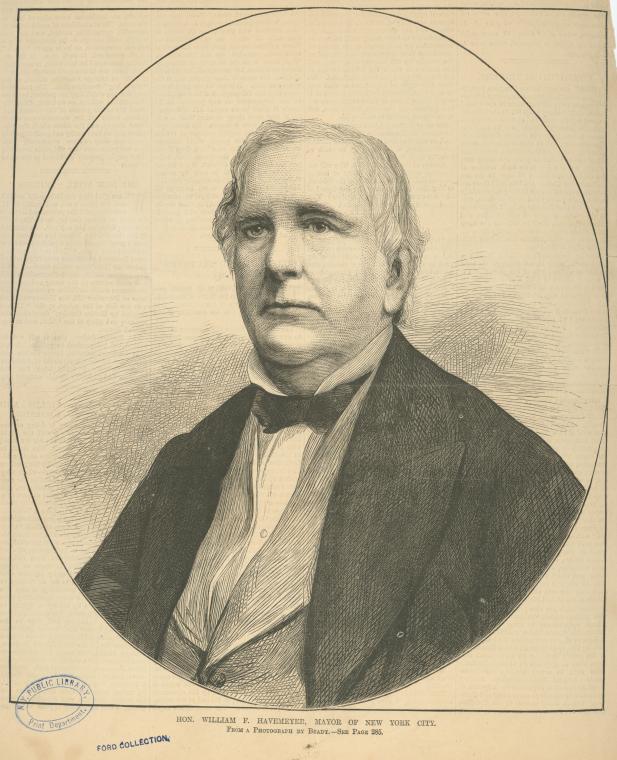
Frederick’s brother William, the mayor of New York for three separate terms (NYPL)
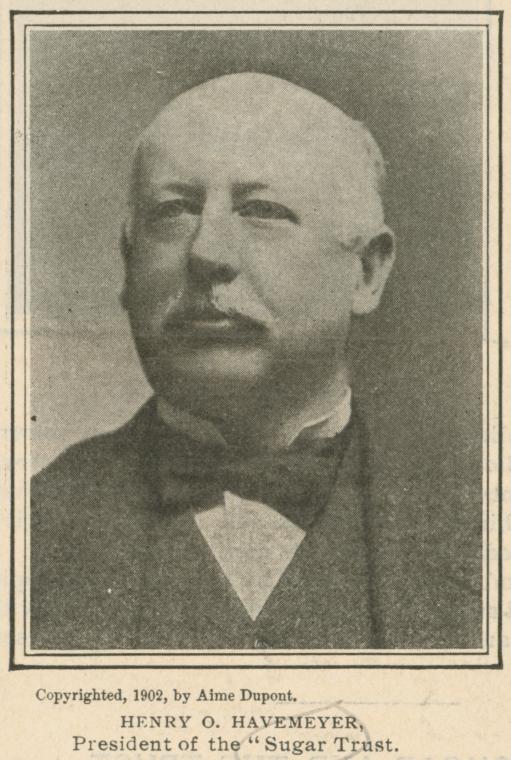
Henry (Harry) Havemeyer, “president of the Sugar Trust. Pic NYPL
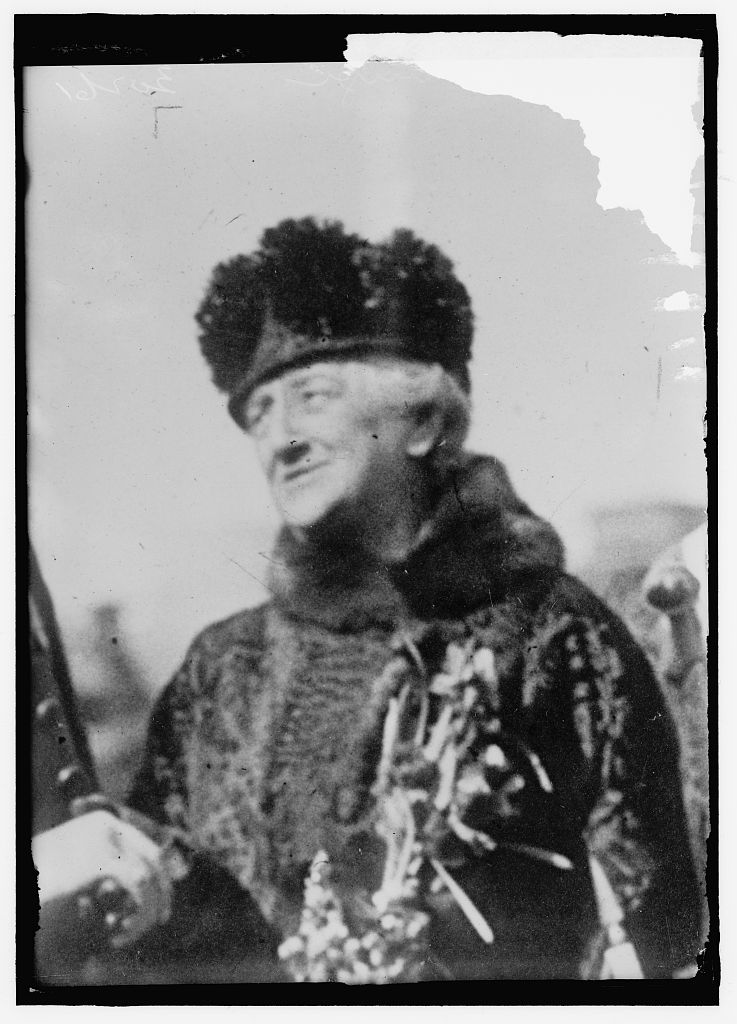
Louisine Havemeyer, 1919, in her suffragist phase (Library of Congress)
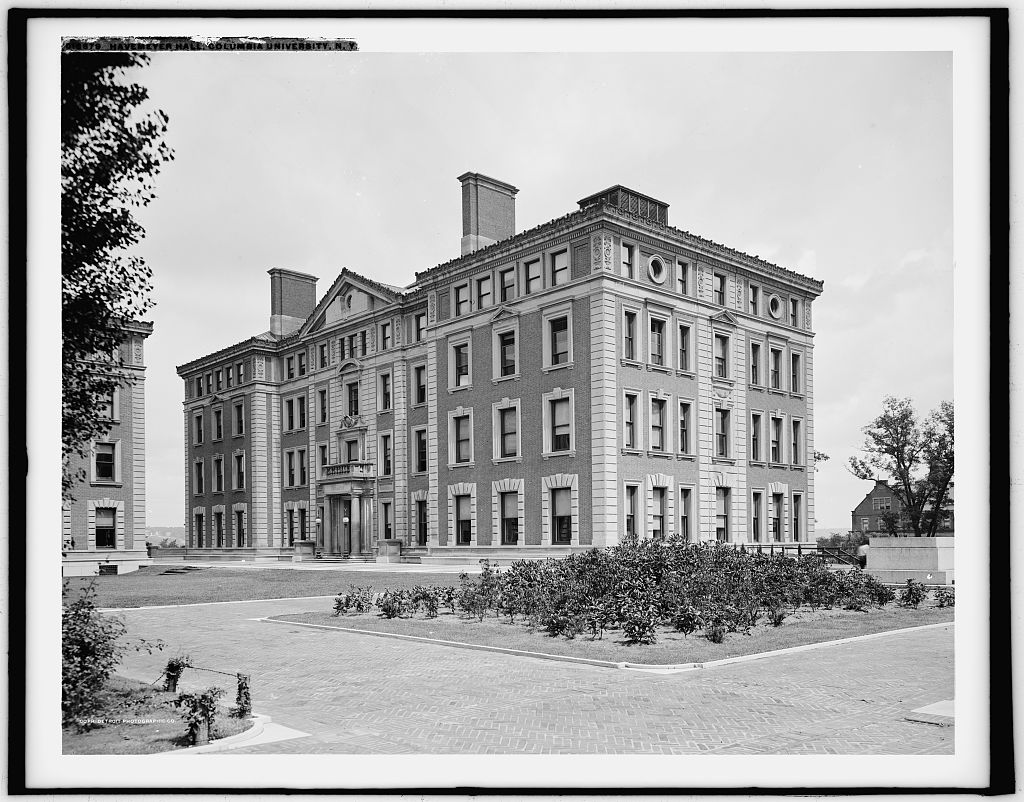
Havemeyer Hall on the Columbia University campus, built in 1897 and named for Frederick Havemeyer who moved the family’s sugar enterprise to Brooklyn. According to Untapped Cities, it happens to contain Hollywood’s favorite classroom.
Library of Congress
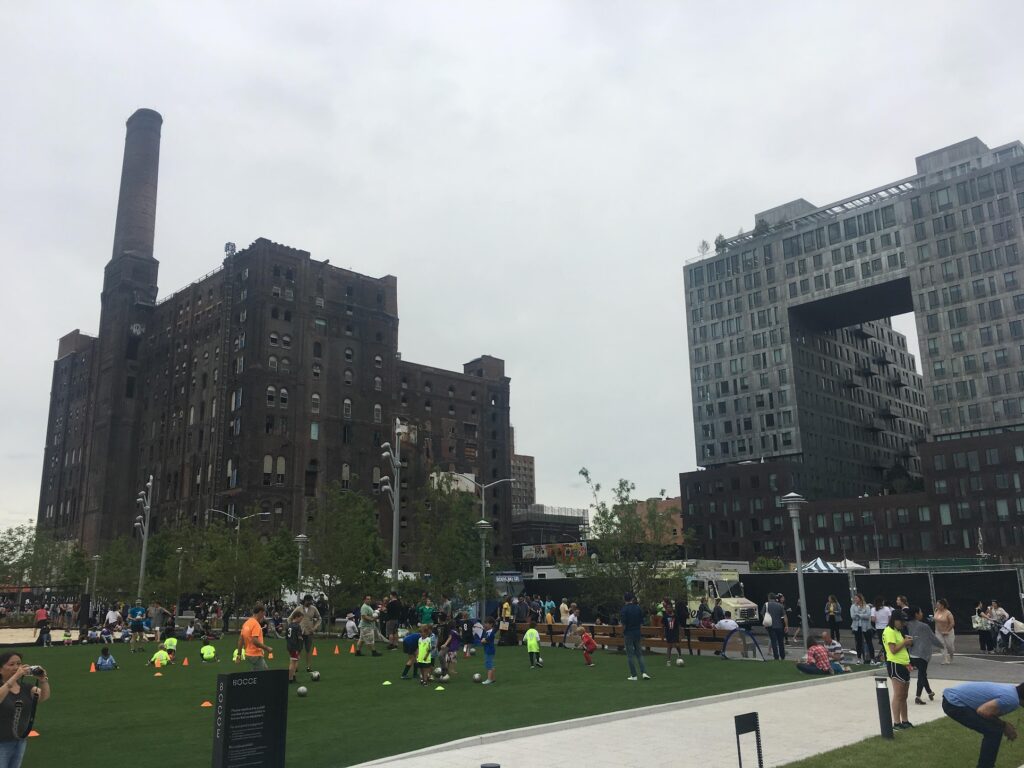
Taken by Greg June 2018, before the completion of The Refinery:
Current photos by Greg (circa January/February 2024)
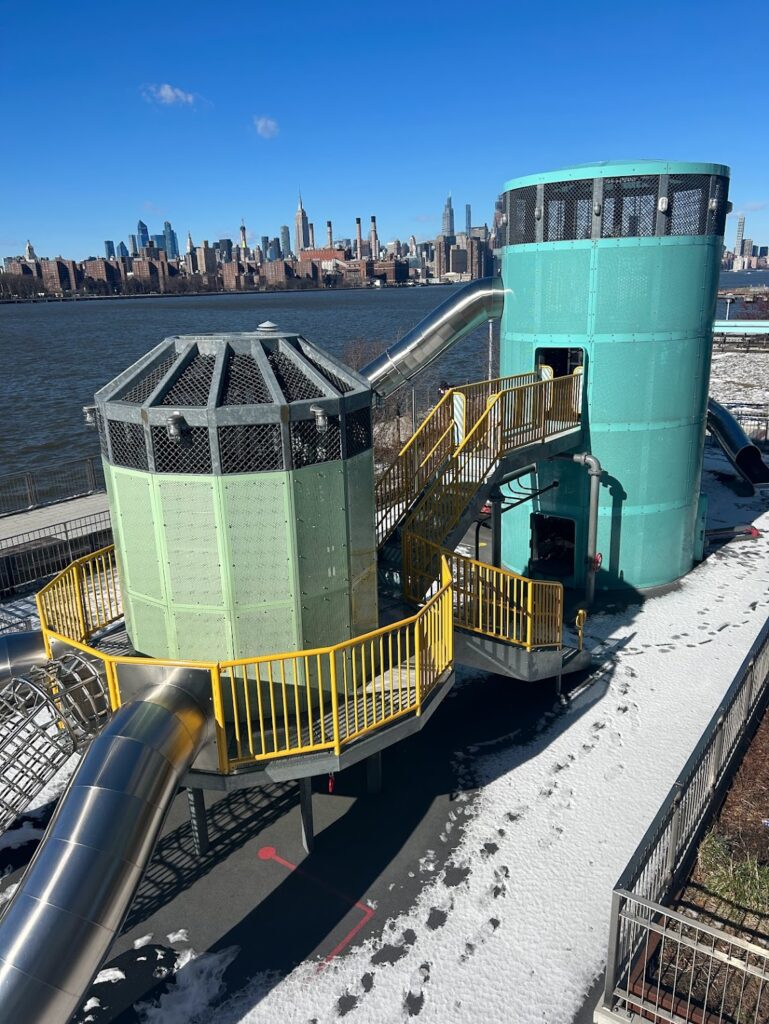
The playground pays homage to the sugar refining process.
Site of the former wharves where ships docked with sugar cane product from destinations around the world.
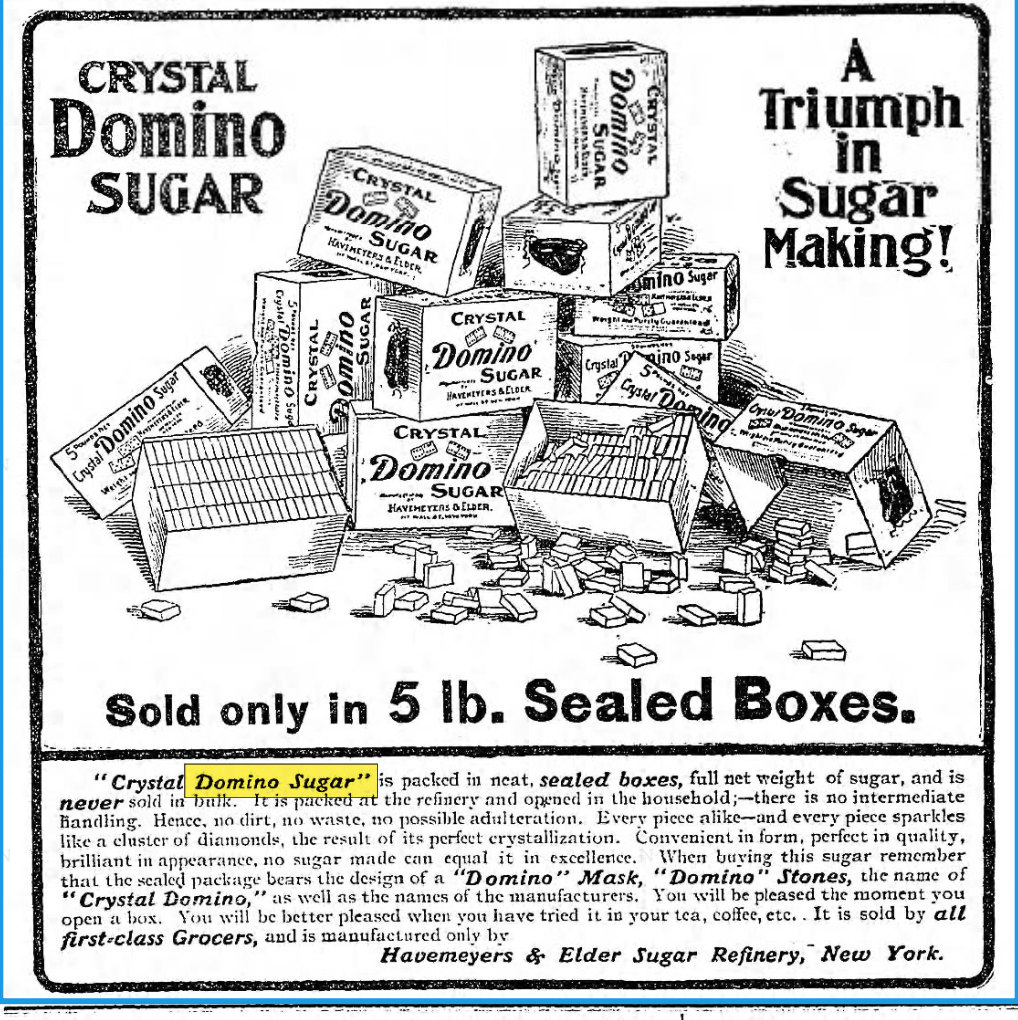
Where does the name Domino come from? Most likely from a kind of factory cut — the domino cut — name for the sugar appearing like little dominos. The box today is also rectangular like these ‘domino’ lumps.
Brooklyn’s Sweet Ruin: Relics and Stories of the Domino Sugar Refinery / Paul Raphaelson Cuba: An American Story / Ada Ferrer Food City: Four Centuries of Food-Making in New York / Joy Santlofer Frederick Christian Havemeyer Jr: A Biography / Harry W. Havemeyer Henry Osbourne Havemeyer: The Most Independent Mind / Harry W. Havemeyer The Havemeyers: Impressionism Comes To America / Frances Weitzenhoffer The Rise and Fall of the Sugar King / Geoffrey Cobb Sugar: A Bittersweet History / Elizabeth Abbott White Gold: A Brief History of the Louisiana Sugar Industry / Glenn R Conrad, Ray F. Lucas The World of Sugar: How the Sweet Stuff Transformed Our Politics, Health, and Environment Over 2,000 Years / Ulbe Bosma
The origin of a true Brooklyn ‘start up’ — Charles Pfizer and Co, who went from developing intestinal worm medication in 1849 to being a leader in vaccine distribution in the 21st century.
This is story of Pfizer Pharmaceuticals before the 1950s, a tale of German immigration and of early medical practices and concoctions that might seem alien to us today. Patent medicines! Worm lozenges!
But this company’s biography is also a celebration of Brooklyn — the City of Brooklyn in the mid 19th century, developing into an economic force in the United States and in opposition to the city of New York across the East River.
PLUS You can’t tell the Pfizer story without looking at the world of apothecaries and early drug stores in New York City in the 19th century.
Apothecaries were the first ‘natural’ medicine makers but their objectives were limited, seeking only to alleviate symptoms, not tend to the root cause of so many discomforts.
Later on, drugstores would stock up on manufactured medicines and questionable additions to the health regimen like soft drinks.
FEATURING Duane Reade, Kiehl’s, C.O. Bigelow, E. R. Squibb and Johnson & Johnson
ALSO: What important American figure today grew up delivering parcels for his family drugstore in Dyker Heights, Brooklyn?
LISTEN TODAY ON YOUR FAVORITE PODCAST PLAYER — PFIZER: A BROOKLYN ORIGIN STORY
FURTHER LISTENING
After listening to this show, take a dive in other episodes on similar or adjacent subjects.
The German biotechnology company Biopharmaceutical New Technologies (BioNTech) developed the COVID-19 vaccine injection with Pfizer, one of the world’s large pharmaceutical companies, who will manufacture and distribute it.
Let’s give our thanks to the scientists, researchers and physicians who helped get us to this moment. And yes, Brooklyn, you also get to share in a little bit of that pride today.
Because Charles Pfizer & Company — the originating business, founded in 1849 — first got its start in Brooklyn.
Or, to be more specific — the Brooklyn neighborhood of Williamsburg.
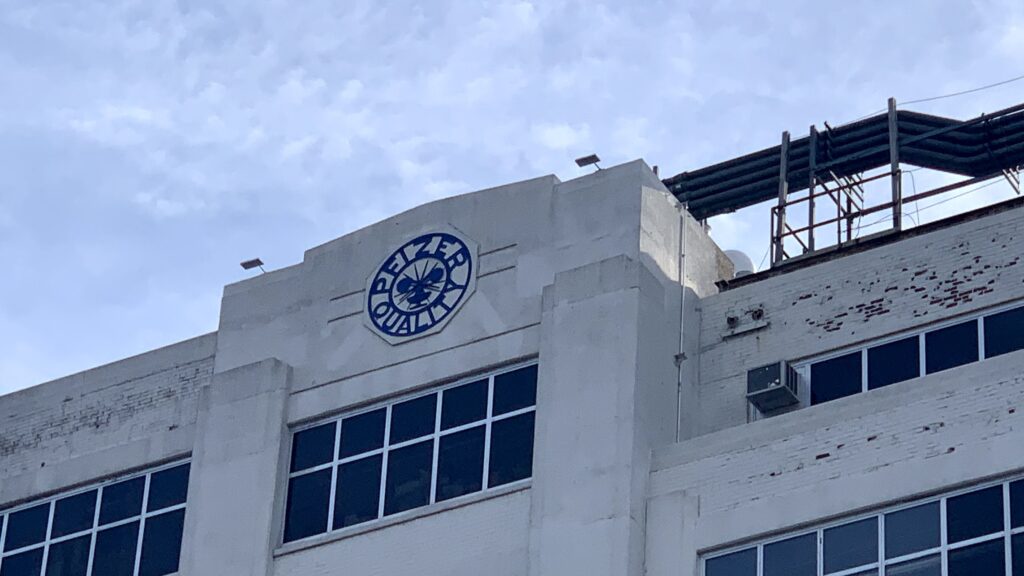
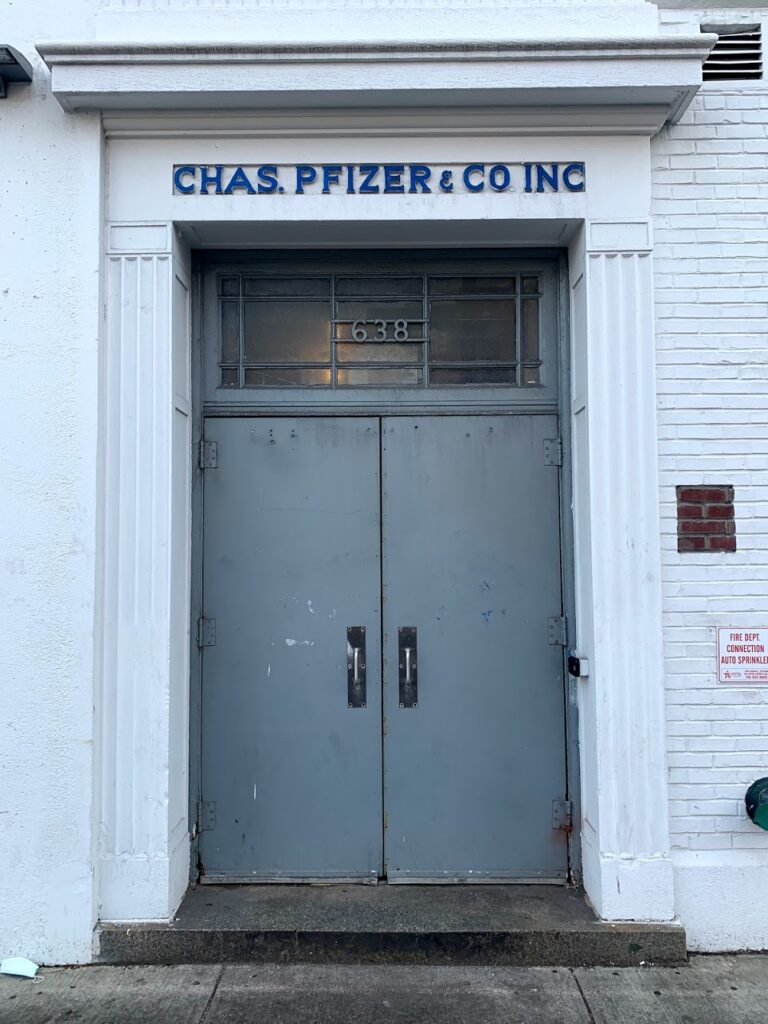
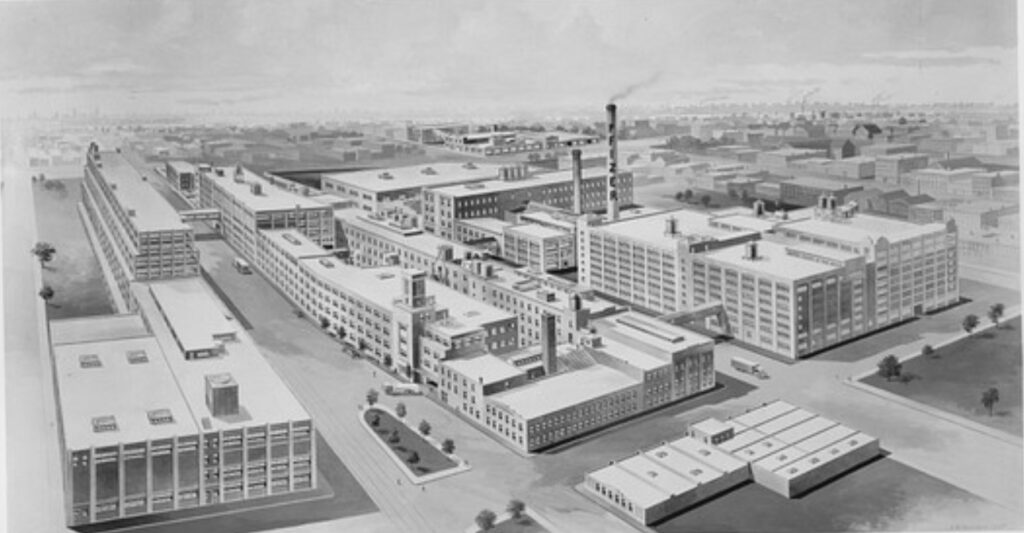
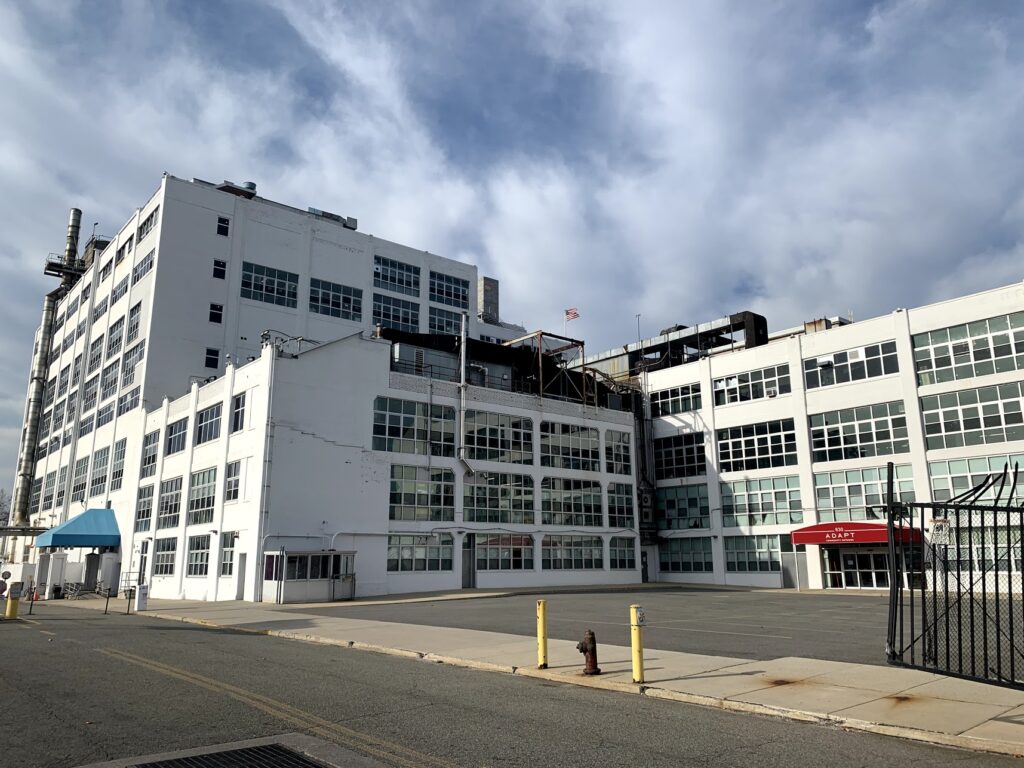
At their original Brooklyn location, the architectural details still gleam with ‘Pfizer Quality’.
A Company of Immigrants
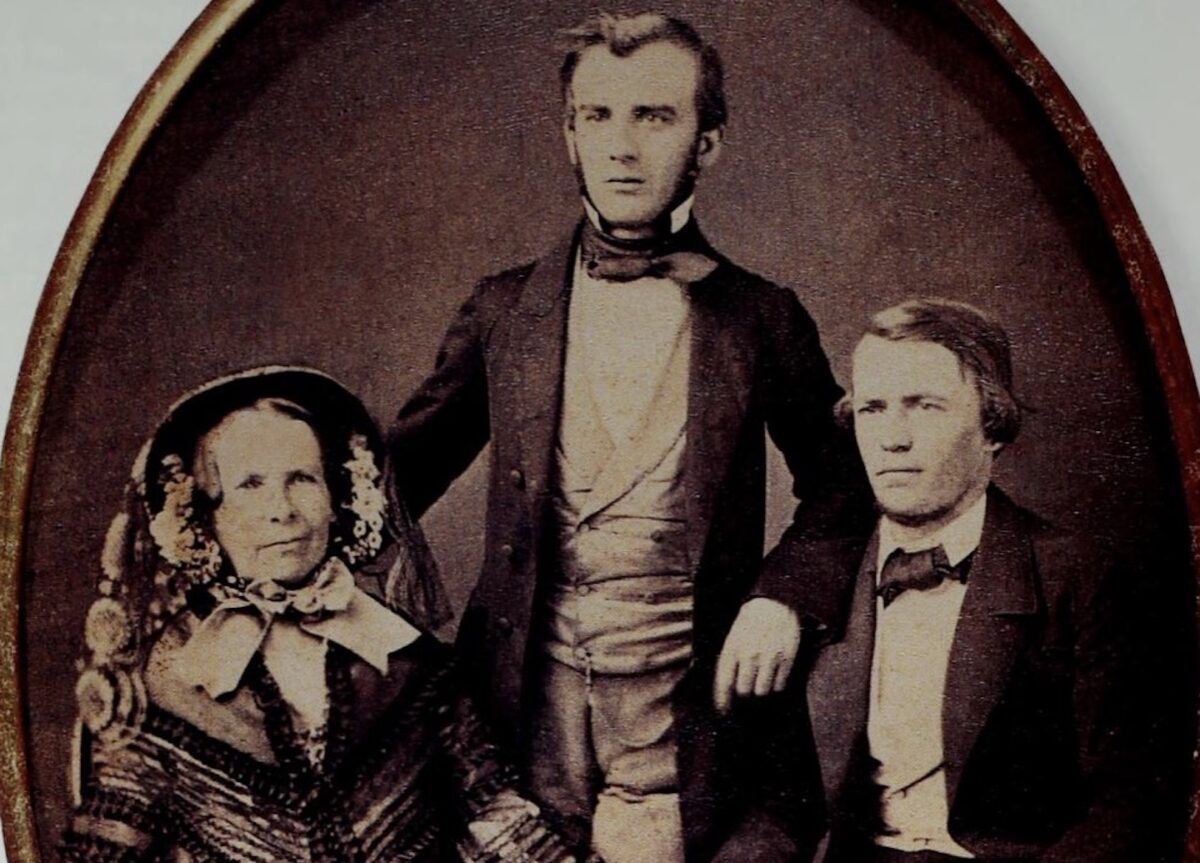
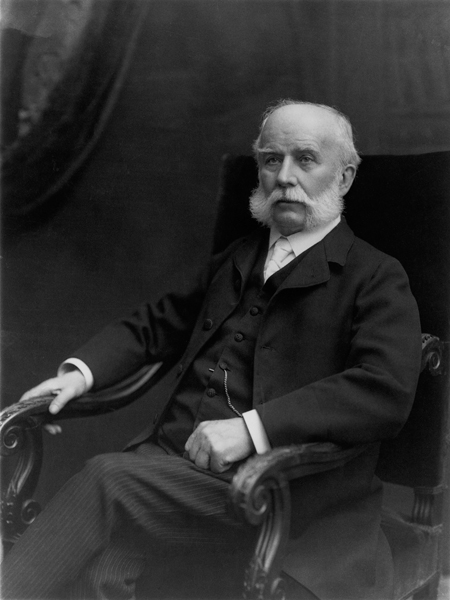
Karl Christian Friedrich Pfizer (later Charles Pfizer), born in 1824 in the Kingdom of Württemberg, was one of the many thousands of Germans who would immigrate to the United States during the 1840s.
Pfizer came to America with his cousin Charles Erhart in the fall of 1848. Unlike the experiences of so many immigrants during this time, both Pfizer and Erhart came from wealthy families and were both highly educated — Pfizer as a chemist, Erhart in the grocery and confectionary trade.
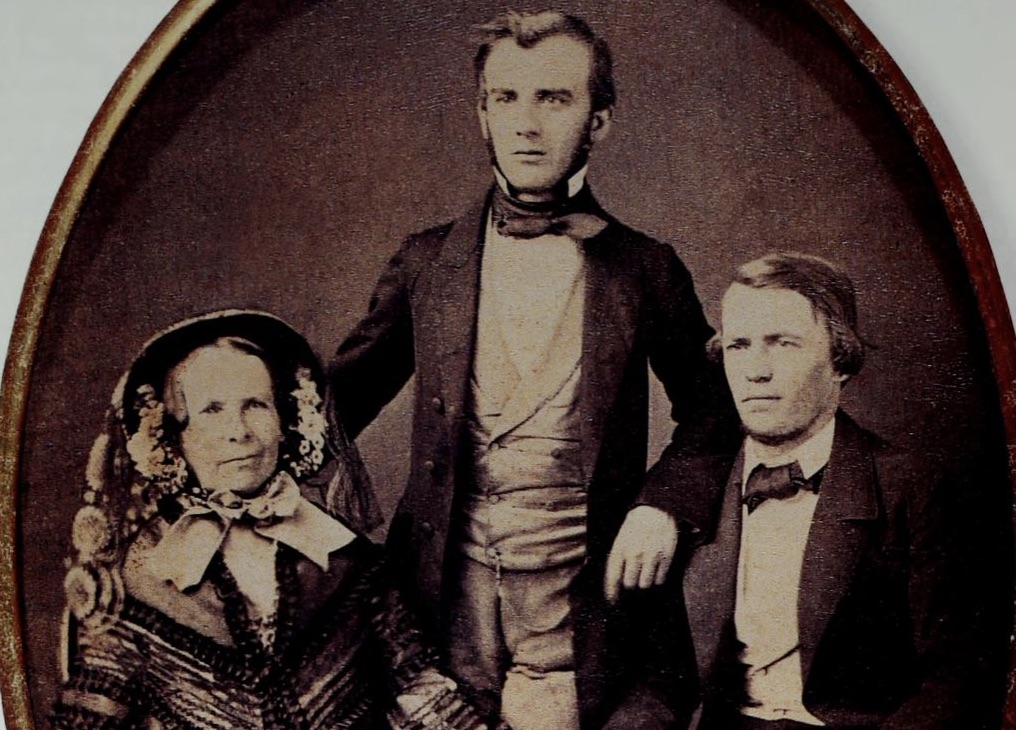
Wilhelmine Klotz Erhart, her son Charles Erhart, and her nephew Charles Pfizer standing. Photograph taken in 1855, courtesy the book The Legend of Pfizer
The practical applications of science to modern life were just beginning to be explored in the early 19th century. Pfizer was taking his training to a country not yet internationally known for scientific breakthrough.
According to author Jeffrey L. Rodengen, “Chemicals that once interested only scholars were becoming indispensable in manufacturing, agriculture and medicine. [Pfizer] also recognized that in the new nation of America, virtually no one was meeting the growing demand.”
Charles Pfizer, photographed here in 1890
A Home Among The Factories
Pfizer and Erhart would form their new chemical operation in Long Island’s King County in 1849, shortly after their arrival in America.
They had their eye on a spot near the Town of Williamsburgh, north of the burgeoning Brooklyn metropolis.
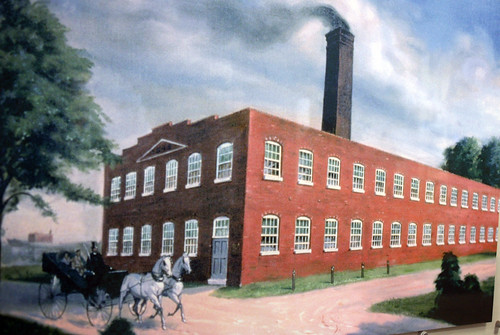
The first Pfizer building
Williamsburgh — a former village under the jurisdiction of the town of Bushwick — was a desirable destination for budding industrialists thanks to its proximity to a busy waterfront and the already busy waters of Newtown Creek. Chemical and oil plants were already home here when the cousins arrived.
Pfizer’s first headquarters was a bit far from the waterfront. They couldn’t quite afford to build a new factory.
Instead the cousins moved their operations into a pre-existing red brick building at Bartlett and Tompkins Streets thanks to a $2,500 loan from Pfizer’s father. (That’s about $78,000 today thanks to inflation.)
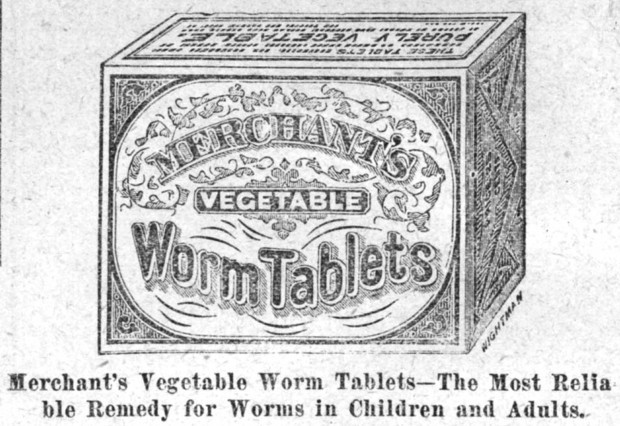
An example of 19th century medicine used to treat worms *shivers*.
How To Deal With Worms
A chemist and confectioner might seem like an odd couple today. But go to your medicine cabinet. How many of your medicines have flavor? Most pharmaceuticals would be hard to swallow without additives literally meant to make the medicine go down.
In 1849 the Pfizer company rolled out its first product — a product made from santonin. But this was santonin that tasted, well, not good exactly, but palatable enough to help relieve a very grotesque condition — intestinal worms.
Pfizer and Erhart produced santonin (made from the flower of Artemesia plants) with a relatively delicious almond-toffee taste.
Given that intestinal worms were a far bigger problem in the mid 19th century than they are today, the product flew off the shelves, allowing Pfizer to expand into other chemical remedies.
The original Brooklyn location of Pfizer still displays its history.
Room To Grow
As business was just getting off the ground, exciting things were happening in the neighborhood. In 1851, Williamsburgh briefly became its own incorporated city.
Less than four years later the city — along with the township of Bushwick and Greenpoint — would be incorporated into the expanding City of Brooklyn. It was collectively known as the Eastern District.
As the community was quickly growing, so too was business booming for the cousins who over the next three decades quickly expanded into the lots surrounding their original headquarters on Bartlett and Thompson.
Like many areas of the Eastern District by the late 19th century, the chemical aroma must have been remarkable.
Brooklyn Public Library
Of course Pfizer also expanded outside of Brooklyn almost immediately. In 1868, they naturally moved their central headquarters closer to Wall Street — to 81 Maiden Lane.
Meanwhile their Brooklyn location was cranking out such products as iodine, chloroform, borax, camphor and even morphine. They also specialized in non-medicinal products like cream of tartar.
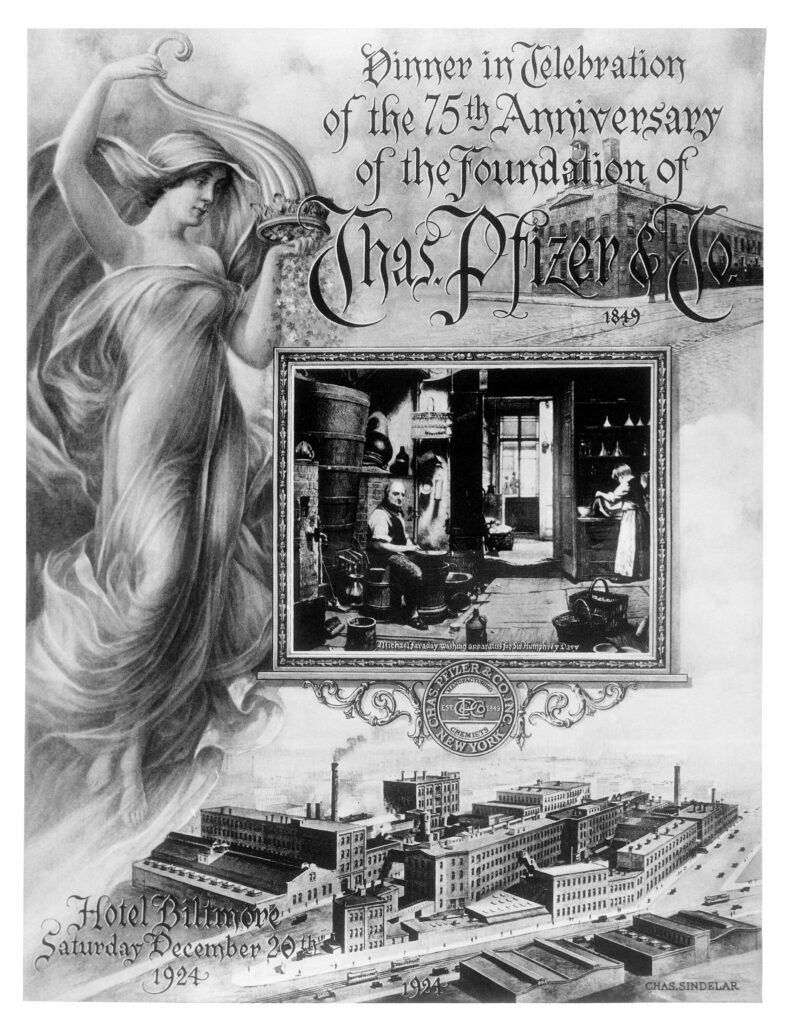
A celebration of their 75th anniversary featuring a depiction of their Brooklyn operation.
As Scott H. Podolsky writes in his journal article Antibiotics and the Social History of the Controlled Clinical Trial 1950-1970:
“For nearly a century of Pfizer’s existence, it did not market pharmaceuticals but rather had centered upon the production and refinement of chemicals such as citric acid, which Pfizer was the world’s largest producer by World War II.
“However the fermentation techniques used in the production of citric acid would render Pfizer a leader in the American World War II efforts to mass-produce penicillin and Pfizer soon followed as one of the largest producers of the equally nonexclusive streptomycin and dihydrostreptomycin (selling to other companies to distribute).”
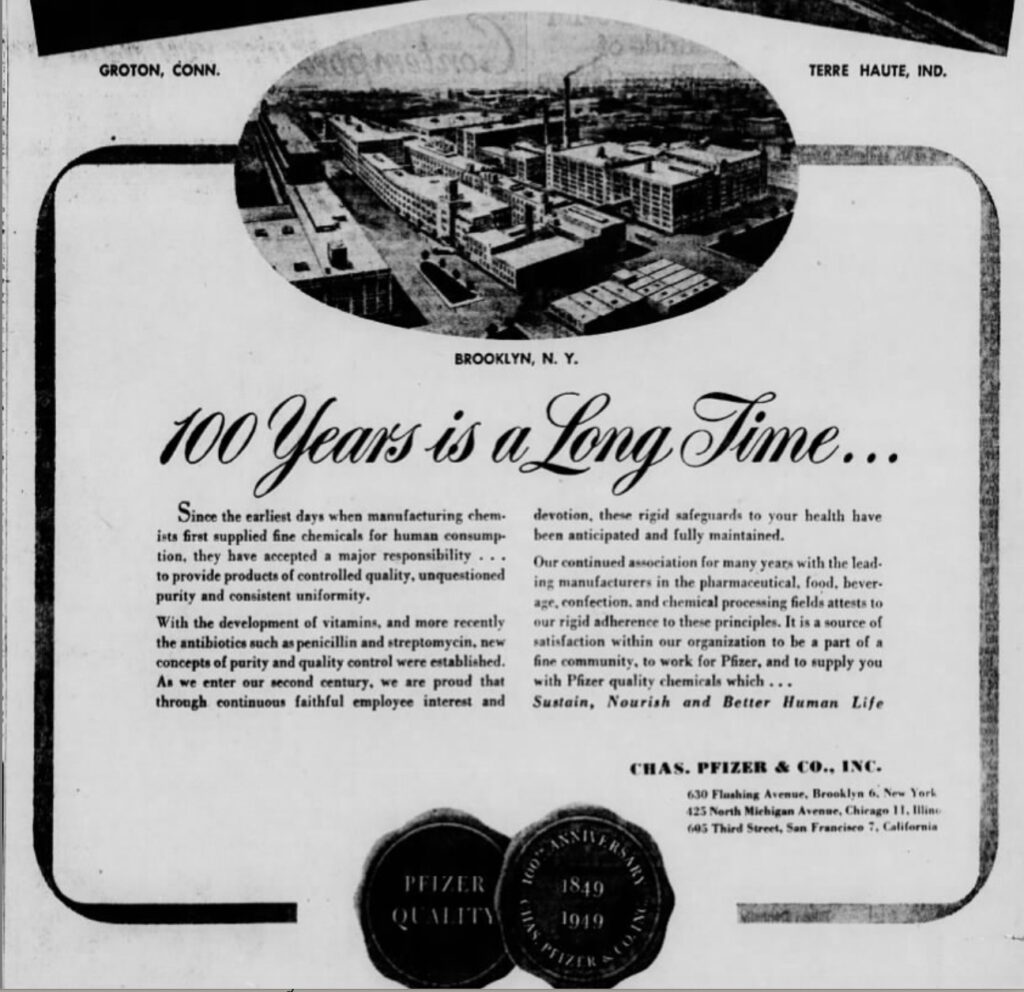
An advertisement touting their 100th anniversary
Penicillin would change the world — and significantly expand Pfizer’s profile by the second half of the 20th century through corporate mergers and expanded offices in several countries.
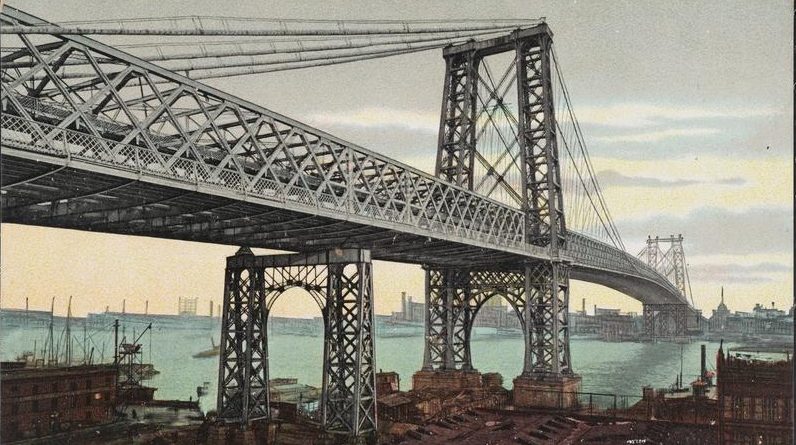
PODCAST The story of the Williamsburg Bridge — poorly received when it was built but vital to the health of New York City
Sure, the Brooklyn Bridge gets all the praise, but the city’s second bridge of the East River has an exceptional story of its own.
In this episode, we’ll answer some interesting questions, including:
— Why is the bridge named for a 19th century industrial neighborhood in Brooklyn and why is it not, for instance, called the Manhattan Bridge (a name not in use yet in 1903) or the East River Bridge (which was its original name)?
— Why did everybody think the bridge looked so unusually ugly and how did the city belatedly try and solve the problem?
— Why did one population in the Lower East Side find the bridge more important than others?
— And why was the bridge is such terrible shape in the 20th century? Did it really almost collapse into the river?
PLUS: How the fate of the two neighborhoods linked by the Williamsburg Bridge would change radically in the 115 years since the bridge was opened.
The Bowery Boys: New York City History podcast is brought to you …. by you!
We are now producing a new Bowery Boys podcast every other week. We’re also looking to improve the show in other ways and expand in other ways as well — through publishing, social media, live events and other forms of media. But we can only do this with your help!
We are now a member of Patreon, a patronage platform where you can support your favorite content creators for as little as a $1 a month.
Please visit our page on Patreon and watch a short video of us recording the show and talking about our expansion plans. If you’d like to help out, there are five different pledge levels (and with clever names too — Mannahatta, New Amsterdam, Five Points, Gilded Age, Jazz Age and Empire State). Check them out and consider being a sponsor.
We greatly appreciate our listeners and readers and thank you for joining us on this journey so far.
We’d also like to thank WeWork for sponsoring the Bowery Boys podcast. Enter to win a 1-month hot desk membership to WeWork checking into this link. This contest only last a few more days and the winner will be announced on March 30.
And we’d also like to thank our additional sponsors Hulu (and the gripping new thriller The Looming Tower) and Audible. For a free 30-day trial (and a free audiobook) go to audible.com/bowery or text the word BOWERY to 500-500
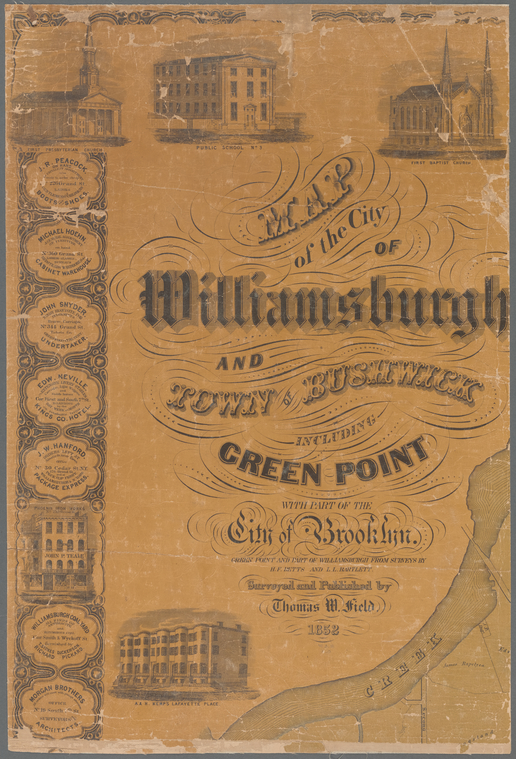
A map of the City of Williamsburgh and Town of Bushwick including Green Point, 1852
NYPL
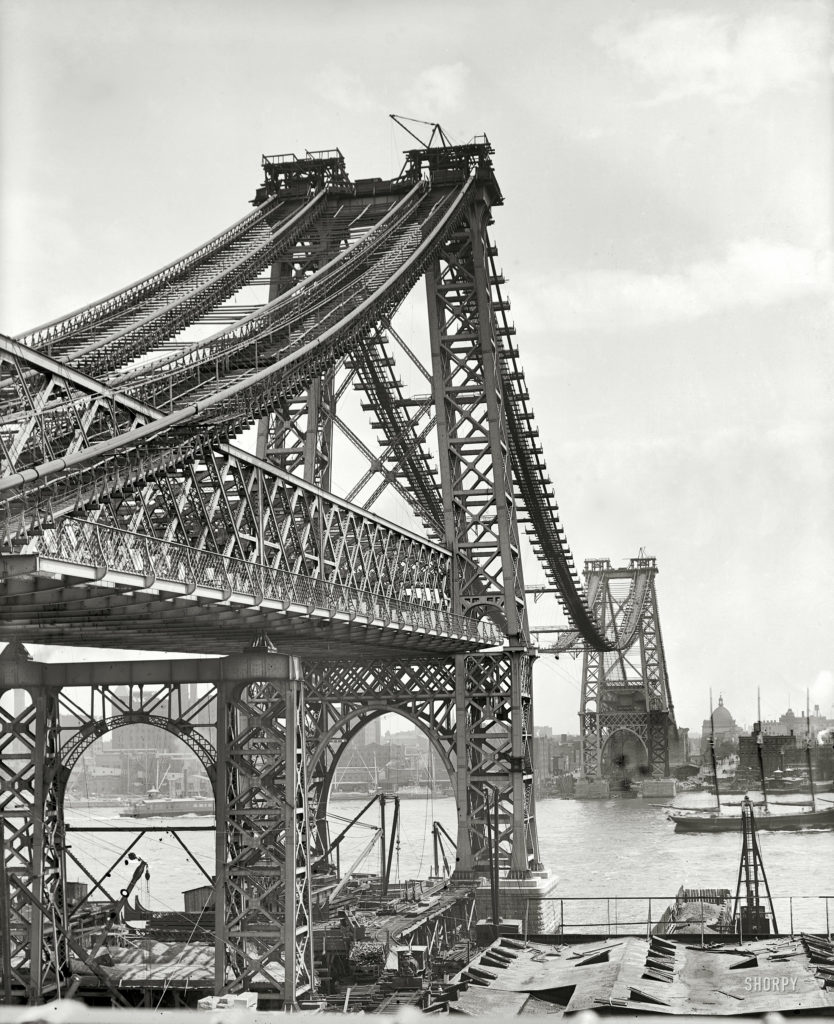
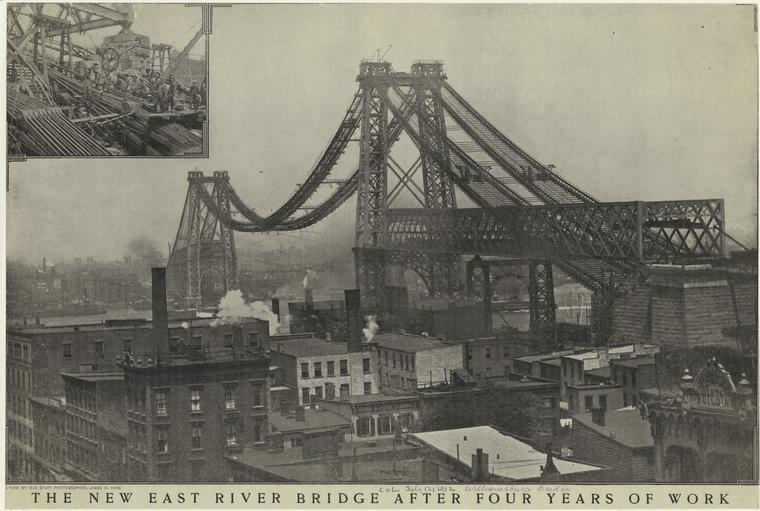
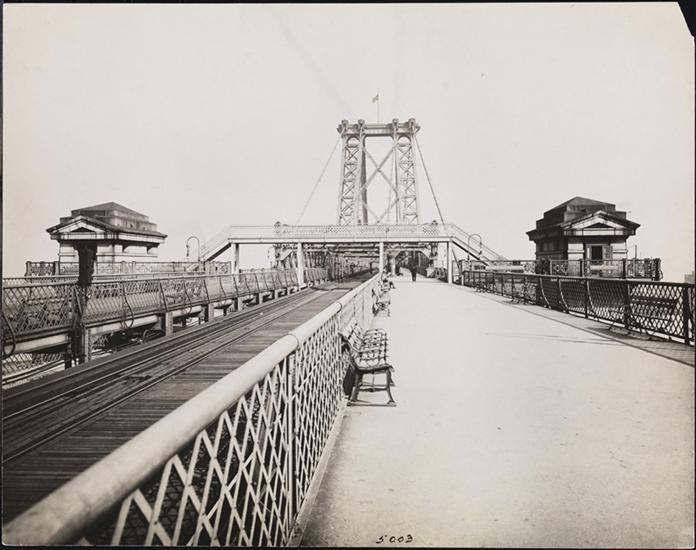
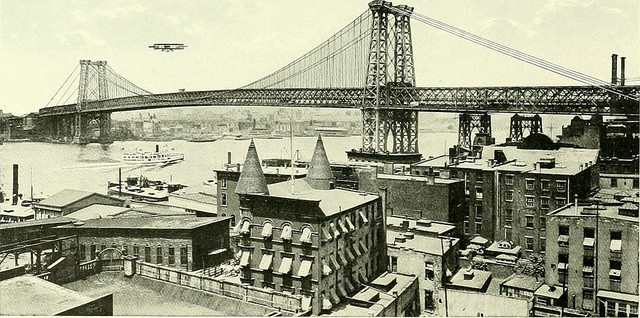
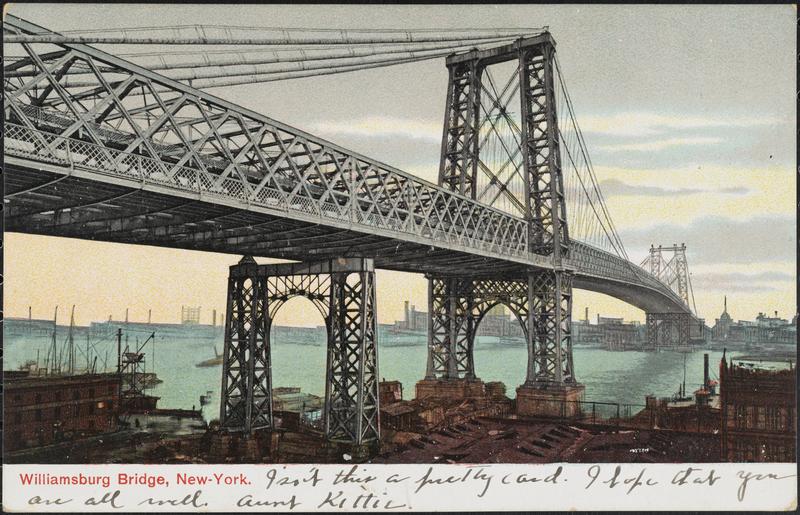
In 1902, the bridge was finally near completion, but many were worried about the bridge’s functional plainness.
Library of Congress/Cleaned up image courtesy ShorpyNew York Public Library
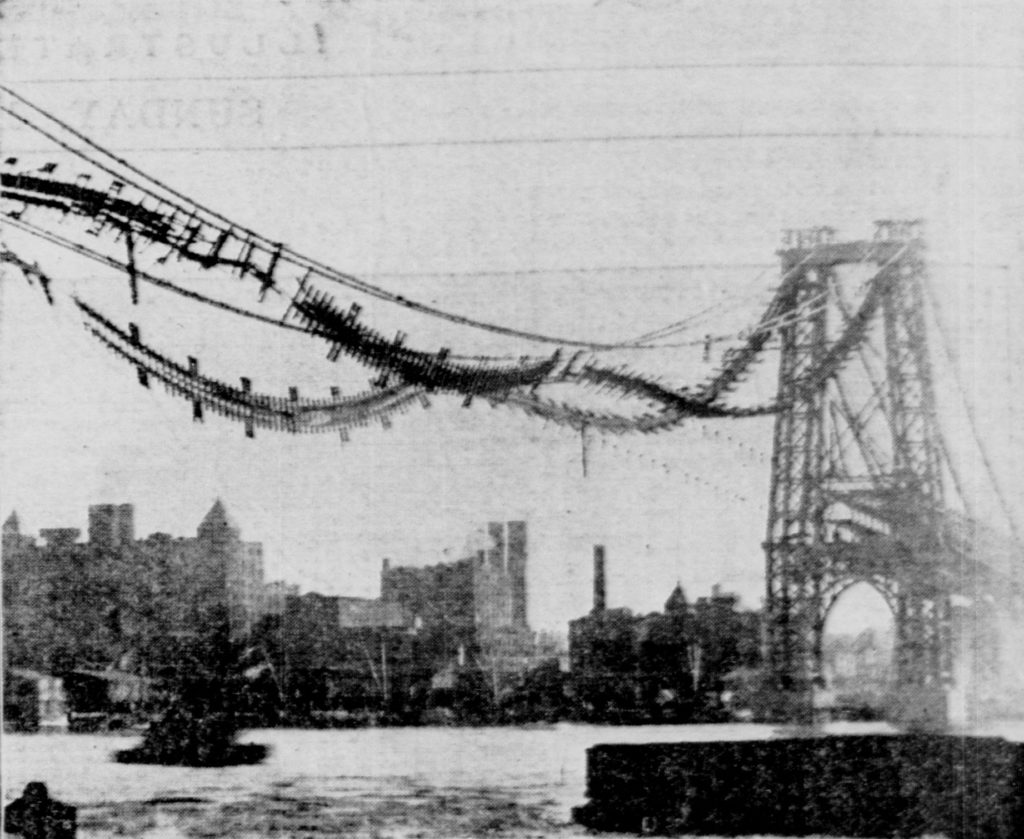
A 1903 fire on the bridge created a scary scene over the East River, but the cables and wires proved durable.
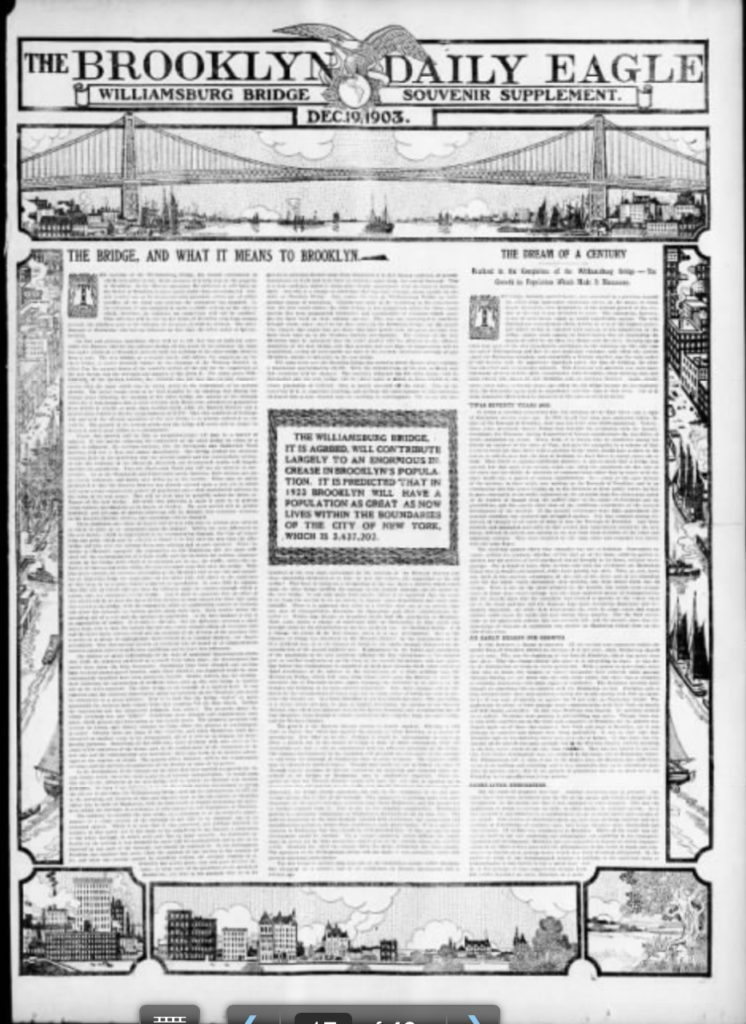
From the Brooklyn Daily Eagle souvenir section celebrating the opening of the bridge:
Bertrand Brown/MCNY
An illustration from the 1915 book New York: The Wonder City
Flickr commons
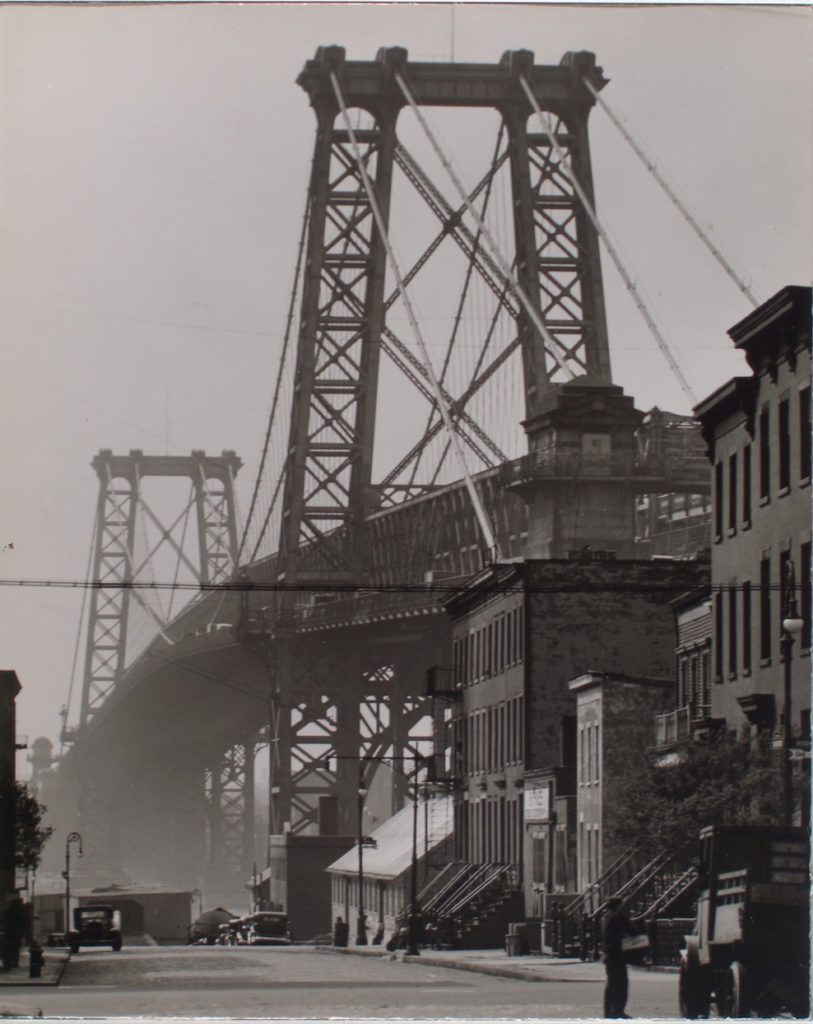
Seen from South Eighth and Berry Streets in Brooklyn, 1935.
Berenice Abbott/NYPL
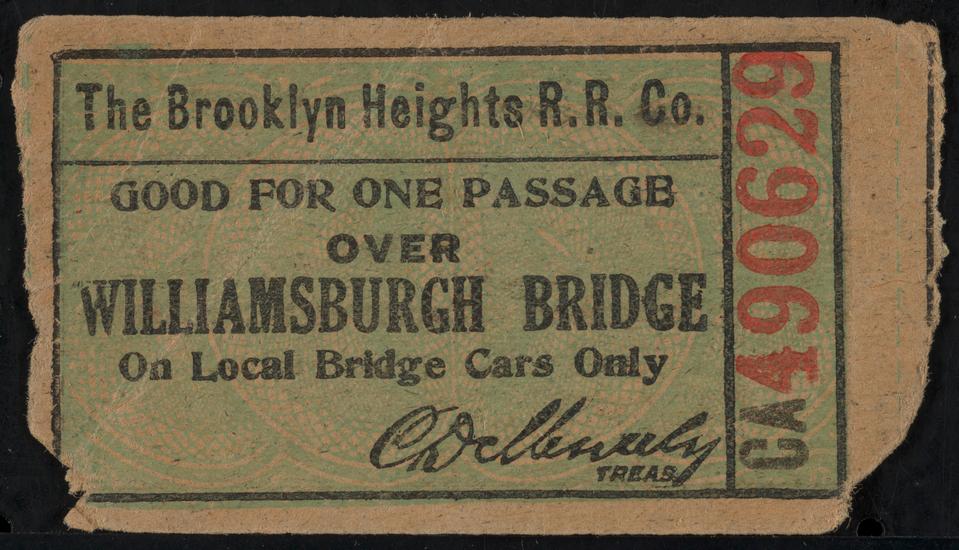
The old spelling of the name continually popped up in various places as late as the early 20th century. This passenger tickets dates to between 1903 and 1915.
MCNY
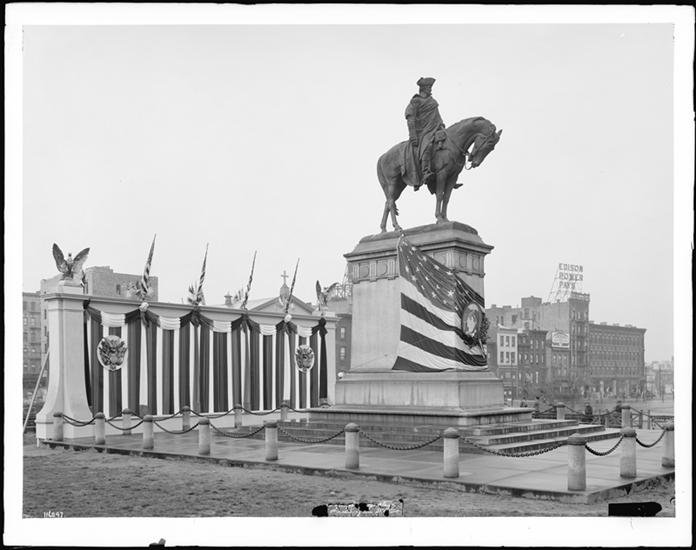
Williamsburg Bridge Plaza — and the handsome equestrian statue of George Washington — festooned with banners at the start of World War I.
MCNY
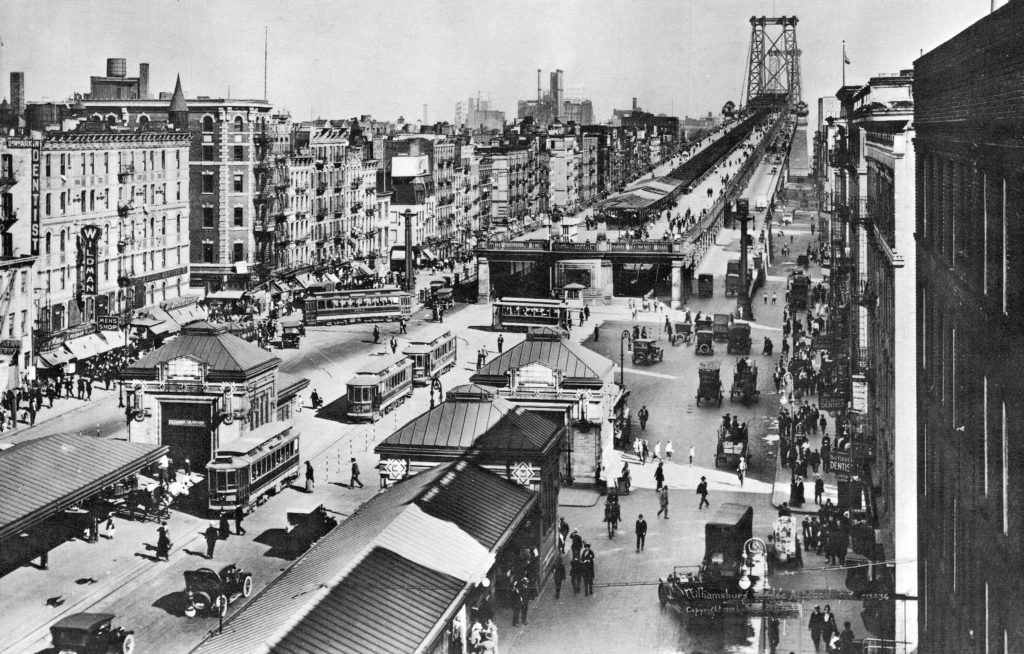
The approach to the Williamsburg Bridge from the Manhattan side. Delancey Street had to be widened to accommodate the influx of transportation options flooding onto the bridge.
The bridge is central to the growth of New York’s immigrant (and particularly Jewish) communities. While its construction did displace thousands of people, the bridge would actually facilitate better living conditions for Lower East Side immigrant groups by encouraging migration to less populated Brooklyn neighborhoods. The New York Herald even called it the “Jews Highway” as those of Eastern European and Russian Jewish heritage transplanted to Williamsburg.
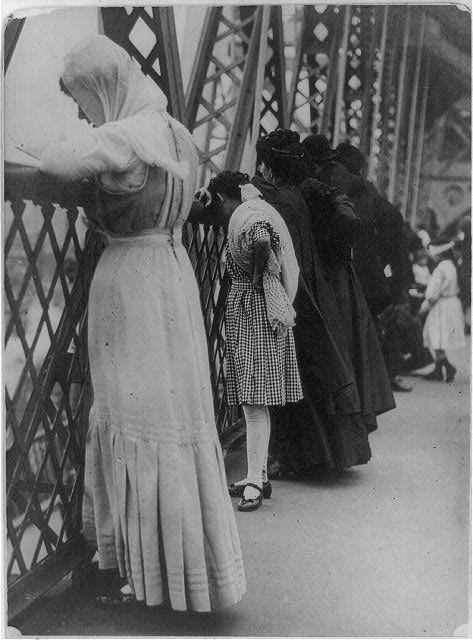
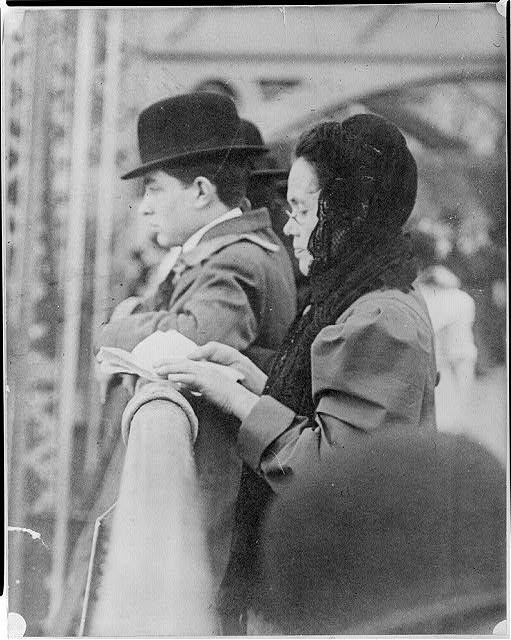
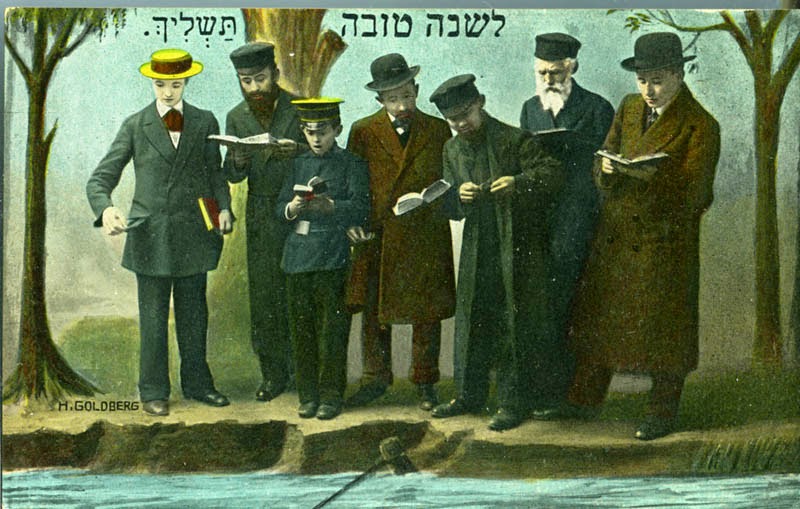
The ritual of tashlikh תשליך has often been performed on the bridge.
Library of Congress
From the film The Naked City
FURTHER LISTENING
These past episodes were mentioned in this week’s podcast. After finishing the Williamsburg Bridge show, go back and give these a listen:
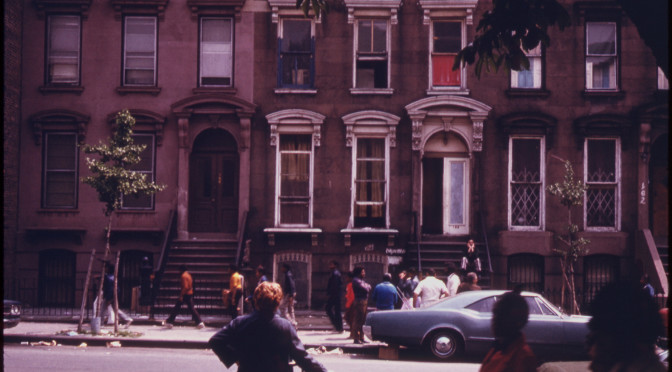
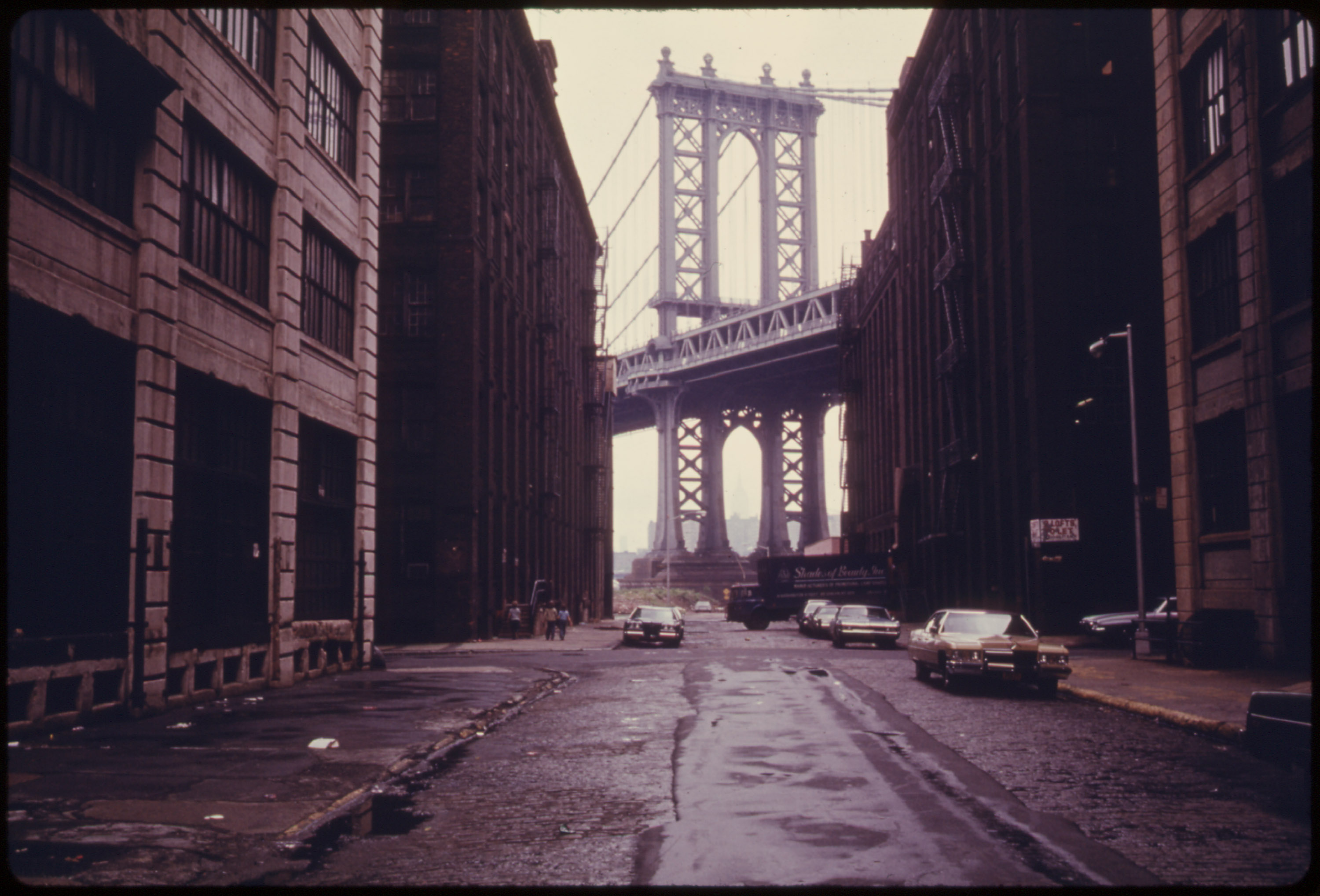
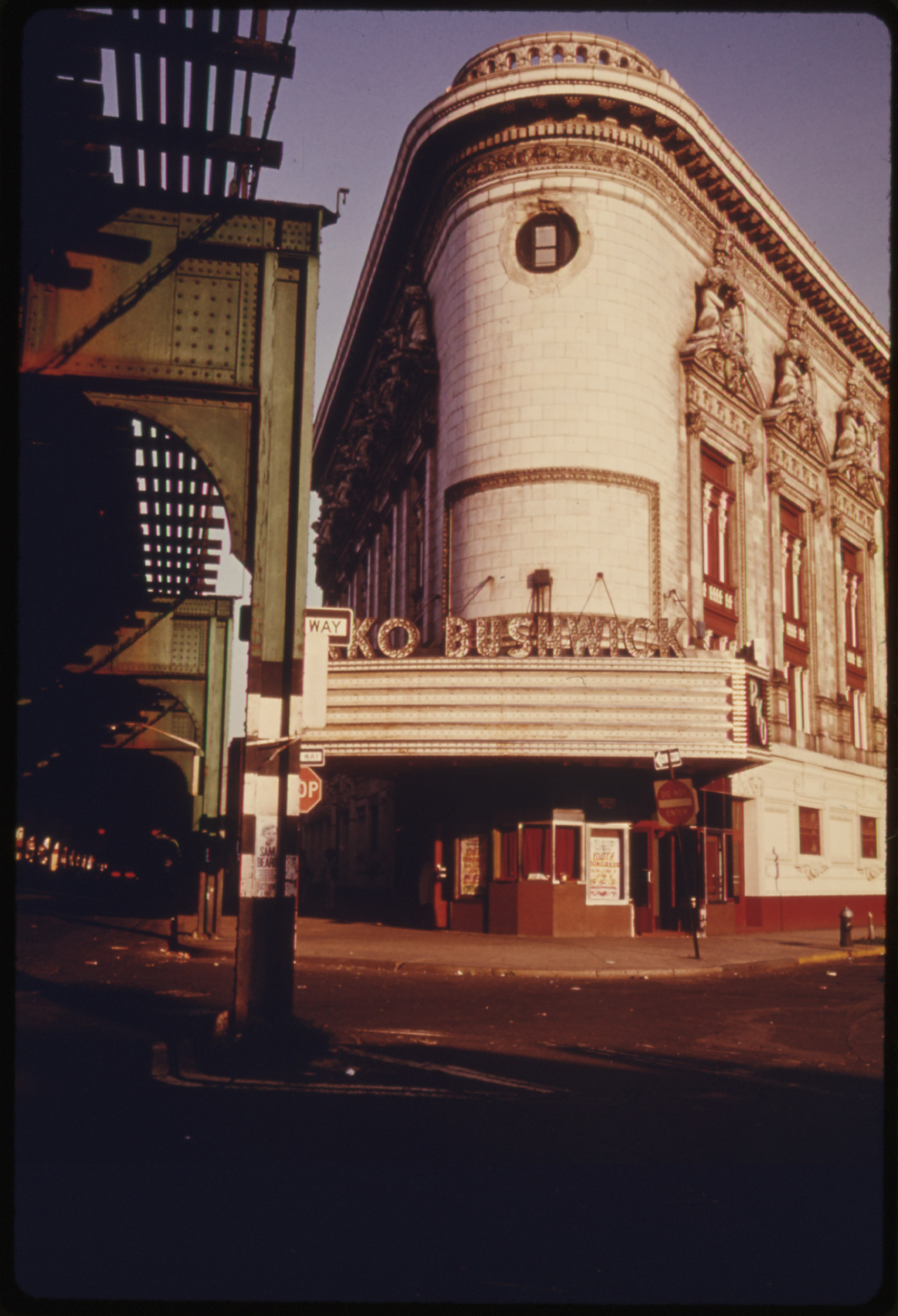
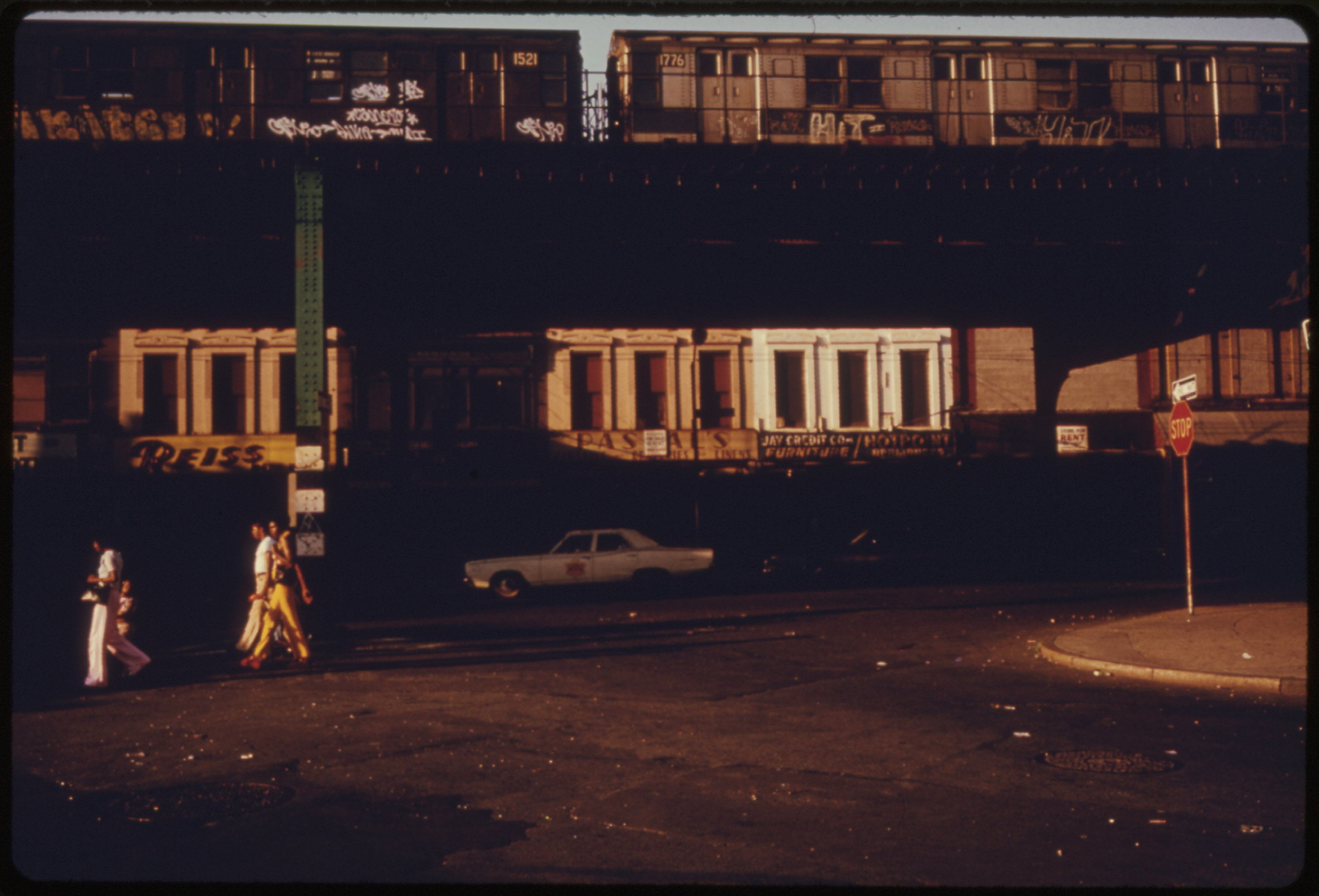
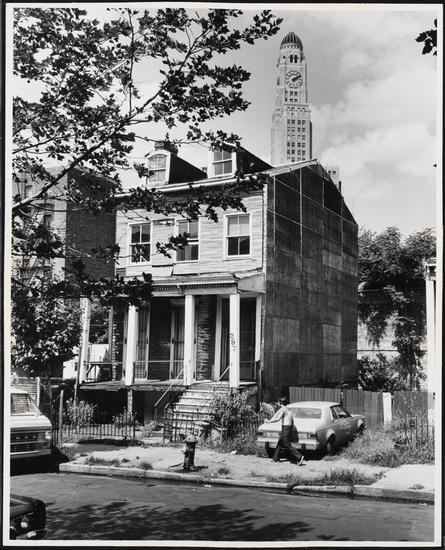
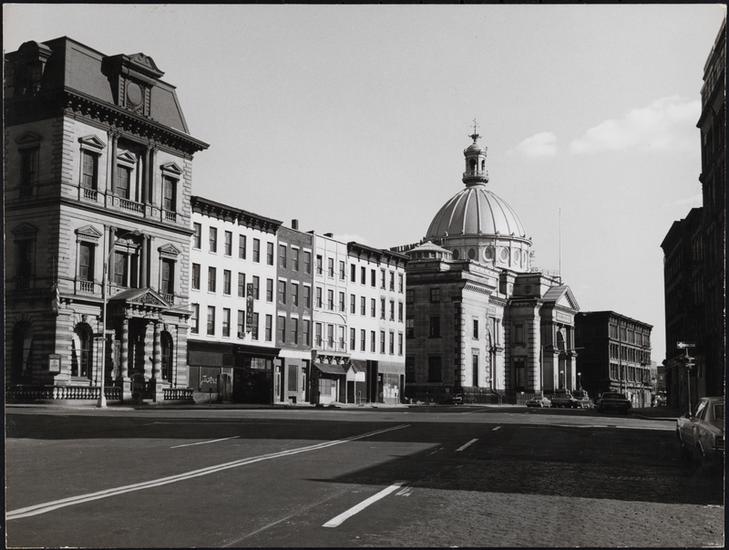
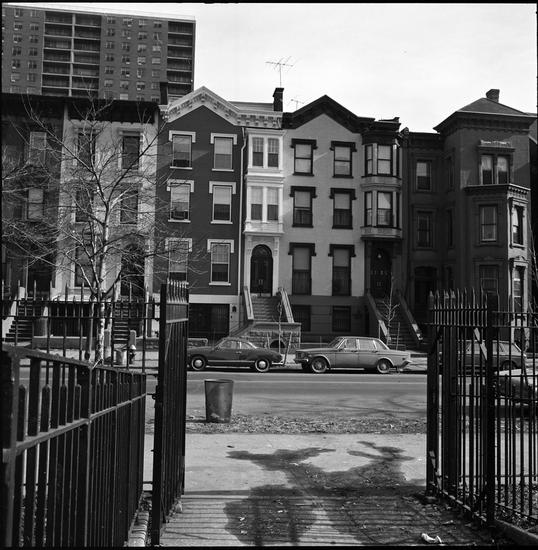
The new Bowery Boys podcast that comes out this Friday will be about Brooklyn. So let’s get in the mood with some pre-Instagram tinted photography from the U.S. National Archives, most of them taken in 1974 by Danny Lyon. followed by some black and white images by Edmund V Gillon.
You might have seen many of these photographs before (perhaps even here on this blog), but it’s striking to revisit them in context of Brooklyn current gentrification patterns.
The homes of Brooklyn Heights began seeing the arrival of ‘bohemians’ as early as the 1910s, and brownstone revivalists (the so-called ‘pioneers’) discovered the neighborhood after World War II.
But a noticeable trend of Brooklyn gentrification happened in earnest in the late 1950s, with wealthy escapees from Manhattan (fending off the urge to suburbanize) moving into South Brooklyn brownstones and row houses and giving enclaves attractive new names like Boerum Hill, Cobble Hill and Carroll Gardens.
The most successful example occurred up on the park slope as a movement of urban activists and historical preservations refurbished and brought to life one of Brooklyn’s original Gold Coasts. Its official name became, of course, Park Slope.
While the ‘brownstone Brooklyn’ movement was well at hand in 1974-5 — the date of most of these photographs — much of the borough was still facing blight and deterioration then. Most of the neighborhoods pictured below are today considered ‘hot’, trendy places with incredibly high rents.
DUMBO, a name invented in the late 1970s, Down Under the Manhattan Bridge Overpass.
The RKO Bushwick Theater, at the Bushwick/Bed-Stuy border.
Bushwick Avenue
Two pictures of Bond Street
Across from Lynch Park, near the Brooklyn Navy Yard
There’s no location listed in the caption but probably Park Slope?
Fort Greene, across from the park.
This is taken on Vanderbilt Avenue but I can’t ascertain exactly here. Perhaps today’s Prospect Heights area.
Images of the Fulton Ferry area in 1975 (courtesy the Brooklyn Historical Society)
And a couple images from the Museum of the City of New York archives, all from 1975, taken by Edmund V Gillon. You can find many more of astounding photographs here:
397 Dean Street, considered part of Park Slope today
Williamsburg, looking east on Broadway from Bedford Avenue and South 6th Street.
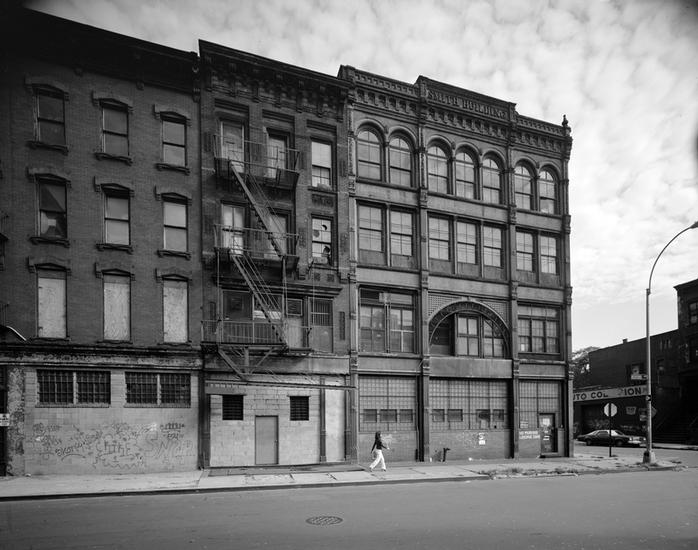
Boarded-up buildings and the Bedford Avenue façade of the Smith Building, 123 South 8th Street
Clinton Hill:Â Row houses on the eastern side of Washington Avenue between Dekalb and Lafayette Avenues
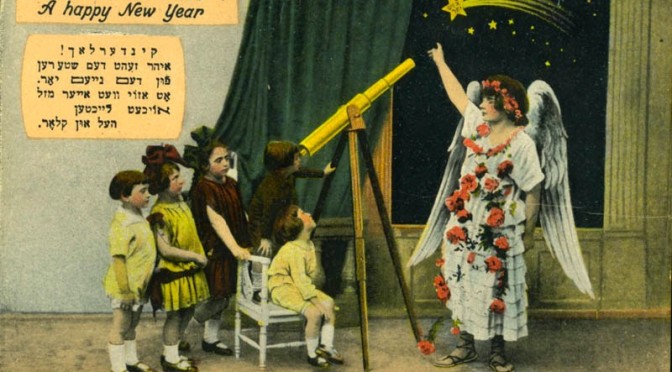
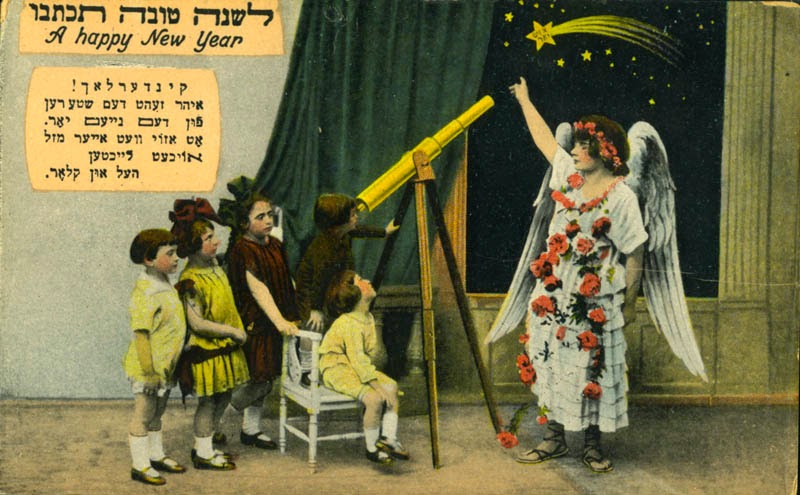
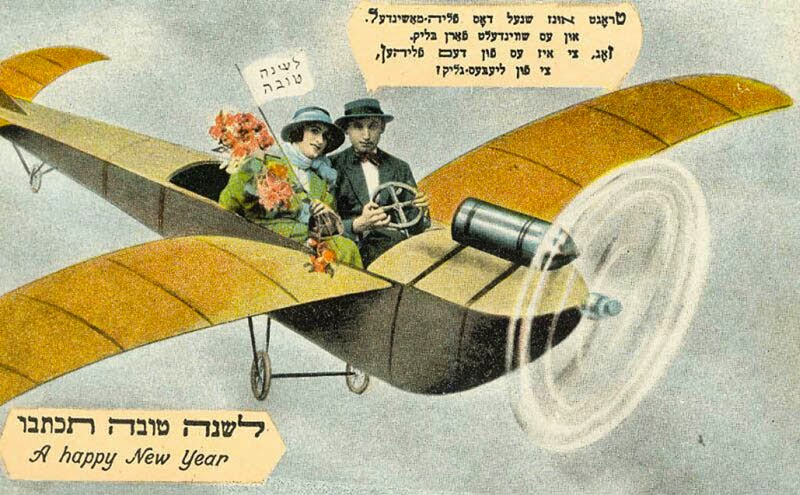
Look to the stars children! A vintage Rosh Hashanah card manufactured by the Williamsburg Art Company in the 1920s.
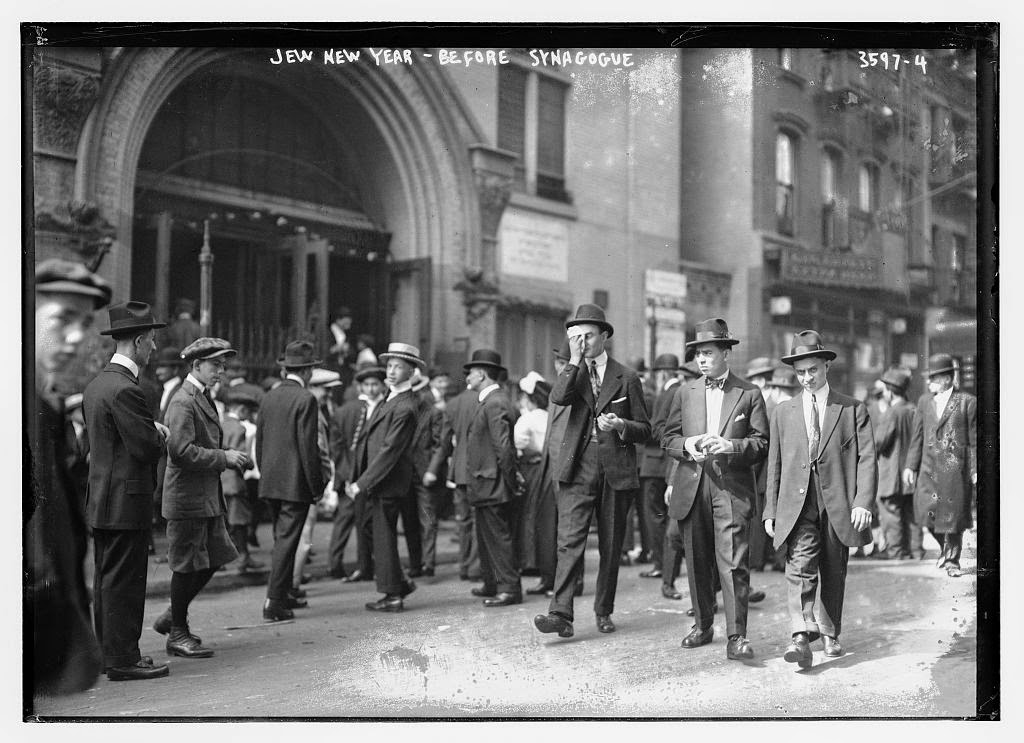
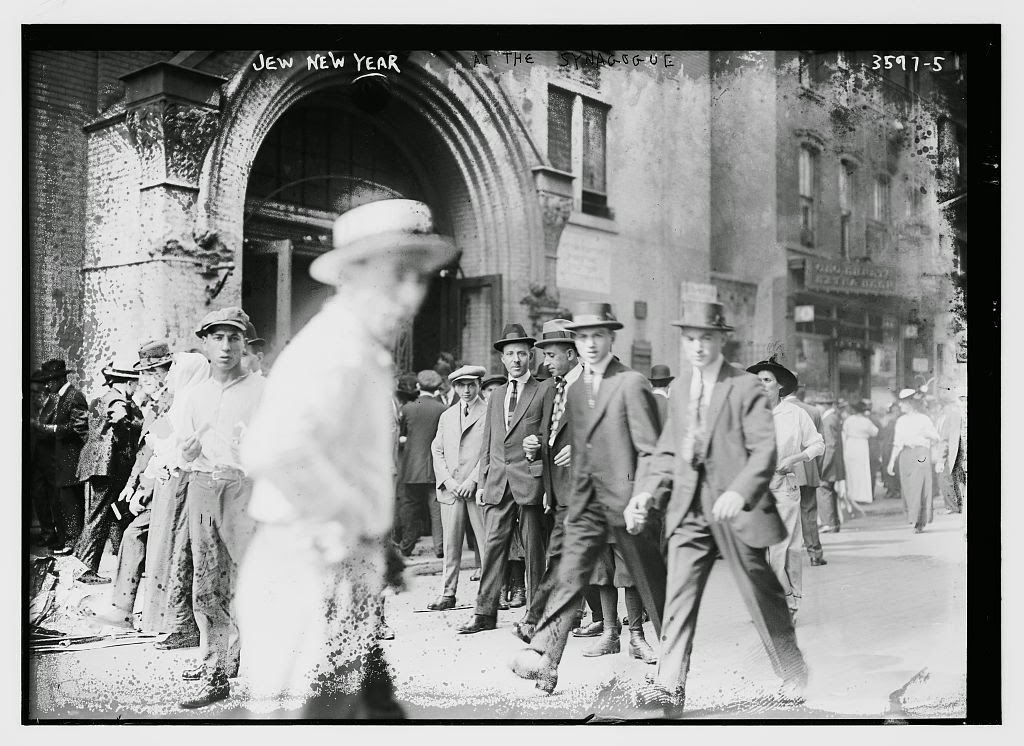
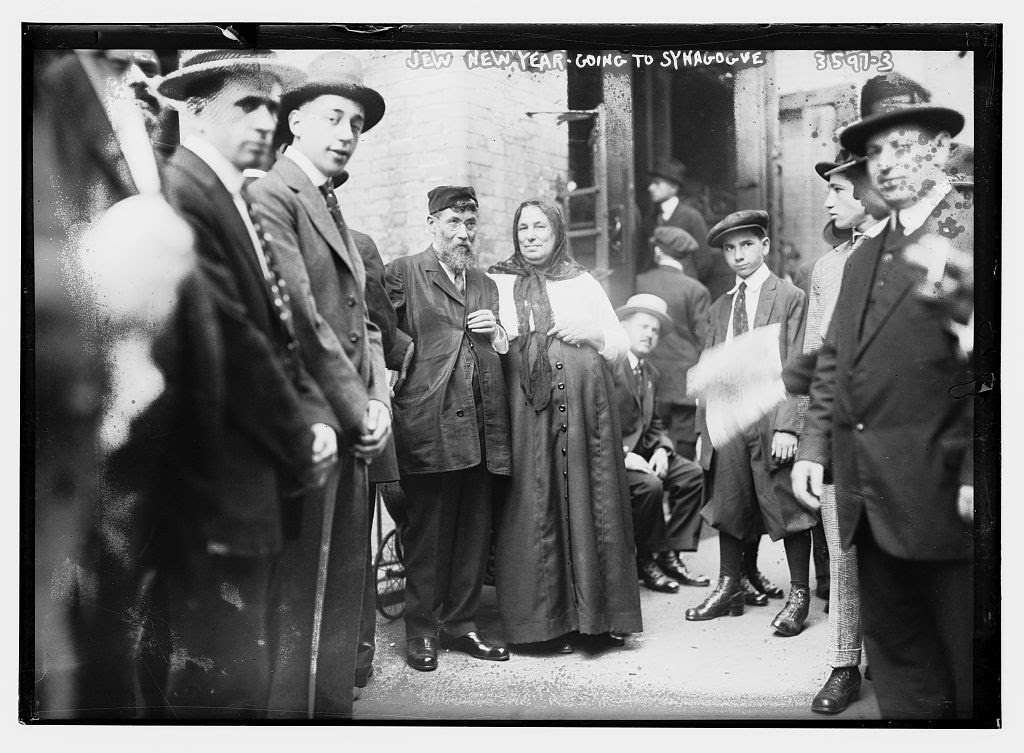
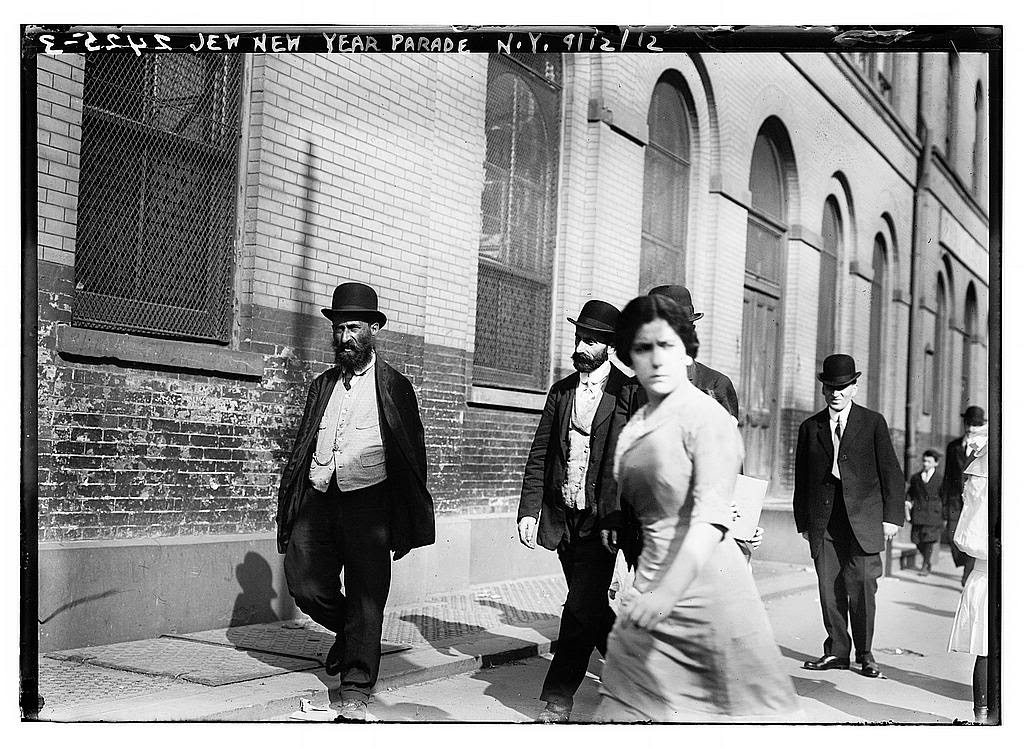
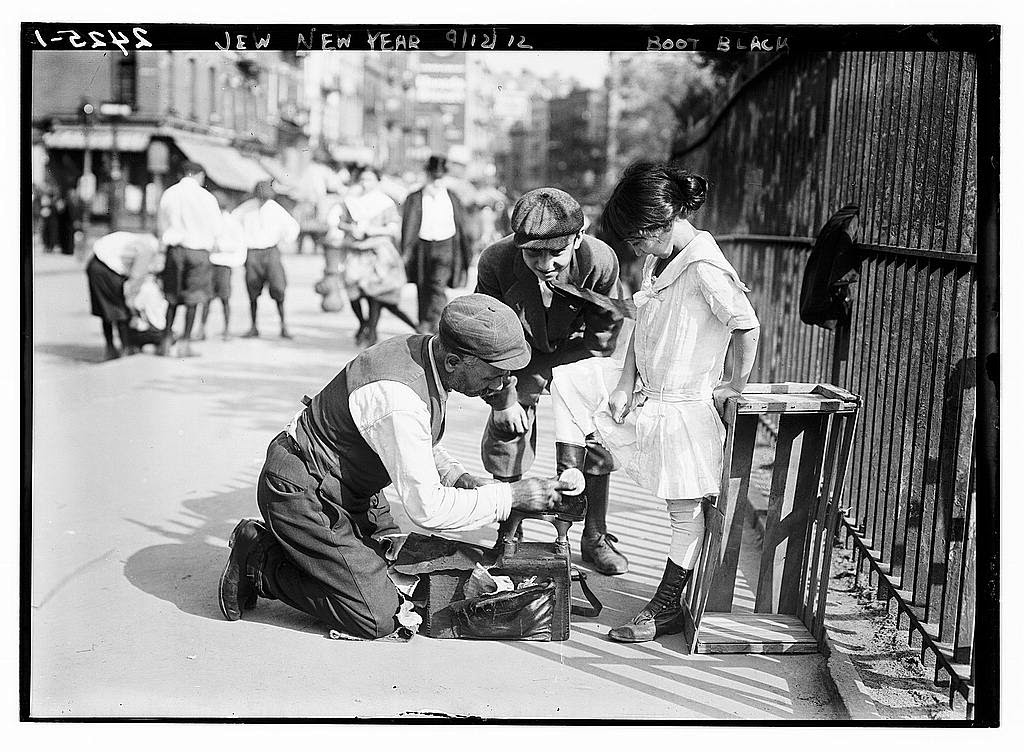
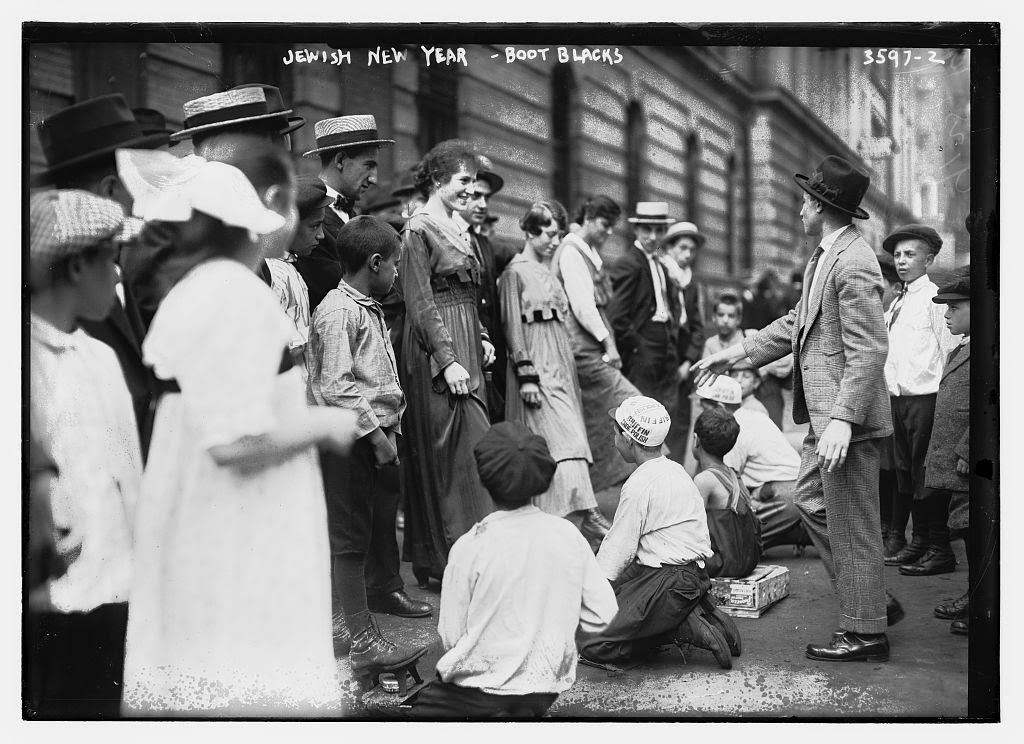
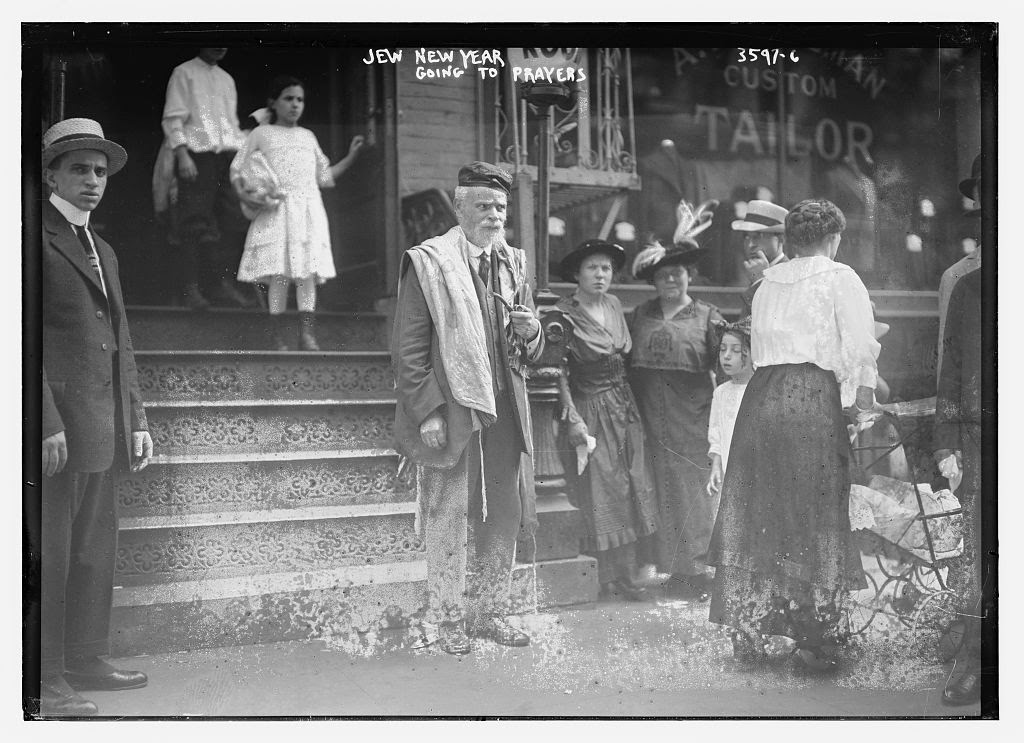
Rosh Hashanah is here — the first of Tishrei, year 5775. Presented here are a selection of photographs from the Library of Congress depicting Jewish New Yorkers celebrating the new year (or, at least, on their way home to start the festivities). These images date from 1909-1915, although most are 1912. As most of these photographs were possibly taken (or labeled) by non-Jewish photographers, some of the meaning is a little lost. If you have any insights into these images, please leave a comment!
And there’s some detective work to be done here. For instance, anyone recognize this synagogue?
One hundred years ago, Jewish New Year celebrations were especially fraught due to the events in Europe. Ethnics groups from embattled countries, in fear their rituals made them targets for local violence, made doubly sure to distance themselves for the politics of the day, while affirming their continuing connection to their Jewish brethren.
A leader of the reformed Jewish congregation proclaimed, “The conservative and patriotic citizenship of America refrains from endorsing the attitude of any country involved in the horrible European conflict. … [O]ur hearts go out to the 300,000 men in the Russian army who, having bled and suffered at the hands of their country on account of being Jews, are now suffering and dying for their country because as Jews they are loyal to the flag under which they live.” [source]
This one is dated September 1912 although there was not a “Jewish New Year Parade” and this is hardly an image of a parade anyway!
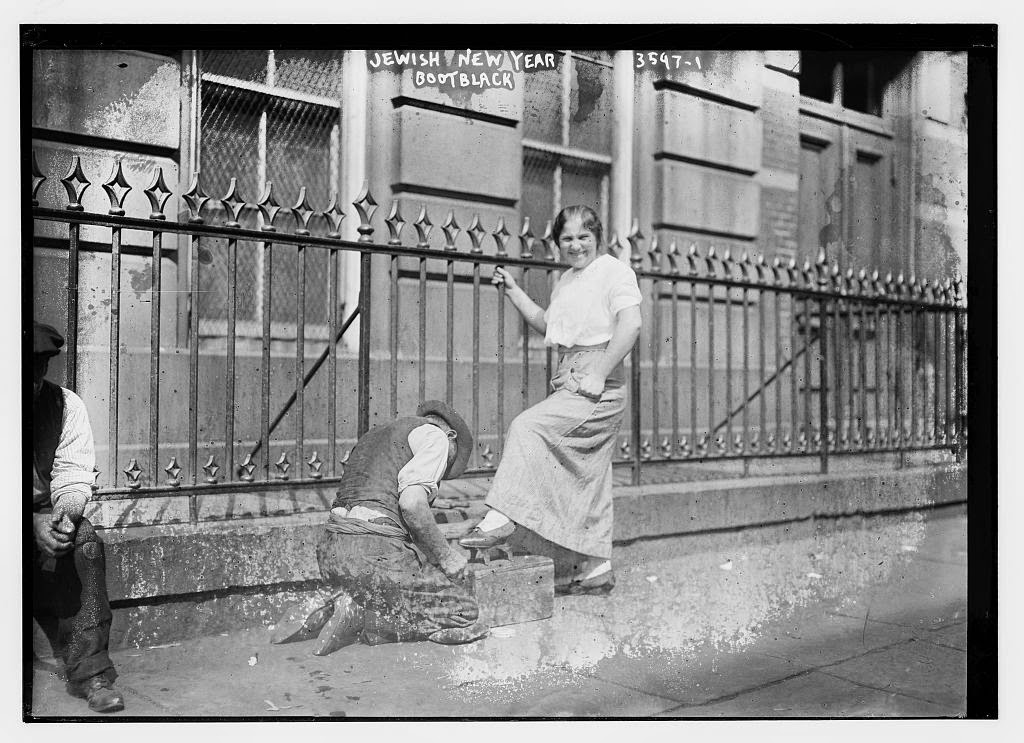
There appear to be a series of old Rosh Hashanah photographs focusing on boot blacks polishing the shoes of young ladies. I doubt this was an actual custom but more a recognition of the fact that many young boot blacks came from Jewish families. (However, for Passover, people leave their shoes at the door.)
The smile of the girl at center is totally making my day:
Here’s a telling detail from 1914: New Jersey decided to hold a statewide primary election on the same day as Rosh Hashanah that year, disenfranchising thousands of Jewish voters “who are prohibited from signing their name.” Registering to vote was quite different back in the day; luckily, there was an alternate date provided that fell before the holiday, but no attempts were made to actually move election day. [source]
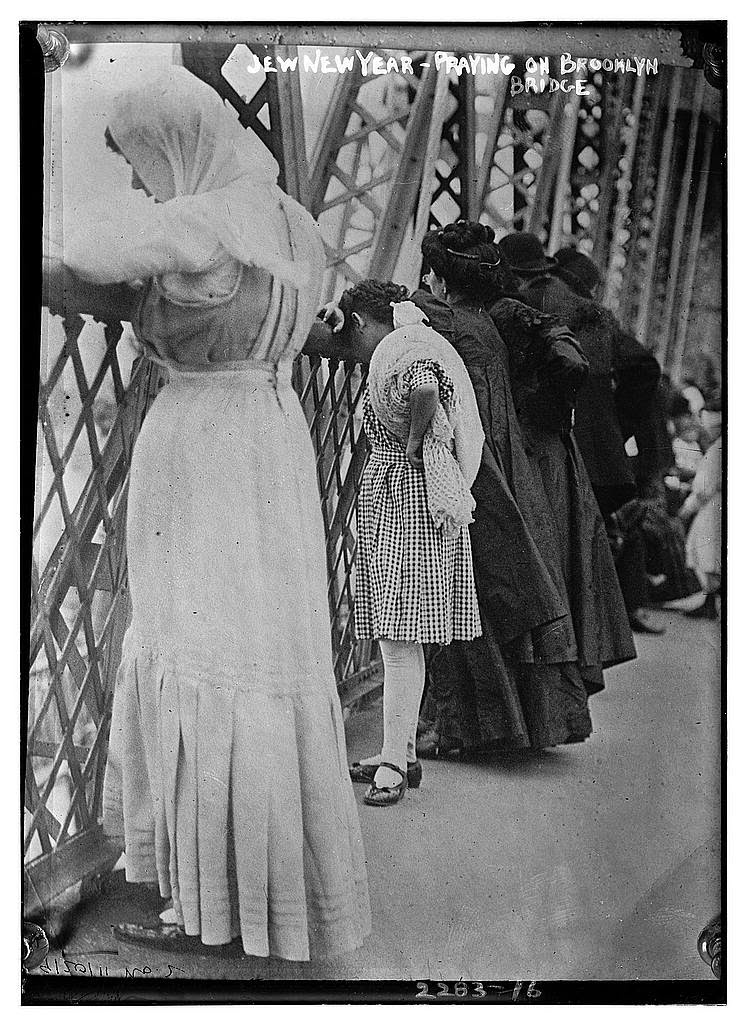
Then there’s this captivating image:
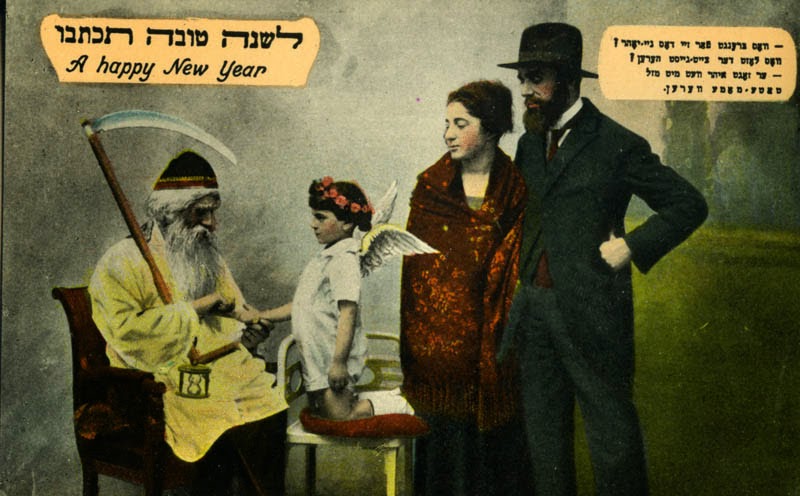
So what’s going on in the picture above, taken on the Williamsburg Bridge in 1909? Per some commentary from a Library of Congress commenter: “If this was photo was indeed taken around Rosh Hashanah (Jewish New Year) as the notation implies then these people are most likely taking part in a “tashlich” ceremony. The ceremony is when the previous year’s sins are symbolically “cast off” by throwing pieces of bread into a flowing body of water.” And finally here’s some rather imaginative Jewish New Year postcards that were manufactured by the Williamsburg Art Company sometime in the 1920s. While the company was located in Brooklyn, all of these were actually manufactured in Germany.
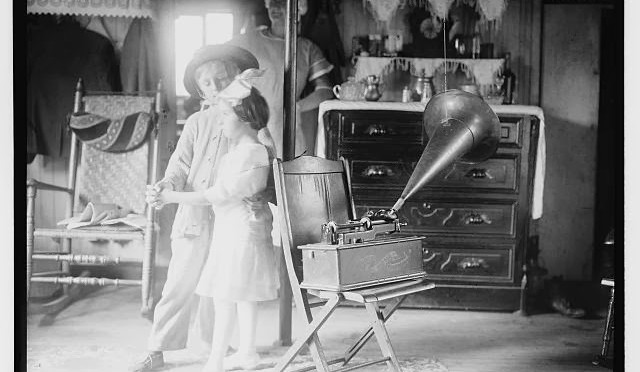
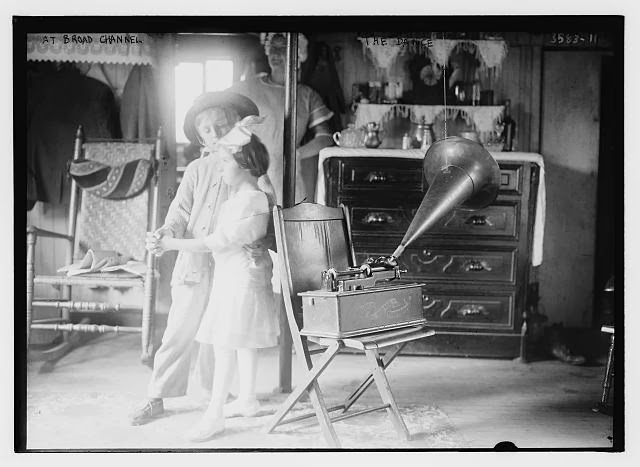
“Photograph shows a boy and a girl dancing while an Edison Home Phonograph plays in a house in Broad Channel, Queens, New York City.” — taken between 1910-1915 Here’s something many people thought they’d never see again in New York City — the opening of a new record store. Rough Trade, known for their famous London record shop, will open an awesomely spacious new store in Williamsburg this week, with vinyl-record listening stations, a coffee shop, live performances and a heap of nostalgia on its shoulders.
Remember Tower Records on Broadway? Virgin Records in Times Square? The old subway Record Mart? The long-vanished Commodore Record Shop? The past is littered with the ghosts of music stores long gone.
But where did people first buy recorded music in New York City? The first recordings came on phonograph cylinders, long tubes with the grooves etched along the front, often made with wax. Essentially, they looked like — and probably smelled like — big, decorative candles.
They were soon in competition with phonographs in a flat, wax disc form, the musical delivery device which eventually won out and became the standard for decades.
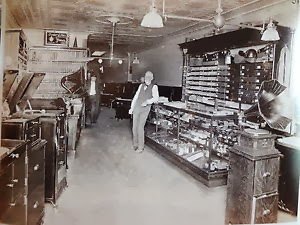
In the beginning, recorded music was played in exhibition halls, not available for home use. By the 1890s, the first musical devices were available for purchase, and phonographs were sold in establishments that offered instruments, music boxes or early electronics — Broadway piano stores (like the one above, in 1910) or the places down on the soon-to-be-named Radio Rowwhich offered New Yorkers the latest technology.
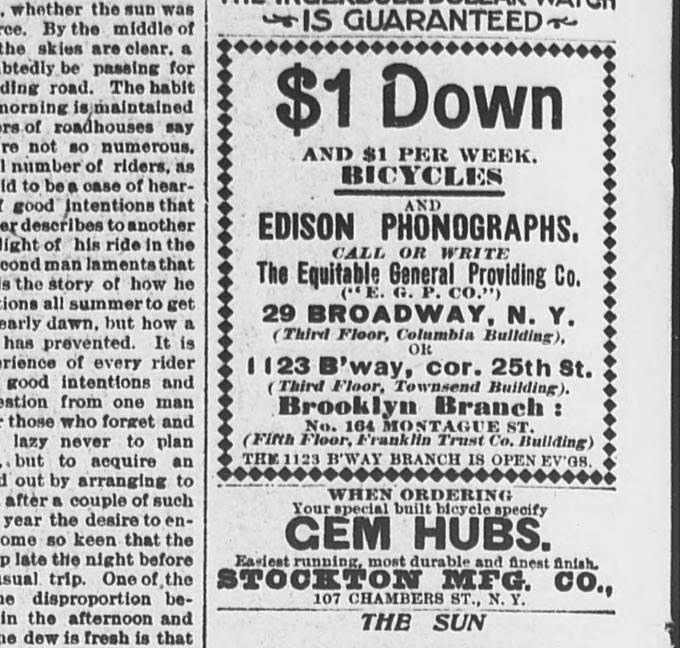
Naturally, the first records were made to play on Edison machines, pricey novelties in the late 1890s. Here, in 1898, you could put a down-payment on the purchase of a phonograph machine and a bicycle — a real hipster double-play today!
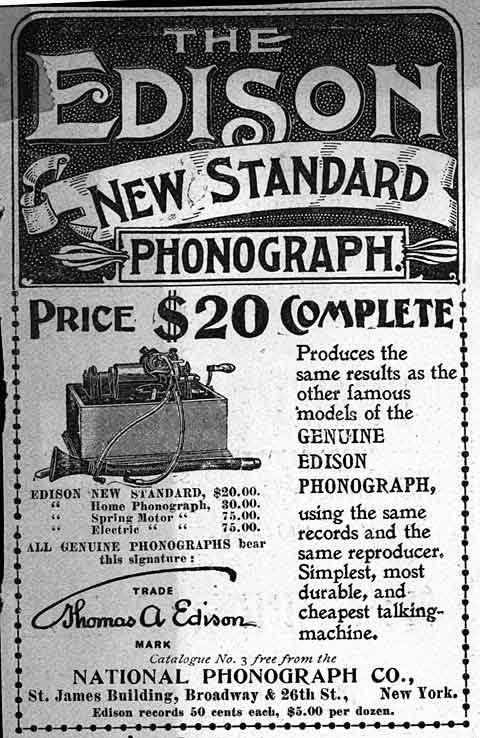
Another advertisement from 1898 presents Edison records at just “$5.00 a dozen”, found at the St. James Building at Broadway and 26th Street. Of course, a great many of these records were spoken word, not music; after all, they were nicknamed ‘talking machines’ at this time.
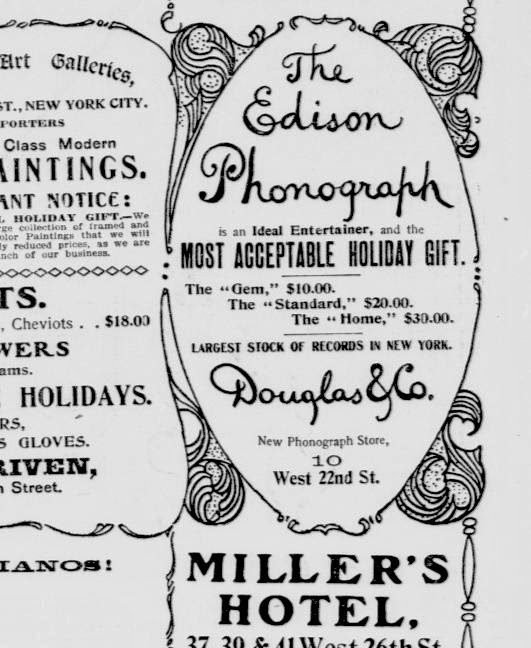
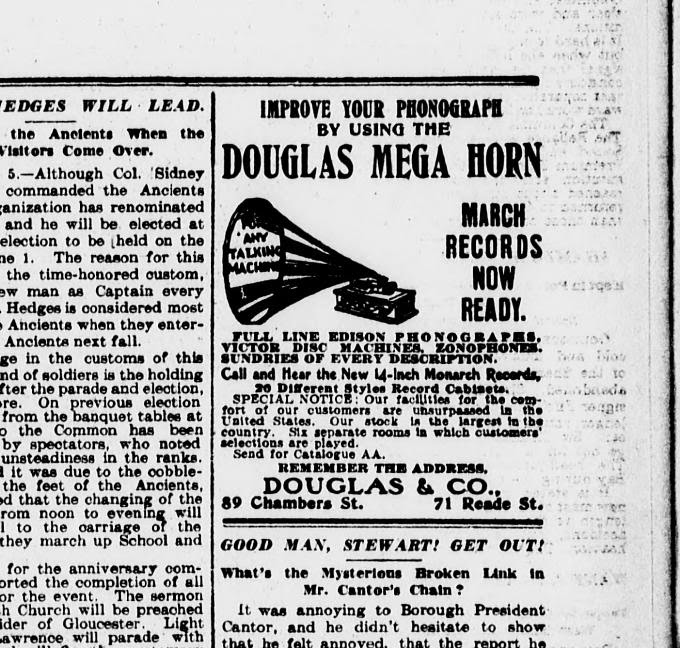
I was able to find a few other early photographer retailers in old newspaper advertisements. For instance, Douglas & Co., at 10 West 22nd Street, appears to be one of New York’s earliest retailers specializing in recorded sound. From Dec 16, 1900:
By 1903, Douglas & Co. had moved downtown, closer to the electronic retailers that would later specialize in radio and televisions:
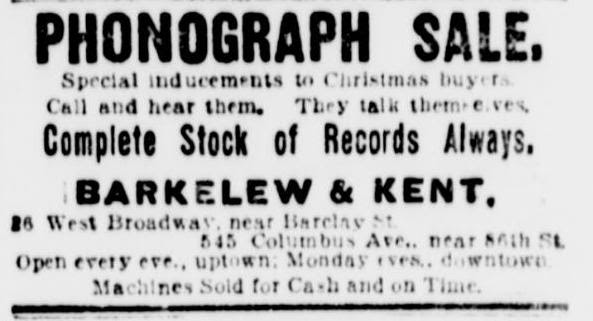
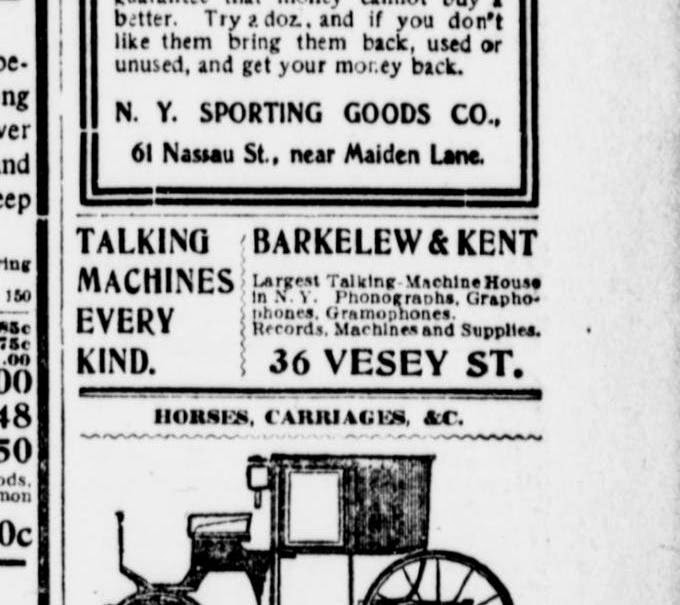
Another early phonograph retailer I was able to locate was A.B Barkelew & Kent. “Call and hear them. They talk themselves.” They would eventually move to Vesey Street and, in 1902, claim “the largest stock in New York.”
As early in 1899, Barkelew & Kent could claim to be one of New York’s first used record stores. From a trade ad: “We exchange records you tire of and do not like.”
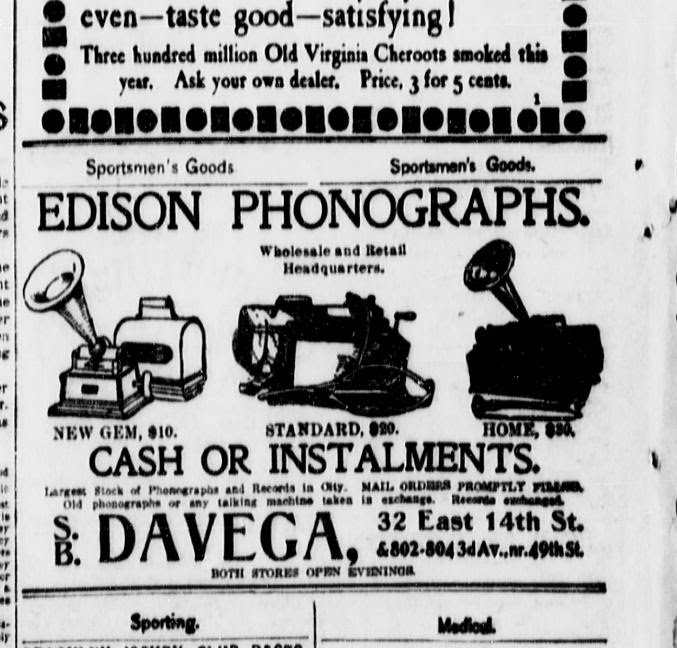
Interestingly, early record stores were listed alongside advertisements for sporting goods. This ad is from May 1902:
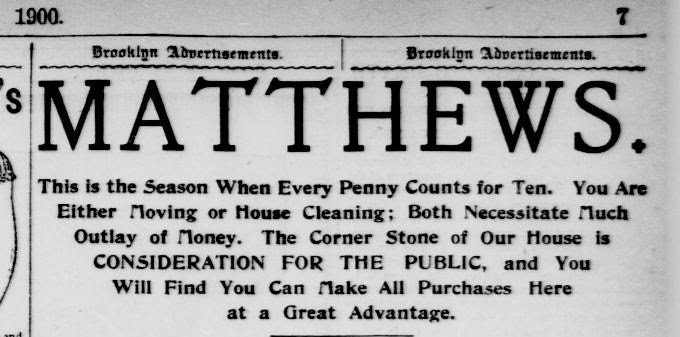
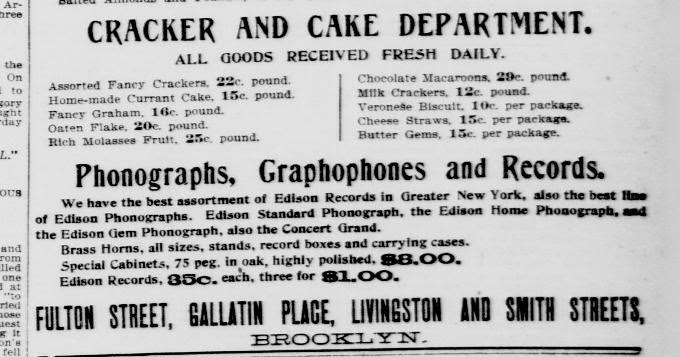
And since we’re celebrating the opening of a new record store in Brooklyn, I should add that one of Brooklyn’s first major record stores was at A.D. Matthews Department Store on Fulton Street.
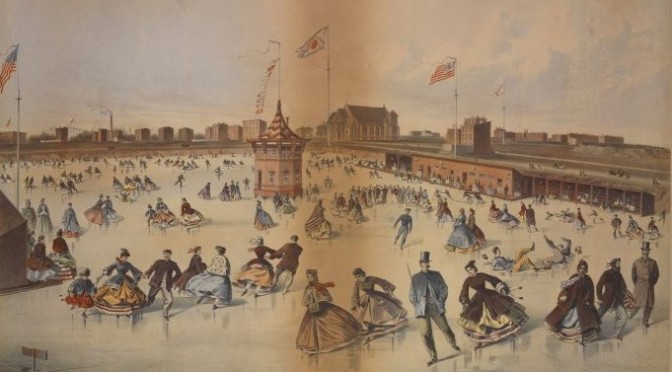
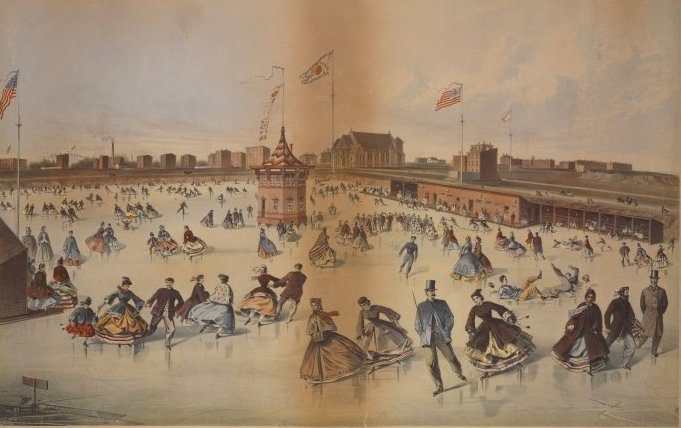
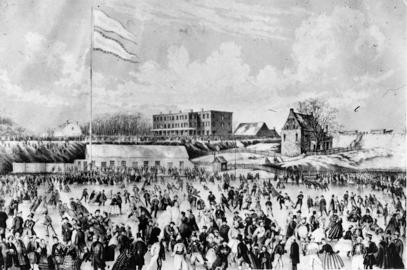
Williamsburg(h)’s Union Pond, one of the finest destinations for ice skating in the city, 1863. It later became America’s first enclosed baseball field.
The nation was at war one hundred and fifty years ago, but that didn’t stop the austere celebrations in the ‘borough of churches’. But while thousands of Brooklyn residents attended church that morning in 1861, many participated in a more whimsical holiday celebration — wild and uncontrollableice skating.
So famous was the city of Brooklyn’s famed ponds — which reliably froze each winter — that New Yorkers by the boatloads crammed into ferries across the East River to join in the icy merriment. On really cold days, of course, it was often the East River itself that froze solid. But in 1861, an unseasonable warmth kept the river disappointingly liquid, forcing thousands of skaters upon Brooklyn’s small ponds where the ice quickly melted.
For instance, Washington Pond (at right), at 5th Avenue and 6th Street — then considered Gowanus, today it’s Park Slope — was normally ideal for skating. Horse-drawn streetcars took crowds right from the Fulton Ferry to the door of the nearby old stone house, built in 1699 and famous for its role in the Revolutionary War. (It’s why the pond is named for Washington, after all.) But on Christmas 1861, “the ice was unpleasantly rough” there.
Skaters may have found more success at other Brooklyn skating destinations. The Capitoline Skating Lake, near the train station in the former independent village of Bedford, was known as the “principle pond of the Western District.” In Williamsburg, the versatile ‘world-renown‘ Union Pond drew thousands during the winter and thousands more in the summer — as the nation’s first enclosed baseball field. On this particular day, the newly opened pond in its ‘gay and brilliant appearance’ was crammed with skaters laughing and caroling, in various states of sobriety.
By the afternoon of Christmas 1861, most of the closest ponds were mushy and nearly dangerous. At a pond on Third Avenue, “a gentlemen with two ladies fell trough the ice and took their Christmas immersion without any material damage save a very decided shivering,” according to the Brooklyn Eagle.
Urban ice enthusiasts were forced to follow the advice of horsecars festooned with the signs ‘Good Skating in East Brooklyn’. I’m not sure exactly where crowds went that day, but a New York Times article from a three years later lists several ‘free ponds’ that might have been available for ice skating that day, including Seller’s Pond “in Bedford, near the Jamaica Pond Road”, “Dumbleton’s Pond on Myrtle Avenue” and the Suydam’s Pond, “on Atlantic-avenue near the Hunters-Ferry road.”.
All that skating and merriment drove many to more intoxicating holiday spirits, preferring their drinks ‘on the rocks’, or as the 1861 Eagle reports, “the boys will insist that ‘Christmas comes but once a year’ and with it comes a large measure of ‘good cheer’ and so they must get cheerful.” The most serious altercation came with one reveler, tiring of throwing rocks at boys, attempted to pistol whip a police officer.
The more respectable Brooklynites traipsed home at dawn, as the gaslights meet the fading light, casting the wet snow in a bright glare. Many reformed again for choirs of caroling, or else to distribute presents at charity ‘Christmas tree exercises’, where children lined up outside downtown theaters hoping for presents and a gander at the gorgeously trimmed tree, sparkling with candles.
You probably know something about the Civil War draft riots that kept New York paralyzed during the week of July 13, 1863. But New York only meant Manhattan back then. What about the rest of the future boroughs?
The conscription act initiated draft lotteries throughout the area as, by 1863, the Union struggled to fill its quota of volunteers. Many thought the state of New York had contributed enough; hundreds were already dead after two years of bleak and depressing battle.
Then there was that troublesome little exemption clause. Those chosen in the ‘wheel of misfortune’ could either find a substitute or pay a $300 commutation fee. According to the Inflation Calculator, that’s about $5,250.00 today. Look at your bank account. Could you afford to pay that?
People revolted violently when the drafts were held in New York on July 13. There were also seismic reactions in the surrounding counties as well, chain reactions of the anger quelling in New York. In the surrounding regions, local law enforcement were often better prepared to handle disruptions amongst their less concentrated populations. Even still, the horror of New York’s draft riots did spread.
The homes of many black residents on Staten Island were torched. According to historian Richard Bayles, “From its proximity to New York City this county could not help but feel every pulsation of popular emotion that disturbed the bosom of the city.” Mobs attacked black shopowners in Factoryville, surrounded a black church in Stapleton and threatened parishioners inside, and burned down a railroad station owned by Republican and Union supporter Cornelius Vanderbilt.
Residents from the village of Astoria and the farmlands of Sunnyside and Ravenswood could see New York burning across the water. But Queens County caught the loathsome riot fever when the draft commenced in nearby Jamaica, on July 14. Riled crowds gathered at dusk and nearly torched the village but for the intervention of a few Democratic community leaders.
The draft office in Jamaica was eventually destroyed and number of buildings filled with government property were vandalized. Rioters stormed one building and stole piles of garments intended for the battlefield. According to an 1882 history of Queens County, it was an apparel Armageddon, the rioters “taking out some boxes of clothing which they broke open, piled in heaps and set on fire. The largest pile, which they derisively called ‘Mount Vesuvius’ was about ten feet high.”
In Westchester County, towns along the BronxRiver reacted similarly to their own draft lotteries, with rioters in Morrisania and West Farms destroying telegraph offices and yanking railroad ties from the ground. However, other local towns, like Yonkers, were successfully insulated from violence, due to better living conditions and the entreaties of an especially popular local leader, the Rev. Edward Lynch. A mass gathering on July 15th in the village of Tremont eventually snuffed out violence in the region.
Although it was one of the country’s largest metropolises, the independent city of Brooklyn never saw the intensity of violence that New York did. Indeed, some black New Yorkers escaping violence in the city fled to the countryside in Kings County, to places like Weeksville. However the county did see a good share of bloodshed and destruction, particularly in the Eastern District (the areas of Williamsburg and Greenpoint).
The Brooklyn Eagle, solidly Democratic and in quiet support of the anti-draft agitators, had this to say in a July 16th article, “We could fill columns of the Eagle with exciting stories of anti-negro demonstrations, threatened outbreaks, etc.. So far no disturbance has occurred in Brooklyn which two or three policemen could not surprise [sic]. There has been nothing like any attempt to get up a mob, or create a riot.”
This is preposterous, but even through the Eagle’s glossy lens, it’s apparent that violence never fomented to the degree that it did in New York. This, of course, would be of cold comfort to the dozens of black Brooklynites who did have to flee their homes and businesses that week.
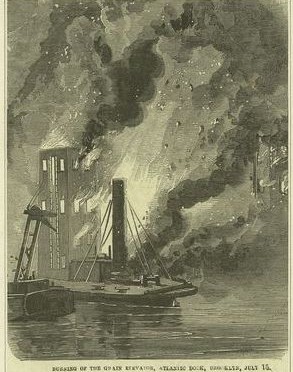
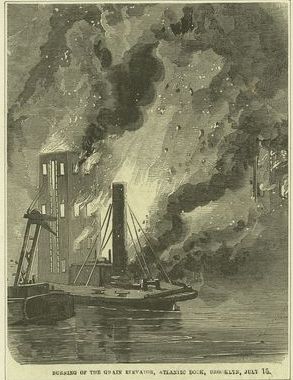
The most dramatic scene in Brooklyn took place before midnight on Wednesday, July 13, with the destruction of two large grain elevators in the Atlantic Basin, in Red Hook. (Pictured at top.)
The Eagle’s reasoning for the blaze demonstrates the reasonless chaos that typified violence in the latter days of the riots. It had nothing to do with racism or with drafts, but rather “[t]he fire was the work of incendiaries, supposed to be grain shovellers who recently had some trouble about a raise on wages, and who have always looked with feelings of animosity on these elevators because they dispensed with a large amount of manual labor.”
The burning elevators, facing into the East River, made a grim bookend to the burning structures across the water in New York. Luckily, within 24 hours, the riots would be calmed throughout the region.
Patrick Henry McCarren — best known today for leaving his last name to a park and a swimming pool — was a complicated figure, so it makes sense he should be considered a sort of godfather to a rather complicated neighborhood like Williamsburg.
McCarren became the voice of Greenpoint and Williamsburg at a pivotal time of growth for Brooklyn, during the years of consolidation with New York. He worked his way up and, once there, bought himself favor like a good old-fashioned machine Democrat would — one hand outstretched to the working class, the other in the pocket of big industry.
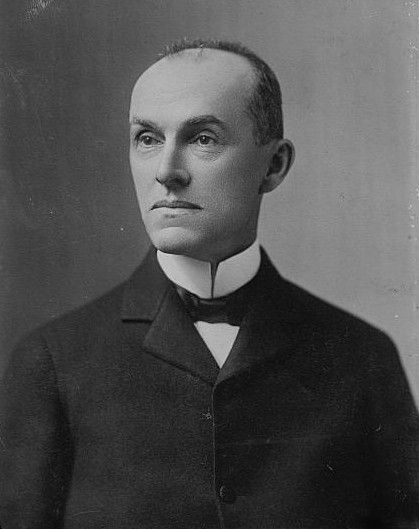
Born in East Cambridge, Massachusetts of Irish parents in 1847, McCarren headed to Brooklyn and worked first in Williamsburg’s thriving sugar refineries, then as a cooper, and finally as a lawyer, the springboard for his real ambitions in local politics. Civic service was his singular objective, entering Kings County’s democratic machine at age 21. In 1881, he was elected a state senator, a vantage he would use in accumulating great influence.
“Far from being offended at being called a politician,” according to a glowing eulogy. “[McCarrin] took pains to emphasize his right to the name and became a power….because of his singleness of aim.”
During 18 years as a state senator, McCarrin rallied for the fortunes of Brooklyn and, in particular, for the East River Bridge to link New York with the factories of Greenpoint and Williamsburg. (And, oh yes, blossoming Brooklyn’s population with the fleeing residents of the Lower East Side.)
There is much truth in the statement, “The bridges, the parks, the improved means of transit, the better paved and lighted streets…by which the Brooklyn of to-day is distinguished….are due more to the legislative efficiency of Senator McCarren than to the influence of any other individual.”
Of course, he did so frequently on behalf of the Eastern District’s big industries, becoming a political marionette for both oil and sugar. He was publicly charged with actually being on the payroll of Rockefeller’s Standard Oil Company. According to one account, “No denial of the charge was ever made by the Senator.” One paper even referred to him as “the Standard Oil serpent of Brooklyn politics.”
Remarkably, with such unabashed connections to corruption, you’d think he’d be a welcome ally to New York’s Tammany Hall. Far from it; as a powerful Brooklyn Democrat, he remained unbought by Tammany, on the outskirts of their most important political objectives. By 1908, the year he thwarted Tammany’s plans to put William Randolph Hearst in the governor’s seat, he was possibly the most powerful man in Brooklyn.
He died the next year, 1909, hated and mocked across the water but beloved by most in Brooklyn, even some of his most fractious enemies. His funeral was purported the biggest in the borough since Henry Ward Beecher’s.
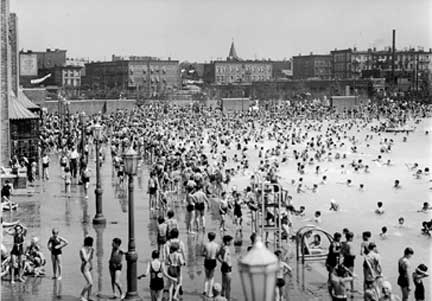
Greenpoint Park, which had opened in 1906, was quickly renamed in his honor. Had he been around, Patrick might have blanched thirty years later when another steadfast politician, Robert Moses, decided to plunk down the biggest of eleven WPA-funded municipal swimming pools here in 1936. Today, the pool is a popular but surprising venue for concerts and is currently being renovated.
Below: McCarren Pool in its heyday, date unknown (Courtesy McCarren Park)
Williamsburg used to have an H at the end of its name, not to mention dozens of major industries that once made it the tenth wealthiest place in the world. How did Williamsburgh become a haven for New York’s most well-known factories and then become Williamsburg, home to such wildly diverse communities — Hispanic, Hasidic and hipster? Find out how its history connects with whalebones, baseball, beer, and medicine for intestinal worms.
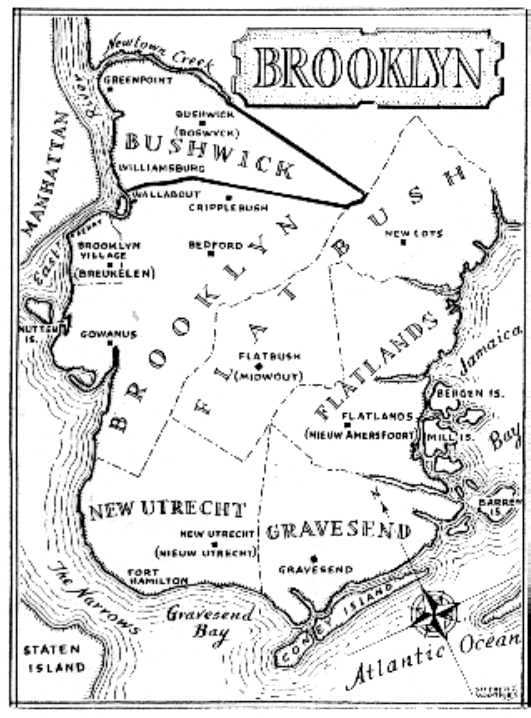
A modern map of the townships of Kings County. Cripplebush is listed here as a settlement in Brooklyn. The dense undergrowth that gave Cripplebush its name stretched well into the jurisdiction of Bushwick, which the Dutch actually called Boswijck.
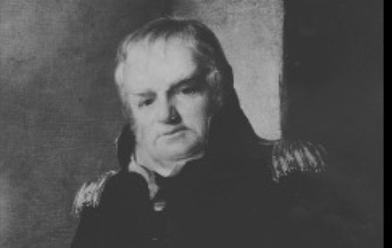
The esteemed Lt Col. Jonathan Williams, who surveyed the land along the Bushwick shore and eventually gave Williamsburg its name. You can also find his handywork at Castle Clinton and Castle Williams (also named after him).
Another father of Williamsburg, David Dunham, can still be found today on a very tiny street near the bridge called Dunham Place. (Forgotten New York has a great look at this odd little side street.)
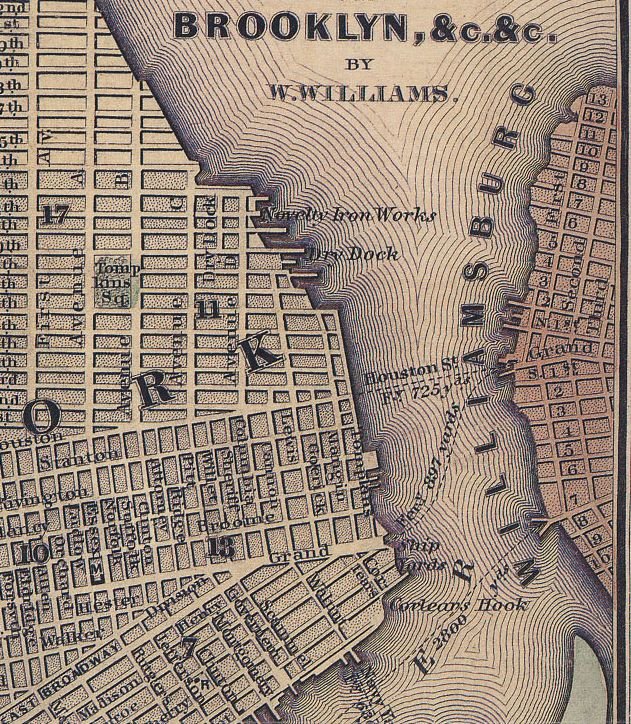
A detail from this mid-19th century map of New York and Brooklyn indicates the two ferry paths across the East River from the Grand Street dock in Williamsburg.
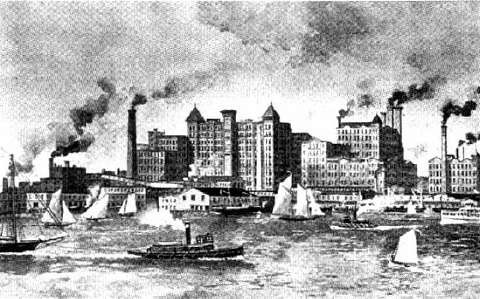
The Williamsburg waterfront during the 1880s. Havemeyer’s sugar refinery became one of the most profitable businesses along the East River. It became Domino Sugar in 1900.
While Havemeyer’s factory, closed in 2004, has been landmarked, its future could include a vast complex of condominiums — but with community opposition and a $1.3 billion dollar price tag, is it viable?
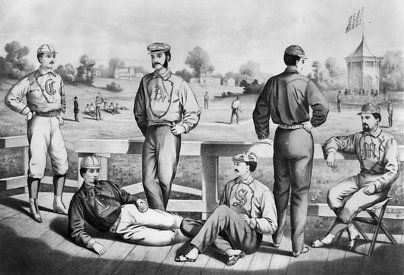
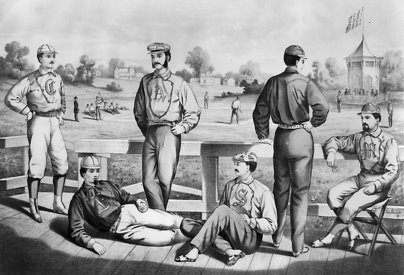
These fancy guys are relaxing after a vigorous game of baseball at the Union Grounds, the first to fence in the playing field and charge spectators. Check out our previous article on this historic place and where you can find its location today.
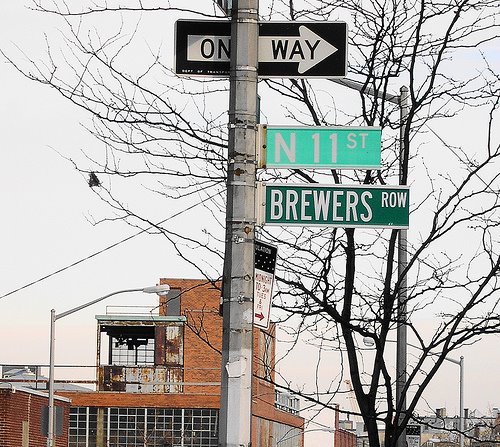
There are no more breweries along Brewer’s Row, but the once grand boulevard of beer makers that stretched from Williamsburg to Bushwick is still recognized on street signs.
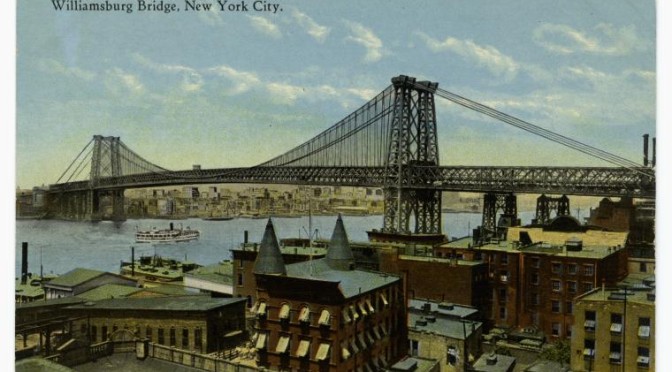
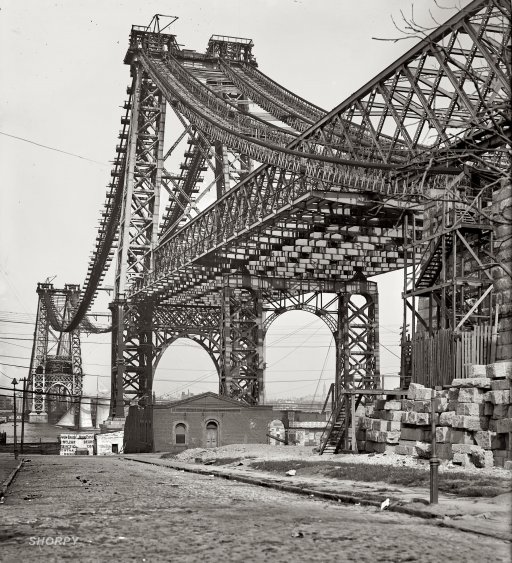
The East River Bridge (today the Williamsburg Bridge) in 1902. It would be opened a year later, opening the neighborhood to thousands of new residents fleeing overcrowded Lower East Side (pic courtesy Shorpy)
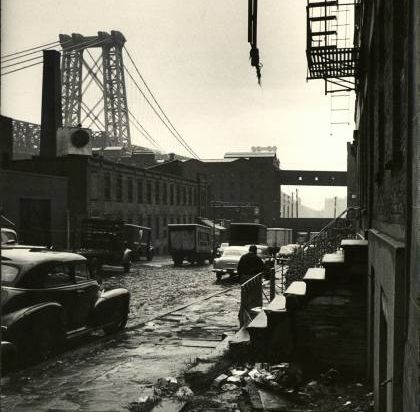
Williamsburg in 1954, not the sunniest place ever. Photo by Alfred Eisenstaedt (LIFE archives)
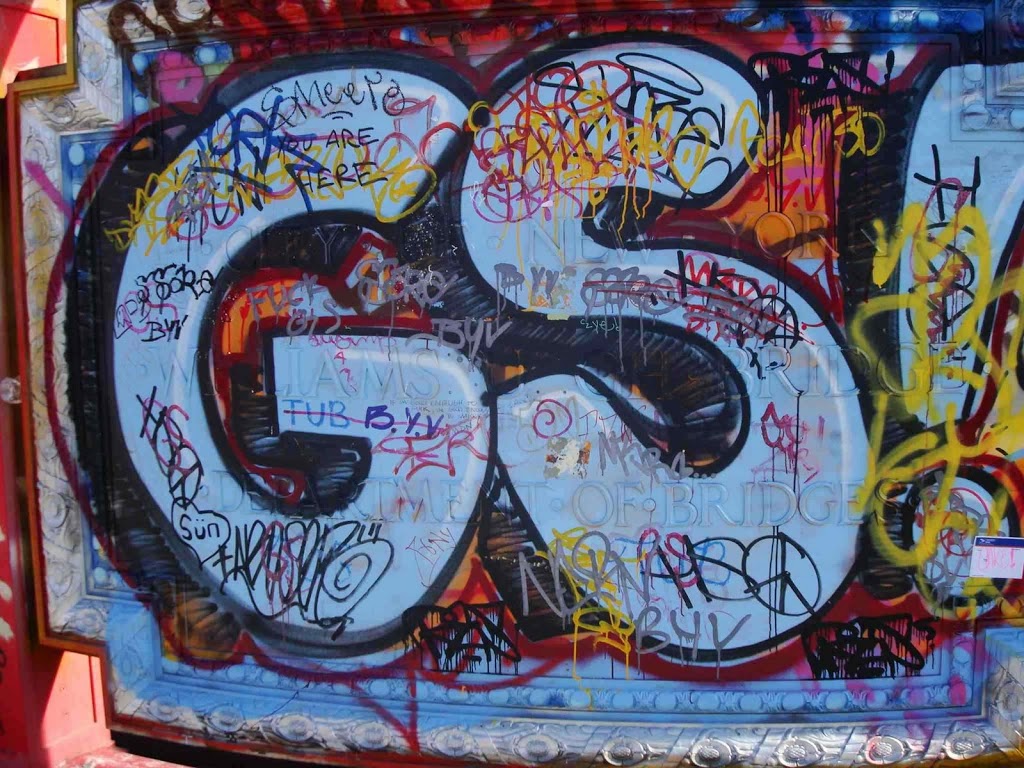
Look really closely at this dedication found at the pedestrian fork on the Williamsburg Bridge. If you scrape away the graffiti, you’ll see Williamsburg with an H on the end. (Click it to get a closer look.)
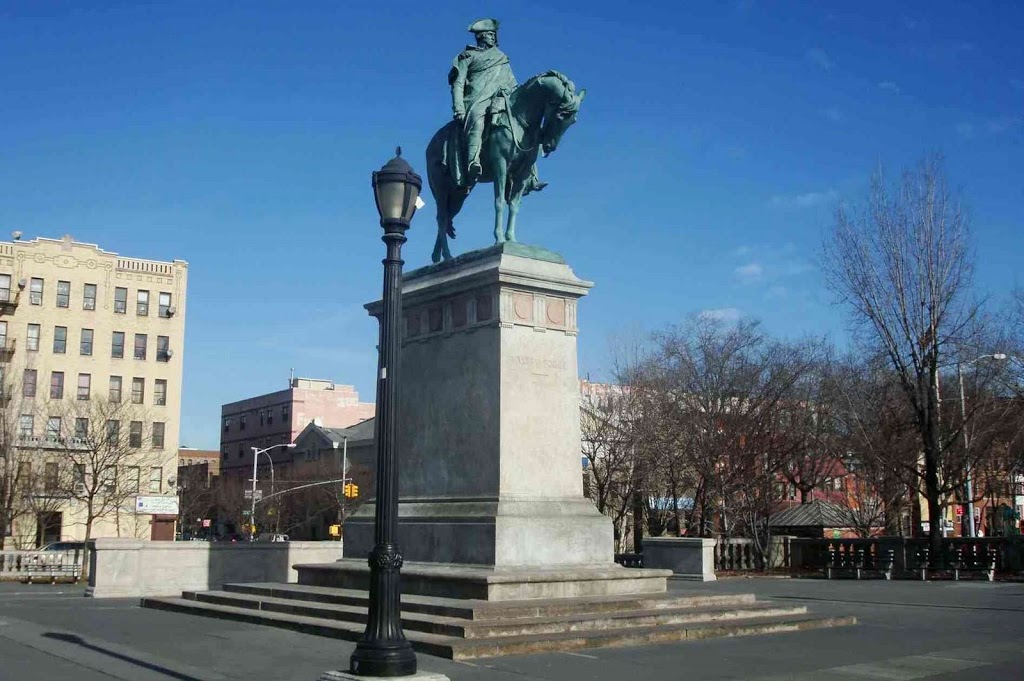
Continental Army Plaza, now overlooking the entrance and exit ramps of the Williamsburg Bridge. An engraving in the sidewalk points towards Valley Forge. The statue and the plaza were installed shortly after the opening of the bridge. So, in fact, this has pretty much always been George’s view.
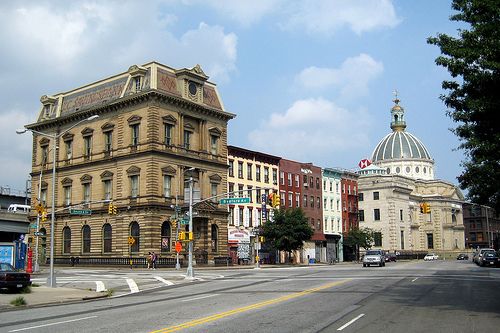
Two gorgeous examples of Williamsburg’s opulent past — the Kings County Savings Bank (built in 1868!) in the foreground, and the George Post’s domed Williamsburgh Savings Bank in the distance. (pic courtesy Flickr)
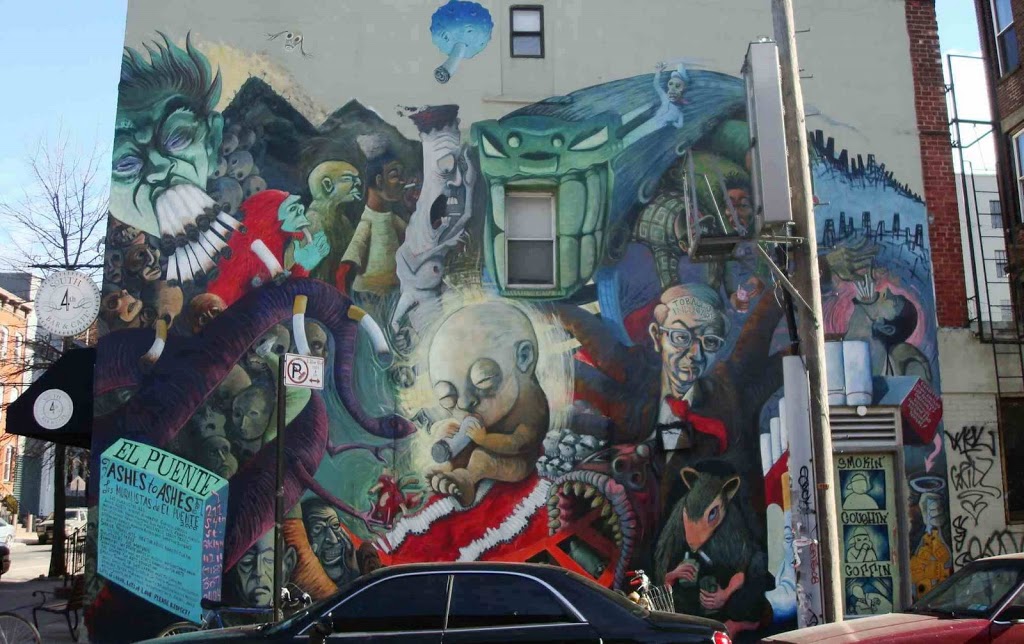
A mural just north of the bridge. Don’t smoke, kids!
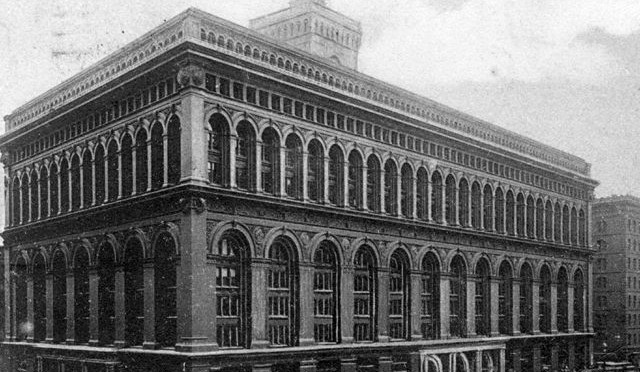
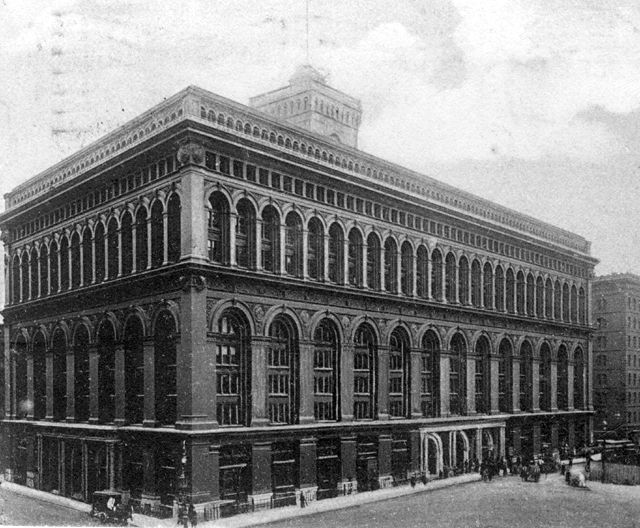
Who knew a produce exchange could look so elegant?
One of New York’s most important architects was George B. Post, but you would barely know it today.
Only a handful of his most important buildings — the New York Stock Exchange being the most famous — still stand, the victim of a rapidly changing city sweeping away the former glories of the Beaux-Arts style.
Post wasn’t your typical purveyor of the sometimes gaudy excesses of Beaux-Arts, that amalgam of classical and formal styles that dictated American architecture from the 1880s into the 1920s. He was known for making its particular beauty climb, refitting its graceful symmetry literally to new heights. Post proved that the merely traditional needn’t be staid and uninspiring. My two favorites of long-gone works:
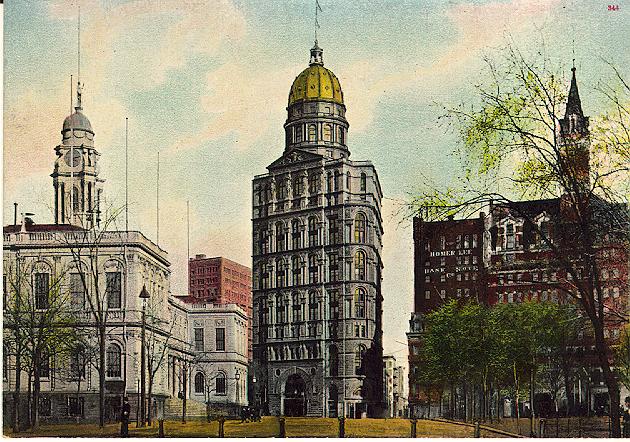
New York World Building
His best known building during his life was the New York World building on Newspaper Row, more appropriate referred to as the Pulitzer building after the paper’s imperious publisher Joseph Pulitzer. It was the tallest building in the world when it was completed in 1890 and was the first building to rise above the spire of Trinity Church.
This was demolished to make way for a car ramp for the Brooklyn Bridge:
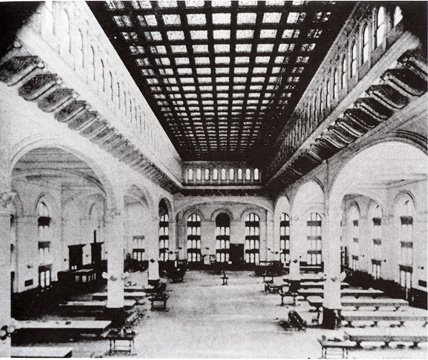
You wouldn’t expect a building made to hold produce to be an architectural marvel, but Post graceful talent at creating lively open spaces made this one, at 2 Broadway down at Bowling Green, a stunner and certainly must have recommended him as the ideal candidate to design the trading room floor at the New York Stock Exchange. The Produce Exchange was wiped out in 1957. (The exterior is shown up top.)
(Picture above, and others of Post’s work, can be found at City Review, reviewing a book of Post’s work by Sarah Bradford Landau.)
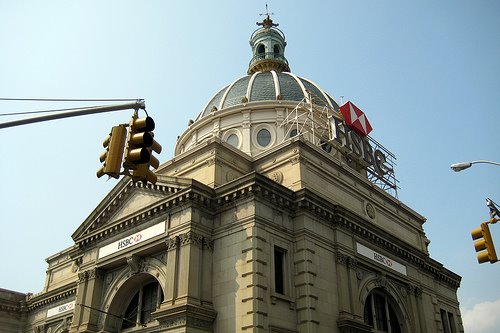
If you’d rather see one of his few existing ones, simply cross the Williamsburg Bridge over to the Brooklyn side, turn left and look for that beautifully domed and very out-of-place beauty that’s now an HSBC bank branch. That’s the Williamsburgh Savings Bank, the little brother of the Williamsburgh Savings Bank Tower and one of Brooklyn’s most beautiful buildings, built in 1875, many years before the bridge sprouted up in front of it:
Above: Quite a fancy looking team of baseball players! Note the pavilion in the background. Picture courtesy Brooklyn Ball Parks
I love finding out where very basic, everyday, take-for-granted concepts were invented. For instance, there is some place on the planet I’m sure that heralds as the first place somebody put a straw in a beverage and drank it.
Well, in today’s Williamsburg, in a crowded section inhabited by a mostly Hasidic Jewish population, there once stood a baseball field named the Union Grounds with a unique distinction: it’s the first to regularly charge spectators to watch a game of baseball.
In the mid-19th Century, Williamsburgh was a fairly new independent city, having divested itself from the neighboring town of Bushwick several years earlier to govern itself. The Union Grounds were actually built on the outskirts of the nearby town of Wallabout, but its location on a large patch of land bounded by Marcy Av., Rutledge St., Harrison Ave., and Lynch St. is today in modern Williamsburg.
Believe it or not, baseball had been a recreation for New Yorkers for over 20 years — a New Yorker even invented it — by the time that William Cammeyer built Union Grounds in 1862 from an outdoor skating rink he owned. It would still be used for ice skating during the winter months.
Previously, field owners made profits by charging teams fees to play. Seating was provided at some fields for fans, and spectators were encouraged to stand around and watch, sometimes even around the very baselines.
Baseball was well organized by this time; the first official baseball league incorporated sixteen teams — most of them from New York and Brooklyn. Cammeyer decided to capitalize on the sports popularity in 1869 by fencing in the field and charging the spectators (a reasonable ten cents) for the honor of watching these top-notch squads in action.
Certain teams gravitated to the Union Grounds, loosely giving the field its own home teams. The Eckfords, a team named after a shipbuilder, were league champions that played most of their games here, as did the Mutuals and the Hartford Deep Blues. The field would continue to host teams in the 1870s, when baseball went ‘professional’ and paid players and teams would be associated with particular cities.
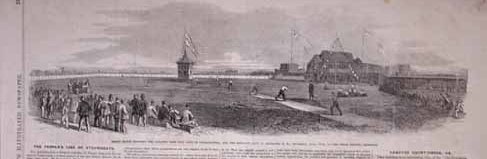
Apparently the field was still making enough money as an ice skating rink that one certain disruptive feature sat in the outfield during baseball season. According to Brooklyn Ball Parks, an elegant three-story pavilion was planted in the middle of outfield, used during the winter to light up the ice at night. (Below is a page from Frank Leslie’s Illustrated Newspaper circa 1865, before the fence went up. However if you click into it, you can see greater detail of the ballfield and this curious feature.)
The field was plowed over on July 1883 and replaced with the 17th Corps Artillery Armory, which still stands there today.