Categories
Gilded Age New York The Gilded Gentleman Women's History

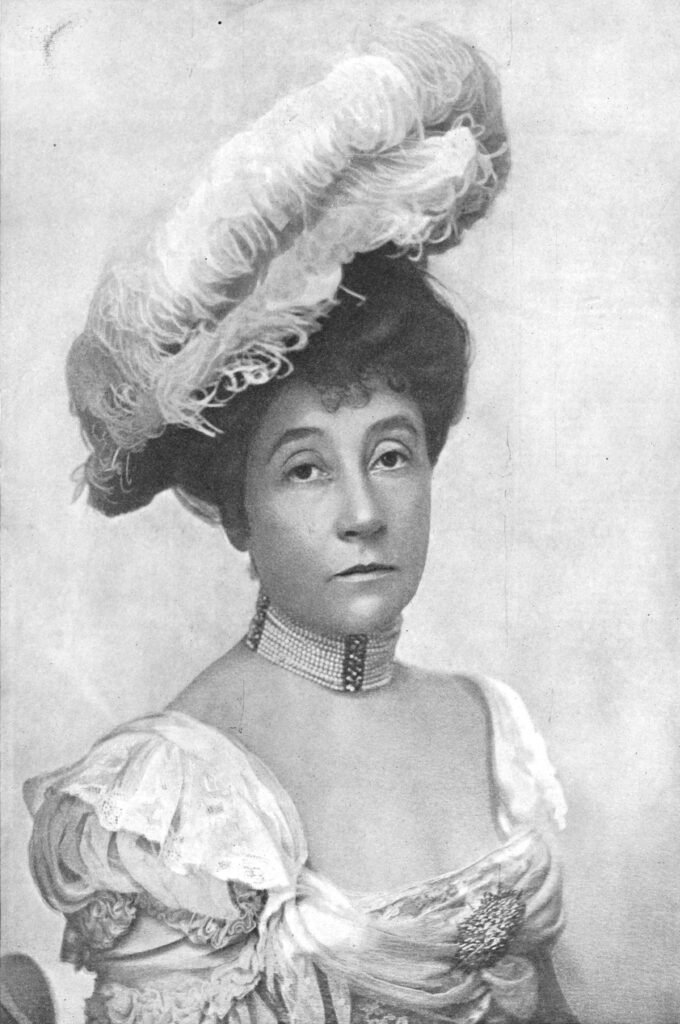
Who was Mamie Fish? The story behind The Gilded Age’s wildest party hostess

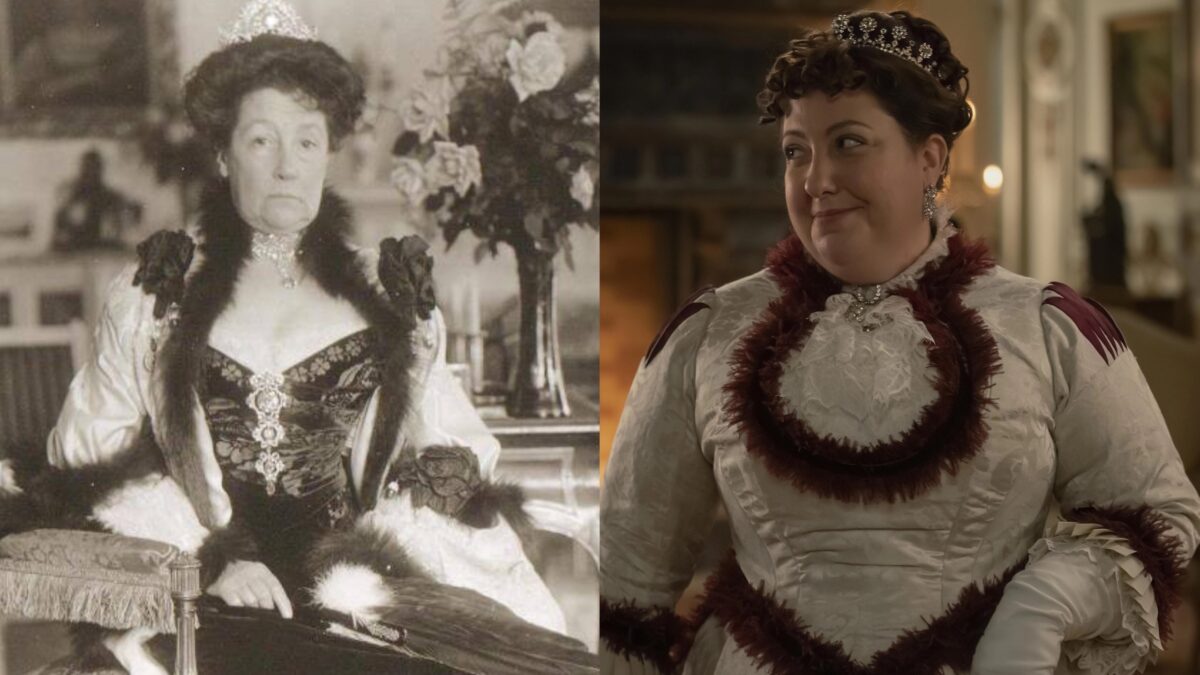
Mrs. Stuyvesant Fish, known to all as just Mamie Fish, was one of the more larger-than-life personalities of the Gilded Age, a hostess who thrived within the confines of high society.

Who was this enigma of the Newport set? Carl Raymond is joined by historian and writer Keith Taillon, a returning listener favorite, as well as actor Ashlie Atkinson who portrays Mamie Fish in HBO’s The Gilded Age for a look at this complicated but fascinating woman.

If you received an invitation to a party at Mamie Fish’s — you went. 

Mamie Fish was known as a “fun maker” with an iron-clad family pedigree and enough money to compete with other Gilded Age hostesses. If yoy attended a party by Mrs. Astor’s you may have cemented your role in society. If you attended a party Mamie’s, however, you were just looking for a really good time. 

Her parties bordered on the outrageous —  from inviting an elephant as a guest to co-hosting the famous dinner for dogs, some of them adorned with diamond collars. But just who was Mamie Fish – and why do we find her fascinating today? 

Historian Keith Taillon and actor Ashlie Atkinson offer deeply insightful perspectives on this woman who sought to break out of the role prescribed to her and shake up society. 

Mamie, when looked at through a modern lens, was challenging, complicated, conflicted and certainly controversial — but given the Gilded Age’s restrictions and gender rules and roles, it’s interesting to consider how much she can also be considered a rebel and revolutionary for her time. 

Listen to the latest episode of The Gilded Gentleman on Apple Podcasts, Spotify, Overcast or wherever you get your podcasts. And be sure to subscribe or follow the show to get future episodes

Categories
Podcasts Politics and Protest Preservation

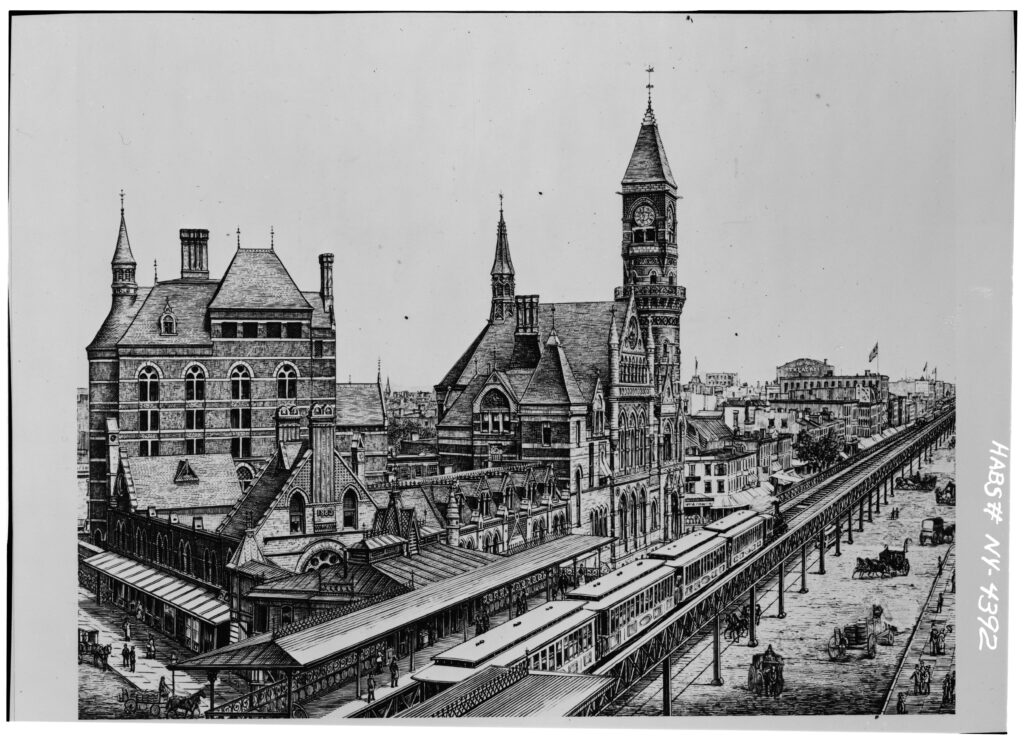
The History of Jefferson Market and the Women’s House of Detention

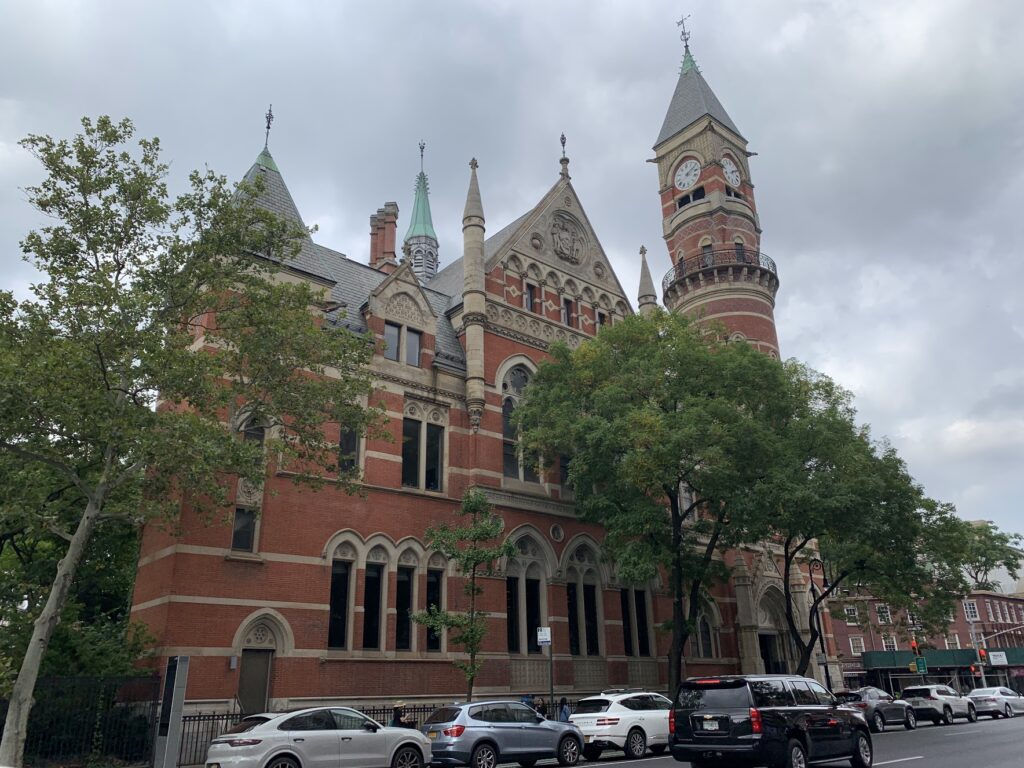
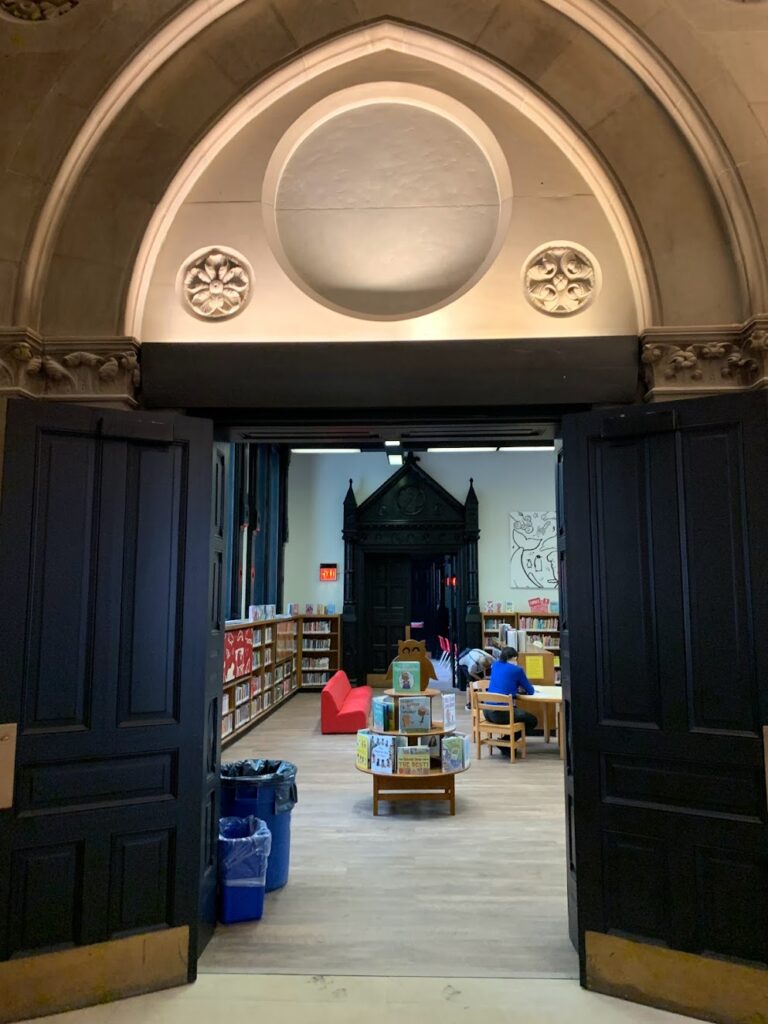
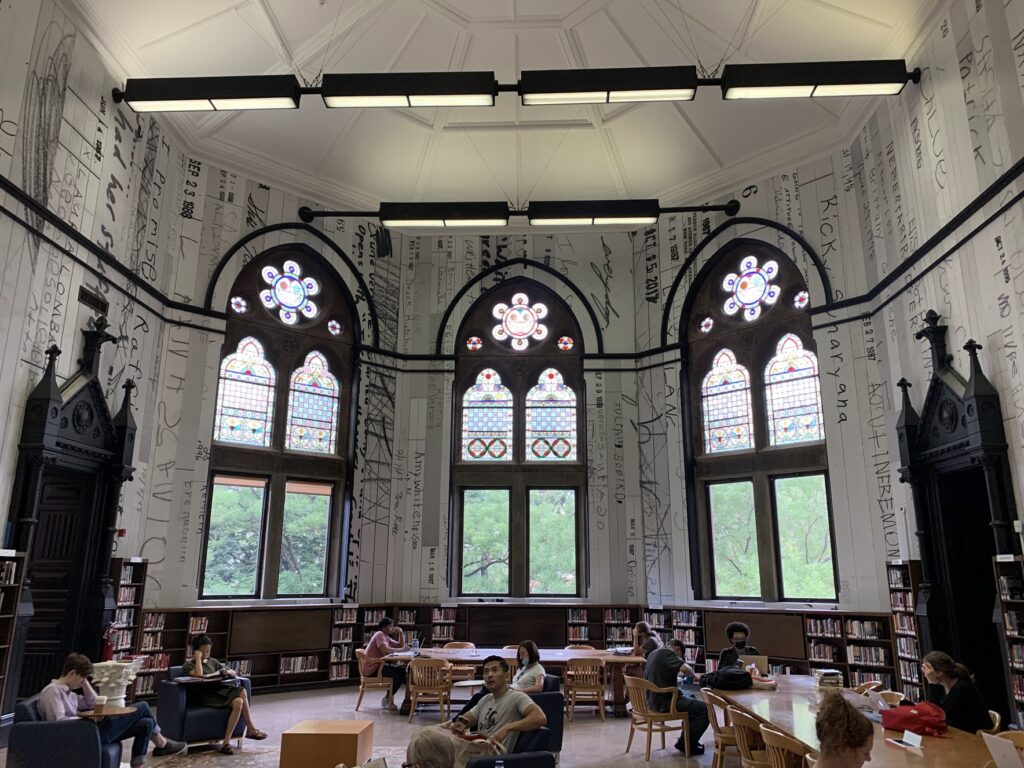
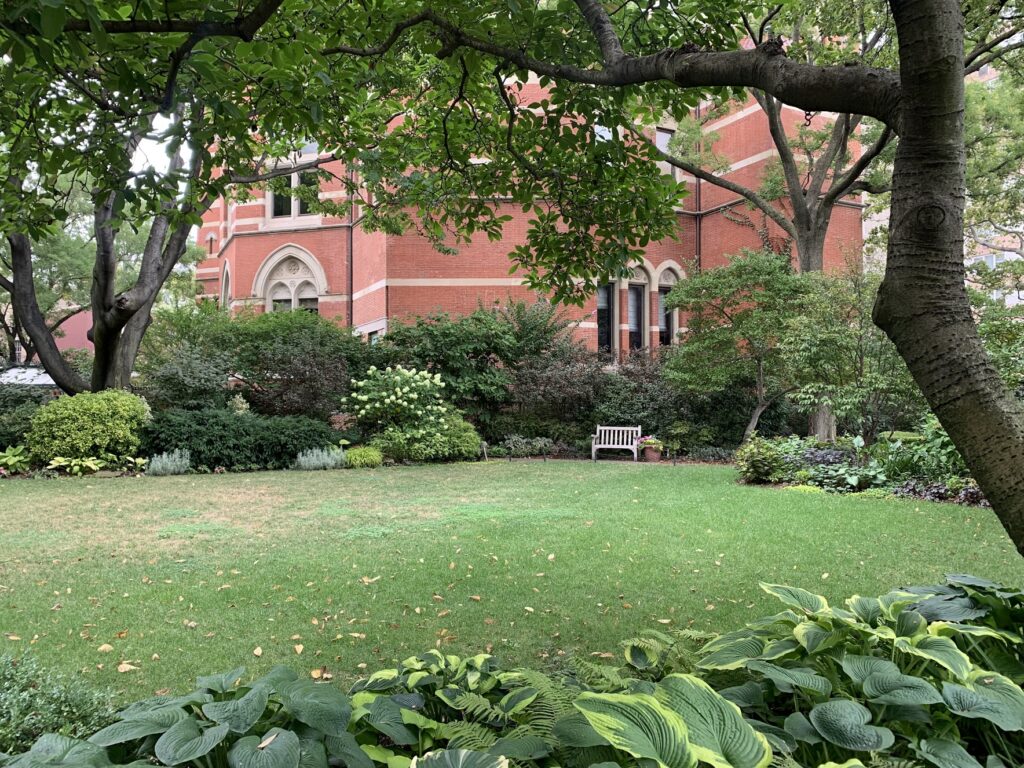
In the heart of Greenwich Village sits the Jefferson Market Library, a branch of the New York Public Library, and a beautiful garden which offers a relaxing respite from the busy neighborhood.

But a prison once rose from this very spot — more than one in fact.

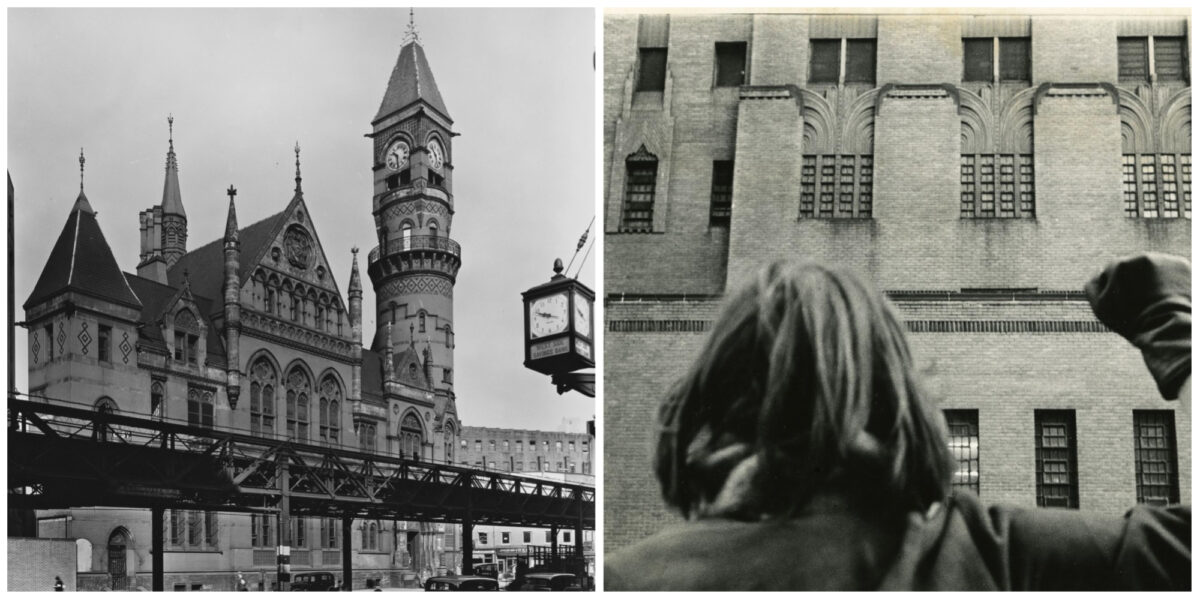
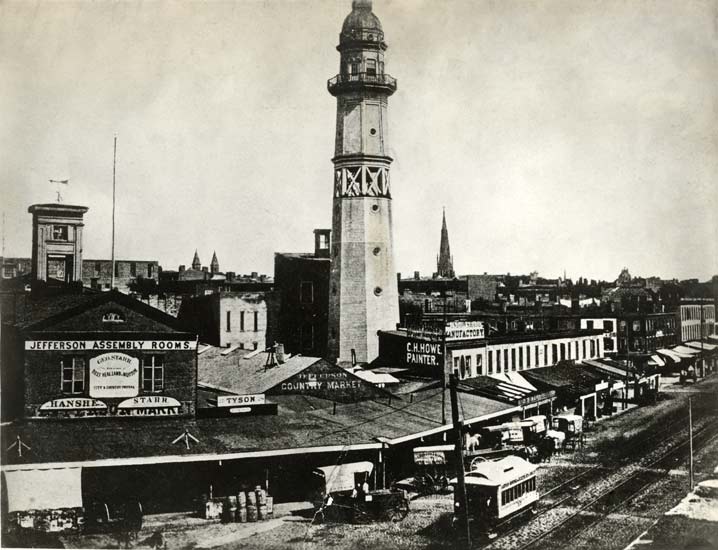
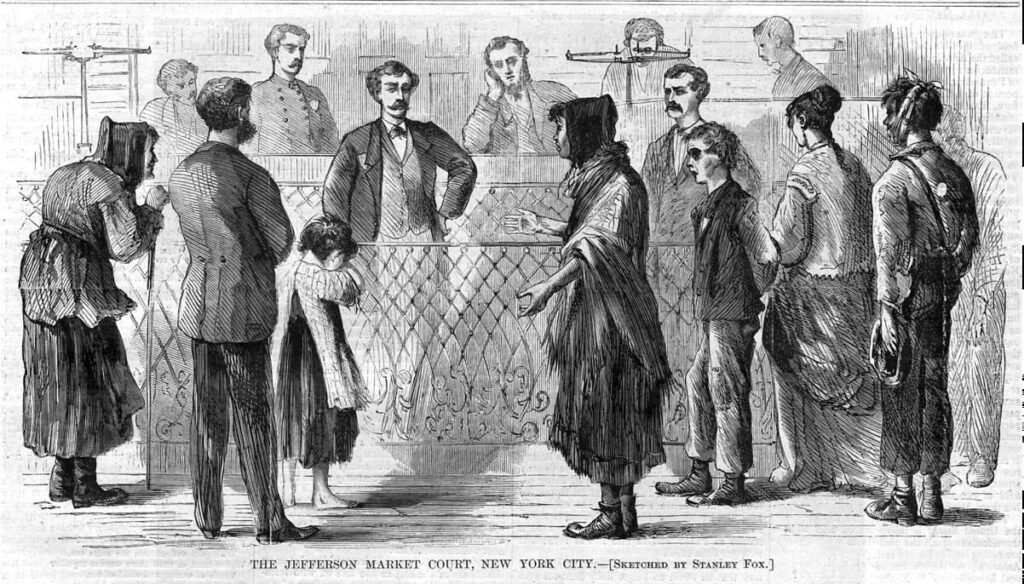
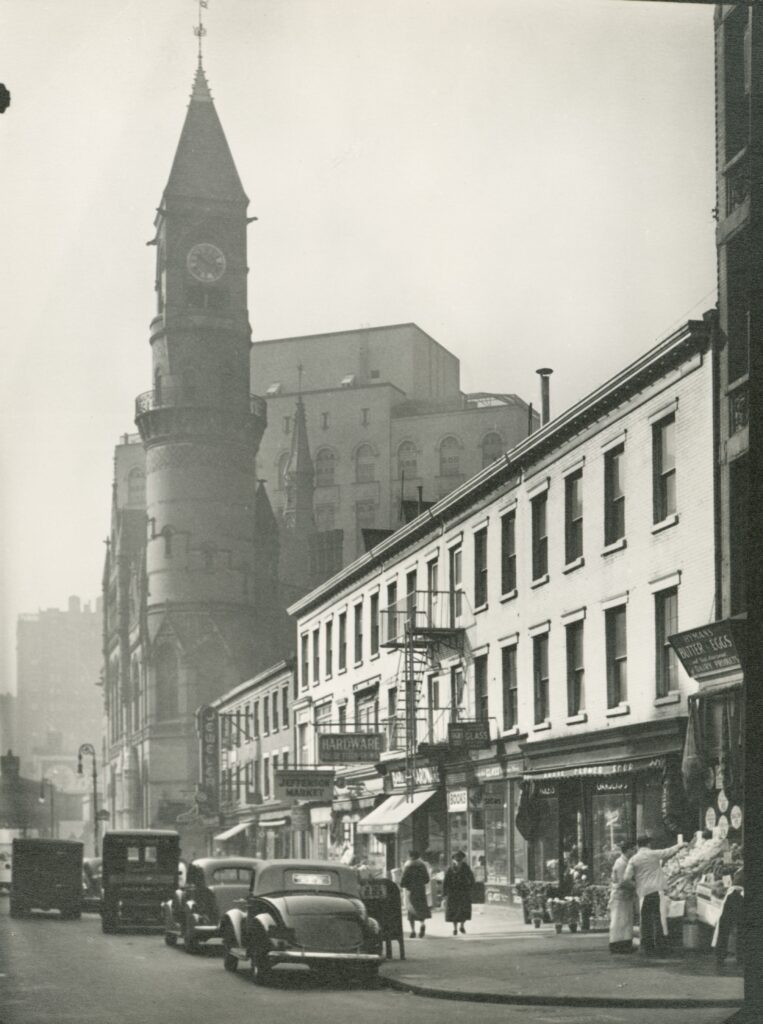
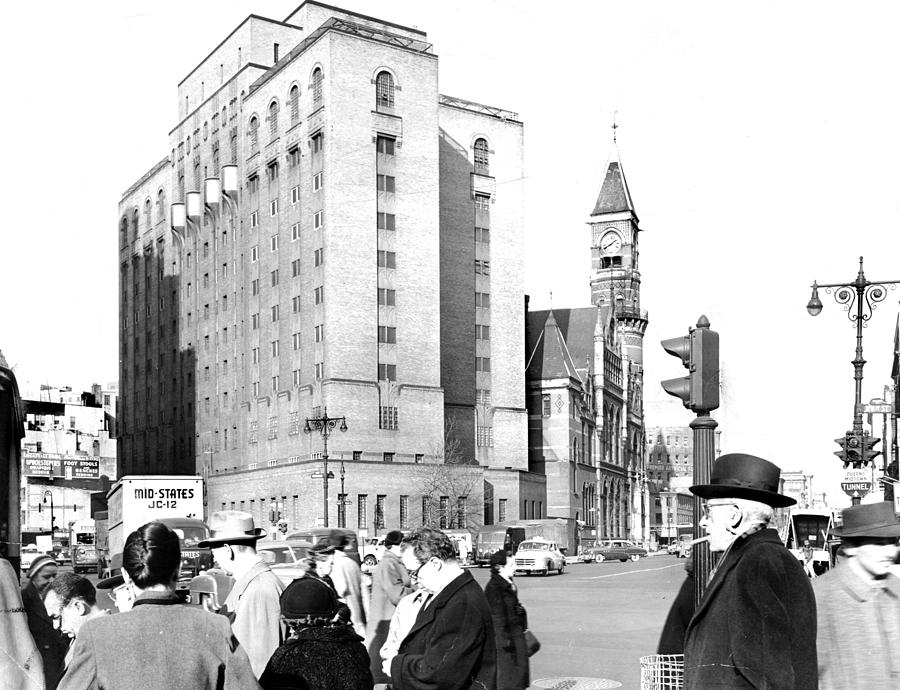
While there was indeed a market at Jefferson Market — dating back to the 1830s — this space is more notoriously known for America’s first night court (at the Jefferson Market Courthouse, site of today’s library) and the Women’s House of Detention, a facility which cast a gloom over the Village for over 40 years.

Almost immediately after the original courthouse (designed by Frederick Clarke Withers and Calvert Vaux) opened in 1877, it was quickly overburdened with people arrested in the Tenderloin district. By 1910 a women’s court opened here, and by the Jazz Age, the adjacent confinement was known as “the women’s jail.”

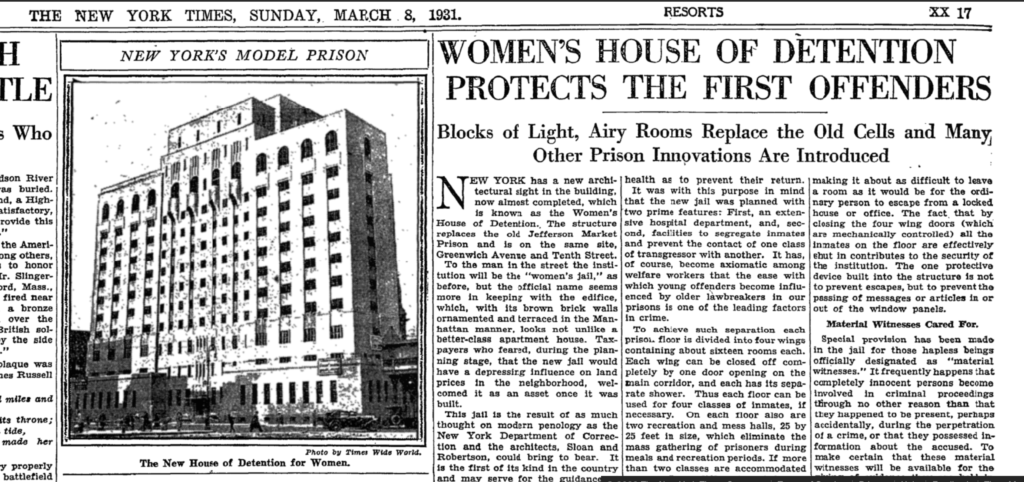
When the Women’s House of Detention opened in 1931 — sometimes referred to as the world’s only Art Deco prison — it was meant to improve the conditions for women who were held there. But the dank and inadequate containment soon became symbol of abuse and injustice.

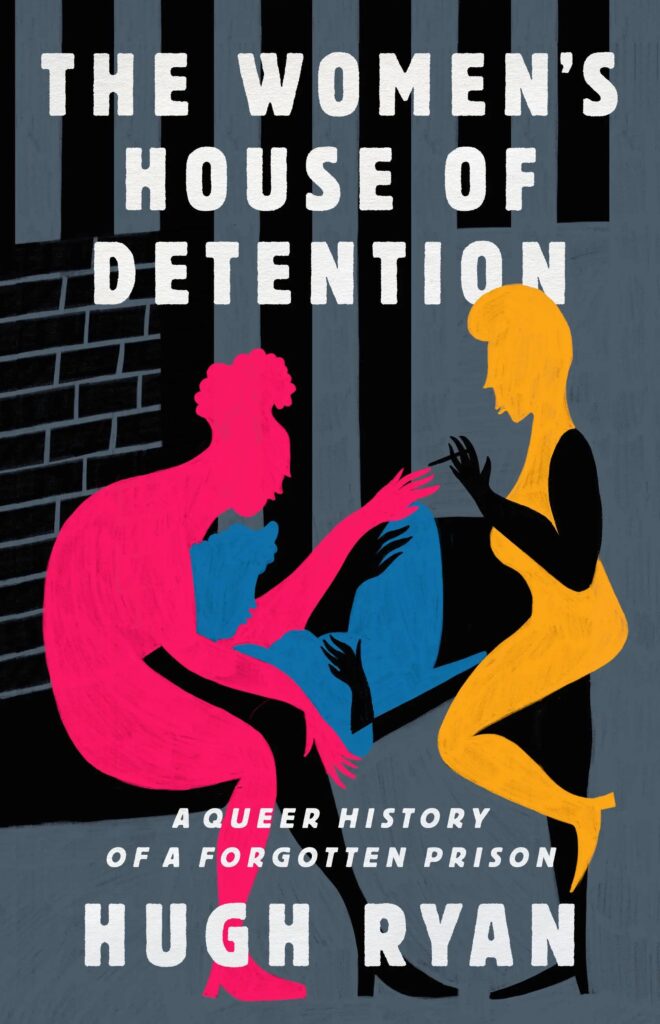
In this special episode — recorded live at Caveat on the Lower East Side — Tom and Greg are joined by Hugh Ryan, author of The Women’s House of Detention: A Queer History of a Forgotten Prison to explore the detention center’s place in both New York City history and LGBT history.

How did the “House of D” figure into the Stonewall Uprising of 1969? And what were the disturbing circumstances surrounding its eventual closure?

FEATURING: Stories of Mae West, Stanford White, Alva Belmont, Mayor Jimmy Walker, Angela Davis, Andrea Dworkin and — Tupac Shakur?

LISTEN NOW: THE HISTORY OF JEFFERSON MARKET AND THE WOMEN’S HOUSE OF DETENTION

Hugh Ryan on Patreon, Twitter and Instagram


Historic American Buildings Survey, Photocopy, c. 1880, Courtesy of New-York Historical Society,
New. York Public Library
The courtroom and House of Detention, 1938, New York Public Library
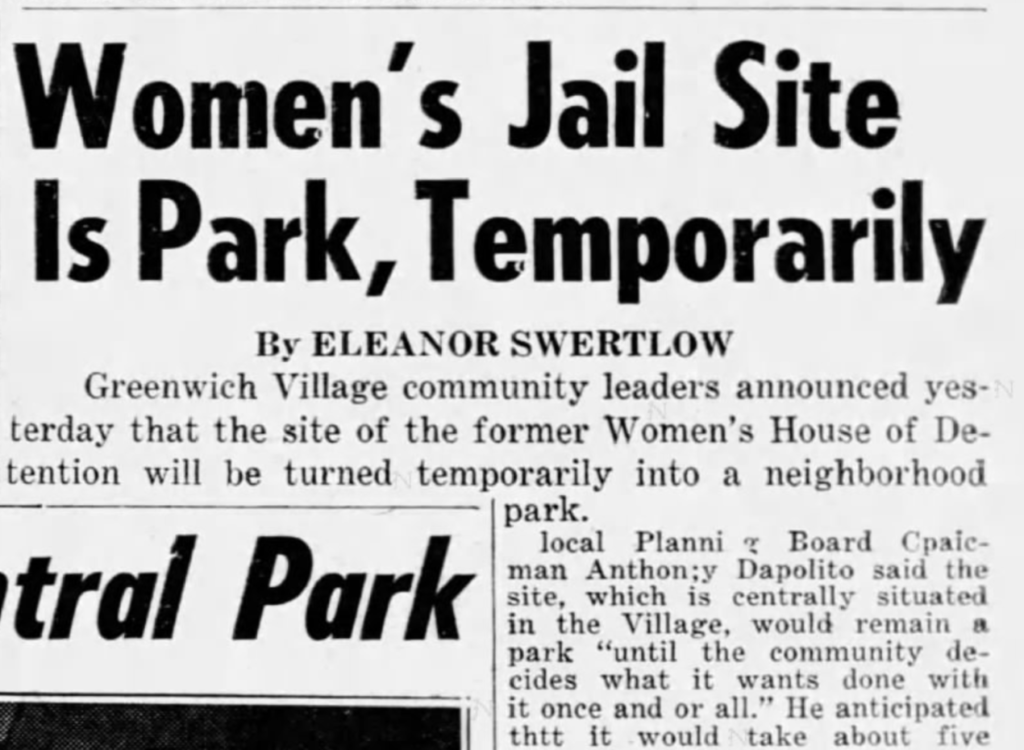
The Women’s House of Detention. Courtesy the New York Daily News Archives
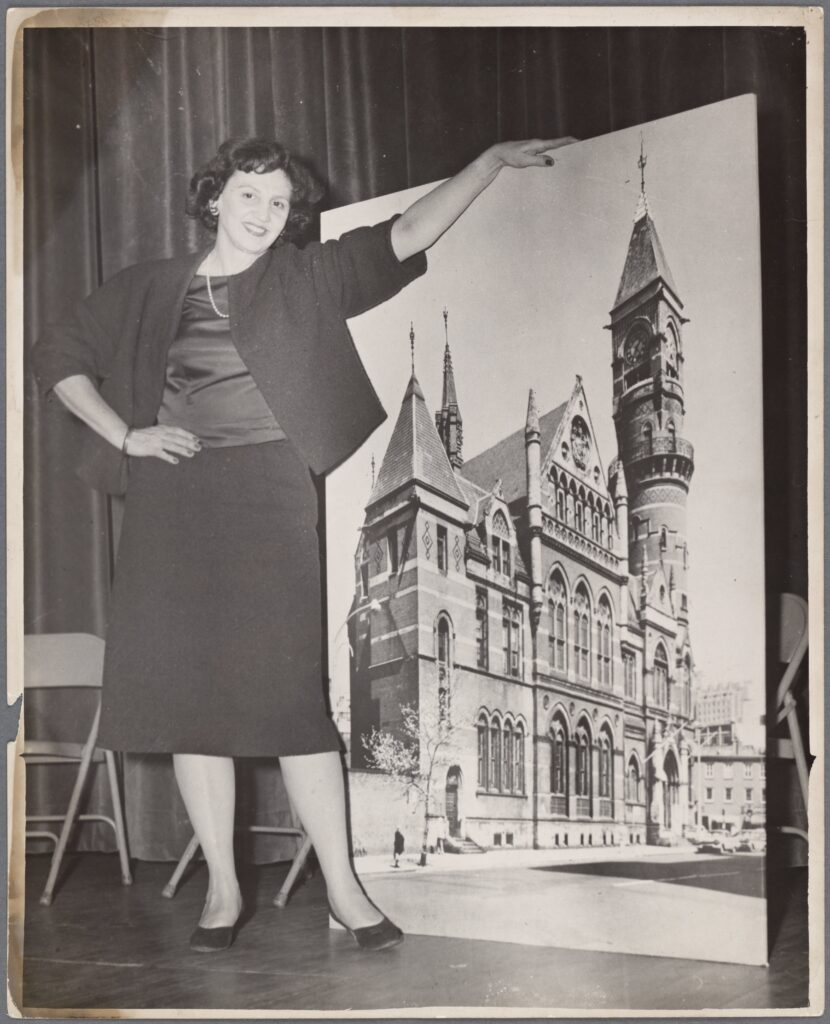
Margot Gayle with an image of the building she would help save. New York Public Library Digital Collections

Photos of the current Jefferson Market Library

Photo by Greg Young
Photo by Greg Young
Photo by Greg Young

FURTHER LISTENING

The subjects of these episodes are featured on this week’s episode. So check them out after listening to the current show:


The Bowery Boys: New York City History podcast is brought to you …. by you!

We are producing a new Bowery Boys podcast every other week. We’re also looking to improve and expand the show in other ways — publishing, social media, live events and other forms of media. But we can only do this with your help!

We are creators on Patreon, a patronage platform where you can support your favorite content creators.

Please visit our page on Patreon and watch a short video of us recording the show and talking about our expansion plans. If you’d like to help out, there are several different pledge levels. Check them out and consider being a sponsor.

We greatly appreciate our listeners and readers and thank you for joining us on this journey so far.

Categories
On The Waterfront Women's History

The Deep Sea Hotel: A nautical housing solution for independent women

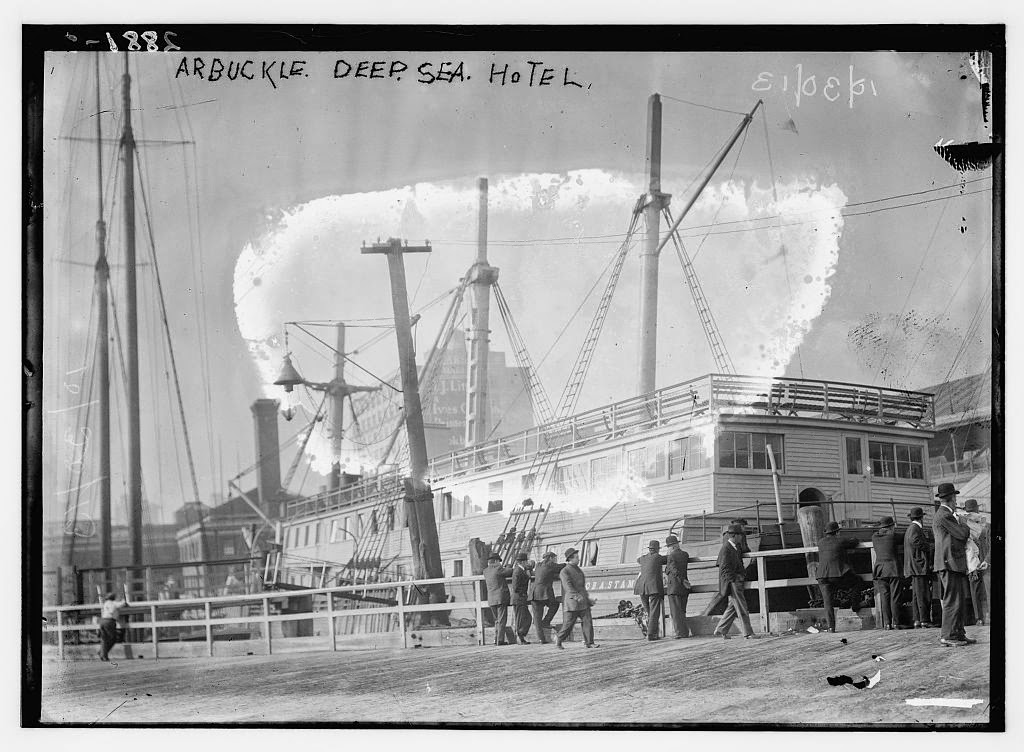
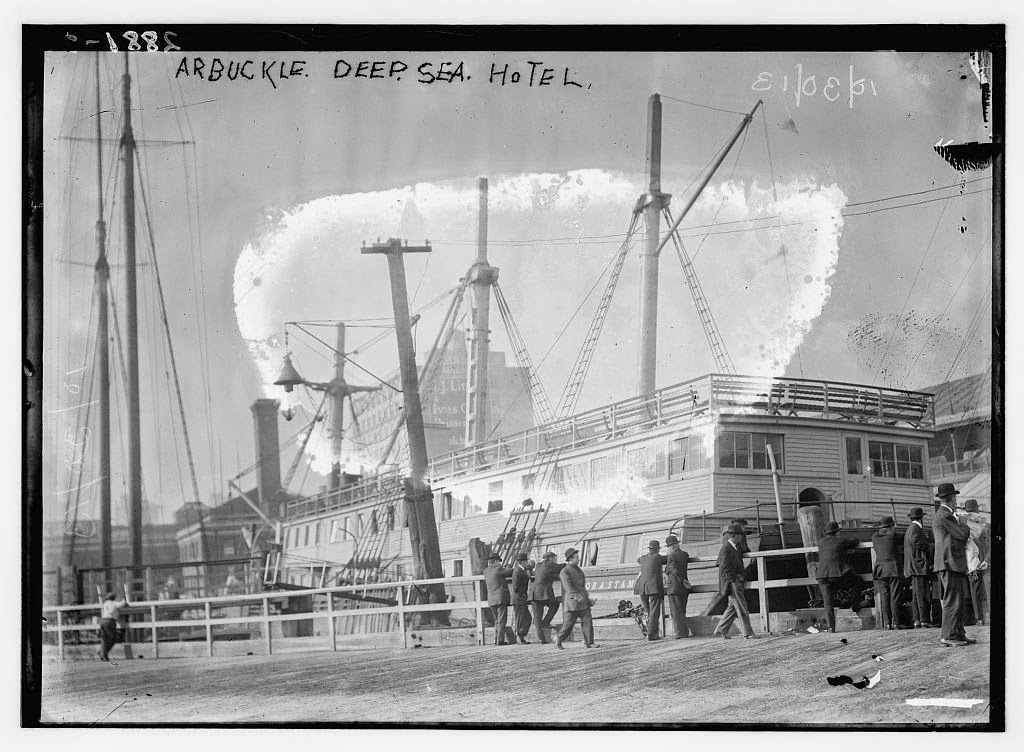
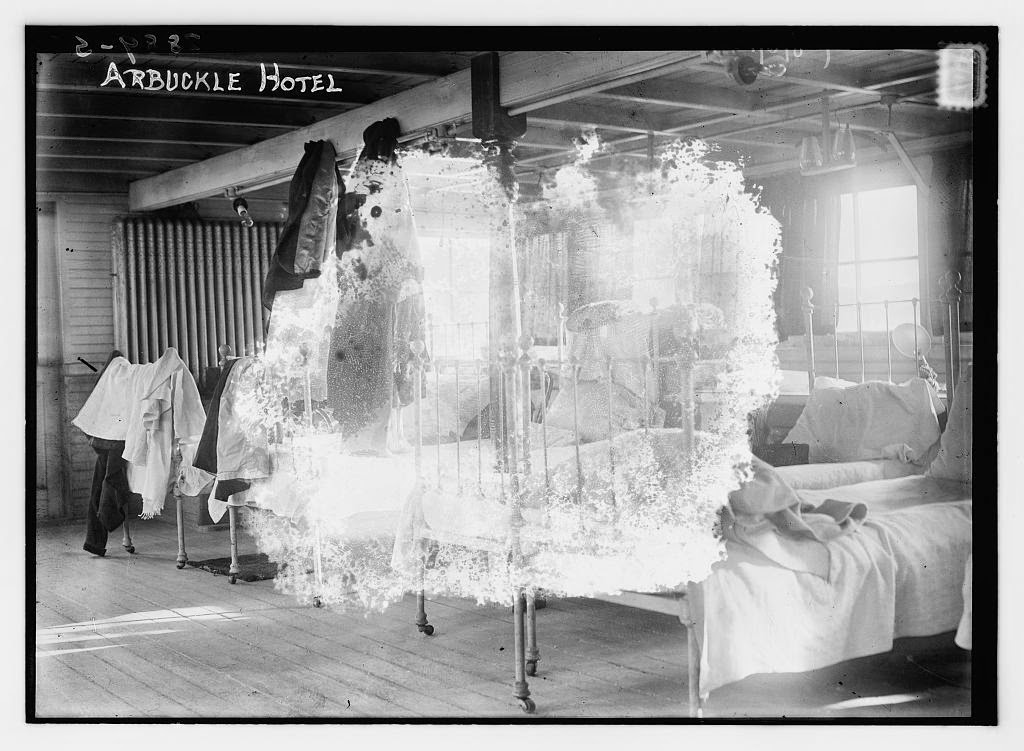
Arbuckle’s Deep Sea Hotel was neither in the deep sea, nor was it a hotel.  But for hundreds of young, single women at the end of the Gilded Age, it was home.

The boat hotel built by a coffee manufacturer, photo from January 1913 (Library of Congress)
The Challenges of Living Single

Accommodations were indeed limited for the thousands of young single women who arrived in New York City at the start of the 20th century.  

Wealthier single ladies could enjoy a degree of independence by indulging in fashionable apartment living. Affordable options like boarding houses were often socially binding.  

For instance, the morality-minded YWCA housed hundreds of New York women by the 1890s. It was often too expensive to rent on your own place, even with roommates, and the neighborhoods where such housing was available would not have been too desirable.

Enter Brooklyn coffee millionaire John Arbuckle.

A Caffeine Jolt

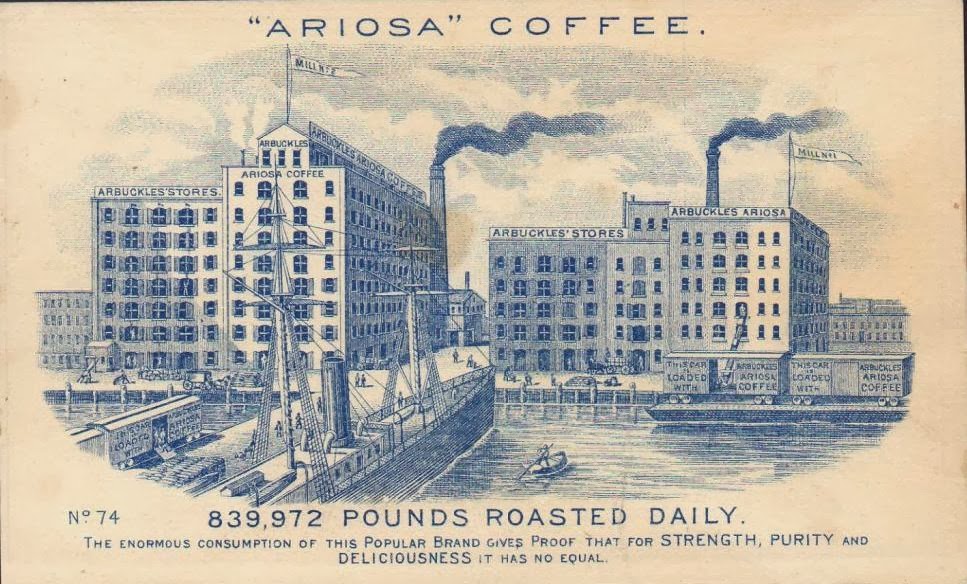
The sugar manufacturer, already a chief competitor of William Havemayer, innovated the mass production of coffee by the 1890s, making himself extremely wealthy and jumpstarting America’s love affair with coffee in the process.  

His Jay Street plants and Water Street warehouses dominated the Brooklyn waterfront in the area of today’s DUMBO.

In emulation of other progressive-minded New York philanthropists, Arbuckle commissioned free water-bound excursions for the overcrowded poor of the Lower East Side.

However, when a steamboat owned by another company — the PS General Slocum — exploded during one such excursion in 1904, killing over 1,000 people, such trips quickly went out of fashion.  

Arbuckle then decided to use one of his ships in a more unconventional way — a long-term hotel for single women.

The Floating Hotel

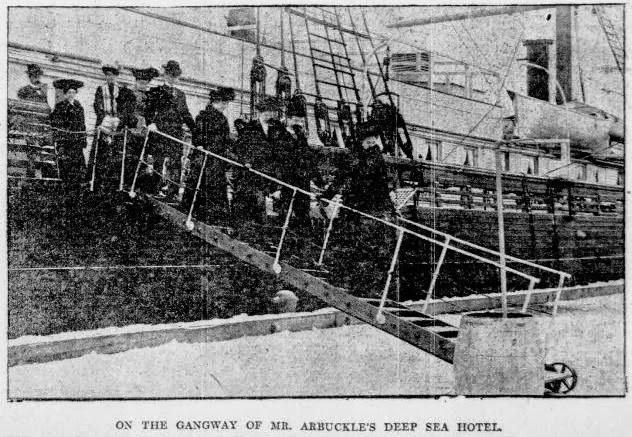
His ship the Jacob A. Stampler was turned into a floating hotel for one hundred women, with a smaller ship nearby for young working men. It was docked at West 21 Street on the Hudson River, near the massive piers for passengers liners.

“The fundamental idea of this hotel scheme,” according the New York Tribune in 1905, “is to benefit young men and young women who are receiving low wages and are striving to live respectable lives.”  

In 1905, its first year of operation, women paid “40 cents a day, or $2.80 a week, while the young men pay 50 cents a day or $3.50 a week.” [source]

From the Tribune profile:

While both genders benefited from the unusual hotel idea, Arbuckle’s focus was in the assistance of women.  

“A young fellow can fight for himself and get along his own way,” said the millionaire, “but it is different with a woman or girl confronted with problem of keeping herself respectable while working for low wages.”

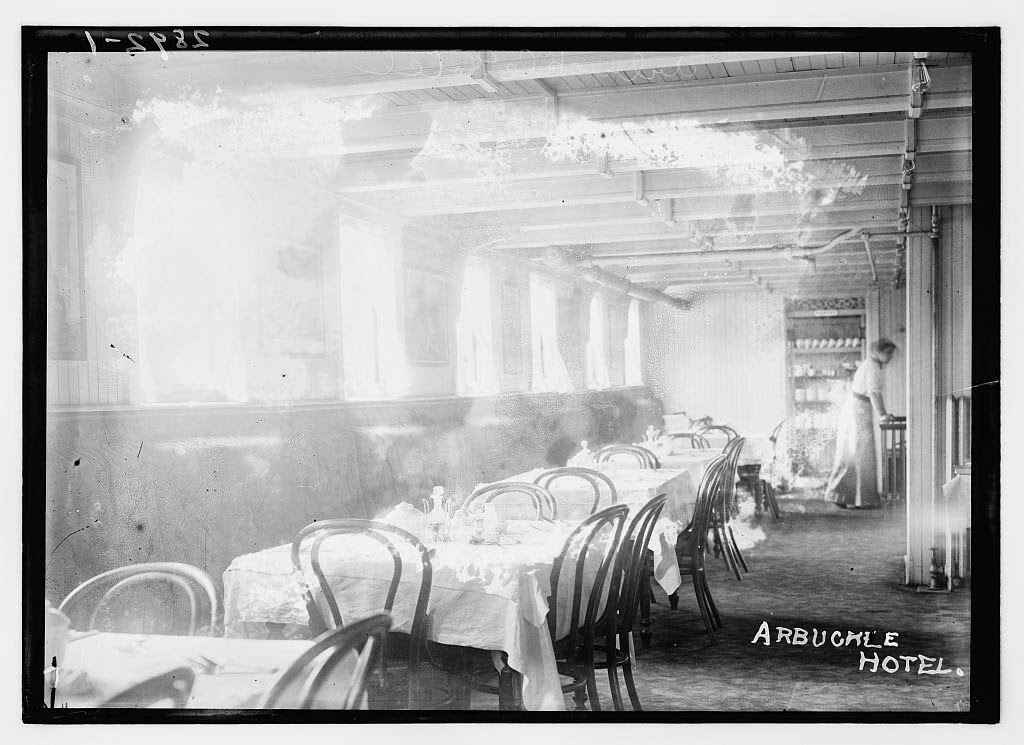
The women were fed well and provided a selection of magazines and newspapers, not to mention a piano for Sunday evening sing-alongs. They were also given sewing machines and laundry facilities.

The rocking of the boat and the relative bustle of a busy pier seems not to have bothered Arbuckle’s early tenants.  

“It’s so quiet here. No rattle and roar from the streets,” said one young woman. [source]  Ladies could receive gentlemen callers, but men had to vacate by 10 pm. As many women worked quite late in the day, this probably didn’t amount to much socializing.

A House and a Vacation Home

During the summer, the boat actually did take regular trips to various places in the region, from Coney Island to the shore of Staten Island.  

In July, the two floating hotels would head out to Coney Island every day, docking for a couple hours at Dreamland amusement park.

Surmising from its frequent journeys, I imagine Arbuckle’s floating hotels had few long-term summer tenants in these early days.

Below: The dining room and the sleeping quarters of the Deep Sea Hotel, circa 1913 (LOC)

The Final Days

Over the next ten years, the Deep Sea Hotel took fewer trips, becoming more or less a semi-permanent, floating apartment complex.

It was referred to by this point as the Working Girls Hotel.  

At some point, perhaps due to overwhelming traffic at the Chelsea piers, the Stampler made the east side its home, regularly docking at East 23rd Street.

The floating hotel never really made a profit, and after Arbuckle died in 1912, his inheritors attempted to shut it down.  

I should also note that the Stampler was a very, very old boat.

“[The] ship was beginning to rot and soon would be unsafe,” said the New York Sun.  The women who lived there, however, fought successfully to keep it open until 1915, when they were finally told to permanently disembark.

Interesting fact to note about its final days — both single men and women lived aboard the boat by 1915.  

Its last documented population was 50 girls and 16 boys, according to the Sun. (Most likely teenagers or adults in their early twenties.) The ship rarely sailed to Coney Island in the summer, but had become a destination in itself.  

“One of the five decks is fitted up as a dance hall,” “crowded every night with dancers” when music from a nearby pier begins to play.

The price of rent these days!

The last tenants finally left on September 1, 1915, with many unable to find further housing.  “There isn’t a girl on this boat that makes $9 a week,” said one mournful tenant, “and you know how far that goes in this city.” [source]

By 1917, the Stampler was a rotted breakwater off of Bayville Beach in Oyster Bay.  To this day, perhaps, some remnant of the ship still sits in the water off the coast of Long Island.

By the way, Arbuckle may no longer sponsor floating housing accommodations for working people, but they still make coffee.


For more information on Arbuckle and the New York coffee scene, check out our podcast on the history of DUMBO:
Categories
Women's History

Suffragettes on Parade! In 1915, thousands march for right to vote

For once, the biggest news story in America in 1915 was not about the war waging in Europe.

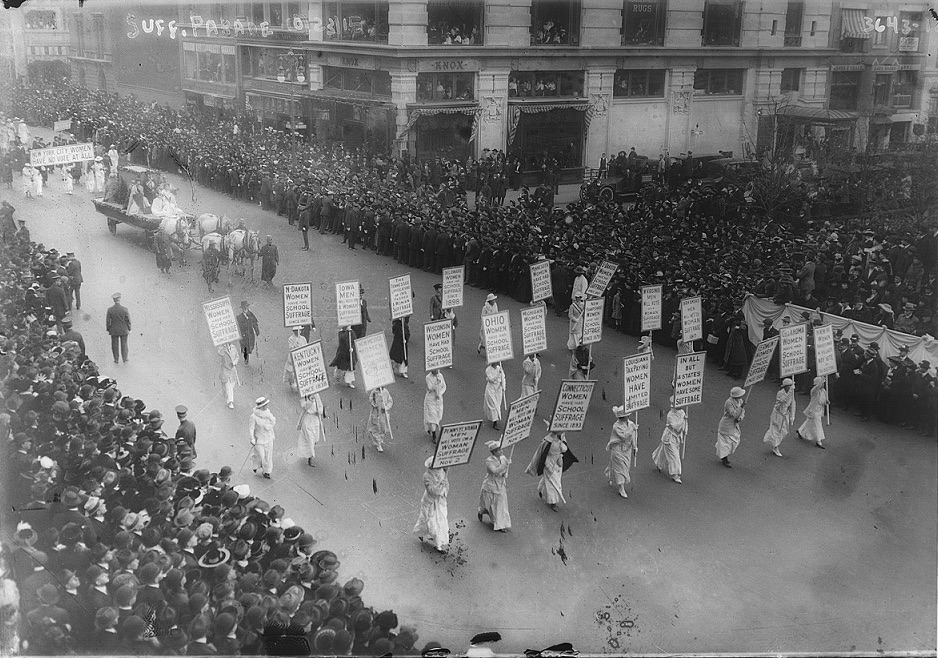
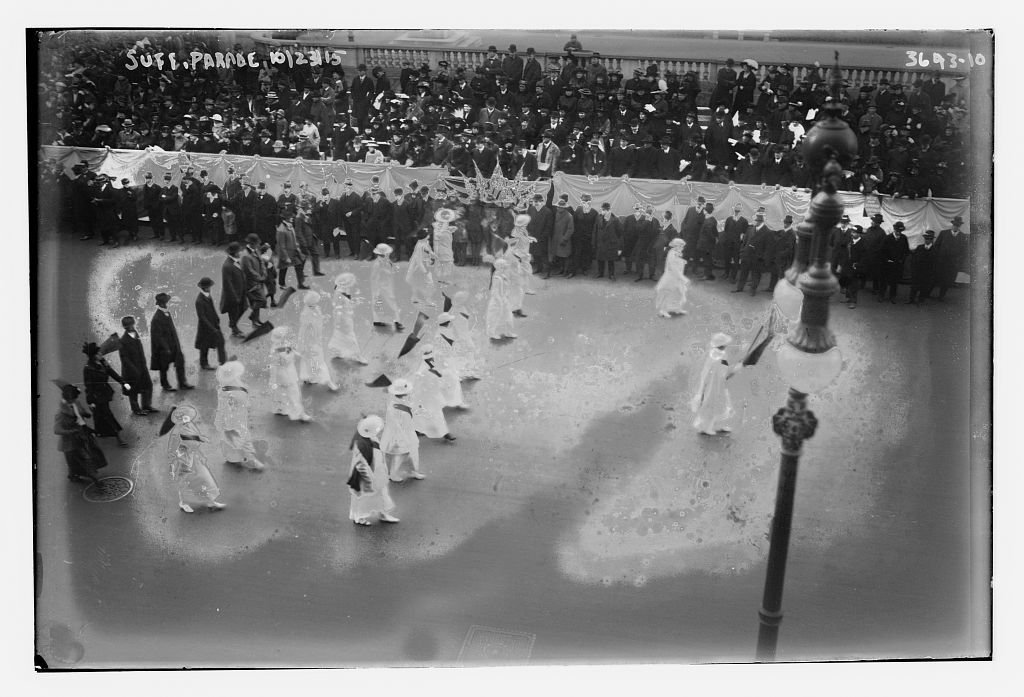
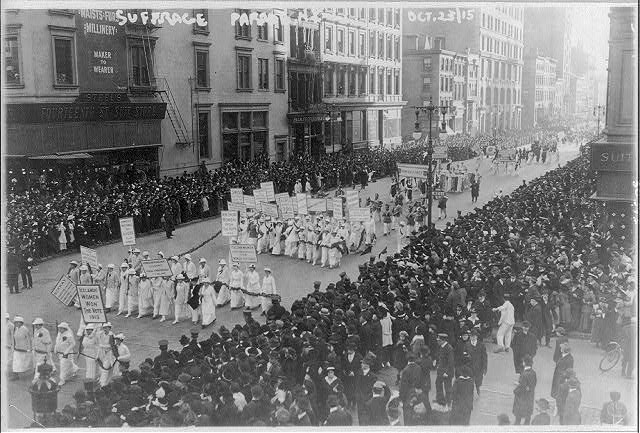
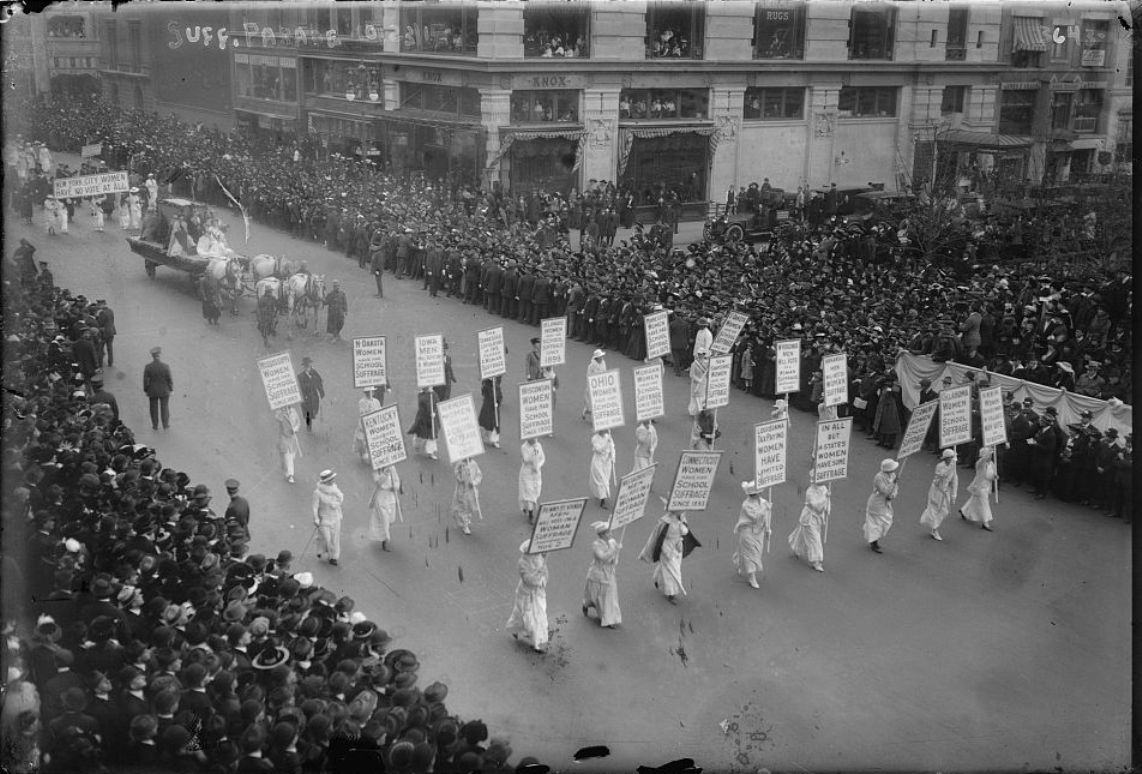
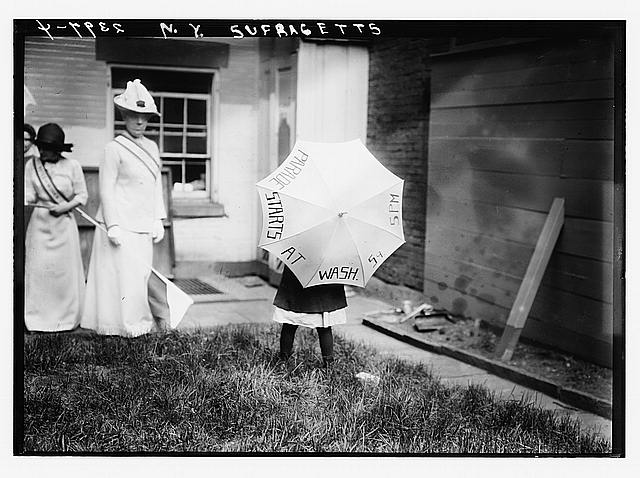
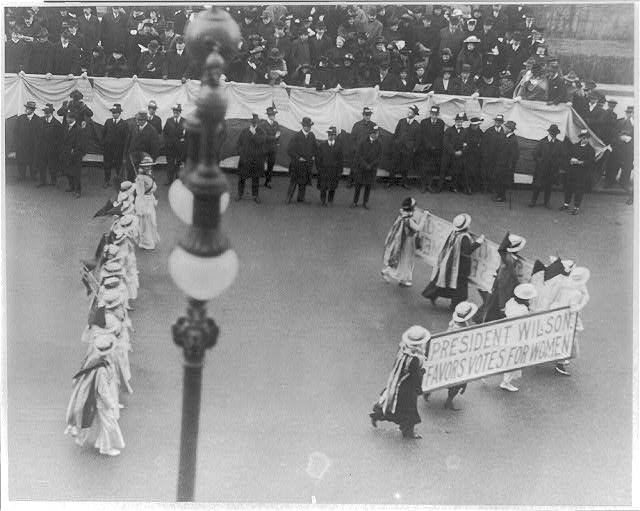
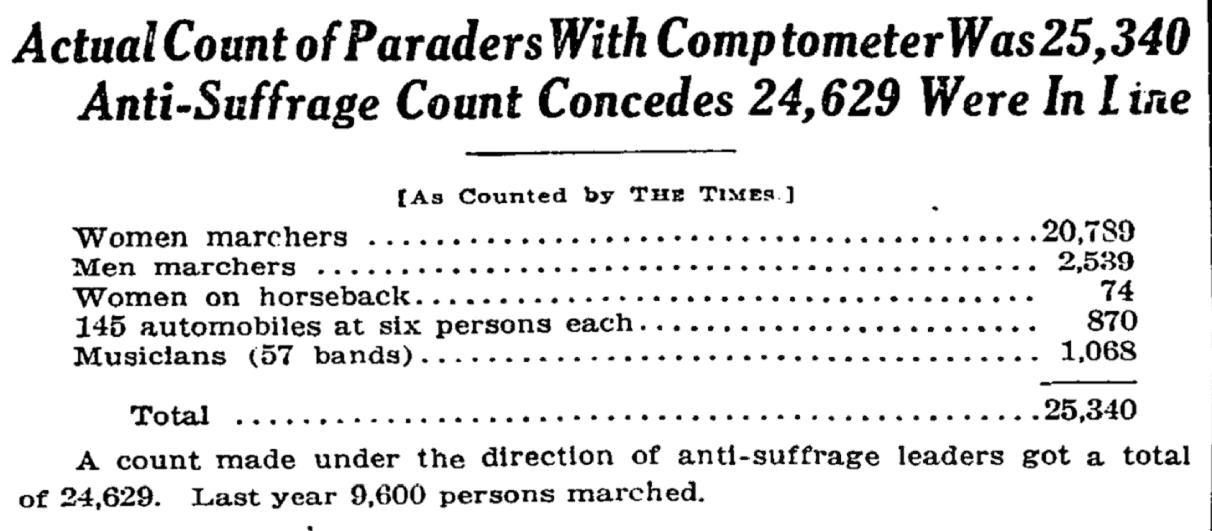
On October 23, 1915, the forces of the women’s suffrage movement mobilized to create the most ambitious gathering to date, a parade of thousands to force the issue into the consciousness of New Yorkers and American at large. 

Here are some clips from newspaper articles of the day, celebrating their efforts, chastising and trivializing in part, but recognizing that a corner had been turned and that the right to vote for American women was now an inevitable (if not immediate) outcome:

2

“The latest, biggest and most enthusiastic of suffrage parades, and the one which, according to the leaders of the suffrage forces, will be the last ever needed to plead their cause in New York, marched up Fifth Avenue from Washington Square to Fifth-Ninth Street yesterday afternoon, blazoned the whole city with the yellow of its banners, and brought out what seemed to be the larger part of the population of Manhattan to look at them.”
New York Times, October 24, 1915

“It was a three mile argument for equal rights — a dignified, splendid argument — and every vantage point along the gay colored way was covered with men and women who saw its force.  Through the chill of a windy afternoon, though the sun shone on the mighty host, the great army of women passed, the white costumes of many glittering in the sunlight, defying the cold wind that the onlookers felt to their spines as they stood to see it all.”
New York  Sun, October 24, 1915

1

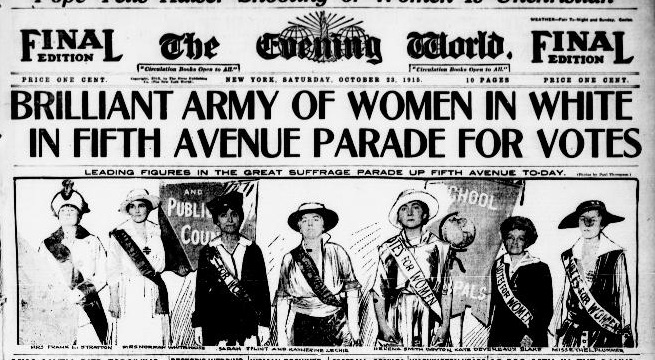
“Some whose names are to be found all through the Social Register marched side by side with working mothers with babies in their arms. A large proportion of the marchers were young girls who would not be old enough to vote were they enfranchised. They made up in beauty what they lacked in years and were cheered all along the crowded Fifth Avenue sidewalks.”
New York Evening World, Late Edition, October 23

“Old women, as old as suffrage, marched. Often beside them were little girls barely in their teens. And there were even tiny babies in carts, making their appeal for their mothers’ votes.

There was little applause all along the route for the women marchers. But this was not strange, for it could be seen that the spirit of the parade had made itself felt on the sidewalks. It was no laughing matter, this parade. The women in it did not smile or giggle. They were serious and determined. And this mental characteristic was contagious.”
New York Tribune, October 24

1
8

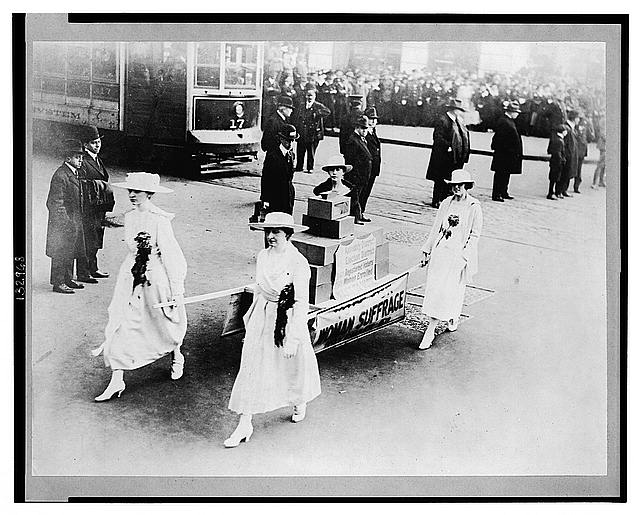
Above: Four women carrying ballot boxes on a stretcher 

“Is Dame Nature a suffragist? At any rate, she was kind yesterday. In golden sunlight and keen air the great parade went its triumphal way, to the satisfaction of participants and spectators. With no disrespect to the men in it, the female marchers and riders, as always, showed the hopeless feminine superiority in grace, decorative effect, art of representation.”
editorial, New York Times, October 24

“The spectators laughed in good natured sympathy with the struggles which the wind caused the marchers.

Unruly skirts demanded attention from those who bore the militantly inscribed banners.

Nearly all the flag carriers had to call for help upon heir companions and sometimes four or five women struggled with brave laughter with a single standard to keep it from being swept to the street.”  — NY Evening World

1

“[S]igns were a cardinal feature of the parade. One which attracted attention everywhere and appealed significantly to the male onlookers was, “We talk with you, we eat with you, we dance with you, we marry you, why can’t we vote with you?” Another read: “Oh, men, please do give us the vote.” — NY Tribune

“King Albert of Belgium favors votes for women,” “Australian women have the ballot,” “Queensland women vote,” “Bohemia was the first in the world to pass a law for women’s suffrage in 1861,” “Oestreichischer Komite fur Frauenstremrecht” were some of the inscriptions on the banners. In all the languages of the earth they proclaimed the advance women have made in the various countries in gaining the vote, and scattered through the division were banners asking: “Women vote in Australia, why not in New York?” and “Women vote in twelve Western States, why not in New York?” — NY Sun

1
4

“It was a long parade — begun in mid-afternoon and finished by moonlight. And while thousands had drifted away, the avenue was still packed with onlookers when the men’s brigade — some thousands this time in place of the valorous ninety-two who were jeered in the first parade only four years ago — came along just in front of the army of automobiles that ended the procession.” – NYT

“The parade ended with a concert of thirty bands and a giant chorus singing patriotic songs at the Central Park Plaza.  There were several battalions of men in sympathy with the cause which were noisily greeted by the people along the curb.” — Evening World

Graphic from the New York Times, October 24

1
wilson

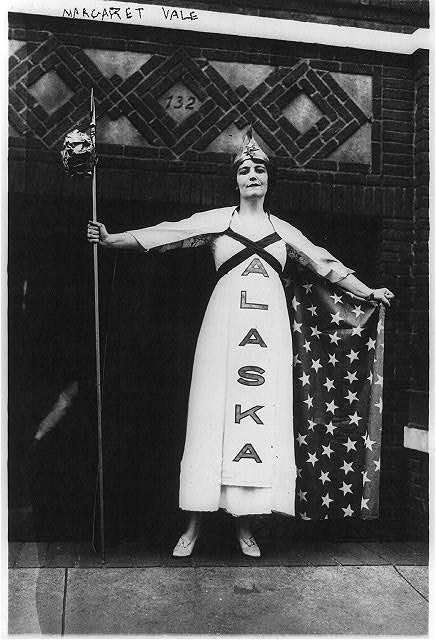
Margaret Vale, niece of President Woodrow Wilson, at the Suffrage parade. Alaska had granted women the right to vote in 1913.

2

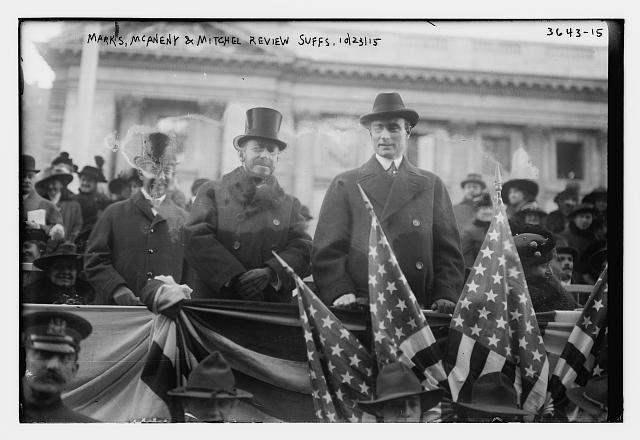
The appearance of Mayor John Purroy Mitchel (‘the boy mayor of New York‘) was considered a big boost for the marchers although it certainly would have been a major snub if the mayor has skipped such a major parade!

mayor

Absent from all of the news coverage (at least the articles I reviewed) was the participation of African-American suffrage advocates. They played an active role in the movement but were most likely absent from the parade.

Despite this grand parade, New Yorkers defeated a referendum on suffrage the following month. A little over two years later — on November 6, 1917 — the women of New York state would win the right to vote.

The Nineteenth Amendment, ensuring the vote for all American women, was ratified on August 18, 1920.

All photographs on this page courtesy Library of Congress

Categories
Wartime New York

New York doughnut history: From Washington Irving’s olykoeks to doughnut huts in Union Square

Today is National Doughnut Day which is not a real holiday although that shouldn’t stop you from celebrating in whatever powdered, glazed, creme-filled way you see fit.

However you will be surprised to learn that this day traces its roots to the Salvation Army and World War I.

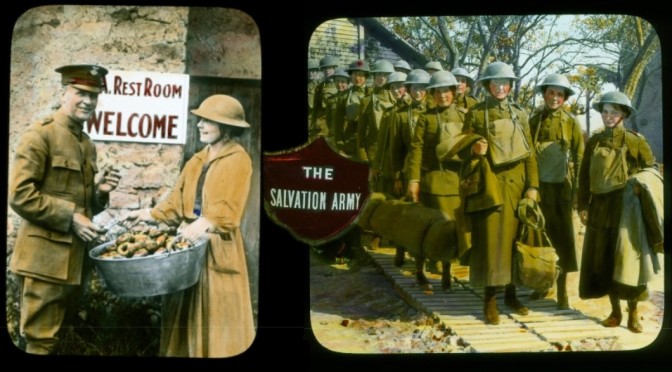
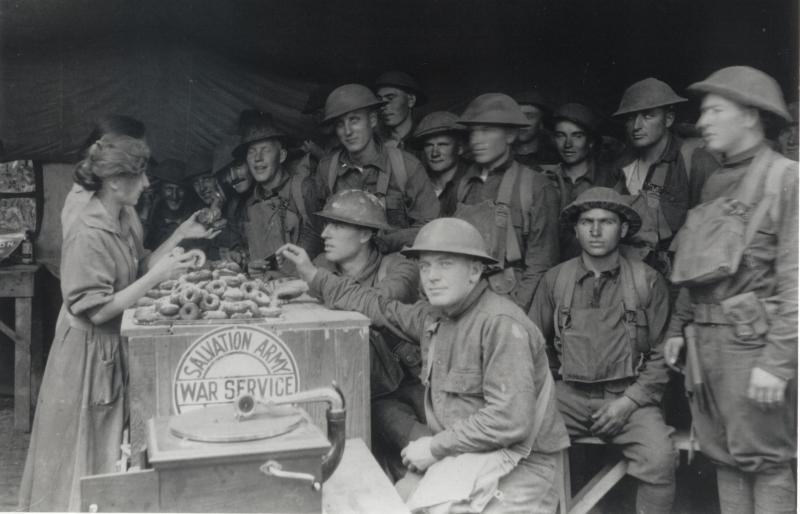
To provide for the American troops fighting in France in 1917-18, Salvation Army workers set up small tents or ‘huts’, providing the comforts of home, with nourishing meals, a quiet place to write letters or to get clothing mended.

Time to make the doughnuts: A Salvation Army hut during World War I (Courtesy the Salvation Army)

There were actually several dozen of these Salvation Army huts already set up in the United States near military bases so the tradition was simply transferred over to Europe when the war began, with workers often setting up huts in abandoned or even bombed-out buildings.

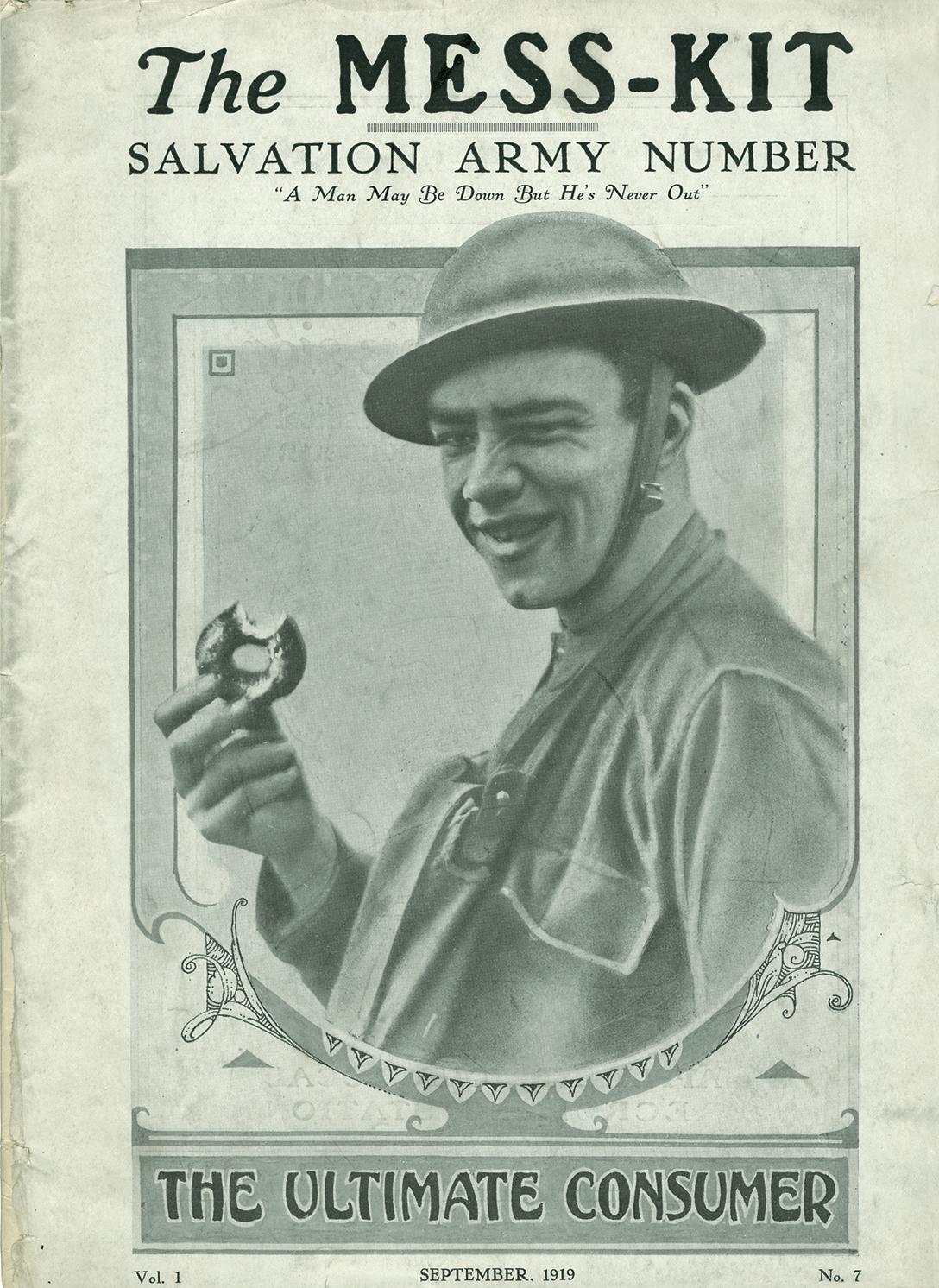
Below: A doughboy eating a doughnut on a 1919 magazine cover. (LOC)

8616914748_9dd3a80bf3_o

What brings greater pleasure than a baked good? But the Salvation Army couldn’t transport large baking ovens, so they improvised with the doughnut, deep-frying dough on small portable stoves.

Irving and the Oly Koek

The round pastry was not invented by the Salvation Army.  Indeed, Washington Irving himself is credited with the first mention of the doughnut in print back in 1809.

Regaling on old Dutch custom, he writes “[I]t was always sure to boast of an enormous dish of balls of sweetened dough, fried in hog’s fat, and called dough-nuts, or oly koeks: a delicious kind of cake, at present known scarce to this city, except in genuine Dutch families.”

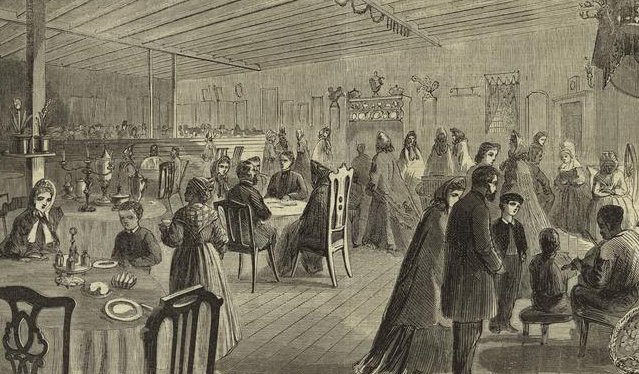
Above: A scene from the Knickerbocker Kitchen in 1864 (NYPL)

Due to their ease of preparation, doughnuts became associated with wartime cuisine.  But even the original Dutch ‘oly koeks’ made a wartime return as well, brought back as a fund-raiser during the Civil War, sold during the 1864 Metropolitan Fair in the Knickerbocker Kitchen, a sort-of theme restaurant where Dutch delights were sold.

The Battleship in Union Square

Interestingly, the Knickerbocker pavilion was located just off of Union Square. Many decades later, the doughnut would return to Union Square for yet another war-related pageant.

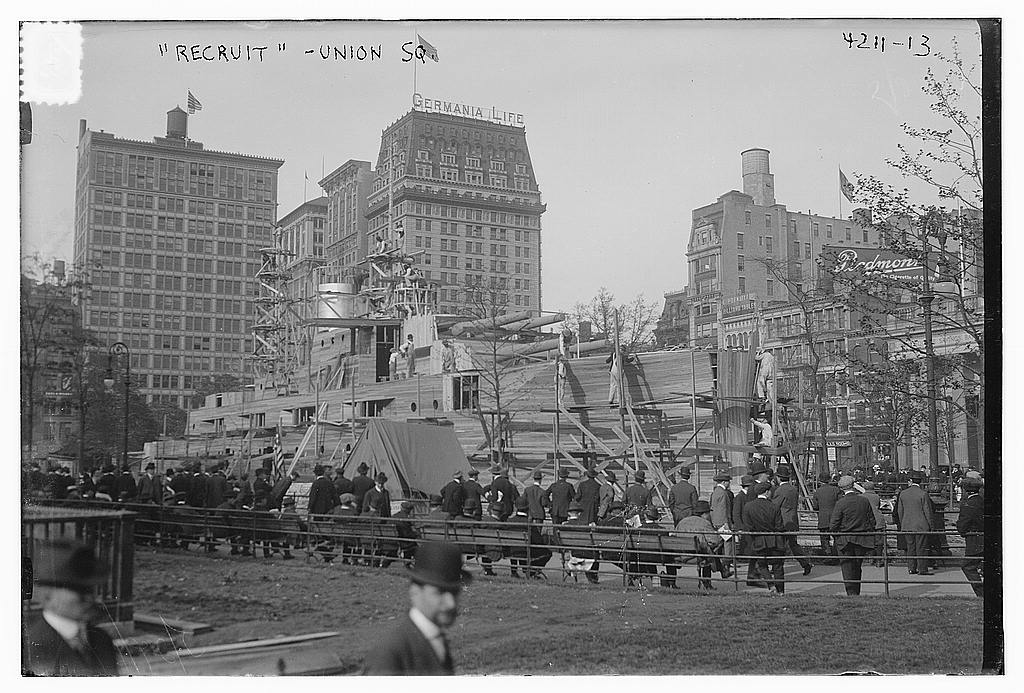
In 1917, during World War I, the U.S. Navy set up a curious recruitment tool in Union Square — a life size wooden battleship called, appropriately, the USS Recruit.

Courtesy Library of Congress

Once the war was over, the Salvation Army thought it would be a kind gesture to those New Yorkers were fought in the war to recreate their welcoming war huts. And it made natural sense to set one up here in Union Square, next to the wooden battleship and conveniently located near their headquarters on West 14th Street (still there today).

The Salvation Army’s Union Square hut opened for business January 12, 1919, with a grand ceremony around the USS Recruit and military officers from the Brooklyn Navy Yard.

Inside Salvation Army workers were busily preparing the doughnuts, using the same tools as on the battlefield.  It was led by Adjutant Violet McAllister, one of the original “doughnut sweethearts” of the war, with “flour on her nose and a great white apron over her khaki uniform.

That day over 1,000 doughnuts were prepared, many for soldiers returning from the war.  In emulation of the war front huts, the Union Square edition was “open every day for reading, writing and gossip, with doughnut and coffee for 10 cents for all men in uniform.” [source]

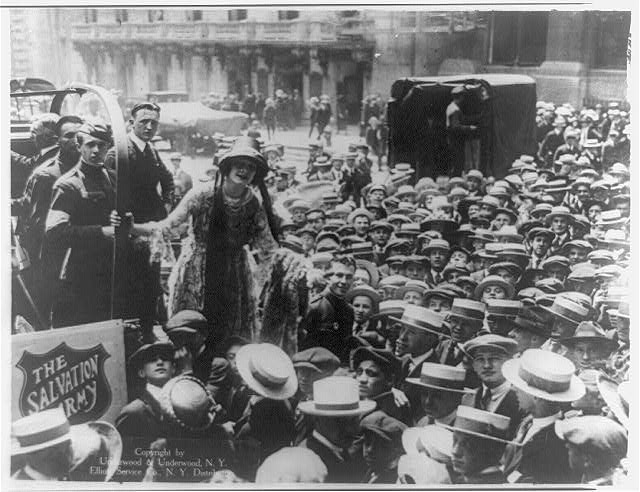
Above: Silent film star and New Yorker Martha Mansfield sells doughnuts for $1 apiece on the streets of New York during a fundraiser for the Salvation Army. (LOC)

Doughnuts on Every Corner

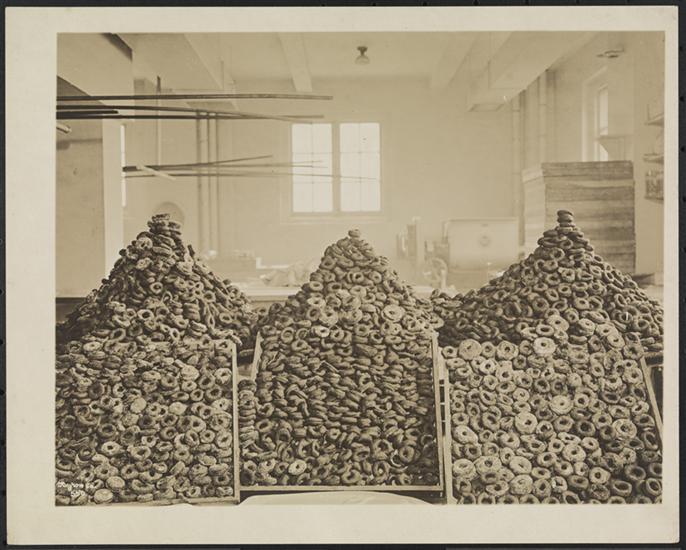
To those at home, observing the battles of World War I from afar, the doughnut became a symbol of the war effort (although the word doughboy is not related.)  A month before the Treaty of Versailles was signed, Salvation Army volunteers sold doughnuts on street corners throughout the city and even auctioned off doughnuts on the steps of the Sub-Treasury Building (today’s Federal Hall), with one doughnut being sold for $5,000!

Below: The doughnuts were prepared at the Hotel Commodore, Lexington and 42nd Street.

Courtesy Museum of the City of New York

By 1920, the battleship — and I assume the doughnut hut as well — were dismantled.  In 1938, two decades after World War I, the Salvation Army started National Doughnut Day as a fundraiser and in honor of its phalanx of busy doughnut makers.

New Yorkers of course no longer needed to associate this food with wartime activities as the pastry soon sprang up at every lunch corner and automat in town.

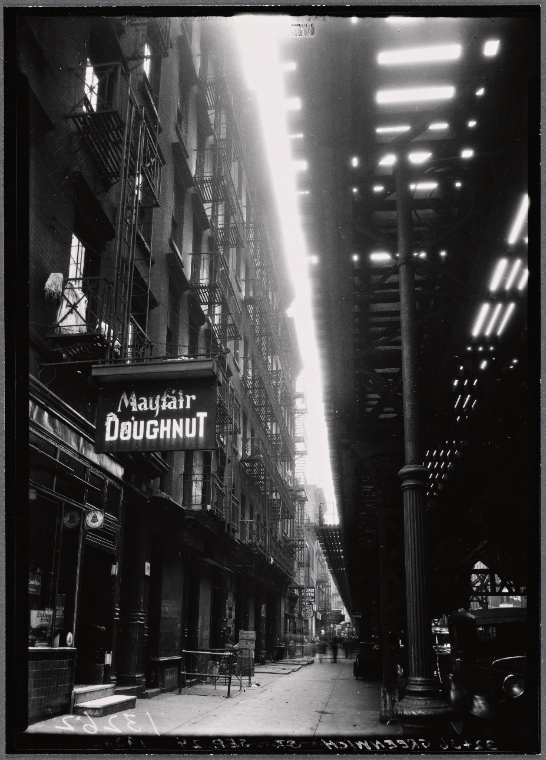
Below: Mayfair Doughnut under the elevated at 32-36 Greenwich Street (courtesy NYPL)

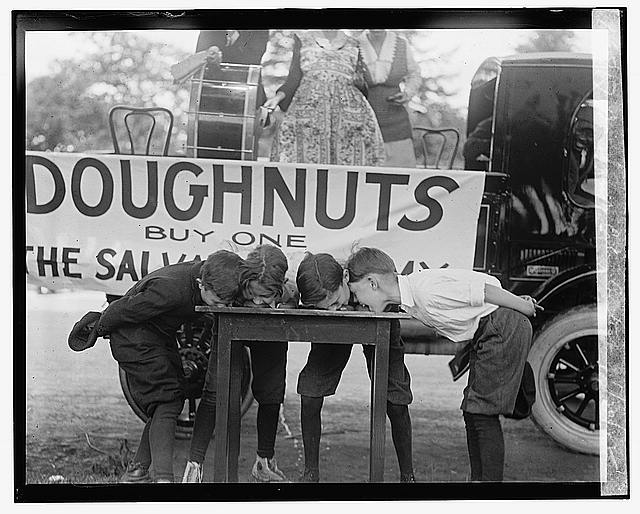
A doughnut eating contest from 1922. I’m not sure this is from New York City, but how could I overlook this hilarious picture? (LOC)

Categories
The First

Josephine Cochrane and her Dazzling Dish-Washing Machine

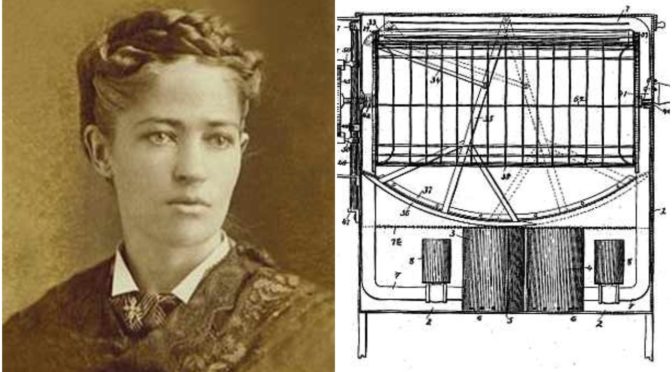
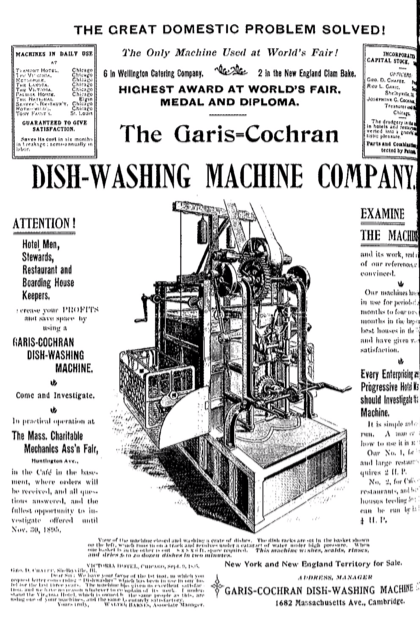
THE FIRST PODCAST Of the tens of thousands of U.S. patents granted in the 19th century, only a small fraction were held by women. One of those women — Josephine Cochrane — would change the world by solving a simple household problem.

While throwing lavish dinner parties in her gracious home in Shelbyville, Illinois, Cochrane noticed that her fine china was being damaged while being washed. Certainly there was a better way of doing the dishes?

Cochrane’s extraordinary adventure would lead to places few women are allowed — into gritty mechanical workshops and the exclusive corridors of big business. Nobody could believe a woman responsible for such a sophisticated mechanical device.

In her own words: I couldn’t get men to do the things I wanted in my way until they had tried and failed on their own. They insisted on having their own way with my invention until they convinced themselves that my way was the better.

FEATURING: The voice of Beckett Graham from the History Chicks podcast, portraying the actual quotes of Mrs. Cochrane (or shouldn’t that be Cochran)?

To get this episode, simply download it for FREE from iTunes or other podcasting services.

Subscribe to The First here so that you don’t miss future episodes!

You can also listen to the show on Stitcher streaming radio from your mobile device.

Or listen to it straight from here:
JOSEPHINE AND THE DISH-WASHING MACHINE

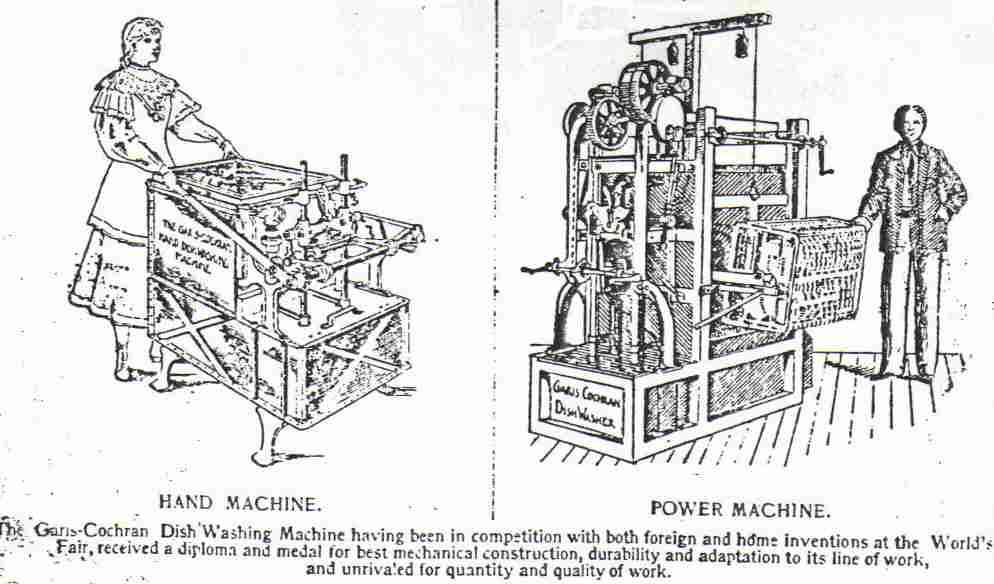
“The Garis-Cochran Dish Washing Machine having been in competition with both foreign and home inventions at the World’s Fair received a diploma and medal for best mechanical construction, durability and adaptation to its line of work and unrivaled for quantity and quality of work.”

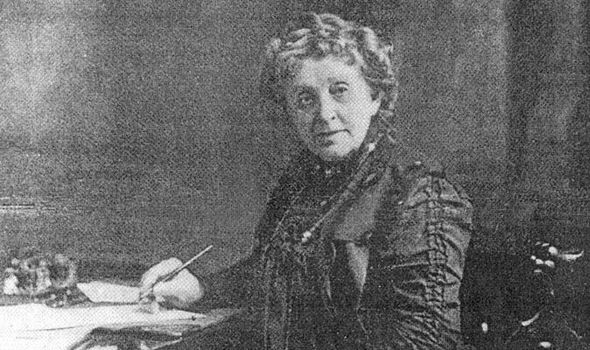
Mrs. Cochrane in her later years:

Categories
Sports

And now, the New York Female Giants: (Briefly) A League Of Their Own

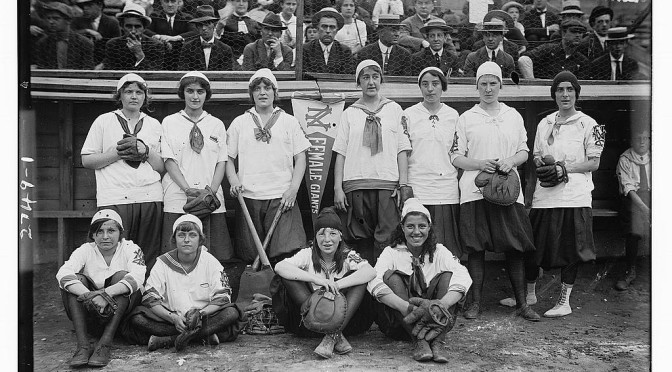
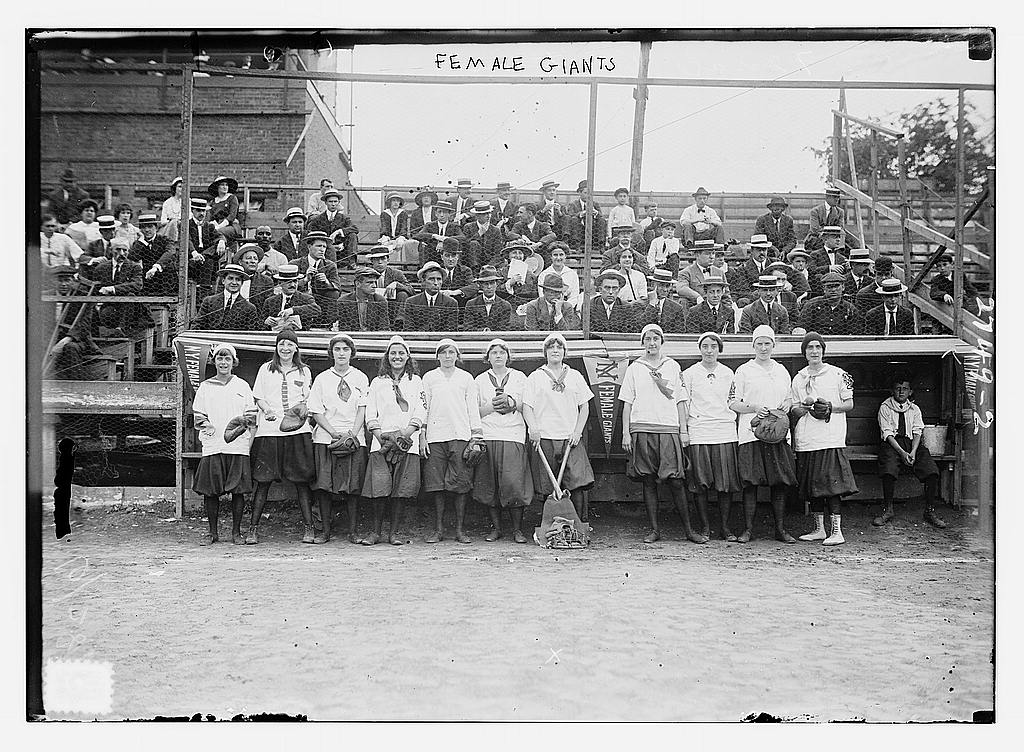
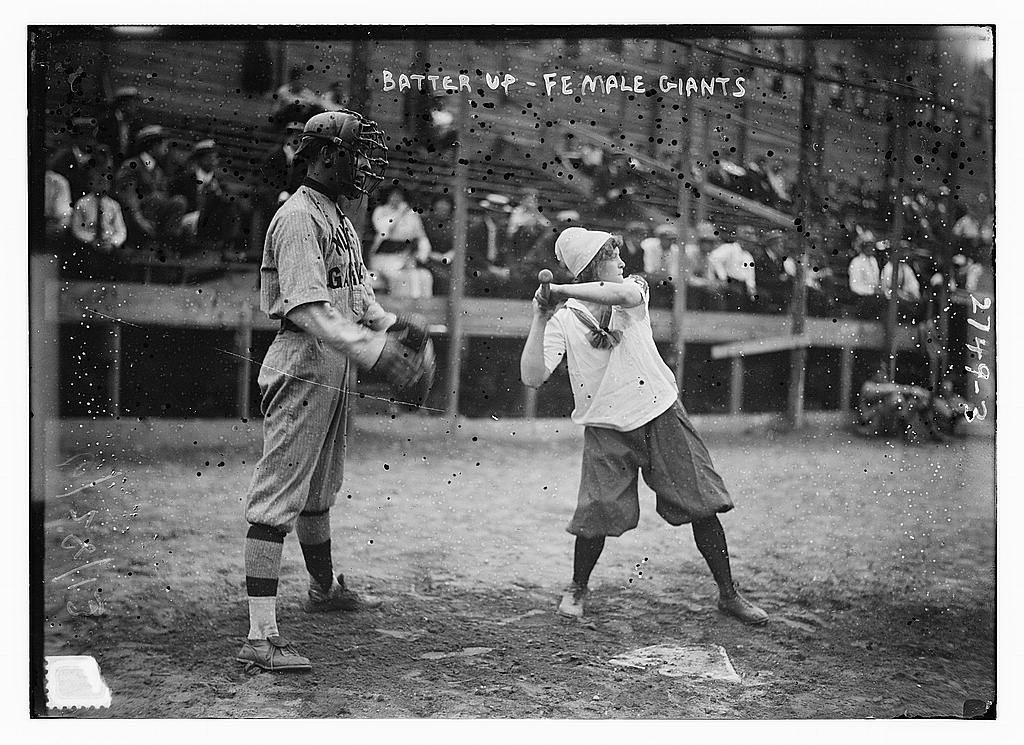
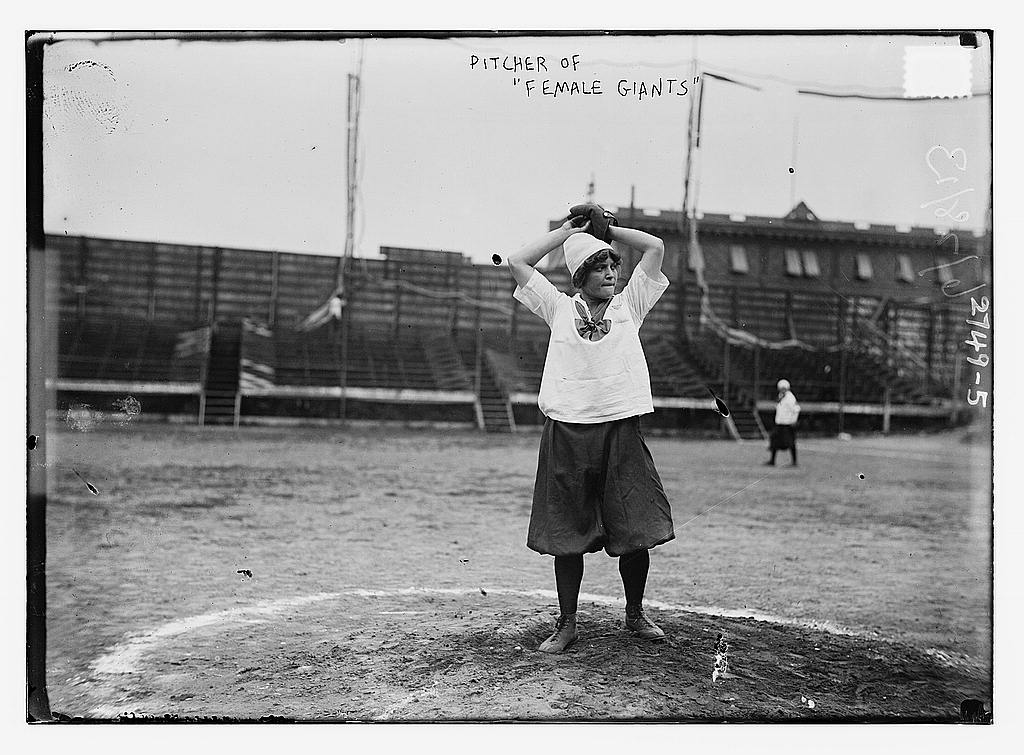
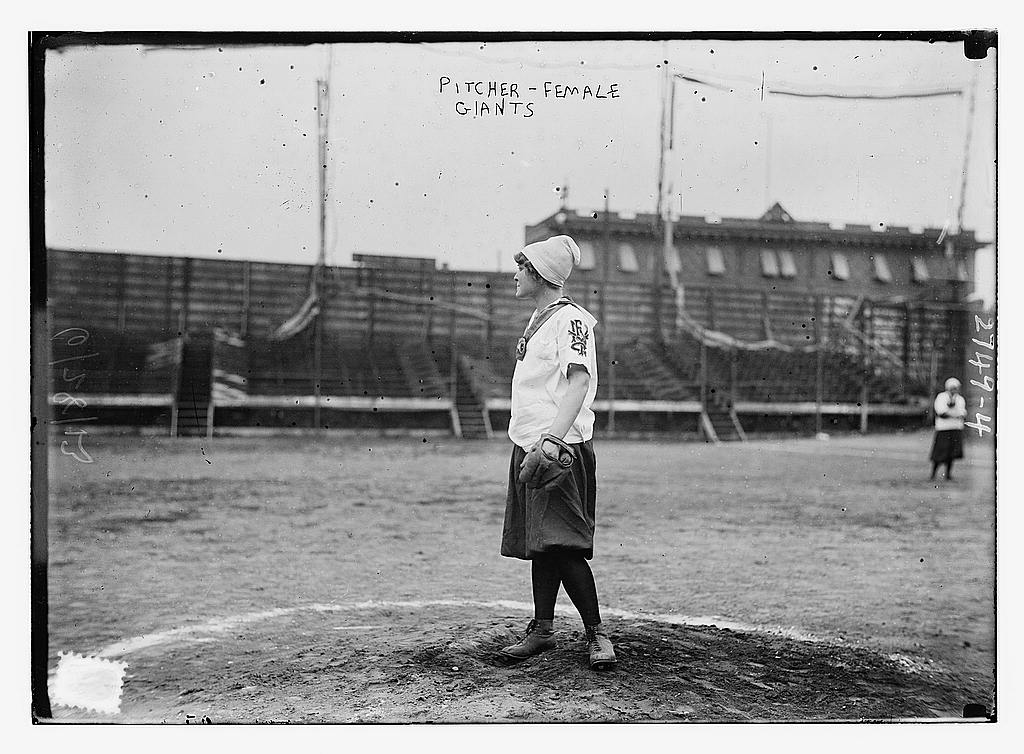
For a very brief period — likely just a single year — there was a female counterpart to the New York (Male) Giants.

The New York Female Giants seem to have an unofficial affiliation with the better known Giants, the city’s most popular baseball team.  Author Michael Carlebach speculates the team was probably formed by Giants manager John McGraw.

2

Early women’s teams — called ‘Bloomer Girls’ — often had a few men playing alongside them.  Occasionally those men even disguised themselves as women as in a revealing case in the summer of 1913 in Washington DC: “Four thousand angry fans surged on the diamond in the old Union League baseball park this afternoon when they learned that the “Bloomer Girls,” who were playing against a team of young men, were not girls. The deception was suspected when the “girl” playing in centre field threw the ball from deep centre to the home plate.” [source]

(The All-American Girls Professional Baseball League, featured in the movie A League Of Their Own, would not be formed until the 1940s.)

The Female Giants don’t appear to be all women players either although there are no disguises at least. The men featured in these pictures played with the New York Giants.

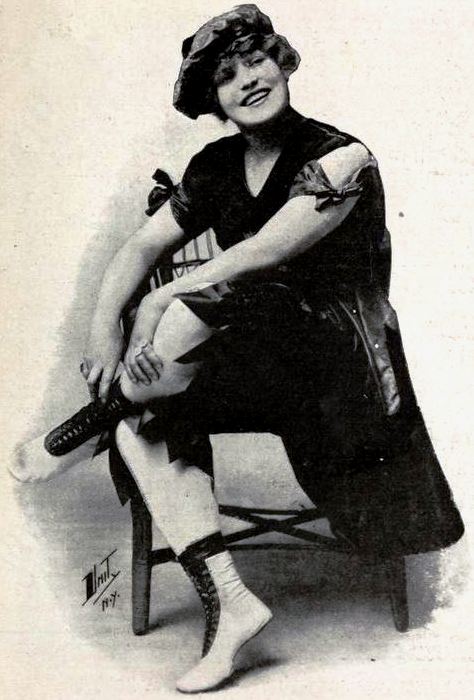
The female players were mostly girls from local high schools and women athletes from other fields of sports.  Following her stint with the Female Giants, their captain Ida Schnall would head to Hollywood and become a silent film actress. She would later become an accomplished swimmer and an advocate for women’s sports, petitioning the National Olympics Committee to expand their offerings for women. Below: Ida in a glamorous pose

ida


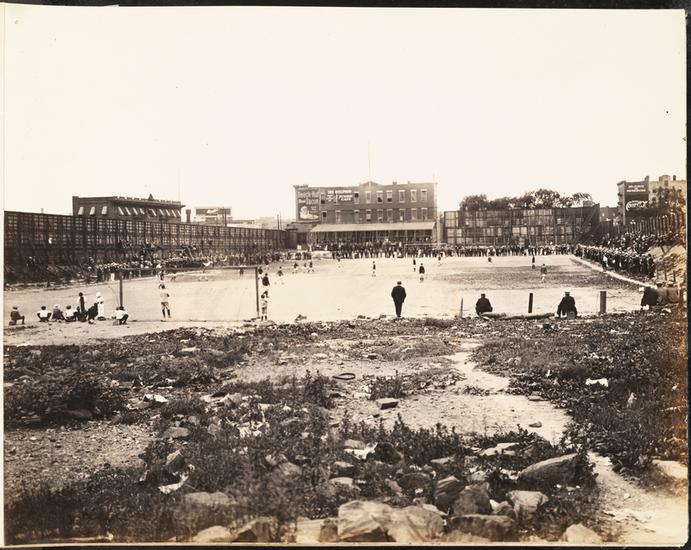
They broke up into two teams — the ‘Red Stockings’ and the ‘Blue Stockings’– and played a notable exhibition game for almost 1,500 people on Sunday, May 25, 1913 at the Lenox Oval, a sports field at Lenox Avenue and 145th Street.

Below: A 1919 soccer game being played at the Lenox Oval

Courtesy Museum of the City of New York

It seems their typical game schedule went unnoticed by the press which is probably a good thing. That May 25th game was written about by the New York Tribune in the following fashion : “The batter hitched up her skirt.  The pitcher nervously adjusted a side comb. Girls will be boys, and the Reds and the Blues of the New York Female Giants were playing an exhibition game at Lenox Oval, 145th Street and Lenox Avenue.” [source]

Below: A catcher from the New York Giants, playing alongside a diminutive young player

3

We know about this particular game because it got shut down by the cops.  In the ninth inning, a detective stepped out onto the field and handed the third baseman — a 17 year old teenager named Helen Zenker – a subpoena to appear in Harlem court.

Due to New York ‘blue laws’, teams were not supposed to legally sell tickets to a baseball game on Sundays. While the women were indeed playing a practice game, Helen had been caught selling programs. She claimed that no such sales activity had taken place; people were just giving her money, including the detective. [More details in this amusing New York Times article from 1913.]

Fortunately, the young Zenker (“seventeen, pretty, active, intelligent, and has the easy gait and springy step of the athlete”) easily charmed the judge, and the case was dismissed. [source]

The photos in this post obviously take place on another date as they’re wearing uniforms which they were not allowed to do on a Sunday.

4


5


EDIT: After going live, I later included the line about the All-American Girls Professional Baseball League and also to clarify that the team also featured adult women playing along with high schoolers. For instance, Ida Schnall, who went on to greater athletic fame, was 24 or 25 at the time of the game described above.

Categories
Those Were The Days

THIS is New York Fashion Week — as it might have been in 1915

New York Fashion Week, the city’s twice-yearly celebration of couture and runway, traces its roots to a 1943 press week event at the Plaza Hotel, organized by publicist Eleanor Lambert.

But there had been a variety of one-off ‘fashion weeks’ or American fashion events in the years between the wars.

In 1934, the Mayfair Mannequin Academy, a local modeling school, even petitioned Mayor Fiorello LaGuardia to declare an official New York Fashion Week as a way to encourage American designers who worked in an industry dominated by Paris.

But well before any of those events, New York’s most famous runway show took place on the street — the Sunday promenades along Fifth Avenue.

It was especially robust during Easter with wealthy women trying to outdo each other in latest styles from Europe. Newspapers covered Easter Sunday with the same fervor as a modern fashion show, noting colors, hem lines, and even the plumage flagrantly bursting from hats.

While there was no dedicated ‘fashion week’ one hundred years ago, there was heightened and excited attention to of-the-moment fashion trends. So here’s a little thought experiment — what would an actual Fashion Week in 1915 look like?

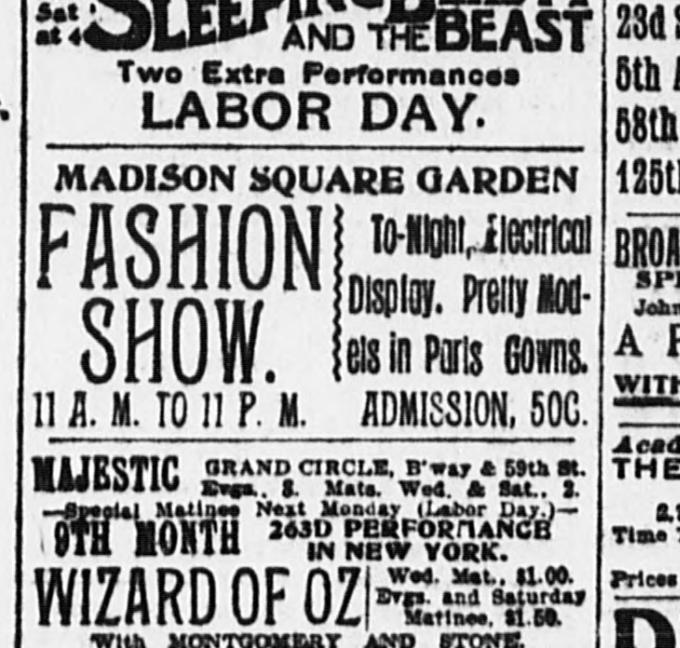
There would in fact be fashion-related events at Madison Square Garden (in its original location off of Madison Square) so let’s put this imaginary Fashion Week there:

from September 4, 1903, New York Evening World

An End to Bondage

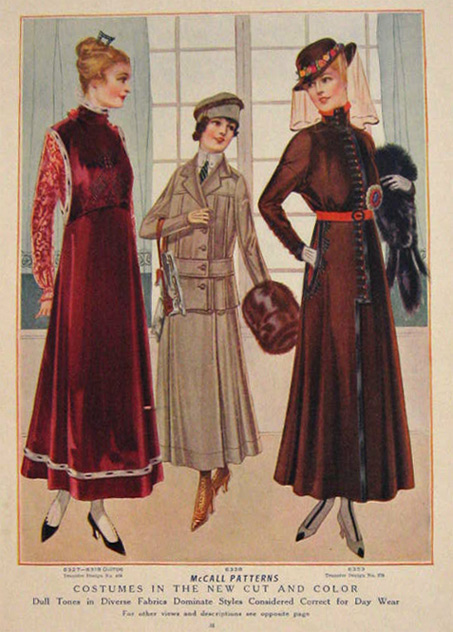
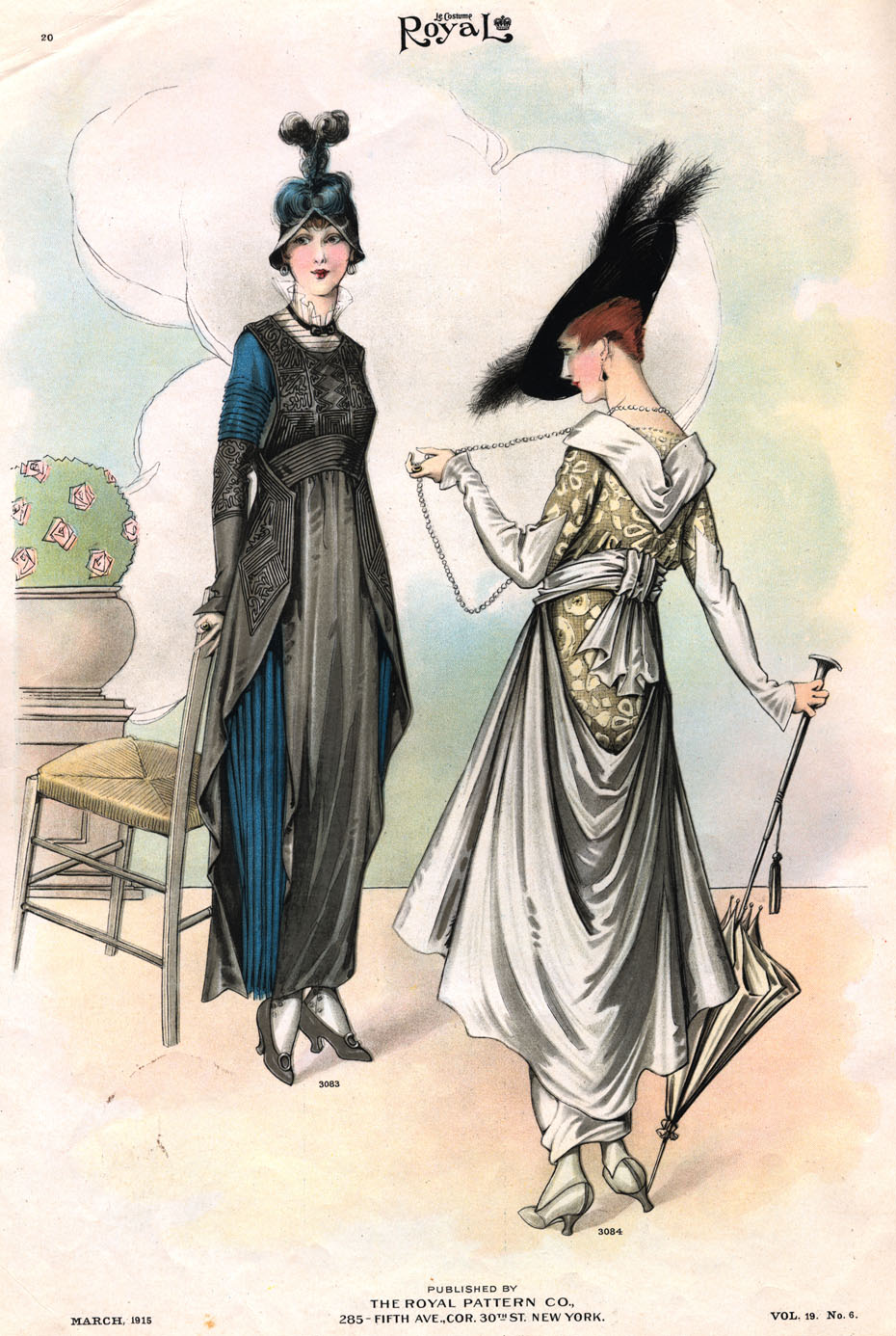
Women’s fashion would be affected by the war in Europe in many ways.  Travel restrictions put an end to the constant flow of fashion queues from Paris. New ideas that were strictly American could begin influencing the way women dressed here.

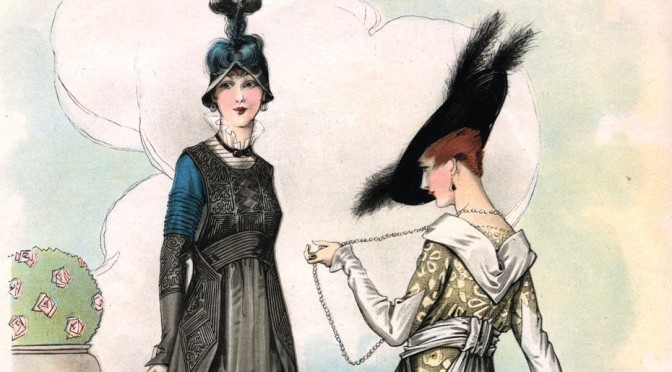
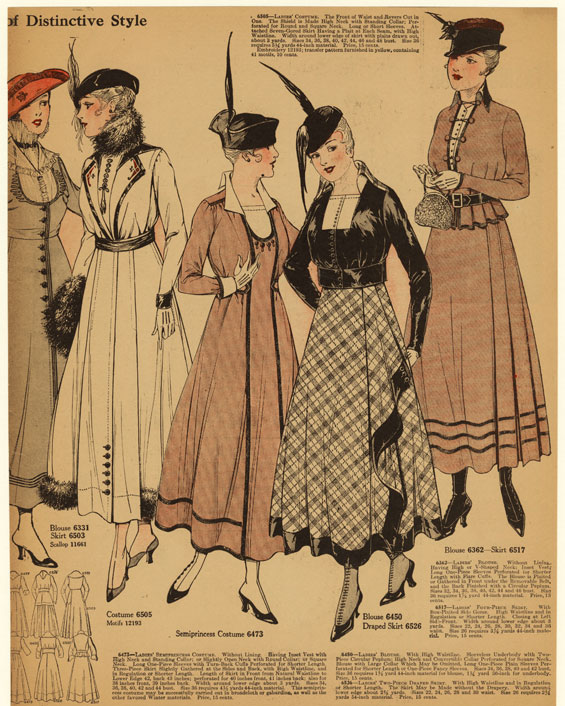
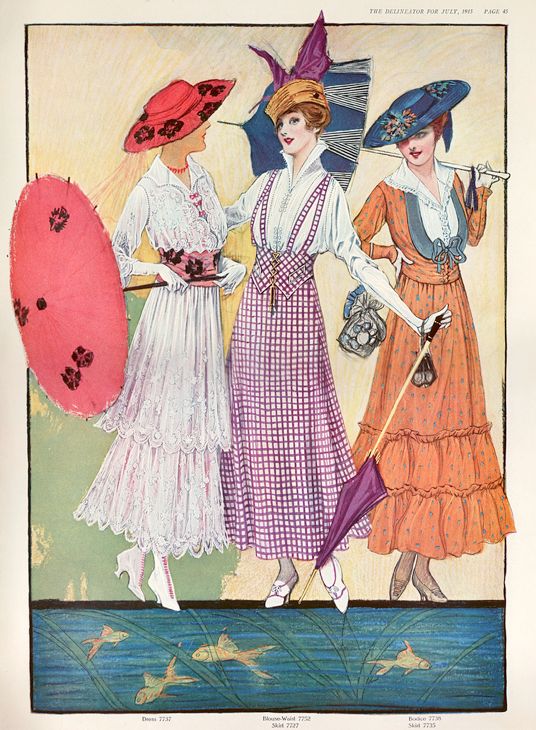
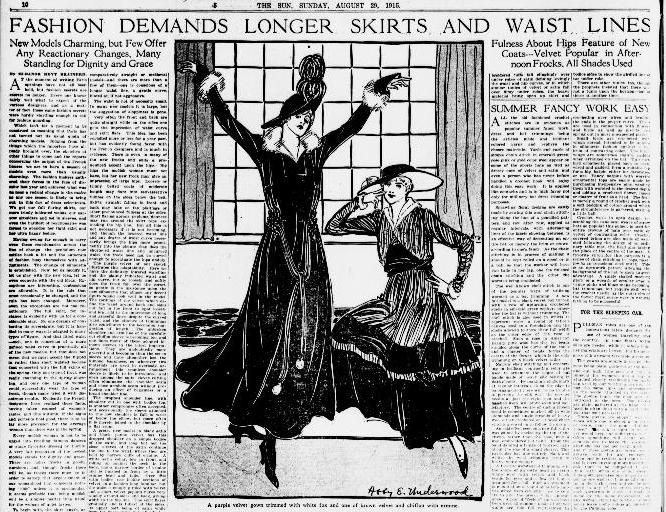
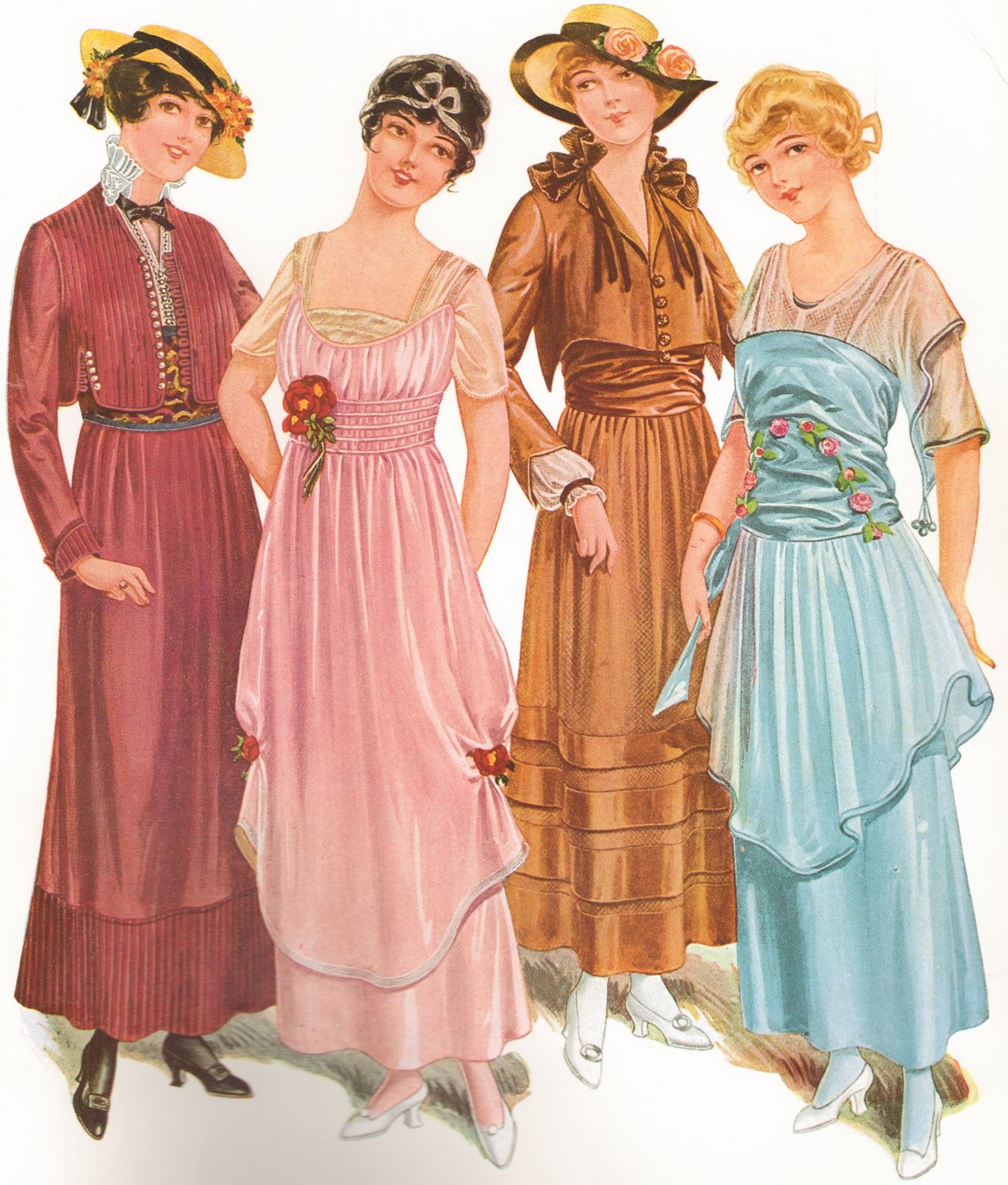
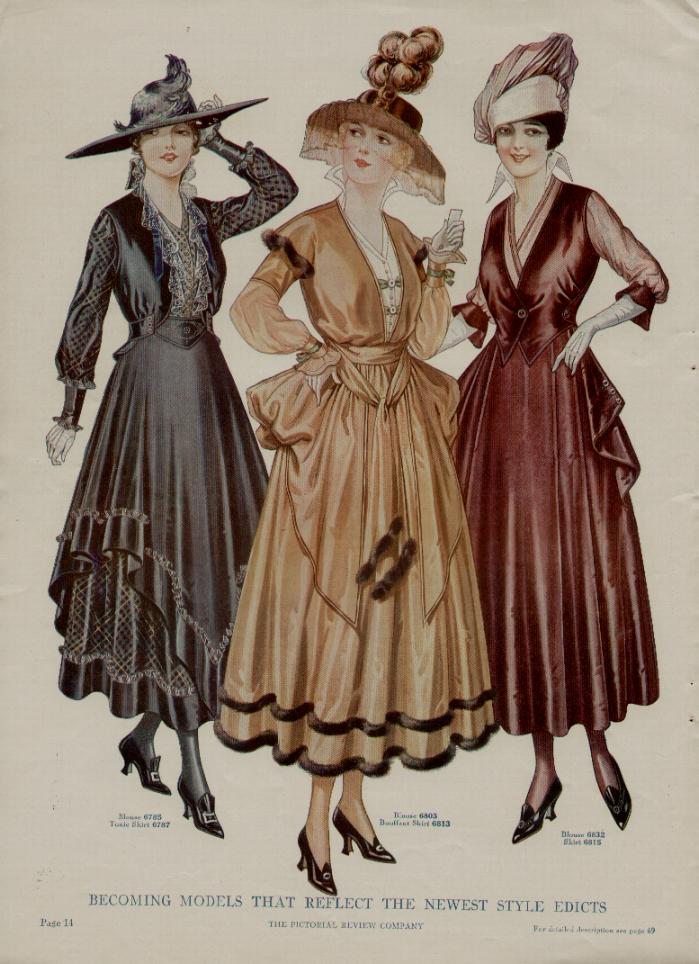
The growing independence of women also allowed for a looser, more comfortable style.  Gone from the streets were the dreaded hobble skirts, limiting the ability of women to take long strides. (Anything for fashion!) What audiences might have seen in 1915 were skirt styles that opened up at the bottom, allowing for freer movement.

Ladies' Costume (6505) ; Blouse (6362) ; Ladies' Four-Piece Skirt (6517) ; Blouse (6450) ; Ladies' Two-Piece Draped Skirt (6526) ; Ladies' Semiprincess Costume (6473) ; Motifs (12193) ; Blouse (6331) ; Skirt (6503) ; Scallop (11661). Courtesy New York Public Library
Ladies’ Costume (6505) ; Blouse (6362) ; Ladies’ Four-Piece Skirt (6517) ; Blouse (6450) ; Ladies’ Two-Piece Draped Skirt (6526) ; Ladies’ Semiprincess Costume (6473) ; Motifs (12193) ; Blouse (6331) ; Skirt (6503) ; Scallop (11661). Courtesy New York Public Library

These would come to be called ‘war crinoline’, essentially a precursor to a modern conservative skirt and described as bell-shaped, a “very full calf-length skirt” requiring extra fabric to attain its flowy, romantic look.

This would seem to be antithetical to wartime thinking — when lifestyles were often pared back — but these larger gowns were touted as practical fashion and thus ‘patriotic’ in their intent.  The role of women in wartime, many thought, was to simply look their best. At least, this was the line many fashion designers took during the era.

1915 Delineator Spring dresses
New York Sun, August 1915

Revolutionary Undergarments

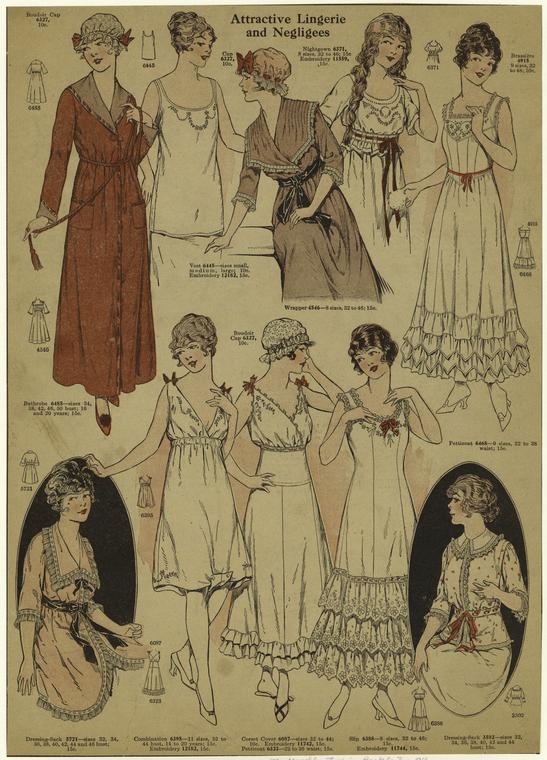
While some women would continue to subject themselves to the corset, the practicalities of life soon led to its unpopularity.  In 1914, Carisse Crosby, a well-connected society heiress from New Rochelle, received the patent for a revolutionary new form of support  — the modern bra.  Called the backless brassiere, the invention further facilitated a departure from stiff and uncomfortable silhouettes.

Crosby (really named Mary Phelps Jacobs) was a well connected society woman and would have been milling about the crowd at Madison Square Garden.  In 1915 she married the Boston Brahmin playboy Richard Peabody and eventually moved to Manhattan when she became pregnant with his child.

Lingerie And Negligees, 1915. Courtesy New York Public LIbrary
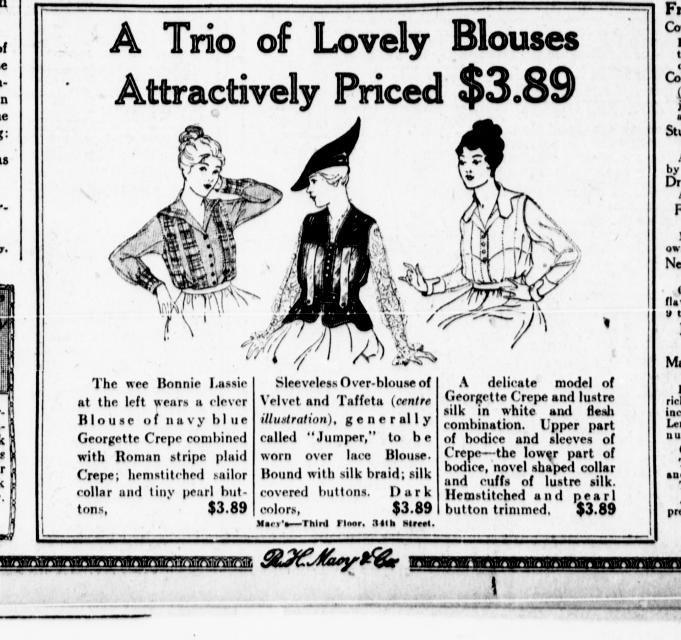
from the New York Evening World, October 21, 1915

The Gradual Straight Line

Perhaps the boldest fashion transition in the 1910s was the subtle shift from curvaceous, hour-glass forms to a straight, shapeless silhouette.  While the war crinoline still required a narrow waist for some of its dramatics, competing styles leaned towards sleekness.   This was an evolution from the Empire waist which had gained a resurgence earlier in the decade.

1

Rise of the Dangerous

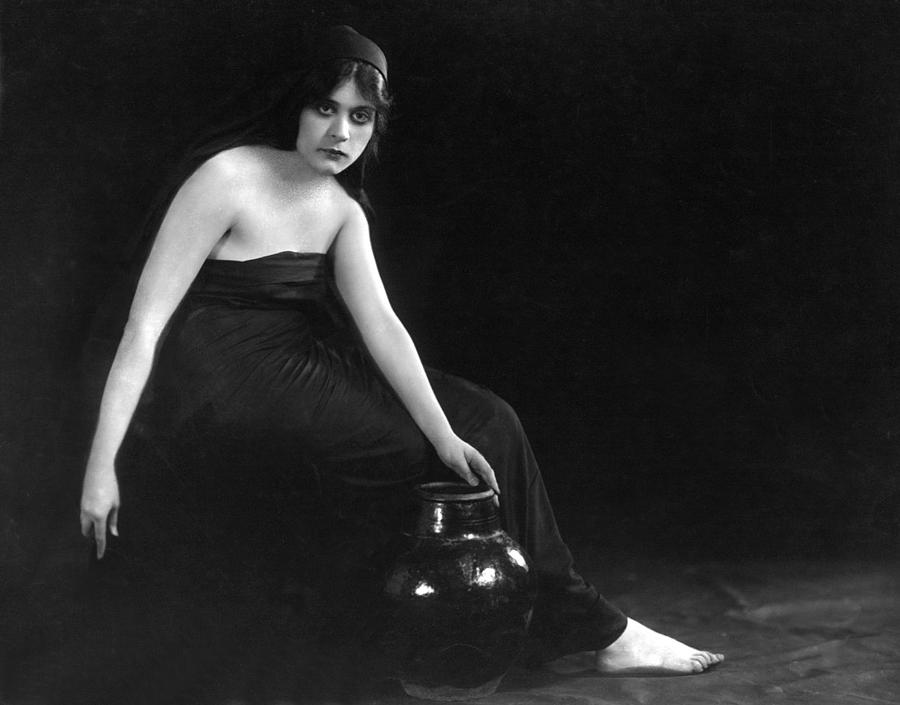
The predominant form of women’s fashion in the 1920s — the boyish flapper with sleek dresses and short hair — would rise from the edgier look of the ‘vamp’, best embodied in the late 1910s by film and stage actress Theda Bara.  This took the reformed instincts of woman’s fashion to its extreme. Sexuality became more overt and stylized, from bold makeup to exposed flesh.  This was certainly not the look of your average lady on the street, but soon slight shades of the vamp style would eventually seep into everyday fashion.

Theda Bara in the 1915 film Sin

The Popularity of Make-Up

It was unseemly of women to paint their faces with too many cosmetics during the late 19th century. But by the mid 1910s, women were influenced by actresses and dancers, and taboos against wearing cosmetics were relaxed.  The natural pale complexion so desired a decade earlier gave way to a kind of democratization that only makeup could provide.  Women were allowed to heighten the drama in their faces and mask the imperfections.

In 1915, two major forces in women’s beauty opened salons on Fifth Avenue — Elizabeth Arden and Helena Rubenstein. Both heavily influenced by the Parisian fashion aesthetic, elite New York women flocked to their shops.   Within a decade, these two entrepreneurs would be the anchors of a burgeoning and highly lucrative beauty industry.

from a 1915 Gimbels fashion magazine, courtesy  the blog Historically Romantic
from a 1915 Gimbels fashion magazine, courtesy the blog Historically Romantic
1

Hints of the ‘Little Black Dress’?

Black was not worn by women of gaiety and glamour.  It was strictly the hue of mourning during the Gilded Age and rarely made an appearance in actual evening wear.  However in an imagined fashion show in 1915, you may have seen a slight hint of it here or there, although not very practical and only as part of bold ‘vamp’ styling of its time.  It might have seemed edgy and even a bit bizarre, something only a worldly woman might have worn.

It would take another decade — and the influence of Coco Chanel — to bring the black dress into fashionable prominence. It would eventually becoming one of the defining looks of the New York woman.

from a 1915 Pictoral Review
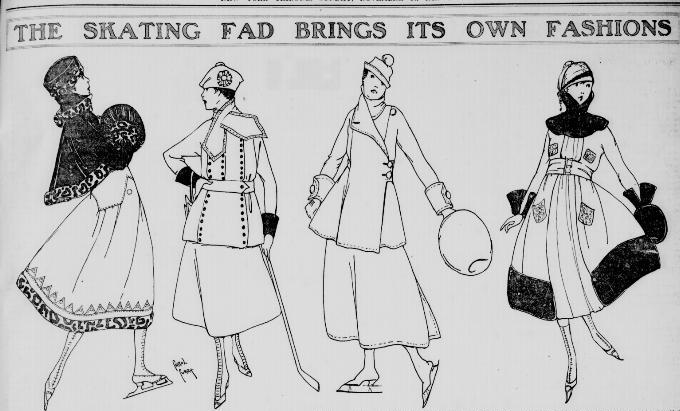
A brief skating fashion fad inspired this spread in the New York Tribune, November 14 1915

Driving Attire

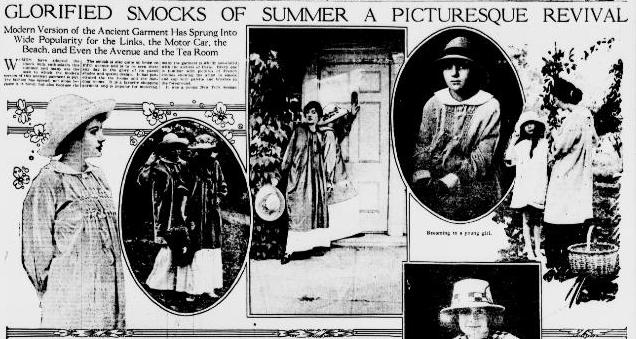
The continued popularity of the automobile required specific sorts of fashion to protect the clothes from dust.  These items found their way into regular wear.  This article from an August 1, 1915, issue of the New York Sun proclaims the return of the smock. “The smock is worn in the garden and on the golf links.”

1

Still A World of Hats

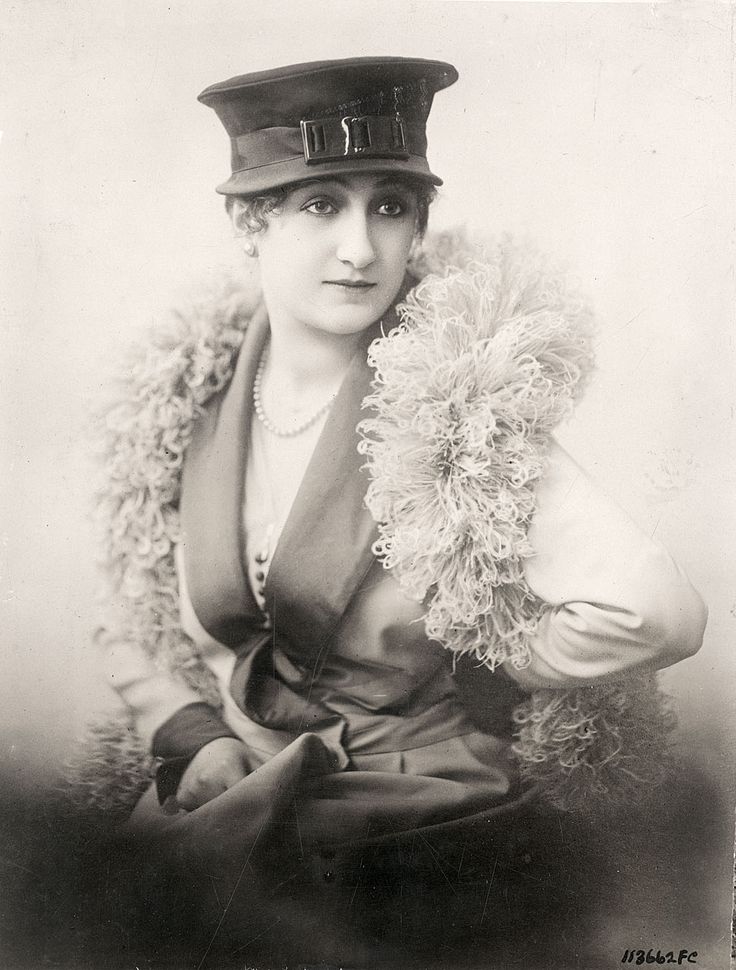
One taste that didn’t wander far was the love of hats. While flamboyant hats still topped many society ladies head, styles eventually became a little serious with nautical and even military influences.

1

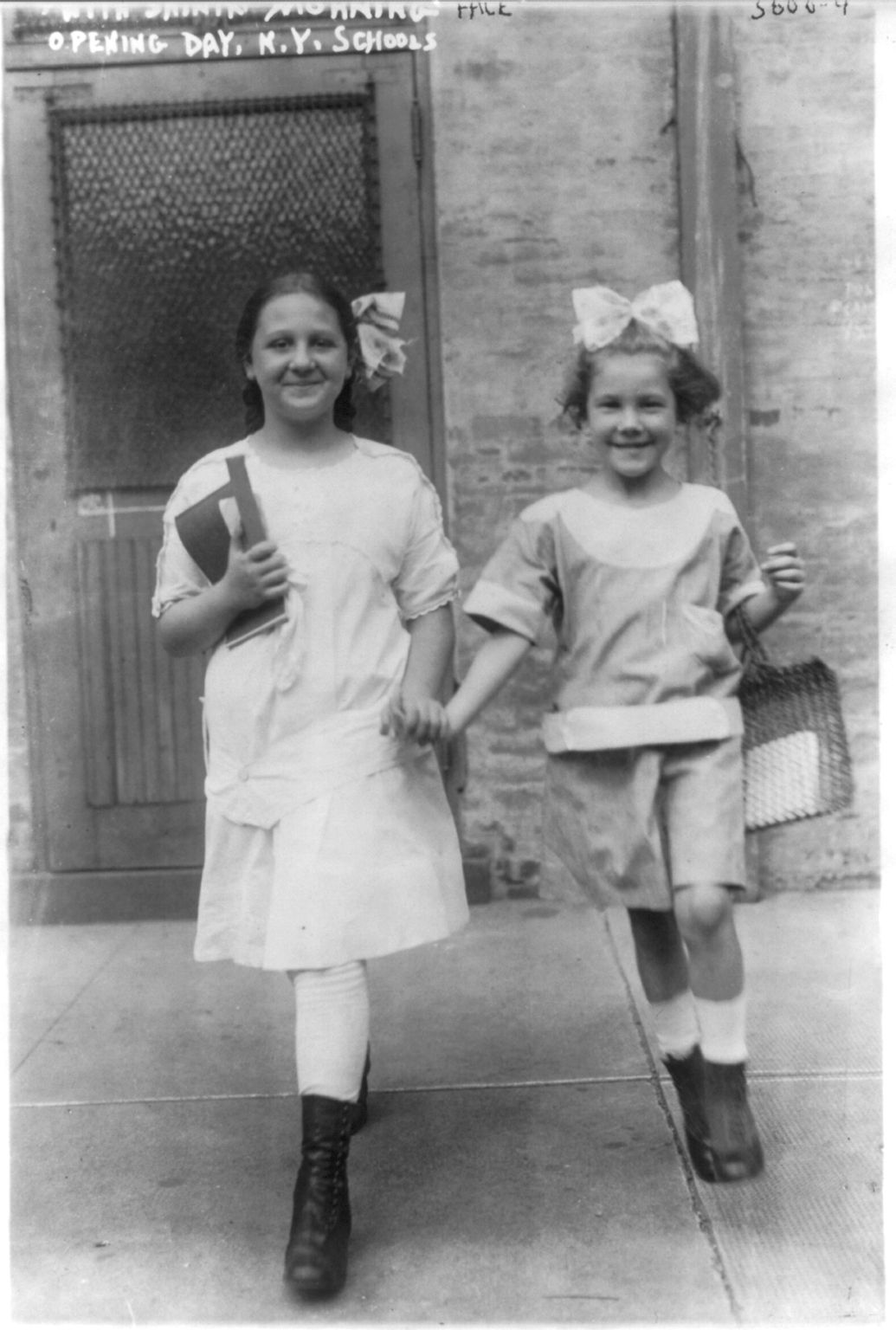
Even the school girls got into the act of fashion!  Here’s a pair from the first day of school in 1915….

1
Categories
Those Were The Days

Housewives demand open markets! One century ago, New York radically changed how people bought groceries

[Manhattan open market.]

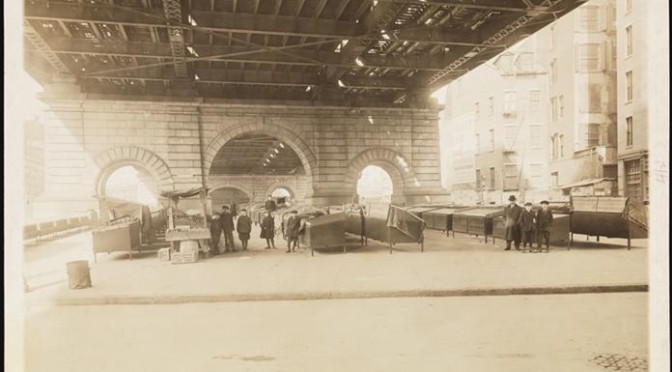
Setting up a market under the Manhattan Bridge. (Courtesy MCNY. Note: This photo may be of an earlier market here, but this gives you an idea of where the 1914-15 markets would have been located.)

Groceries are becoming more expensive as retailers mark up prices due to food shortages (or simple price gouging at perceived shortages). So people are turning to rather unconventional methods of getting fresh meat and produce.  Is this 2014 or 1914?

At the start of World War I, there was an immediate shortage of certain food items at New York grocers. Local distributors greatly took advantage of this special circumstance, marking up a variety of essential items.  “Sugar and flour, which have been increasing in price so rapidly, gave indications of continuing their upward march,” an article from August 19, 1914 proclaimed.

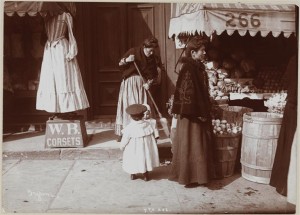
Shopping at a typical New York grocer, 1903 (MCNY): 

266 Seventh Avenue c. 1903.

Fifty years before, New Yorkers could interact with farmers and butchers directly at open-air markets.  But by the 1910s, most transactions were governed by local distributors. Old Washington Market was by this time a thriving indoor wholesale market. Local grocers had limited space with limited selection. The era of the modern supermarket — with greater selections and better values — was still a decade or two in the future. (The first supermarket is often considered to be Piggly Wiggly, which opened in Tennessee in 1916.)

To fend off rising food rates, the city of New York did something rather extraordinary:  it opened its own direct markets (or “open markets”) which cut out the middle-man entirely.

Manhattan Borough President Marcus M. Marks authorized the opening of four such markets in the following open areas — under the Manhattan sides of the Manhattan and Queensboro Bridges, the intersection of 3rd Avenue and 129th Street (today’s Harlem River Park), and the Fort Lee Ferry Terminal (West 139th Street and the Hudson River, near today’s Riverbank State Park).  A similar program was also set up in Tompkinsville, Staten Island.

Below: Interior of the Queensboro Bridge Market, 1915 (MCNY)

[Interior of market under the Queensboro Bridge.]

The markets opened in September 1914 with dozens of Long Island and New Jersey farmers bringing their wares to New York. Pushcart vendors, already spread throughout the city, also set up shop here.  What makes this such a controversial move is that it was a clear attempt to undercut all established grocers, to force distributors to quit gouging price.

They were an immediate hit despite being located in areas quite distant from certain populated areas. The markets appealed to women of many classes, because who doesn’t love a bargain? “At this market were many housewives who came in automobiles to buy from the farmers,” said a report from September 20, 1914. “Baskets filled with fresh vegetables and fruits were on seats, and the legs of more than one chicken projected from paper parcels under the chauffeur’s elbows.”  By 1915, the markets were considered by some “a social affair.”

Below: from an April 1915 profile from the Sun:

 The open markets were so successful that stock was usually emptied out by mid-morning.  Late-arriving women “actually wept when the market was bought out.” [source]

Naturally, retail grocers were angered by the city’s bold move and soon went on the offensive. “There is nothing but politics in this open market game, gentleman, from start to finish,” declared one speaker at a grocers union rally that October.

The city counteracted the grocer’s propaganda by providing ‘bargain days’ for extra values, reeling in the participation of farmers, butchers, poultry brokers and even honey producers.  “A butcher, who will open a new stand, says that he will give a head of cabbage in lieu of trading stamps to every purchaser of a piece of corned beef.” [October 15, source]

The markets lasted only a few months and, strangely enough, it was the city itself that killed them. Obviously bending to pressure from local businessmen, the city began charging high rents for a spot at the markets, and smaller farmers soon fled.  The Evening World noticed rents that would equal up to “$900 a year”. That’s $20,000 in 2014 currency.

In essence, this was one end of New York government attempting to dampen the authority of the other (namely, the borough president’s office).  Vendors had to raise prices to keep their place, and so the usefulness of the markets swiftly faded.

Categories
Wartime New York

The Women’s Peace Parade, a moody anti-war protest in 1914

Give Peace A Chance: Women take to the streets in a stunning parade of mourning

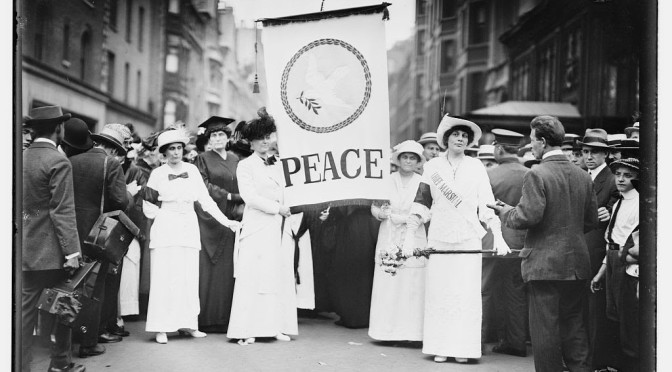
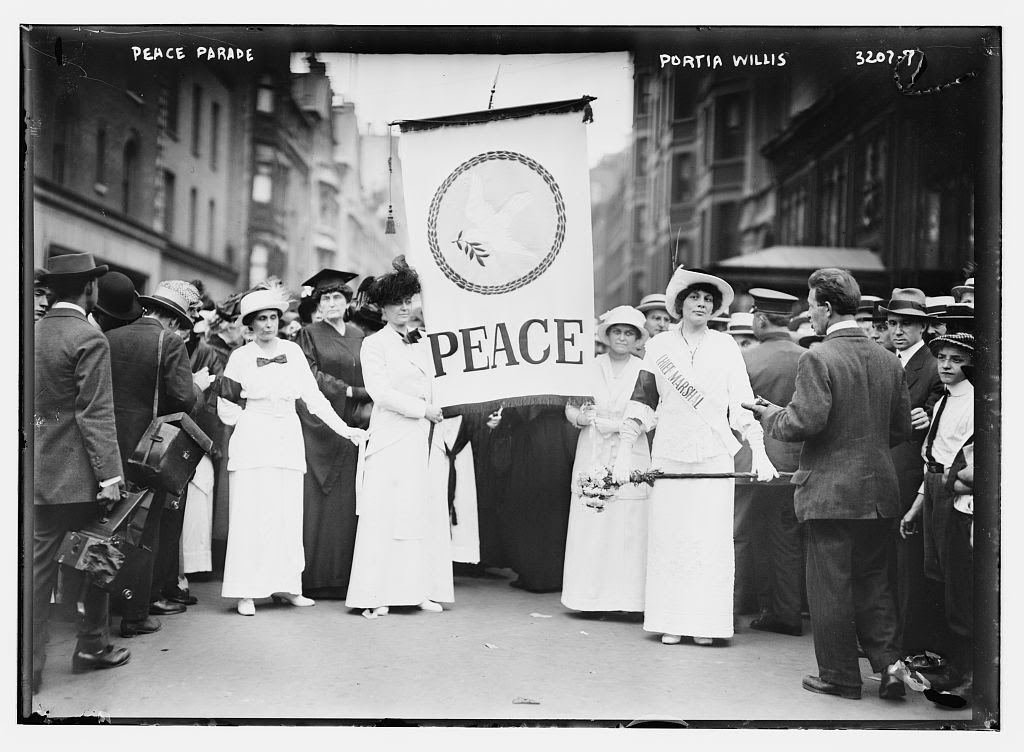
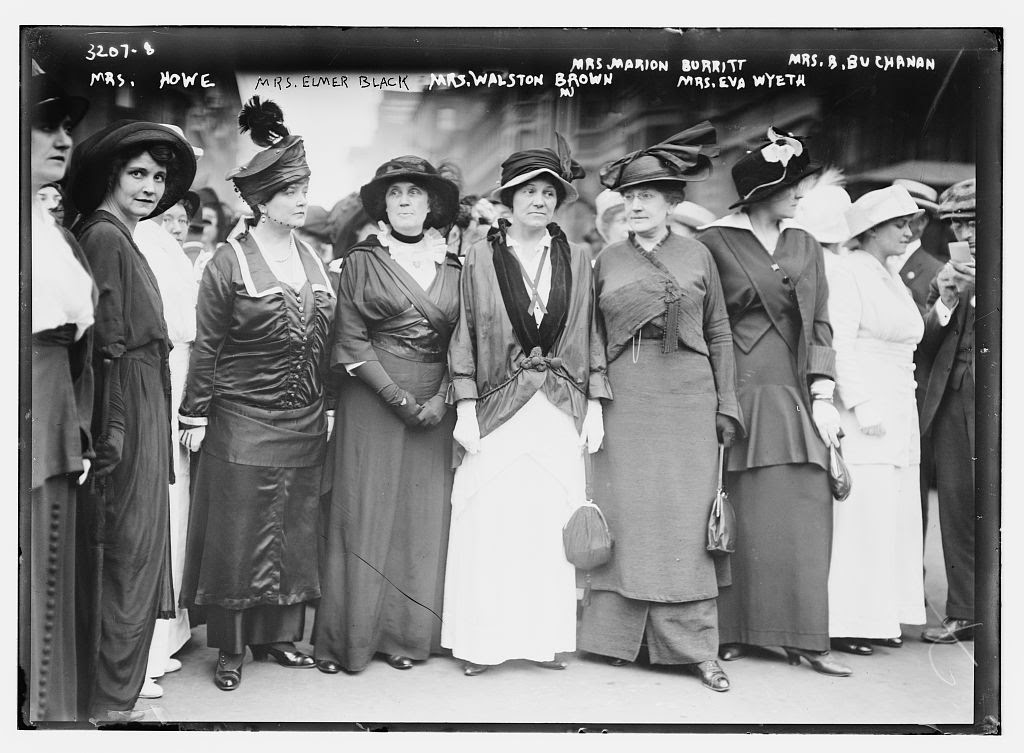
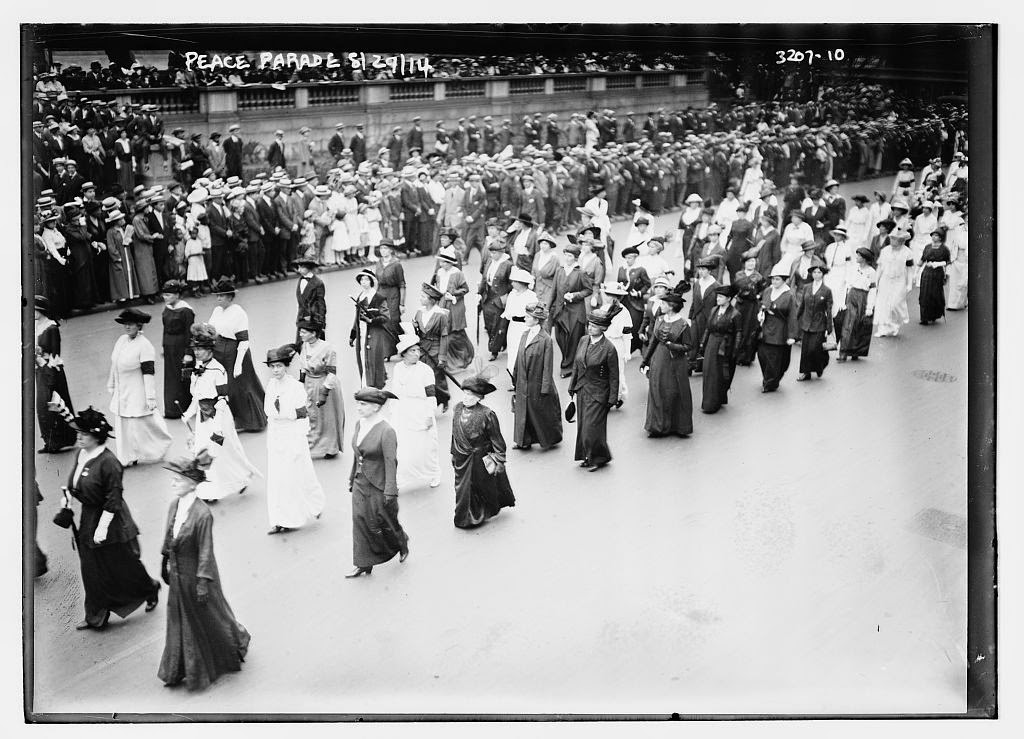
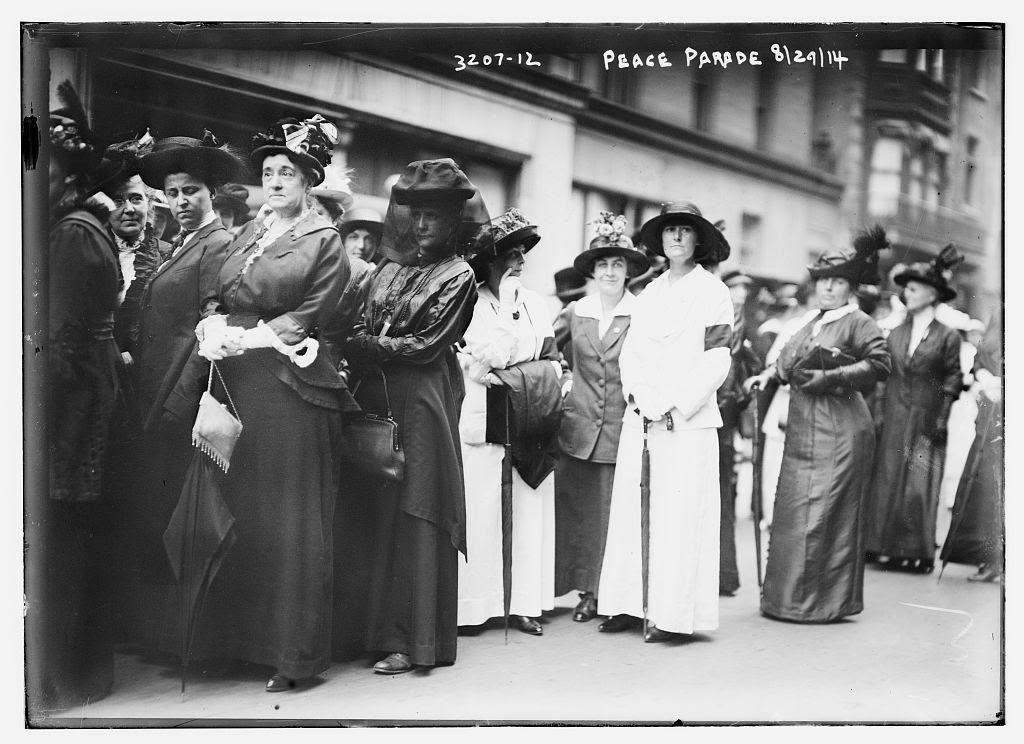
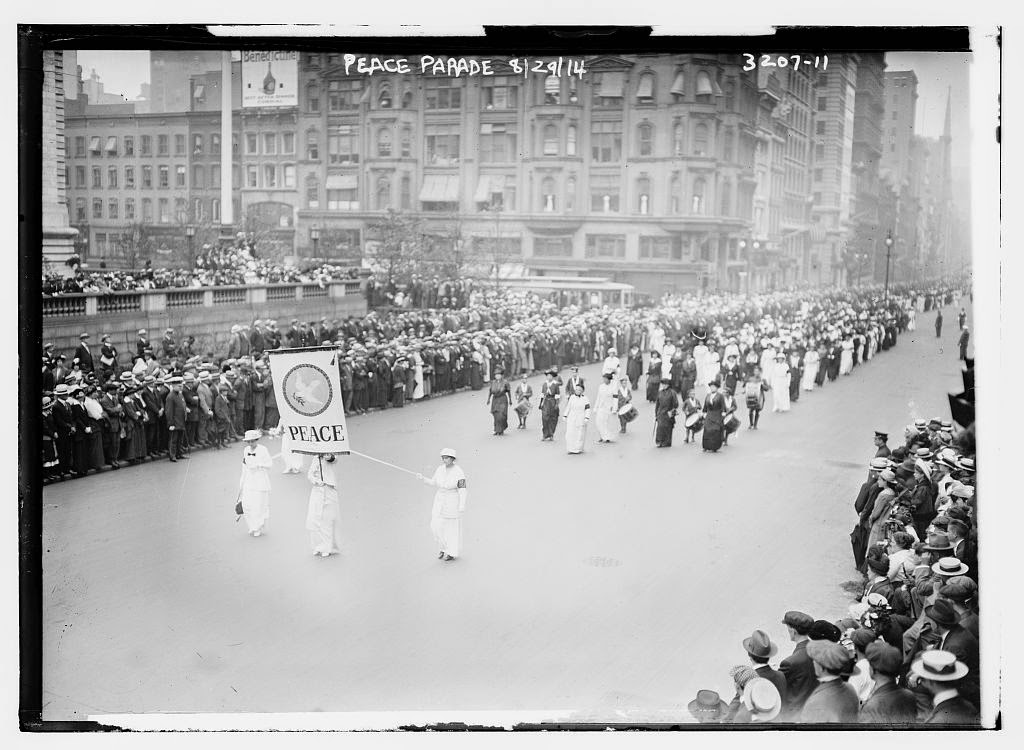
Below are some pictures of what’s possibly New York City’s first anti-war protest organized by women, on August 29, 1914.

War had erupted that summer in Europe, sparked by the assassination of Archduke Franz Ferdinand in late June and unfurling into a continent-wide catastrophe, as countries entered the fray on either side of the conflict.  Within weeks of the conflict, New Yorkers with strong ties to individual nations were raising money and even boarding ships to fight alongside their distant countrymen.

In other cities with sizable European populations — such as Montreal — people were already marching, calling for an end to the conflict.  And leading this call were women already involved in social organizations, in particular, suffragists with networks that reached into high society.

Protesting war has been a touchy issue in New York City. [See the Civil War Draft Riots for such a protest gone wrong.]  The mayor had expressly forbade parades in support of individual nations on New York streets lest a microscopic version of the European conflict erupt here.  Anti-war was often associated with socialist organizations and indeed, that August, several did march in Union Square.  But these were comprised largely of men.

Which makes the Women’s Peace Parade so unusual.  Prominent women met at the Hotel McAlpin in mid-August to plan what was essentially a mourning parade, with its participants — from all walks of life — dressed in black as though in a funeral procession. (As you can see in the pictures, many women also chose to wear white in a symbol of peacetime, garnished with black accessories.)

Many people didn’t quite understand what a peace protest even meant, seeing it as a wasted effort. One letter writer to the New York Times asked. “Will any of the women who intend to parade in protest of the war explain what they mean to accomplish by such a demonstration?”

While the parade drew from prominent individuals in the suffrage movement, others were simply not convinced.  Carrie Chapman Catt, one of America’s most famous suffragists, remarked, “If anybody thinks that a thousand, or a million, women marching through New York or talking about peace in the abstract will have any effect on the situation in Europe, it is because they don’t know the situation in Europe.”

But, in fact, there was a motivation.  One of New York’s leading activists Harriet Stanton Blanch — daughter of Elizabeth Cady Stanton — was very succinct about their motivation. “This is a movement for actual work. We intend to do something definite. We wish to have a meeting at The Hague Peace Conference called.”

The parade began in the afternoon, marching down Fifth Avenue from 58th Street down to Union Square. Women who either lived or shopped along the avenue now marched in formal procession down it, accompanied by the “ominous beat of muffled drums.”  There was occasional applause but otherwise “the general silence of the great gathering was considered the best evidence of understanding.” [source]

Among the marchers were Lillian Wald and the nurses of Henry Street Settlement.
The skies were appropriately gray.  Some participants hoped for rain actually.  “Every woman in the slow-moving line wore some badge of mourning, either a band of black around her sleeve or a bit of crepe fluttering at her breast, as a token of the black death which is hovering over the European battlefields.” [source]

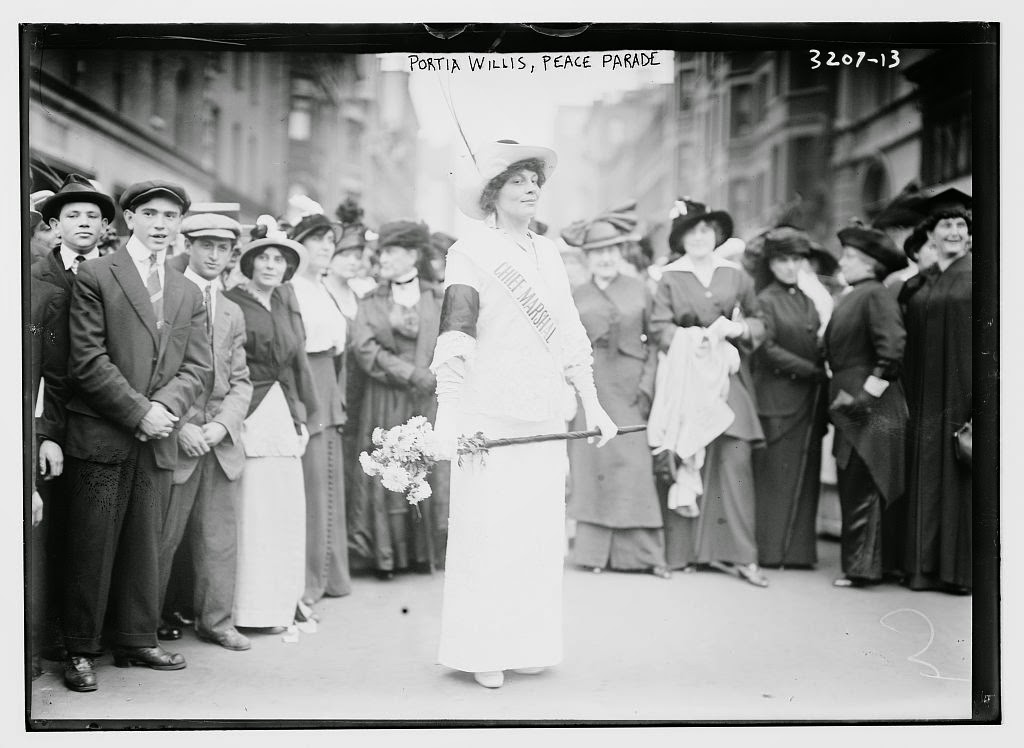
The parade marshal was the young Portia Willis, a magnetic lecturer on the suffragist circuit. .

While the organizers announced there was to be only one flag on display in the parade — the flag for peace — one other crept into the proceedings.  “The smallest Boy Scout was Alfred Greenwald, 4 years old, who … attracted much attention.  Little Alfred unknowingly broke the most stringent rule of the parade by carrying a flag.  He carried a United States flag but it was furled.” [source]

Unfortunately I was not able to locate any pictures of the second half of the parade — with 250 African-American women in solidarity, followed by “a number of Indian and Chinese women” and carloads of elderly women and babies.

Those who witnessed the parade would not soon forget it, especially in the following months as the conflict that would become known as World War I grew to eventually encompass the United States.

Categories
Neighborhoods Podcasts

The sumptuous story of Ladies’ Mile: Cast-iron grandeur and Gilded Age architecture


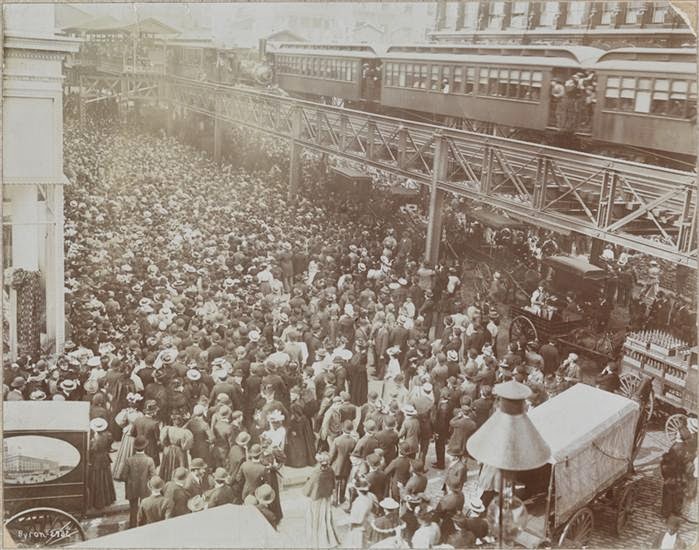
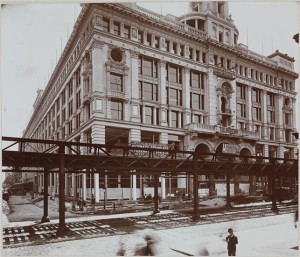
The opening of Siegel-Cooper department store, 1896, created one of the great mob scenes of the Gilded Age.  Today, TJ Maxx and Bed Bath and Beyond occupy this once-great commercial palace.  

PODCAST  Ladies’ Mile — the most famous New York shopping district in the 19th century and the “heart of the Gilded Age,” a district of spectacular commercial palaces of cast-iron. They are some of the city’s greatest buildings, designed by premier architects.

Unlike so many stories about New York City, this is a tale of survival, how behemoths of retail went out of business, but their structures remained to house new stores. This is truly a rare tale of history, where so many of the buildings in question are still around, still active in the purpose in which they were built.

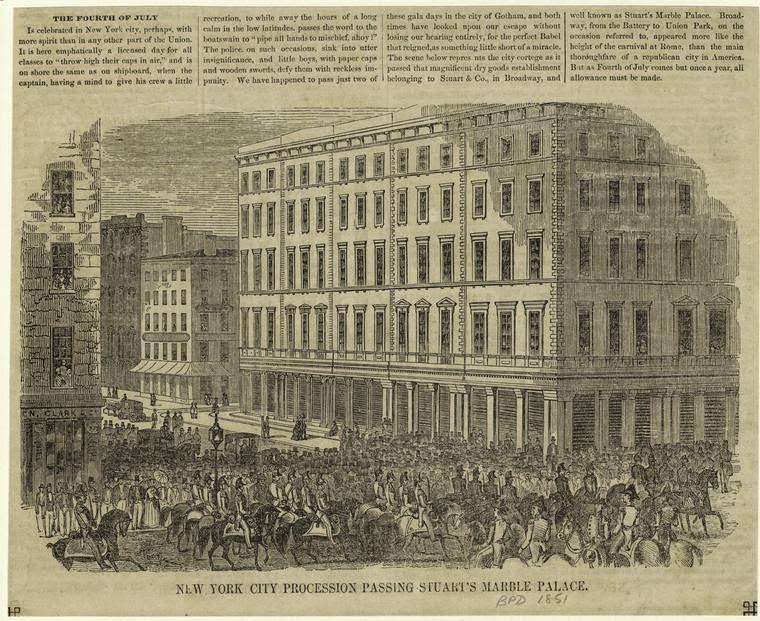
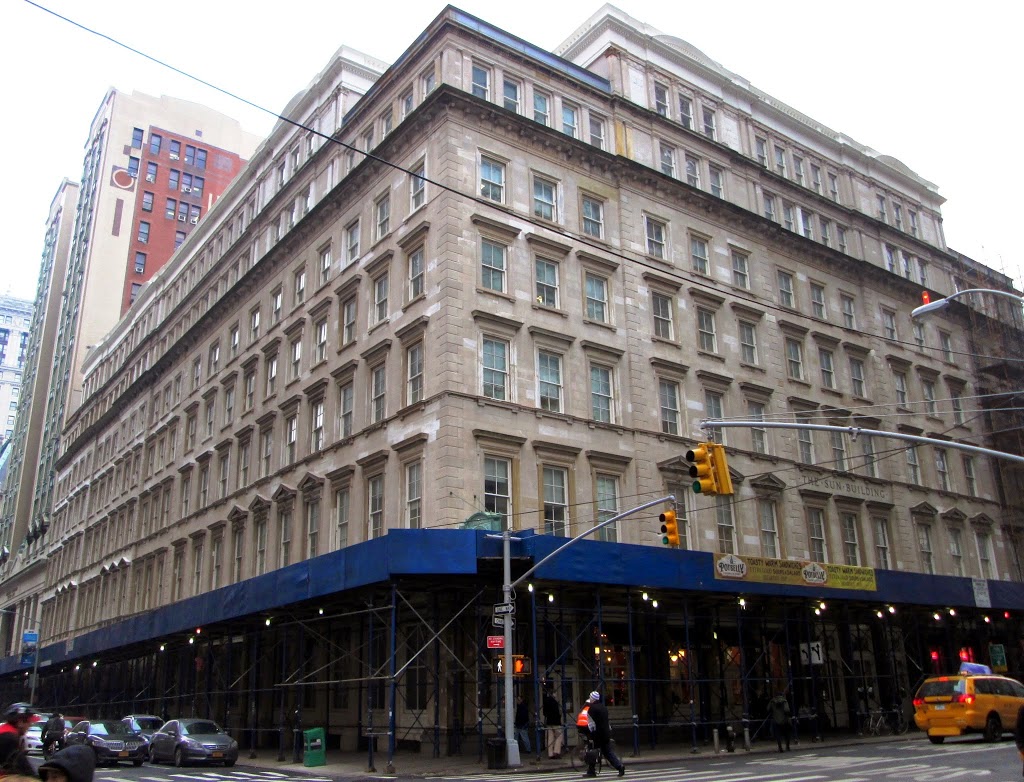
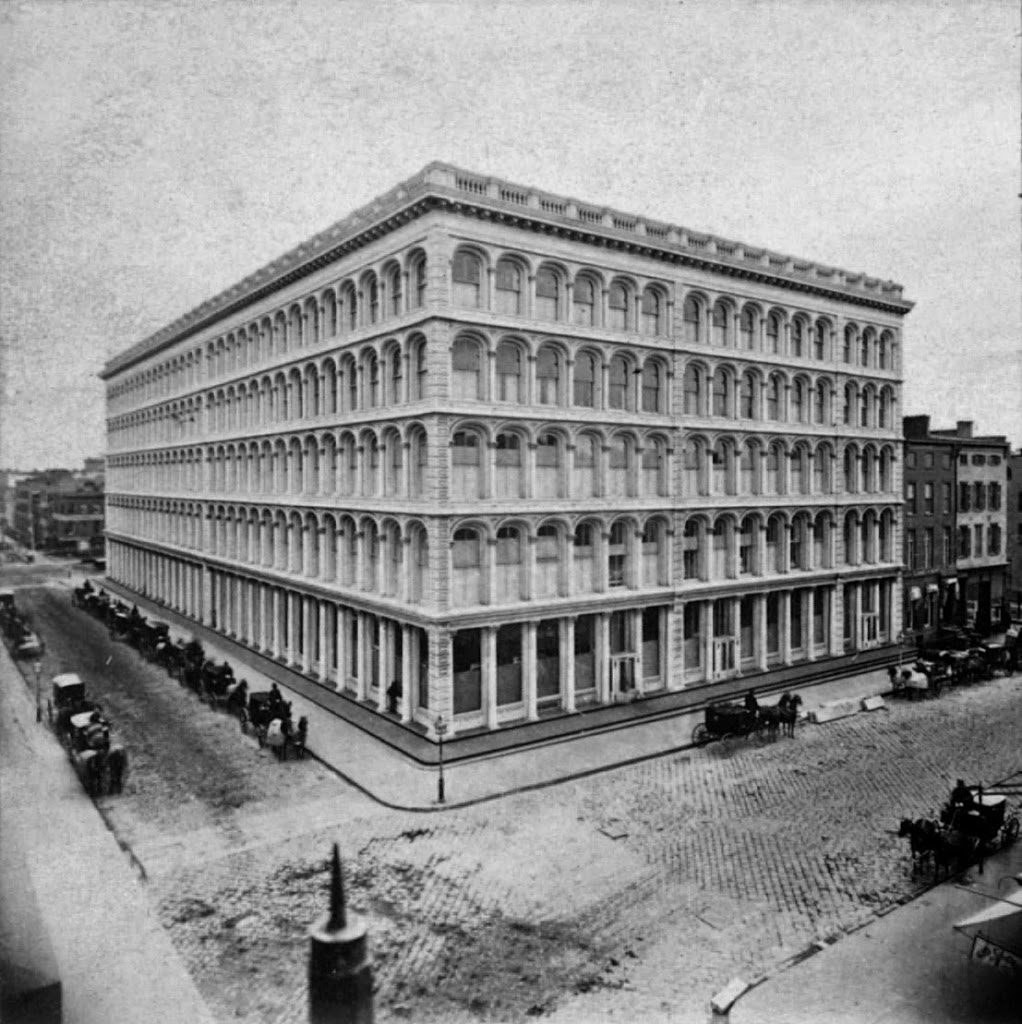
We start this story near City Hall, with the original retail mecca of A.T. Stewart — the Marble Palace and later his cast-iron masterpiece in Astor Place. Stewart set a standard that many held dear, even as his competitors traveled uptown to the blocks between Union Square and Madison Square.

Join us on this glamorous journey through the city’s retail history, including a walking tour circa 1890 (with some role play involved!) of some of the district’s best known buildings.

PLUS: Why is Chelsea’s Bed Bath and Beyond so particularly special in this episode? You’ll never buy towels there the same way again!


America’s first department store — A.T. Stewart’s Marble Palace, near City Hall. The building is actually still there today! The address is 280 Broadway. (Courtesy NYPL)

Stewart’s even more celebrated department store at Astor Place, nicknamed the Iron Palace with its cast-iron construction. Unlike Stewart’s first store, this one is no longer there. (NYPL)

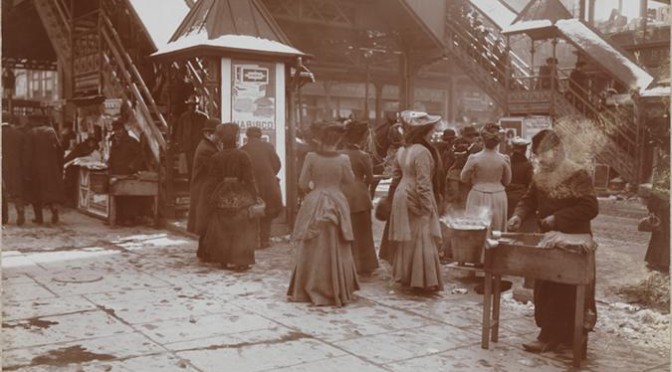
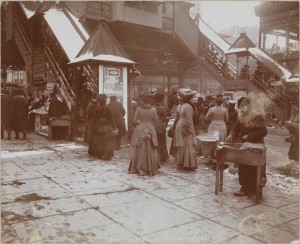
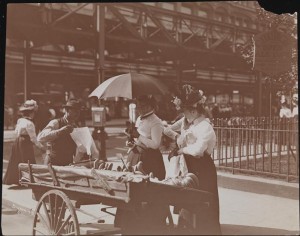
1903: Ladies on a freezing day, surrounding the 23rd Street entrance to the Sixth Avenue Elevated Railroad, placing them just a few blocks from the biggest department stores in the world. (Courtesy Museum of the City of New York)

6th Ave & 23rd St.

The entrance to Stein Brothers on 23rd Street. There’s a Home Depot in this building today, but you can still see the SB insignia over the door. And below, the street scene in 1908.(Photo: Edmond V Gillon, MCNY)

[32-46 West 23rd Street.]
[West 23rd Street from 6th Avenue East.]

Adams Dry Goods, decades after the shop at closed. In later years, it was a Hershey’s plants and a military storage space. Today, on the ground floor, there’s a Trader Joe’s grocery store. (Photo: Edmond V Gillon, MCNY)

[675 Sixth Avenue.]

1901: Women in front of the Church of the Holy Communion, the elevated train in back of them. (MCNY)

Street Scenes, Sixth Avenue at 20th Street.

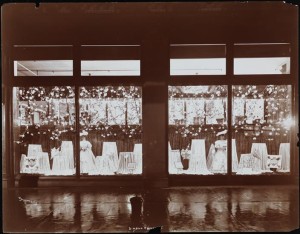
The windows at Simpson Crawford Co. at Sixth Avenue and 20th Street, 1904. (MCNY)

Simpson Crawford Co.

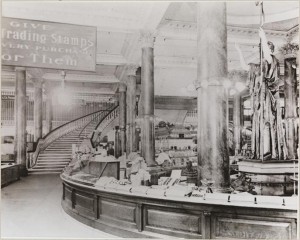
The Siegel-Cooper department store fountain, with a statue of Republic (by Daniel Chester French) and electric lights in a kaleidoscope of colors. And, below it, another view of Siegel Cooper from the opposite side of the tracks. (MCNY)

Siegel Cooper
Retail Trade - Dept. Store 1896. Siegel Cooper Co. (Exterior) 6th Ave at 18th St.

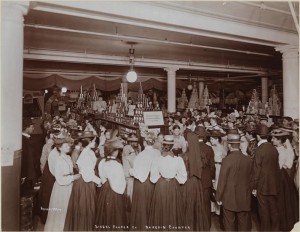
Ladies in the Siegel Cooper canned goods department. The store canned its own food. Very organic! (MCNY)

Retail Trade Dept. Store.

An overhead shot of Macy’s at 14th Street and the Sixth Avenue elevated railroad station. (MCNY)

[6th Avenue and 14th Street.]
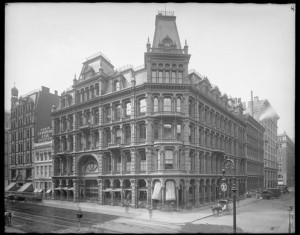
Broadway and East 20th Street. Lord and Taylor, old building.

Lord & Taylor’s, at Broadway and 20th Street, 1904. (Wurts Brothers, MCNY)

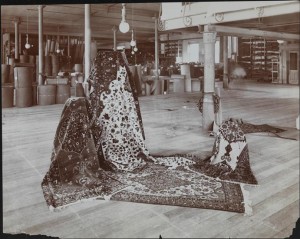
Inside WJ Sloane, Carpets Rugs and Furniture, at Broadway and 19th Street (MCNY)

W.J. Sloane, Carpets Rug & Furniture, 19th St. & Broadway.

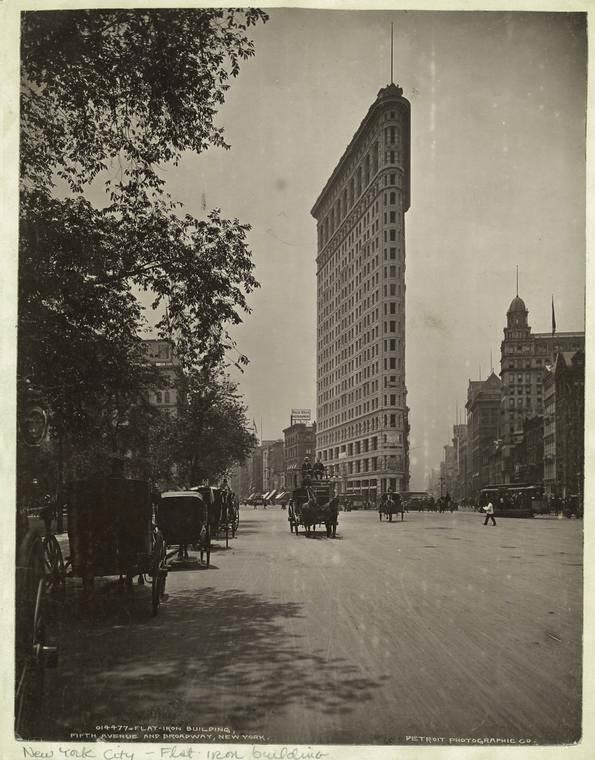
The Flatiron Building, completed in 1902, is considered part of the Ladies Mile Historic District, even though it was never a department store.

Categories
True Crime

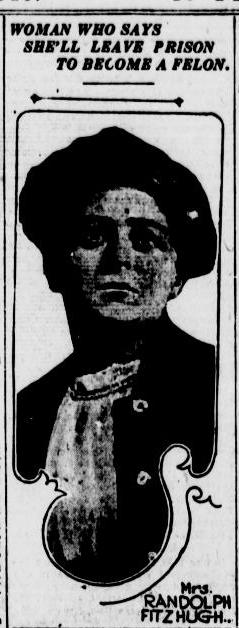
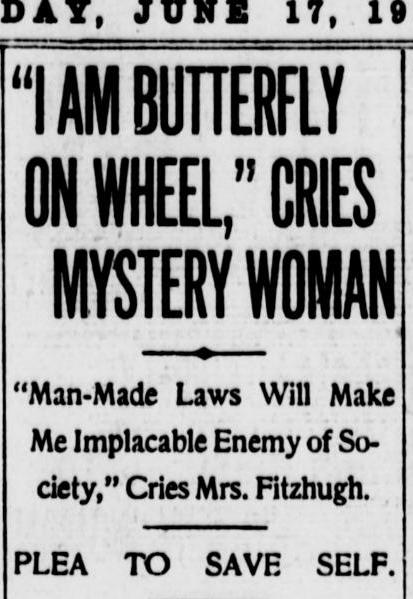
Presenting Mrs. Randolph Fitzhugh, Kaleidoscope woman, society church thief: “I am being hounded to prison by men”

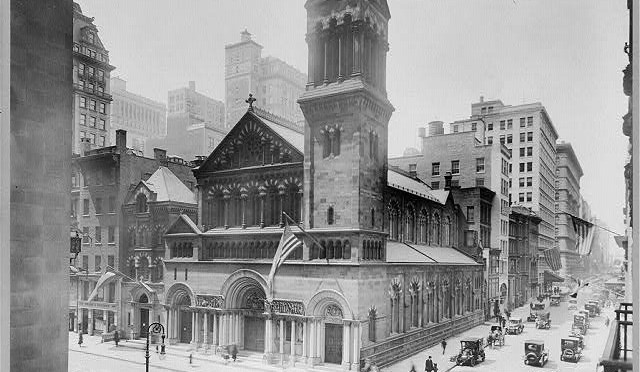
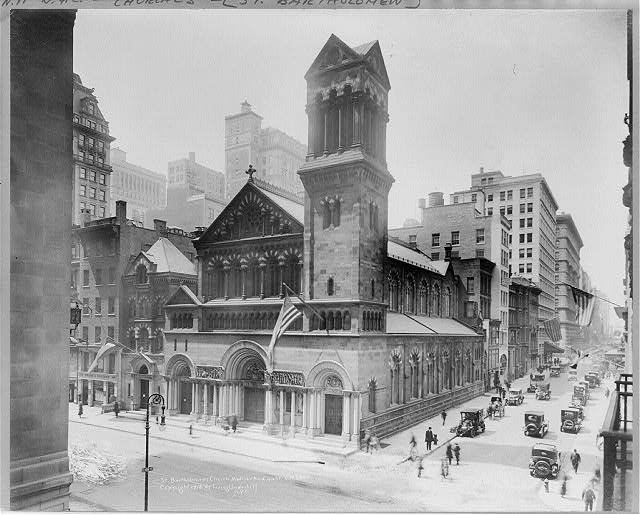
The former St. Bartholomew’s on Madison Avenue and 44th Street, burgled by one Mrs. Randolph Fitzhugh. [LOC]

NOTE: I revised this article this afternoon which some additional information just discovered, making this story ever stranger! New information includes Mrs. Fitzhugh’s real name, details about her baby, her length of stay in the Tombs, and information on another arrest at St. Patrick’s.

The papers called her ‘woman of mystery’ and a ‘woman enigma‘. Later on, she would garner a new nickname — the Kaleidoscope woman.

Rarely had a female criminal so confused New York law enforcement as the unusual Southern woman arrested in early 1913 for stealing from society ladies prominent New York churches.

She called herself Mrs. Randolph Fitzhugh, a Southern woman with a demeanor as such that she could spirit into any number of prominent churches and snatch up a host of items, including a diamond bracelet at the Church of the Transfiguration and a $500 gold mesh bag at St. Bartholomew’s (at its previous building on Madison and East 44th Street, see above).

The revelation of this crimes was most strange.  The owner of the bag received a letter from the Hotel Flanders (6th Ave/W.46th Street) claiming a woman carrying that bag was staying there. Fitzhugh was staying at the hotel with an infant; later witnesses claimed the hotel was holding the baby for an “unpaid rent bill.”

To those in the hotel, Mrs. Fitzhugh claimed she was only “renting the child” due to some troubles in Washington DC. The baby was taken to an acquaintance in Brooklyn, and Mrs. Fitzhugh arrested.

The story with Mrs. Fitzhugh (her real name was Catherine Fennell or Northrup) wasn’t her crime but her reaction to prosecutions.  She plead guilty to avoid a sentence at Auburn Correctional Facility.  But she didn’t stop with that.

A reporter from the New York Evening World interviewed the convicted from her cell at the Tombs where she had been a prisoner for almost seven months.

She told a remarkable tale of a runaway betrothed to the previously-named Randolph Fitzhugh.  It was apparently a controversial marriage, for when he died, her family rejected her. She was then arrested for stealing from a department store.  “All I had done is charge some goods to an intimate friend of mine who had an account at the store . I had often done it before and she gave me carte blanche.”

She then claimed to have married and had a child, although she “never bothered to take good care of our marriage certificate” and was later sued by the man.  Most likely the child was hers, but the ‘renting’ business is still a mystery.  She used the child in later testimony to claim that she took the solace of random churches because she believed somebody was trying to kidnap her baby.

She then exploded with emotion at the Evening World reporter.  “I tell you I am being hounded to prison by men–men–men.  It is ‘The Butterfly on the Wheel’ all over again! I cannot get justice from men.”  The phrase ‘butterfly on the wheel’ is from Alexander Pope‘s ‘Epistle to Dr. Arbutnot’, meaning a concerted effort in appearance to break to the will of something insignificant.

Whatever is going on with Mrs. Fitzhugh — bad luck, desperation, mental illness — it’s easy to sympathize with her from our vantage a century later.  She feared the prison system, knowing it would change her forever, knowing she might never break from it.  She was instead put to a lighter sentence at Bedford Hills in Westchester County.  But she issued a grave warning.

“I am not a common woman.  I understand that almost every inmate of that Bedford place is such a woman. To be thrown with them may embitter me to such an extent that I shall ever after revenge myself on society and turn a really clever, unscrupulous thief.  I may and very likely shall become a professional thief.”

Indeed, she lived up to her word.  After she was released, she returned to a life of crime.  She was arrested once again in February 1915 in front of St. Patrick’s Cathedral.

And later that year, from her perch at the Holland House at 5th Avenue and 30th Street, Mrs. Fitzhugh again plundered neighborhood churches, stealing from the Catholic parish St. Leo’s Church on 28th Street.

To avoid suspicion — although this seems to have failed — Mrs. Fitzhugh changed costumes “six to eight times a day” and was known to hotel staff as the Kaleidoscope woman due to her ever-different garments.

Somehow, Mrs. Fitzhugh had befriended a film actress and was living in her flat at the Holland House.  Most likely, it was the clothing of this unnamed actress that Mrs. Fitzhugh was wearing.  “Her bills, according to the management of the hotel, had been always promptly paid.” [source]

From there I’m able to find anymore information about Mrs. Fitzhugh, the Kaleidoscope lady. She disappears from the criminal record under that name. But I’ll continue to look, because she strangely fascinates me.

Categories
Holidays

Whip it! Early Valentine’s Day custom in old New York involved public displays of flirtatious flagellation

In old New York, there was a curious Valentine’s Day custom involving young women running around town whipping men with rope.

Yes, you read that correctly.  This form of socially acceptable violence was popular in the colonial era and extended well into the early 1800s.  It derives from a tradition practiced as part of an early Dutch holiday known as Vrowen Dagh* (or Woman’s Day) and was likely popular among the young ladies of New Amsterdam, New York’s precursor.

According to the 1850 history ‘Rural Hours’ written by Susan Fenimore Cooper (daughter of James), “[e]very mother’s daughter … was furnished with a piece of cord, the size neither too large or too small” and fitted with a “due length left to serve as a lash.”  Cooper elaborates on this playfully violent custom:

“On the morning’s of this Vrowen Dagh, the little girls — and some large ones, too, probably for the fun of the thing — sallied out, armed with such a cord, and every luckless wight of a lad that was met received three or four strokes from this feminine lash.”

Young men of marrying age dashed from place to place, fearful of being flirtatiously struck in this whirlwind of flying rope.

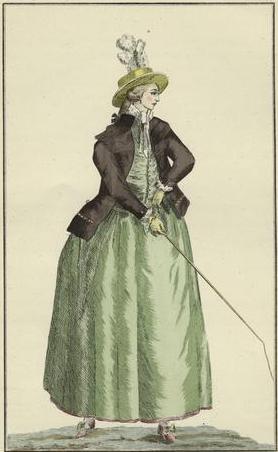
At left: Woman with a whip, 1780

“Every lad whom they met was sure to have three or four smart strokes from the cord bestowed on his shoulders,” writer Gabriel Furman recalled in 1875.  “These, we presume, were in those days considered as ‘love-taps’, and in that light answered all the purposes of the ‘valentine’ of more modern times, as the lasses were not very likely to favor those with their lashes whom they did not otherwise prefer.”

There obviously seems to be some statement about domestic violence in this practice.  At one point, injured males suggested the following day be a “Men’s Day,” allowing men to chase women around with these braided whips.  But they were told “the law would thereby defeat its very own purpose, which was, that they should, at an age and in a way most likely never to forget it, receive the lesson of manliness — he is never to strike.” [source]

At some point in New York, this custom actually did blend with the English custom of Valentine’s Day, and young women of the colonial era continued enjoying this frivolous custom — in fact, well into the early 1800s.  It blessedly vanished by the mid-19th century, replaced with the more recognizable gesture of sending valentines through the mail.

“We heard that 20,000 [valentines] passed through the New  York office last year,” Cooper writes in 1850.  But it seems the writer had grown tired of even this custom. “They are going out of favor now, however, having been much abused of late years.”

*I think the actual Dutch word would be Vrouwendag but I’m preserving the original spelling from Fenmore and Furman’s text. An 1832 Dutch dictionary says Vrouwendag means ‘Lady Day’!

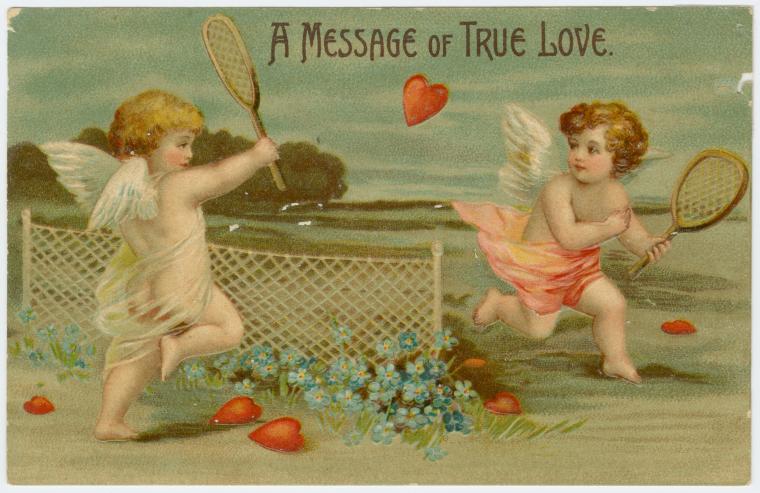
Vintage valentine and whip lady courtesy New York Public Library

Categories
Podcasts

Bicycle Mania! The story of New York on two wheels, from velocipedes to ten-speeds — with women’s liberation in tow


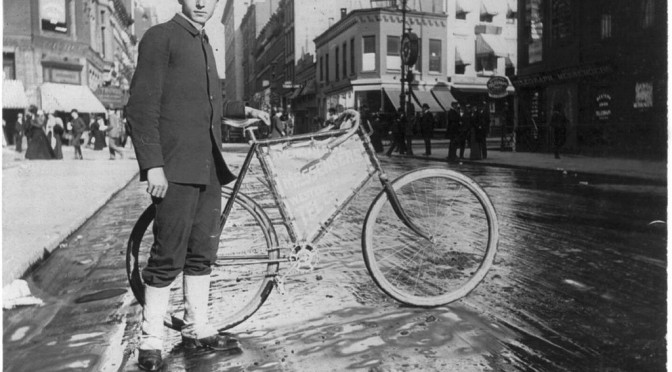
Alice Austen’s iconic photograph of a telegram bike messenger in 1896, a year where many New Yorkers were wild about bikes. Austen even rode one around with her camera. 

PODCAST The bicycle has always seemed like a slightly awkward form of transportation in big cities, but in fact, it’s reliable, convenient, clean and — believe it or not — popular in New York City for almost 200 years.

The original two-wheeled conveyance was the velocipede or dandy horse which debuted in New York in 1819. After the Civil War, an improved velocipede dazzled the likes of Henry Ward Beecher and became a frequent companion of carriages and streetcars on the streets of New York. Sporting men, meanwhile, took to the expensive high-wheeler.

But it was during the 1890s when New Yorkers really pined for the bicycle. It liberated women, inspired music and questioned Victorian morality. Casual riders made Central Park and Riverside Drive their home, while professionals took to the velodrome of Madison Square Garden. And in Brooklyn, riders delighted in New York’s first bike path, built in 1894 to bring people out to Coney Island.

FEATURING:  Robert Moses, Charles Willson Peale, Ed Koch, and New York’s bike thief in bloomers!


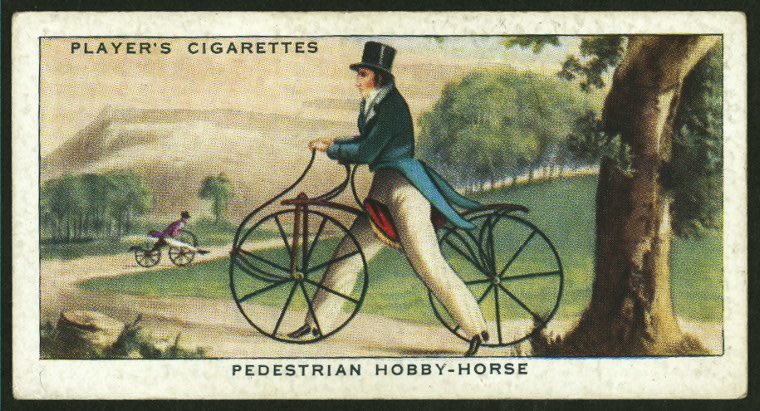
The early velocipede went by several names — the hobby horse, the dandy horse, the draisine. This device made a big splash in 1819 before they were effectively banned from the city. [NYPL]


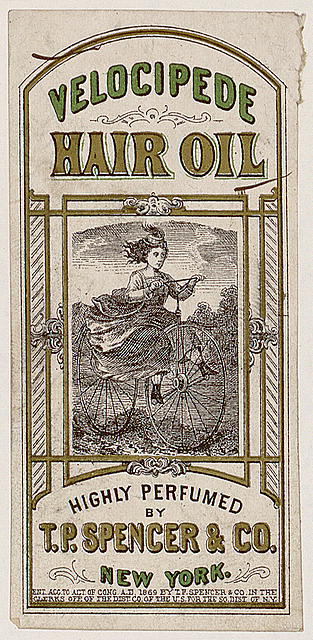
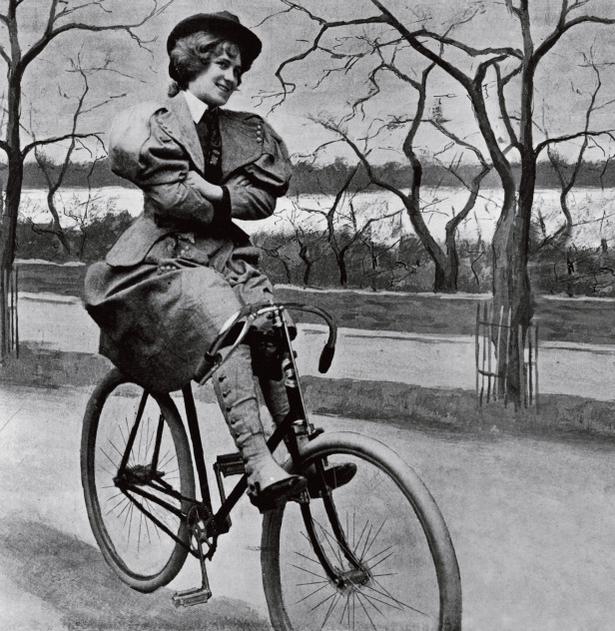
With the velocipede craze of the late 1860s, women attempted to conform to Victorian ideals of fashion with a host of bizarre products to maintain a ladylike presentation. By the 1890s, women riders chucked most of those conformities out the window, introducing more comfortable clothing and embracing the independence offered by the bicycle.

At top: An ad for a hair product, 1869. (LOC) Below: A radical change of costume in a photo illustration from 1890s (courtesy Brain Pickings, accompanying an amusing article of women’s bicycle do’s and don’ts from 1895)

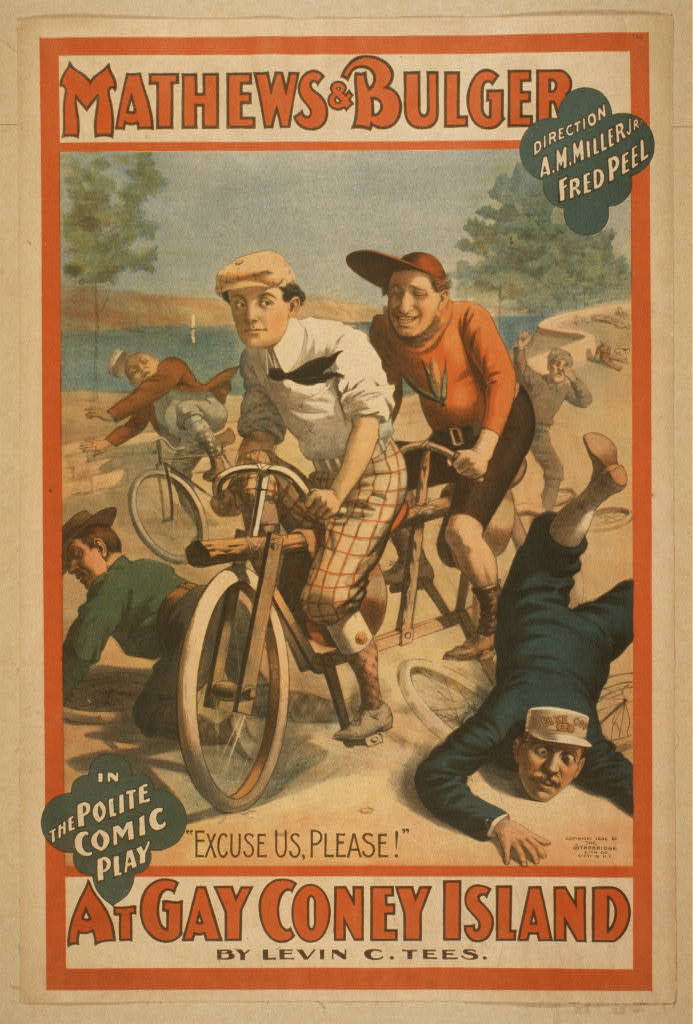
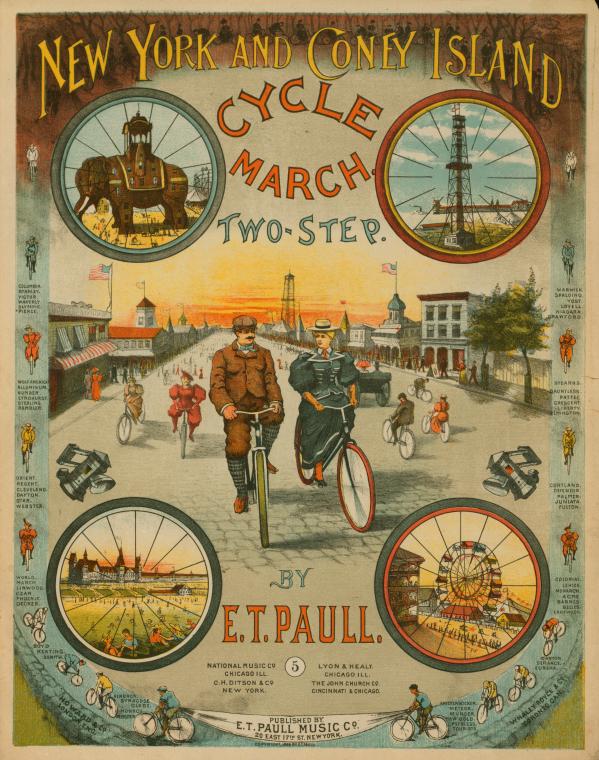
The bicycle didn’t just provide transportation and recreation in the 1890s. It influenced entertainment as well, through the songs of Tin Pan Alley. Below: A ‘comic play’ and a two-steph, both from 1896, and both inspired by the Coney Island Bike Path. (LOC)

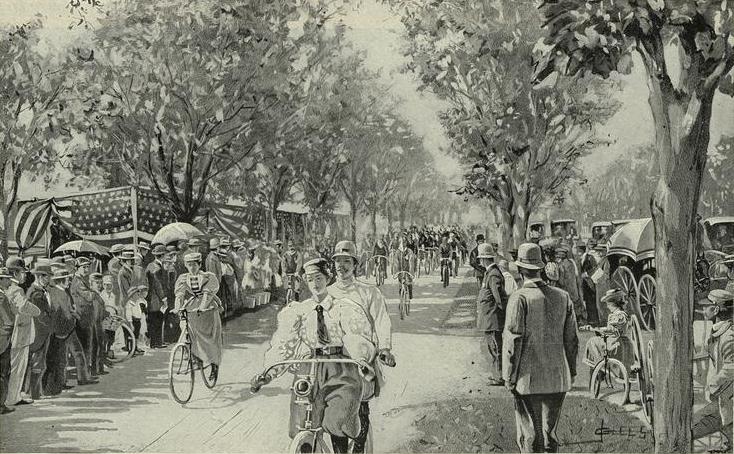
The Coney Island Bike Path in 1896, running up Ocean Parkway to Prospect Park. I believe this illustrates the opening of the return path, as the original path opened in 1894

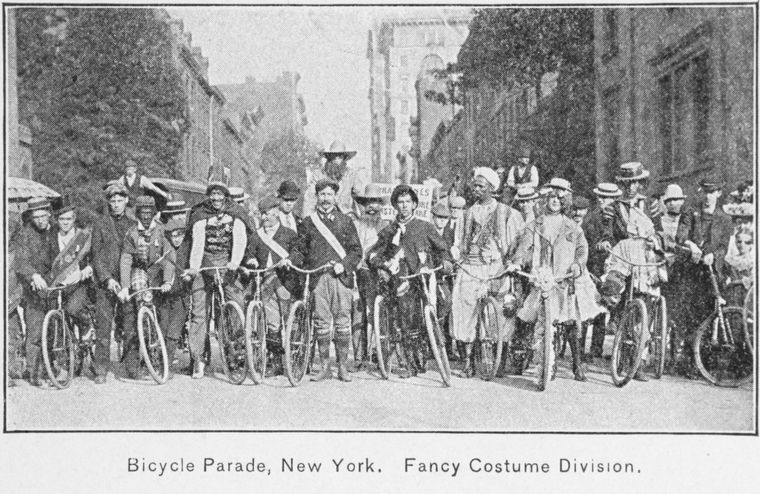
I have absolutely no context for this image, but I love it. Taken sometime between 1894-1901 [NYPL]

Tammany Hall hosts the city’s first Democratic Convention: Susan B. Anthony, the KKK, and a reluctant nominee

Many of you may remember New York’s sole Republican National Convention, held in 2004 at Madison Square Garden, celebrating the re-election bid of George W. Bush. Some may recall any one of New York’s three recent Democratic National Conventions — two (1976, 1980) for Jimmy Carter, and a rather memorable one in 1992 that placed Bill Clinton on the ticket.

Oh, but that’s modern politics! Conventions of the past — stodgy, contentious, male — are more fascinating artifacts, gentlemanly in tone, chaotic and raw in execution, and dominated by a mix of issues both eternal (war, debt, taxes) and outdated (slavery, territorial expansion).

Of New York’s five Democratic nominating conventions, the most infamous is certainly the 1924 gathering at Madison Square Garden — the old Garden, Stanford White’s palace on 26th Street — distinguished by rancor, the significant influence of an energized Ku Klux Klan and an exhaustive trek through 103 ballots only to settle upon a weak compromise candidate, West Virginian politician John W. Davis, who was crushed in the general election by Republican Calvin Coolidge. Within two years, the Garden would be closed and promptly demolished, as though in embarrassment.

But I find the first national convention, held in 1868, to be the most intriguing and telling of New York life in the mid-19th century, a convention so unusual that the eventual presidential nominee actually recoiled from accepting the nomination.

Four years prior, in 1864, a splintered Democratic Party had tried to replace Abraham Lincoln in the White House with his former Union general George B. McClellan. In New York, former mayor and now-Congressman Fernando Wood led a drive for new national leadership — even though he loathed McClellan — and called for an end to the Civil War with their ‘Southern brethren’. But opposition quickly withered after a series of Union victories, and Lincoln was re-elected.

Flash forward to 1868. Lincoln was dead, the Civil War was over and slavery was abolished. The current president Andrew Johnson aligned with Democrats over Southern inclusion, eventually leading to his impeachment and a serious damaging of the national Democratic brand.

To bring glory back to the White House, the Republicans hoisted forth as their nominee the hero of the war, Ulysses S. Grant. Perhaps the most famous man in America, Grant would eventually prove to be a mediocre president. But his reputation and charm were so great in 1868 that the Democrats knew they stood little chance to defeating him.

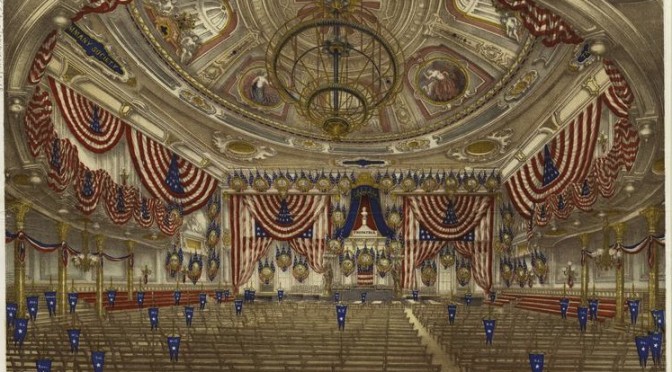
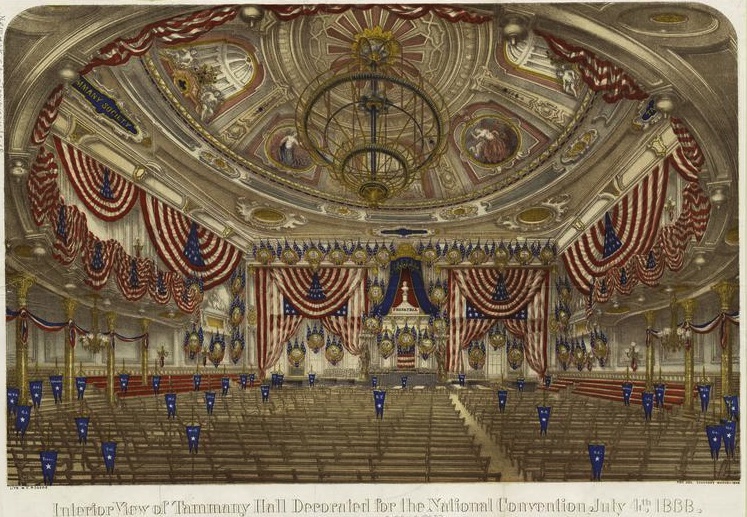
New York’s Democratic contingent — in particular, the political machine Tammany Hall and its leader William ‘Boss’ Tweed — controlled the national committee during this period and steered the convention to New York for the very first time in July 1868.

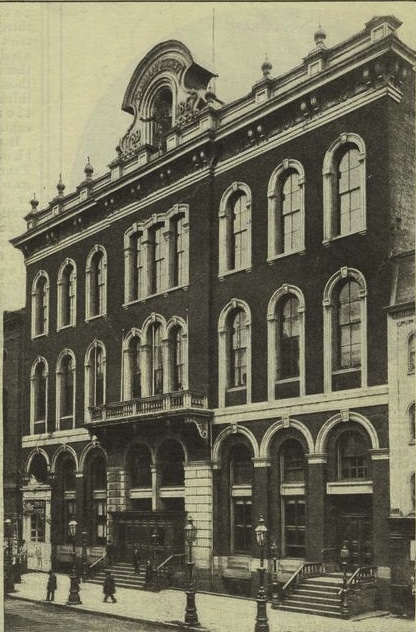
Their headquarters at 141 14th Street (at left) was sparkling new, ‘fresh from the builder’s hands,’ a lush multi-use venue with auditoriums, clubrooms and even a basement cafe, situated next door to New York’s poshest destination, the Academy of Music.

The convention was especially notable as it featured several Democrats from Southern states for the first time since the war.

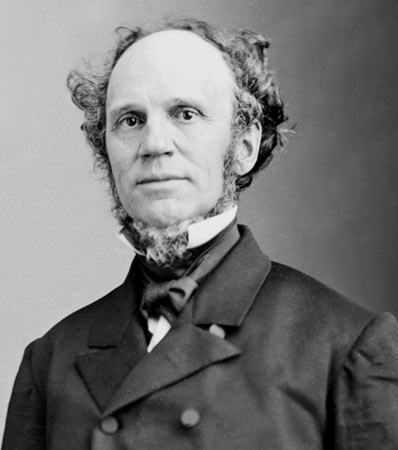
Delegates crowded into the main hall on July 4, and a roar of support greeted Democratic power player (and horse breeder) August Belmont, who gaveled in the proceedings. “I welcome you to this good city of New York,” Belmont declared, “the bulwark of Democracy.”  Nearby smiled former New York governor Horatio Seymour (pictured below), president of the convention. Five days later, there were be far less formality and Seymour, in particular, would not be smiling.

On July 5th, the Democrats unfurled their official platform, embracing the return of the Southern states and harshly criticizing the Republican-dominated Congress:  “Instead of restoring the Union, it has, so far as in its power, dissolved it, and subjected ten States, in time of profound peace, to military despotism and negro supremacy.”  Certainly pleased with this particular inclusion was Tennessee delegate Nathan Bedford Forrest, grand wizard of the Ku Klux Klan.
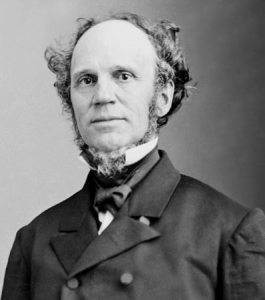
But the Democrats made room for the consideration of progressive causes too, such as a call for women’s suffrage.  Seymour read aloud a plank from the Women’s Suffrage Association written by Susan B. Anthony and co-signed by Elizabeth Cady Stanton.

Anthony appealed to their quest for dominance. “It was the Democratic party that fought most valiantly for the removal of the ‘property qualification’ from all white men, and thereby placed the poorest ditch-digger on a political level with the proudest millionaire. And now you have an opportunity to confer a similar boon on the women of the country … a new talisman that will ensure and perpetuate your political power for decades to come.”

The request was greeted warmly by the room before being respectfully dismissed altogether.

Things grew less harmonious when the balloting for president began.  Several candidates were submitted, even the disgraced Andrew Johnson. For several arduous ballots, the leader was George H. Pendleton, who had been the vice presidential hopeful under General McClellan. But it immediately became clear that the factions within the party were in no mood to settle quickly.

Pendleton’s lead had weakened by the 13th or 14th ballot, leaving two key candidates — Thomas Hendricks, an Indiana politician, and Winfred Scott Hancock, a Union general that seemed an attractive challenger to Grant.  But neither could approach the two-thirds needed to snatch the nomination.

A stalemate called for a third candidate, somebody that all could agree with, while at the same time, an individual that was absolutely nobody’s top choice.  It was at the podium that delegates found their man — Horatio Seymour.
He was horrified. Seymour wanted to retire and had previously rejected calls to run for national office. Privately he must have considered the pitiful chances of running a lengthy campaign against Grant. But delegates greatly respected the former governor, a bastion of cool Democratic leadership who had been an opponent to the federal draft during the war.  He had also been partly responsible for the Draft Riots, emptying the city of federal militia days before the draft was to begin that July.
Still, their were few ready options for the Democrats. When a delegate from Ohio suddenly declared “against his inclination, but no longer against his honor” to put forth Seymour as a suitable compromise, the room followed suit. On the 22nd ballot, Seymour was enthusiastically declared the Democratic nominee for president.

The only one not enthusiastic about it was Seymour. “I said to them that I could not be a candidate [and] I meant it.” [source]  He left the convention in a huff, only to begrudgingly accept the nomination back at Tammany Hall the following day.

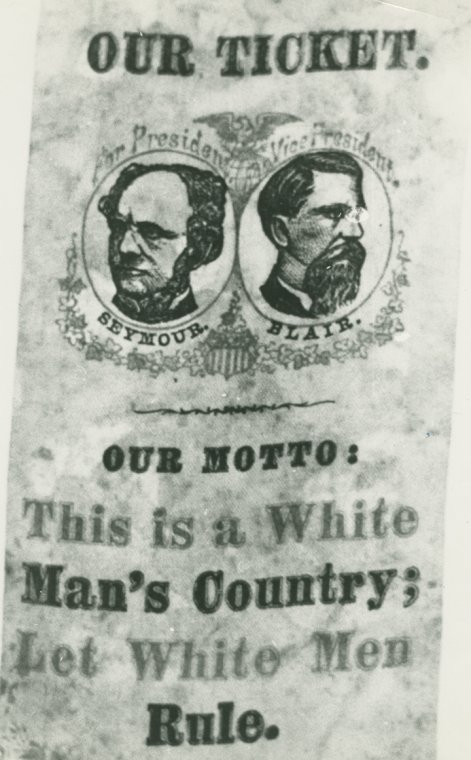
Seymour threw himself into the campaign with vice presidential choice Francis Blair Jr. (whom Seymour barely knew and hardly liked). As evidenced by the campaign poster above, they weren’t afraid to use the Southern racial divide to appeal to voters. But no matter; they lost soundly in the electoral vote to Grant and vice president Schuyler Colfax.

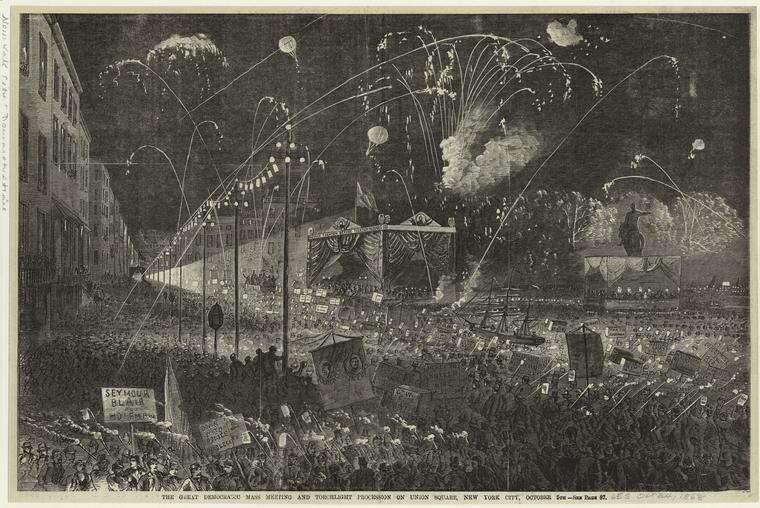
Perhaps the real objective of the convention wasn’t to sway a national crowd, but to energize New Yorkers. Democrats swept into local and state offices, including Boss Tweed’s own choice for governor John T. Hoffman.

Below: Democrats rally in Union Square in support of Seymour and other local candidates, October 5, 1868

Pictures courtesy of New York Public Library